
A contractor wins a major project, but the excavator needed to start the work costs more than the company wants to remove from its bank account. A café needs a commercial espresso machine before opening its second location. A logistics company has to replace a delivery van before breakdowns disrupt customer schedules. In each situation, the business has a productive asset in front of it, a revenue opportunity attached to that asset, and a cash-flow decision to make.
That's the practical answer to what is equipment finance. It's a funding arrangement built around a tangible business asset, such as machinery, vehicles, technology, restaurant equipment, or construction tools. Instead of paying the full purchase price immediately, the business uses the equipment while repaying the financing over time.
Table of Contents
- What Equipment Finance Actually Means for a Growing Business
- Equipment Loans, Leases, and Finance Agreements Explained
- How Equipment Finance Stacks Up Against Other Funding Options
- Eligibility and Underwriting Factors Lenders Look At
- Typical Terms, Rates, and Costs You Should Expect
- A Practical Step-by-Step Application Checklist
- Real Use Cases From Restaurants, Construction, and Service Businesses
- Common Misconceptions and Smart Decision Moves Before You Sign
What Equipment Finance Actually Means for a Growing Business
Equipment finance differs from general-purpose borrowing because the equipment is central to the transaction. The lender evaluates the business, but also examines the asset's value, usefulness, condition, and resale prospects. In many arrangements, the equipment serves as collateral, giving the lender a clear recovery path if the borrower stops paying.
That structure explains why equipment finance can feel more direct than an unsecured working-capital product. The funds have a defined purpose, the supplier usually provides a quote or invoice, and the lender can connect the repayment schedule to the asset being purchased. The business gets access to the equipment now, while the payments spread the cost across the period in which the equipment helps generate revenue.
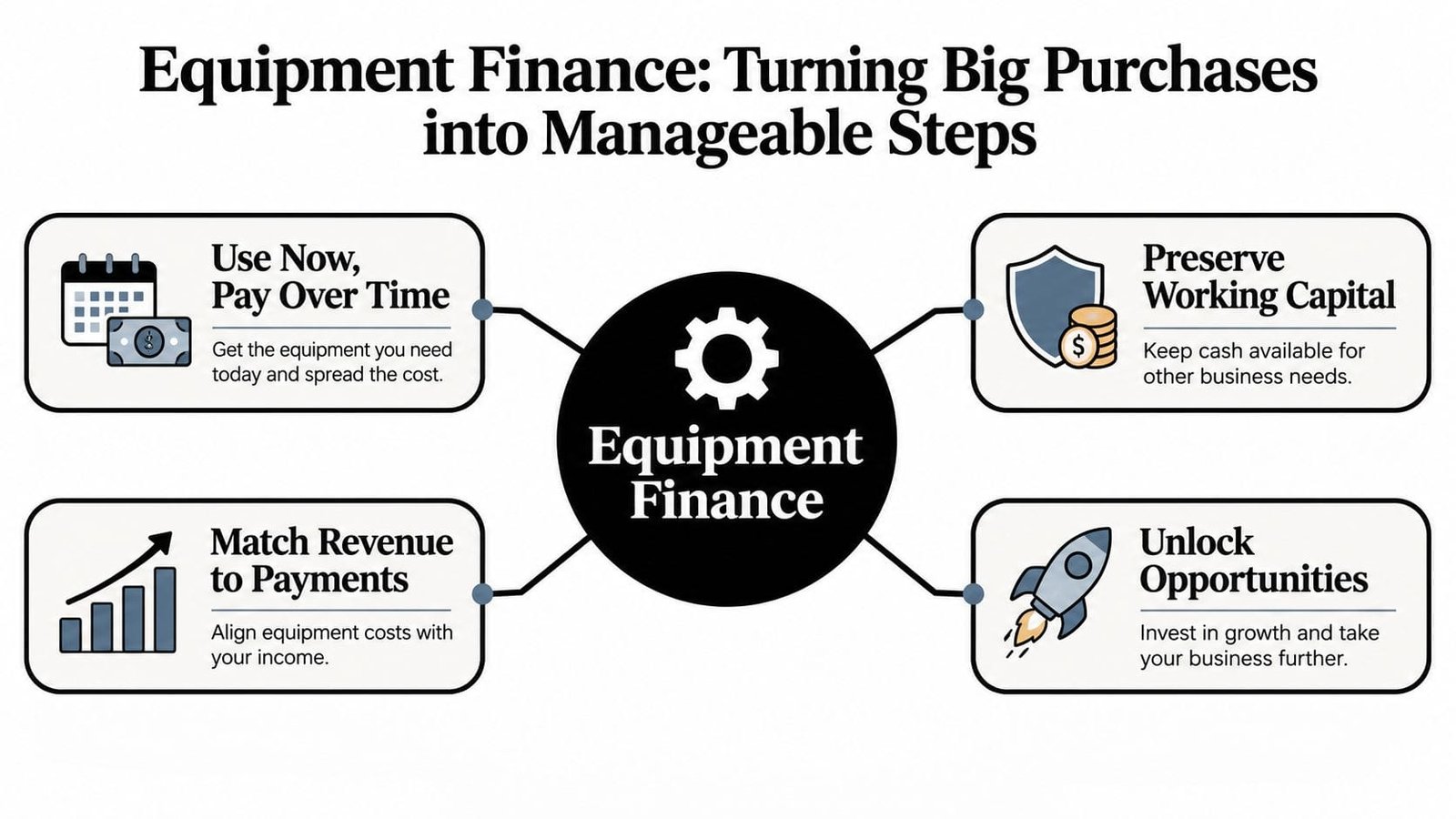
Practical rule: Treat the asset and the financing as one operating decision. The right payment schedule should support the equipment's useful life and the revenue it helps produce.
The two basic structures
Most offers fall into two broad families. A loan-style arrangement gives the business ownership, either immediately or after the final payment. A lease-style arrangement gives the business the right to use the equipment for a defined period, with ownership depending on the contract and any end-of-term purchase option.
The terminology can be confusing because lenders use labels such as equipment loan, finance lease, capital lease, operating lease, hire purchase, or equipment finance agreement. The label matters less than the mechanics: who owns the asset, who carries residual-value risk, how payments are calculated, and what happens when the contract ends.
A business can learn more about the practical benefits in this guide to equipment financing benefits, but the central idea is simple. Equipment finance lets a company turn a large purchase into manageable payments without automatically sacrificing the cash needed for payroll, inventory, insurance, or the next growth opportunity.
For companies in the $20 million to $50 million revenue range, that trade-off becomes especially important. These businesses may have meaningful operating cash flow, yet a single fleet replacement, production upgrade, or expansion project can still consume liquidity at the wrong moment. Financing can preserve flexibility when timing matters more than avoiding every dollar of interest.
Equipment Loans, Leases, and Finance Agreements Explained
The same piece of equipment can be funded through different legal and accounting structures. A traditional equipment loan usually makes the business the owner from the start. A capital lease or finance lease often gives the business ownership benefits during the contract, with ownership transferring at the end or through a nominal purchase option. An operating lease generally prioritizes use over ownership, so the business returns the asset unless it exercises a separate buyout right.
The four shapes behind most offers
Traditional equipment loan: The lender advances money for a specified asset, and the business repays principal and interest. The equipment typically secures the loan. The business records the equipment as an owned asset, records the loan as a liability, claims depreciation where permitted, and treats interest separately from principal repayment.
Capital lease: The business uses the equipment under a lease that functions economically like a purchase. The contract may include a bargain purchase option, ownership transfer after the final payment, or another path to ownership. Payments can be more predictable than a cash purchase, but the agreement may include a residual or balloon amount that must be handled at the end.
Operating lease: The business pays for use rather than ownership. This can suit equipment that becomes obsolete quickly or that the company expects to replace. The lessor generally retains residual-value risk, but the contract may assign maintenance, insurance, return-condition, mileage, or usage responsibilities to the business.
Equipment finance agreement: This structure resembles a conditional sale. The business makes scheduled payments and receives ownership once it satisfies the contract, although the lender may retain a security interest until repayment is complete. Some agreements use a final balloon payment, so the borrower must understand the payoff amount before signing.
| Product | Ownership at End | Payment Structure | Typical Term | Tax Treatment |
|---|---|---|---|---|
| Equipment loan | Business owns the asset, subject to the lender's security interest until repayment | Principal and interest, with possible down payment or balloon | Set by asset life and lender policy | Owned equipment is generally capitalized and depreciated, while interest is treated separately, subject to tax advice |
| Capital lease | Usually transfers to the business or includes a purchase option | Scheduled lease payments, sometimes with a residual or buyout | Set by the contract and expected asset use | Often treated similarly to financed ownership, but the exact treatment depends on the agreement and tax rules |
| Operating lease | Usually returns to the lessor unless the business buys it | Rent-like payments for the right to use the equipment | Based on usage period and replacement needs | Lease payments may generally be treated as operating expenses, subject to the contract and tax rules |
| Equipment finance agreement | Transfers after the required payments or final purchase condition | Installments, potentially including a final payment | Matched to the equipment's economic life | Often follows ownership-style treatment, but the business should confirm the tax position |
Tax treatment deserves professional review. Depreciation, Section 179 eligibility, lease deductions, and interest treatment can differ materially depending on ownership, business use, jurisdiction, and contract language. A lender's description isn't a substitute for advice from the company's accountant.
For businesses comparing flexible property and equipment arrangements, Pacific Mobile lease options provide an example of how a master lease framework can organize repeated equipment needs under a broader agreement. The useful lesson is to examine the actual schedule and end-of-term provisions, not just the product name.
Choose the structure based on how long you'll use the asset, whether ownership matters, how much balance-sheet visibility you want, and whether predictable payments outweigh eventual control.
How Equipment Finance Stacks Up Against Other Funding Options
A business owner usually has more than one way to fund an asset. The right comparison isn't “financing versus no financing.” It's a choice among equipment finance, a line of credit, an SBA loan, a conventional term loan, or a cash purchase.
For a company in the $20 million to $50 million revenue band, three questions usually matter most: How quickly can the funds arrive? What will the total cost be? What will the transaction do to liquidity and the balance sheet?
| Funding Option | Best For | Typical Speed | Cost Profile | Key Trade-Off |
|---|---|---|---|---|
| Equipment finance | A defined purchase of vehicles, machinery, technology, or other hard assets | Often faster than broad-purpose lending because the asset anchors the deal | Depends on credit, equipment, structure, and fees | Funds are restricted to the asset and contract terms |
| Business line of credit | Short-term, recurring, or unpredictable needs | Usually flexible after approval | Interest applies to drawn funds, with possible account fees | May not provide enough capacity for a major asset purchase |
| SBA 7(a) loan | Broad business purposes and longer-term growth needs | Can take longer because documentation and program requirements are heavier | May offer attractive pricing, but the process can be more involved | Slower execution and more extensive underwriting |
| SBA 504 loan | Long-life fixed assets and qualifying expansion projects | Often slower than asset-specific financing | Designed for fixed-asset funding, with program conditions | Less flexible and more structured |
| Traditional term loan | Larger, general-purpose borrowing for established companies | Varies by lender and complexity | Pricing reflects the borrower's credit and financial strength | May require broader financial analysis and more collateral |
| Cash purchase | An asset that won't weaken operating liquidity | Immediate once the supplier is paid | No financing interest, but the business gives up cash | Can reduce funds available for payroll, inventory, taxes, and contingencies |
When the alternatives make sense
A line of credit works well when the need is uncertain. A contractor may draw funds for materials as projects progress, while a retailer may use revolving capacity to manage inventory timing. It's less naturally suited to a single, clearly identified machine whose payment life can be matched to its productive use.
An SBA loan can win when the asset has a long useful life and the borrower values potentially lower-cost, longer-term funding more than immediate execution. A conventional term loan can also make sense when the purchase is part of a broader expansion rather than a standalone equipment transaction.
A cash purchase avoids interest, but only if the company can pay without undermining its operating cushion. The relevant question isn't whether cash is technically available. It's whether using that cash could delay payroll, reduce purchasing power, or force expensive emergency borrowing later.
If paying cash would put operations under pressure, preserve the cash and compare financing costs against the value of keeping liquidity available.
Equipment finance often wins when the purchase is specific, time-sensitive, and directly tied to revenue production. It can also reduce documentation friction compared with a broader-purpose loan, though every lender evaluates risk differently.
Eligibility and Underwriting Factors Lenders Look At
Lenders don't approve equipment finance based on the machine alone. They assess whether the business can make the payments, whether the asset can support recovery if necessary, and whether the proposed structure fits the borrower's existing obligations.
Five questions usually shape the review
Time in business comes first. Operating history gives a lender evidence about seasonality, customers, management decisions, and repayment behavior. A contractor with a stable deposit pattern and an established operating record may present less uncertainty than a newer company with strong projections but little historical evidence.
Revenue and cash flow follow. Lenders want to see enough recurring cash generation to support the proposed payment after existing expenses and debt service. Bank statements, income statements, tax returns, and accounts-receivable patterns help distinguish reliable operating cash from a temporary spike.
Credit matters, but it isn't the whole file. Personal and business credit history can affect pricing, guarantor requirements, down-payment expectations, and approval size. A weaker score may be offset by a stronger asset, a larger down payment, consistent deposits, or a well-supported explanation of past issues.
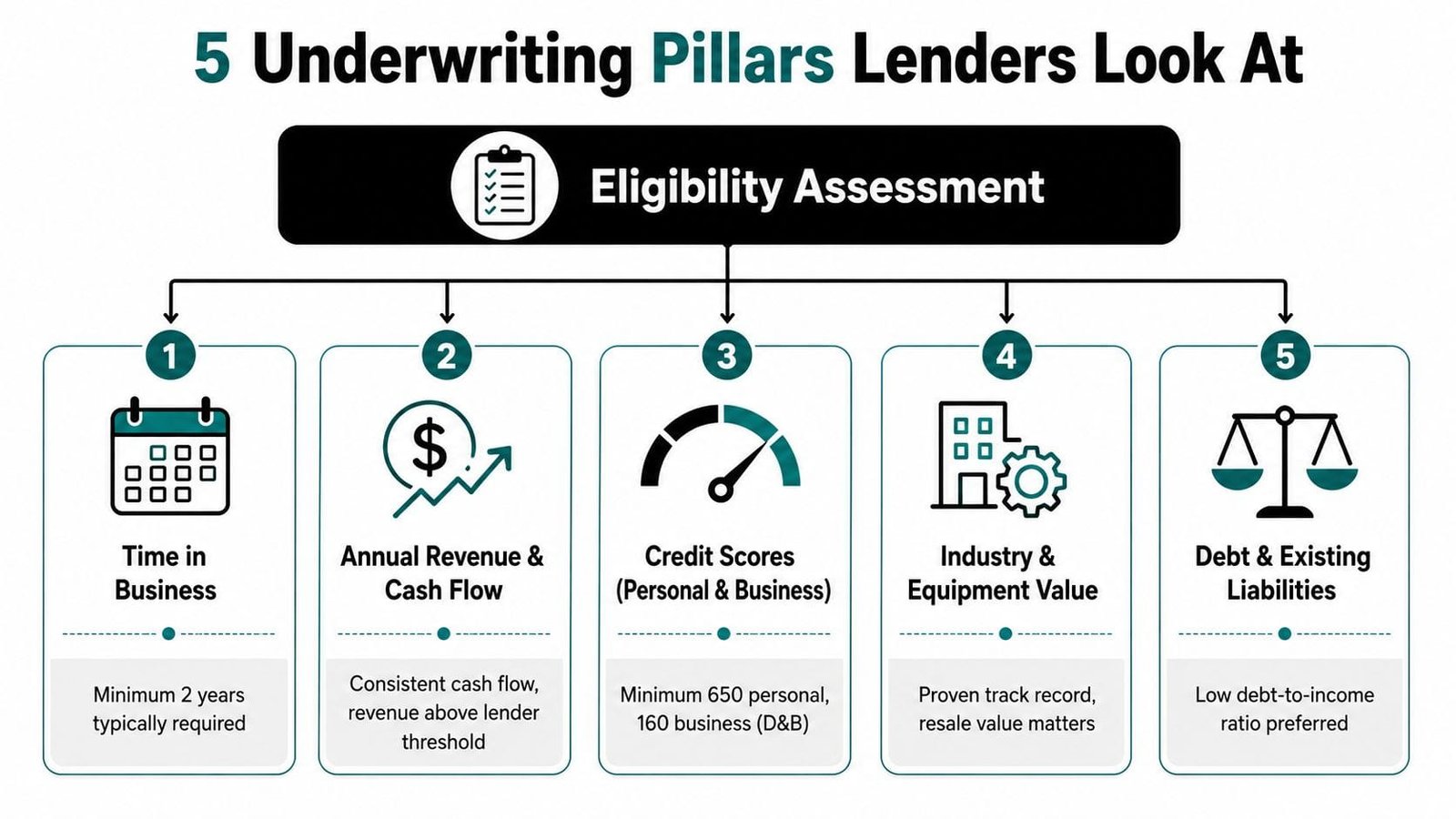
Industry and equipment quality influence collateral value. Standard, in-demand equipment with a clear resale market is easier to evaluate than a heavily customized asset with few potential buyers. Construction machinery, commercial vehicles, restaurant equipment, and IT hardware can each carry different obsolescence, maintenance, and resale concerns.
Existing liabilities complete the picture. A business may generate substantial revenue and still struggle to qualify if its current debt payments consume too much cash. Lenders review loans, leases, credit lines, tax obligations, guarantees, and other recurring commitments before deciding whether another payment is sustainable.
The exact approval standards vary by lender and transaction. Don't assume that a single credit-score rule or revenue threshold applies across the market. Instead, prepare a clean file that shows operating history, cash-flow consistency, asset details, supplier information, and the full debt stack.
For an owner with damaged personal credit, the strongest strategy is often to improve the rest of the application. A financeable asset with dependable resale value, realistic payment sizing, and documented business cash flow can give the lender more support than a credit score viewed in isolation.
Typical Terms, Rates, and Costs You Should Expect
Equipment finance quotes can look simple until you read the entire contract. One offer may show an annual percentage rate, while another uses a lease money factor, a fixed payment, or a buyout amount. You can't compare them accurately until you convert the pricing into a common view of total repayment.
Read beyond the monthly payment
Loan and lease terms commonly vary with the asset, borrower, and structure. Repayment periods may run from 24 to 84 months, but that range doesn't make every term appropriate for every machine. A longer schedule lowers the monthly payment while increasing the time the business carries the obligation and may raise the total amount paid.
A lease money factor isn't automatically cheaper than an APR. Ask the provider to show the implied annualized cost, total scheduled payments, purchase option, and any final residual. Then add the fees that can sit outside the headline pricing.
| Product | Amount Range | Term Length | Pricing | Typical Fees |
|---|---|---|---|---|
| Equipment loan | Varies by lender, asset, and borrower strength | Often aligned with asset life | APR or fixed interest structure | Origination, documentation, filing, and possible late fees |
| Capital lease | Varies by equipment and lessor | Set by the lease schedule | Money factor, implicit rate, or equivalent pricing | Documentation, purchase option, and possible early-termination charges |
| Operating lease | Varies by equipment and usage | Based on use and replacement cycle | Rent-like payment or lease factor | Delivery, maintenance, return-condition, mileage, or excess-use charges |
| Equipment finance agreement | Varies by asset and approval | Set installment schedule | Fixed payment or stated rate | Documentation, filing, and possible balloon or buyout costs |
Build the true cost
Request a written payoff schedule. Check whether the contract includes an origination fee, documentation fee, early-buyout penalty, maintenance obligation, insurance requirement, residual-value risk, or end-of-term purchase charge.
A down payment can reduce the financed balance, but it also removes cash from the business. A longer term can protect monthly cash flow, but it may leave the company paying for equipment after its most productive period. The best quote is the one that fits both the asset and the operating plan.
Use this commercial equipment lenders guide to organize lender questions before comparing offers. Ask every lender to present the same information, including total payments, fees, ownership outcome, and early-payoff terms.
A Practical Step-by-Step Application Checklist
A clean application usually starts before the lender sees the form. Suppose a restaurant is replacing refrigeration, a construction firm needs another machine, and a service company is outfitting a vehicle. Each owner can reduce delays by preparing the same core information, then tailoring the financing structure to the asset.
Eight steps that keep the process moving
Gather financial documents. Prepare business tax returns, recent bank statements, financial statements, ownership details, and existing debt information. Missing documents often create more delay than the credit decision itself.
Review credit before applying. A soft credit preview can help identify issues without turning the process into a series of uncoordinated applications. Check both business and personal information where the lender requires a guarantee.
Itemize the equipment. Get a supplier quote with the manufacturer, model, serial information where available, purchase price, delivery terms, installation costs, and included warranties.
Match the structure to the asset. A long-life excavator may fit an ownership-oriented loan. Technology that needs frequent replacement may fit a lease. A vehicle used constantly for revenue production may suit a finance agreement.
Compare two or three written offers. Keep the asset, down payment, term, and requested amount consistent so the comparison is meaningful. Look at total repayment, not only the advertised monthly figure.
Submit one complete application. Inconsistent revenue figures, unexplained deposits, or missing ownership information can trigger follow-up questions. A single organized file gives the underwriter a clearer picture.
Answer questions quickly and precisely. Underwriters may ask about seasonality, customer concentration, existing liens, equipment use, or a recent change in cash flow. Respond with documents and concise explanations.
Review the contract before signing. Confirm payment dates, insurance, maintenance, default provisions, prepayment rules, purchase options, residuals, and what happens if the equipment is damaged or becomes unusable.
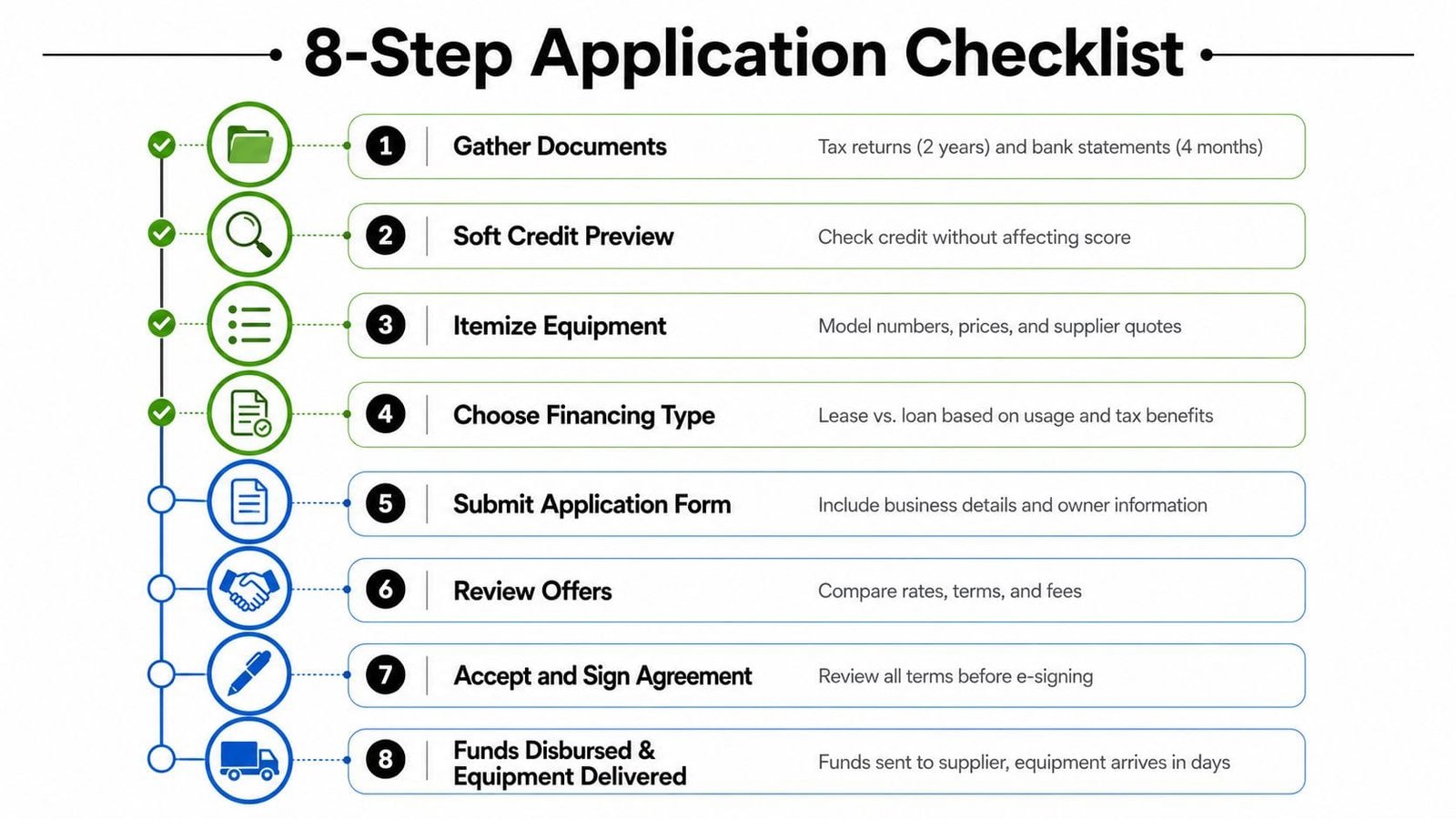
A modern digital workflow may let owners upload documents, connect financial accounts, track status, and sign electronically. Those features can simplify administration, but they don't remove the need to understand the legal and financial terms.
The supplier invoice should also match the application. If the requested amount changes because installation, freight, or accessories were added, tell the lender before closing. Small inconsistencies can create avoidable rework at the funding stage.
Real Use Cases From Restaurants, Construction, and Service Businesses
Maria operates a restaurant and has signed a lease for a second location. Her challenge isn't only the ovens, refrigeration, prep stations, and espresso equipment. She also needs cash for opening inventory, staffing, permits, and the inevitable adjustments that come with a new site.
A capital lease may let her place the equipment into service while spreading payments over the period in which the kitchen supports sales. She'll need to verify the ownership terms and tax treatment with her advisers, but the structure can preserve cash for opening costs while giving her a path to eventual ownership.
Dale runs an excavation company that has secured a long-term municipal contract. His aging machine creates downtime risk, so he considers an equipment loan for replacement machinery. An ownership-oriented structure may fit because the equipment should remain useful across the contract and beyond it, while the repayment schedule can be evaluated against expected project cash flow.
Priya owns a mobile veterinary service. She needs a van fit-out containing specialized equipment, storage, and power systems, but she doesn't want the purchase to consume the working capital used for payroll, supplies, and travel. An equipment finance agreement can tie the payment obligation to that specific fit-out, provided she confirms the final ownership condition and the treatment of custom components.
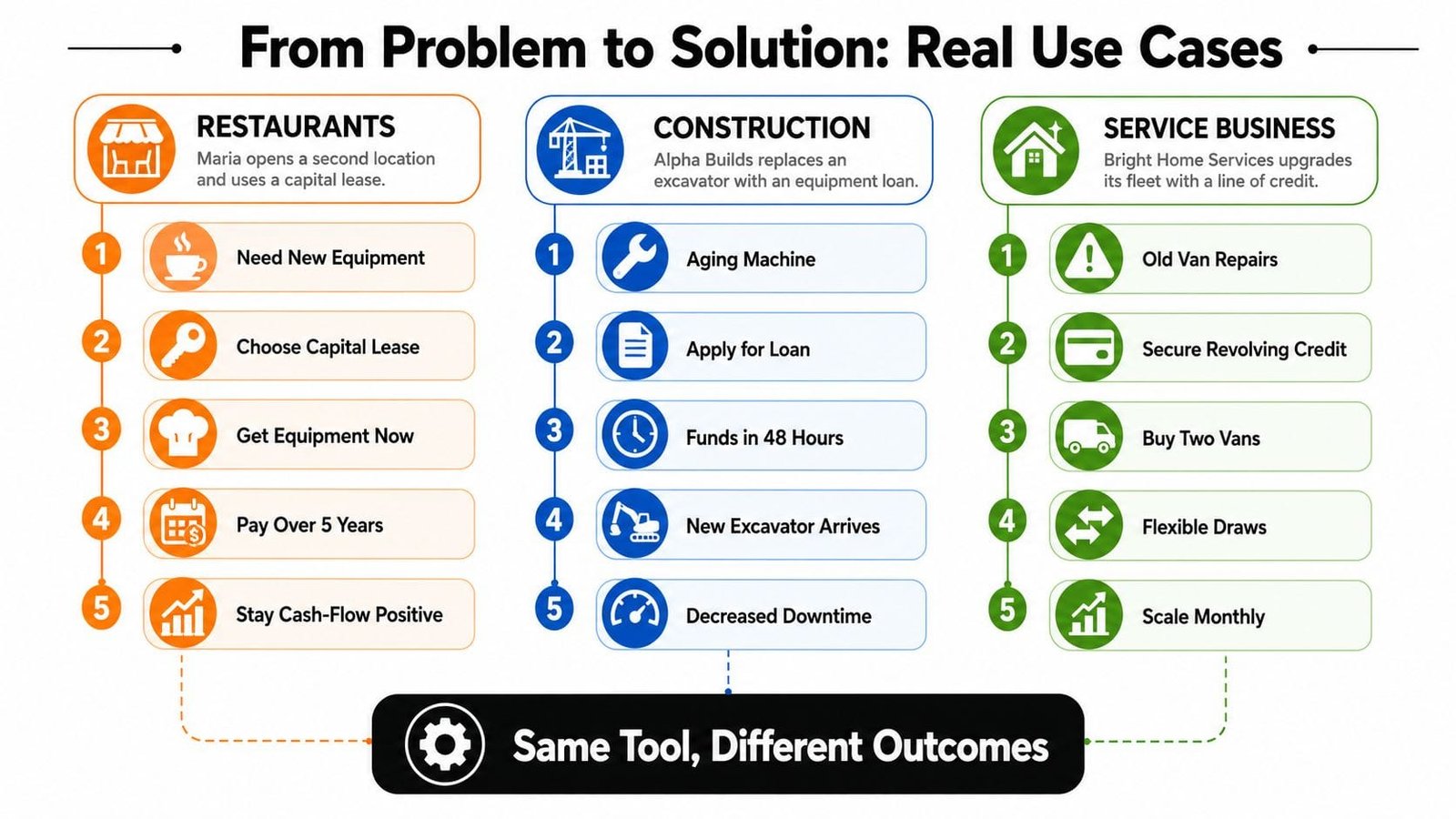
These examples show why there's no universal winner between a loan and a lease. Maria values cash preservation during expansion. Dale values control and long-term use. Priya needs a structure that follows one specialized operating asset.
Restaurant owners can use this restaurant equipment financing resource to think through purchases such as kitchen equipment, refrigeration, furniture, and other opening or replacement needs. The decision should still come from the asset's expected use, cash-flow profile, and contract terms.
Common Misconceptions and Smart Decision Moves Before You Sign
Misconception one, leasing is always more expensive. A lease can cost more when the business intends to buy the asset at the end and the contract includes a substantial purchase amount. But a lease may be economically sensible when the asset becomes outdated quickly, the company values replacement flexibility, or preserving cash protects a more valuable operating opportunity.
Misconception two, a loan is always better because ownership is better. Ownership matters when the business expects to keep and use the asset for a long time. It matters less when the equipment has a short technology cycle, unpredictable resale value, or high disposal burden. Paying for ownership can create residual-value risk that a lease transfers to the lessor.
Misconception three, any equipment financing harms future borrowing capacity. A new obligation does affect the debt picture, but the effect depends on payment size, cash flow, collateral, and how the lender reports the arrangement. A well-sized asset loan may support productive growth, while an oversized payment can restrict later borrowing.
Misconception four, the lowest monthly payment is the best deal. A low payment may result from a longer term, a balloon, a residual, or a buyout charge. Compare the total scheduled payments, fees, ownership outcome, maintenance duties, and early-payoff terms before choosing.
A final decision checklist
Before signing, answer these questions:
- Will the equipment generate or protect revenue quickly enough to support the payment?
- How long will the business realistically use the asset?
- Does the contract end with ownership, return, renewal, or a buyout?
- What is the total cost, including fees and any final payment?
- Who carries repair, insurance, obsolescence, and resale risk?
- How will the arrangement appear on the balance sheet and credit reports?
- Does the payment preserve enough cash for normal operations and surprises?
The right choice is a cash-flow and tax-planning decision, not an automatic response to a supplier invoice. For the owner asking what is equipment finance, the most useful answer is also the most practical one: finance the asset when keeping liquidity available creates more operating value than paying cash, and choose the structure that matches how the business will use it.
Business Loan Warrior offers equipment financing and other business funding options through a single application process, allowing owners to explore financing for a defined purchase while considering broader capital needs. Visit Business Loan Warrior to review your equipment funding options and begin comparing a structure that fits your company's cash flow.