
Growth capital is minority-stake private equity used to fund relatively mature companies that want to expand without giving up control. It's the money that fits a business that's already working, but needs more fuel to open more doors, launch more products, or buy a smaller competitor.
You might be sitting on steady revenue, a strong team, and a list of opportunities that cash flow alone can't cover. The hard part is that the wrong funding choice can either choke growth with repayment pressure or hand over too much ownership too early.
Table of Contents
- A Clear Definition of Growth Capital
- Where Growth Capital Fits in the Funding Lifecycle
- Typical Deal Structures and Terms
- Who Qualifies and Where the Money Comes From
- How the Funding Is Actually Used
- A Practical Checklist for Evaluating an Offer
- Alternatives Worth Comparing Before You Raise
A Clear Definition of Growth Capital
A lot of owners hear “private equity” and picture a full sale. That's not what this is. Growth capital is usually a minority-stake investment into a company that already has traction and wants to expand, not rescue itself.
A simple way to think about it is this. A tow truck helps when the car won't move. Growth capital is more like a fuel stop on a long highway trip, the business is running, but it needs more range to reach the next city. If you're a U.S. owner with healthy demand, real customers, and a growth plan that needs more capital than a bank loan comfortably covers, this is often the conversation you're having.
What the investor is actually buying
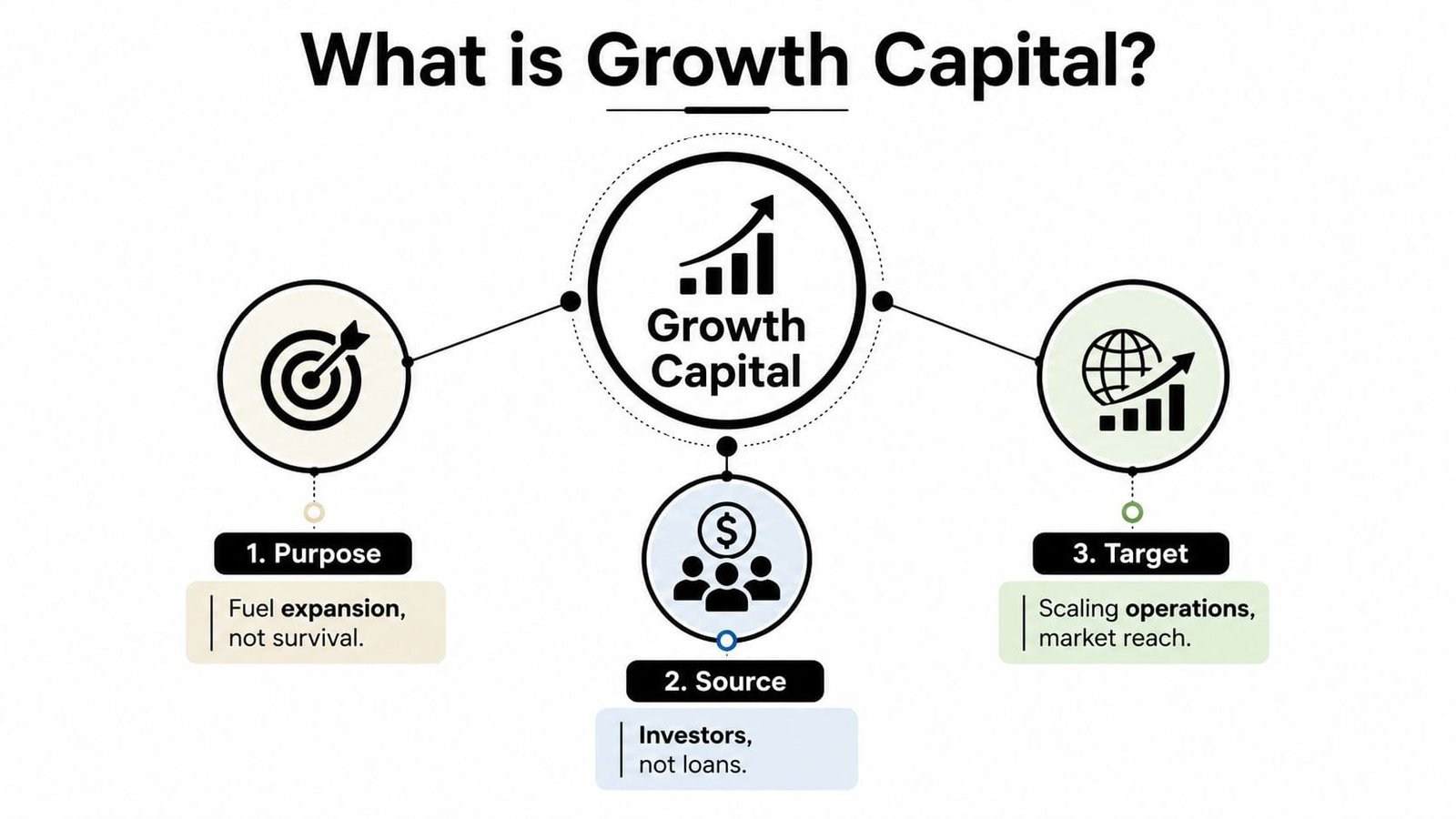
The investor isn't mainly buying control. They're buying equity exposure in a company that's already past the earliest startup stage and is now trying to scale. In plain English, the owner keeps running the business, while the investor gets a share of the upside if the growth plan works.
That's why growth capital shows up in businesses that have already proven demand. It's not for a company still trying to figure out whether customers want the product at all. It's for a company that knows customers want it and now has to fund more inventory, more people, more locations, or more infrastructure.
Practical rule: If the money is meant to accelerate a proven business model, growth capital belongs on the list. If the money is meant to keep the lights on, it usually isn't the right fit.
For owners comparing funding paths, it also helps to look at related options such as revenue-based financing, since both can fund expansion without the structure of a traditional term loan.
Where Growth Capital Fits in the Funding Lifecycle
A growth capital round usually lands after a company has already proved customers will buy and keep buying. At that point, the question is no longer whether the business works. The question is how to fund the next stage without forcing a full sale or moving all the way into a lender's model. CAIS describes growth equity as a “middle ground” between venture capital and buyout funds in its CAIS growth equity overview, and that description fits the place it occupies in the funding lifecycle.
How the main options compare
| Option | Stage | Control | Dilution | Repayment Pressure | Typical Check Size |
|---|---|---|---|---|---|
| Venture capital | Early-stage, still proving product-market fit | Founder usually shares control earlier | High | None | Varies widely |
| Growth capital | Established company, scaling after traction | Founder usually keeps operational control | Moderate | None | Roughly $5 million to $50 million |
| Buyout private equity | Mature company, control change likely | Investor seeks control | High for owner, often a sale | None at company level, but debt may sit on the business | Larger and more control-heavy |
| Traditional debt | Company with cash flow to service payments | Founder keeps control | None | High, because principal and interest must be repaid | Lender-driven |
For U.S. SMB owners, the useful question is where the business sits on that timeline. A startup with an untested model usually needs venture-style risk capital. A mature business with stable cash flow may fit debt. A company in the middle, with real customers and room to expand but no desire for a sale, is where growth capital tends to fit best.
The lifecycle position matters because it shapes what kind of capital the business can absorb. A company that still needs to prove demand does not usually belong in growth equity. A business that is already stable, profitable, and ready for a control change is closer to a buyout. Growth capital sits between those poles, where the company has traction and now needs funds for the next phase of expansion.
If you are comparing growth capital with a structured debt option, it helps to read about a subordinated loan, since both can sit behind a more senior layer of capital and both can be used when a business needs room to grow.
Why founders use it instead of a sale
A sale answers a different question. It can give an owner liquidity and shift the business into new hands, but it also changes who sets the direction. Growth capital is for owners who want the business to keep operating under the same management while adding fuel for expansion.
That is why the fit is often strongest for businesses that are past startup mode but not ready for a buyout. The company needs capital to open locations, add capacity, fund inventory, or support bigger contracts, and the owner wants a financing structure that matches that stage instead of forcing an exit.
Typical Deal Structures and Terms
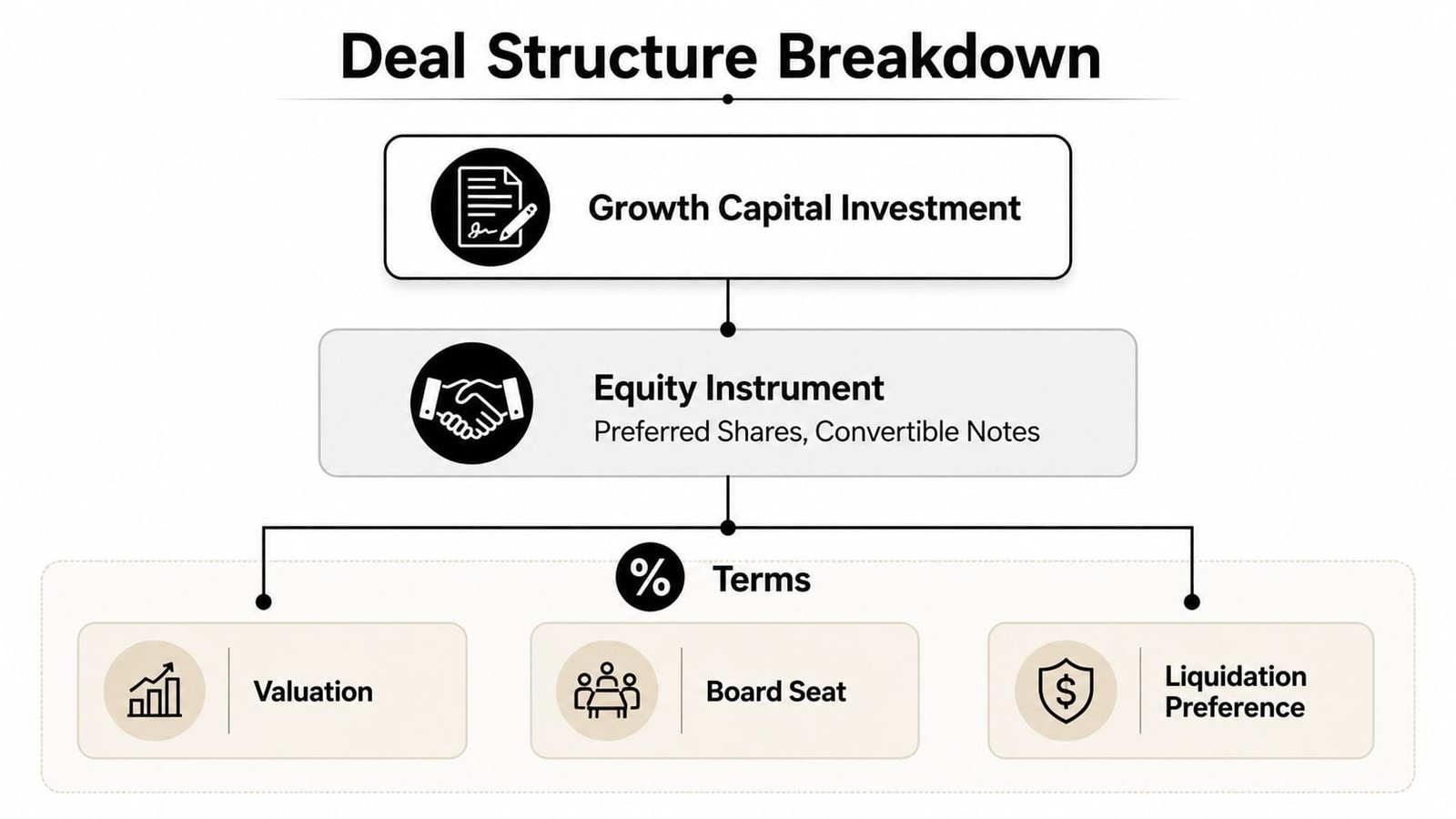
A growth capital deal usually starts with the company issuing new equity to the investor. That can be preferred shares, common equity in some cases, or a structured version of equity that has special rights attached. The owner gives up part of the future upside, but in exchange the business gets cash for expansion without scheduled loan payments.
The terms that matter most
The first number owners focus on is valuation, because it drives how much ownership gets sold. But the document usually has several other moving parts. A liquidation preference tells you who gets paid first in a sale. A board seat or observer seat tells you how much oversight the investor gets. Protective covenants can limit what the company can do without investor approval. Anti-dilution language can protect the investor if later rounds happen at a lower valuation.
Those terms sound technical, but they're really about control. The more rights an investor asks for, the more the deal starts to feel like a partnership with strings. That may still be fine, but owners should know exactly where those strings run.
Plain-English read: A good growth capital deal gives the company more room to grow. A bad one makes every major decision harder.
Independent guides describe typical check sizes of roughly $5 million to $50 million for companies with established revenue, with targets often around $2 million to $10 million in annual recurring revenue or strong double-digit growth, which helps show the type of business profile these investors usually want. Growth capital guide
Why some deals look more structured
Not every growth deal is plain preferred stock. Some use structured equity with a dividend, a redemption feature, or a future buyback path. That can help bridge the gap between a founder who wants to avoid full dilution and an investor who wants downside protection.
If you're comparing this to debt-like funding, a subordinated loan can also sit in the capital stack, but it behaves very differently from true equity. Debt still asks for repayment. Equity asks for ownership.
Video context can help here, because deal terms often feel abstract until you see them laid out visually.
Who Qualifies and Where the Money Comes From
A growth capital offer can look attractive on paper and still be wrong for a company if the business is too early, too fragile, or too dependent on one person. The owners who tend to fit are the ones who can show a working business, a clear plan for expansion, and enough leadership depth that the company will not stall if the founder steps away for a week.
The cleanest filter is often what does not fit. If the company needs cash just to make payroll, is still trying to prove its market, or has no practical way to turn new money into more revenue, growth capital usually creates more pressure than help. The investor is not buying a rescue story. They are backing a business that can use outside money to build a larger one.
Where the checks come from
The money usually comes from dedicated growth equity funds, late-stage venture arms, family offices, sovereign wealth funds, and other private-market investors that want minority ownership and a path to upside. Some quasi-equity providers also show up, depending on how the deal is structured. For U.S. SMB owners, the practical question is not just who is writing the check, but whether that source fits the company's capital stack and the amount of control the owner is willing to share, which is why a capital stacking guide can help frame the conversation.
Some owners also compare these offers with other finance support from Wisely, especially when they need to think about banking, treasury, and growth funding as one package.
The source of capital matters because each investor type brings different expectations. A fund may want a cleaner exit path, while a family office may care more about patient ownership and downside protection. The company should know which trade-off it is accepting before it signs.
What usually keeps a company out
- No clear use of funds: If the raise is mostly to plug operating gaps, the deal can become a short-term patch instead of growth money.
- Founder dependence: If only one person knows how sales, operations, and customer retention work, the risk sits too heavily on that person.
- Weak decision discipline: Investors get cautious when the business cannot explain how capital will be spent, tracked, and tied to expansion.
- No believable path to scale: A company that cannot show where the next layer of revenue will come from has a hard time justifying outside ownership.
- Mismatch in control expectations: Some offers come with board influence, reporting demands, or buyback terms that do not fit every owner's comfort level.
That is the qualification test for this kind of money. A strong company can still be a bad candidate if the owner wants full independence, if the timing is off, or if the business cannot support the structure that comes with the capital.
A simple qualification test
- Operational depth: The business can run without the founder handling every key decision.
- Expansion logic: New money has a direct job, such as opening locations, adding sales coverage, improving systems, or funding a strategic add-on.
- Capital discipline: The owner can use outside money for growth, not for patching recurring problems.
- Investor fit: The company can live with the amount of reporting, control, and exit pressure that comes with the offer.
- Ownership trade-off: The founder understands how much control, dilution, or repayment risk is being taken on in exchange for the funding.
That checklist helps owners compare equity, debt, and hybrid offers without getting distracted by the headline amount. A deal can look bigger and still be the wrong shape if it creates too much repayment pressure, gives away too much ownership, or puts a smaller company under a larger investor's rules.
How the Funding Is Actually Used
Growth capital should buy future revenue, not cover yesterday's bills. The strongest uses are the ones that widen capacity, raise market reach, or create a bigger platform for the next phase of the business. That usually means spending on projects that may hurt margins for a while, but improve the business over the long run.

Common expansion uses
A regional retailer might use the money to open a second or third location in a new market. A service company might add salespeople and field managers so it can cover more territory. A manufacturer might buy equipment or upgrade systems so it can produce more without bottlenecks.
A strategic acquisition can also make sense when the target is small enough to integrate but meaningful enough to add customers, locations, or capability. In that case, growth capital can help the owner buy speed instead of building everything from scratch. A new product line fits the same pattern, because the investment goes into building a broader offer, not plugging a cash shortfall.
Growth capital works best when the spend creates capacity the business can keep using after the money is gone.
A few plain-English scenarios
A restaurant group with steady traffic could use expansion capital to fund a new unit in a nearby city, but only if the operating team can duplicate the model. A commercial services company could hire a dedicated sales lead and a small support team, then use the new coverage to win larger accounts. A healthcare practice could invest in technology and infrastructure so it can handle more volume without breaking service quality.
The common thread is that the capital goes into repeatable growth. That makes it different from working money for payroll, rent, or supplier gaps. If the use case is mostly about smoothing cash flow, that's usually a sign to look elsewhere.
A Practical Checklist for Evaluating an Offer
The first thing to check is whether the valuation makes sense against the economics of the business. If the number feels rich but the business can't support the growth story, the owner may be selling too much future upside too cheaply. If the valuation feels low, dilution gets expensive fast.
Run the term sheet through these questions
- Valuation sanity: Does the price reflect the company's current performance and realistic upside, not just a flattering multiple?
- Dilution cost: How much ownership am I giving up today, and what does that mean if the business performs well?
- Liquidation preference: In a sale, who gets paid first, and does that leave enough value for the founder and team?
- Board rights: Does the investor get a seat, an observer role, or veto power over key moves?
- Covenants: Could the terms block future borrowing, hiring, acquisitions, or capital spending?
- Founder vesting or reverse vesting: Is any part of my equity still tied to staying and performing?
- Track record: Has this investor backed businesses like mine, or are they learning on my balance sheet?
Those questions matter because a growth round is not just about price. It changes the governance of the company. A fair check can become a bad deal if the investor has too much control over the next financing, the exit process, or even routine strategic decisions.
Get the business ready before you raise
Clean financials matter more than owners think. So does a credible growth plan with specific uses for the money and a target list of likely investors. If the business can show how the funds will translate into growth, the conversation becomes sharper and much more credible.
A good rule is to prepare the company as if every assumption will be challenged. That means tightening reporting, documenting the growth plan, and knowing which terms are deal-breakers before the first term sheet shows up.
Owner test: If you can't explain why this capital is better than debt, or why debt is better than equity, you're not ready to choose.
Alternatives Worth Comparing Before You Raise
Debt is usually the first alternative owners should test. SBA 7(a) and 504 loans can work well for buying equipment, real estate, or other assets with a clear payback path. Business lines of credit help with timing gaps, equipment financing matches the useful life of the asset, and mezzanine debt sits in a middle layer for companies that can support more borrowed capital but don't want to sell much equity.
Revenue-based financing can make sense when repayment should flex with sales, especially for businesses with predictable revenue patterns. Continued bootstrapping is still the cheapest path if the company can grow from retained profits and the owner can move at that pace. The trade-off is obvious, because slower self-funding preserves control but may delay expansion.
For many SMB owners, the decision comes down to whether the project is short-term and cash-flow driven, or multi-year and uncertain in timing. If the project is the first kind, debt is often cheaper. If it's the second kind, growth capital's lack of repayment pressure can justify the dilution.
Business owners who want a structured comparison across lending options can also look at Business Loan Warrior, which matches borrowers with different business financing paths through one application flow. It's one more way to compare debt against equity before making a decision.
Choose the structure that fits the job. If the money only needs to bridge a temporary gap, don't sell equity for it. If the money is meant to build something bigger over several years, and you want room to execute without repayment pressure, growth capital may be the right tool. For a side-by-side funding review and practical next-step guidance, visit Business Loan Warrior and compare the options before you sign anything.