
A customer's invoice is approved, but payment won't arrive soon enough to cover this week's payroll, supplier bills, and rent. The business is profitable on paper, yet its cash is temporarily trapped in receivables. A fixed loan may deliver more money than the owner needs and still demand scheduled repayments after the immediate gap has closed.
That's the situation a working capital line of credit is designed to address. It gives a business access to a set amount, lets the owner draw only what's needed, and restores available credit as the balance is repaid. The right question isn't whether a line sounds flexible. It's whether the facility will remain affordable and usable when receivables slow, inventory sits longer, or a lender asks for updated reporting.
Table of Contents
- When Cash Flow Gets Uneven and a Loan Is Not the Answer
- How a Working Capital Line of Credit Works
- The Real Cost of a Working Capital Line of Credit
- Eligibility and Underwriting Factors That Matter
- When a Line of Credit Beats and Loses To Alternatives
- The SBA Working Capital Pilot and Monitored Lines Explained
When Cash Flow Gets Uneven and a Loan Is Not the Answer
A B2B services firm can have signed contracts, completed work, and a healthy pipeline while still facing a cash shortage this week. Its client may pay on normal terms, but payroll and supplier obligations arrive first. Borrowing a full lump sum to cover one timing gap creates a second problem, because the business now has a fixed repayment obligation after the customer payment arrives.
A revolving facility fits that pattern more naturally. The owner draws enough to cover the shortfall, uses the funds for operating expenses, and repays the draw when collections arrive. If another gap appears later, the business can draw again without arranging a new loan, subject to the facility's terms and available credit.

The product's practical purpose
A working capital line of credit is revolving business financing. The company draws funds as needed, repays them, and can draw again. That structure helps smooth uneven receivables and seasonal demand, rather than funding a single, predetermined purchase.
The need is widespread. In the U.S., 37% of employer firms applied for a loan, line of credit, or merchant cash advance in 2023, and 34% reported using lines of credit regularly, according to the U.S. Small Business Administration's 7(a) loan information. The same Federal Reserve data cited in that source found that half of applicant small employer firms sought $100,000 or less, while 30% sought $50,000 or less. Those amounts can be modest relative to annual sales, but they can determine whether a company makes payroll without rushing to discount an invoice.
Practical rule: Match the funding structure to the cash-conversion problem. Recurring timing gaps usually call for access to capital, while a defined one-time expense usually calls for a lump sum.
A line can also support seasonal operations. A wholesaler may need to buy inventory before peak demand, while a contractor may pay labor and materials before a customer's progress payment clears. But flexibility doesn't make a facility automatically safe. You still need to test the line against slower collections, higher costs, renewal conditions, and reporting requirements. For additional context on managing operating liquidity, see this guide to working capital financing tactics for small-business stability.
How a Working Capital Line of Credit Works
A working capital line operates like a faucet connected to a reservoir. The approved credit limit sets the reservoir's ceiling, a draw sends funds into the operating account, and repayment restores room for another draw. The full limit does not arrive in the account automatically. The business uses only the amount needed to cover a cash-flow gap.
Suppose a lender approves a $100,000 line. The business draws $40,000 for payroll, leaving $60,000 available. As the company repays that balance, the paid-down amount generally becomes available again, provided the lender has not reduced the limit or imposed another restriction.
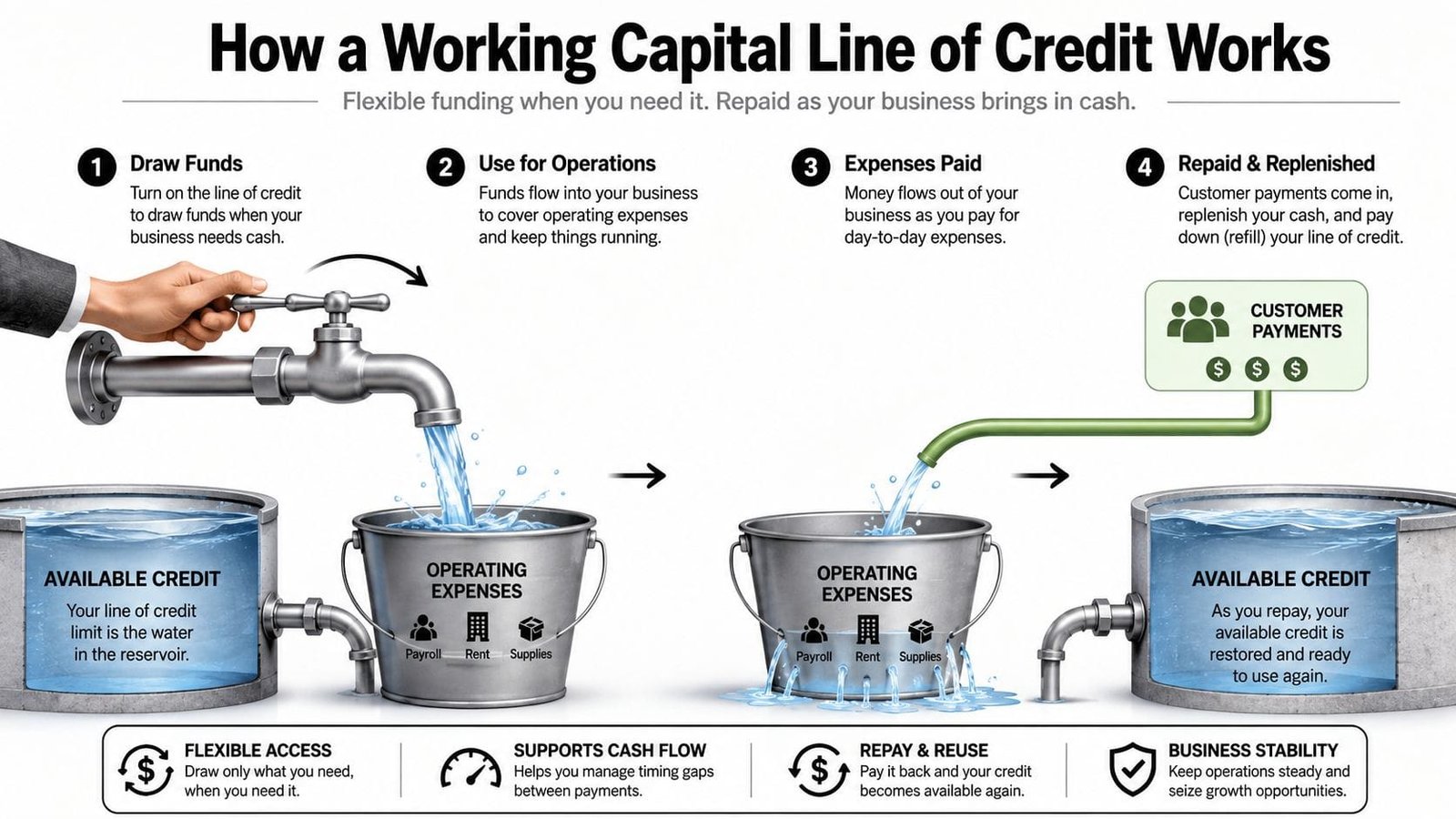
The basic draw and repayment cycle
The account activity might look like this:
| Transaction | Outstanding balance | Available credit |
|---|---|---|
| Facility opened | $0 | $100,000 |
| Payroll draw | $40,000 | $60,000 |
| Partial repayment | Lower than $40,000 | Higher than $60,000 |
| Full repayment | $0 | $100,000 |
Repayment rules vary by lender. Some facilities require scheduled principal payments. Others expect the balance to decline as receivables arrive. Interest usually applies to the outstanding balance, while the agreement may also charge for access, draws, maintenance, or renewal.
A revolving line restores borrowing capacity after repayment. A non-revolving facility does not. Under a non-revolving structure, repaying the borrowed amount may end access to that portion, so the business cannot assume it can redraw funds when the next cash gap appears.
Commitments, renewals, and borrowing bases
A committed line generally provides stronger contractual access, subject to the agreement's conditions. An uncommitted line gives the lender greater discretion to reduce or withdraw availability, even when the borrower has not used the full facility. Ask which structure is being offered. An approved limit is not always a permanent reserve.
Some lenders calculate availability through a borrowing base. The usable amount may depend on eligible receivables, inventory, purchase orders, or contracts rather than the stated limit alone. Overdue invoices, concentrated customer exposure, or ineligible inventory can reduce borrowing capacity without changing the headline limit.
Renewal also requires planning. A line may run for an agreed period and then require a fresh review of financial statements, bank activity, collateral, covenant compliance, and receivables quality. Larger monitored facilities can add a meaningful reporting workload, so test whether the business can produce the required information while managing its cash-conversion cycle. Treat the line as an ongoing financing relationship, not cash that will remain available indefinitely.
The Real Cost of a Working Capital Line of Credit
The headline rate rarely tells the whole story. A revolving facility may price from a floating benchmark, such as prime, plus a lender spread. The borrower may then pay additional draw fees, annual commitment fees on unused capacity, monthly maintenance charges, or other facility costs.
The working capital loan rate summary from Capital Xo describes secured revolving lines commonly near prime plus 0.5% to prime plus 3.0%, and unsecured lines near prime plus 2.0% to prime plus 5.0%. It also identifies commitment or draw fees commonly adding roughly 0.25% to 2.5% of facility cost. These are market-summary ranges, not a quote for your business, and a floating rate can change as the benchmark changes.
| Facility Type | Typical Rate Spread | Common Add-On Fees | Cost Sensitivity |
|---|---|---|---|
| Secured revolving line | Prime + 0.5% to prime + 3.0% | Draw, commitment, annual, or maintenance fees | Sensitive to collateral quality and utilization |
| Unsecured revolving line | Prime + 2.0% to prime + 5.0% | Draw, commitment, annual, or maintenance fees | Sensitive to credit strength and repayment behavior |
Utilization changes the economics
Consider two borrowers with similar approved limits. Borrower A draws most of the facility and keeps the balance outstanding. Its interest expense is driven mainly by the amount borrowed and the time it remains unpaid. Borrower B uses the line only occasionally, but pays an annual commitment charge or monthly maintenance fee for keeping capacity available. For Borrower B, unused availability can become a meaningful part of the true cost.
A line can therefore be expensive in two opposite ways. Carrying a large balance creates interest expense, while keeping a mostly idle facility can create fees without producing operating value. Draw fees can also matter when the business makes many small withdrawals instead of fewer, well-planned draws.
Build a true-cost question list
Before accepting an offer, ask the lender to show:
- Benchmark and spread: Is the rate fixed or floating, and what causes it to change?
- Draw pricing: Does each draw carry a fee, and is the charge based on the amount drawn?
- Unused capacity: Is there an annual commitment fee on the undrawn portion?
- Maintenance costs: Does the account carry a monthly service or administration charge?
- Renewal economics: Can the lender change the rate, limit, or fees at renewal?
- Repayment mechanics: Are payments interest-only, principal plus interest, or tied to collections?
Compare the cost under at least two operating patterns, one where the line is heavily used and another where it remains mostly available. The cheaper headline spread may not produce the cheaper facility if its fee structure penalizes your actual usage.
Eligibility and Underwriting Factors That Matter
A lender reviewing a working capital line is testing more than the owner's credit score. The central question is whether the facility matches the business's cash-conversion cycle. Underwriters examine operating cash flow, collateral reliability, and the company's ability to provide timely information as risk is monitored.
The first metric to understand is debt service coverage ratio, or DSCR. It divides annual operating cash flow by annual debt service. A DSCR of 1.25x means the business generates $1.25 of cash flow for every $1.00 of required debt payments, a threshold discussed in the HUD Section 108 underwriting guidelines.
Why the committed limit can matter
Some lenders test DSCR against the full committed credit limit rather than the current drawn balance. For a seasonal or uneven business, that can reduce the approved amount because the lender evaluates the payment obligation that could arise from the entire commitment.
A line that looks affordable when lightly drawn may not qualify at the requested size if the lender tests the full commitment.
Underwriters also examine:
- Operating history: How long has the company been trading, and does it show consistent financial activity?
- Revenue quality: Is revenue recurring, concentrated among a few customers, seasonal, or dependent on large projects?
- Owner and business credit: Do personal and commercial credit histories show unresolved defaults, late payments, or excessive debt?
- Collateral: Can receivables, inventory, equipment, or other assets support a secured structure?
- Guarantees: Will the lender require a personal guarantee or other support from the owners?
A strong credit profile cannot compensate for a facility that is too large for the company's collection pattern. Owners can use this guide to line-of-credit eligibility to organize the preparation process, while the lender's agreement determines the final requirements.
Prepare for the reporting workload
A conventional line may require financial statements, tax returns, bank statements, and accounts-receivable aging. A monitored facility can go further. The lender may review which invoices qualify, how old they are, how much each customer owes, and whether inventory remains eligible.
Borrowing-base reporting may include:
- Receivables aging: Older invoices may receive reduced credit or be excluded.
- Customer concentration: The facility may limit reliance on one customer or related group.
- Advance rates: The lender may lend only against an approved portion of eligible collateral.
- Inventory controls: The lender may examine turnover, valuation, and saleability.
- Availability certificates: The borrower may need to report collateral and availability on a regular schedule.
Larger monitored lines therefore create an operating obligation alongside the funding capacity. Before applying, assemble clean bank statements, current profit-and-loss reports, balance sheets, debt schedules, customer aging, inventory records, and supporting contracts. If the business cannot maintain those records on schedule, the facility may create strain even when the credit decision is favorable.
When a Line of Credit Beats and Loses To Alternatives
The best product depends on the distance between cash going out and cash coming in. A company that pays suppliers weekly and collects customer invoices on roughly predictable terms has a different need from a company waiting through long project cycles with irregular billing.
Start with the cash-conversion profile
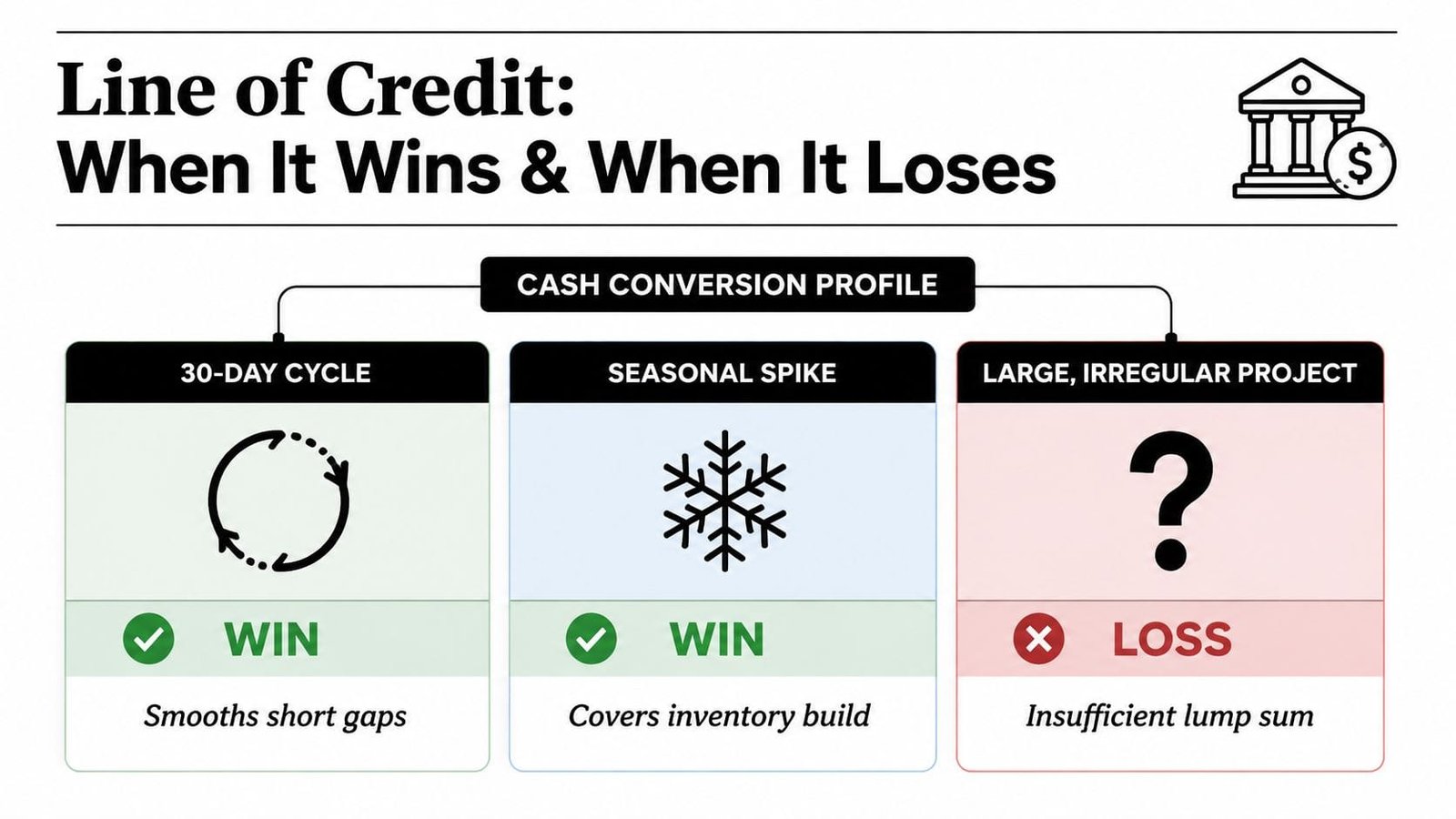
A working capital line usually fits when the gap is recurring, variable, and short enough for normal collections to close. It's especially useful when the business needs different amounts at different times, such as payroll one cycle and inventory or supplier payments the next.
Invoice financing may fit better when the main asset is a large receivables ledger and customers pay slowly. The financing is tied more directly to invoices, which can make it more suitable for a company whose borrowing base is primarily unpaid customer bills.
A short-term loan is often cleaner for a single, known expense. If the company knows the purchase price and expects one project or event to repay the borrowing, a fixed lump sum can be easier to budget than an open facility.
A merchant cash advance may be considered by a business with substantial card-based revenue that values speed over price. It can be a poor match for a B2B company that invoices customers, because repayment tied to card receipts won't align with its actual collection cycle.
| Product | Typical Cost | Speed to Fund | Flexibility | Best-Fit Business |
|---|---|---|---|---|
| Working capital line of credit | Floating rate and facility fees may apply | Varies by lender and underwriting | Draw, repay, and potentially redraw | Recurring operating gaps and seasonal needs |
| Invoice financing | Pricing is tied to financed receivables and fees | Often depends on invoice verification | Linked to eligible invoices | Businesses with strong receivables and slow customer payment |
| Short-term loan | Fixed repayment cost or scheduled interest | Often faster than traditional lending | Limited after funding | One-time, defined expense |
| Merchant cash advance | Usually higher-cost revenue-based financing | Often designed for speed | Repayment follows sales activity | Card-heavy businesses prioritizing speed |
Two decision scenarios
A growing services firm with recurring contracts, weekly payroll, and customer payments that arrive unevenly may choose a revolving line. It can draw for payroll, repay from collections, and keep the facility available for the next cycle. The owner still needs to verify that fees, renewal terms, and any borrowing-base rules won't undermine the benefit.
A wholesaler building seasonal inventory may also benefit from a line, especially when inventory purchases occur before sales. But if the inventory remains unsold longer than expected, the facility can become a poor fit. Interest continues, availability may shrink, and the business could face pressure to repay before the stock converts to cash.
Stress test: Delay your largest expected customer payment, extend inventory holding time, and add a slower sales period to your forecast. If the line becomes unusable under that scenario, compare invoice financing or a structured loan before signing.
The SBA Working Capital Pilot and Monitored Lines Explained
The SBA Working Capital Pilot Program represents a more structured version of revolving working capital finance. Effective August 1, 2024, the program offers asset- or transaction-based revolving lines up to $5 million, with a 75% guaranty and an annual renewal structure, according to Commerce Bank's explanation of the SBA Working Capital Pilot.
The program recognizes that larger operating facilities may need to connect availability to actual business assets and transactions. A lender can monitor receivables, inventory, purchase orders, or contracts rather than treating the line as a generic unsecured pool of cash. That structure may support a larger facility, but it also gives the lender more visibility into how much the company can safely borrow.
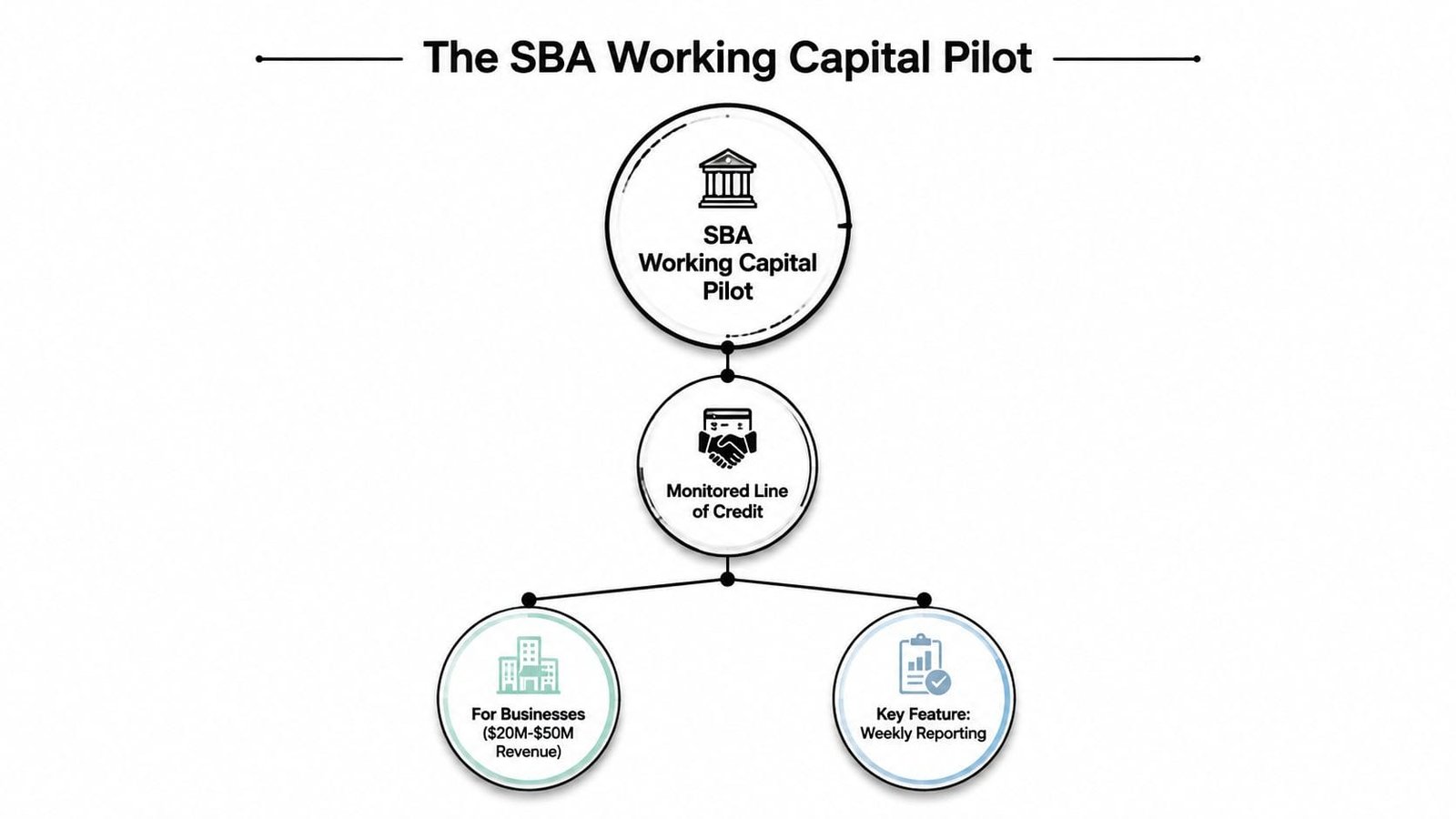
What “monitored” means in practice
A monitored line can require regular information about:
- Receivables eligibility: The lender may exclude overdue, disputed, or concentrated invoices.
- Inventory support: The borrower may need to report quantities, values, and turnover.
- Transaction evidence: Purchase orders or contracts may need to support a borrowing request.
- Availability calculations: The usable balance can change as collateral changes.
- Covenant headroom: Financial or operational requirements can restrict borrowing during a weak period.
- Renewal preparation: The annual review can revisit the limit, collateral, reporting, and repayment performance.
The reporting burden isn't just paperwork. A wholesaler may need disciplined inventory records. A services company may need accurate invoice aging and contract documentation. A company with one dominant customer may find that concentration limits reduce practical availability even when the stated facility is large.
When the trade-off makes sense
The SBA structure may appeal to an established U.S. company with substantial operating needs, quality receivables, and the staff or systems to produce reliable reports. It can be less attractive for an owner who wants simple access with minimal monitoring, particularly when a conventional bank line already meets the company's needs.
Canada's small-business credit data illustrates why operating liquidity remains central to borrowing decisions. In 2025, 45% of debt-financing requests were intended for working or operating capital, compared with 22% for fixed assets, according to the Canadian small-business credit condition trends report. The SBA's own 7(a) Working Capital Pilot framework similarly treats monitored lines as a formal structure for operating finance, not merely an informal overdraft.
Before applying, ask the lender to demonstrate the borrowing-base calculation using your actual receivables and inventory. Then ask what happens if collections slow, a customer becomes ineligible, or the annual renewal produces a lower limit. A facility is useful only if the business can operate inside those rules during an ordinary difficult quarter.
Business Loan Warrior helps owners compare funding structures, including lines of credit, SBA financing, invoice financing, short-term loans, and other business capital options. Review your cash-conversion needs and explore available financing through Business Loan Warrior, then use the application process to discuss a facility that fits your actual operating cycle rather than accepting the largest offered limit.