

A debt schedule is a table that tracks each lender, the principal balance, the interest rate, and the maturity date for every debt obligation your business carries. It turns those pieces into a period-by-period view of what you owe, when you owe it, and how repayments affect your cash flow.
You’re usually looking for one of these in the middle of a loan application, a refinance conversation, or a month when cash feels tighter than it should. The lender wants a clean answer, and you need one too, because debt doesn’t help or hurt you as a lump sum, it creates timing pressure.
Table of Contents
- The Debt Schedule in Plain English
- Five Components Every Debt Schedule Must Capture
- How to Build a Debt Schedule From Scratch
- Why Lenders and Borrowers Both Rely on the Schedule
- Connecting the Debt Schedule to Your DSCR
- Handling Variable Rates, Lines of Credit, and Seasonal Payments
- Preparing Your Schedule Before a Financing Application
- Key Takeaways and Next Steps
The Debt Schedule in Plain English
A business owner calls before a financing application and says the same thing I’ve heard hundreds of times, “I know we have debt, but I can’t pull it together fast enough for the lender.” That’s exactly where a debt schedule earns its keep. It gives the lender a clear view of every borrowing, and it gives the owner a current map of what cash is already spoken for.
At its simplest, what is a debt schedule? It’s a period-by-period table that lists each loan or line of credit, tracks how the principal balance changes over time, and shows the interest and maturity tied to each obligation. In corporate modeling, that table also feeds the income statement, balance sheet, and cash flow statement, which is why it’s more than a bookkeeping attachment, it’s a working financial model (Corporate Finance Institute).
Why lenders ask for it first
Lenders don’t want a single total debt number with no context. They want to know which obligation matures first, what cash leaves the business each period, and whether new financing will collide with existing repayment timing. A proper schedule answers those questions in one place.
That’s also why public finance uses the same logic. The U.S. Treasury’s federal debt schedules separate debt held by the public from intragovernmental holdings, then break the total into components like principal debt and accrued interest payable (U.S. Treasury Fiscal Data). The structure is the point, not just the total.
Practical rule: if you can’t show when the debt gets paid, you don’t really know what the debt costs you.
Some borrowers also confuse a debt schedule with a credit facility summary. They’re related, but not identical. A credit facility can be one source of borrowing, while a schedule shows how that source and every other obligation flow through your books. If that distinction feels fuzzy, a plain explanation of how a credit facility works helps put the pieces in place.
Five Components Every Debt Schedule Must Capture
A useful schedule doesn’t just say “loan balance.” It shows the specific terms that control how the balance moves and how much cash leaves the business. If you’re using one sample loan to organize everything else, a straightforward term loan works well as a reference point, because the mechanics are easy to see.
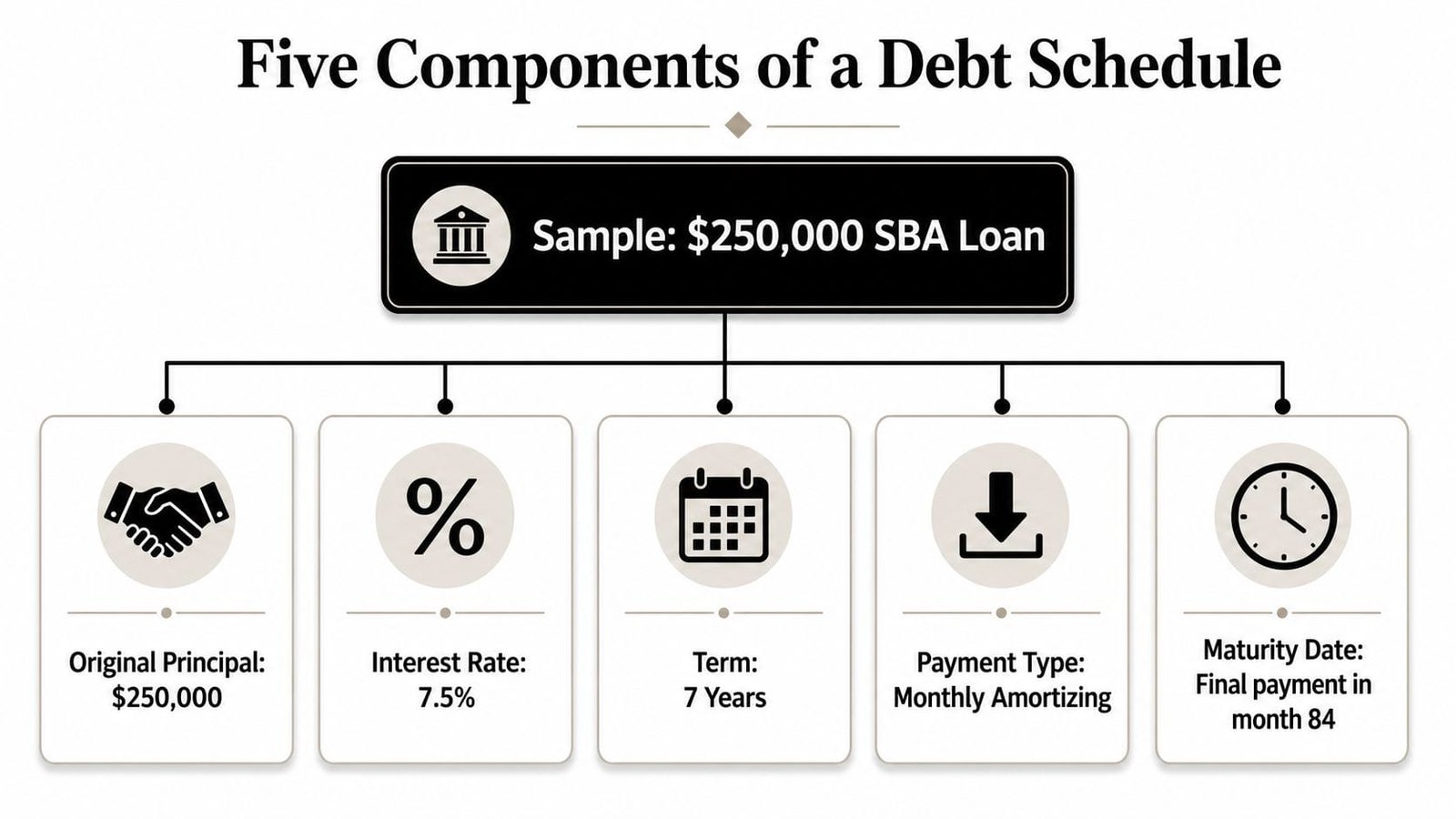
Principal, interest, and maturity
The principal is the amount still outstanding. Each scheduled payment reduces it. The interest is the cost of borrowing, and in modeling it’s often estimated from the balance over the period, which is why repayment timing matters so much. The maturity date is the deadline for full repayment, and that date is where refinancing risk can show up if the business isn’t ready.
Payment frequency and covenant pressure
A debt schedule also has to show payment frequency, because monthly, quarterly, and seasonal payments hit cash flow very differently. That’s not a minor formatting detail. It changes when the business needs cash on hand.
Then there are covenants, the lender’s financial tests. A schedule won’t calculate them by itself, but it should tell you when debt service or balance changes could strain them. That’s why practical credit analysis treats the schedule as a liquidity and covenant-planning tool, not just a record of loans.
An example many business owners recognize is an SBA term loan. If you’re also comparing tax treatment on equipment and loaned assets, a CPA guide for equipment tax planning can help you keep those discussions separate, because debt repayment and depreciation are not the same thing.
| Component | What it tells you | Why it matters |
|---|---|---|
| Principal | Outstanding balance | Shows how much is still owed |
| Interest | Cost of borrowing | Affects profit and cash flow |
| Maturity date | Final repayment deadline | Signals refinancing timing |
| Payment frequency | Monthly, quarterly, seasonal | Drives cash timing |
| Covenants | Lender financial tests | Can trigger review or default concern |
Five-part memory hook: principal, interest, maturity, payment timing, and covenant pressure.
How to Build a Debt Schedule From Scratch
Start with a spreadsheet, not with a guess. Create one row per obligation and use columns for lender, loan type, original principal, current balance, interest rate, payment amount, payment date, and maturity date. That basic layout keeps similar-looking debts from getting blended together, which is where bad schedules usually begin.
A clean schedule works period by period. Beginning balance goes in the first column. Principal repaid comes out of each payment, interest is calculated on the applicable balance, and the ending balance rolls forward into the next row. If you want a broader cash planning model around that, the structure pairs naturally with a cash flow forecast because both tools are really about timing.
The simplest interest logic is to calculate it on the average balance for the period when that's how the lender prices the debt. Then subtract the principal portion from the beginning balance to get the ending balance. That ending balance becomes next period's beginning balance.
| Period | Beginning Balance | Principal Repaid | Interest Expense | Ending Balance |
|---|---|---|---|---|
| 1 | 250,000 | 0 | 0 | 250,000 |
| 2 | 250,000 | 0 | 0 | 250,000 |
| 3 | 250,000 | 0 | 0 | 250,000 |
That table is just the framework, not the final math. The point is to show the flow clearly, then replace placeholders with the actual payment logic from your loan documents.
Keep one notes column for exceptions
Add a notes column before you send the schedule to anyone else. Mark variable-rate pricing, balloon payments, holiday periods, and any seasonal structure that doesn’t fit a standard monthly amortization. That one habit saves a lot of confusion later, especially when the debt is being reviewed for underwriting.
Rule of thumb: if a lender’s payment terms are unusual, the schedule needs a note beside the number.
That’s also where many owners trip up. They build a neat spreadsheet, then leave out the one-off term that changes the actual cash requirement. If you’re applying for financing, that gap can create a mismatch between what you report and what the bank statement shows.
Why Lenders and Borrowers Both Rely on the Schedule
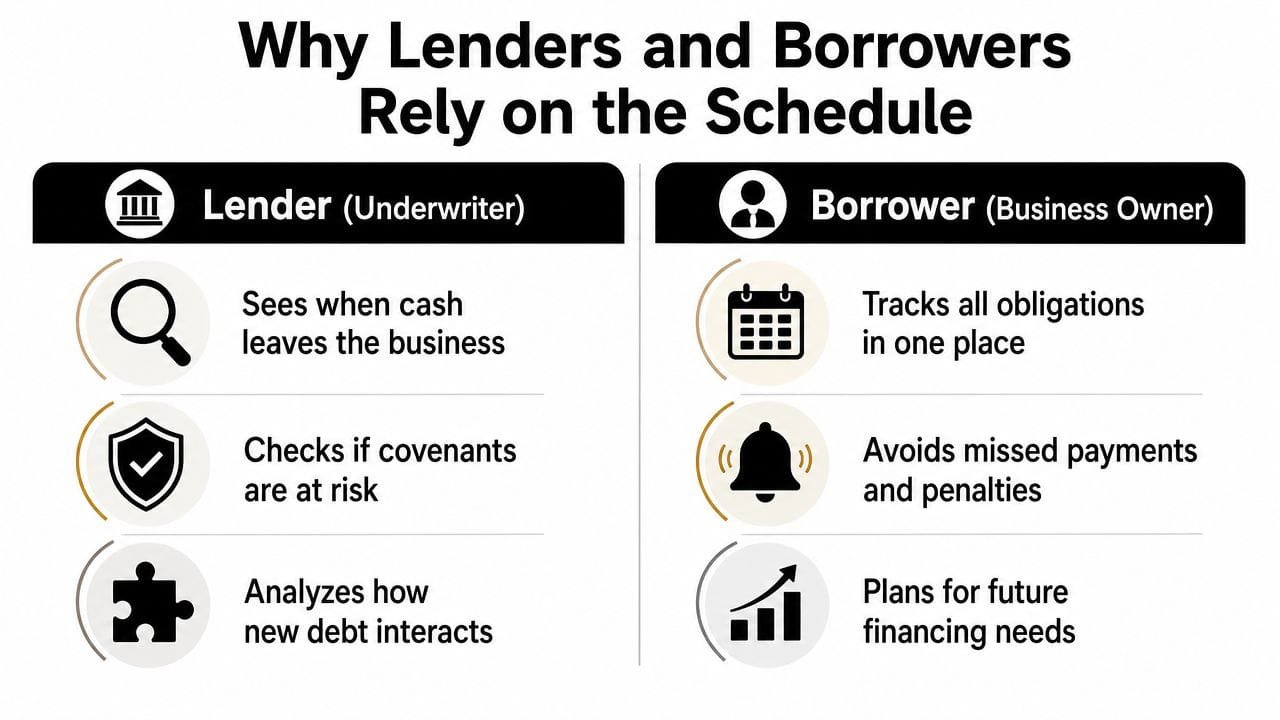
A debt schedule answers two different questions at the same time. The lender wants to know whether the borrower can keep up with payments without slipping into covenant trouble. The owner wants to know when the cash squeeze starts, and how much warning exists before it turns into a refinancing problem.
What the underwriter is looking for
An underwriter is not only checking the headline balance. They are looking at whether repayment timing fits the business’s cash flow, because a loan that looks affordable in total can still strain the file if principal ramps up at the wrong moment, a maturity is close, or another obligation already takes too much monthly cash.
The schedule works like a cash-flow radar. It shows where the pressure points sit before the lender has to guess, which is why a credit team uses it to test repayment strength before approval.
What the owner needs to see
The owner uses the same table to see where liquidity gets tight and which debts need attention first. A clean schedule makes it easier to spot a balance that should be reduced sooner, a renewal that needs to be planned for, or a refinancing window that is smaller than it first looked.
That matters because many businesses carry more than one moving piece at once. Variable rates, seasonal payments, and other uneven obligations can make a simple balance sheet look calm while the actual cash requirement is swinging around underneath it. The schedule turns that mix into dated obligations the owner can act on.
It also matters during due diligence. If you are preparing a financing package, a financial due diligence checklist can help you make sure the debt schedule matches the rest of the file, not just the spreadsheet built at the last minute.
A lender asks, “Can this borrower handle more debt?”
An owner asks, “When does this debt become a problem?”
A solid schedule gives both readers the same facts. The difference is in the decision each one makes from those facts.
Connecting the Debt Schedule to Your DSCR
A borrower can look healthy on a profit-and-loss statement and still miss a loan test if the debt schedule is sloppy. DSCR, or debt service coverage ratio, is the underwriting check that ties those scheduled payments to operating income. The formula is simple, net operating income divided by total debt service, and total debt service means the principal and interest due in the period. The debt schedule feeds that calculation, so DSCR is not a separate exercise, it grows out of the schedule itself.
That is where timing starts to matter. A balloon payment can push debt service sharply higher in one period, while a floating-rate line can raise interest expense after a reset. If the schedule is wrong, the ratio looks wrong too, and the lender is judging on bad inputs.
For a lender, DSCR is a quick read on repayment capacity. A stronger ratio says the business has room to cover debt from operations. A weaker ratio says the borrower may be stretched, even when revenue looks acceptable on the surface.
Keep the schedule beside your underwriting checklist so the figures stay aligned. That matters during file review, especially if you are preparing materials for financial due diligence and want the debt service numbers to match the rest of the package. A mismatch forces extra questions, and extra questions slow approvals.
Why maturity pressure changes the ratio
The schedule also shows DSCR pressure before it shows up in a lender memo. If a loan matures and the business has to refinance on tougher terms, the new payment burden can compress coverage. If a line of credit balance grows, interest expense can take a bigger bite out of cash than the owner expected. The schedule lays out both the timing and the size of that pressure, month by month.
Useful lens: DSCR weakens when debt service becomes harder to predict.
That is why I tell borrowers to treat the schedule like a warning system, not a filing form. It points to the months when coverage is comfortable and the months when the business may need more cash, more borrowing room, or a refinancing plan already in motion.
A revolving facility needs its own logic here too. For a practical explanation of how a line of credit works for a business, the drawn balance matters more than the maximum limit, because DSCR only reflects the obligation the business is carrying.
Handling Variable Rates, Lines of Credit, and Seasonal Payments
Most simple explanations break down here. Real business debt isn’t always a neat fixed-rate term loan. It can include floating-rate borrowing, a revolving line, a seasonal payment pattern, or a structure that only makes sense if you read the lender’s documents carefully.
A revolving line of credit should be scheduled from the drawn balance, not the maximum limit. If the business draws more, the principal changes, and the interest needs to be recalculated on that new balance. A line of credit also deserves its own logic, because the repayment pattern is often different from a standard installment loan. A practical explanation of how a line of credit works for a business can help owners keep the facility separate from a term loan.
Special products need special notes
A merchant cash advance or revenue-based product should be modeled around the actual remittance pattern, then reconciled against bank deposits so the schedule matches real cash movement. A seasonal loan should show the months when payments pause and the months when they resume. Leases also belong in the same family of obligations, even if the accounting treatment differs.
The mistake isn’t usually the formula. It’s bad classification. Two debts can look similar on a spreadsheet and still behave differently in real life, which is why source documents matter more than assumptions. Pull the signed agreement, confirm the payment rule, then match the balance to the latest statement before you hand the schedule to anyone.
Best practice: reconcile the debt schedule to bank activity before you use it for underwriting or planning.
That discipline matters most when the business carries a mix of products. The schedule should reflect what the lender sees in repayment behavior, not just what the owner remembers from the original approval.
Preparing Your Schedule Before a Financing Application
Before you upload anything to a lender, treat the schedule like a closing document. Gather every loan agreement, pull the latest statements, and verify each balance against the bank. Then update the spreadsheet so the dates, rates, and payments line up with current reality.
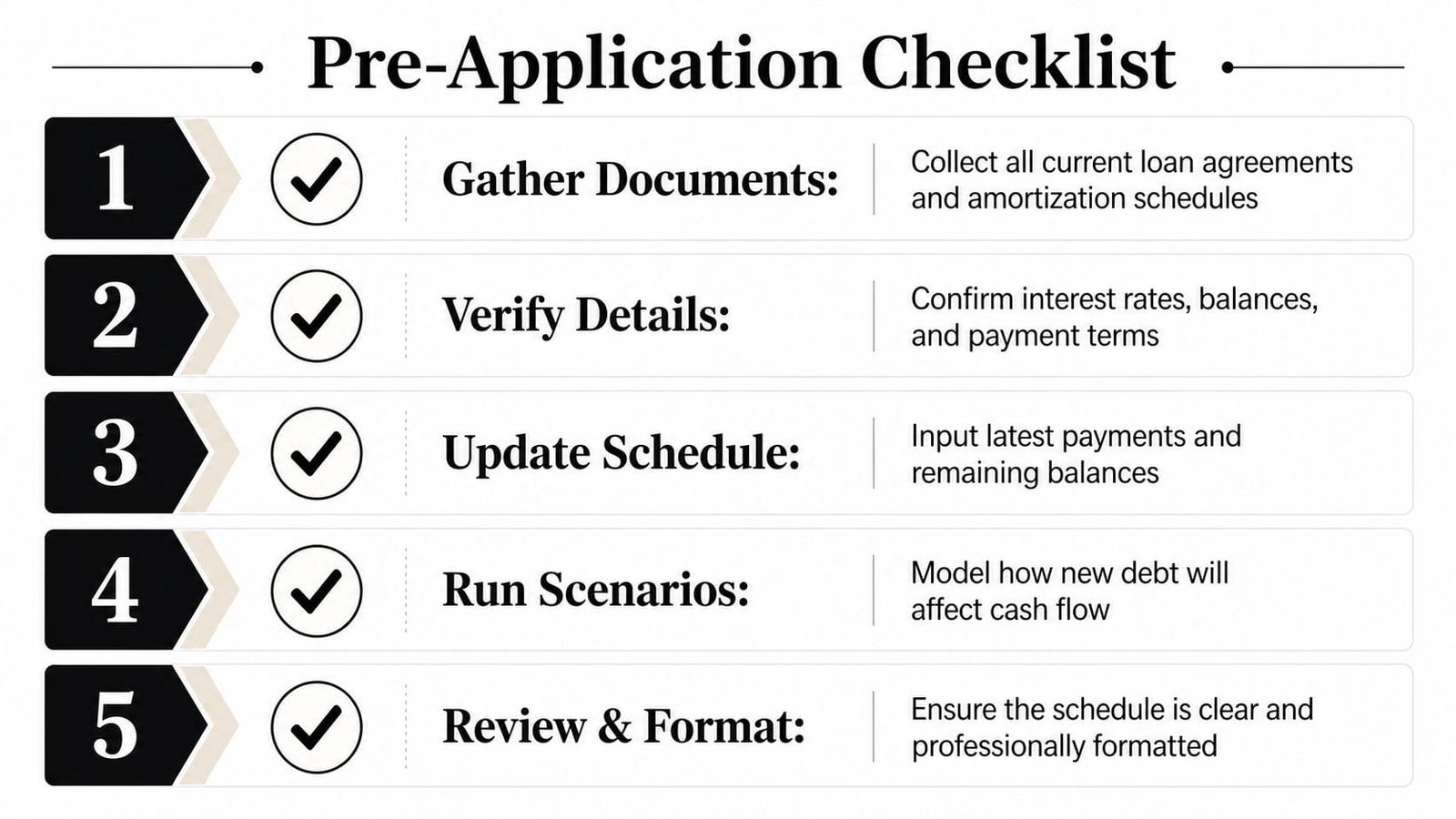
- Gather documents. Collect current loan agreements and amortization schedules.
- Verify details. Confirm rates, balances, and payment terms against each statement.
- Update balances. Enter the latest payments so the schedule reflects today, not last quarter.
- Run scenarios. Check how new debt changes cash flow and maturity timing.
- Review formatting. Make the document clear, consistent, and easy for a lender to read.
Business Loan Warrior’s single-application process also lets owners upload supporting documents once and connect bank accounts for automatic balance verification, which cuts down on manual reconciliation. That doesn’t replace a debt schedule, but it can make the data-cleaning part less painful.
A current schedule shortens underwriting time because it gives the lender fewer things to question. It also reduces back-and-forth when balances, rates, or due dates don’t match the rest of the file.
Key Takeaways and Next Steps
A debt schedule is a period-by-period table that tracks principal, interest, maturity, and payment timing for each debt obligation. Used well, it’s not a static spreadsheet, it’s a living cash-flow radar that shows refinancing pressure before a maturity wall shows up.
The schedule becomes useful when you rebuild and reconcile it against actual bank activity on a regular basis, because that’s what keeps the numbers tied to lending decisions instead of stale assumptions. In a rate-sensitive environment, that habit can make the difference between a smooth refinance and a painful cash squeeze.
A clean debt schedule gives you an advantage in every financing conversation, because it shows lenders that you know exactly what you owe and when it hits. If you want help getting your numbers organized before you apply, visit Business Loan Warrior and use the application process to line up your debt, cash flow, and funding options in one place.