

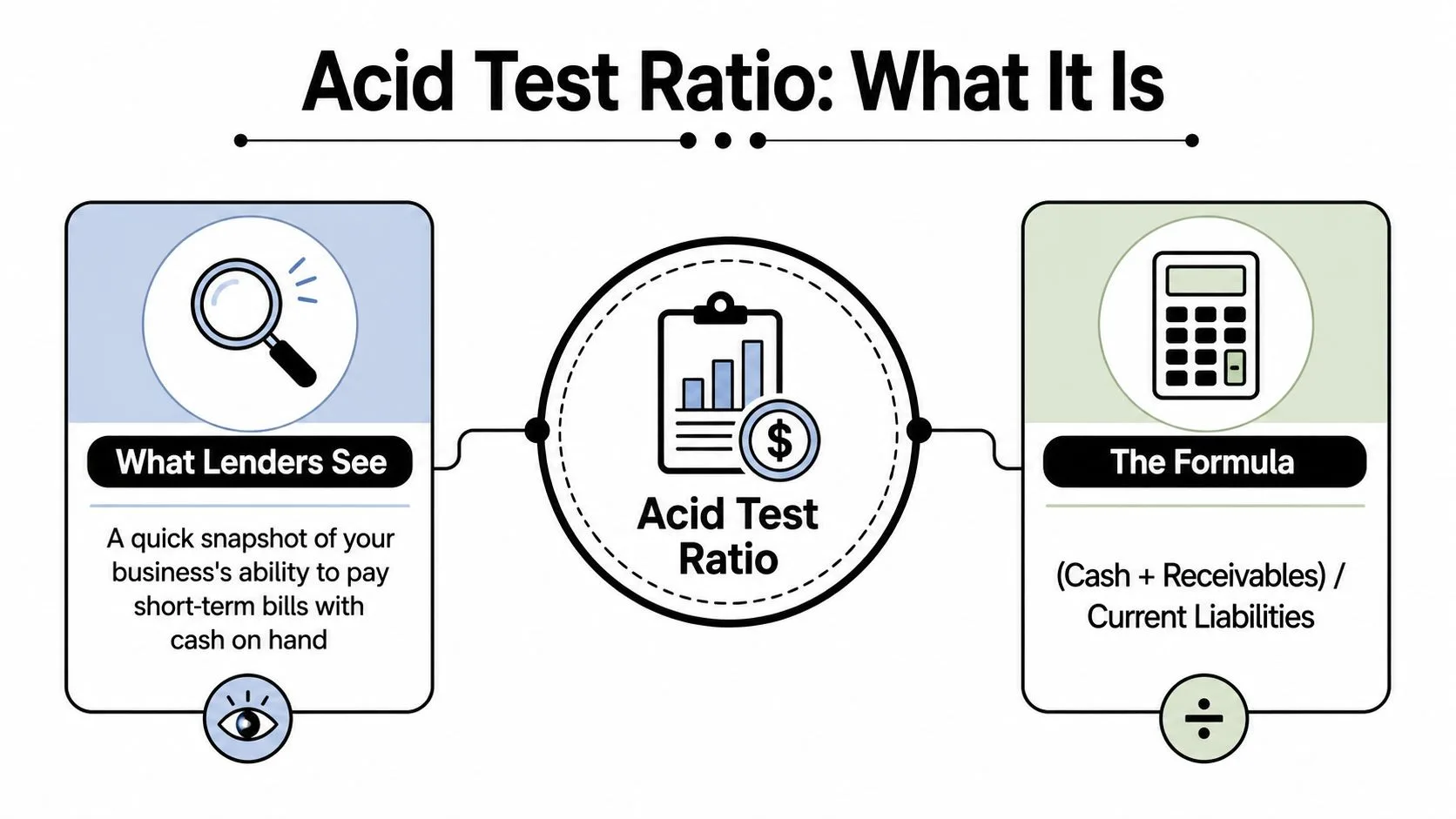
The acid test ratio is (cash + marketable securities + accounts receivable) ÷ current liabilities. A 1.0 ratio means a business has $1 of quick assets for every $1 of current liabilities, and that's the baseline many lenders use before they look deeper.
You're probably staring at a loan application, a bank request, or a cash-flow problem and wondering whether your numbers look strong enough. Maybe your inventory is tied up, your customers pay slower than you'd like, or your operating account looks thin right before a big bill hits. That's exactly when the acid test ratio starts to matter, because it asks a very direct question, can your business cover short-term obligations without leaning on inventory or new financing?
Table of Contents
- A Plain-English Definition for Busy Owners
- The Formula and What Each Line Item Means
- A Worked Example With Two Small Businesses
- Acid Test Ratio vs Current Ratio in Plain English
- Industry Benchmarks That Lenders Actually Use
- Why Underwriters Care About the Ratio
- Practical Ways to Improve Your Ratio Before You Apply
- Common Questions Small Business Owners Ask Next
A Plain-English Definition for Busy Owners
A lender is usually asking a simple question when the acid test ratio comes up, can your business cover near-term bills with assets that can turn into cash quickly, without relying on inventory sales? That is why the ratio matters more for a warehouse-heavy retailer than for a software company with mostly receivables and cash in the bank. The standard formula is (cash and cash equivalents + marketable securities + accounts receivable) ÷ current liabilities. U.S. government accounting guidance tied to the metric says it should not be less than 1:1, which is why 1.0 is the number to remember. Defense Department acid test ratio guidance
A simple way to say it at your kitchen table is this, the acid test ratio asks whether your business has enough quick assets to cover current liabilities. If the ratio is 1.0, you have $1 of quick assets for every $1 of current liabilities. If it falls below 1.0, your quick assets alone do not cover the near-term bills. That does not automatically mean the business is in trouble, but it does mean the lender will look harder at cash flow, collections, and other sources of repayment. BDC acid test ratio glossary
The name makes sense once you treat it as a stress test. Classic accounting sources describe it as the most stringent short-term liquidity test because it strips out inventory and asks what happens if sales slow and no one wants to wait on stock to move. For a wider view of how liquidity fits into the rest of your numbers, the guide to financial ratios for UK SMEs is a useful companion, and the financial health assessment guide helps you compare liquidity with the rest of the balance sheet.
Underwriters at fintech and SBA lenders use that same logic in a practical way. A software company with recurring invoices and fast customer payments may get a different read than a distributor that ties up cash in inventory, even if both businesses show the same ratio on paper. They are not just checking the formula, they are asking how quickly the assets behind it behave in real life.
Practical rule: If you can explain your ratio in one sentence, you probably understand it well enough to discuss it with a lender.
The Formula and What Each Line Item Means
Quick assets on the top
The top of the formula holds the assets a lender believes can turn into cash fast. Cash and cash equivalents usually mean the money already sitting in operating accounts, petty cash, and similar near-cash holdings. Marketable securities are short-term investments that can be sold quickly if needed. Accounts receivable is the money customers already owe you, so it counts only if those customers are likely to pay soon.
A small-business owner can think of that top line as the pile of resources available without liquidating inventory. That distinction matters because a warehouse full of stock may look valuable on paper, but it doesn't help if bills are due before the stock sells. Some practitioner guides simplify the formula to cash plus receivables, but the more conservative version includes marketable securities too. Lenders who want the stricter reading usually prefer the fuller definition.
Current liabilities on the bottom
The bottom of the formula is everything due within the near term. That typically includes bills, payroll, taxes, loan payments, and other obligations due within twelve months. In plain English, it's the set of claims on your cash that can't wait until next year. The higher that number, the harder it is for quick assets to keep up.
A clean way to think about the denominator is this. If your lender can point to an obligation coming due soon, it probably belongs there.
That's why receivables quality matters so much. A large customer balance on paper can support the ratio, but only if collections are reliable and timely. If you're reviewing your own numbers, list the cash, then the near-cash holdings, then the receivables you expect to collect, and only then divide by the liabilities due soon. For a practical comparison of how owners read ratios in context, the guide to financial ratios for UK SMEs is helpful, especially if you're trying to translate accounting language into lender language.
A Worked Example With Two Small Businesses
A stable service company
Suppose a consulting firm has cash and cash equivalents of 90, marketable securities of 10, and accounts receivable of 100. Its current liabilities are 150. The formula looks like this, (90 + 10 + 100) ÷ 150 = 1.33.
That result says the company has more than enough quick assets to cover its current liabilities. A lender reading that number would usually see a business with room to absorb normal timing gaps between invoices and collections. The firm still has to manage cash well, but it isn't relying on inventory or outside money just to meet routine obligations.
A growing retail business with slower collections
Now take a retailer with cash and cash equivalents of 40, marketable securities of 0, and accounts receivable of 50. Its current liabilities are 120. The formula becomes (40 + 0 + 50) ÷ 120 = 0.75.
That company may still be growing, and it may still be profitable, but the ratio says it can't cover all current liabilities using only quick assets. A lender will usually ask why. The answer might be slow collections from commercial clients, a heavy upcoming payroll, or cash trapped in inventory that doesn't count toward the ratio. A late-paying customer can move the number more than owners expect because receivables sit right in the numerator.
Why the gap matters
The difference between 1.33 and 0.75 isn't abstract. It changes how much pressure the business feels when a bill arrives early or a customer pays late. If you want to work through your own balance sheet, start with the assets that can become cash fastest and compare them only to obligations due soon. Then compare that result with the broader picture in your working capital review, like the one outlined in the working capital for businesses guide.
Acid Test Ratio vs Current Ratio in Plain English
The easiest way to separate these two ratios is to remember that the current ratio is broader, while the acid test ratio is stricter. The current ratio includes inventory and often prepaid expenses, so it can make a business look stronger than it really is if those assets are slow to turn into cash. The acid test ratio removes that cushion and asks a harder question, can the business pay short-term bills with assets that are already close to cash?
| Component | Acid Test Ratio | Current Ratio |
|---|---|---|
| Cash and cash equivalents | Included | Included |
| Marketable securities | Included in the stricter formula | Usually included in current assets |
| Accounts receivable | Included | Included |
| Inventory | Excluded | Included |
| Prepaid expenses | Excluded | Included |
| Main question | Can quick assets cover near-term debts? | Do current assets exceed current liabilities? |
A business can look fine on the current ratio and still fail the acid test ratio. That usually happens when inventory props up the broader number, but inventory isn't converting fast enough to help with payroll, taxes, or loan payments. Lenders like the acid test ratio because it strips away the comfort blanket and shows what's available right now.
That's also why one number alone can mislead you. A retail operator with lots of inventory may prefer the broader current ratio for internal planning, while a lender may focus on the stricter measure to judge immediate solvency. If you want a concise external reference on how lenders and owners think about the liquidity side of the ledger, the working capital for businesses guide connects the ratio to day-to-day cash needs.
Industry Benchmarks That Lenders Actually Use
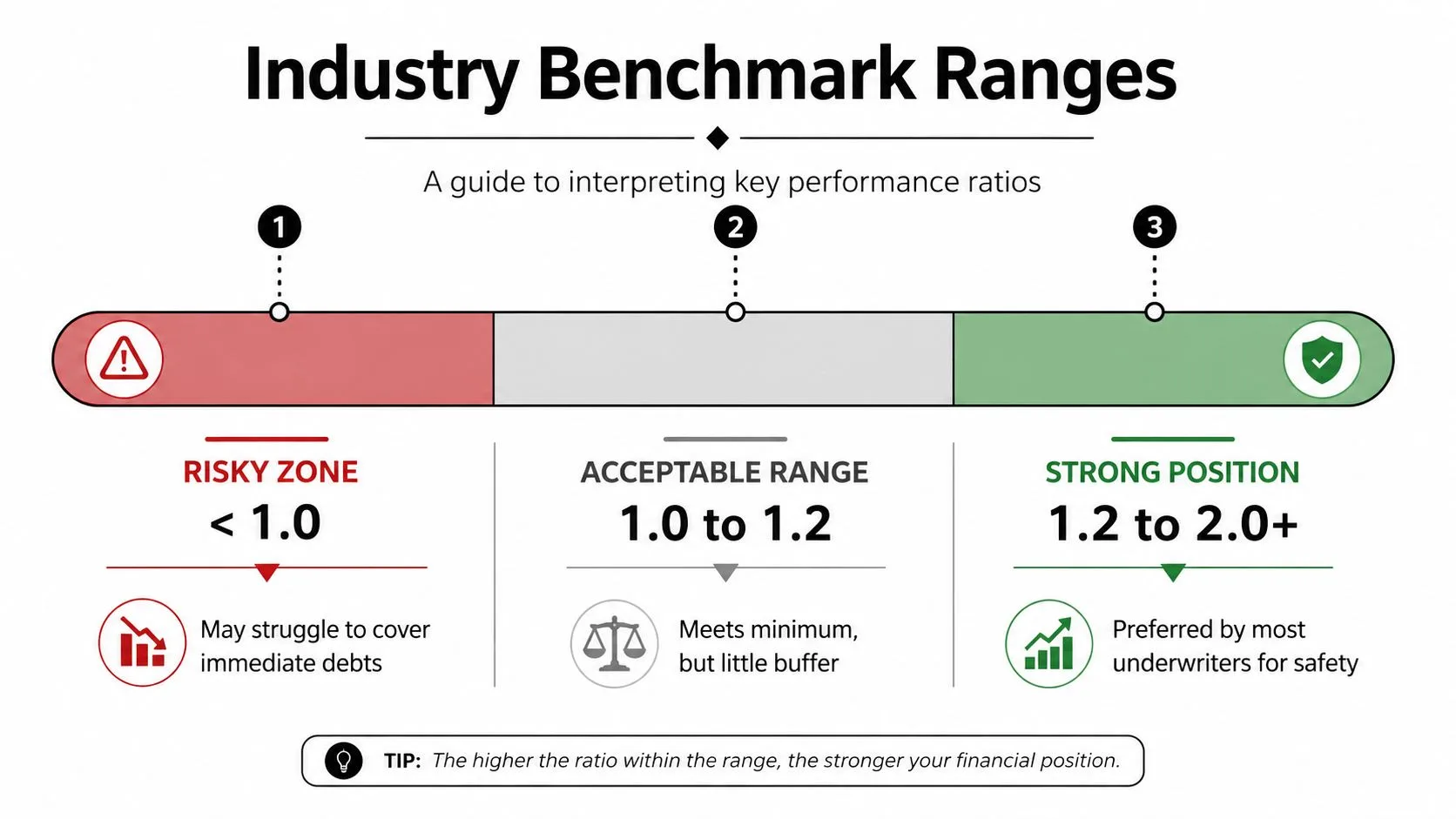
A 1.0 acid test ratio is often treated as the bare minimum for liquidity, but lenders do not stop at the headline number. They look at the business model first, then ask whether the quick assets on the balance sheet are available to cover near-term obligations. A common reference point places 1.2 to 2.0 in a healthy zone, though the right target still depends on how the business collects cash and manages short-term bills. CFI acid test ratio overview
For a business owner, that range works like a checkpoint, not a verdict. A company that keeps cash moving quickly through customer payments may justify a lower ratio than a company whose money is tied up longer, and underwriters know that those differences change how much comfort the number really gives.
Why the same number feels different by industry
A consulting firm or SaaS business usually carries little or no inventory, so the acid test ratio often gives a cleaner read on liquidity discipline. A retailer, restaurant, or construction-heavy company can look weaker on this metric because cash is constantly moving through stock, job costs, or contract milestones. In those situations, underwriters often want to know whether collections are predictable, whether bank activity is steady, and whether the business has enough cushion to cover timing gaps.
Practical rule: A ratio just under 1.0 can be less concerning in a business with fast inventory turns or reliable deposits than in a business with slow collections and thin cash.
That does not mean lenders ignore the ratio. It means they read it alongside the rest of the story, especially in businesses where receivables behave differently from a classic invoice model. In software-driven and subscription businesses, the balance sheet can understate how quickly money arrives, so underwriters look closely at collection timing, renewal behavior, and the quality of recurring revenue.
A quick way to frame your own benchmark
If your business depends on immediate cash conversion, a lower ratio can raise concern quickly. If your receivables are strong and your cash cycle is short, the same number may be easier to defend. A general benchmark still helps, but the lender's real question is whether liquid assets are likely to cover current obligations without strain.
Working capital analysis gives that question a wider frame, because it connects the ratio to payables, receivables, and the cash needed to keep operations running. For a plain-language look at how lenders and owners connect these moving parts, the working capital for businesses guide is a useful companion.
For lenders that rely on document review and automated workflows, Intelligent Character Recognition explained is a good example of how quickly statements, invoices, and supporting records have to be checked before a ratio gets trusted. The point is not the acronym itself, it is the habit of making sure the numbers are easy to verify and easy to defend.
Why Underwriters Care About the Ratio
An underwriter isn't just asking whether your ratio looks neat on paper. They're asking whether your business can keep paying bills if revenue slows, customers delay payment, or a new loan payment starts hitting the bank account. The acid test ratio helps answer that because it focuses on liquid resources that can cover near-term obligations without a fire sale of inventory.
What a borderline ratio can still pass
A borderline ratio doesn't always kill a deal. If your bank account activity is steady, deposits are predictable, and receivables are collecting fast, an underwriter may decide the business can handle the debt anyway. That's especially true in fintech-style underwriting, where lenders can see real cash movement and not just a month-end snapshot.
What a strong ratio can still fail
A good number can still fall apart under review if the receivables are stale, concentrated in one slow-paying customer, or not as collectible as they first appear. In that case, the ratio overstates the cash you can rely on. Underwriters often test whether the numerator is real liquidity or just numbers that look liquid until someone calls the customer.
Underwriting rule of thumb: The ratio opens the conversation, it doesn't end it.
That's why modern lenders care about both balance-sheet strength and operating behavior. They want to know how money moves through the account, how fast invoices convert to deposits, and whether the business can absorb a short stretch of softer revenue. The acid test ratio gives them a fast filter for that risk.
If you're comparing how a lender interprets your file against the raw balance sheet, the financial health assessment guide is a practical place to think through the rest of the picture. The ratio is one signal, but the decision usually comes from the full pattern of liquidity, payment history, and cash flow.

Practical Ways to Improve Your Ratio Before You Apply
A small business owner can improve the acid test ratio by changing how quickly cash arrives and how much short-term pressure sits on the balance sheet. A lender reading the file is looking for the same thing a bartender looks for when checking the till, enough liquid money to cover what is due without waiting on slow-moving assets.
Move cash in faster
The fastest fix is usually collections. Send invoices as soon as the work is complete, follow up before receivables age, and ask for deposits on larger jobs so cash comes in before the work sits on your books for too long. That raises the numerator because more cash arrives sooner, and it keeps receivables from stacking up in a way that can make the business look tighter than it is. Underwriters at fintech and SBA lenders tend to read that as a sign the business manages timing instead of letting timing manage it.
Shrink near-term pressure
Short-term debt affects the other side of the equation, so reducing obligations due soon can help the ratio improve. If the numbers support it, restructuring debt so more of it matures later can also ease pressure, as long as the new terms still fit the business. A business line of credit can bridge timing gaps between receivables and payables, but it should be used to smooth cash flow, not to cover a habit of running short. For a broader playbook, the how to improve cash flow guide gives owners a practical way to think about the same problem from the operating side.
Clean up what doesn't count
Inventory does not belong in the acid test ratio, but stale inventory still traps cash in real life. Selling slow-moving stock, trimming oversized purchase orders, and avoiding overbuying can free up money that may later show up as cash instead of goods sitting on a shelf. That does not change the formula directly, but it can improve the business's real liquidity, which is what lenders care about once they look past the headline number.
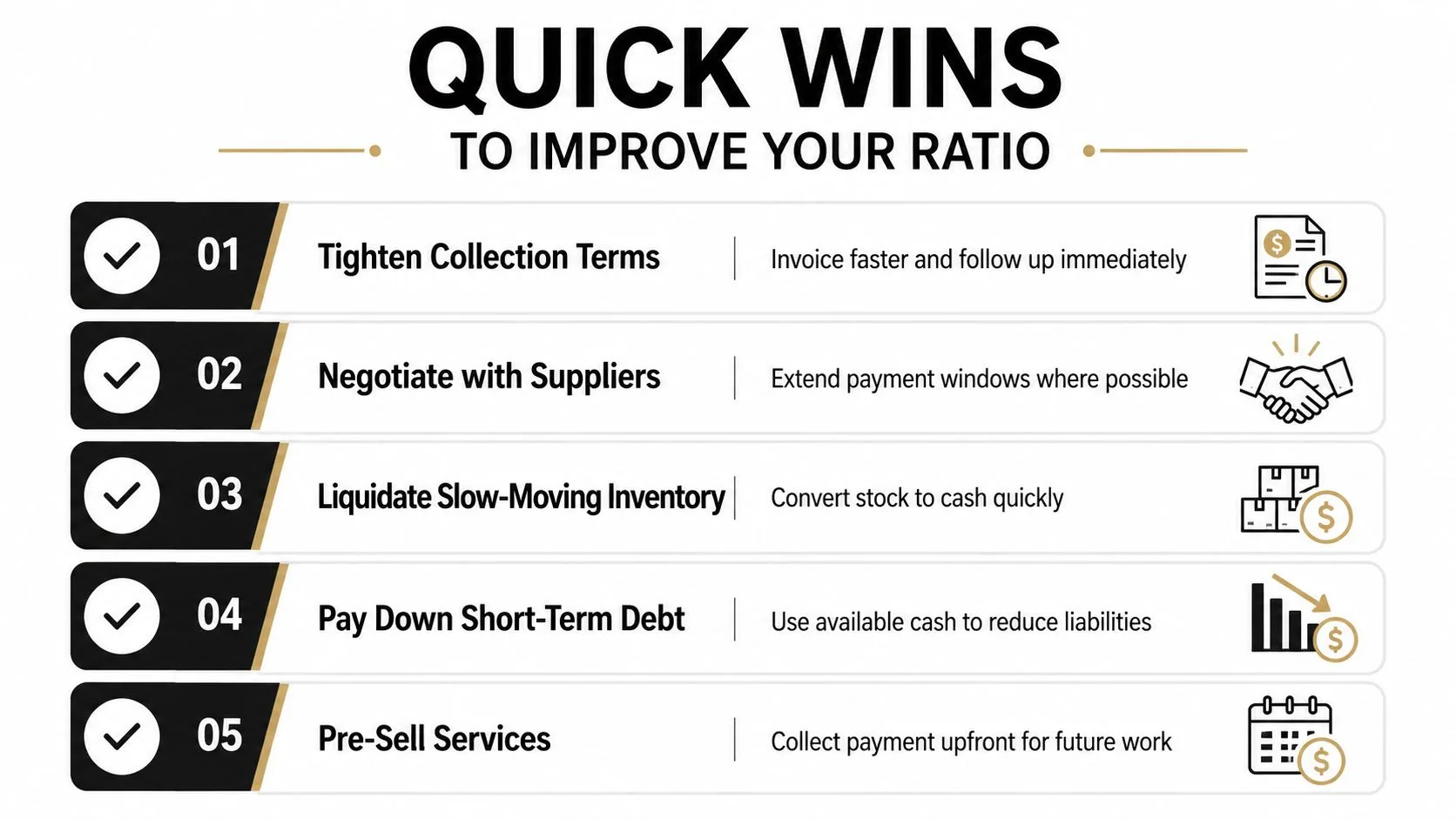
A simple priority list helps owners act in the right order:
- Tighten collection terms: Invoice faster and follow up right away.
- Negotiate with suppliers: Extend payment windows where possible.
- Liquidate slow-moving inventory: Turn stock into cash sooner.
- Pay down short-term debt: Use available cash to reduce current liabilities.
- Pre-sell services: Collect payment upfront for future work.
If your team uses document automation or faster approval workflows, it also helps to keep records organized and easy to review. That is one reason lenders care about systems such as how banks use document automation to speed up loan approvals, and it is also why it can help to learn how EDocGen helps banks streamline files before a credit team even opens them. Better records do not change the ratio, but they do make the case easier to underwrite.
Common Questions Small Business Owners Ask Next
How often should I calculate it
Most owners look at it at least at month-end, because lenders usually review a recent balance-sheet snapshot rather than an old average. If you're preparing for financing, use the most recent close you trust and make sure receivables and liabilities are classified correctly. A stale balance sheet can hide the actual story.
How do SaaS or subscription businesses read it
A subscription business may have little inventory, so the ratio can be a helpful liquidity check, but it still won't capture every part of recurring revenue quality. Underwriters often care less about textbook inventory replacement and more about whether collections are steady and whether deferred or recurring cash comes in on time. The acid test ratio is still useful, but it's only one piece of the picture.
Does a personal guarantee change the way lenders read it
A personal guarantee can help a lender feel more comfortable, but it doesn't make a weak ratio disappear. The business still needs enough liquidity to meet near-term obligations because the guarantee is a backup, not a substitute for cash. If the ratio is borderline, the underwriter may still want to see stronger deposits, better collections, or cleaner debt timing.
What if my ratio is borderline but my bank account looks healthy
That's exactly the kind of case modern lenders review closely. Strong bank activity can offset a borderline ratio if deposits are consistent and receivables are collectible, but a good cash balance alone won't rescue stale invoices or heavy short-term debt. The number matters, but the behavior behind the number matters just as much.
If you're trying to read your numbers the same way a lender does, Business Loan Warrior can help you think through liquidity, underwriting, and funding options in one place. Visit Business Loan Warrior to explore financing paths that match your cash-flow reality and get a clearer read on how your business stands before you apply.