
The interest rate is the annual cost of borrowing the principal, while APR is broader and includes most loan fees. That difference matters fast when you're comparing business financing, because the rate that looks cheapest on paper isn't always the loan that costs the least.
You can feel the trap in a stack of term sheets. One lender leads with a clean headline rate, another adds origination or broker fees, and both try to win your attention before you've had time to ask what the monthly payment really buys.
| What you're looking at | Interest rate | APR |
|---|---|---|
| What it measures | The annual cost of borrowing the principal | The annual cost of borrowing plus many loan charges |
| What it's used for | Calculating periodic interest charges and monthly payments | Comparing the true cost of offers across lenders |
| Why it can mislead | It can hide fees | It is usually higher because it includes fees |
| Best use | Cash flow planning | Side-by-side offer comparison |
Table of Contents
- The Core Difference Between Interest Rate and APR
- How Each Rate Is Calculated Behind the Scenes
- How APR vs Interest Rate Plays Out Across Business Loan Types
- Worked Examples Demonstrating the Cost Gap
- Which Number Should You Prioritize
- Using Business Loan Warrior to Compare Real Offers
- Common Questions and Smart Habits Before You Sign
The Core Difference Between Interest Rate and APR
Two loan quotes can look nearly identical until you read the fee line by line. That is usually the point where a business owner discovers the lower headline rate was not the cheaper deal.
What each number actually measures
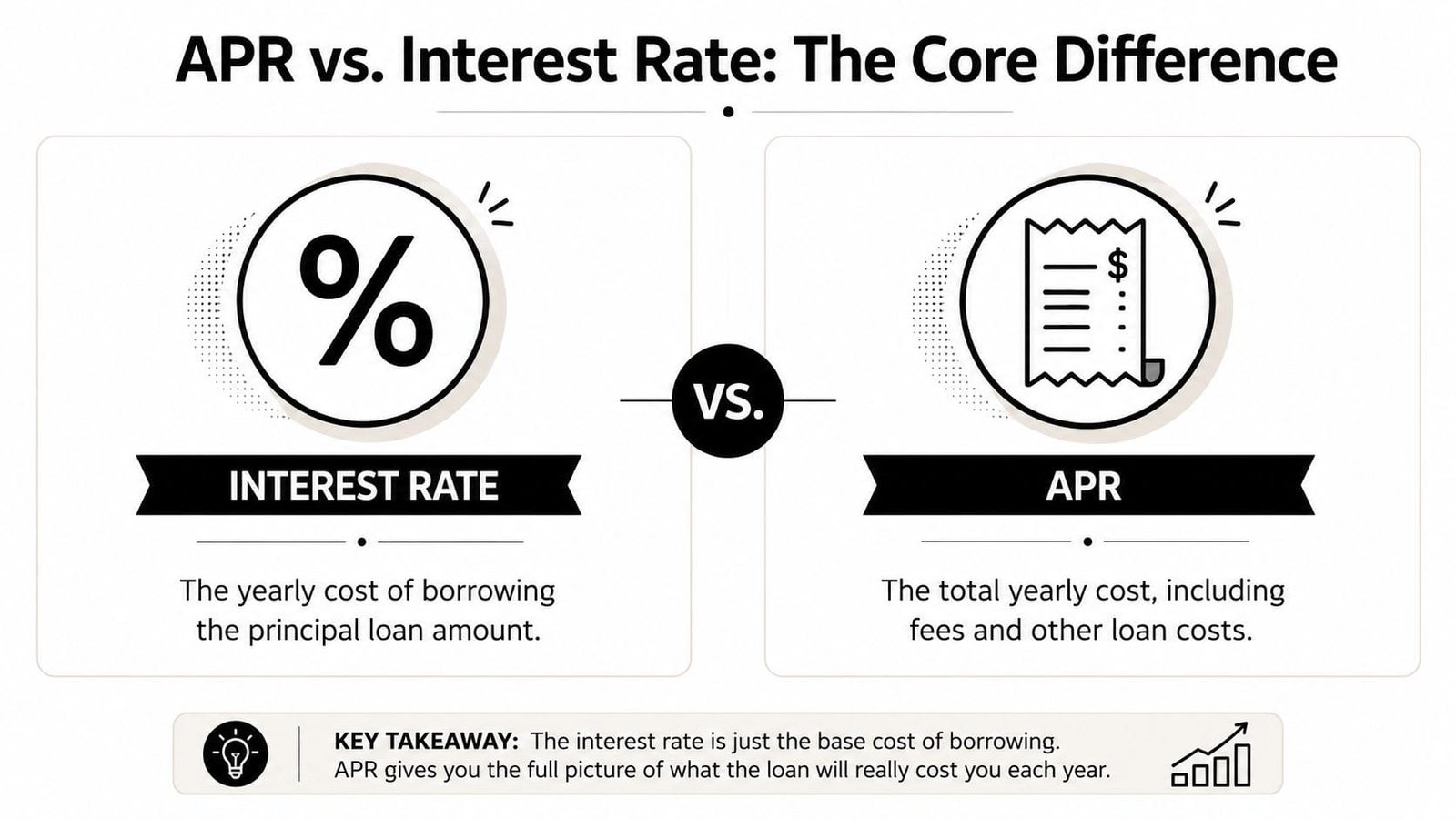
The interest rate is the annual cost of borrowing the principal. It tells you what the lender charges for the money itself, and it is the number that drives the periodic interest on the balance. The APR, or annual percentage rate, is broader. It folds in many loan charges such as points, broker fees, origination fees, and other costs, so it gives you a fuller view of the loan’s price. The Consumer Financial Protection Bureau explains that this distinction matters because monthly mortgage payments are based on the interest rate, not APR, even though APR is the standardized comparison metric under federal disclosure rules. CFPB explanation of mortgage interest rate and APR
That is why APR is usually higher than the interest rate. If one lender charges extra upfront fees and another does not, both can advertise the same interest rate while showing different APRs. The fee-heavy offer costs more overall, even if the payment looks fine at first glance.
Practical rule: if you are only checking the rate, you are checking the loan halfway.
Why APR became the comparison standard
In U.S. consumer lending, APR disclosure is required. The Truth in Lending Act of 1968 created a standardized way to disclose borrowing costs, and that is why APR shows up across mortgages, personal loans, and credit cards. Bank of America’s APR overview also frames APR as the annualized percentage that captures interest plus compulsory fees, which is what makes it useful for comparing offers that do not share the same fee structure. Bank of America on APR vs. interest rate
That history matters in business lending too. A lender can make one offer look better by trimming the rate, then recover margin through fees. A borrower who understands the difference does not get pulled in by the headline.
For a quick consumer-friendly follow-up on a related trap, Toya AI’s guide on avoiding deferred interest traps is a useful reminder that promo language can hide actual costs if you do not read the timing rules.
How Each Rate Is Calculated Behind the Scenes
The cleanest way to understand a loan is to ask, “What exactly is being charged, and when?” That question cuts through most of the confusion around APR and interest rate.
How interest is computed
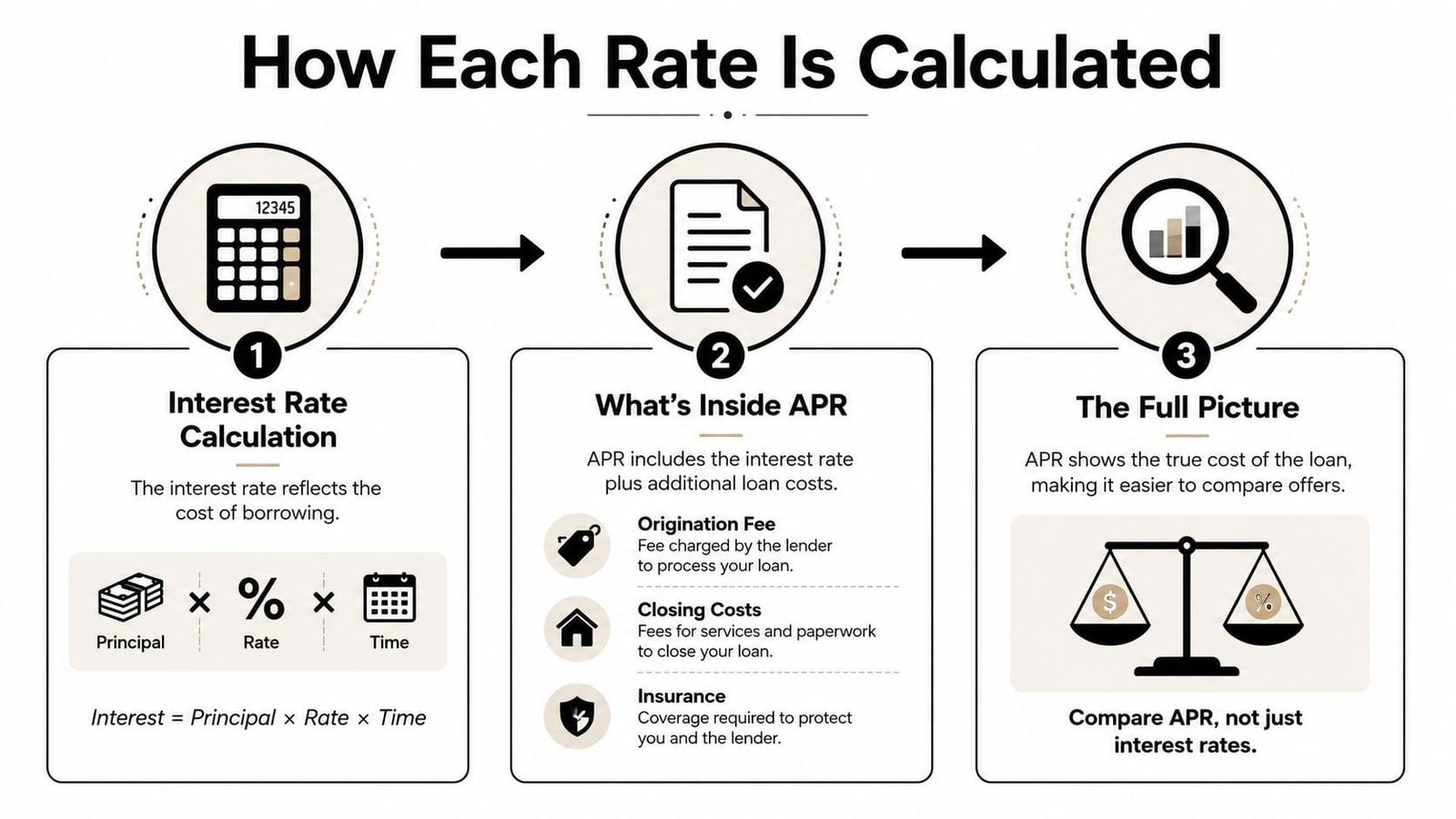
The interest rate is the piece lenders use to calculate the periodic interest charge on the outstanding balance. On many business loans, the math starts with the annual rate and breaks it into monthly charges. In simple terms, monthly interest is often approximated by dividing the annual rate by 12, then applying it to the unpaid principal. On amortizing loans, the payment stays steady while the balance slowly falls, so the interest portion shrinks over time.
That’s why two loans with the same rate can still feel different month to month. If one has a shorter term, you’re repaying principal faster, so the cash flow hit is different even before fees enter the picture. If the lender compounds differently or calculates interest on a daily basis, the effective cost can shift again. That’s not a marketing detail. It changes what leaves your operating account.
Bottom line: the rate tells you how the lender charges interest, but not what the lender collects to close the deal.
What APR rolls into one annual number
APR pulls more into the comparison. It annualizes the cost of many fees, which is why the number is often higher than the interest rate. The cleaner the fee structure, the closer APR tends to sit to the headline rate. The more upfront charges a loan carries, the more APR rises.
A simple way to think about it is this. If a lender adds fees to a loan, those charges get spread over the life of the borrowing relationship, so the cost is not just the posted rate anymore. On a shorter loan, that fee load hits harder because the same upfront expense is recovered over fewer months. On a longer loan, the same fee gets diluted across more payments.
If you want a plain-English breakdown of the math you can use at the term-sheet stage, this guide on how to calculate the real cost of a small business loan without the headache walks through the same idea from another angle.
How APR vs Interest Rate Plays Out Across Business Loan Types
Business owners usually don’t shop for “a loan.” They shop for a term loan, an SBA loan, a line of credit, or a merchant cash advance because each product solves a different problem. The rate-versus-APR gap shows up differently in each one.
| Loan Product | Interest Rate | APR Includes | Watch Out For |
|---|---|---|---|
| Term loan | The stated annual rate on the borrowed principal | Origination fees, broker fees, and other closing costs | A low rate can hide a fee stack |
| SBA loan | The stated annual rate on the loan balance | The rate plus required program and closing costs | Fees can make the all-in cost look much higher than the headline rate |
| Line of credit | The rate on the drawn amount | Interest plus any facility or maintenance costs | The cost can be close to the rate if fees are light at draw |
| Merchant cash advance | Usually marketed with a factor rate, not a true interest rate | A true APR can be computed from the total cost | The marketing number can be hard to compare to a normal loan |
Term loans and SBA loans
On a term loan, APR often does the heavy lifting because origination and broker fees can sit in the deal from day one. That makes APR the number that tells you whether a lower headline rate is worth it. With an SBA loan, the same issue shows up through program fees and closing costs. The published rate might look attractive, but the all-in cost can move once mandatory charges are layered in.
That’s why SBA offers and conventional term loans shouldn’t be judged on rate alone. If the terms look similar, compare the full disclosure page line by line.
Lines of credit and merchant cash advances
A line of credit can look simpler because fees are often lighter at draw, so APR may sit closer to the rate. That doesn’t mean it’s free of traps. Some lenders charge maintenance or unused-line fees, and those belong in the comparison, especially if you plan to keep the facility open for a while.
Merchant cash advances are different. They’re often marketed with factor rates rather than a traditional interest rate, which makes apples-to-apples comparison harder. A true APR can be calculated, but many borrowers don’t see it presented in the same way they would on a term loan. If you’re comparing working capital options, don’t let a fast approval distract you from total payback.
For current market shopping context, Business Loan Warrior’s business loan interest rates today page is a useful starting point when you’re benchmarking offers.
Worked Examples Demonstrating the Cost Gap
Numbers settle disputes that marketing copy starts. Once a deal is laid out line by line, the fee structure can matter almost as much as the stated interest rate. That is the part many borrowers miss when they compare term sheets for a term loan, an SBA loan, a line of credit, or a merchant cash advance.
A term loan with the same rate but different fees
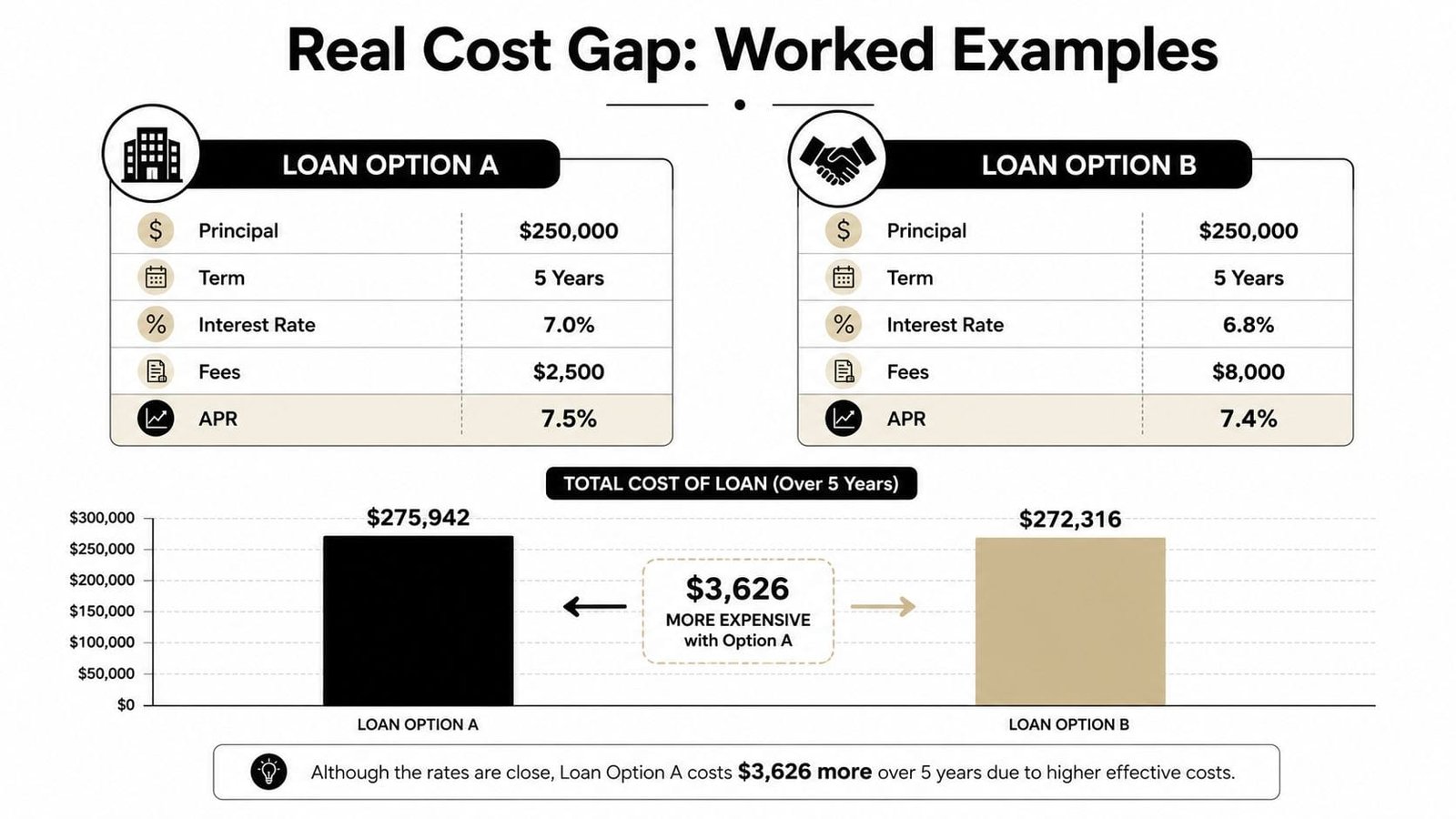
Take two $250,000 five-year term loans with the same interest rate. Loan A charges 2% in upfront fees. Loan B charges 4%. The headline rate is identical, but the borrower is not paying the same price.
The fee difference is easy to miss if you only scan the rate column. With the larger fee, you are financing more cost before the first payment even lands. Because those fees are spread across the repayment term, the APR rises even if the stated rate stays flat. A deal that looks a little cheaper at first glance can end up costing more over the full life of the loan. If you want to see how that payment schedule gets built, the amortization period guide shows how the repayment clock changes the shape of the debt.
Decision prompt: if the rate is the same, which lender is cheaper after fees, and which lender still looks cheap only because you have not read the disclosure closely enough?
A merchant cash advance with no interest rate headline
Now look at a $100,000 merchant cash advance with a 1.20 factor rate. That means total payback is $120,000. The marketing language may avoid calling that an interest rate, but the cost is still there. What borrowers usually miss is that the factor rate does not tell you how expensive the money is on an annualized basis.
That is why a merchant cash advance can feel fast and flexible while still being expensive in practice. The product may fit a cash flow emergency, but it should be compared against a term loan or line of credit using the same total-cost lens. If you are also checking whether the interest portion is tax-deductible in your situation, find answers on interest deductibility before you assume every financing cost gets treated the same way.
For borrowers comparing several offers at once, Business Loan Warrior’s pre-approval dashboard turns the legal disclosure into a side-by-side view, so the rate, fees, and payback amount sit on the same screen before you sign.
Which Number Should You Prioritize
A lender can show you a low interest rate and still hand you a loan with enough fees to change the outcome. That is why the better number depends on how you plan to use the money, how long you expect to keep the debt, and which product you are comparing, whether that is a term loan, an SBA loan, a line of credit, or a merchant cash advance.
When the interest rate deserves more attention
If your first question is the monthly payment, the interest rate deserves a close look. It drives the periodic charge on the balance, which is why owners focus on it when they are trying to protect payroll, inventory, or another near-term expense. When fees are small, refunded, or unlikely to change the total cost in a meaningful way, the rate can give you the clearest read on cash flow.
It also matters if you expect to refinance soon or pay the balance down early. In those situations, a fee that looks large on paper may not stay on the books long enough for APR to tell the full story. The rate tells you what the loan costs in the moment, which is often the number borrowers need first when timing matters more than the full lifetime cost.
When APR should anchor the decision
If you plan to carry the loan to maturity, APR should guide the decision. It becomes especially helpful when two offers carry similar rates but very different fee structures. It also gives you a cleaner comparison when you are weighing one product against another, such as a term loan against an SBA loan or a line of credit.
The easiest rule is simple. Use the number that matches the cost you will carry. If the loan is short-term or fee-light, the rate may tell you enough. If fees are part of the offer, APR should lead, because it folds those charges into the comparison.
Simple habit: compare both numbers on the same page, then ask which one fits your hold period.
For borrowers who want a clearer view of how timing changes loan cost, what an amortization period means adds the next layer of context without burying you in jargon.
If you are also comparing financing while watching operating costs, it helps to use the same mindset a mortgage shopper uses when they check how property taxes affect your monthly payment. The label on the page is only part of the bill.
Using Business Loan Warrior to Compare Real Offers
A lot of owners already know they should compare APR and interest rate. The problem is they’re doing it across PDFs, emails, and three different lender portals while running the business.
Business Loan Warrior is built to reduce that mess. You can submit a single no-fee application, connect bank accounts, and get pre-approvals without the usual credit drag from repeated hard pulls. The dashboard then lays out APR, interest rate, term, and total repayment side by side, which makes the fee question visible instead of buried.
The value is in the conversation around the numbers. If a lender’s APR looks higher than expected, you can ask what fees are included, whether the rate is fixed or variable, and what happens if you pay early. That’s the point where underwriter chat and credit insights matter, because they help you challenge the offer before you sign, not after.
If you’re comparing financing while also watching operating costs, it can help to think the same way a mortgage shopper does when they check how property taxes affect your monthly payment. The label on the page is only part of the bill.
Common Questions and Smart Habits Before You Sign
The best borrowers don’t just ask for a rate. They ask for the full cost, then check whether the numbers line up with the use case.
Habits that keep you from overpaying
- Ask for both numbers on one page. If the lender gives you only the interest rate, ask for the APR and the fee breakdown together.
- Check whether fees are refundable. A nonrefundable fee belongs in your cost comparison, even if the rate looks sharp.
- Run two time frames. Look at the cost over 12 months and over the full term, because short hold periods change the math.
- Do not negotiate on rate alone. A lender can trim the rate and leave the fees untouched.
- Compare product to product carefully. A term loan, an SBA loan, and a line of credit can solve the same problem in very different ways.
Quick answers to the questions owners ask most
Does the lowest APR always win? No. A lower APR usually means a lower borrowing cost, but your cash flow, hold period, and payoff plans still matter.
How is APR handled on a line of credit? It’s based on the cost of borrowing and any related fees, but the cost depends on how much you draw and for how long.
Why can two SBA offers have the same rate but different APRs? Fees. The rate can match while closing costs and program charges differ.
What if a lender doesn’t disclose APR? Ask for it in writing. In U.S. consumer lending, APR disclosure is part of the standard comparison framework.
If you’re reviewing offers right now, bring those numbers into one place before you decide. Business Loan Warrior gives you a single dashboard to compare APR, rate, and total repayment across lenders, so you can spot the expensive fee stack before it turns into a bad signature.