
You’re probably at the point where the numbers on the farm look fine, but the cash is still tight. You need a new tractor attachment, drainage work, cold storage, or operating money to get through the season, and the phrase farm grants for females keeps turning up in your searches like it’s going to provide easy money. It usually doesn’t. The better move is to treat women-focused farm funding as a use-case matching problem, because most of the useful support comes through conservation cost-share, set-asides, priorities, matched subsidies, and loan products that are easier to win when you know exactly what you’re applying for.
Table of Contents
- Where Women Farmers Stand in U.S. Ag Funding
- Federal Grant and Grant-Adjacent Programs Women Can Use
- State, Regional, and Private Grant Opportunities Worth Applying To
- Eligibility, Documentation, and the USDA Farm Number
- How Grants Stack with Loans and Working Capital
- Application Strategy, Timelines, and Common Rejection Reasons
- Your Action Plan and Funding FAQs
Where Women Farmers Stand in U.S. Ag Funding
A woman applying for farm money usually runs into the same problem fast. The grant she wants is often tied to a conservation practice, a partnership, or a project budget that only covers part of the bill. The funding exists, but it is rarely structured as simple free cash for one individual operation.
The gap is real, and it should shape your strategy
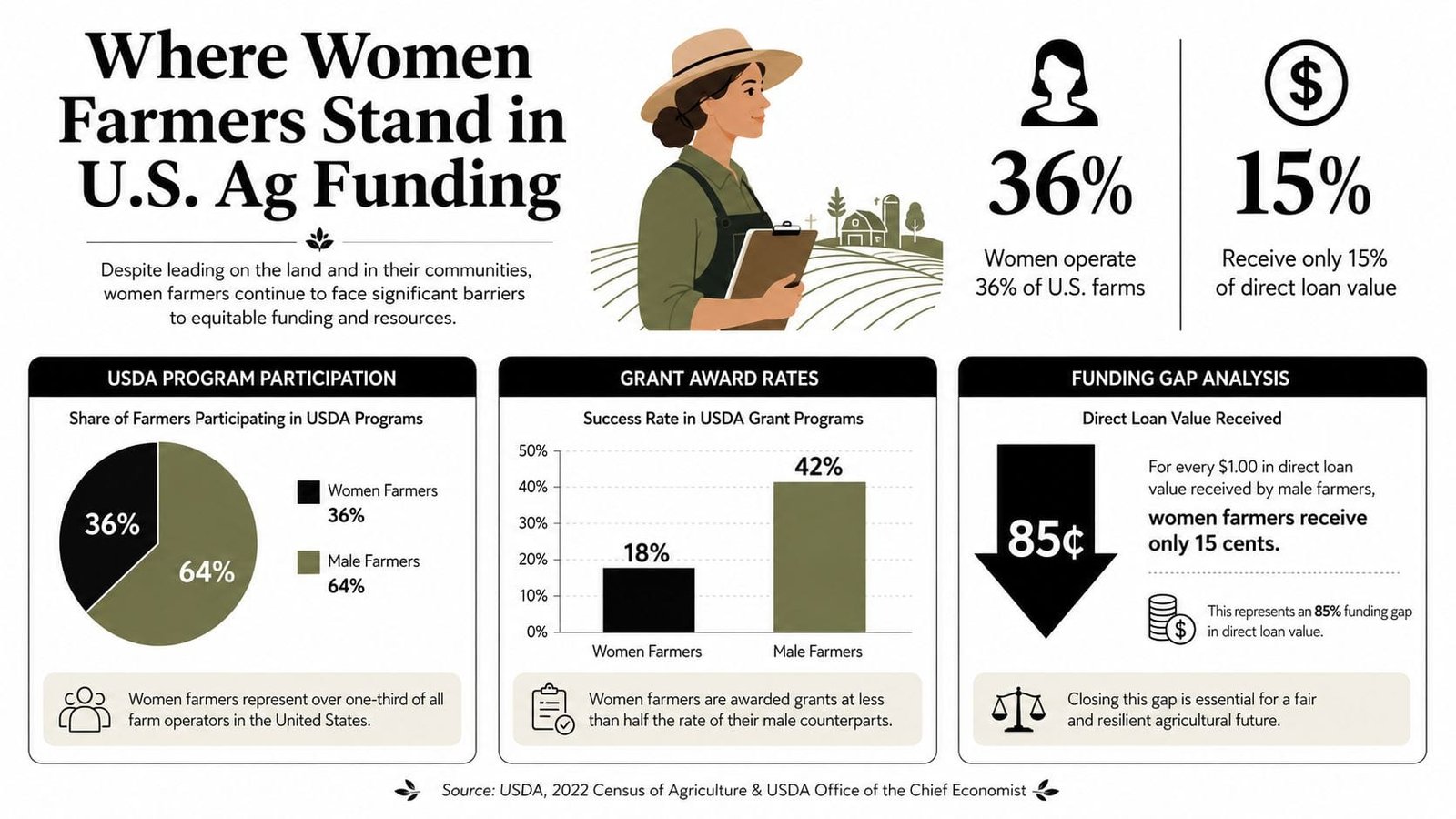
USDA-linked analysis shows that women made up about 36% of U.S. producers in the 2022 Census of Agriculture, yet from 2015 to 2022 they received just over 17% of NRCS EQIP contracts and just over 10% of CSP contracts. In that same period, about 82% of FSA Direct Loans went to men or male-owned organizations, while only about 16% went to women or women-owned organizations. Nearly 89% of FSA Guaranteed Loans went to men, and only about 5% went to women or women-owned organizations.
That is not a small mismatch. EQIP and CSP are two of USDA’s main conservation channels, so the gap affects who gets help with stewardship, water, soils, and resilience, the same upgrades lenders like to see in a file. For women-only grant money, ignoring these channels is looking in the wrong place.
Read the market like an applicant, not a shopper
Split the options into three buckets. First, there are programs that pay for part of a project and behave like grant support. Second, there are loans with targeting, preferred treatment, or set-asides attached. Third, there are training and technical assistance programs that make your operation more fundable even when they do not write a large check.
Practical rule: If a program helps you buy equipment, improve conservation, or secure land access, it may be more useful than a women in agriculture label that sounds generous but does not cover the expense you need to pay.
The federal USDA women farmers page points applicants toward those targeted programs, and that is the right place to start. A complete file, a USDA farm number, and a clear use case beat vague interest every time. The women who get funded are usually matching the right capital source to the right job, not chasing free money.
Federal Grant and Grant-Adjacent Programs Women Can Use
The federal layer is where most serious applicants should start, but you need to know the difference between grant-like support and actual debt. USDA explicitly says women farmers can access programs with priority points, set-asides, and special loan funding on some applications, so the smart move is to screen for those mechanisms instead of looking only for a women-only title (USDA women farmers page). That’s the game.
Why some USDA programs pay like grants and others don’t
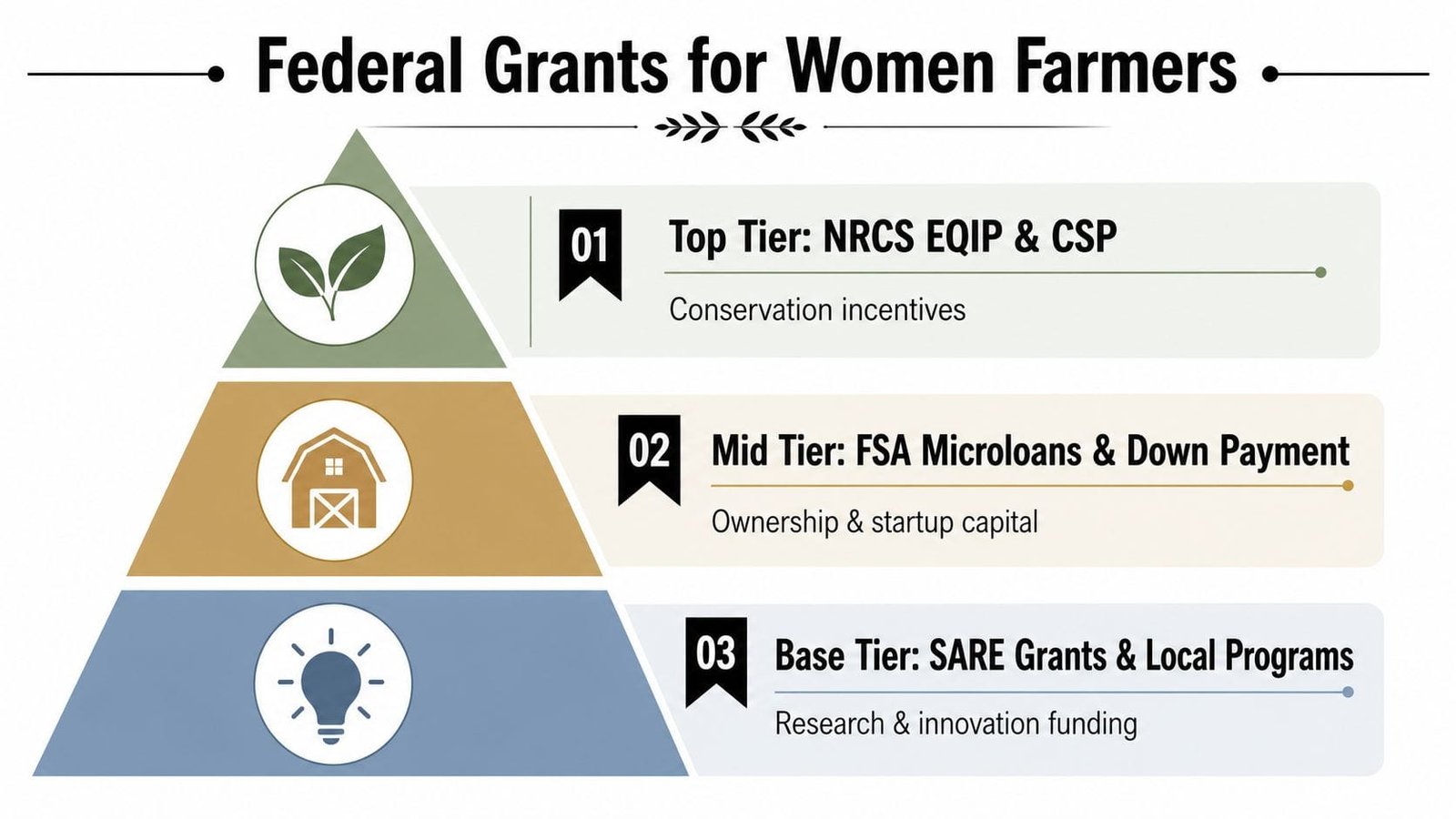
Conservation programs are the closest thing many applicants will see to grant funding. NRCS EQIP and CSP don’t operate like a simple grant check, but they can function as cost-share support for conservation work, and that’s exactly why they matter to women-led farms. They can help with practices tied to land stewardship, water, soils, and resilience, which often are the projects lenders want to see too.
Other federal programs are more niche but still useful. Federal RFA roundups regularly include opportunities like farmers market promotion, local food promotion, regional food system partnerships, beginning farmer training, and specialty crop research support. Those grants are real, but they usually go to entities, partnerships, nonprofits, or institutions rather than an individual farm owner looking for one check to cover everything.
The USDA doesn’t hide the fact that many women farmers are served through special loan funding and program design, not women-only grants. The Minority and Women Farmers and Ranchers Loans are a designation tied to Socially Disadvantaged Applicant funding, not a separate loan type, and that distinction matters because people waste time chasing the wrong application path (FSA minority and women farmers and ranchers loans).
What the Direct Farm Ownership Down Payment loan changes
The one USDA loan program specifically named for historically underserved and women farmers is the Direct Farm Ownership Down Payment loan. That’s not a grant, but it can be the difference between continuing to rent ground and getting a path to ownership. For many women operators, land access is the biggest capital problem, not seed money.
Here’s the plain-spoken takeaway. If your use case is land, look at ownership financing. If your use case is conservation, look at EQIP or CSP. If your use case is training or business development, look at partnership grants, education programs, and technical assistance. If your use case is cash flow, you need operating credit, not a grant fantasy. That’s how strong applicants think.
Buy the financing product that fits the expense. Don’t force every problem into a grant-shaped box.
The other clean federal example is the Farm Storage Facility Loan program. USDA says it provides low-interest financing for storage and handling facilities, and beginning farmers often use the microloan version with a lower down payment and smaller ceiling (USDA FSFL Q&A). That’s a funding tool, not a grant, but it’s exactly the sort of capital many women-led farms need.
State, Regional, and Private Grant Opportunities Worth Applying To
Once you’ve looked at USDA, go local. That’s where a lot of women find the more realistic openings, because state departments, regional food systems, and private foundations often fund narrower projects that are easier to position. The best applicants don’t stop at the federal layer. They build a shortlist of one state opportunity, one regional opportunity, and one private fit, then apply in parallel.
Build a shortlist the right way
Start with your state agriculture department and scan for commodity, specialty crop, conservation, organic transition, or value-added funding. A lot of these awards are not women-only, but they’re still highly usable for women-led farms because eligibility is tied to the project, not the applicant’s gender. If your operation touches local markets, aggregation, processing, food safety, or equipment upgrades, that’s where many state and regional grants live.
Private and quasi-private programs are worth real attention too. Some national foundations and program administrators consistently release RFPs for specialty crops, local food, training, or business development. Others are tiny but useful for very specific education costs. The Vermont Farm Women’s Fund, for example, caps scholarships at $150 for conferences and classes, which is small but still worth using when training is the bottleneck (Forbes Advisor on woman farmer grants).
Match the program to the actual expense
Do not apply to a training grant when you need a shed. Do not apply for a processing grant when you need land. That sounds obvious, but mismatched applications sink more good farms than weak missions do. Read the expense rules first, then decide whether the program can cover equipment, infrastructure, training, or only education.
A useful way to screen opportunities is to ask four questions before you start paperwork.
- Can this fund my exact expense? If the answer is no, move on.
- Does the applicant need to be a nonprofit, a cooperative, or a public body? Many grants aren’t open to individual farms.
- Is there a match requirement? If yes, make sure the match exists before you write the narrative.
- Does the program require a farm number, tax records, or acreage history? If yes, gather those documents first.
If you want a practical example of how state-level opportunities get organized, review a well-structured grant roundup like this one on Tennessee small business grants. The state-by-state logic is the part most applicants miss.
Eligibility, Documentation, and the USDA Farm Number
You can’t win a federal farm program with a messy file. USDA systems reward readiness, and that means the paperwork has to be clean before you submit. If the application asks for legal structure, acres, tax history, or a project budget and you’re still hunting for that information after the deadline opens, you’re already behind.
What a complete file usually needs
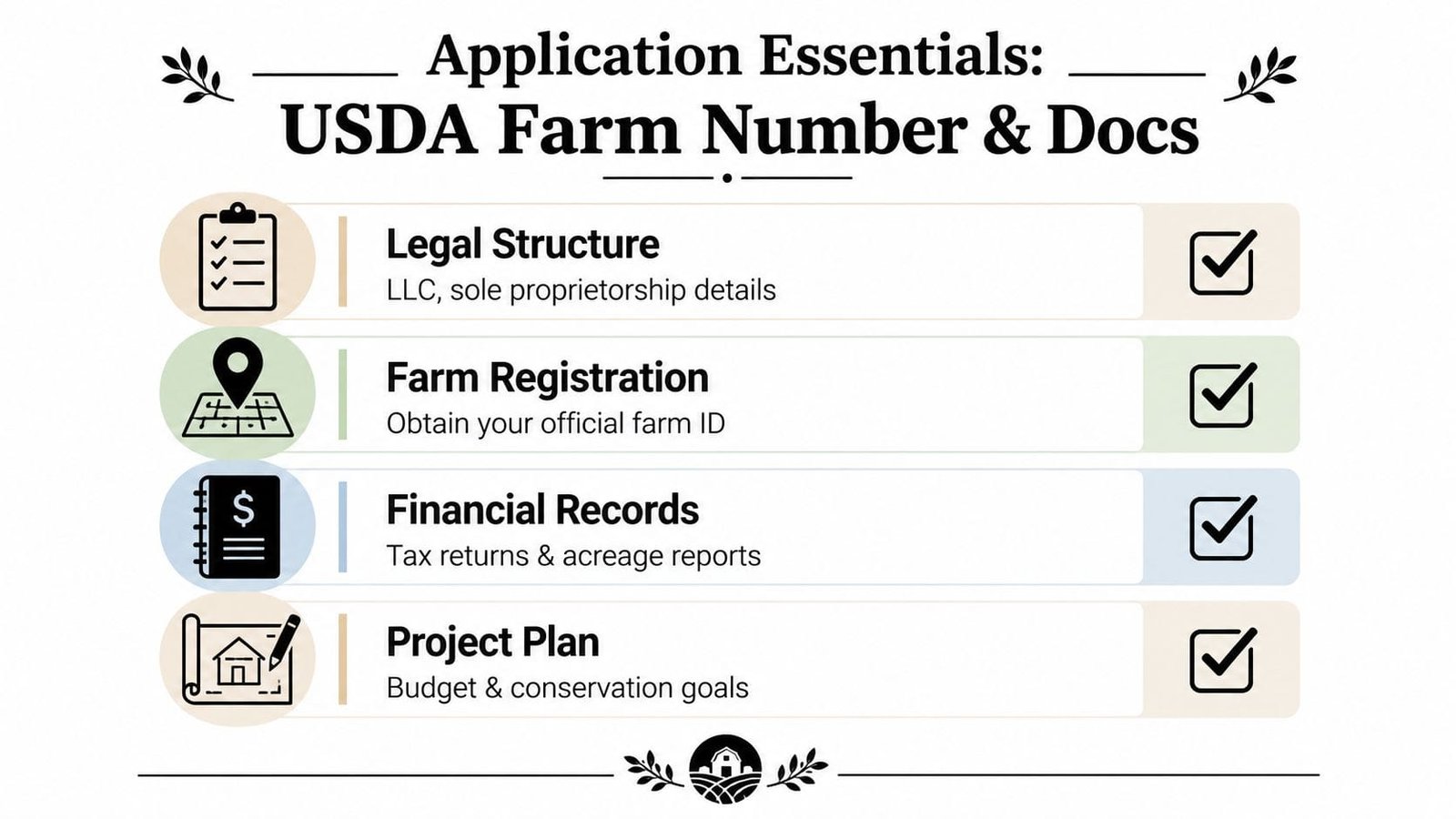
At minimum, get your legal structure straight. Know whether you’re applying as a sole proprietorship, LLC, partnership, trust, or another entity, because that affects signature authority and who receives funds. Then secure the USDA farm number, because it’s the gateway to most federal farm programs and a frequent early question from local offices.
After that, assemble your financial and operational proof. That usually means tax returns, acreage documentation, business records, and whatever conservation or production history your program asks for. If the project touches storage, irrigation, drainage, or land improvement, the budget needs to be precise enough to show that you understand what the work costs and why it matters.
How to think about eligibility before you click submit
USDA says female applicants should screen for priority points and reserved funding rather than only women-only program names (USDA women farmers page). That changes how you prepare. A farm with complete records and a defined capital use case can compete better when scoring rewards producer status, feasibility, and documented need.
Rule I give applicants: if your file can’t answer who you are, what the money buys, and how the project gets finished, the reviewer will move on.
If you’re missing documents, fix that before you draft your narrative. Use this as your prep checklist, then review the detailed document list at what documents you need. The strongest women-led applications are usually not the most eloquent, they’re the most complete.
How Grants Stack with Loans and Working Capital
Most farm projects don’t fail because the grant idea is bad. They fail because the applicant doesn’t have the cash to bridge the gap between approval and delivery. A grant might cover part of the cost, but you still have to pay suppliers, hire contractors, and keep the operation moving while the reimbursement or draw process runs its course.
Why a grant rarely stands alone
That’s why the financing stack matters. If the project is land, you need ownership capital. If it’s equipment, you need equipment financing. If it’s a storage buildout or handling upgrade, a storage loan can preserve cash. If it’s seasonal operating pressure, you need working capital, not a ceremonial award letter.
USDA’s Farm Storage Facility Loan program is a good example of why loans often solve the core issue. USDA says producers use it to build or upgrade storage and handling infrastructure while keeping capital on hand for unexpected expenses (USDA FSFL Q&A). That’s the logic you want in any stacked-finance plan.
Build the stack in the right order
Start with the project’s job, then layer the capital around it.
- Grant or cost-share first: Use this for conservation, training, or partial project funding.
- Loan second: Use this for the chunk the grant won’t touch, especially land, equipment, or storage.
- Working capital third: Use this for payroll, feed, inputs, and the gap between signing and cash arriving.
A lender that can surface multiple products from one application can help here, because women-led farms often need a funding mix rather than one product type. If your project also carries insurance exposure, keep a practical resource like farm insurance in the conversation so the capital stack doesn’t ignore risk.
If you’re trying to understand where operating cash fits in, review working capital for businesses before you submit anything. That’s especially important when a grant pays out after work starts, not before.
Application Strategy, Timelines, and Common Rejection Reasons
Deadlines aren’t the hard part. Matching the application to the program is. Many women-led farms miss out because they submit a well-written proposal to the wrong funder, or they leave out one required attachment and assume the reviewer will be flexible. Reviewers usually aren’t flexible.
Use a calendar, not memory
Federal Requests for Applications, now often called NOFOs, are usually posted in cycles, and deadlines can cluster tightly. If you’re chasing USDA or USDA-adjacent funding, build a quarterly review habit. Look for opening dates, match requirements, eligibility changes, and whether the fund is aimed at individuals, nonprofits, cooperatives, or institutions.
When you read the RFA, pay attention to what gets scored. Some programs reward technical feasibility. Others care more about producer status, partnership strength, or the public benefit of the project. If the narrative talks about women-led impact, make that relevant to the actual scoring criteria instead of trying to force it into every paragraph.
The mistakes that sink good applications
The most common rejection reasons are boring, which is exactly why they’re so dangerous.
- Missing attachments: Budgets, letters, certifications, and maps get left out.
- Unrealistic costs: The proposal says one thing, the budget says another.
- Weak match documentation: If matching funds are required, the source has to be clear.
- Wrong program fit: The applicant asks for operating cash from a training grant.
- Thin project logic: Reviewers can’t see how the work gets finished.
If a reviewer has to guess what your farm will do with the money, you’ve already lost points.
Use prior denials as a diagnostic, not a verdict. If you were turned down once, fix the gap, tighten the budget, and resubmit to the right program or the next round. That’s how persistent applicants win.
Your Action Plan and Funding FAQs
Start with the registrations and records you’ll need everywhere, then choose two federal targets and one local or private target. If your project is conservation or infrastructure, aim at a grant-like program and a loan in parallel. If your project is land access, start the ownership financing conversation now, not after you find the property.
A 30-60-90 day approach
In the next 30 days, secure the farm number, organize tax records, and define the exact use of funds. In 60 days, shortlist one USDA channel and one state or private opportunity that fit the same project. In 90 days, submit the application and line up backup financing so the season doesn’t stall if the award is delayed.
Short answers to the questions people ask most
Can farm grants for females cover land purchases? Usually no. Land is more often financed through loans or ownership programs.
Are women-only grants common? No. Most useful programs are set-asides, priorities, cost-share, or training grants.
What if I’ve been rejected before? Fix the fit, the documentation, or the budget, then reapply.
Can a lender help while a grant is pending? Yes, and that’s often the smarter move when the project has a deadline.
For a practical next step, don’t keep chasing random grant lists. Start with the program that fits your expense, get your file in order, and line up the capital stack that keeps the farm moving.
Business Loan Warrior helps business owners line up the funding stack that grants alone won’t cover, from equipment and working capital to SBA processing and short-term financing. If your farm project needs cash flow, timing help, or a second source of capital while you pursue public funding, visit Business Loan Warrior and compare the options that fit your operation.