

A turnkey business is fully operational at the moment of sale, so the buyer can take over and start running it on day one. The question isn't whether the label sounds attractive, it's whether the deal still makes sense once you count the cash you need to close it, the debt you'll carry, and the work you'll still have to do after closing.
Table of Contents
- What Is a Turnkey Business in Plain English
- The Building Blocks That Make a Deal Truly Turnkey
- Common Types of Turnkey Businesses Worth Considering
- Pros and Cons Every Buyer Should Weigh
- Due Diligence and Valuation Checklist
- Financing Options for a Turnkey Acquisition
- Common Pitfalls and How to Avoid Them
- Deciding Whether a Turnkey Purchase Is Right for You
What Is a Turnkey Business in Plain English
A first-time buyer usually sees the difference fast. One listing is a coffee shop that still needs equipment orders, menu testing, hiring, and a soft launch. The other is an existing resale with staff, customers, supplier relationships, and day-to-day routines already in place. Only the second one is turnkey, because the buyer can step in and keep operating instead of building from zero.
Whether the deal still makes sense once you count the cash you need to close it, the debt you will carry, and the work you will still have to do after closing is the key issue. A genuine turnkey business is operationally ready at transfer, meaning the systems, staff, customers, suppliers, and processes already exist and the buyer can take control immediately, not after months of setup. According to Indeed's definition of turnkey business, the business should already be functioning when ownership changes. Buyers should also verify a paper trail, including at least 12 months of financial statements and, ideally, 24 months, before they accept the turnkey label at face value. Business operations and why every business needs a solid system matters here because a business without repeatable processes is not ready for a smooth handoff, no matter how good it looks in a broker deck.
The label gets overused because it sells speed. Sellers know buyers want to skip the hardest part of starting a business, so every somewhat organized operation suddenly looks “turnkey.” Don't buy the marketing language. Check whether the business has the machinery of continuity in place, and whether the seller can prove it with documents, not promises. The seller operations documentation tips are useful for exactly that reason, because undocumented workflows are one of the fastest ways a “turnkey” deal turns messy.
Practical rule: if the seller cannot hand over a working business on day one, it is not turnkey, it is a work-in-progress with a better sales pitch.
Use one sentence with brokers and sellers. Ask, “Show me what already runs without you.” If the answer is vague, the deal needs more scrutiny.
The Building Blocks That Make a Deal Truly Turnkey
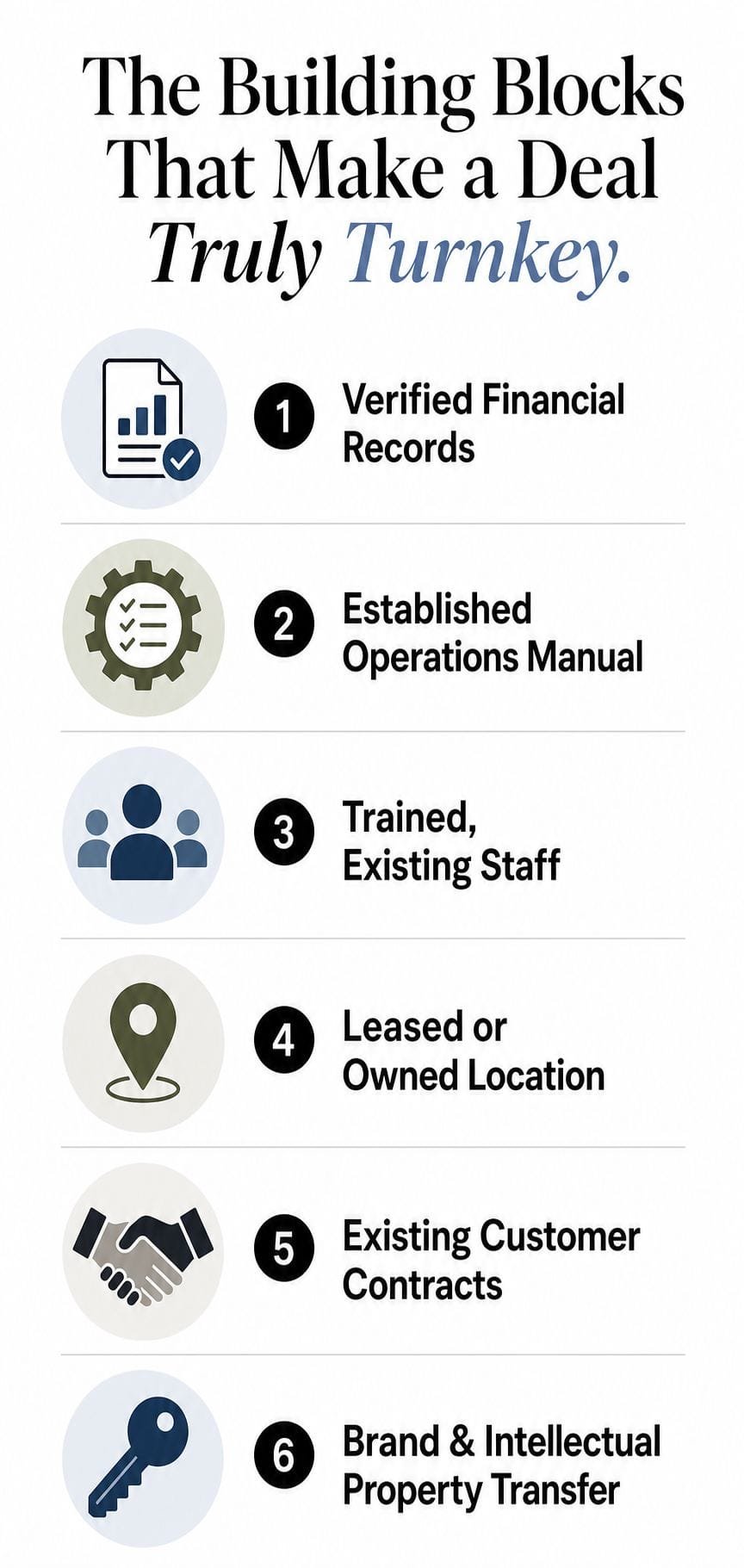
A real turnkey acquisition has six working parts, not two or three. Operational completeness is the standard, and that means the buyer gets more than a name and a lease. It means the business can keep serving customers with minimal interruption, which is why system quality matters as much as revenue.
The six parts that should already be working
- Verified Financial Records: Ask for clean statements and compare them to tax returns or management reports. If the numbers only look good in the teaser, pause.
- Established Operations Manual: Processes should be written down, not stored in the owner's head. A useful resource on that topic is seller operations documentation tips, because undocumented workflows are one of the fastest ways a “turnkey” deal turns messy.
- Trained, Existing Staff: The business should have people who can keep serving customers after the handoff. If everyone says they're “replaceable,” ask who knows how the business runs.
- Leased or Owned Location: The real estate or facility arrangement should support continuity. If the lease is shaky, the business may not be turnkey at all.
- Existing Customer Contracts: A buyer wants repeatable revenue, not just a hope that people come back. Look for contracts, subscription agreements, or a durable customer base.
- Brand and Intellectual Property Transfer: The business name, digital assets, and other rights need to transfer cleanly. If the seller keeps the key assets, the buyer doesn't own the whole machine.
A quick on-site test helps. Can the manager explain the workflow without calling the owner? Can a staff member show you the systems? Can the supplier call go through without the seller as a middleman?
If the business loses its rhythm the moment the owner steps out, it's not turnkey. It's owner-dependent.
For a practical systems lens, this operations framework is useful because it forces buyers to think in terms of repeatability, not just presentation.
Common Types of Turnkey Businesses Worth Considering
Franchise resales are the clearest physical-world example. The buyer takes over an operating unit, staff, and a known brand, which is why this market gets described in turnkey terms so often. The broader franchise market keeps attracting buyers because it offers a prebuilt operating model, but the key question is whether the unit transfers cleanly. CTA Acquisitions notes that roughly 1 in 4 new franchisees buys an existing unit rather than starting from scratch, which tells you how normal resale ownership has become.
Online businesses are the digital version. A professionally built new high-ticket dropshipping store may cost $15,000 to $50,000, while buying an existing profitable online business commonly starts around $50,000 and can reach the millions for established brands. Those prices are not just labels on a listing. You are paying for time, traffic, revenue history, and operating systems that are already in motion, which means the buyer still has to verify traffic quality, platform dependence, fulfillment, and whether the business can run without the seller constantly steering it.
Small-business resales, like restaurants, local service firms, and retail shops, sit in the middle. These deals often come from retiring owners and can transfer cleanly if the staff, permits, equipment, and location stay intact. The risk shows up fast when the seller is the face of the business, or when vendor relationships, lease terms, or day-to-day know-how live in one person's head.
| Turnkey Business Formats at a Glance | Typical Price Band | What “Turnkey” Means | Diligence Focus |
|---|---|---|---|
| Franchise resale | Varies by brand and unit | Existing branded unit with systems and staff | Franchise transfer rules, lease terms, operational continuity |
| Existing online business | Often starts around $50,000, can reach the millions | Revenue-generating digital asset with documented systems | Traffic quality, revenue durability, platform dependence |
| Local small-business resale | Varies widely | Operating shop with location, customers, and employees | Owner dependence, permits, equipment, lease assignability |
Choose the format that fits your capital stack and your operating tolerance. A buyer with limited cash may like a lower-friction online asset, but financing still depends on the quality of the records and the seller's willingness to support the handoff. A buyer with more capital and a stronger management bench can handle a physical business, but that choice demands harder diligence on the lease, staff retention, and post-close execution. The more a business relies on a location and on people, the more you need to test how much of the operation survives the owner's exit.
Pros and Cons Every Buyer Should Weigh
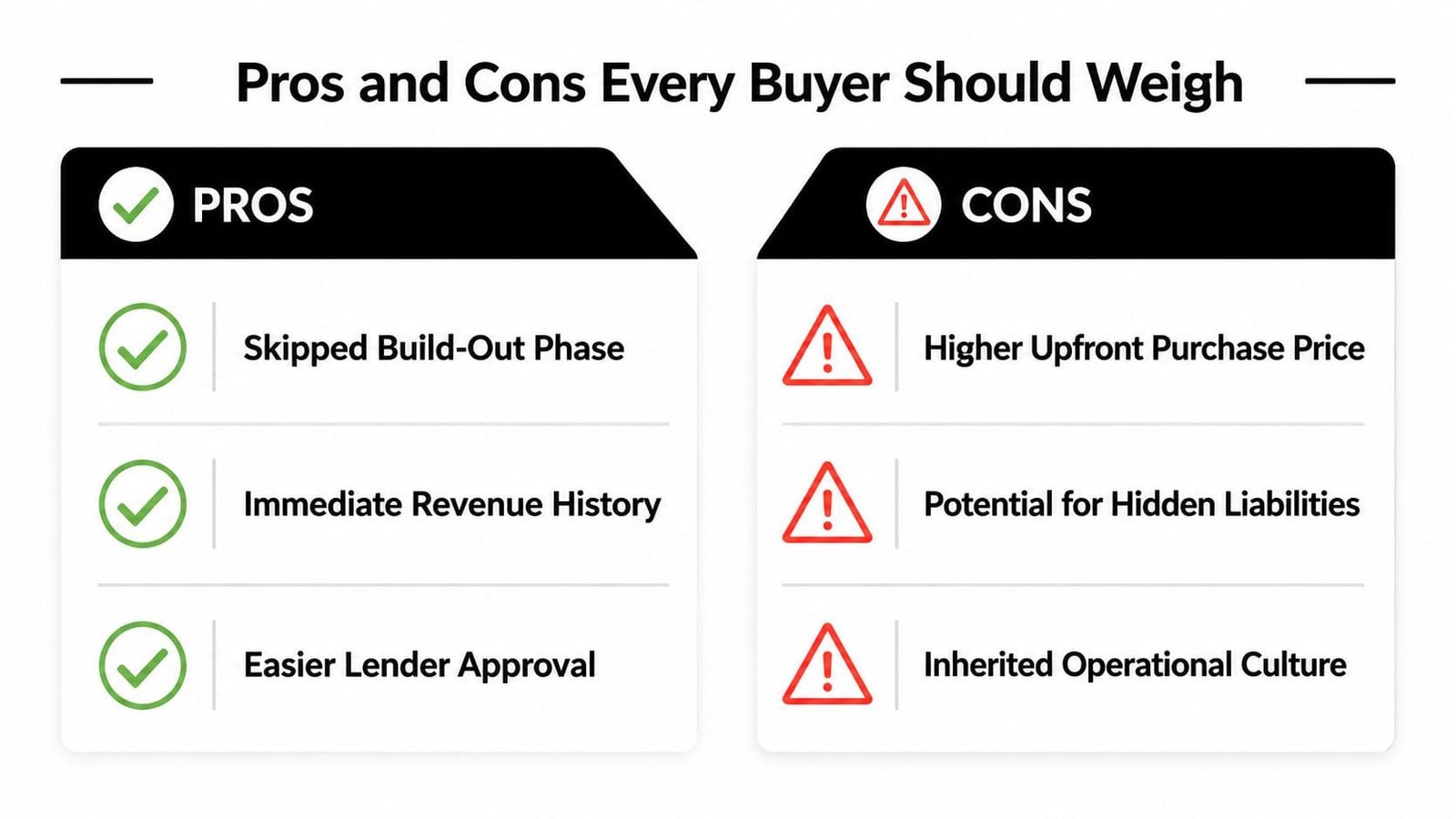
Buyers like turnkey deals for a simple reason. You start with real operations, real customers, and a business that already has revenue history, which gives lenders and buyers something concrete to inspect instead of a projection deck. In a tighter lending market, that operating track record can matter more than a polished plan.
The trade-off shows up quickly in the purchase price and the diligence file. You usually pay a premium for something already assembled, and that premium can hide issues the teaser never mentions. A “ready-made” business can still carry old liabilities, a shaky management culture, or systems that only look stable because the seller has been propping them up.
What the upside really looks like
A turnkey acquisition cuts out a lot of startup chaos. You are not guessing whether customers will show up, and you are not trying to build supplier relationships while payroll is already coming due. That gives you a clearer opening runway and lets you spend your first weeks improving an existing machine instead of building one from scratch.
It also changes how you finance the deal. A business with documented cash flow, clean records, and transferable assets is easier to explain to a lender than a blank slate. If you want help framing the price against the earnings profile, a business valuation service can help you pressure-test whether the asking price matches the business's actual earning power.
What the downside really looks like
You may inherit employees who are unsure about the new owner, a lease that needs consent before transfer, or a business that depends on the seller being present every day. The lease or ownership arrangement should support continuity, or the “turnkey” label starts to lose its meaning fast.
You also need to verify what is really transferable. The Franchise Foundry founder guide is a useful reference point for the disclosure package you should expect before you sign, especially if the seller controls the records and the handoff process.
Buying a working business requires a different mindset than buying a simple one. You are acquiring operating history, and that history can hide friction just as easily as it reveals stability.
The right approach is to treat turnkey as a convenience premium, not a guarantee. If the premium is high, the operating risk needs to be low, and the diligence has to prove it.
Due Diligence and Valuation Checklist
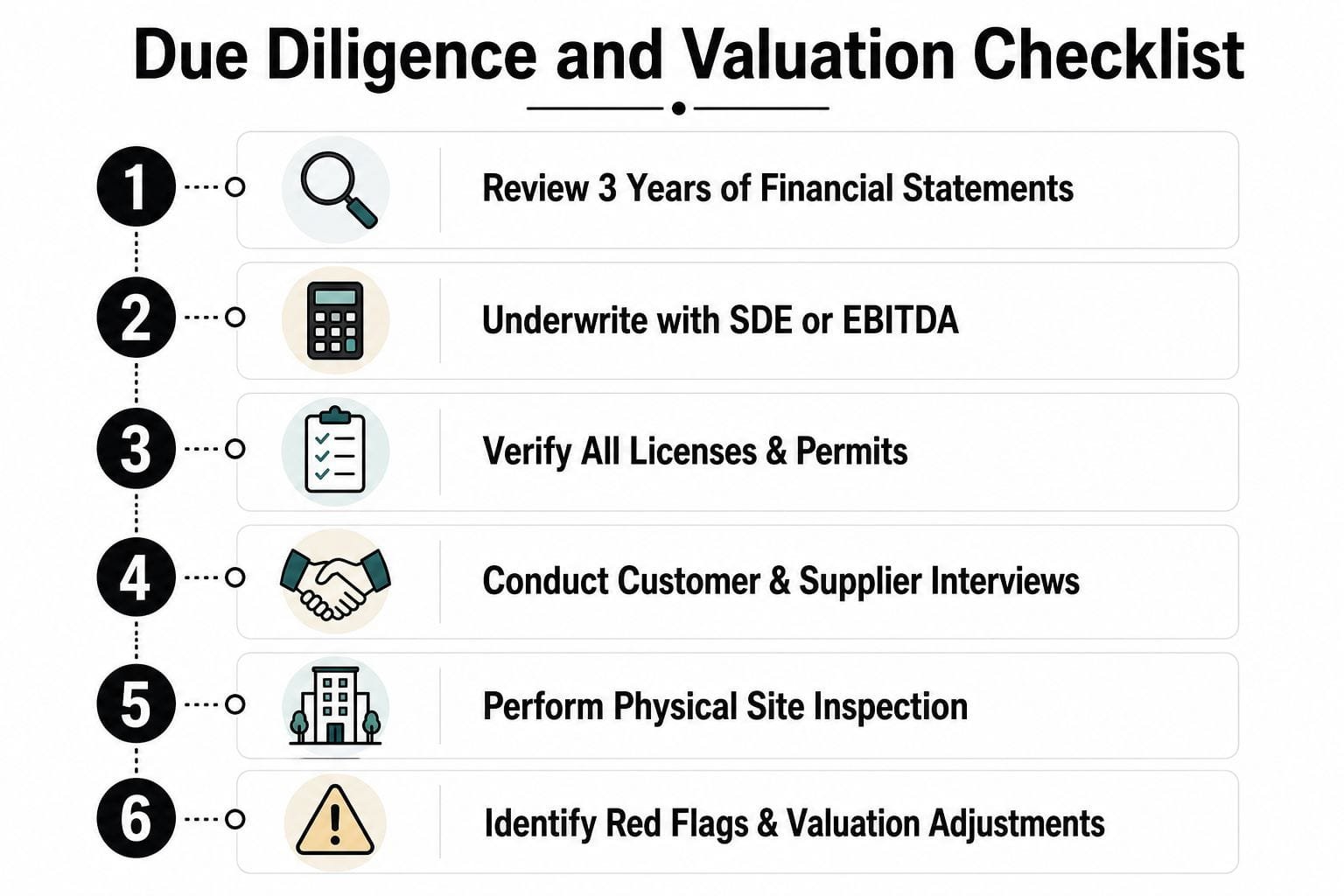
Start with the financials. Major industry guidance says to verify at least 12 months of statements, and ideally 24 months, before trusting the turnkey claim, because one clean year doesn't prove durability. That review should match revenue to deposits, normalize owner add-backs carefully, and test whether earnings depend on a single customer or a temporary spike. If you need help framing the disclosure package, the Franchise Foundry founder guide is a useful reference point for what should be in front of you before you commit.
What to verify before you value the deal
- Financial history: Ask for tax returns, profit and loss statements, and balance sheets, then compare them for consistency.
- Owner dependence: Determine how much sales, service delivery, and vendor management still run through the seller.
- Equipment condition: Inspect the assets yourself, don't rely on a one-line summary.
- Lease and permits: Confirm that location rights, licenses, and compliance approvals transfer cleanly.
- Contracts and litigation: Review customer, supplier, and employee agreements, plus any legal disputes.
The valuation side is simpler than most brokers make it sound. Start with earnings, adjust for true owner compensation and nonrecurring items, then compare the asking price to the cash flow the business can really support. If the seller's number assumes perfect execution after closing, the price is too optimistic.
A tidy listing can still hide a weak deal. The valuation only works if the operations and the paperwork agree with each other.
For a deeper pricing conversation, business valuation services can help buyers pressure-test whether the asking price matches the business reality, not just the marketing story.
Financing Options for a Turnkey Acquisition
A turnkey business is easier to finance than a raw startup because the lender can see operating history. That does not mean financing is easy. It means the business gives you a better story, while you still have to prove the debt can be carried after closing.
The main options are SBA 7(a), conventional acquisition loans, seller financing, and equity or rollover capital. SBA and bank loans are usually the first places buyers look because they preserve ownership and can be structured around the business's cash flow. Seller financing matters because it keeps the seller tied to the outcome, which can reduce friction in the handoff if the terms are sane.
How buyers usually stack the capital
- SBA 7(a) Loan: Common for acquisition deals where the buyer needs longer terms and flexible structure.
- Conventional Bank Loan: Works best when the business has stable financials and the buyer has strong credit and collateral.
- Online Lender: Faster, but often more expensive, so it fits shorter-term or bridge-style needs.
- Seller Financing: Useful when the seller wants more certainty at closing and the buyer needs the deal to pencil out.
One practical rule matters more than the label. If the acquisition debt leaves too little working capital, the business can be “ready” and still fail. That's the part most first-time buyers miss, especially in a high-rate environment where borrowing costs tighten the margin for error.
If you want a financing conversation specific to a particular acquisition, find a vet practice purchase loan is a relevant example of how practice buyers think about deal structure, cash flow, and lender expectations in a real operating business.
For buyers comparing funding paths, a business acquisition loan is often the cleanest starting point because it aligns the loan request with the asset being purchased instead of forcing a startup-style structure onto a live business.
Common Pitfalls and How to Avoid Them
The first trap is padded financials. A broker teaser can make a business look healthier than it is, especially if owner perks, one-time revenue, or aggressive add-backs are doing the heavy lifting. The fix is blunt, request tax returns, bank statements, and source documents, then make the seller explain any gap between cash flow and paper profit.
The second trap is a “turnkey” franchise that still needs remodeling or compliance updates. Sellers sometimes advertise a smooth handoff while ignoring the capital the buyer will need right after close. Before you sign, ask for a current facility condition review, a copy of the franchise transfer requirements, and the exact list of post-close upgrades.
The third trap is owner dependence. If the key employee leaves, the business can lose institutional memory overnight. The best defense is a transition plan with named staff commitments, written procedures, and a seller stay-on period that's detailed enough to matter.
The fourth trap is lease failure. A business that can't keep its location has a major continuity problem, no matter how nice the books look. Get the landlord's transfer requirements early, not after you've fallen in love with the deal.
The last trap is a post-close cash crunch. Buyers often focus on the purchase price and forget that debt service and working capital hit at the same time. If the deal only works with optimistic numbers, it's not a stable acquisition, it's a strained bet.
Guardrail: if you can't explain how the business survives the first 90 days with conservative assumptions, walk away or renegotiate.
Deciding Whether a Turnkey Purchase Is Right for You
The right questions are simple. How stable is the cash flow? How dependent is the business on the current owner? Can you still afford the deal after financing, working capital, and normal surprises? If you can't answer those three clearly, you're not ready to buy, no matter how polished the listing looks.
Use a 30-day action plan. First, collect the last 12 to 24 months of financial statements and tax returns. Second, interview the seller, manager, and at least one key vendor about what happens after closing. Third, get a lender or advisor to pressure-test the capital stack before you negotiate price.
A turnkey purchase is smart when the business is already stable, the transfer risk is low, and the financing still leaves enough room to operate. It's a bad move when “ready-made” just means “expensive, underdocumented, and dependent on the seller's personality.”
If you're serious about buying, start with the numbers, not the branding. Then talk to a financing team that understands acquisition structure and cash flow, not just loan applications.
Business Loan Warrior helps small business buyers compare funding paths for acquisitions, working capital, and other operating needs through a single application process. If you're weighing a turnkey purchase, visit Business Loan Warrior and start a real conversation about what the deal can support before you sign.