
South Dakota didn't become a top startup state by chance. In Patriot Software's 2025 Startup Index, it ranked #1 with a 78.5% one-year survival rate, a $150 LLC filing fee, and a #2 tax-climate rank, while Washington posted the highest one-year survival rate at 86.4% yet landed lower overall because of a $200 LLC fee and a #35 tax-climate rank Patriot Software. That gap is the story behind the best state to start a business, because survival alone doesn't tell you whether the launch environment will stay affordable, financeable, and manageable through month 12.
| State | What stands out | Why it matters |
|---|---|---|
| South Dakota | 78.5% one-year survival rate, $150 LLC fee, #2 tax climate | Strong balance of survival and cost discipline |
| Wyoming | #1 tax climate, $100 LLC fee | Lean launch environment with low fixed friction |
| Washington | 86.4% one-year survival rate, $200 LLC fee, #35 tax climate | Strong early survival, weaker tax profile |
| Ohio | #1 cost of doing business, #9 access to capital | Better fit when financing and operating scale matter |
The useful question isn't which state gets the trophy. It's which state gives your business the best odds of getting funded, staying compliant, and surviving long enough to matter. A lot of rankings blur those goals together, then sell a neat top-10 list as if every founder needs the same answer.
Table of Contents
- Why the Best State to Start a Business Is Not a Single Answer
- How Major Rankings Score the States
- Top States Ranked for 2026 and Why They Win
- Eight Criteria That Move the Ranking
- A Decision Framework for Choosing Your State
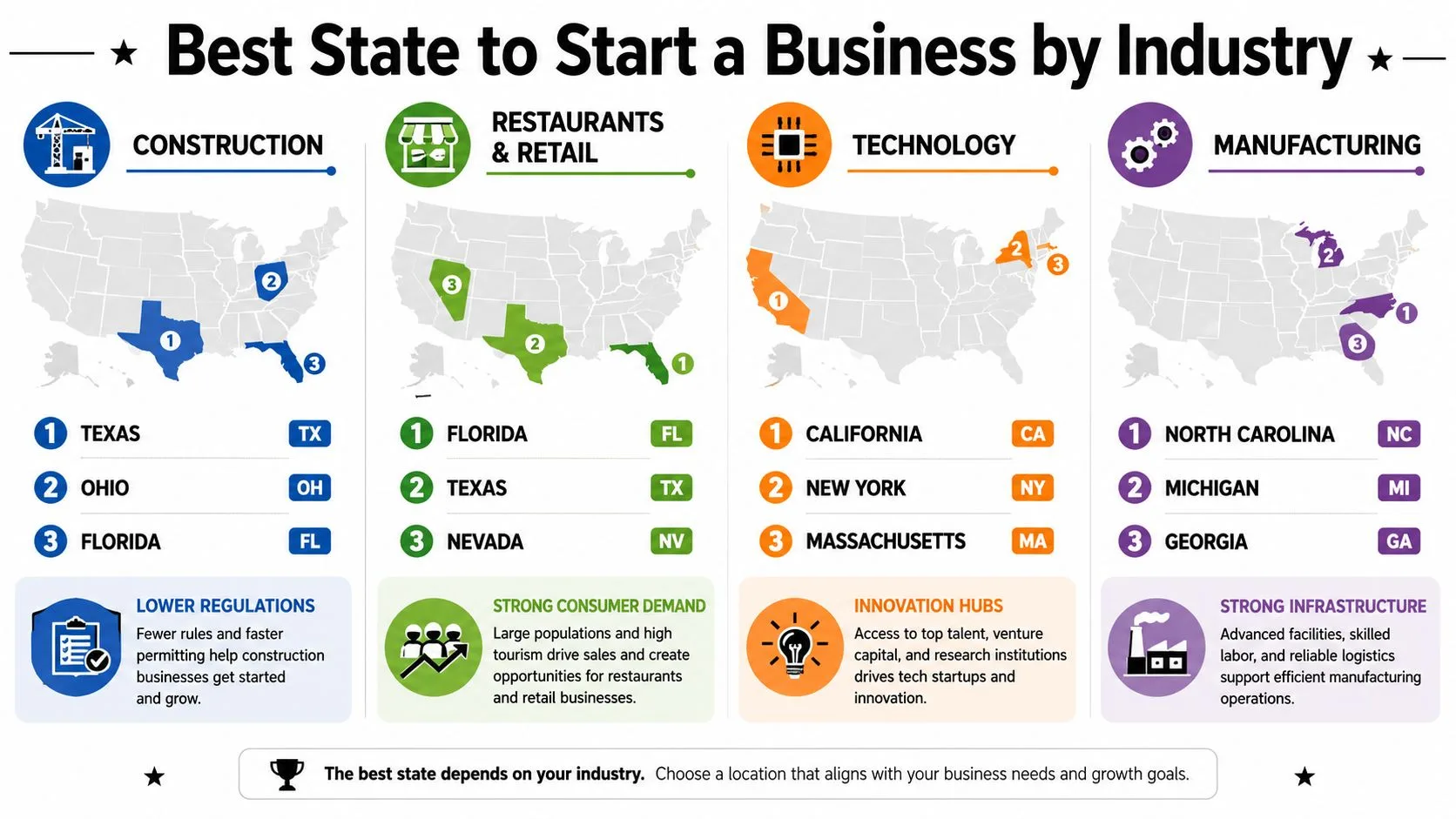
- Best State to Start a Business by Industry
- Tying State Choice to Funding and Capital Access
- Your 30-Day Action Plan After You Pick a State
Why the Best State to Start a Business Is Not a Single Answer
The main mistake in startup-state rankings is treating the result like a universal truth. In CNBC's 2026 ranking, Ohio took the top spot overall, helped by a #1 ranking for cost of doing business and #9 for access to capital CNBC. WalletHub's 2026 startup study put Utah at #1 and Georgia at #2, while Patriot Software's 2025 index crowned South Dakota WalletHub, Patriot Software. Those are not contradictions. They're proof that the answer changes when the scoring lens changes.
The same state can win one test and lose another
A founder who cares most about low launch friction will look at formation cost and tax climate first. A founder raising outside money may care more about capital access, legal predictability, and infrastructure. A founder hiring technicians, drivers, or field crews will care about operating costs and logistics, not just headline-friendly startup rankings.
That's why the phrase best state to start a business only becomes meaningful when you attach it to the business model. A home services company, a SaaS startup, and a capital-intensive manufacturer shouldn't be forced through the same ranking logic. The state that makes sense for one can be a drag on another.
Practical rule: choose the state that improves your odds at month 12, not the state that merely looks cheap on day 1.
The historical pattern is consistent enough to trust. Low-tax, low-fee states often outperform larger, higher-cost states on business-launch metrics, but that doesn't mean they are always the best place for every founder Patriot Software. The right answer depends on whether your bottleneck is formation cost, payroll, tax burden, or funding access.
Business license requirements also matter because incorporation is only one layer of compliance. If your license stack is heavy, a state with a great tax story can still become expensive in practice.
How Major Rankings Score the States
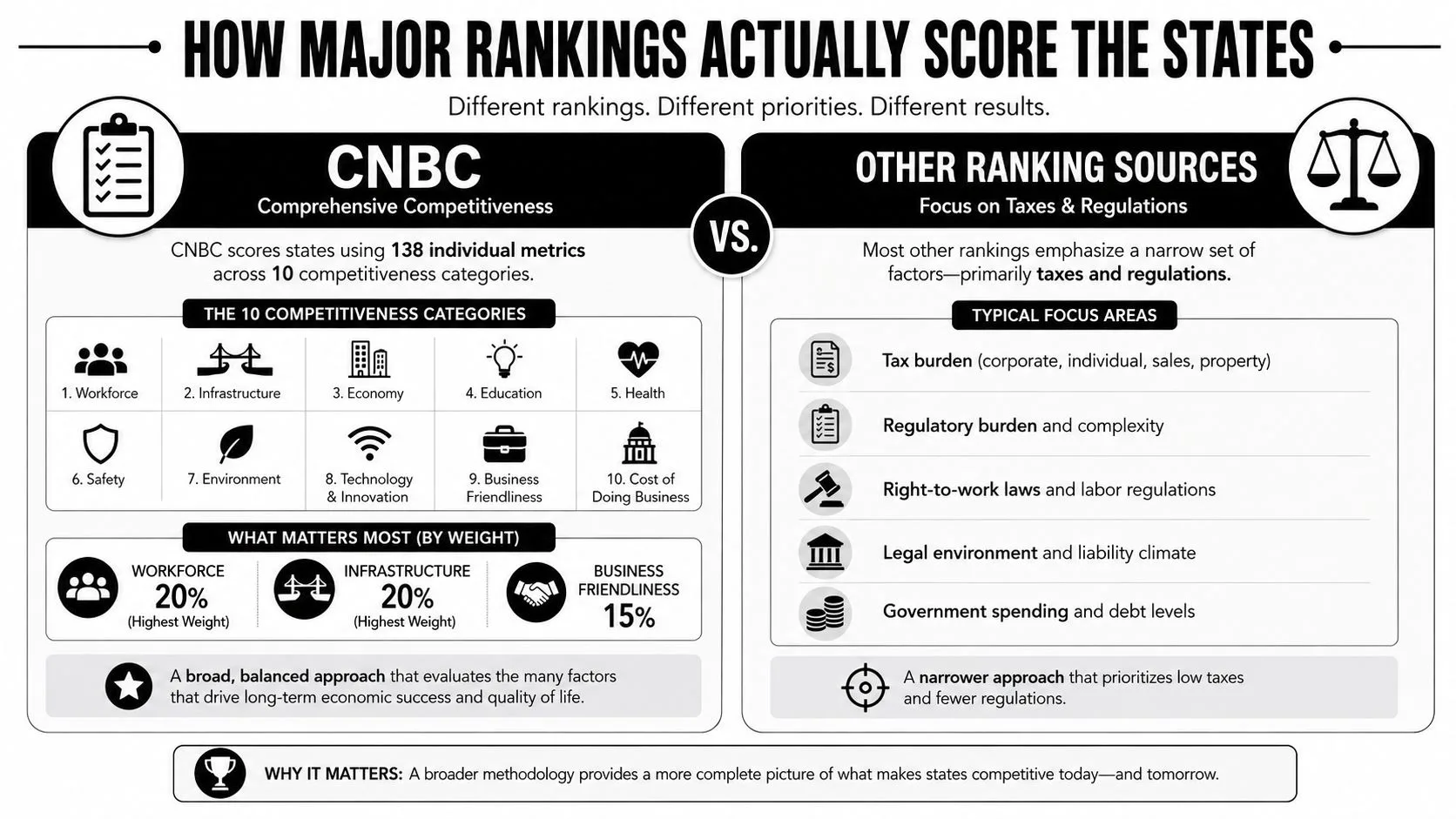
The first thing to inspect in any state ranking is the methodology, because the scoring model often matters more than the final winner. CNBC's 2026 framework evaluates all 50 states on 138 metrics across 10 competitiveness categories, normalized to a 2,500-point maximum. Its Infrastructure category carries nearly 18% of the total score, which makes it a strong proxy for logistics reliability, broadband, transportation access, and day-to-day operating efficiency CNBC methodology.
Three common scoring models, three different answers
WalletHub's 2026 startup ranking uses 25 metrics split across Business Environment, Access to Resources, and Business Costs, with each metric normalized on a 100-point scale WalletHub. National Business Capital's 2026 report uses 11 metrics, including Year One Survival Rates (10%) from the Bureau of Labor Statistics, plus labor productivity growth, electricity costs, and a consolidated taxes measure. The point is not that one framework is right and the others are wrong. It is that each one answers a different question.
A broad competitiveness model tends to reward states that support scaling, not just formation. A tax-heavy model rewards states that keep recurring costs low. A survival-based model rewards places where new businesses make it through the first year without running out of cash or patience. That is why Utah, Ohio, Wyoming, and South Dakota can all appear near the top in different studies without creating a contradiction.
If a ranking does not tell you what it weights most heavily, it is not a business decision tool. It is a marketing headline.
For a founder comparing states, the checklist is simple. Ask what the ranking measures, whether it overweights one factor, and whether that factor matches your business plan. If your business depends on trucks, warehouses, or field crews, a ranking that gives extra credit to infrastructure is more useful than one that emphasizes pure tax simplicity. If you are building a lean online service, the opposite may be true.
A better screen is your own balance sheet, hiring plan, and cash runway. A financial health assessment can show whether your business is sensitive to filing fees, payroll taxes, credit access, or operating overhead before you anchor on a state score that may not match your economics.
Top States Ranked for 2026 and Why They Win
A blended reading of the major 2025 and 2026 rankings shows a familiar cluster at the top, even though the order changes by methodology. The same states keep surfacing because each ranking rewards a different slice of the startup equation. South Dakota, Wyoming, Utah, Ohio, Washington, Florida, Georgia, and North Carolina stand out because they tend to score well on tax climate, business costs, survival, capital access, or infrastructure.
Top 10 states for starting a business in 2026
| State | LLC Filing Fee | Tax Climate Rank | 1-Year Survival Rate | Best For |
|---|---|---|---|---|
| South Dakota | $150 | #2 | 78.5% | Lean founders who want a balanced startup profile |
| Wyoming | $100 | #1 | 75.7% | Tax efficiency and low fixed overhead |
| Ohio | Not cited in verified data | Not cited in verified data | Not cited in verified data | Cost-sensitive operators that need capital access |
| Utah | Not cited in verified data | Not cited in verified data | 75.7% | Resource-rich startups and high-growth founders |
| Washington | $200 | #35 | 86.4% | Founders prioritizing early survival and talent depth |
| Florida | $125 | #4 | 77.0% | Consumer-facing and service businesses |
| North Carolina | $125 | #9 | 79.5% | Growth-oriented businesses with stable first-year survival |
| Indiana | $95 | #10 | 78.0% | Cost-conscious operators and manufacturers |
| Michigan | $50 | #11 | 76.8% | Lower-entry-cost startups and industrial businesses |
| Montana | $35 | #5 | 76.4% | Very lean launches and small-footprint operators |
Why the leaders look different
South Dakota stands out because it pairs a solid survival rate with a moderate filing fee and a favorable tax climate. That combination matters more than any single score if a founder is trying to preserve runway while still choosing a state that does not create immediate friction.
Wyoming is the clearest tax-first option in the group. It keeps showing up in rankings that give heavy weight to recurring business costs and formation expenses, which is why it appeals to founders whose first priority is protecting early cash flow.
Washington is the example that keeps the rankings honest. Its first-year survival figure is strong, but a weaker tax and fee profile keeps it from looking as clean in a composite ranking. That is a useful reminder that a state can be excellent for business continuity and still be a poor fit if the company is sensitive to fixed overhead.
Ohio deserves attention for a different reason. In CNBC's broad state business ranking, it rose because of its cost structure and capital access. That makes it more relevant for firms that need a workable operating base, not just a low-cost filing destination. For a founder comparing real-world options, that difference can matter more than the headline rank.
Eight Criteria That Move the Ranking
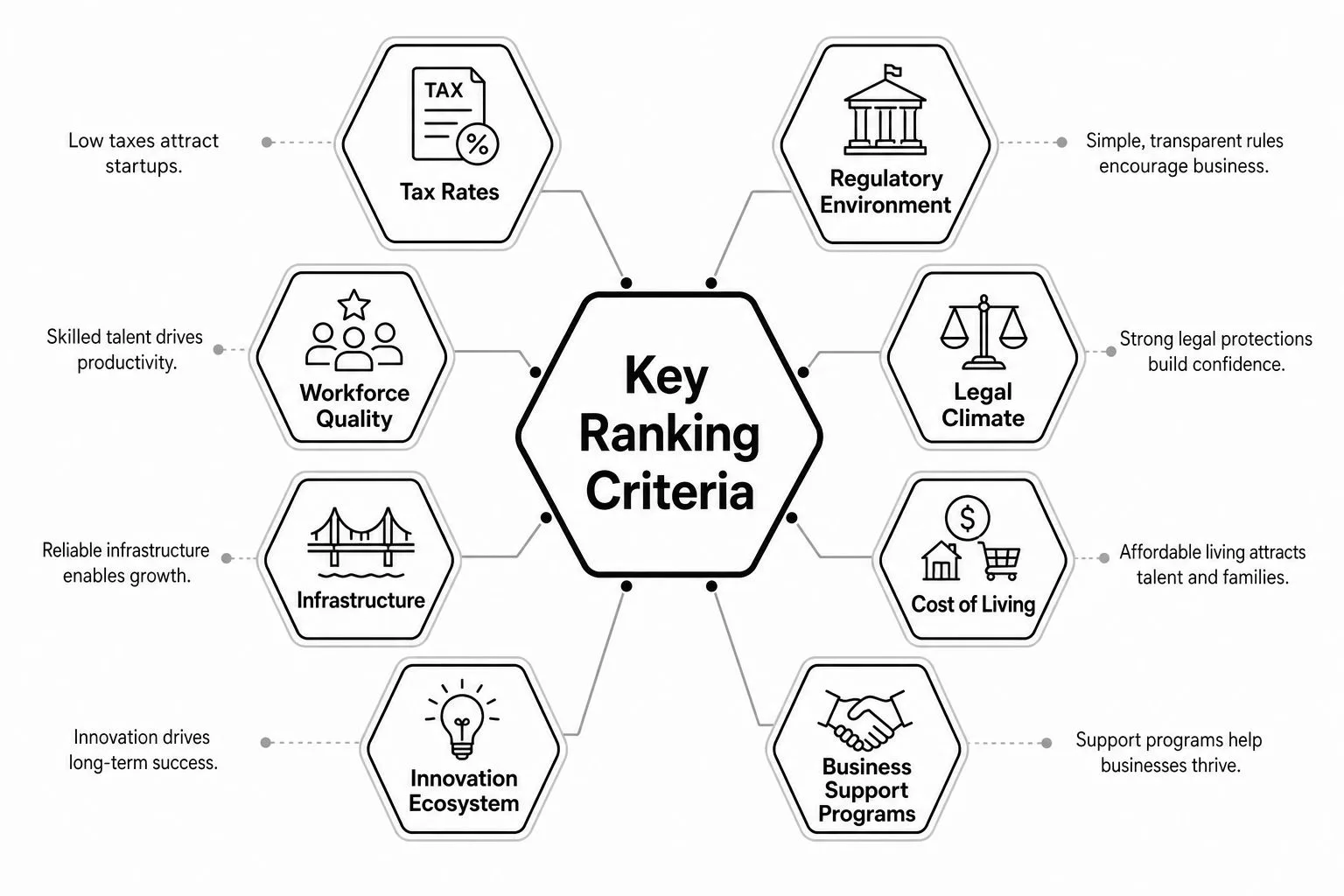
Rankings compress a state into a headline, but a founder does not operate inside a headline. Taxes, payroll, rent, compliance, shipping, and financing all show up in the first year cash flow, and the ranking criteria matter because they change those line items in different ways. A state can look attractive on paper and still be expensive for the business model you are running.
The criteria that change the P&L
- Tax rates: Lower state tax burdens preserve cash for inventory, payroll, and marketing. Wyoming, South Dakota, and Nevada are often discussed in this context because they avoid state income tax structures that can squeeze early cash flow.
- Formation and annual fees: A modest filing fee can matter more than it looks if you're comparing it against renewal and report costs over time. A lower entry fee reduces the cash drain before revenue stabilizes.
- Labor costs: Minimum wage and broader wage pressure affect service firms, retailers, and field crews quickly. If your model depends on a large hourly workforce, labor costs can outweigh a small tax advantage.
- Commercial rent: Office, storefront, and warehouse costs can swamp a state's tax benefit if your business needs physical space.
- Regulatory and licensing burden: If your model needs multiple permits, inspections, or local approvals, a business-friendly state can still feel slow in practice.
- Incentives and grants: Some states offset costs with targeted support, especially for manufacturing, logistics, and expansion projects.
- Access to capital: A strong lender network, active SBA ecosystem, and local credit culture can determine whether you can fund month 12 growth.
- Industry clusters and target-market proximity: The right state is often where your customers, suppliers, or talent already are.
Decision rule: a state that saves you a little on taxes but adds friction to labor, licensing, or shipping can be the more expensive choice.
CNBC's methodology puts weight on the operating features that affect physical businesses, which helps explain why infrastructure-heavy states can rise even when their fee profile is not the cleanest. For a construction firm, a distribution company, or a multi-location retailer, that emphasis can matter more than a simplistic low-fee headline.
A founder should also check entity choice before treating a state ranking as a complete answer. Practical business structure advice from David J. Greiner Law Corp. is useful because the state you choose and the entity you form should support the same operating plan, not work against each other.
A Decision Framework for Choosing Your State
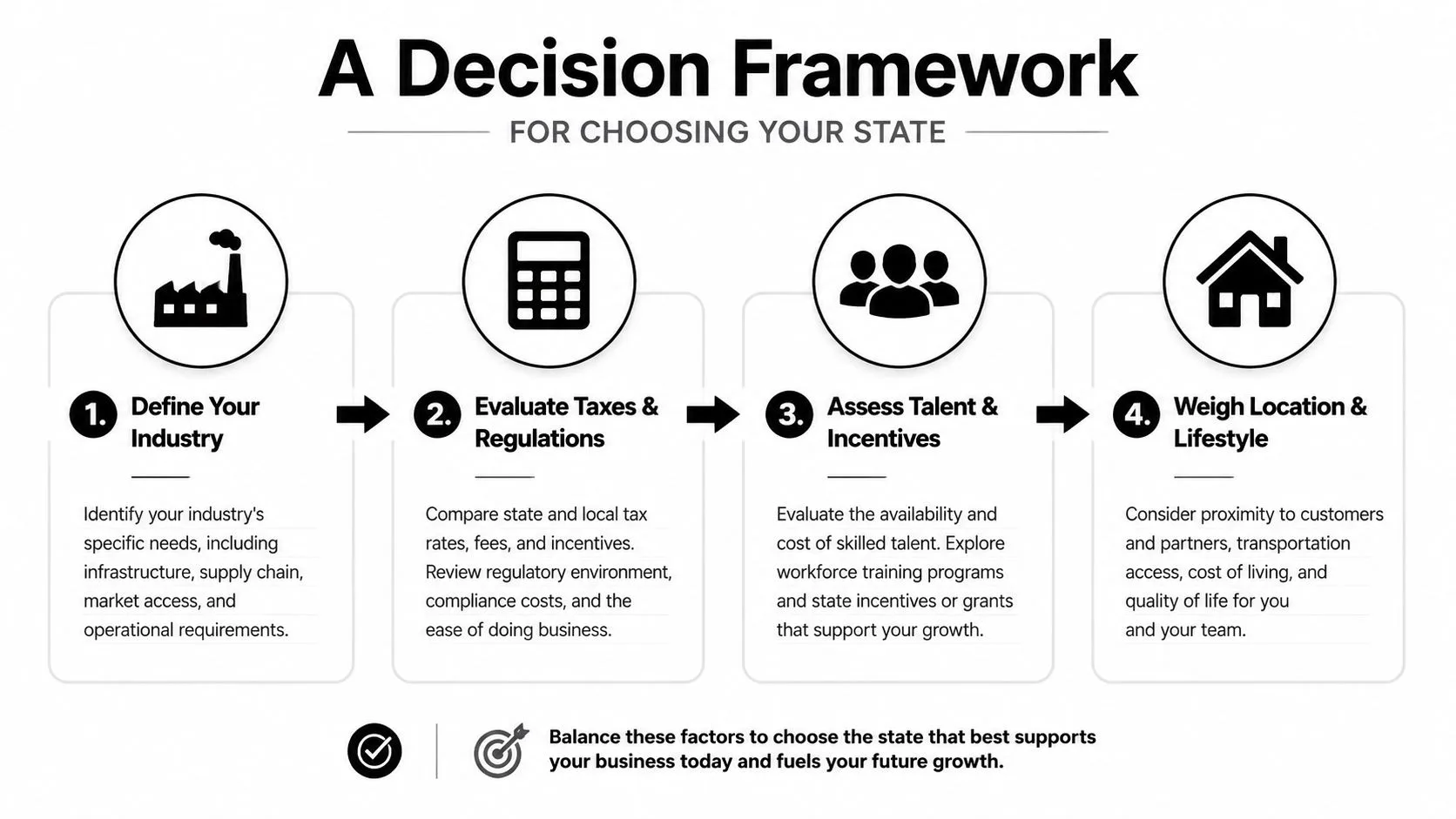
A useful state decision starts with the business model, not the map. The right answer for a capital-light consultant is rarely the right answer for an equipment-heavy contractor. That's why a four-step screen works better than a generic list.
Start with industry and capital intensity
If your business needs trucks, machines, inventory, or a staffed physical location, state-level operating costs matter immediately. If you're digital and remote, tax simplicity and filing friction may matter more than local customer traffic. The capital intensity of the model should set the first filter.
Then map customers, suppliers, and licenses
A cheap state can become expensive if your customer base sits elsewhere or if you'll need to register as a foreign entity in every place you work. A local service company, for example, usually needs the home-state setup to match where the work is performed. The same logic applies to companies with state-specific licensing, where compliance can outweigh a small fee savings.
Use the state choice as a financing decision
If you expect to borrow, the state should support the lending plan, not complicate it. Lenders care about real cash flow, operating stability, and whether the business can survive long enough to repay. A founder who expects to need underwriting support can also compare entity and location tradeoffs with business structure advice and financing readiness before filing.
A state that looks cheapest at formation can be the wrong answer if it weakens your lender profile or pushes compliance into too many jurisdictions.
The fourth step is the one founders skip. Test whether the business can survive 12 months in that state with realistic rent, payroll, taxes, and permit costs. If the answer is no, the ranking is irrelevant.
Best State to Start a Business by Industry
The useful question is not which state looks best on a ranking. It is which state matches the way the business will make money, hire, move inventory, and hold cash through the first year. Industry changes that answer more than most ranking tables admit.
Construction, equipment, and field services
Texas, Ohio, and Florida usually fit construction and field-service operators because these businesses depend on infrastructure, customer density, and lender comfort with hard assets. If a company owns equipment or runs crews, monthly operating cost matters every month, not just at formation. Ohio stands out for founders who need a disciplined cost base and a state that does not strain cash flow early.
Restaurants and retail
Georgia, Florida, and North Carolina tend to work better for consumer-facing businesses because they combine market reach with a broader operating ecosystem. These firms live and die by foot traffic, staffing, and local demand. A low-fee filing state will not rescue a concept that sits too far from customers or cannot attract enough people to staff the floor.
SaaS and tech-enabled services
Utah, Washington, and Colorado fit founders who care about talent access, investor familiarity, and the ability to scale without heavy physical infrastructure. Washington keeps showing up in startup discussions because its ecosystem supports software hiring and long-run expansion, even when the tax profile is less friendly. For a software founder, that tradeoff can make sense if the business needs engineers more than it needs cheap filings.
Manufacturing and logistics
Ohio, Indiana, and Tennessee make more sense when distribution, site efficiency, and throughput drive value. The ranking logic used by major state studies gives infrastructure real weight, which is why these states remain relevant for operators moving goods or relying on physical flow. For these businesses, a strong road network and logistics base often matter more than a lighter tax headline.
Professional services and consulting
Wyoming, South Dakota, and Nevada are usually the tax-efficiency names in this group. They matter most when the business is lean, owner-operated, and not tied to a single physical market. The tradeoff is simple. You may save on formation and tax friction, but you still need clients, credibility, and a bank that will work with the business.
The right state depends on where revenue comes from and what the operating model demands. For founders who want to test how state choice affects borrowing conditions after launch, small business lending trends guide is a useful companion read.
If you are thinking specifically about HVAC, the setup choices are even more tied to licensing, vehicles, and equipment than most service businesses. A practical guide like HVAC business setup tips for 2026 can help you pressure-test whether your preferred state fits the way the work gets done.
Tying State Choice to Funding and Capital Access
A cheap state can be a costly mistake if it leaves the business undercapitalized. That's the lender's view, and it's the one founders should borrow before they file. The state matters because it shapes how easily you can fund equipment, inventory, payroll, and expansion when the first year gets tight.
Think in terms of capital stack, not just formation
Different businesses need different funding channels. A construction firm may lean on equipment and construction loans, a retailer may need working capital or a line of credit, and a service company may need short-term financing or invoice financing. The state you choose should make that capital stack easier to support, not harder to justify.
If you want a broader view of how borrowing trends affect small firms, small business lending trends guide is a useful companion read. It helps connect formation decisions to the financing environment owners face after launch.
Why capital access changes the state answer
Ohio's strong access-to-capital position in CNBC's ranking matters because funding availability can outweigh a pure tax comparison CNBC. A founder who expects to raise debt or working capital should care about lender depth and business support as much as filing fee differences. That is especially true for businesses that won't survive month 12 unless the next round of capital lands on time.
Unitism's discussion of sustainable growth through capital formation is a useful framing device here, because the question isn't just whether you can launch. It's whether your structure supports the next stage of growth without forcing a costly reset.
Bottom line: incorporate where your business can borrow, operate, and expand, not just where it can file cheaply.
Business Loan Warrior's model is built around that same reality. A single no-fee application, pre-approval checks that don't affect credit, and a secure dashboard can shorten the distance between a state decision and a deployable funding plan. For founders comparing locations, that's not a nice-to-have. It's part of the launch calculus.
Your 30-Day Action Plan After You Pick a State
Once the state is selected, speed matters. The first month should turn the decision into a functioning legal and financial setup, not just paperwork in a folder. Start by reserving the business name, filing formation documents with the Secretary of State, and getting the EIN in place.
In week two, register for the state and local tax accounts you'll need, then open the business bank account so revenue and expenses stay clean from day one. Week three should cover any industry-specific licenses, permits, or local registrations tied to your model. Week four is for funding, because capital is easier to secure before cash gets tight than after.
A tight launch checklist looks like this:
- Reserve the name early: Make sure your chosen name is available before you spend on branding or signage.
- File the entity correctly: Match the filing to your operating model, not just the cheapest option.
- Get the EIN and banking set: Separate the business from personal cash flows immediately.
- Confirm licenses and tax registrations: Avoid a launch delay that comes from one missing approval.
- Line up capital before spending: Pre-approval gives you a cleaner path into inventory, payroll, or equipment purchases.
The best state to start a business is only the first decision. The next one is whether you can launch fast enough, fund properly, and stay compliant long enough to reach month 13.
Business Loan Warrior helps founders move from state selection to funding with a single no-fee application, pre-approval checks that don't affect credit, and a secure dashboard that keeps the process organized. If you're comparing states and want financing that matches your operating plan, visit Business Loan Warrior and see how its lending platform can support your launch.