
You just ordered a new truck, a CNC machine, or a server stack that keeps your business running, and the invoice was the easy part. The harder question starts now, because that purchase won't sit still on your books, and its value will not hold steady. Depreciation of equipment is the accounting system's way of tracking that change over time, and it matters for taxes, profitability, and the story your balance sheet tells a lender.
A lot of owners learn depreciation the hard way. They see a fixed asset on the purchase date, then months later they're wondering why the tax deduction looks nothing like what the machine could still fetch on resale. If you've ever compared old electronics to a newer phone, the logic feels familiar, and myhalo phone buyback advice makes that everyday loss of value easy to understand in a consumer setting.
Table of Contents
- Your New Equipment and Its Hidden Financial Story
- Why Depreciation Is More Than a Tax Entry
- Comparing Common Depreciation Methods
- Tax Accelerants Section 179 and Bonus Depreciation
- Putting It on Paper Calculations and Journal Entries
- How Depreciation Impacts Loans Covenants and Decisions
- Frequently Asked Questions About Equipment Depreciation
Your New Equipment and Its Hidden Financial Story
A bakery buys a new mixer. A contractor picks up a trailer. A logistics company adds a delivery van. On day one, each asset feels like a straightforward purchase, but the financial story starts the moment it's placed into service.
That story has two layers. The first is the accounting layer, where the cost is spread over the asset's useful life. The second is the operating layer, where the equipment may still be doing useful work long after the books have reduced its value. The difference between those two views is why depreciation matters for owners who plan to borrow, refinance, or eventually replace assets.
Practical rule: if the equipment helps generate revenue for years, its cost shouldn't hit one month's profit all at once.
Under IAS 16, depreciation is a systematic allocation of an asset's depreciable amount over its useful life, and the depreciable amount is cost minus residual value. That means depreciation is an accounting method, not a live market quote for what someone would pay to buy the asset today, which is exactly why book value and resale value can move apart over time. The ACCA's technical guide on measuring depreciation under IAS 16 is a useful reference if you want the formal accounting definition.
The cleanest way to think about it is this. You paid cash or financed the asset upfront, but the income the asset helps produce arrives across many periods, so the expense needs to follow that pattern too. That's what turns depreciation from a bookkeeping chore into a planning tool.
Why Depreciation Is More Than a Tax Entry
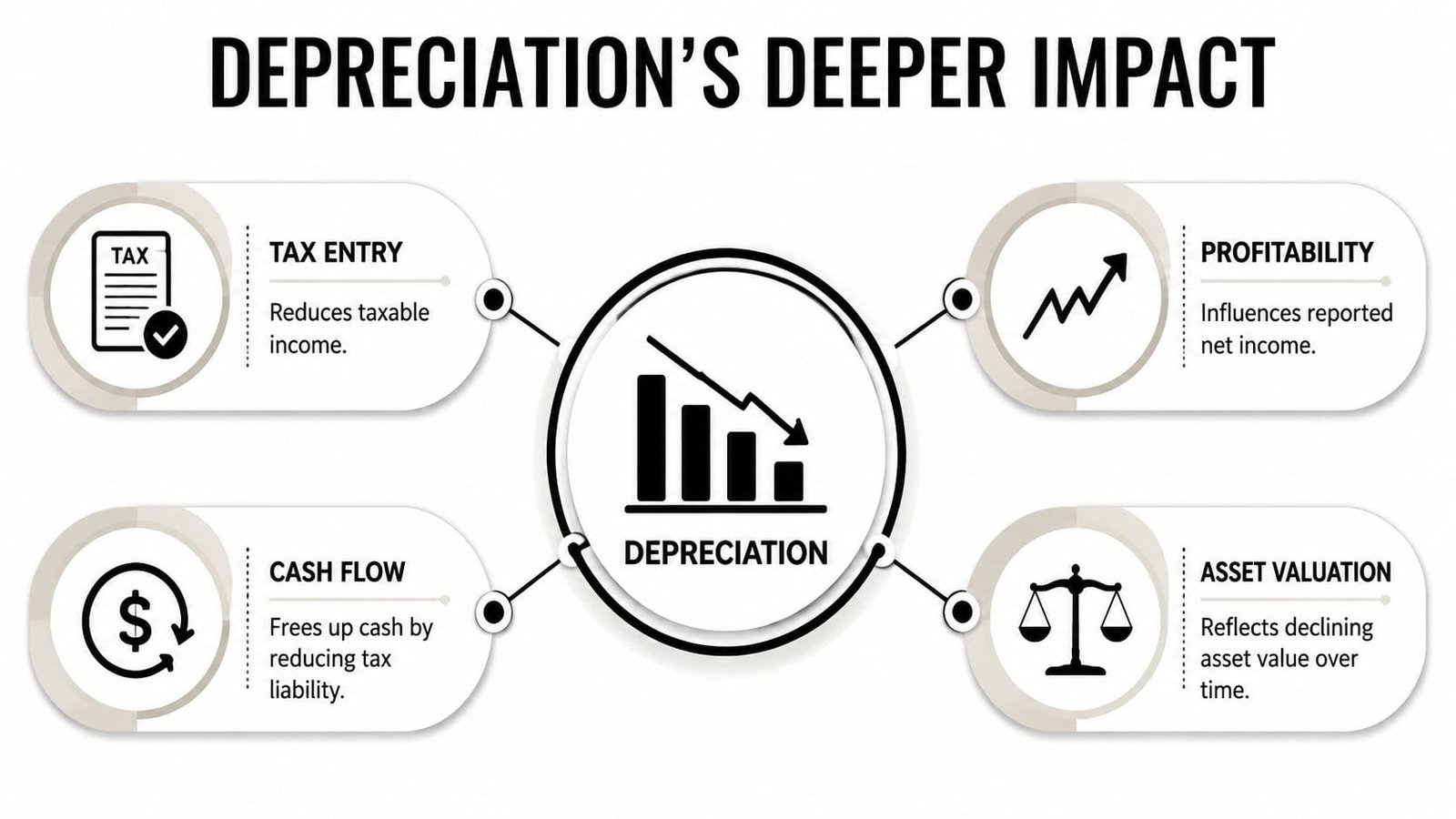
A new machine can improve production on day one and still reduce reported profit on paper. That is the part many owners miss. Depreciation lowers taxable income, but it also lowers net income and book value, so the same asset affects your tax return, your financial statements, and how outsiders judge your company.
The accounting view and the business view
The accounting view is the rulebook. You spread the cost of the asset over the years it is expected to help generate revenue, using a method that matches how the equipment is used. The business view is the management decision. You decide whether the asset is still earning its keep, whether replacement should be planned, and whether the statements match what is happening in the shop, on the route, or on the production line.
Owners often confuse book value with real operating value. A truck, press, or server can be heavily depreciated and still do useful work every day. A clear way to separate those ideas is to remember that depreciation measures accounting allocation, while the market decides resale value, and the asset itself decides whether it still supports revenue. A useful asset can keep producing long after its book value has dropped, and that distinction is why the conversation belongs in finance, not just tax prep.
Why the distinction matters
If you read depreciation as a resale estimate, you will misjudge both profitability and asset strength. If you treat it only as a tax deduction, you can miss the signal it sends about replacement timing, cash preservation, and borrowing capacity. The better approach is to see it as one of the links between operations, reporting, and financing.
A finance team has to keep book value, operating usefulness, and borrowing value separate, even when all three show up on the same schedule.
That separation matters when capital is tight and a lender is reviewing your numbers. A bank may care less about the tax deduction itself than about whether the equipment still produces, whether it can support collateral value, and whether your statements line up with the debt you are requesting. The same mindset also helps when reviewing circular economy furniture, because useful assets can retain business value well after the original purchase date.
Comparing Common Depreciation Methods
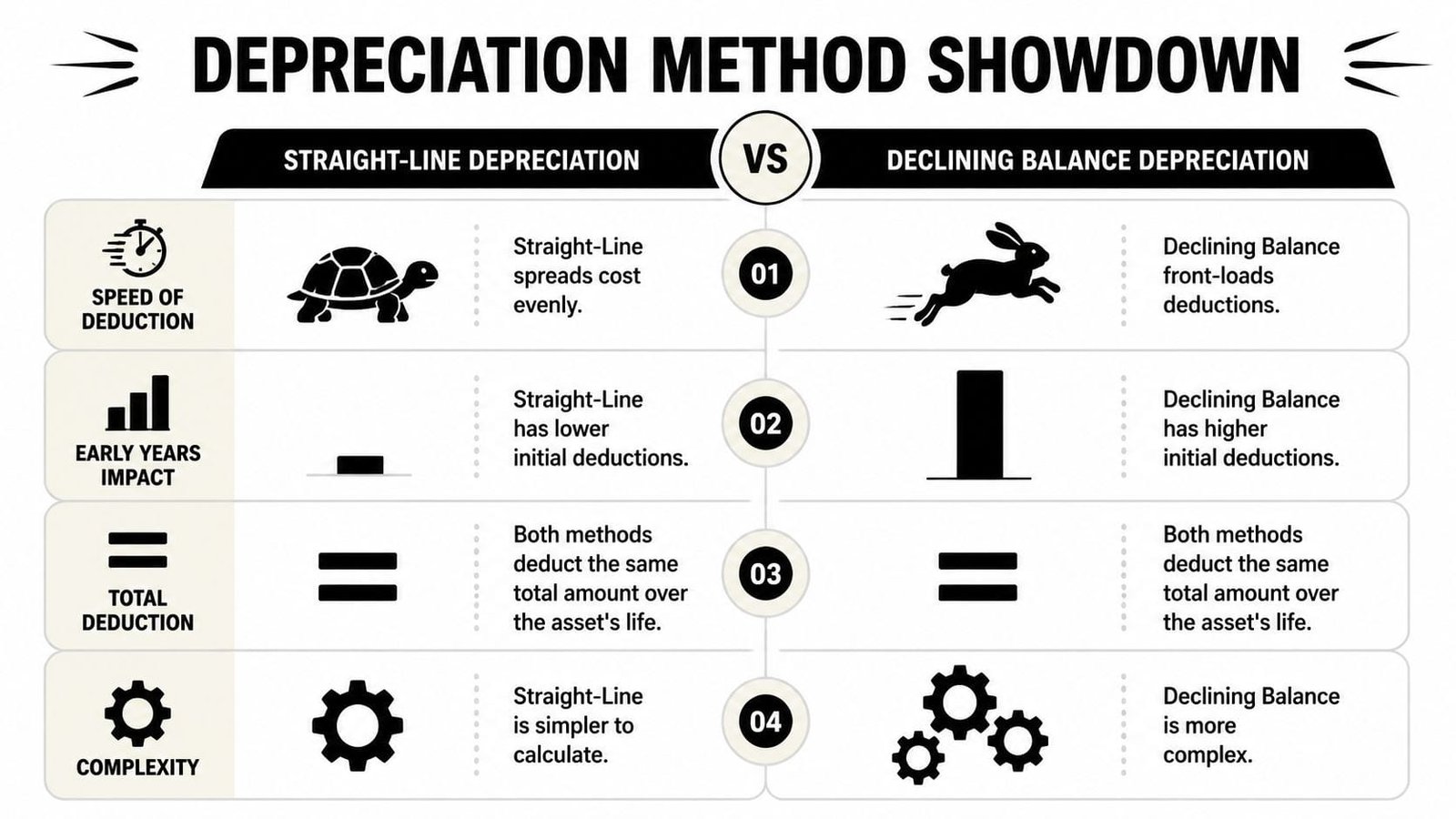
The method you choose changes when the expense appears, not the total amount you eventually recognize. That timing affects reported profit, taxable income, and the speed at which an asset's book value declines.
A good way to picture the difference is with loan payments. Straight-line depreciation works like a level payment, steady and predictable. Accelerated depreciation works more like heavier early payments, followed by smaller ones later.
Straight-line and declining balance side by side
The most common starting point is straight-line depreciation. The formula is simple, (cost minus salvage value) divided by useful life, and it creates the same annual expense each period. Managers can explain it easily, auditors can follow it easily, and forecast models usually handle it without trouble.
Declining balance, including double-declining balance, puts more expense into the early years. That can fit assets that lose value quickly or produce more economic benefit when they are new. It takes a little more work to track, but it can match equipment with fast obsolescence more closely.
The pattern changes with the asset itself. Computers and associated hardware usually wear out and become outdated sooner than heavy construction equipment, so their depreciation patterns rarely look the same. For a clean comparison of the mechanics, see the embedded chart on the differences between straight-line and declining balance depreciation methods for equipment accounting.
The business point is simple. A faster write-off can reduce taxable income sooner, which may help preserve cash for payroll, inventory, or the next equipment purchase. A steadier schedule can make earnings easier to read, which matters when a lender reviews statements for financing or covenant compliance, as explained in tax-smart business financing strategies.
Other methods owners run into
- Units-of-production: Best when usage drives wear, because the expense follows output instead of time.
- Tax systems like MACRS: Useful when the tax code sets the rules, even if management prefers a different internal schedule.
- Component approaches: Better for complex machines with parts that age at different speeds.
| Method | Expense Pattern | Best For | Complexity |
|---|---|---|---|
| Straight-Line Depreciation | Even expense over the useful life | Stable assets with steady use | Low |
| Declining Balance Depreciation | Higher expense early, lower later | Fast-obsolescing or heavily used equipment | Medium |
| Units of Production | Tied to actual usage | Equipment with variable output | Medium |
| Tax-Specified Methods | Set by tax rules | Filing and compliance | Varies |
The right method depends on the asset, the purpose of the schedule, and whether you care more about management reporting or tax reporting. For a useful visual on the mechanics, the embedded video below is worth a watch.
Bottom line: one method does not fit every asset, because a computer and an excavator do not lose value at the same pace. A short-life asset can justify faster expense recognition, while a long-life machine usually calls for a slower, steadier schedule.
A Canadian productivity-account update also showed that machinery and equipment depreciation rates shift when the underlying database and weighting method change, with the figures clustering around a similar range and implying an expected life of roughly 5 years. The same update noted that the U.S. average depreciation rate for machinery and equipment was lower than Canada's. Those findings are summarized in the official update at Statistics Canada's productivity-account publication.
Tax Accelerants Section 179 and Bonus Depreciation

Standard depreciation spreads cost over time. Tax accelerants do the opposite, they push more of that deduction into the current year so cash isn't tied up in tax payments longer than necessary.
The two tools owners ask about most
Section 179 lets qualifying equipment purchases be expensed in the year the asset is placed in service, subject to the tax rules that apply in that year. Bonus depreciation is different, because it can also accelerate deductions for eligible assets under the tax code, which makes it a separate lever from straight-line accounting. For tax planning, those tools often matter more for cash flow than for book reporting.
The right choice depends on the business's current tax picture, the type of asset, and how much immediate deduction helps the owner. If your company is trying to preserve liquidity for payroll, inventory, or a down payment on another piece of equipment, an accelerated deduction can be valuable. If your accounting team cares more about consistent earnings, the book schedule may stay separate from the tax election.
Where the planning gets practical
The main mistake is assuming tax depreciation and financial depreciation are the same thing. They're often not, and that's why a tax strategy can improve cash flow without changing how the asset appears in management reports. Owners who want to pair financing with tax planning can look at tax-savvy business financing strategies to see how borrowing decisions and deductions can work together.
A useful planning habit is to ask three questions before you buy:
- Will the asset qualify for accelerated tax treatment?
- Does the deduction help more this year or later?
- Will the tax election interfere with covenant reporting or lender expectations?
The answer isn't always obvious, especially when the asset also supports a loan request. Tax acceleration can be smart, but only if you know how it affects both the return and the broader financing picture.
Putting It on Paper Calculations and Journal Entries
The cleanest way to make depreciation concrete is to run one example from start to finish. Suppose you buy a piece of equipment, assign it a salvage value, and then spread the depreciable amount over its useful life using straight-line depreciation.
A simple straight-line schedule
The formula is (cost minus salvage value) divided by useful life. For a $100,000 asset with a $10,000 salvage value and a 5-year life, annual depreciation is a constant $18,000. That's the number you record each year if you're using straight-line depreciation for that asset, according to the calculation example in the equipment depreciation guide at EZO.
A basic schedule would look like this:
- Year 1: Beginning book value $100,000, depreciation $18,000, ending book value $82,000
- Year 2: Beginning book value $82,000, depreciation $18,000, ending book value $64,000
- Year 3: Beginning book value $64,000, depreciation $18,000, ending book value $46,000
- Year 4: Beginning book value $46,000, depreciation $18,000, ending book value $28,000
- Year 5: Beginning book value $28,000, depreciation $18,000, ending book value $10,000
The journal entry
The accounting entry is simple. You debit Depreciation Expense and credit Accumulated Depreciation. That keeps the cost of the asset visible while also showing how much of it has already been allocated through the income statement.
Accounting note: accumulated depreciation is a contra-asset account, so it lowers the carrying value without erasing the original purchase price.
A monthly schedule works the same way, just in smaller slices. That can help managers compare usage, maintenance costs, and financial reporting more closely. If your team needs a refresher on the mechanics of posting entries, this guide on how to do journal entries is a practical companion.
The important part is consistency. Once you set the method, the salvage value, and the useful life, your schedule should match your accounting policy and stay easy to trace.
How Depreciation Impacts Loans Covenants and Decisions
A machine can be fully depreciated on the books and still matter to a lender. That gap is where many owners get tripped up, because the tax schedule may say one thing while the equipment still supports production, cash flow, and borrowing capacity.
Book value is not collateral value
Depreciation is an accounting allocation, not a verdict on what the asset can still do. A machine with a low book value may still run well, support revenue, and provide real collateral support if the lender can verify its condition and marketability.
That difference matters inside a covenant test. If a lender measures debt levels, tangible net worth, or asset coverage, a faster drop in book value can make the ratio look tighter on paper even when the equipment is still useful in the business. The balance sheet can lag behind the shop floor, so lenders often want appraisals, maintenance logs, and clean asset records to see the full picture. The Federal Reserve's discussion of property and equipment treatment helps explain why accounting value and operating value do not always move together.
For a small business owner, that is a lot like watching two dashboards at once. One shows the accounting view, the other shows the machine's actual earning power. Both matter, but they answer different questions.
How owners should present the story
When a lender asks about an older asset, start with condition, maintenance, and how the equipment supports cash flow. Tax depreciation is part of the record, but it does not tell the whole story. If the asset is part of a trailer or transport fleet, it helps to review ANTS Trailers financing solutions with the borrowing base in mind, because the asset itself often drives the financing discussion.
Owners also need to separate financing choices from the urge to replace equipment too early. An asset that still produces profit may belong in service even if the books show very little value left. A replacement can wait if the equipment still supports covenant compliance, but it can move up fast if downtime rises or repairs start draining cash that should be used elsewhere.
For teams that watch debt terms closely, an internal early warning dashboard for covenant breaches can help spot pressure before the lender does. That kind of visibility is useful when depreciation, debt balances, and asset age are all changing at the same time.
Lenders care about the story behind the numbers, not just the numbers themselves.
Frequently Asked Questions About Equipment Depreciation
Owners usually ask these questions after the books, the tax return, and the equipment itself seem to tell different stories. The short answers matter most, because they help you decide what to do next with cash flow, financing, and the asset on your floor.
Can I depreciate used equipment
Yes, used equipment can usually be depreciated if it is used in the business and your tax and accounting rules allow it. The key issue is not whether the machine is new, it is whether it is producing business value and whether your depreciation method matches the reason you are tracking it.
When do I start depreciation
Depreciation starts when the asset is placed in service, not when you place the order and not when the invoice is paid. That distinction matters when equipment sits in storage for a while, because an idle machine does not begin its accounting life until it is ready to help generate revenue.
What happens if I sell it early
If you sell an asset before the end of its useful life, you may have to account for the remaining book value and any tax effects tied to the sale. On the accounting side, you stop depreciating it and remove it from the books. The tax result depends on the rules that apply to your situation and on how the sale is handled.
Why do depreciation rates vary so much
They vary because equipment does not wear out on the same schedule. As noted earlier, the official update summarizes Treasury discussion showing different depreciation patterns for consumer automobiles, producer automobiles, office equipment, and metal-working machinery, which reflects how quickly value can change in different commercial settings. The point is simple, each asset deserves its own review instead of being forced into one blanket assumption. The reference is the Treasury discussion summarized in Statistics Canada's official depreciation update.
What should I track internally
Keep the purchase date, placed-in-service date, cost, salvage value, useful life, and depreciation method together in one record. That file makes tax work easier, and it also gives lenders and appraisers a clearer picture when they ask how the equipment supports borrowing capacity and cash flow.
If you want help tying equipment purchases to financing, covenants, and cash flow decisions, visit Business Loan Warrior to see how an equipment-centered borrowing strategy can fit your next move. Their team works with owners who need capital, clarity, and a faster path from application to funding.