
Payroll is due on Friday. A major customer's invoice is still outstanding. Your sales report looks healthy, yet the bank balance says you have a problem today. That timing mismatch is where financing working capital can either protect a sound business or hide an expensive operational flaw.
The right question isn't whether you can get funding. It's what the money will cost, how long you'll need it, and whether your cash conversion cycle can repay it without squeezing the business. A fast approval can keep a company operating, but a poorly matched repayment structure can turn a temporary gap into permanent margin pressure.
Table of Contents
- When Cash Flow Gets Tight and You Need Options
- What Working Capital Financing Means
- Comparing Your Financing Options Side by Side
- How Businesses Use Working Capital Financing
- When Financing Masks Bigger Operational Problems
- Choosing the Right Option for Your Situation
- Preparing Your Application and Getting Approved
When Cash Flow Gets Tight and You Need Options
A commercial cleaning company can be profitable and still face a cash shortage. It pays employees every week, buys supplies before completing contracts, and waits for large customers to pay according to their terms. If two invoices arrive late at the same time, the owner may need liquidity before the underlying sales become cash.
That isn't a sign of failure. It's a timing problem. Working capital financing exists to cover the space between cash leaving the business and cash returning from customers. The funding becomes useful when the business knows the source and expected timing of repayment.
Canadian federal small business credit data shows how common this need is. Among small businesses requesting debt financing, 49% said they intended to use the funds for working capital in 2024, and the share remained 45% in 2025. Only 21% to 22% of requests were for fixed assets during that period. The same data says 36% of small businesses requested external financing in 2024, placing working capital demand within a recurring financing cycle rather than a rare emergency. Canadian small business credit condition trends
Advisor's rule: Borrow to bridge a known timing gap, not to disguise a business model that consistently spends more cash than it generates.
Start by separating the immediate shortfall from the reason behind it. A short-term line of credit may suit a seasonal dip. Invoice financing may fit a business with reliable commercial customers and slow payment cycles. A term loan may be appropriate for a defined inventory purchase, but it can be a poor choice for an unpredictable recurring gap.
Owners dealing with rising food costs or inventory exposure can also review practical cash flow solutions for SMBs before applying. For businesses affected by food-price volatility, this guide to working capital loans for rising food costs and inventory risk adds a more specific financing perspective.
The objective is simple: keep payroll, suppliers, and essential operations moving while the business converts earned revenue into collected cash. Financing helps when it buys time for a healthy cycle. It hurts when every new advance only funds the same unresolved delay.
What Working Capital Financing Means
Working capital is the cash gap between operating obligations and customer collections. In accounting, it is current assets, including cash, receivables, and inventory, minus current liabilities such as payables and short-term debt. For an owner, it is the funding that keeps payroll, suppliers, and daily operations running while payment schedules remain out of sync.
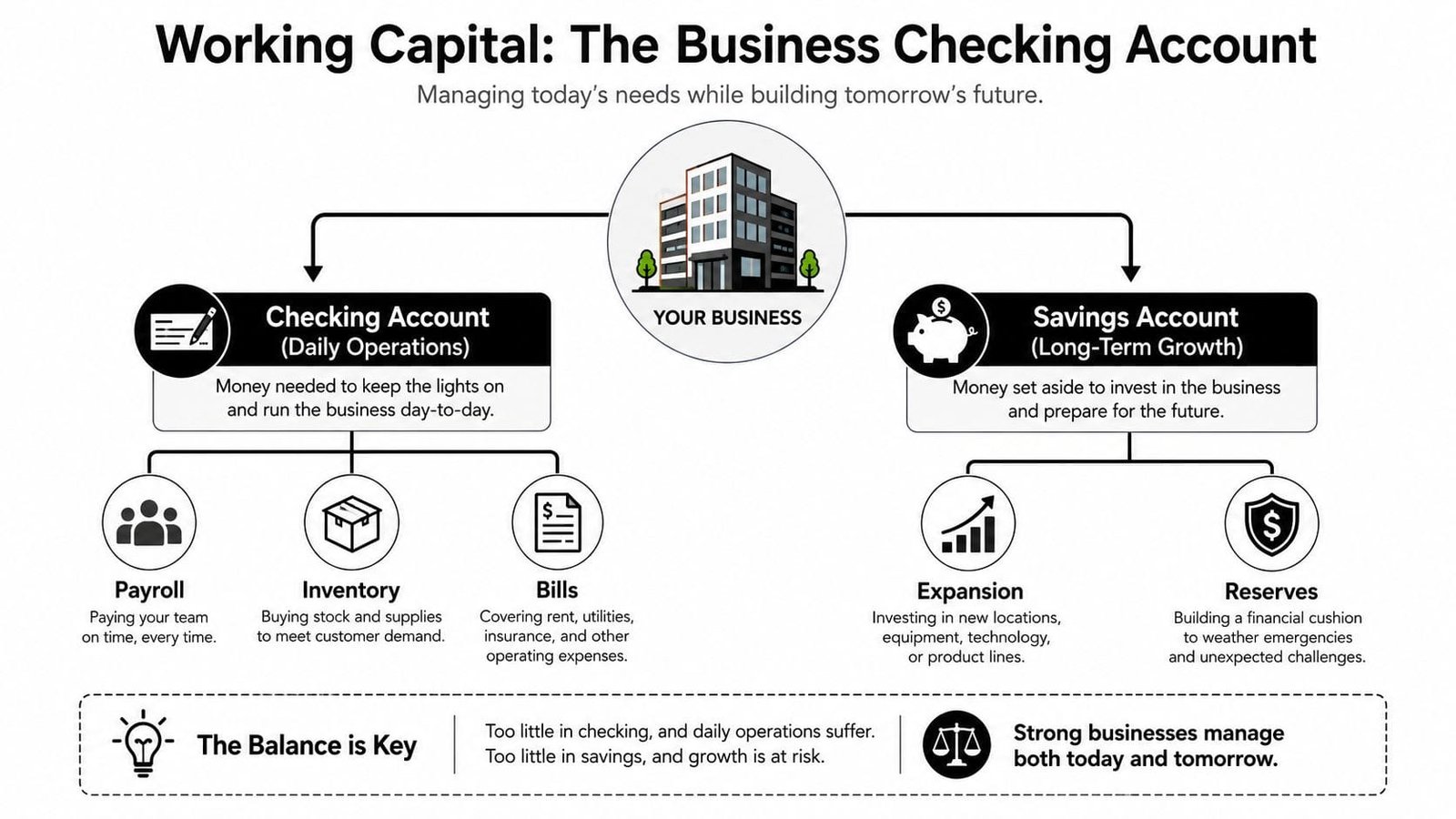
Separate operating cash from reserves:
- Checking account: Cash for payroll, inventory, rent, utilities, vendors, and ordinary operating expenses.
- Savings account: Cash reserved for expansion, equipment, acquisitions, unexpected disruption, or longer-term goals.
The checking account keeps the business open. The savings account preserves choices when conditions change. Working capital financing can supplement operating cash during a defined timing gap, but it should not replace reserves or cover a recurring shortfall caused by weak margins.
Follow the cash through the business
Four balances determine how much cash remains available:
- Accounts receivable is earned revenue that has not been collected. Strong sales do not fund payroll until customers pay.
- Inventory is cash held in products or materials. Excess stock traps money and creates markdown risk, while insufficient stock can interrupt sales.
- Accounts payable records bills owed to suppliers. Payment terms determine how long the business can retain cash.
- Cash on hand absorbs surprises and reduces reliance on expensive emergency funding.
The cash conversion cycle, or CCC, measures the time between paying for inventory or delivering work and collecting customer cash. A longer CCC ties up more money in receivables and inventory, increasing borrowing needs. JPMorgan's benchmarking approach considers CCC alongside cash and working-capital indexes when comparing operating performance. The guide to cash conversion cycle benchmarking offers useful context.
A profitable distributor can still face a cash crisis during growth. Stock purchases, new hires, and generous customer terms may all occur before collections arrive. The income statement shows sales, while the bank account carries the timing gap.
Review guidance on working capital for UK SMEs and working capital for businesses before choosing finance. Measure the CCC first. Borrowing is a strategic bridge when it funds a healthy cycle and a poor fix when it repeatedly covers the same operational delay.
Comparing Your Financing Options Side by Side
No financing product is universally cheapest. Banks usually win on pricing, while alternative lenders often win on speed and flexibility. Your choice should match the life of the cash gap, the reliability of repayment, and the cost of being delayed.
| Financing Type | Typical Amount | Funding Speed | Cost Range | Best For |
|---|---|---|---|---|
| Bank term loan | Varies by lender and borrower profile | Slower approval | Usually lower than fast alternative products | Established businesses with documented cash flow |
| SBA loan | Varies by program and lender | Slower, documentation-heavy | Often competitive for qualified borrowers | Planned working capital with stronger credit and patience |
| Business line of credit | Revolving facility sized by underwriting | Moderate to fast | Interest and possible account or draw fees | Repeating, uneven cash gaps |
| Invoice financing or factoring | Based on eligible receivables | Fast when invoices qualify | Advance and service fees reduce proceeds | B2B companies waiting on credible customers |
| Merchant cash advance | Based on sales history | Often very fast | Can be materially expensive | Short bridge only when repayment is highly predictable |
| Revenue-based financing | Based on revenue and provider structure | Faster than many banks | Flexible but potentially expensive | Businesses with recurring revenue and variable sales |
A bank term loan makes sense when the use is defined and the company can wait for underwriting. It gives predictable repayment, but lenders generally require stronger documentation, credit quality, and evidence that the business can service the debt. Don't use a fixed term loan for a cash gap that appears unpredictably every month.
An SBA loan can offer attractive economics for an eligible established company, but the process demands patience and financial detail. Recent comparison coverage cited established-business working-capital loans around 22.45% APR and SBA options around 9.50% variable, though actual pricing depends on the borrower, lender, structure, and market. Working capital financing cost comparisons
A line of credit is usually the most natural structure for fluctuating needs. You draw only when required and repay as collections arrive, but variable pricing and unused-facility fees can change the economics. Review this guide to a working capital line of credit before treating revolving access as permanent cash.
Invoice financing is compelling when invoices are valid, accepted, and owed by dependable customers. A UK market survey found typical advances of 80% to 90% of invoice value, with many providers charging service fees below 2% and setup averaging 6.2 working days. UK invoice finance benchmark data
Merchant cash advances and revenue-based products can fund quickly and adjust repayment to sales, but that flexibility often carries a higher effective cost. Treat them as emergency bridges, not default operating infrastructure.
How Businesses Use Working Capital Financing
A business can be profitable and still face a cash shortfall. Payroll may fall due during a seasonal slowdown, inventory may need to arrive before a high-demand period, or a supplier may require a deposit before customer receipts come in. These are legitimate timing gaps. Borrowing makes sense only when management can identify the cash event that will repay it and calculate the full cost of waiting for that cash.
The right question is not, “Can we get funding?” Ask what the financing does to the cash conversion cycle. If faster access to cash supports a profitable order, it can serve as a strategic bridge. If it repeatedly covers slow collections, excess inventory, or weak pricing, borrowing may conceal an operating problem while adding fees and interest.
Common operating patterns
A seasonal retailer might draw on a line before its busiest selling period, then reduce the balance as customer receipts arrive. A contractor may finance labor and materials while waiting for payment on a completed project. A wholesaler may use receivables financing when customers pay reliably but supplier terms demand cash sooner.
Marketing requires tighter controls. Borrowing for a campaign is reasonable only after the owner has tested the offer, mapped the expected collection path, and assessed weaker-than-planned results. A rigid daily repayment can strain cash before a campaign has time to produce revenue, especially when the total financing cost exceeds the campaign's likely contribution.
Growth creates a separate timing issue. A large account may require new hires, additional stock, or order fulfillment before the customer pays. That borrowing is strategic when the order produces sufficient margin and a defined repayment event. Management should still track whether growth is generating cash or merely increasing unpaid receivables.
Invoice finance is now a substantial source of business liquidity. One recent market estimate placed the global invoice finance and factoring market at $276 billion in 2026, compared with $206 billion in 2016, a roughly 34% increase. It estimated invoice finance at approximately 19% to 22% of SME working-capital financing across developed markets by 2026, including 28% in the United Kingdom, 21% in continental Europe, and 24% in Australia. These figures are market estimates rather than universal official measurements, but they show how receivables can function as formal financing collateral. Global invoice finance market estimate
Use the product only when the underlying receivables and sales cycle are sound. Watch the accompanying video for another practical discussion of business funding decisions.
When Financing Masks Bigger Operational Problems
A business that draws funds every month to cover ordinary payroll has a working-capital problem to diagnose, not just another facility to arrange. Review collections, inventory, supplier terms, pricing, and the timing of customer commitments before increasing debt.
The cash conversion cycle shows how long money remains tied up between paying suppliers and collecting from customers. A longer cycle traps more cash in receivables and inventory, so it offers a better diagnostic starting point than profitability alone. Benchmarking guidance can help you compare the cycle across periods and identify where cash is getting stuck.

Diagnose before you draw
Start with receivables. Review the aging report, identify overdue accounts, and assign clear responsibility for collections. Faster collection of existing invoices can reduce the need for new debt without harming customer relationships.
Check inventory next. Slow-moving stock consumes cash and may later require discounting. Smaller replenishment batches, tighter purchasing controls, and a narrower product range can release liquidity without adding a financing fee.
Supplier terms can shorten the gap between outflows and inflows. Negotiate payment dates that better match customer collections, then examine whether pricing supports the cash demands of each contract. A deal may produce accounting profit while requiring so much upfront spending that it weakens the business.
Deloitte's working-capital research reports only modest liquidity improvement in 2025, including a cash conversion cycle shortening of about 0.9 days year over year. Its priorities for resilience include forecasting, automation, and supplier collaboration for 2026. Deloitte working-capital management research
Operational test: If the same borrowing need returns after every collection cycle, financing is treating the symptom rather than fixing the cause.
Borrowing works as a strategic bridge when a specific invoice, seasonal event, or contracted opportunity provides a credible repayment event. It becomes expensive dependency when the business cannot identify that event and keeps paying for ordinary operating activity.
Set a review date before drawing. Compare the projected cash conversion cycle with the actual result, monitor collections and inventory movement, and stop using high-cost funding while the operating problem remains unresolved. Pair a modest facility with a concrete plan to improve the cycle and reduce the total cost of capital.
Choosing the Right Option for Your Situation
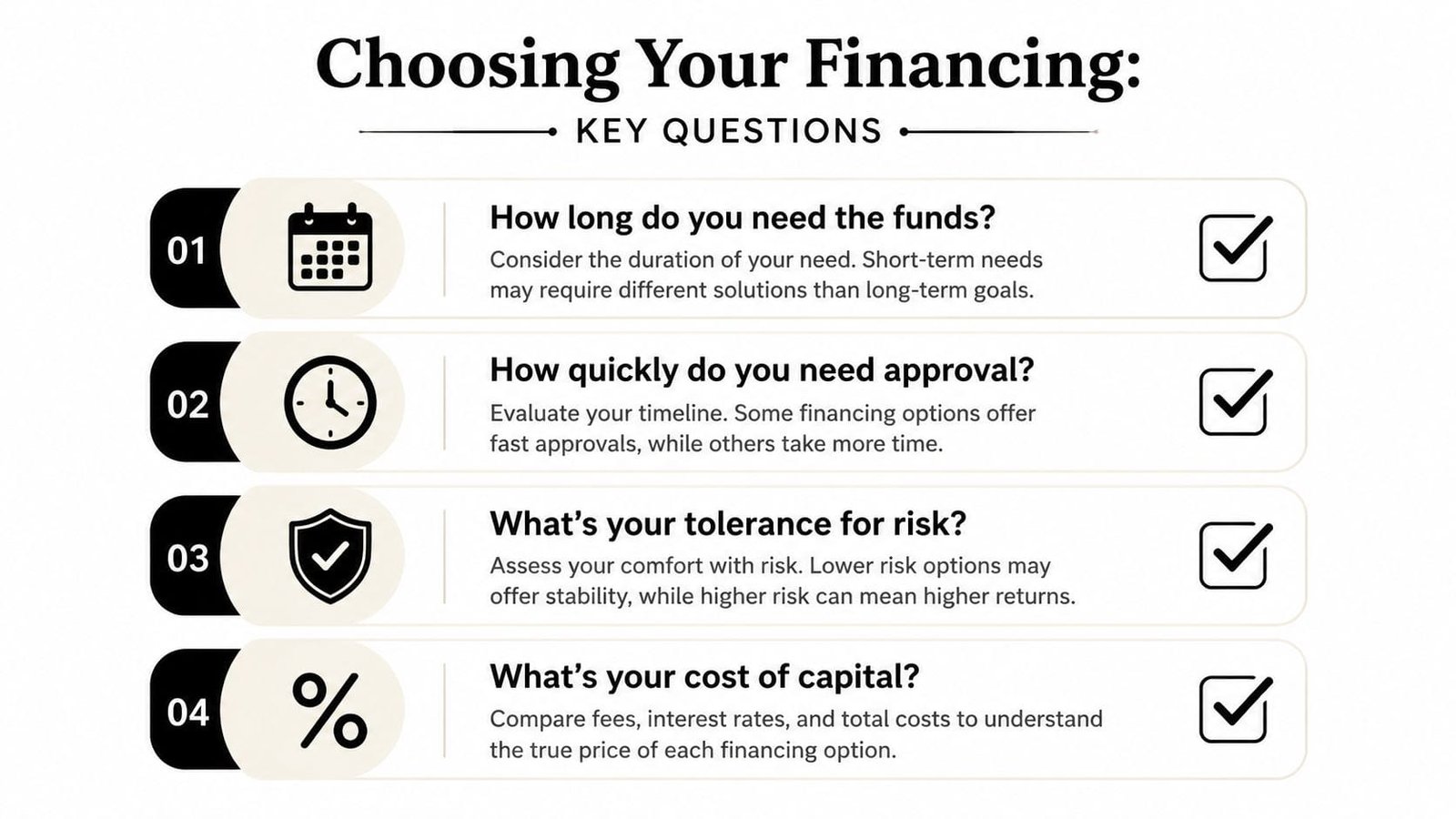
Use four questions before comparing lenders. They force the financing decision back to the business's actual cash pattern.
Start with the timing
How much do you need, and for how long? A defined invoice gap may call for receivables financing. A recurring but uneven need may justify a line of credit. A long repayment schedule can be dangerous if the asset or cash event lasts only briefly.
How quickly must the money arrive? If payroll is imminent, waiting for a low-cost bank product may not be realistic. If the need is several weeks away, use that time to improve documentation and compare lower-cost alternatives.
How volatile are sales and collections? Fixed payments work better when receipts are predictable. Variable repayment can fit uneven revenue, but providers may charge more for that flexibility. Never choose a payment structure that assumes your strongest sales month will repeat.
What risk can the company and owners accept? Review collateral requirements, personal guarantees, default triggers, reporting obligations, and whether the lender can sweep funds from operating accounts. A cheaper offer isn't cheap if its covenant structure creates a new operational threat.
Calculate the full cost
Don't compare a stated rate with a flat fee as if they were identical. Add origination fees, draw fees, servicing charges, factor costs, required reserves, prepayment restrictions, and the cash cost of repayment frequency. Then estimate the total dollars repaid and the period over which the capital remains outstanding.
For businesses in the $20 million to $50 million revenue range, standard small-business examples can be misleading. Larger companies may qualify for bank or SBA discussions yet still face covenant pressure, customer concentration, seasonal inventory, or slow enterprise collections. Ask lenders to underwrite the actual receivables and operating cycle, not just headline revenue.
Traction-based products can be relevant for businesses whose revenue history is stronger than their traditional credit profile. Fundl's traction-based funding strategy offers useful context for evaluating funding through demonstrated business momentum.
Business Loan Warrior can also be considered as one marketplace option for owners comparing business loans, SBA processing, lines of credit, invoice financing, and short-term products. Use any platform to compare structure and total repayment, not merely approval speed.
Preparing Your Application and Getting Approved
Lenders want proof that the business can repay. Prepare current financial statements, tax returns, business bank statements, accounts receivable aging, inventory details, and a concise plan showing how the funds will move through the business.
Reconcile the bank account before applying. Explain unusual deposits, overdrafts, customer concentration, and recent debt. State the cash gap clearly: amount required, purpose, expected inflow, repayment source, and fallback plan. This file should show whether financing bridges a timing problem or merely postpones an operational one.
Review every offer
Compare total repayment, payment frequency, fees, collateral, personal guarantees, renewal conditions, default language, and prepayment treatment. Convert any factor rate or revenue-based remittance into equivalent dollars. A fast offer with daily withdrawals can strain cash during a slow collection cycle.
Common mistakes include requesting an unsupported amount, submitting incomplete statements, hiding obligations, and waiting until a cash crisis damages the business. Apply while the company can still demonstrate control. Respond quickly to underwriting requests and keep collections and payment records clean.
The timeline varies by product and documentation. Prepare the file first, approach suitable lenders, and approve the final structure only after confirming that repayments fit the cash conversion cycle and the total cost justifies the bridge.
Business Loan Warrior helps owners compare working-capital funding, SBA loans, lines of credit, invoice financing, and short-term options through one application process. Visit Business Loan Warrior to review potential funding paths before a temporary gap becomes an expensive habit.