
A factor rate is a fixed decimal multiplier, typically 1.1 to 1.5, applied to the borrowed amount to determine total repayment upfront, not an annual interest rate. A $100,000 advance at 1.3 means you owe $130,000, regardless of how fast you pay it back.
You're reviewing a funding offer for payroll, inventory, or an urgent repair. The approval looks attractive, the lender highlights a factor rate of 1.3, and the number appears simple enough to understand. Many owners assume that means 30% interest. That assumption can lead to a costly decision because the repayment speed changes the effective annual cost dramatically, even though the factor rate itself never changes.
Table of Contents
- The Funding Offer on Your Desk
- How to Calculate Total Repayment With a Factor Rate
- Converting Factor Rate to APR for True Cost Comparison
- Factor Rate vs Interest Rate Loans in Real Scenarios
- Why Factor Rates Can Be Deceptive
- When Factor Rate Financing Makes Sense for Your Business
- Your Action Plan Before Signing Any Factor Rate Agreement
The Funding Offer on Your Desk
A restaurant owner receives an offer for a merchant cash advance. The paperwork shows a 1.3 factor rate, daily payments, and fast access to working capital. The owner sees “30%” and compares it mentally with a conventional annual interest rate.
That comparison is wrong.
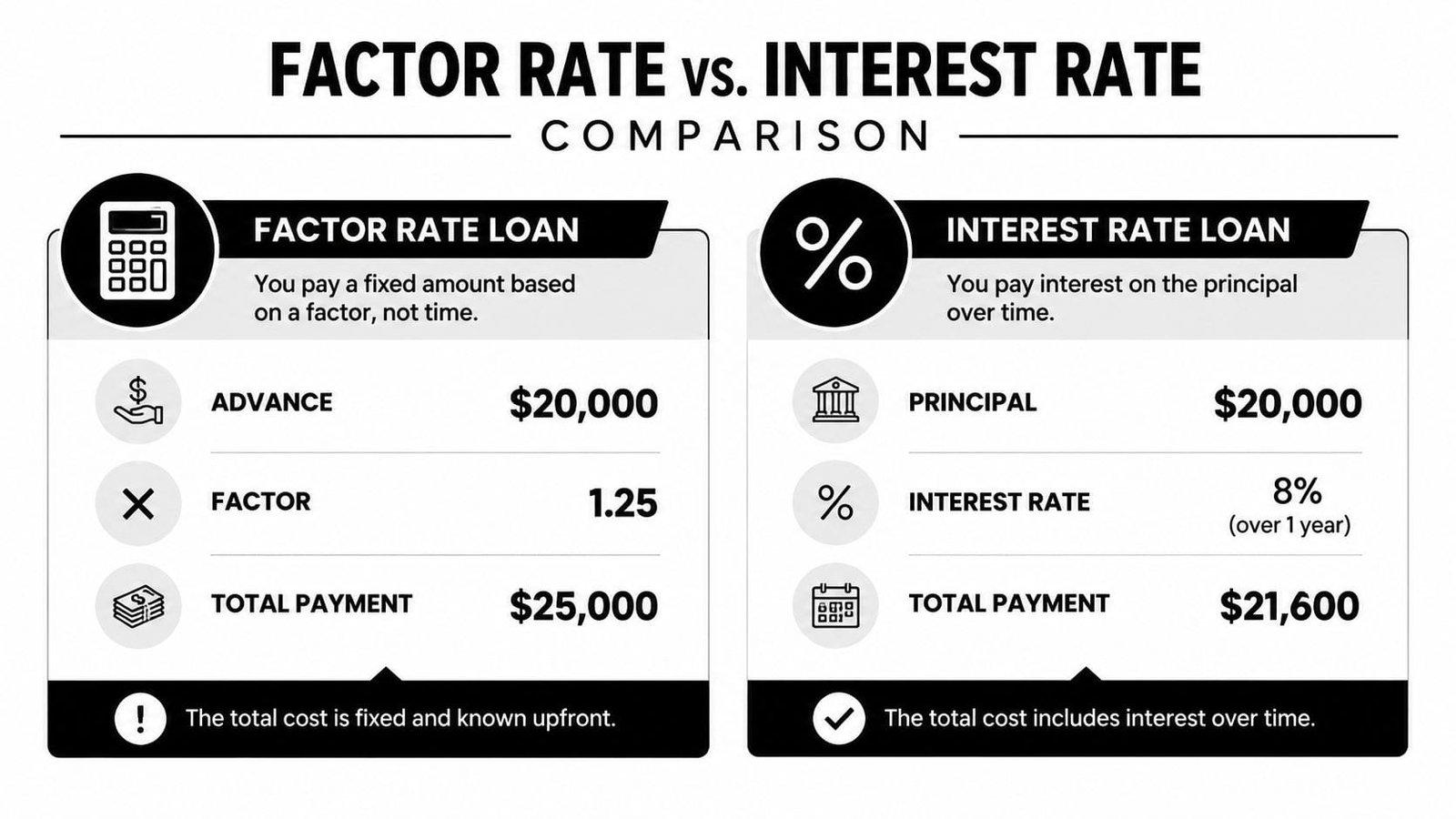
A factor rate is a fixed multiplier, not a percentage that accrues on a declining balance. The basic calculation is advance amount multiplied by the factor rate. A $100,000 advance at 1.3 creates total repayment of $130,000, so the financing cost is $30,000. The lender sets that total cost at origination rather than recalculating interest as the balance falls. This distinction is outlined in LendingTree's explanation of factor rates.
Where factor rates appear
You'll most often see factor rates in merchant cash advances, revenue-based financing, and other short-duration business-capital products. In a merchant cash advance, the provider commonly purchases a portion of expected future receivables rather than presenting the transaction like a traditional amortizing loan. Revenue-based products may connect repayment to sales, while other short-term products use fixed daily or weekly remittances.
The label matters because it affects how you evaluate the offer. A traditional interest-bearing loan generally calculates interest against an outstanding balance and expresses cost over time. A factor-rate product gives you a fixed payback amount, but the headline multiplier doesn't tell you how expensive the capital becomes when repayment happens quickly.
For owners researching funding strategy alongside marketing and operations, a practical home service business blog can help with broader business planning. But don't let operational advice distract from the financing math. Review the actual remittance schedule and total payoff, and use this merchant cash advance meaning guide to clarify the product before signing.
Practical rule: Treat every factor-rate offer as a fixed dollar obligation first, then evaluate how quickly the lender will collect it.
The most important question isn't “Is 1.3 high or low?” Ask instead: How much cash will leave the business, and over what period? The same multiplier can produce very different effective costs when the repayment schedule changes.
How to Calculate Total Repayment With a Factor Rate
The math is straightforward:
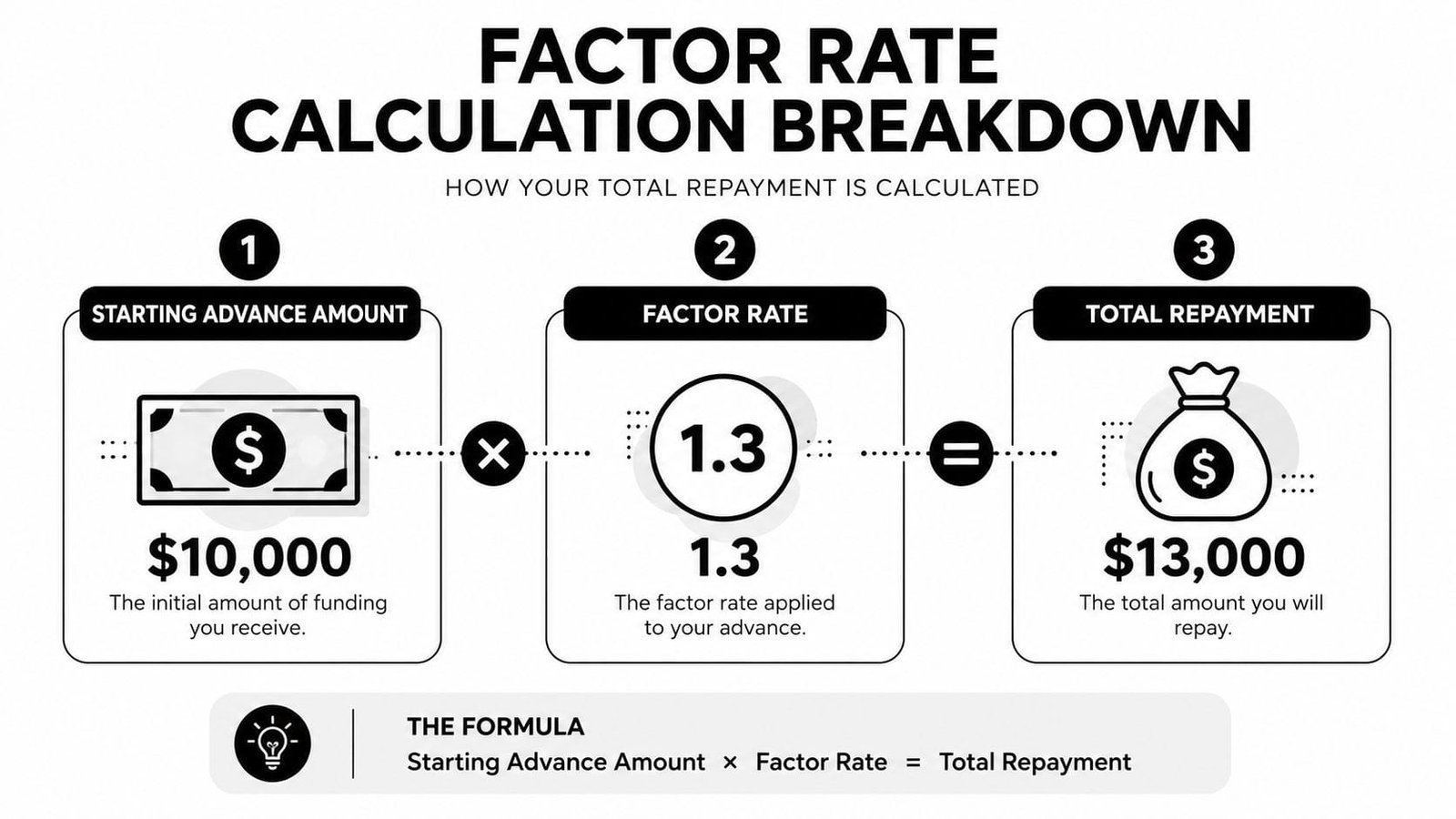
Total repayment = advance amount × factor rate
To find the financing cost, subtract the original advance from the total repayment:
Financing cost = total repayment − advance amount
That calculation gives you the amount the provider expects to collect in total. It doesn't yet tell you whether the offer is affordable for your cash flow, but it removes the first layer of confusion.
Three quick examples
- $50,000 at 1.2: $50,000 × 1.2 = $60,000 total repayment. The financing cost is $10,000.
- $100,000 at 1.3: $100,000 × 1.3 = $130,000 total repayment. The financing cost is $30,000.
- $250,000 at 1.45: $250,000 × 1.45 = $362,500 total repayment. The financing cost is $112,500.
These examples follow the fixed-multiplier structure described by Credibly's factor-rate guide. The dollar cost is established when the agreement begins. Paying the obligation faster doesn't reduce that fixed amount unless the contract specifically provides a written discount or reconciliation provision. You shouldn't assume an early payoff will produce the same savings available under some interest-bearing loans.
Why the payoff number comes first
Suppose two offers provide the same advance and use the same factor rate. Their total contractual repayment may be identical, but their impact on the business can be very different if one collects the balance over a shorter period. A fast schedule sends more money out of the operating account during each period, leaving less room for payroll, suppliers, rent, taxes, and unexpected expenses.
Watch for additional fees, origination charges, renewal costs, and contract language that changes the amount deposited. The multiplier only answers the fixed-payback question. It doesn't automatically reveal every cash-flow condition in the agreement.
Before comparing offers, write down four figures: the amount you receive, the total amount you repay, the remittance frequency, and the expected repayment period. Without all four, the factor rate is incomplete information.
Converting Factor Rate to APR for True Cost Comparison
APR gives you a time-based comparison. A factor rate doesn't. That difference is the hidden cost trap most basic explanations leave out.
Start with the same example, a 1.3 factor rate. On a $100,000 advance, total repayment is $130,000 and the fixed financing cost is $30,000. The simple cost relative to the advance is 30%, but that figure isn't annualized. To estimate an APR, you need to account for the actual repayment term.
A practical approximation works like this:
- Calculate total repayment with the factor-rate formula.
- Subtract the advance to find the dollar financing cost.
- Divide that cost by the advance amount to find the cost for the repayment period.
- Annualize the result based on the repayment term in months.
This approach is an estimate rather than a replacement for the lender's legal disclosures. It gives you a more useful comparison against a term loan or line of credit.
Same factor rate, different effective cost
Industry examples cited by Crestmont Capital's merchant cash advance analysis show that a 1.3 factor rate repaid over 6 months can translate to an estimated APR of about 60% to 80%. The same 1.3 factor rate repaid over 3 months can imply roughly 120% to 160% APR.
The repayment period changed. The factor rate didn't.
| Factor Rate | 3-Month Term APR | 6-Month Term APR | 9-Month Term APR | 12-Month Term APR |
|---|---|---|---|---|
| 1.1 | Not specified in verified data | Not specified in verified data | Not specified in verified data | Not specified in verified data |
| 1.2 | Not specified in verified data | Not specified in verified data | Not specified in verified data | Not specified in verified data |
| 1.3 | Roughly 120% to 160% | About 60% to 80% | Not specified in verified data | Not specified in verified data |
| 1.4 | Not specified in verified data | Not specified in verified data | Not specified in verified data | Not specified in verified data |
| 1.5 | Not specified in verified data | Not specified in verified data | Not specified in verified data | Not specified in verified data |
The brief doesn't provide verified APR figures for every cell in the requested table, so those figures should not be guessed. A blank-looking market estimate is better than fabricated precision.
The comparison method lenders don't lead with
Ask the provider to show the total dollar repayment, the expected payoff date, and the implied annualized cost. Then compare those figures with at least one interest-bearing alternative. The APR versus interest rate explanation can help separate a nominal rate from the broader cost measure, but your own agreement controls the final calculation.
A shorter collection period can make a factor-rate product especially punishing. Daily remittances may appear manageable individually, yet the fixed fee is being collected over fewer days. SMB Compass explains why faster amortization can sharply increase effective APR. That's why the repayment schedule belongs beside the multiplier in every funding comparison.
Factor Rate vs Interest Rate Loans in Real Scenarios
A factor-rate offer can be rational when speed or access matters, but it usually loses on cost against a conventional loan with a manageable term. The right comparison includes total repayment and operating cash flow, not just the approval speed.
Consider a restaurant seeking $80,000 for kitchen equipment. One option is a merchant cash advance at a 1.35 factor rate over 9 months. The factor-rate repayment is $108,000, producing a $28,000 financing cost before any separate fees. The repayment schedule would require the business to return that amount over the stated period, with the exact daily or weekly remittance determined by the contract.
The alternative is a term loan at 15% APR over 24 months. The exact amortization payment depends on the lender's calculation and fees, so don't present a precise total without the loan schedule. Still, the longer term spreads repayment across a wider period and can protect operating liquidity, even if the application takes longer or requires stronger qualifications.
A seasonal inventory decision
Now consider a retailer seeking $150,000 for seasonal inventory. A revenue-based advance at a 1.25 factor rate over 6 months creates total repayment of $187,500 and a fixed financing cost of $37,500. That may make sense if the inventory turns quickly and produces enough gross profit to cover the remittances without starving the rest of the business.
A business line of credit at 12% APR offers a different structure. The owner may draw only what the business needs, repay, and potentially reuse available capacity under the agreement. The final cost depends on the amount drawn, the balance over time, fees, and repayment terms, so the lender's disclosure must be reviewed rather than replaced with an invented total.
| Business need | Factor-rate structure | Interest-rate structure |
|---|---|---|
| Kitchen equipment | Fixed repayment of $108,000 on an $80,000 advance at 1.35 | Interest calculated under the lender's 15% APR schedule |
| Seasonal inventory | Fixed repayment of $187,500 on a $150,000 advance at 1.25 | Interest charged under the line's 12% APR and utilization terms |
| Cash-flow effect | Faster remittances can pressure daily operations | Longer or reusable access may provide more flexibility |
| Main trade-off | Speed and accessibility versus fixed cost | Lower-cost structure may require stronger qualification |
The factor-rate option may win when a supplier deadline is immediate, revenue is strong and predictable, and traditional approval isn't available. It becomes a poor choice when the equipment produces returns slowly or inventory may sit unsold.
Advisor's view: If the business can qualify for a reasonably structured term loan or line of credit, compare it first. Use factor-rate funding for a defined, high-confidence need, not as a default source of working capital.
Why Factor Rates Can Be Deceptive
Factor rates survive because they make a funding offer easy to quote. A lender can present one multiplier and one total payoff without leading with an annual percentage rate. That simplicity benefits the provider, but it can leave the owner comparing unlike products.
The problem isn't that the multiplier is mathematically unclear. The problem is that it removes time from the headline. A factor rate of 1.3 communicates the fixed payback relationship, but it doesn't reveal whether the provider collects that cost over a short period or a longer one. As the earlier APR comparison shows, repayment speed changes the effective annual burden substantially.

The disclosure and classification problem
Merchant cash advances are often discussed as purchases of future receivables rather than standard loans. That classification can affect how the provider describes pricing, repayment, and borrower protections. Public-sector and consumer-protection discussions have raised concerns that small businesses may not receive the same apples-to-apples APR presentation associated with consumer lending, as explained in this guide to MCA debt and its risks.
Read the contract, not the sales summary. Look for:
- Collection method: Determine whether payments are daily, weekly, or tied to revenue.
- Reconciliation language: Find out whether remittances can be adjusted when revenue falls.
- Personal exposure: Review guarantees, default provisions, and confession-of-judgment language.
- Restrictions: Check whether the agreement limits additional borrowing or requires a specific bank account.
Stacking can turn an expensive product into a cash-flow crisis
Stacking happens when a business takes a second or third advance while the first obligation remains active. Each provider may withdraw its own remittance, and the combined amount can consume operating cash before the owner pays employees, suppliers, taxes, or rent.
The risk isn't limited to the total fees. Several simultaneous withdrawals can make revenue volatility harder to absorb. If a slow week arrives, the business still faces the scheduled burden unless the agreements provide meaningful flexibility.
A lender that avoids a clear explanation of total repayment, collection frequency, and early-payoff treatment deserves extra scrutiny. If the offer sounds cheaper only because it avoids an APR comparison, treat that as a warning rather than a selling point.
When Factor Rate Financing Makes Sense for Your Business
Factor-rate financing isn't automatically wrong. It can serve a narrow purpose when the owner understands the fixed cost and has a reliable plan for repayment.
Seasonal companies may use it to purchase inventory before a known sales window. A business with strong daily card revenue may be able to handle frequent remittances without cutting essential expenses. An owner who can't qualify for a bank loan because of credit history, limited operating history, or documentation gaps may also view short-term funding as one of the few available options.
Those circumstances don't make the product cheap. They make the cost potentially defensible when the capital creates enough value quickly.
Use this decision screen
- Name the use of funds. “Working capital” is too broad. Identify the inventory purchase, equipment repair, payroll bridge, or contract opportunity the money will support.
- Calculate the fixed payoff. Multiply the advance by the factor rate and include every fee that reduces the deposited amount.
- Annualize the cost. Use the actual expected repayment period, not the provider's headline multiplier.
- Test the remittance against weak revenue. Model a slow period using your own sales history. If the payment threatens payroll or supplier obligations, reject the offer.
- Compare alternatives. Ask about a term loan, line of credit, SBA-backed financing, equipment financing, or invoice financing. Compare at least two other structures before accepting a factor rate.
- Review the contract. Confirm reconciliation rights, default triggers, collateral, guarantees, and restrictions on future borrowing.
Negotiate the schedule, not just the multiplier
A lower factor rate is useful, but repayment speed deserves equal attention. Ask whether the provider can extend the collection period or align remittances with the business's revenue cycle. A longer schedule may reduce the effective annual cost, although it won't automatically change the fixed dollar payoff.
Avoid stacking. If the business needs another advance to make payments on the first one, the original financing decision has already failed. Factor-rate capital should fund a specific, measurable business outcome, not cover a recurring operating deficit.
Your Action Plan Before Signing Any Factor Rate Agreement
Before signing, write the offer into a simple comparison sheet:
- Cash received: Record the amount that will reach the business bank account.
- Total repayment: Multiply the advance by the factor rate and add contractually required charges.
- Estimated APR: Annualize the financing cost over the expected repayment period.
- Remittance burden: Confirm the daily or weekly amount and test it against slower revenue.
- Early payoff terms: Ask whether paying early changes the fixed obligation.
- Existing obligations: Add every current advance or loan payment to the cash-flow forecast.
- Alternatives: Compare a term loan, line of credit, SBA loan, or another suitable product.
Don't sign because the multiplier looks familiar. Sign only when the total dollars, timing, and downside fit the business's actual cash cycle. For owners already dealing with heavy obligations, a practical motivation guide for indebted entrepreneurs can support the personal side of rebuilding, but the financial fix still starts with accurate repayment math.
Understanding factor rates puts you in control of the lender conversation. Once you translate the multiplier into total dollars and an annualized cost, the offer becomes comparable, and the decision becomes much less mysterious.
Business Loan Warrior can help you compare factor-rate financing with business loans, lines of credit, SBA funding, equipment financing, and other capital options through one application. Visit Business Loan Warrior to review funding paths, evaluate repayment structures, and choose capital that fits your cash flow instead of chasing a headline rate.