
Friday payroll is due, suppliers want payment, and your largest customer says its invoice will clear later. The business may be profitable on paper, yet the bank balance can't cover the timing gap. That's the situation a working capital loan is designed to address.
The simplest answer to what is working capital loan is short-term business financing for everyday operating needs, including payroll, inventory, rent, repairs, and other expenses that keep the doors open. It isn't usually meant for a building, major equipment purchase, or permanent expansion. The right amount and structure depend on when cash leaves the business and when customer payments arrive, not merely on annual revenue.
Table of Contents
- What a Working Capital Loan Solves
- The Cash Conversion Cycle Behind the Loan
- Four Common Types of Working Capital Financing
- How Lenders Qualify You for a Working Capital Loan
- Choosing the Right Product for Your Business
- Three Borrower Scenarios and the Loans They Picked
- Working Capital Loans Done Right
- Working Capital Loan Questions Owners Ask Next
What a Working Capital Loan Solves
A catering company has staff payroll due this week, a large produce order committed for upcoming events, and a corporate invoice that will not be paid for several weeks. Its contracts may support healthy future revenue, yet those promises cannot cover today's wages or supplier bills.
A working capital loan bridges the gap between outgoing operating costs and incoming customer payments. Businesses use this short-term financing for payroll, inventory, rent, repairs, utilities, and similar costs that keep daily operations running. Market guidance describes operating expenses as a common reason small businesses seek this type of funding. It also defines working capital loans as financing for short-term business needs.
The timing problem
Working capital measures liquidity, not profitability. A business can record a sale, buy materials, pay employees, and still wait weeks for the customer's invoice to clear. Financing covers that temporary gap, allowing the company to meet scheduled payments while it waits for earned revenue.
The distinction becomes clearer beside other forms of business funding:
- Expansion financing supports a new location, market, or lasting increase in capacity.
- Equipment financing pays for machinery, vehicles, or other long-lived assets.
- Equity financing brings in investor money in exchange for ownership, rather than scheduled repayment.
- Working capital financing supports the operating cycle that turns purchases and labor into collected revenue.
Growth can be a side effect, but the borrowing decision should begin with the cash gap. If the business is losing money repeatedly, a loan may delay the problem while adding another payment. If the gap comes from customer payment timing, supplier terms, or a seasonal buildup in inventory, short-term financing may fit the operating reality more closely.
Practical rule: Borrow for a timing gap you can explain, measure, and repay from identified business cash flow.
Review payment timing, supplier terms, the payroll calendar, and outstanding invoices before applying. This cash-flow improvement guide can help determine whether faster collections or adjusted expense timing would reduce the amount borrowed.
The required amount does not determine the product by itself. Occasional liquidity needs may suit a revolving facility. A business waiting on specific invoices may be better matched with financing tied to receivables. The cash conversion cycle provides the starting point for choosing between them.
The Cash Conversion Cycle Behind the Loan
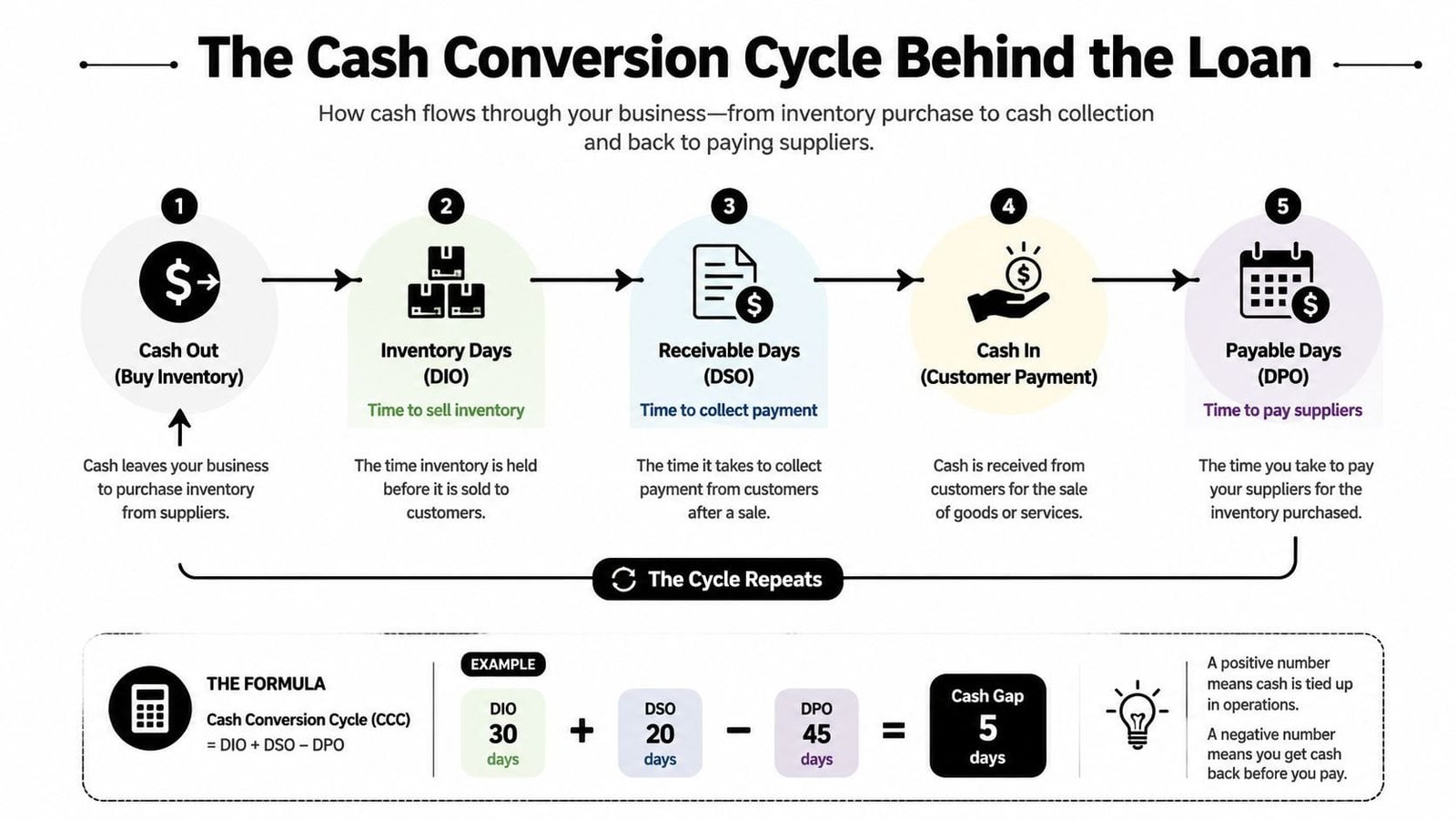
The cash conversion cycle, or CCC, measures how long business cash remains tied up between paying for operating inputs and collecting customer payment. The formula is:
CCC = days inventory outstanding, or DIO, + days sales outstanding, or DSO, − days payable outstanding, or DPO.
Each component answers a practical question:
- DIO: How long does inventory sit before it sells?
- DSO: How long does it take customers to pay?
- DPO: How long can the business wait before paying suppliers?
A B2B wholesaler might hold inventory for 60 days, wait 55 days to collect invoices, and receive 10 days of supplier credit. Its cash conversion cycle is therefore 105 days, calculated as 60 + 55 − 10. The business needs enough liquidity to bridge nearly 3.5 months of cash tied up in inventory and receivables, as explained in this MIT working capital lecture on the cash conversion cycle.
Turning the cycle into a borrowing estimate
Suppose that wholesaler spends cash steadily on inventory, wages, freight, and other operating costs. Its borrowing need should be based on daily cash burn multiplied by the period cash is unavailable, adjusted for cash already on hand and reliable incoming collections. Revenue by itself doesn't reveal that requirement.
A consulting firm may have a much shorter cycle because it carries little inventory and invoices soon after delivering work. If clients pay in roughly a month, the firm may need a smaller bridge than an inventory-heavy distributor with the same annual sales.
Reducing DIO through better inventory planning, lowering DSO through faster invoicing and collection, or negotiating longer DPO can shrink the financing requirement. Owners who want to connect this analysis to lender underwriting can review these Sage Intacct cash management insights.
A short, recurring gap often fits a line of credit. A longer gap supported by unpaid business invoices may fit invoice financing, while a predictable single purchase can justify a fixed-term loan. This cash conversion cycle borrowing-base framework offers another way to connect operating assets with available credit.
Four Common Types of Working Capital Financing
Owners usually encounter four practical structures. They all provide liquidity, but they differ in how money is accessed, how repayment happens, and how the lender prices risk.
Business lines of credit
A business line of credit gives you a maximum approved amount. You draw only what you need, pay according to the outstanding balance, and may draw again after repayment if the facility remains available.
That flexibility suits seasonal businesses and companies with irregular expenses. The drawback is behavioral. A line can become permanent debt if the owner keeps drawing without restoring the balance during stronger cash-flow periods. A business working capital line of credit can be useful when the operating gap recurs but doesn't require a new lump sum each time.
Short-term business loans
A short-term loan delivers a lump sum and uses a scheduled repayment plan. Monthly payments are easier to model than variable withdrawals, but the full balance begins creating repayment pressure immediately, even if inventory sells more slowly than expected.
This structure works best when you know the expense, the expected cash inflow, and the period over which the loan will be repaid.
Invoice financing
Invoice financing uses unpaid commercial invoices as the basis for liquidity. With factoring, a finance company purchases or advances against eligible receivables and may manage collection. An accounts-receivable line keeps the business relationship more directly under the owner's control while borrowing against qualifying invoices.
This option can match repayment to customer payment, but eligibility depends on invoice quality and customer creditworthiness. It can also cost more than a conventional revolving facility and may affect how customers experience the collection process.
Merchant cash advances
A merchant cash advance provides money upfront in exchange for a larger agreed repayment amount, commonly collected through daily or weekly remittances from card sales or business revenue. The product may be accessible when traditional credit isn't, but speed and convenience come at a steep price.
Established businesses may see bank lines priced around 8.5% to 16.5%, while SBA working-capital programs are commonly quoted around 9.75% to 13.25%, according to working capital finance pricing guidance. The same source notes that MCAs may use factor rates around 1.2 to 1.5, with effective APRs potentially reaching triple digits. Factor rates aren't directly comparable to APRs, so calculate the implied annualized cost before signing.
| Product | How It Works | Repayment | Typical Cost | Best Fit |
|---|---|---|---|---|
| Business line of credit | Draw and repay from an approved limit | Revolving payments based on usage | Bank pricing is often around 8.5% to 16.5% | Recurring or seasonal gaps |
| Short-term loan | Receive a lump sum for a defined need | Fixed monthly, weekly, or other scheduled payments | Varies by lender and borrower risk | Known inventory or operating expense |
| Invoice financing | Borrow against eligible unpaid invoices | Repaid when receivables are collected | Fees or discount pricing tied to invoices | B2B firms with slow-paying customers |
| Merchant cash advance | Receive an advance against future sales | Daily or weekly revenue remittance | Factor rates around 1.2 to 1.5, with high effective APR potential | Urgent funding for businesses with reliable sales |
How Lenders Qualify You for a Working Capital Loan
Lenders are trying to answer one question: Will the business generate enough dependable cash to repay this facility without damaging operations? They assess that question through several pieces of evidence.
The five areas underwriters review
- Time in business: Operating history gives lenders a record of sales, expenses, seasonality, and management decisions.
- Revenue quality: Underwriters examine the amount, consistency, and source of revenue. A large one-time sale isn't as persuasive as repeatable customer activity.
- Cash-flow consistency: Bank statements and financial statements show whether money arrives in time to cover obligations or whether the account regularly approaches zero.
- Collateral and guarantees: Some lenders may secure the facility with assets or require a personal guarantee. Read those provisions carefully because default can put business or personal assets at risk.
- Owner and business credit: Credit history helps lenders evaluate repayment behavior, existing obligations, and the likelihood of taking on more debt responsibly.
Banks generally place greater weight on documentation, credit strength, collateral, and established operating history. SBA lenders also require detailed underwriting because government-backed credit still carries application and repayment obligations. Online lenders may emphasize connected bank data and recent operating activity, which can make them more responsive to current cash flow but not necessarily less expensive.
| Qualification Factor | Traditional Banks | SBA Lenders | Fintech / Online |
|---|---|---|---|
| Time in business | Strong emphasis on operating history | Strong emphasis on history and documentation | May weigh recent activity heavily |
| Revenue | Verified financial statements and tax records | Detailed financial review | Bank or platform transaction data |
| Cash flow | Consistency and debt-service capacity | Historical performance and projections | Recent deposits and transaction patterns |
| Collateral | More likely to request it for larger or riskier facilities | May require available collateral and guarantees | Often more flexible, depending on product |
| Owner credit | Frequently important | Important to approval and terms | May be weighted alongside business performance |
Prepare bank statements, a current profit and loss statement, accounts-receivable aging, supplier obligations, and a clear explanation of the cash gap. Applying with a defined use and repayment source helps the lender distinguish a temporary bridge from a business that is borrowing just to stay afloat.
Choosing the Right Product for Your Business
Match the financing structure to the way cash moves through your company. The most useful question isn't, “How much can I get?” It's, “What event will repay this money, and when will that event occur?”
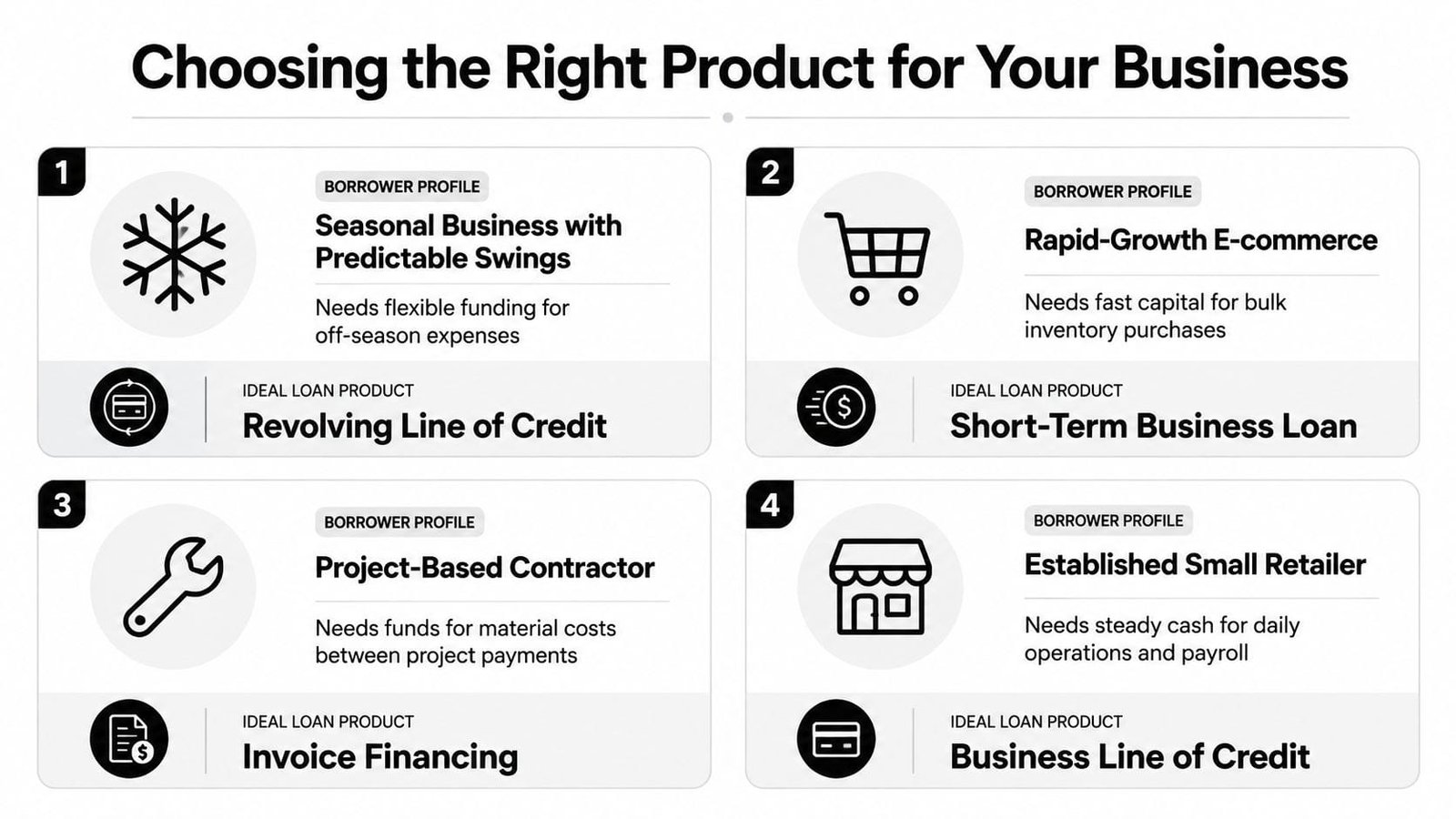
A seasonal business with predictable swings often fits a revolving line of credit. The owner can draw during the slow period, cover payroll or recurring bills, and reduce the balance when seasonal receipts return. Interest applies to the amount used, but the owner must avoid treating the available limit as permanent spending power.
An inventory-heavy retailer or fast-growing e-commerce company may prefer a short-term loan for a specific bulk purchase. A fixed amount and scheduled payments make the commitment visible, but the repayment plan must leave enough room for inventory that sells slower than forecast.
A B2B company with long payment terms may be better served by invoice financing. The facility follows eligible receivables rather than relying entirely on the owner's general cash position. That can make sense when customers are creditworthy but pay slowly.
A founder with thin credit and an urgent sales-driven need may encounter merchant-style financing. It can be easier to access, but a high remittance can drain daily cash and make a weak month worse.
Use this decision check
- Identify the gap: Is the need caused by inventory, receivables, seasonality, or an unexpected operating bill?
- Name the repayment source: Will repayment come from customer invoices, seasonal sales, or regular monthly cash flow?
- Match cadence to receipts: Don't accept daily withdrawals if your customers pay monthly.
- Compare total cost: Convert fees and factor rates into an annualized estimate.
- Test a slower month: Make sure repayment remains affordable if sales arrive later than planned.
Recent lending data points to growing use of non-bank funding where speed matters, but that convenience can carry higher costs. Small-business funding trend data from OnDeck describes a shift toward non-bank borrowing and increased interest in receivables-based liquidity, reinforcing the need to compare structure, not just approval speed.
Three Borrower Scenarios and the Loans They Picked
The following examples are illustrative decision exercises, not reported case studies. Each business has a different operating pattern, so each reaches a different financing choice.
A neighborhood restaurant
A neighborhood restaurant experiences a predictable winter slowdown. Its rent, core payroll, and supplier bills continue even while customer traffic drops.
The owner forecasts the slow months, identifies the recurring operating shortfall, and seeks a revolving line rather than taking a full lump sum. The line fits because the need comes and goes with the season. The owner draws only what is required and plans to reduce the balance when normal sales resume.
The qualifying step is a review of deposits, expense history, existing obligations, and the seasonal pattern. A lender can assess whether the business has historically recovered after the slow period, rather than judging the request only from one difficult month.
A local wholesale distributor
A distributor wins a large contract and must purchase inventory before receiving payment. Its problem isn't a lack of demand. It's the time between paying the supplier and collecting from the customer.
A short-term business loan may fit this single, defined purchase because the owner knows the amount needed and expects the contract to generate the repayment cash. The owner should still test delivery timing, customer payment terms, freight costs, and the possibility of delayed acceptance before accepting fixed payments.
This structure wins when the need is a discrete event rather than a recurring borrowing cycle. If the distributor repeatedly finances the same receivables, invoice financing or an accounts-receivable facility may create a closer match.
A freelance marketing agency
A marketing agency has completed client work, but several invoices carry extended payment terms. Payroll is due before those customers pay.
Invoice financing may advance liquidity against eligible receivables while the agency waits for collection. The owner must review advance fees, reserve mechanics, customer-notification rules, and whether the financier will contact clients directly.
The agency's qualifying step is invoice quality. The lender will care about who owes the money, whether the work was accepted, whether disputes exist, and when payment is expected. That is a different underwriting question from the restaurant's seasonal revenue pattern or the distributor's purchase order.
These examples show why the same requested amount can produce different recommendations. The cash conversion cycle, repayment source, and operating volatility matter more than the label attached to the loan.
Working Capital Loans Done Right
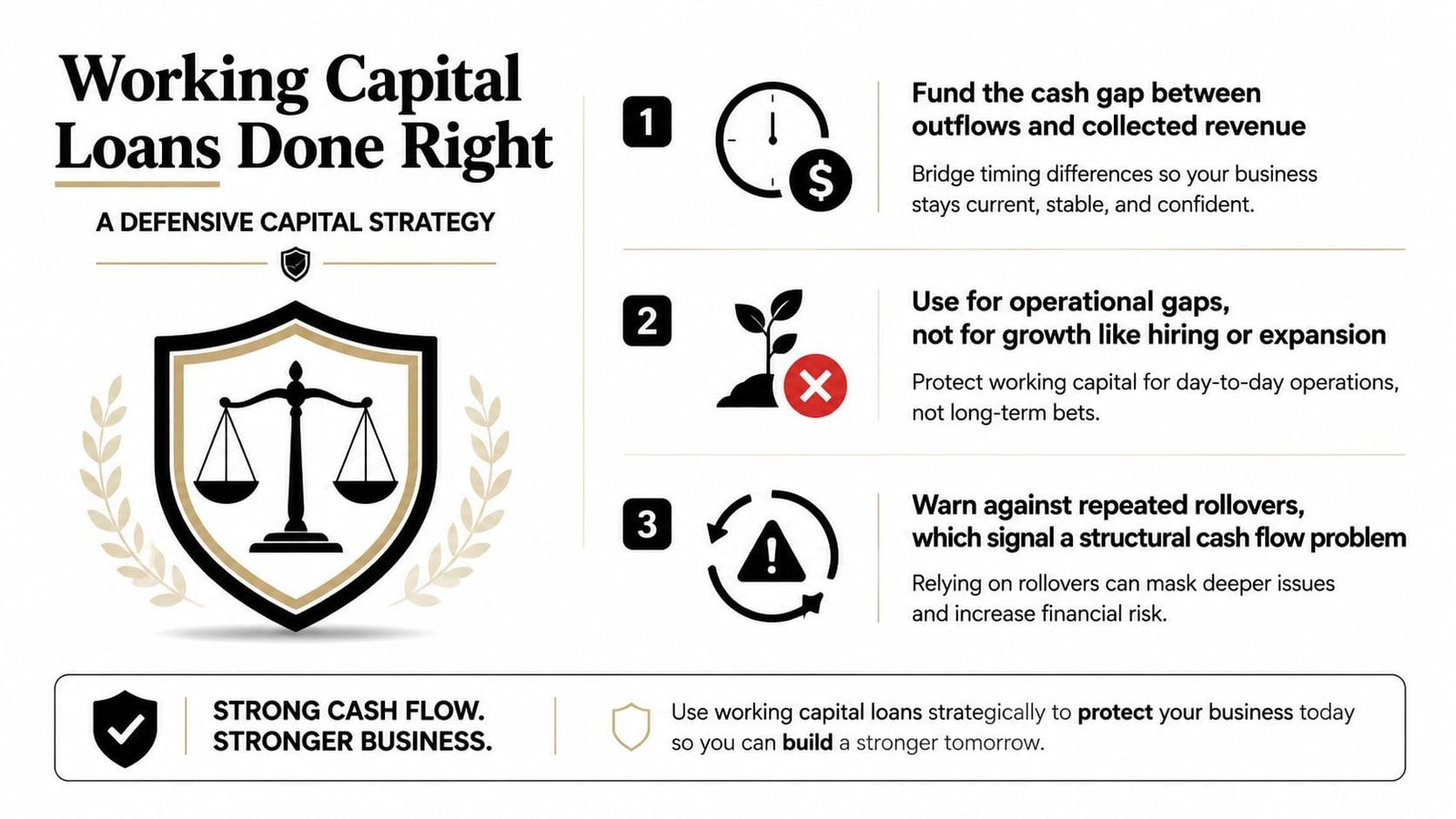
Working capital debt works best as defensive capital. It protects continuity while the business waits for cash already supported by sales, invoices, or a predictable seasonal recovery. It shouldn't become a substitute for fixing prices, collections, staffing levels, supplier terms, or an expense base that permanently exceeds revenue.
Repeatedly refinancing payroll or rent deserves a pause. If every repayment creates the next emergency, the business may have a structural cash-flow problem rather than a temporary operating gap. Another advance can provide relief today while reducing tomorrow's available cash.
Before applying, complete this checklist:
- Measure the gap: Write down the exact expense, amount, start date, and expected repayment date.
- Forecast the near term: Build a rolling cash-flow forecast that shows payroll, suppliers, taxes, rent, debt payments, and expected collections.
- Compare true cost: Convert factor rates and fixed fees into an annualized estimate, then include origination charges and other contractual fees.
- Review personal exposure: Check whether the lender requires a personal guarantee, blanket lien, or collateral.
- Match repayment to receipts: A business paid monthly by customers may struggle with daily ACH withdrawals, even if the total repayment appears affordable.
The cheapest financing isn't always the facility with the lowest advertised rate. It's the financing that covers the measured gap, fits the collection schedule, and prevents another emergency borrowing decision.
Working Capital Loan Questions Owners Ask Next
A payroll deadline is close, customer payments are still pending, and a lender offers fast funding. Four questions should guide the decision before you sign.
What does it really cost? Begin with the total repayment amount, then examine how it is collected. A factor rate, daily remittance, origination fee, and other charges can make an offer look cheaper than it is. Estimate the annualized cost so you can compare it with credit priced by APR. The right comparison is the amount leaving the business and the timing of each payment.
How quickly can funding arrive? Banks and SBA lenders generally request more documents and take longer to review an application. Online lenders may fund faster. Invoice financing follows a different timetable because the lender must verify invoices and establish the financing arrangement. Speed helps only when the repayment schedule still fits incoming cash.
Can an SBA loan fund working capital? Yes. SBA 7(a) financing can support working capital. More than 70,000 SBA 7(a) loans totaling about $31 billion were approved in fiscal 2025, according to the SBA fiscal 2025 lending summary. SBA credit can provide a structured option, but applicants still need detailed financial information and lender review.
Will applying affect credit? Ask whether prequalification uses a soft inquiry and when the lender runs a hard inquiry. Review personal-guarantee terms and business-credit reporting before submitting a formal application.
| Question | Short Answer | Watch Out For |
|---|---|---|
| What does it cost? | Compare total repayment and annualized cost | Factor rates can hide the effective APR |
| How fast is funding? | Timing depends on the product and lender | Fast approval may require costly remittances |
| Can SBA financing be used? | SBA 7(a) financing can support working capital | Documentation and underwriting take time |
| Does applying affect credit? | Prequalification may use a soft inquiry | Formal applications and guarantees may create exposure |
Business Loan Warrior provides one application flow for business loans, lines of credit, SBA processing, short-term financing, invoice financing, and merchant cash advances. Review the cash conversion cycle and repayment capacity first, then visit Business Loan Warrior to compare structures for the operating gap.