
Maria owns a regional HVAC company generating $28 million in annual sales. On Friday afternoon, a major commercial customer delays payment, a supplier wants a deposit, and payroll is due Tuesday. Her bank has the lowest advertised rate, but the loan officer is unreachable until Monday, the application requires another round of documents, and the approval timeline remains unclear.
That situation is common among established companies generating $20 million to $50 million in sales. Revenue can look impressive while cash remains trapped in receivables, inventory, projects, and seasonal operating cycles. Digital lending platforms address that mismatch by replacing much of the paper-heavy process with online intake, connected financial data, automated analysis, and electronic servicing.
The important question isn't whether a platform can deliver a faster application. Most can. The question is whether its underwriting model sees enough of your business to produce a better credit decision, or whether it rejects you faster.
Table of Contents
- Why Digital Lending Platforms Matter for Today's Small Business
- What Digital Lending Platforms Are
- How Small Businesses Benefit From Going Digital
- Digital Lending Compared to Traditional Bank Loans
- A Practical Vendor Evaluation Checklist
- Real Use Cases for Established Small Businesses
- Risks and Blind Spots Most Owners Overlook
- Your Next Step Toward the Right Platform
Why Digital Lending Platforms Matter for Today's Small Business
Maria doesn't need a motivational speech about innovation. She needs working capital before payroll, and she needs a lender that can understand why a profitable contractor may show uneven monthly balances.
A traditional bank often evaluates a business through tax returns, financial statements, collateral, guarantor strength, and relationship history. Those inputs matter, but they can miss the operating signals inside a company's bank activity. A growing HVAC company may have strong contracted revenue and reliable customer payments while carrying substantial receivables and project costs. A static snapshot can make that company look weaker than its underlying operations.
Digital lending platforms change the intake and analysis process. They can collect applications online, connect to bank accounts and accounting systems, verify documents electronically, and route the file through automated decision rules. The result is a lending process built around data movement rather than repeated email requests and branch meetings.
The market direction is clear. The global digital lending platform market was estimated at USD 10.55 billion in 2024 and is projected to reach USD 44.49 billion by 2030, with a projected 27.7% CAGR from 2025 to 2030, according to Grand View Research's digital lending platform market analysis. For an established small business, that growth matters because digital origination is becoming infrastructure, not a novelty.
Access matters more than application speed
The strongest platforms don't merely compress a slow process into a quick rejection. They use cash-flow underwriting, bank-data connections, and alternative signals to assess repayment capacity beyond bureau scores and conventional collateral.
FinRegLab's analysis of more than 38,000 small-business loans from two fintech lenders found that adding cash-flow variables to personal credit scores and other traditional inputs improved default-risk prediction across every borrower segment studied. The strongest gains appeared among businesses under five years old and entrepreneurs with low credit scores, as documented in the FinRegLab analysis summarized by B2B News Network.
That doesn't mean a digital platform approves every strong operator. You still need clean books, consistent deposits, reasonable debt levels, and a specific use of funds. The advantage is that a qualified borrower has a better chance of being judged on current operating reality instead of an incomplete financial snapshot.
What Digital Lending Platforms Are
A digital lending platform is the operating software behind a loan application, from intake through repayment. It may serve a bank, fintech lender, marketplace, or investor group. The platform may not supply the money, so identify who makes the credit decision, owns the receivable, and handles disputes before you sign.
For an established U.S. business generating $20M–$50M in sales, that distinction matters. A polished interface can collect documents quickly while applying a credit policy that rejects a financially sound company. The platform improves access only when its data connections and underwriting process help the lender evaluate the business properly.
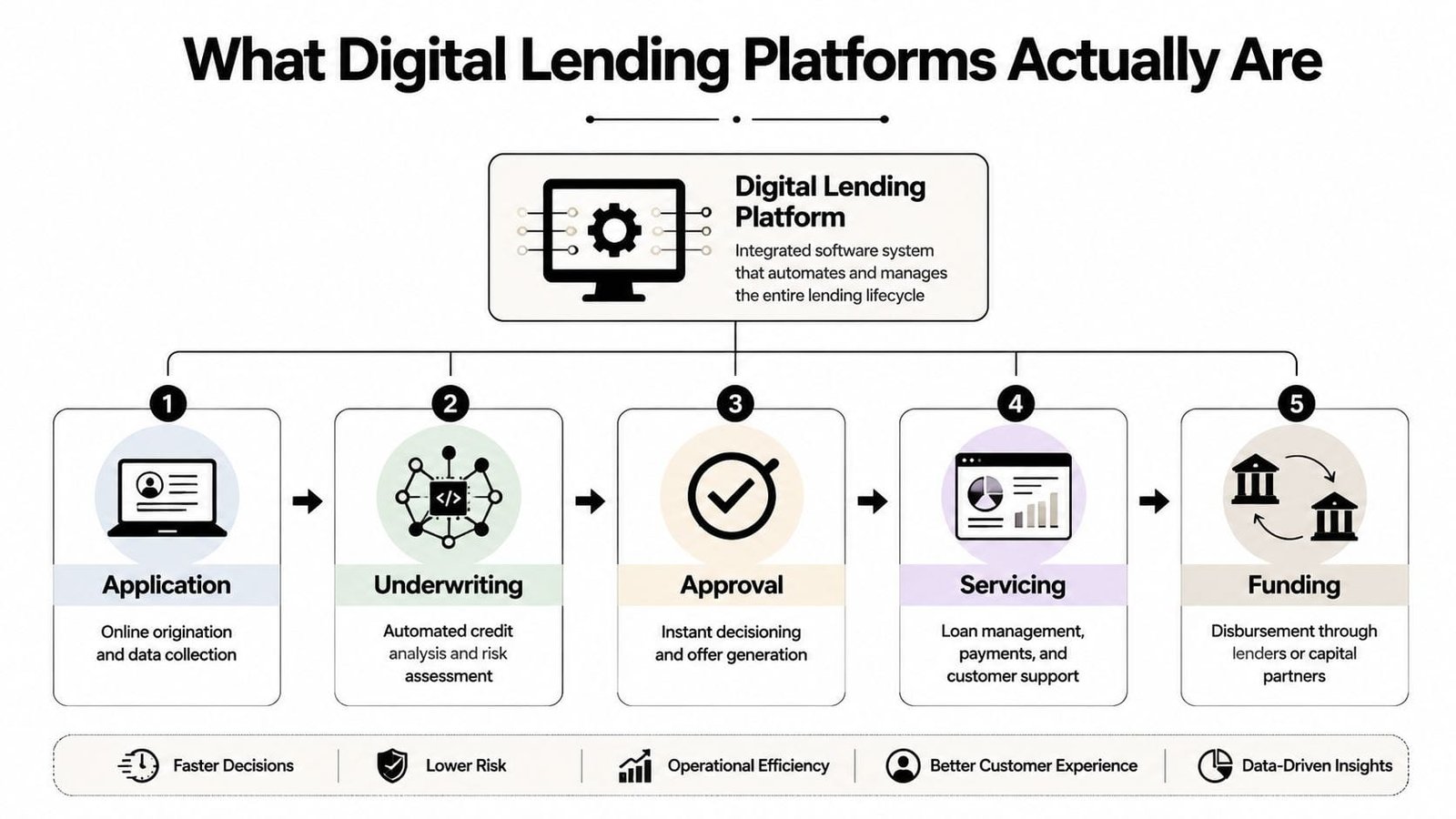
The four operating layers
Application capture: The owner enters company information, ownership details, requested amount, and intended use of funds. The platform may accept accounting feeds from QuickBooks or Xero, bank statements, payroll data, and uploaded financial documents.
Underwriting: The system reviews bank activity, credit history, revenue patterns, balances, deposits, liabilities, and other approved data. Some lenders pair automated analysis with human review, which can matter when a growing company has complex cash flows.
Decisioning: Rules test whether the file fits the lender's credit policy. The platform may assign a risk grade, recommend a loan structure, and calculate pricing from the lender's model. Faster rules do not improve approval odds unless the inputs reflect current operating performance.
Servicing: After closing, the system manages payment schedules, automated withdrawals, statements, reporting, customer messages, and collections workflows.
The funding source may be a bank, nonbank lender, or investors participating through a marketplace. Peer-to-peer lending helped normalize digital credit matching. The global market was estimated at USD 5.07 billion in 2022 and projected to reach USD 21.42 billion by 2030, according to Mordor Intelligence's peer-to-peer lending market report.
For a clearer explanation of how borrowers connect with multiple funders, review this guide to online business loan marketplaces. Then identify the lender behind the interface. The software brand controls the workflow, while the capital provider controls approval criteria and contract terms.
How Small Businesses Benefit From Going Digital
Digital lending delivers its strongest value when the platform has access to useful operating data and the lender knows how to interpret it.
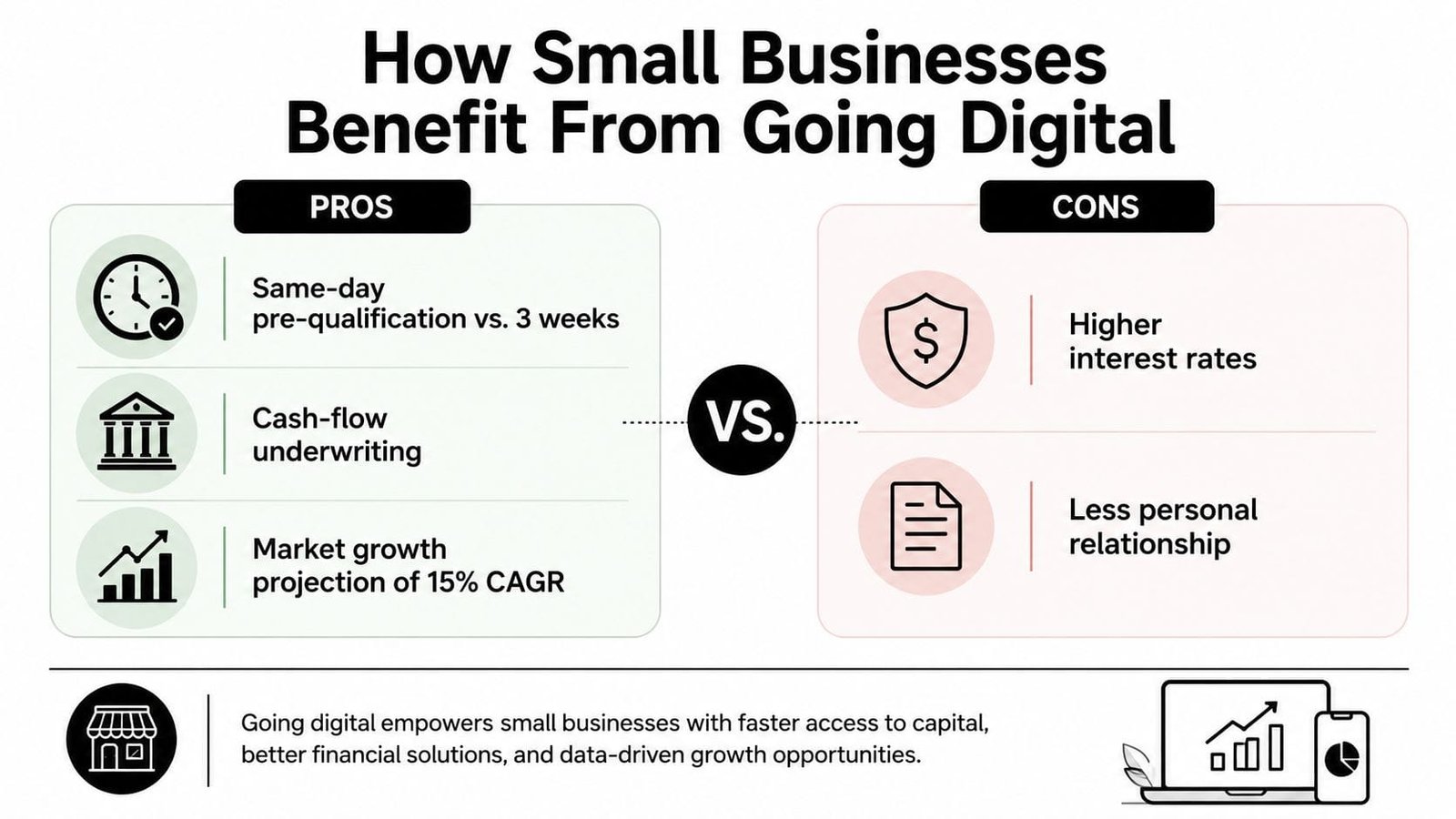
For an established business, the first benefit is reduced friction. A platform can centralize document collection, connect financial accounts, and provide status updates without forcing the owner to coordinate every step by email. That doesn't guarantee approval, but it can expose missing information earlier and eliminate avoidable delays.
The second benefit is cash-flow visibility. Electronic bank variables can reveal deposit levels, withdrawals, balance volatility, and low or negative balance incidents. FinRegLab found that these variables helped predict repayment risk more accurately when combined with traditional information, particularly for weaker-credit and younger businesses. That finding supports a practical recommendation: choose a lender that explains how connected bank data affects the decision, rather than one that merely asks for access and provides no meaningful disclosure.
Where the convenience becomes useful
Faster file completion: Online portals can identify missing statements, signatures, and ownership documents before the application reaches final review.
More informed underwriting: Bank and accounting integrations can show current operating performance instead of relying only on older tax filings.
Simpler servicing: Automated payments, digital statements, and dashboards reduce manual spreadsheet work after closing.
Better lender comparison: A written digital offer makes it easier to compare payment frequency, fees, collateral requirements, and total repayment.
Market expansion reinforces why these capabilities matter. Curinos says its small-business benchmark tracks more than 35% of U.S. small-business loan originations nationally, with weekly visibility from application through portfolio performance across loans, lines, and SBA products. That type of benchmark infrastructure helps lenders evaluate funnel conversion, approvals, pricing, and collections against market peers, as described in its small-business lender benchmarking product.
Don't accept marketing language at face value. “No collateral” may still mean a personal guarantee. A low periodic rate may conceal fees, a factor structure, or frequent withdrawals that increase the cost. Ask for the total repayment amount and a payment schedule before you compare offers.
Digital Lending Compared to Traditional Bank Loans
A digital platform and a bank aren't competing on one dimension. They make different tradeoffs, and a company with meaningful revenue may reasonably pursue both.
| Criterion | Digital Lending Platforms | Traditional Bank Loans |
|---|---|---|
| Time to fund | Usually designed for faster intake, automated review, and electronic closing | Often slower because files move through relationship, credit, legal, and documentation teams |
| Documentation burden | Digital account connections can reduce repeated uploads, though larger facilities still require detailed records | Commonly requires financial statements, tax returns, collateral information, and extensive supporting documents |
| Underwriting criteria | May emphasize current cash flow, bank activity, alternative data, and automated risk rules | Often emphasizes financial statements, credit history, collateral, covenants, and relationship context |
| Loan size range | Varies widely by lender and product, with strong fit for working capital and other standardized needs | Often better suited to larger, customized, asset-backed, or relationship-based facilities |
| Cost of capital | Speed and flexibility can come with higher pricing or additional fees | Rates may be lower, but the process can require more time and stronger conventional documentation |
| Flexibility after approval | Digital servicing can make payments and reporting easy to monitor, but contract terms vary | Relationship managers may offer more room for restructuring, though changes often require formal review |
Consider a $150,000 working-capital line. A digital lender may be the practical choice if the need is urgent and bank transactions clearly support repayment. A bank may be preferable if the company can wait, has strong financial statements, and wants lower-cost revolving capacity.
For a 24-month equipment loan, compare more than the monthly payment. A bank may offer better economics against the equipment, while a digital lender may move faster when the purchase opportunity has a short deadline. For a $50,000 bridge, speed may justify a premium only if the expected receivable or contract payment provides a credible exit.
Decision rule: Use digital lending for a defined timing problem, not as a substitute for financial discipline.
Companies in the $20 million to $50 million revenue range may qualify for bank credit, private credit, equipment financing, and fintech products. That makes the choice strategic rather than desperate. Compare offers by total cost, covenants, guarantees, reporting requirements, repayment mechanics, and renewal risk. This comparison of fintech and bank approval processes can help frame the tradeoff, but your own term sheet controls the decision.
A Practical Vendor Evaluation Checklist
A polished interface doesn't prove that a lender protects your data, prices fairly, or makes consistent decisions. Evaluate the platform as both a technology vendor and a credit counterparty.
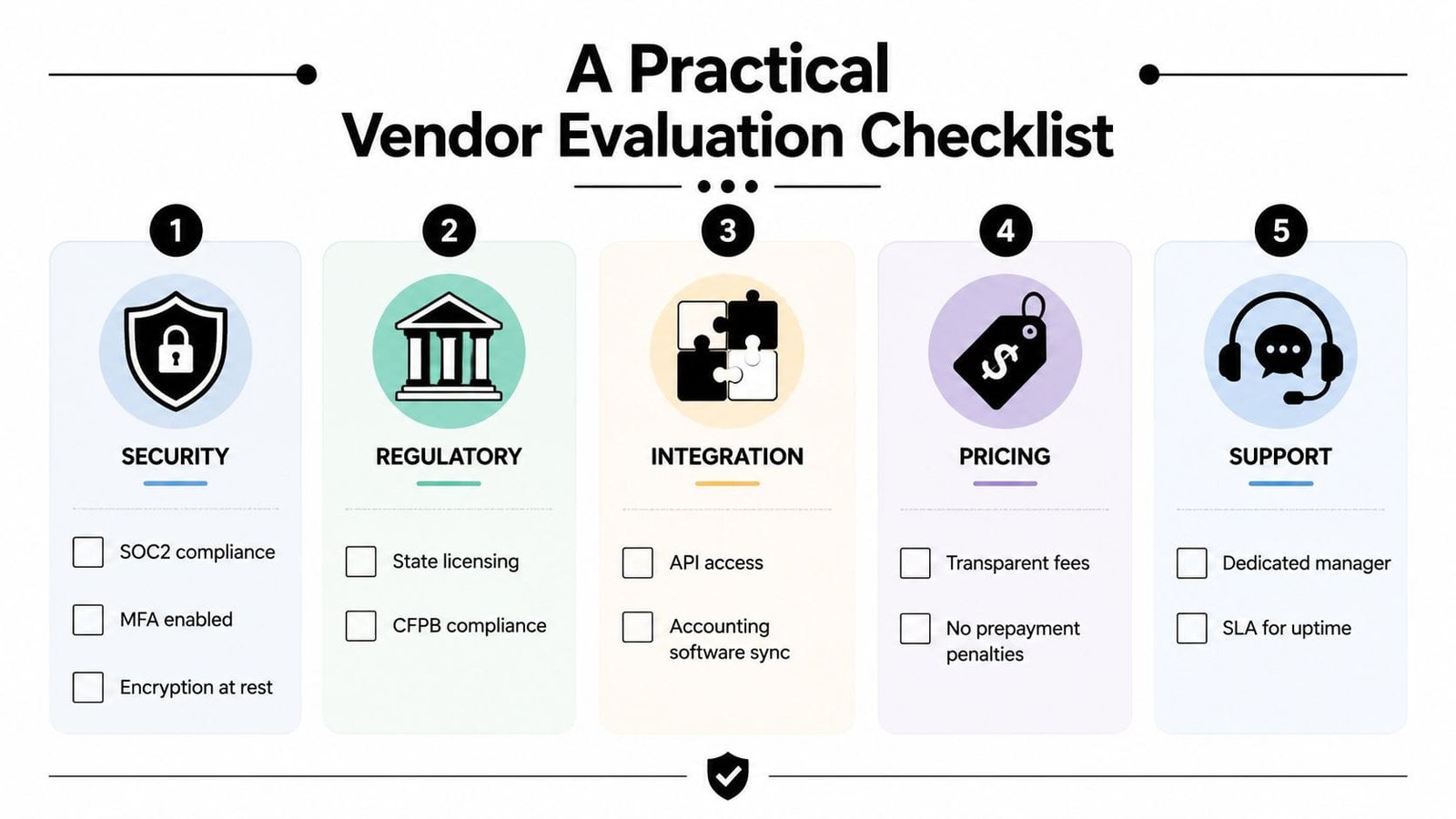
Security and data protection
Ask the sales representative:
- Does the company maintain current SOC 2 documentation?
- Is multifactor authentication required for borrowers and staff?
- How is sensitive information encrypted at rest and in transit?
- Which vendors receive bank, accounting, payroll, and ownership data?
Don't accept “bank-level security” as an answer. Request the relevant security summary, data-retention policy, breach-notification process, and access controls. Your finance team should also know how to revoke connected-account permissions.
Regulatory accountability
Confirm which entity makes the loan and where it is licensed. Ask:
- Which state lending licenses apply to this product?
- How does the lender handle fair-lending review and adverse-action notices?
- What process allows a borrower to correct inaccurate data or challenge a decision?
- Does the lender publish a clear privacy and data-use policy?
The World Bank's regulator survey found that only 22% of jurisdictions formally regulate peer-to-peer lending, demonstrating that oversight remains uneven across markets. Use a resource such as this complete 2026 compliance overview to organize questions, then verify licensing and contract language for your own jurisdiction.
Integrations and workflow fit
A platform should connect to the systems your team already trusts. Test whether it supports your accounting software, ERP, payroll provider, bank-data aggregator, and reporting workflow. Ask whether API access is available, how synchronization errors are handled, and whether your team can export all records when the relationship ends.
For companies assessing automated decision systems beyond lending, an AI buyer scoring engine offers a useful comparison point for how structured inputs can support consistent evaluation.
Pricing and operational evidence
Request the full cost in writing, including APR where applicable, origination fees, underwriting charges, late fees, renewal terms, prepayment treatment, and any broker compensation. Ask for a sample amortization schedule using your proposed amount and term.
Then ask for operating metrics:
- How long does a complete file typically take to reach a decision?
- What percentage of submitted applications receive funding?
- How does the lender monitor defaults and collections?
- What support is available after closing?
Finally, review the platform's automation capabilities through an explanation of automated loan processing. Automation should reduce errors and improve visibility, not prevent you from reaching a human when a legitimate exception needs review.
Real Use Cases for Established Small Businesses
A regional construction company needs a $250,000 excavator. The owner has strong project demand but doesn't want to drain operating cash for a purchase that will generate revenue over time. One digital equipment lender offers rapid processing but requires frequent withdrawals and a broad personal guarantee. A bank offers a lower-cost structure secured by the excavator but wants a fuller financial package and a longer review.
The owner shortlists both, connects current bank data to the digital lender, and asks each provider for total repayment, lien position, insurance requirements, prepayment treatment, and the effect of a slow project month. The faster offer wins only if its payment fits the company's actual billing cycle. Speed alone doesn't justify a contract that restricts cash during seasonal dips.
A payroll bridge
A multi-location retailer faces a six-week gap after a major customer delays payment. The company isn't seeking permanent debt. It needs a bridge tied to a specific receivable, with a clear payoff path and no automatic renewal.
The finance director requests a borrowing-base calculation, evidence of how the lender handles disputed invoices, and a payment schedule under delayed collection. A platform that treats every deposit as available repayment capacity gets rejected. The selected lender receives the receivables schedule, customer concentration details, and bank data, then agrees to terms that preserve operating liquidity while the payment works through.
Inventory for a product launch
A specialty manufacturer wants to expand inventory before launching a new product. The funding request is larger and more complex than a short-term online advance, so the company evaluates an equipment lender, a bank, and a digital marketplace.
The team compares collateral, reporting, covenant triggers, personal guarantees, and the cost of carrying inventory before sales begin. It also negotiates data-use language and an exit provision if the platform changes its underwriting policy. The final decision depends on whether projected inventory conversion can support scheduled payments without assuming perfect sales performance.
The pattern is consistent. Matched use cases produce better financing decisions. Equipment deserves equipment-style repayment. A receivable gap calls for bridge or invoice-based structures. Expansion inventory may require a term loan, line, or blended facility. Pulling a generic product because the application is easy is how established companies overpay.
The plan notes call for precise APRs and monthly payments in each scenario, but those figures depend on actual offers and cannot be responsibly assumed. Ask each lender to calculate those items from its written term sheet, not from an advertised starting rate.
Risks and Blind Spots Most Owners Overlook
A faster application can create a faster mistake. Digital lending platforms remove friction, but friction sometimes forces borrowers to inspect documents they might otherwise skim.
The regulation gap
Bank borrowers generally understand that banks operate within a defined supervisory framework. Nonbank lenders and marketplace structures may operate under different rules, depending on the product and jurisdiction. The World Bank's survey finding that 22% of jurisdictions formally regulate peer-to-peer lending shows why owners must verify the actual lender, licensing position, disclosure obligations, and dispute process rather than relying on the platform's brand.
Data can outlive the application
Connecting bank accounts is convenient, but it gives the platform access to detailed operating signals. Ask what data is collected, how long it is retained, whether affiliates receive it, whether it is used to market other products, and how permission is withdrawn. Never assume that consent for underwriting means unlimited reuse for future scoring.
Pricing hides in mechanics
A stated rate may not reflect the full cost if the contract adds origination fees, daily or weekly withdrawals, factor-rate conversions, late charges, or prepayment restrictions. Request a complete repayment schedule and ask the lender to show how the balance changes under simple and compounding calculations.
Protect your downside: Verify licensing, demand full cost disclosure, and maintain a backup funding relationship before your primary lender becomes unavailable.
Single-platform dependency creates another vulnerability. A lender can tighten its credit policy, pause a product, freeze a draw, or exit a sector. Your company should know the notice period, unused-line treatment, reporting obligations, and termination rights before signing.
Your Next Step Toward the Right Platform
Run the evaluation over a week, but make the decision from evidence rather than urgency.
Days one and two
Create one secure folder containing recent bank statements, profit-and-loss statements, balance sheets, debt schedules, receivables aging, ownership information, and a concise use-of-funds memo. Reconcile the numbers before uploading anything. A digital platform can process clean information quickly, but it can't repair inconsistent books.
Day three
Score three to five vendors against security, compliance, integrations, pricing, servicing, and support. Give more weight to transparent cost and data governance than to a flashy promise of speed. Identify the actual capital provider behind each platform.
Days four and five
Submit parallel prequalification requests where the process uses a soft credit inquiry. Compare real offers, not advertised ranges. Record the amount, term, payment frequency, total repayment, collateral, guarantees, covenants, renewal language, and data permissions in one worksheet.
Day six
Calculate the full APR or equivalent cost using every fee. Then stress-test the payment against delayed receivables, slower sales, and a temporary margin squeeze. If the offer only works under ideal conditions, it doesn't work.
Day seven
Negotiate prepayment terms, data deletion or retention, reporting requirements, default triggers, renewal rights, and exit clauses before signing. Ask for every promised concession in the final agreement, not in an email from sales.
Business Loan Warrior's platform combines a digital application, bank-account connections, funding options, a dashboard, and access to underwriting support. It can be considered alongside bank, equipment, SBA, invoice, and other financing paths when you want one intake process to compare several possible structures. For a company with a complex need, a broker or advisor should model the offer against actual cost of capital, cash conversion, and repayment capacity before closing.
Book a 30-minute funding readiness review this week and bring the seven-day file, the vendor scorecard, and any written offers. That conversation should turn platform research into a financing decision you can defend within the next 30 days, without sacrificing cash flow for the sake of speed.
Business Loan Warrior helps established small businesses compare funding options through a single application, connected financial data, and a secure dashboard for approvals and repayment tracking. Visit Business Loan Warrior to start a funding-readiness conversation and evaluate your next offer against the cash flow your company generates.