
You've got a signed customer contract, a piece of equipment on hold, or a payroll gap that can't wait. Then a lender shows you a promising number after a short online form. The word pre-approved appears on the screen, and you start planning around money that hasn't arrived.
That's where owners get hurt. Business loans pre approval isn't one universal process, and a lender's channel can matter as much as your revenue or credit profile. Large banks, small banks, credit unions, online lenders, and Community Development Financial Institutions evaluate similar businesses through very different approval systems. Recent market benchmarks show approval rates ranging from about 13.5% at large banks to 34.1% at CDFIs, according to comparative small-business lending data. Your first decision shouldn't be which advertised rate looks lowest. It should be which lender is structurally suited to approve a business like yours.
Table of Contents
- Pre-Approval vs Pre-Qualification and Why the Difference Matters
- How Business Loans Pre Approval Actually Works Step by Step
- Financial Metrics That Move Your Pre-Approval Odds
- Matching Your Business to the Right Lender Channel
- Checking Pre-Approval Offers Without Damaging Your Credit
- Realistic Timelines and What Happens After You Get the Yes
- Action Plan and FAQs for Small Business Owners
Pre-Approval vs Pre-Qualification and Why the Difference Matters
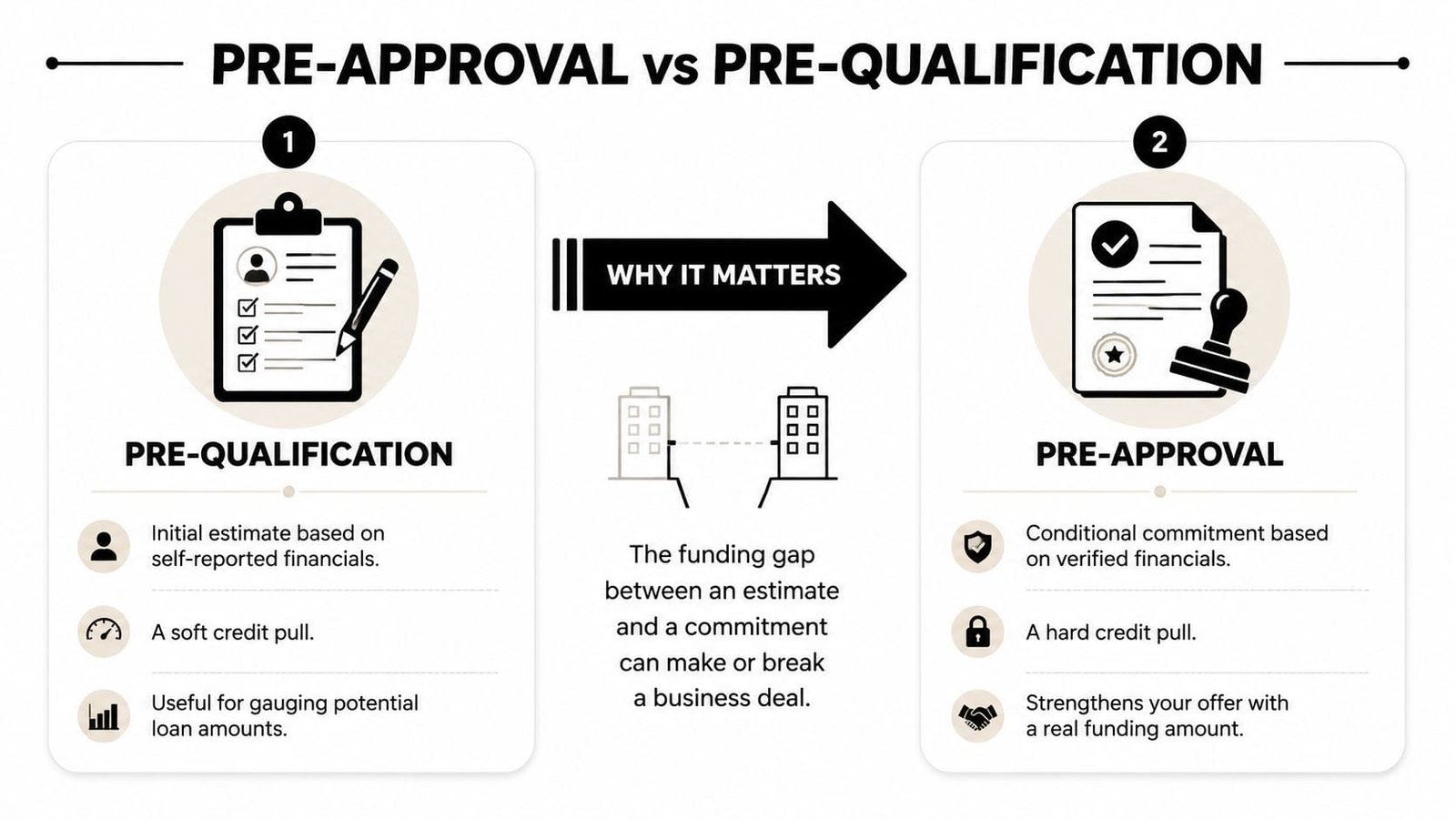
A contractor receives two financing offers after bidding on a major project. One says pre-qualified. The other says pre-approved. The contractor assumes both mean the same thing, orders materials, and promises a vendor that funding is coming. Then the lender asks for tax returns, discovers inconsistent deposits, and reduces the amount or declines the file.
That funding gap is the practical difference between the two terms.
Pre-qualification is usually an early estimate based on information you report yourself, such as revenue range, time in business, existing debt, and stated credit quality. A platform may return an estimated amount quickly, often without reviewing your financial documents. A soft credit inquiry may support the initial screen, but the result is still an eligibility indication, not a lender commitment.
Pre-approval goes further. The lender conditionally reviews verified information such as bank statements, tax returns, profit-and-loss reports, ownership records, and outstanding debt. The lender may use a soft inquiry during an early review or require a hard inquiry before issuing formal terms. Either way, the lender has examined more of your actual file.
Why the label changes your negotiating position
A pre-qualification can help you estimate a realistic borrowing range. It's useful when you're deciding whether to pursue an expansion, compare equipment options, or understand which lending channels might consider your business.
A conditional pre-approval carries more weight because the lender has identified a specific funding structure. That can strengthen conversations with vendors, landlords, sellers, or acquisition targets. It may also reveal problems early, before you spend time negotiating around an amount you can't obtain.
But pre-approval still isn't final funding. Underwriting can uncover unacceptable collateral, excessive debt obligations, ownership complications, unresolved liens, or industry-specific risk. The Federal Reserve's 2025 Small Business Credit Survey data, released in 2026, shows why owners shouldn't confuse a positive signal with certainty. 42% of financing applicants received the full amount requested, 25% were partially approved, and 22% received none, according to reporting on the Federal Reserve survey.
Practical rule: Don't treat an offer as real business capital until the letter states the expected amount, rate range, repayment term, major conditions, and expiration date.
Ask the lender whether the letter is pre-qualified or conditionally pre-approved. Ask which documents were verified, which credit inquiry was used, and what could still cause a decline. If the lender won't answer those questions, the number on the screen is marketing, not dependable financing.
How Business Loans Pre Approval Actually Works Step by Step
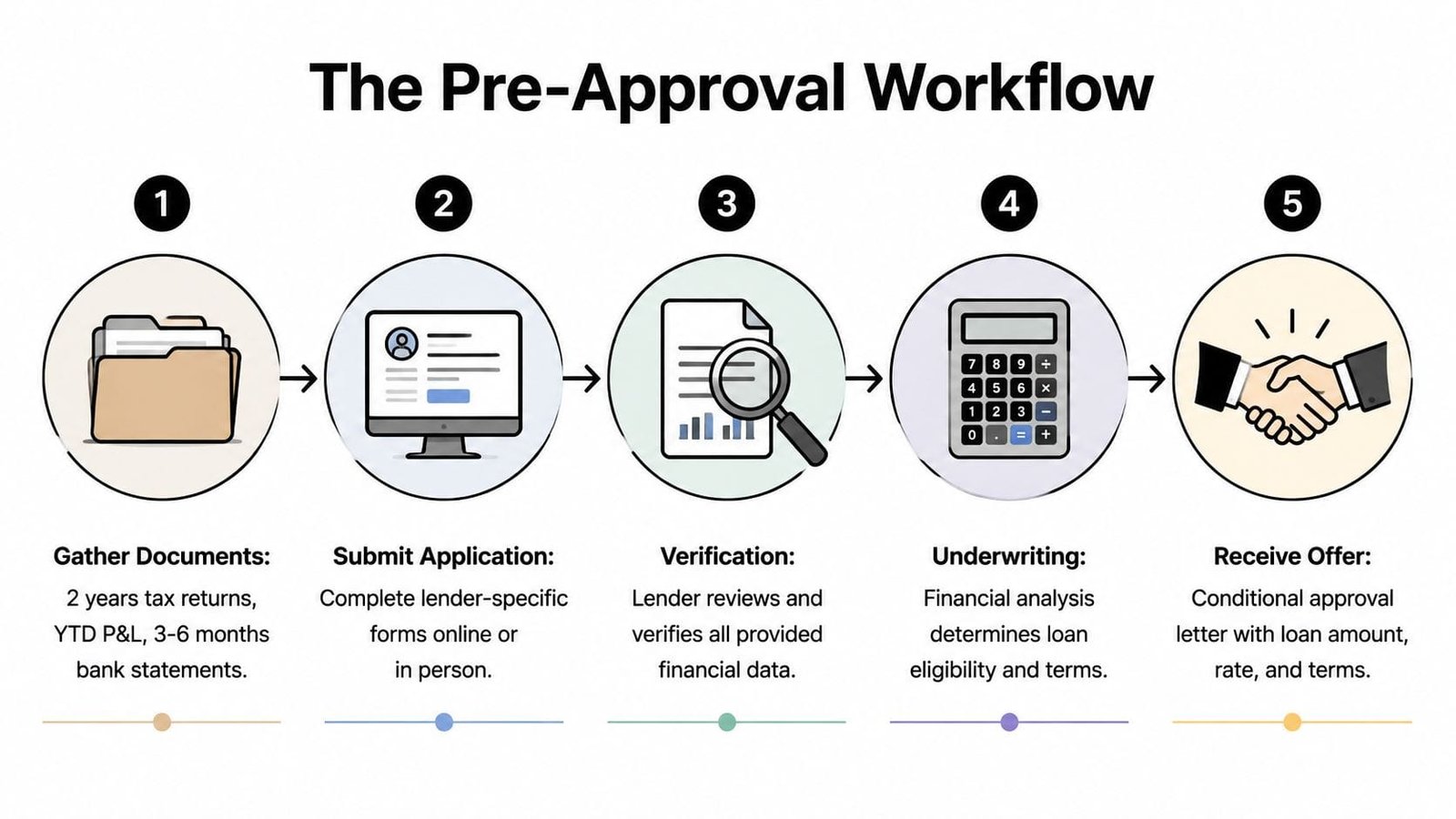
A clean file moves through pre-approval faster because the lender doesn't have to chase basic information. Start by creating one complete document folder rather than sending scattered attachments over several days.
Step 1, assemble the underwriting file
Gather your business tax returns for the requested period, current year-to-date profit and loss statement, recent business bank statements, formation documents, ownership information, government identification, and a current debt schedule. The debt schedule should show each lender, balance, payment, maturity, and collateral position.
Upload clear PDFs instead of photographs whenever possible. Blurry pages, missing statement periods, and cropped account details create avoidable follow-up questions. If a platform offers secure bank linking through a service such as Plaid, linking the account can help the lender verify transaction history more efficiently, but review the permission screen before authorizing access.
Step 2, get an initial rate and eligibility screen
Use one reputable lending platform for the first soft-pull comparison rather than submitting unrelated applications everywhere. The purpose is to map your business against multiple channels while preserving control over the next step.
The lender or marketplace will compare your requested amount, revenue pattern, business age, credit profile, industry, and cash flow. You should identify whether an SBA product, online term loan, line of credit, equipment facility, or community lender makes more sense.
Step 3, choose the channel before the formal application
A lender that prioritizes equipment collateral may overlook a short operating history that would stop a traditional bank. A CDFI may spend more time understanding a community business than an automated online lender. Match the product and lender to the reason you're borrowing, not just the amount advertised.
Step 4, submit the verified package
Once you select the likely channel, authorize the inquiry the lender requires and submit the full documentation package. The lender checks deposits, revenue consistency, existing obligations, ownership, and repayment capacity.
For owners who want a deeper technical explanation of data extraction for underwriting, the important takeaway is simple. Automated systems can organize and interpret financial records, but the lender still decides how exceptions, risk, and conditions affect the final offer.
You can review the broader workflow in this guide to the business loan underwriting process.
Step 5, review the conditional letter
A useful letter identifies the proposed amount, rate or pricing range, term, payment structure, collateral expectations, guarantees, fees, and expiration date. It should also list outstanding stipulations.
Step 6, clear conditions before celebrating
Respond quickly to requests for updated statements, explanations of unusual deposits, ownership documents, insurance, equipment quotes, or lien releases. A pre-approval becomes useful only when you understand what stands between the letter and a funded transaction.
Financial Metrics That Move Your Pre-Approval Odds
Underwriters don't approve a story. They approve evidence that the business can repay the proposed obligation while continuing to operate. Revenue matters, but lenders also examine business age, personal and business credit, debt-service coverage, and the cash left after normal operating expenses.
The most useful thresholds depend on the product and channel. The figures below come from the requested lending benchmarks, not universal rules.
| Metric | SBA 7(a) | Online Term Lender | CDFI / Community Lender |
|---|---|---|---|
| Annual revenue guide | $100,000+ | $50,000+ | Varies by program |
| Time in business guide | 24 months or more commonly preferred | 6 to 12 months may be accepted | 6 to 12 months may be accepted |
| Credit guide | 680 commonly used as a soft floor | 625 commonly used for some products | Relationship and full file may carry added weight |
| DSCR guide | 1.15 or higher strengthens the file | 1.15 or higher strengthens the file | 1.15 or higher strengthens the file |
| Free cash flow margin guide | Above 8% strengthens terms | Above 8% strengthens terms | Above 8% strengthens terms |
These are screening reference points, not guaranteed approval requirements. A lender may approve below a guide when collateral, deposits, guarantor strength, or industry performance offsets the weakness. The reverse is also true. A business with solid revenue can fail if debt payments consume too much cash or if deposits don’t match reported income.
The metrics lenders test hardest
Revenue establishes scale, but the lender wants consistency and verifiable deposits. A high annual figure with sharp unexplained swings can raise more questions than a smaller but stable operation.
Time in business signals operating history. Traditional bank channels generally prefer longer histories, while online and community channels may consider younger businesses when cash flow and ownership support the request.
Credit affects both eligibility and pricing. Review your personal and business reports before applying, and use this business loan credit score guide to understand which score a lender may evaluate.
DSCR compares available cash flow with required debt payments. A ratio below 1.0 suggests the business isn’t generating enough cash to cover obligations, while 1.15 or higher gives an underwriter more comfort.
Free cash flow shows what remains after normal operating needs. A margin above 8% can strengthen terms, but lenders still examine whether that cash flow is recurring or dependent on one unusual month.
The pattern is compensation, not perfection. Weak credit may be supported by strong collateral. Modest revenue may be supported by durable cash flow and a smaller request. Your job is to present the offset clearly instead of hoping the underwriter discovers it.
Matching Your Business to the Right Lender Channel
Lender selection is the biggest controllable lever in pre-approval. Owners often waste time applying to every lender that appears in a search result, then blame their credit when several mismatched institutions reject them.
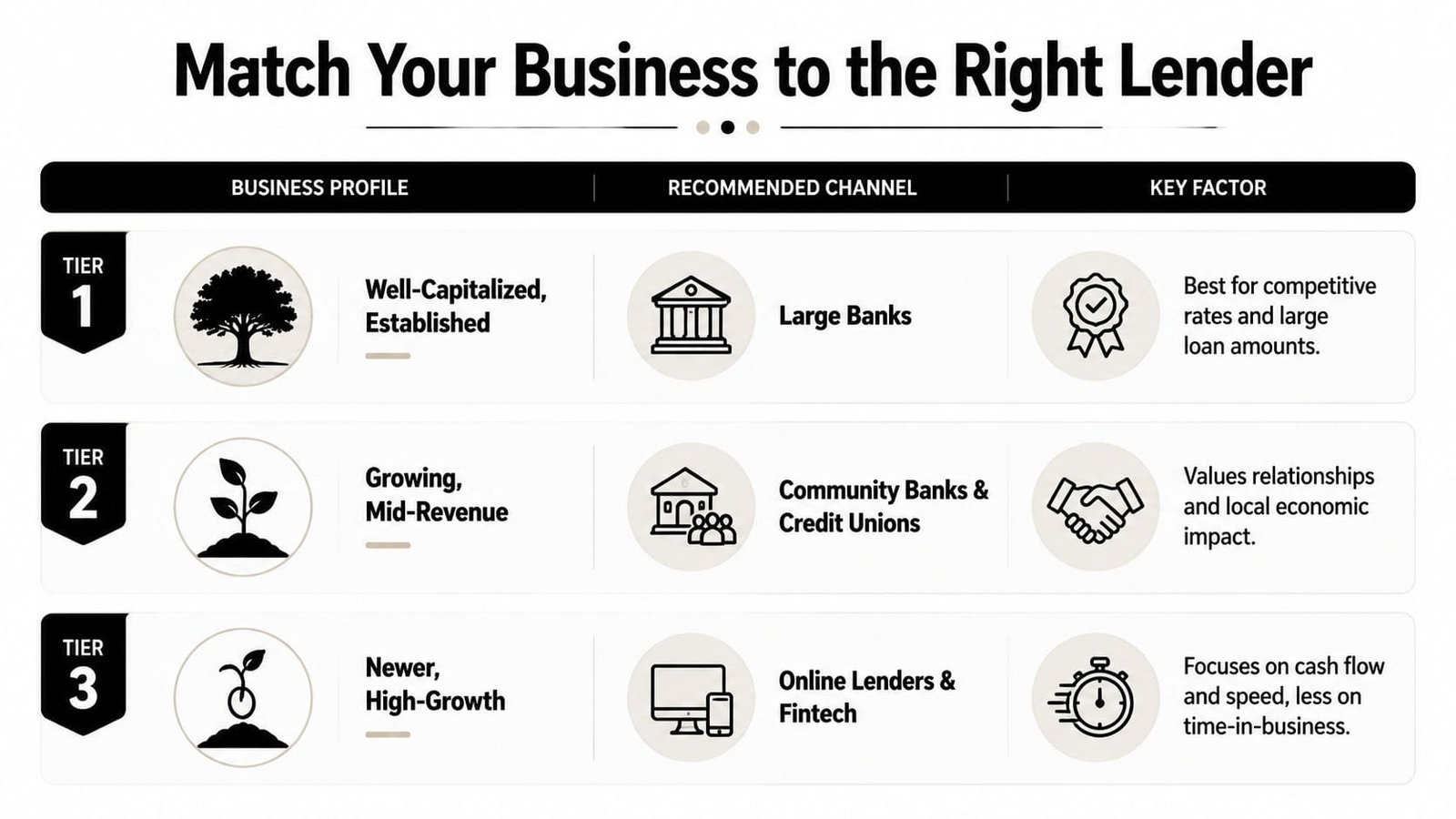
The data shows why that approach fails. Comparative benchmarks place approval rates at about 13.5% for large banks, 18.9% for small banks, 20.2% for credit unions, 26.8% for online lenders, and 34.1% for CDFIs, according to market-channel approval data. Those figures don’t predict your result, but they prove that the channel changes the starting odds.
Segment the business before comparing rates
Large banks can make sense for established companies with strong financial statements, substantial collateral, and a need for a larger facility. Their slower process and lower approval rate may be acceptable when the relationship, pricing, or credit capacity justifies the effort. Online lenders typically emphasize speed and cash flow, but faster access can come with higher costs, smaller average loan sizes, or frequent repayment requirements.
Credit unions and CDFIs deserve a serious look when the business is underbanked, community-focused, or operating in a market that relationship-driven lenders understand better. Their process may involve more conversation and documentation, but that human review can help explain circumstances an automated scorecard would reject.
A lender channel isn’t automatically good or bad. It’s suitable or unsuitable for a particular file.
Use a channel-fit checklist
Before applying, compare:
- Requested amount: Does the lender regularly offer the size you need?
- Operating history: Does the channel accept your actual time in business?
- Revenue evidence: Will it evaluate deposits, invoices, contracts, or another measure?
- Credit expectations: Which personal and business scores matter?
- Collateral and guarantees: What assets or personal exposure will the lender require?
- Repayment design: Is payment daily, weekly, or monthly, and does it fit your cash cycle?
- Total cost: What are the fees, prepayment rules, and effective repayment economics?
- Industry policy: Does the lender serve your industry instead of excluding it?
The right question isn’t “Who advertises the lowest rate?” It’s “Which lender has a repeatable approval pattern for businesses like mine?”
A short marketplace or broker submission can identify likely matches, but don’t authorize blanket applications to unrelated institutions. Start with the channel that fits your business, then submit a complete file there.
Checking Pre-Approval Offers Without Damaging Your Credit
Shopping for business loans doesn’t automatically damage your credit. The key is knowing whether the lender is running a soft inquiry or a hard inquiry.
Soft pulls support pre-qualification and eligibility checks. They don’t affect personal or business credit scores, which makes them useful for comparing indicative amounts, pricing ranges, and repayment structures. That low-friction comparison is especially valuable when bank and non-bank lenders evaluate similar borrowers differently, as reflected in the business-loan soft-pull and hard-pull explanation.
Read the consent screen carefully
A soft check can still expose you to poor security practices. Confirm the platform’s privacy policy, identify which bureaus it checks, and use secure bank-linking tools rather than sending passwords or one-time authentication codes to a person or unknown website.
Treat displayed offers as estimates until the lender verifies your documents. A self-reported revenue range can produce a generous screen result that changes once bank deposits, tax returns, and existing debt are reviewed.
Formal pre-approval is different. A lender may require a hard inquiry after you submit the complete package, authorize a personal guarantee, or move toward final approval. Hard inquiries can create a temporary score impact and appear on personal credit reports.
Ask before submitting: “Will this step use a soft inquiry or a hard inquiry, and at what exact point does that change?”
Rate shopping within a short window can reduce the effect of multiple inquiries, but the treatment depends on the scoring model and the type of credit being evaluated. Don’t assume every business lender groups inquiries the same way. Explore with soft checks first, save the credible options, and authorize a formal application only when you’re prepared to proceed.
If revolving access fits your cash cycle better than a term loan, compare the structure in this guide to line of credit pre-approval. The same inquiry question still applies.
Realistic Timelines and What Happens After You Get the Yes
A simple online pre-approval screen can return quickly. Funding takes longer because the first “yes” often means conditional yes, not cleared money.
Consider a business seeking a $750,000 equipment loan, as a practical example. The owner requests the full amount through an initial soft-pull screen, then compares an equipment specialist with other channels. After selecting the lender, the owner submits bank statements covering the requested period, business tax returns, current profit-and-loss reports, a debt schedule, ownership documents, and vendor quotes for the equipment.
Where the timeline expands
The equipment lender verifies revenue, operating history, credit, debt-service coverage, ownership, and collateral. It may also confirm that the equipment exists, that the seller is legitimate, and that the quoted price supports the financing request.
Delays usually come from ordinary file problems rather than mysterious underwriting decisions:
- Incomplete statements: Missing pages or statement periods force a resubmission.
- Mismatched deposits: Bank activity doesn’t reconcile with reported revenue.
- Stale tax information: The lender requests updated returns or current financials.
- Unresolved liens: A prior creditor’s claim interferes with the new collateral position.
- Slow guarantor documents: An owner or guarantor delays identity, financial, or signature requirements.
- Vendor uncertainty: The equipment seller won’t hold the asset while underwriting finishes.
A conditional commitment may remain valid for 30 to 90 days, while final approval can take several days to several weeks, depending on complexity and responsiveness. The commitment period doesn’t eliminate the lender’s right to verify conditions before closing.
Read the closing package, not just the approval letter
Before signing, compare the annual percentage rate, factor rate when applicable, term, payment frequency, origination fee, prepayment terms, collateral lien, and personal-guarantee exposure. The lender may also require insurance, an appraisal, ACH authorization, board approval, or other closing documents.
Funds might go to your operating account, but equipment financing may send proceeds directly to the seller. Don’t schedule payroll, inventory purchases, or a vendor payment until the agreement confirms when and how disbursement occurs.
A pre-approval gives you a strong position and a working plan. It isn’t money in the bank. Move quickly through conditions, but don’t accept a structure you haven’t modeled against actual cash flow.
Action Plan and FAQs for Small Business Owners
You can prepare a strong first pass in one sitting. The objective is to remove avoidable uncertainty before a lender sees the file.
Your pre-approval checklist
- Collect recent statements: Pull the last 90 days of business bank statements and check for missing pages.
- Prepare financial records: Assemble business tax returns, a current year-to-date profit and loss statement, and a debt schedule.
- Check credit: Review personal credit and any available business scoring information, including FICO SBSS where applicable.
- Verify identity records: Confirm your EIN, formation documents, ownership information, and beneficial ownership records are consistent.
- Map lender channels: Run a soft-pull comparison across at least three suitable channels before authorizing a formal application.
- Explain exceptions: Write short explanations for unusual deposits, late payments, major revenue changes, liens, or ownership transitions.
- Request a real letter: Require the proposed amount, pricing range, term, conditions, and expiration date in writing.
Five silent problems regularly weaken otherwise credible files: undisclosed liens, reported revenue that doesn’t match bank deposits, a dense cluster of recent credit inquiries, dependence on one customer, and UCC filings connected to prior defaults. Don’t hide these issues. Explain them, document the resolution, or choose a lender that knows how to underwrite the situation.
Questions owners ask
How long does a pre-approval letter stay valid?
Many letters are valid for 60 to 90 days, but the lender sets the actual expiration. Ask whether updated bank statements or a new credit review will be required after expiration.
Does pre-approval guarantee funding?
No. It’s a conditional commitment. Final underwriting can still change the amount or decline the request after reviewing collateral, debt, documents, ownership, or industry risk.
Do SBA loans have a separate pre-screen?
SBA lenders commonly perform an initial eligibility and document review before full underwriting. The exact process varies by lender, and an SBA indication still depends on complete verification and program requirements.
What collateral do SBA lenders expect?
Collateral expectations depend on the loan, business assets, available equity, and lender policy. Be ready to identify equipment, real estate, receivables, or other assets, and ask what personal guarantee exposure applies.
How should I reapply after a decline?
Get the reason in writing, correct the specific weakness, and avoid sending the same unchanged file to multiple lenders. A different channel may fit better, but only after you understand whether the problem was credit, cash flow, documentation, collateral, or product mismatch.
Do fintech lenders weigh personal credit differently from banks?
Often, yes. Online lenders may combine personal credit with bank-account activity, revenue consistency, and cash-flow signals. Banks may place heavier emphasis on conventional financial statements, operating history, collateral, and relationship depth. Ask what data drives the decision before you apply.
Business Loan Warrior helps owners compare business financing through a single application, connect bank accounts for verification, and review possible funding across products such as term loans, lines of credit, SBA financing, and equipment loans. Visit Business Loan Warrior to start with a soft-pull pre-approval review and match your file to a lender channel before committing to a formal application.