

A progress payment is approved on paper, but payroll is due Friday. Your supplier wants payment before releasing the next material order. The owner has delayed a change-order decision, and retainage is sitting inside an invoice you earned weeks ago. The jobs are profitable, yet the operating account is too thin to carry the schedule.
That's the central reality of construction financing for contractors. Borrowing usually isn't a rescue operation. It's a way to bridge the distance between paying for work and collecting for it. The right financing keeps crews working, suppliers paid, and projects moving without forcing an owner to over-borrow or pledge every available asset.
Table of Contents
- Why Contractors Borrow Before They Get Paid
- The Main Types of Construction Financing
- What Construction Financing Really Costs
- How Lenders Underwrite a Construction Loan
- Choosing the Right Lender for Your Business
- Three Contractor Scenarios and the Funding Stack That Fits
- Common Pitfalls That Kill Approvals and How to Avoid Them
- Your Pre-Application Checklist and Next Steps
Why Contractors Borrow Before They Get Paid
A mid-size general contractor has three active jobs, a $180,000 payroll due Friday, and only $40,000 in the bank because the August draw hasn't been funded. The owner isn't insolvent. The backlog is healthy. The problem is timing.
Construction puts cash out before it brings cash in. Contractors fund mobilization, deposits, labor, materials, subcontractor invoices, permits, and equipment before an owner approves a pay application. A monthly billing cycle can still leave a contractor waiting about 45 to 60 days from completed work to collected cash, while retainage commonly withholds 5% to 10% until completion or another contractual trigger, as described in this construction working-capital analysis.
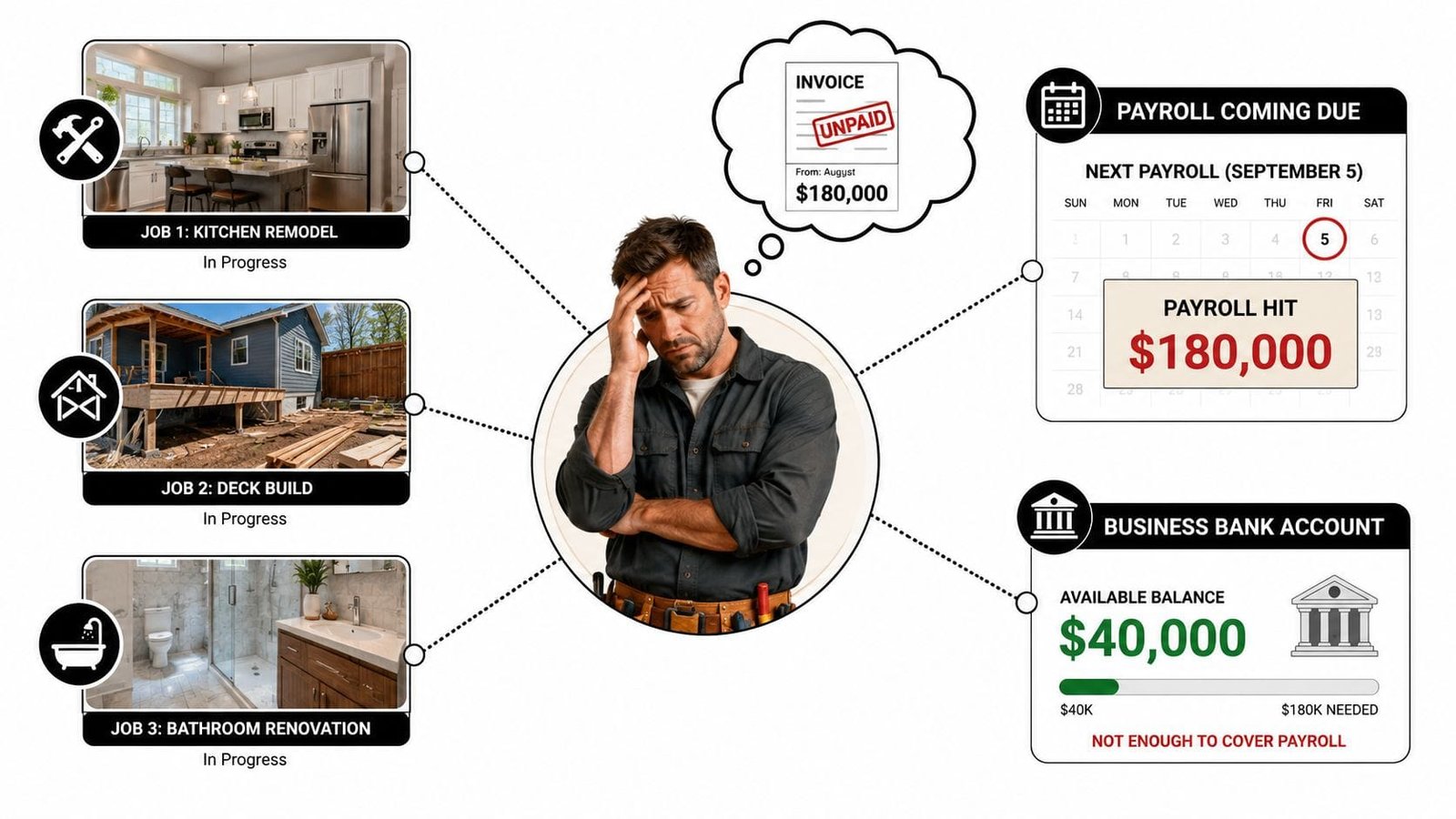
On a $2 million contract, 10% retainage can leave $200,000 tied up even after the contractor has earned it, according to the same source. That cash gap becomes larger when several projects overlap. A commercial general contractor may wait for architect and owner approvals. A residential remodeler may collect deposits but still absorb material purchases and change-order delays. A specialty trade may complete work quickly but wait on the general contractor's payment cycle.
Lending rule: Profitability tells me whether the job works. Cash-flow mapping tells me whether the contractor can survive the job.
Contractors also pay before they're paid at the subcontractor level. A national subcontractor financing survey from 2021 found that 63% of contractors paid for materials before receiving payment for their work, while 74% planned to grow their business, according to the MSCI construction finance research. Growth can therefore increase the funding need instead of reducing it.
That's why you should start with the gap, not the product. A revolving line may cover payroll and recurring material runs. Invoice financing may address approved receivables. Equipment financing belongs against equipment, not general overhead. Construction-only debt fits staged project costs, while bonding capacity helps you win work that lenders may never fund directly. Contractors often combine two or three tools, but each piece should have one defined job. For broader cash flow tips for service businesses, focus on billing discipline and collection controls before adding debt. You can also review how factoring for construction companies fits projects with delayed receivables.
The Main Types of Construction Financing
Treat financing as a working toolkit. Each tool should attach to a specific cash-flow event, collateral source, or project obligation.
| Financing Type | Solves | Typical Size | Collateral | Best For |
|---|---|---|---|---|
| Construction-only loan | Land, vertical construction, and staged project costs | Sized to project budget and lender advance policy | Land, improvements, guarantees, and project equity | Ground-up builders and developers |
| Construction-to-permanent loan | Construction spending followed by long-term real-estate debt | Based on project cost and stabilized value | Completed property and borrower guarantees | Owner-occupants building facilities |
| SBA 7(a) or 504 | Working capital, real estate, and qualifying equipment | Based on program eligibility and repayment capacity | Business assets, real estate, and personal guarantees as required | Established owner-occupied businesses |
| Equipment loan or lease-to-own | Excavators, trucks, tools, and specialty machinery | Matched to equipment invoice and useful life | Financed equipment, sometimes additional guarantees | Equipment-heavy trades |
| Revolving line of credit | Payroll, materials, deposits, and recurring job costs | Tied to borrowing base, backlog, and cash flow | Receivables, inventory, equipment, or blanket lien | Contractors with recurring working-capital swings |
| Invoice or receivables financing | Approved invoices awaiting owner or GC payment | Based on eligible receivables | Invoices and related payment rights | Firms with reliable billed receivables |
| Bonding capacity | Bid, performance, and payment obligations | Tied to surety evaluation and contract capacity | Indemnity, financial strength, and company assets | Contractors pursuing public or larger private work |
A construction-only loan releases money through approved draws for land and building costs. It's the right fit when the repayment event is a sale, refinance, or completion, not ordinary monthly operating cash flow. The lender will care about plans, budget, contractor qualifications, equity, inspections, and lien protection.
A construction-to-permanent loan reduces the need to refinance after completion by converting construction debt into long-term real-estate financing. It works best for a business building or improving property it intends to occupy, rather than for a contractor managing someone else's project.
SBA 7(a) can support working capital and eligible real estate needs, while SBA 504 is more focused on fixed assets and owner-occupied real estate. Neither program should be treated as instant project liquidity. Documentation, eligibility, repayment capacity, and use of proceeds matter.
Equipment debt is clean when the gap is equipment. A contractor buying a fleet shouldn't use an expensive short-term working-capital product if the machine will generate revenue over a longer period. A line of credit is more flexible, but lenders may reduce availability when receivables age or project margins deteriorate.
Invoice financing accelerates cash tied up in eligible invoices. It doesn't fix disputed billings, weak payors, or poor documentation. Bonding is different from a loan. A surety gives you capacity to sign and perform contracts, but it also exposes weaknesses in financial reporting, working capital, experience, and indemnity support.
What Construction Financing Really Costs
The advertised rate is only one part of the bill. Construction borrowing becomes expensive through four separate channels: the interest calculation, transaction fees, required reserves, and the way draws are administered.
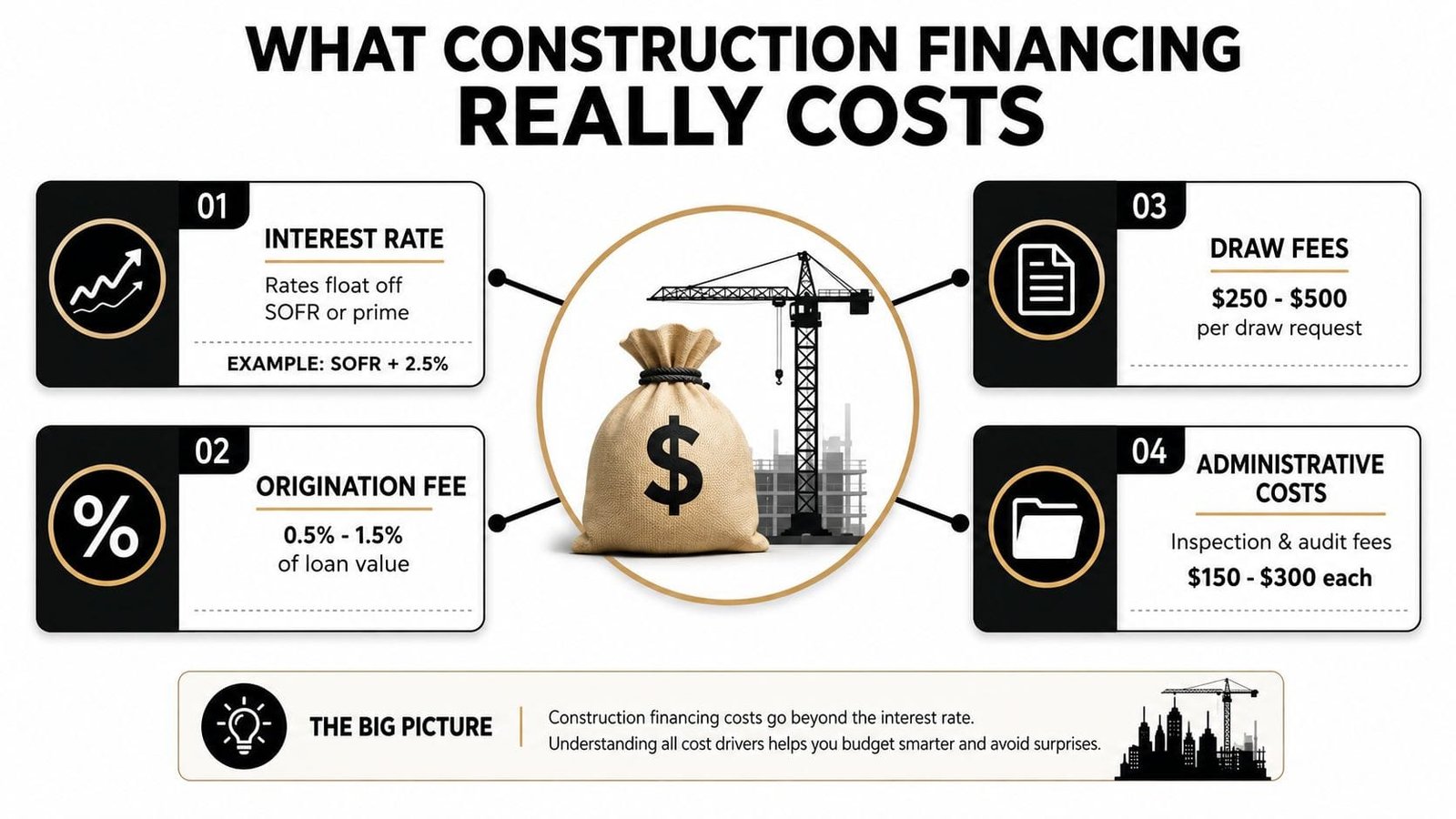
First, determine whether the rate floats over SOFR or prime, and ask when the lender resets it. A construction-to-permanent loan may offer a rate lock for the permanent phase, but the construction period can still carry variable pricing. A quote that looks attractive at signing can cost more if its index moves before funds are fully drawn. Review construction loan rates and pricing mechanics with the same attention you give the headline spread.
Interest and lender fees
Origination points, underwriting charges, appraisal expenses, environmental reviews, inspection fees, legal costs, and unused commitment charges all affect the effective price. Some fees are charged at closing. Others recur every time you request a draw or require a third-party inspection.
The brief's cost illustration identifies possible origination fees of 0.5% to 1.5%, draw charges of $250 to $500, and inspection or audit charges of $150 to $300, but those figures appear in the supplied visualization context rather than a linked verified data source. Treat them as prompts for questions, not universal market terms. Ask the lender for a complete fee schedule and clarify which costs apply even when a draw is denied or delayed.
Reserves and draw timing
An interest reserve can prevent monthly interest payments from draining operating cash, but it still belongs in the project budget. A contingency reserve protects against scope changes and cost surprises. Some lenders also expect cash to remain in the operating account, which means your usable proceeds may be lower than the commitment suggests.
Draw schedules create another cost. Releases may be monthly, biweekly, or tied to inspected milestones. A technically complete draw package can move quickly. Missing lien waivers, unsupported invoices, or unclear cost-to-complete figures can stretch the borrowing window and force you to fund the project from other sources. Draw schedules commonly connect each release to measured progress, inspection status, and lien-waiver documentation, as explained in this draw-schedule guide.
Do not quote a single “true annual carry cost” for a $1.5 million loan without knowing the actual draw pattern, index, fee schedule, reserve requirements, and repayment timing. The correct analysis is a project-level cash-flow model. Calculate interest on the amount expected to be outstanding, add every fee, show reserve funding separately, and stress the schedule for delayed draws.
How Lenders Underwrite a Construction Loan
Underwriters don't approve a contractor because the owner is confident or because the backlog looks impressive. They approve a file when the numbers, project controls, experience, and repayment path tell the same story.
The five files that matter
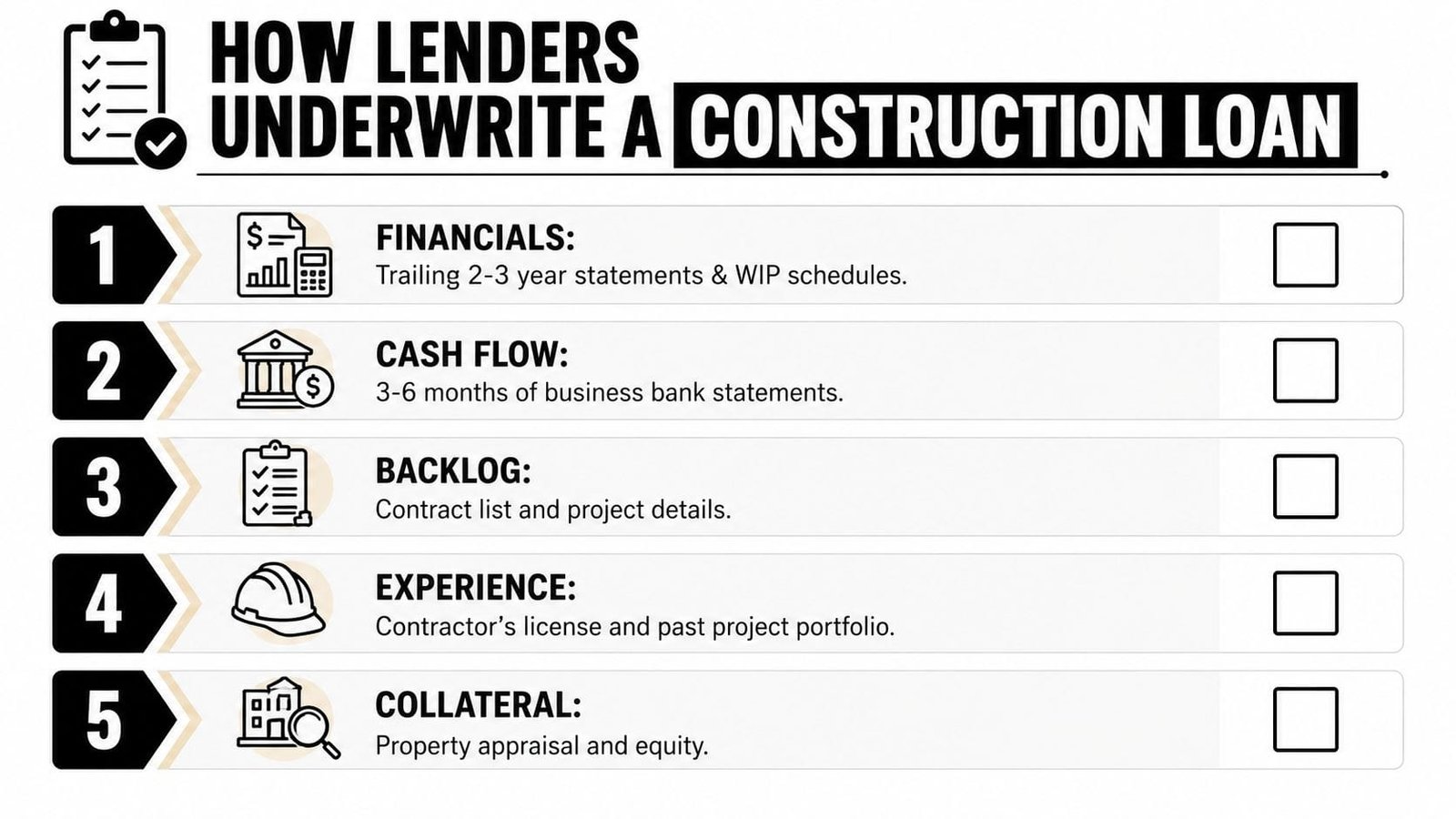
Financial statements and WIP schedules come first. Lenders want trailing business financials, job-level profitability, and a work-in-progress report that reconciles to the general ledger. Reconcile overbilling, underbilling, earned revenue, cost to complete, and gross margin before submission. If the WIP report and tax return tell different stories, the underwriter assumes the difference needs investigation.
Bank statements show how the company behaves. Review operating accounts for overdrafts, unexplained transfers, tax payments, owner draws, and signs that one project is funding another. Keep personal and business spending separate. A clean account history makes the lender's job easier and gives you a more credible view of available liquidity.
Backlog evidence must show signed contracts, remaining costs, billing terms, retainage, change orders, customer concentration, and expected gross margin. A list of project names isn't enough. Attach contract summaries and billing histories so the lender can determine how much work remains and when cash should arrive.
Experience means comparable execution, not merely years in business. Quantify the owner's role in similar project types, self-performed work, supervision, subcontractor management, and projects completed under comparable contract structures. A contractor who has managed small renovations may not satisfy a lender evaluating a complex ground-up build.
Draw quality affects both approval and ongoing availability. Prepare a draw binder with the pay application, invoices, inspection records, lien waivers, updated budget, schedule, change-order log, and cost-to-complete report. Lenders commonly tie releases to inspected milestones and documentation, so weak draw administration can create a liquidity problem after closing.
What turns a yes into a no
Receivables that remain unpaid too long, slow project turnover, dependence on one customer or geography, and weak personal credit can all change the decision. These aren't automatic declines in every file, but they demand an explanation and compensating strengths. Review the lender's proposed construction loan draw schedule before signing, not after the first funding request.
Underwriter's view: The strongest borrower isn't the one with the biggest backlog. It's the one that can prove where every project stands and how the company gets paid.
Choosing the Right Lender for Your Business
The best lender is the one whose underwriting model resembles your backlog. A community bank may understand local contractors and move comfortably through relationship-based decisions, while a regional commercial bank may handle larger projects with more formal reporting. Neither is automatically better.
| Lender Type | Typical Deal Size | Speed to Close | Cost Range | Best For / Watch Out |
|---|---|---|---|---|
| Local community bank | Local projects and established operating companies | Relationship-driven, often deliberate | Negotiated bank pricing | Best for local knowledge. Watch concentration limits and collateral demands |
| Regional commercial bank | Larger operating companies and multi-project borrowers | Structured and documentation-heavy | Often indexed commercial pricing | Best for scale. Watch covenants and reporting requirements |
| SBA-focused lender | Eligible owner-occupied facilities and working capital | Process-driven | SBA-linked pricing and fees | Best for qualifying established businesses. Watch eligibility and documentation |
| Online construction lender | Time-sensitive projects and borrowers needing flexible execution | Faster digital process | May use factor pricing or higher all-in cost | Best for speed. Watch payoff terms, liens, and daily liquidity pressure |
| Bonding surety paired with credit | Contractors pursuing bonded work | Depends on file quality and surety review | Indemnity and financing costs vary | Best for capacity. Watch personal guarantees and contract limits |
The supplied lender comparison framework references SBA 7(a) pricing over prime plus 2% to 3%, traditional bank pricing around SOFR plus 2.5% to 4%, and online construction factor rates of 1.15 to 1.30. Those are not universal offers, and the brief doesn't provide a source link verifying them. Use them only as questions to raise with lenders, not as assumptions in a financing model.
Ask three questions before you submit a full application:
- Does the lender understand your trade? A lender familiar with mechanical, electrical, remodeling, or civil contractors will ask better questions about billing, retainage, equipment, and bonding.
- How quickly can the first draw be approved? Closing speed is irrelevant if the post-closing inspection process stalls payroll funding.
- Will the covenants preserve operating liquidity? A covenant that ignores retainage or delayed pay applications can force a technical default while the project remains economically sound.
Pure speculative work usually receives tighter loan-to-value treatment than contracted work. Read every covenant, borrowing-base formula, inspection clause, and default trigger. A lender that offers flexibility but sweeps every incoming receivable may cost more operationally than a bank with a slower process and better liquidity terms.
Three Contractor Scenarios and the Funding Stack That Fits
A contractor's funding stack should mirror the schedule of values. The question isn't whether a product is popular. The question is what payment or expense it covers, when that cash moves, and what happens if the schedule slips.
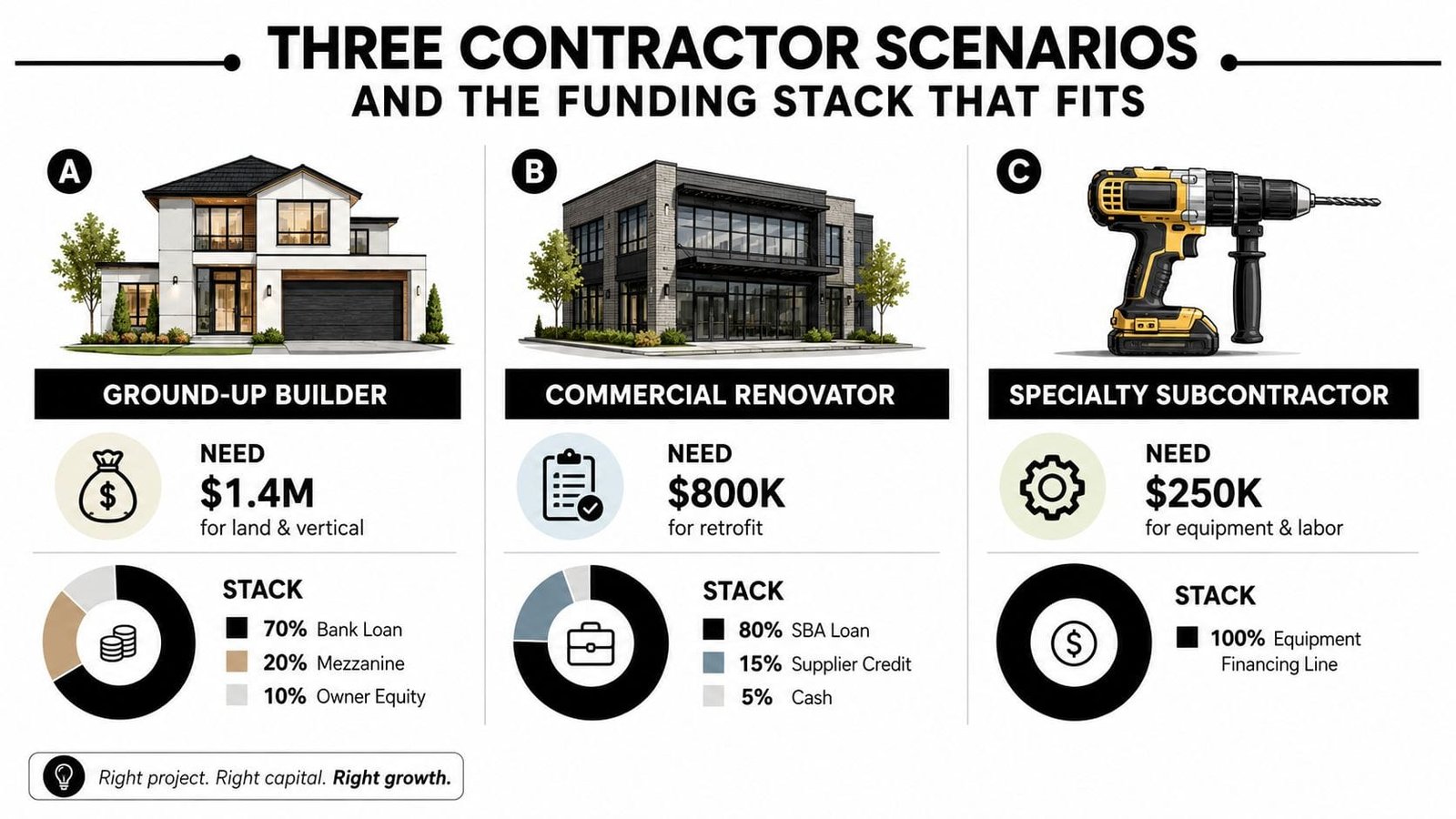
A ground-up custom-home builder
A $6 million custom-home builder needs $1.4 million for land and vertical construction. The primary tool is a construction-only loan secured by the lot and completed improvements, released through inspections as the work progresses. That loan handles the core project cost.
The builder also uses a smaller revolving line for deposits, soft costs, permitting, and timing differences that don't fit neatly into the construction draw. The line shouldn't fund permanent losses or cover an inflated budget. Its job is to keep early-stage expenses from disrupting the main draw schedule.
A commercial remodeling firm
A remodeling firm wins a 14-month tenant-improvement contract with 10% retainage. The project may show revenue, but the withheld cash remains unavailable until contractual completion milestones. Invoice financing can bridge eligible, approved receivables, while an SBA 7(a) loan of $250,000 provides a separate working-capital cushion for payroll, procurement, and overhead.
The separation matters. Invoice financing follows invoices. The SBA facility supports broader business needs. Mixing both into one expensive short-term product makes repayment harder to track and can create confusion over which receivables are pledged.
A mechanical contractor expanding into utility work
A mechanical contractor self-performs three jobs and wins a utility-scale project requiring excavators and trenchers. Equipment financing covers the fleet, with the supplied scenario using 80% loan-to-value equipment financing. A draw-based construction line handles mobilization, initial labor, fuel, and site costs before progress payments arrive.
The contractor also needs a bonding line for bid and performance obligations. Bonding capacity doesn't replace working capital, and equipment collateral doesn't guarantee a surety will support the contract. The lender and surety each need a clear view of project execution, liquidity, and existing commitments.
Practical test: If you can't point to the exact line item, invoice, or milestone a facility funds, you're stacking debt without a cash-flow plan.
Common Pitfalls That Kill Approvals and How to Avoid Them
Underwriters reject more files because the borrower's records don't support the story than because the business lacks opportunity. A busy contractor can still look unfinanceable if margins, receivables, debt, and project reporting don't reconcile.
| Pitfall | Why It Kills Approval | Concrete Fix |
|---|---|---|
| Thin or inconsistent margins | Suggests the contractor can't absorb overruns or delayed payment | Rebuild a rolling WIP forecast with job-level cost-to-complete detail |
| Excess existing debt | Leaves too little cash for payroll and project execution | Map debt service against conservative operating cash flow |
| Retainage omitted from projections | Makes available cash look higher than it is | Model earned revenue and withheld cash as separate streams |
| Sloppy draw packages | Delays funding and increases lien or completion concerns | Use a standardized draw checklist, inspection log, and waiver file |
| Personal and job expenses commingled | Prevents the lender from measuring business liquidity | Separate accounts and code every project expense |
| Contracts exceed bonding capacity | Creates performance exposure beyond the surety's support | Review the contract pipeline with the surety before bidding |
Thin margins deserve special attention. Don't submit a budget that assumes every change order will be approved or every subcontractor will perform without disruption. Show the lender the base case, identify volatile inputs, and explain who controls each cost.
Over-leverage is equally dangerous. A contractor may qualify for another facility on paper but have no room to absorb slower billing or project turnover. Build a debt schedule that includes existing notes, equipment obligations, revolver usage, owner distributions, and the proposed facility. Then test the schedule against delayed collections rather than optimistic billing dates.
Retainage should sit on its own line in the cash forecast. The supplied working-capital data shows why this matters, a contractor can have earned cash that remains withheld until substantial or final completion. If the forecast treats that amount as immediately available, the lender sees a liquidity plan that won't survive actual project administration.
Draw packages should be boring and repeatable. Include the pay application, invoices, inspection photos, lien waivers, updated schedule of values, approved change orders, remaining contingency, and cost-to-complete calculation. The lender isn't looking for presentation polish. It wants evidence that the next release will pay for completed work without creating unresolved lien exposure.
Your Pre-Application Checklist and Next Steps
Use four rules to make the financing decision:
- Match the product to the gap. Use project debt for project costs, equipment debt for equipment, invoice financing for eligible receivables, and a line for recurring working-capital swings.
- Control the total cost. Review index risk, fees, reserves, draw charges, collateral, covenants, and payoff terms together.
- Prepare the underwriting package. Reconciled financials and WIP schedules carry more weight than a polished narrative.
- Choose a lender that funds contractors. The lender's experience with your trade and billing cycle matters as much as its advertised rate.
Documents to assemble
Financial readiness means current financial statements, a reconciled WIP report, aged receivables, aged payables, a complete debt schedule, and a cash-flow forecast showing retainage separately. If your statements are reviewed or audited, provide the latest version and explain any material changes since issuance.
Project documentation should include signed contracts, schedules of values, approved change orders, payment terms, customer information, subcontractor commitments, project budgets, resumes, licenses, and a bonding letter or surety contact where applicable.
Operational controls include a separate operating account, reliable job-costing software, consistent cost codes, and a repeatable draw template. A lender can tolerate complexity. It won't tolerate unexplained complexity.
Work backward from the funding date
Start with the date payroll, mobilization, equipment delivery, or a project deposit must be funded. Gather financial and WIP records first, because reconciliation often takes the longest. Then prepare contracts, collateral documents, and draw materials before requesting formal terms.
Request a prequalification conversation with two lender types, ideally a local bank and an SBA-focused lender. Give both the same project budget, backlog summary, cash forecast, debt schedule, and explanation of the funding gap. Compare not only the proposed rate, but also draw timing, reserves, covenants, reporting requirements, collateral, and what happens when retainage or approvals run late.
If you need to bridge payroll, mobilization, equipment purchases, or delayed construction receivables, visit Business Loan Warrior to compare funding options matched to your company's actual cash-flow gap. Start with a no-fee conversation, bring your WIP and backlog information, and ask for a structure that preserves liquidity instead of maximizing the loan amount.