
You're staring at an application, a bank statement download, and a funding offer that looks fast but strangely vague. One lender asks for three months of statements, another wants processor reports, and a third keeps talking about “qualification” without saying what matters. That's the normal entry point for merchant cash advance requirements, and it's exactly where many owners get stuck.
The good news is that the process becomes much easier once you understand how MCA funders think. They're not looking for one perfect number, they're reading recent cash flow, deposit behavior, and the story your bank account tells about day-to-day stability. For businesses that need working capital quickly, that difference matters more than the headline offer.
A restaurant owner comparing options might also be looking at other fast-funding paths, including specialized resources like oilfield contractor financing when the business type changes the underwriting lens. The larger point is the same, the right funding fit depends on how revenue comes in, how consistently it lands in the bank, and how the business handles money now.
Table of Contents
- What This Guide Covers and Why It Matters
- What a Merchant Cash Advance Is
- Core Eligibility Thresholds You Should Know
- Documents You Need Before You Apply
- How Underwriters Read Your Numbers
- Three Real Qualification Scenarios
- How to Prepare, Apply, and Budget for Costs
- Key Takeaways and Alternatives Worth Considering
What This Guide Covers and Why It Matters
A lot of owners walk into the MCA process thinking it's only about speed. Then they discover the main friction point is the paperwork, the terminology, and the parts of the business that underwriters care about more than the sales pitch. One operator may have plenty of gross revenue and still get a weak offer because the deposits are messy, while another with modest credit still gets approved because the bank activity looks clean.
That's why merchant cash advance requirements deserve a real walkthrough, not just a checklist. If you run a storefront, restaurant, service company, or e-commerce operation, you're likely trying to solve a short-term cash need without wasting time on an application that never had a chance. The difference between a solid fit and a poor one usually shows up before the offer, not after it.
Practical rule: the best MCA application is the one that matches your recent cash-flow behavior, not the one that simply asks for the fewest documents.
The sections below break the process into plain English. You'll see what an MCA is, what baseline thresholds usually matter, which documents lenders ask for, and how underwriters read bank statements when they decide both approval and pricing.
What a Merchant Cash Advance Is
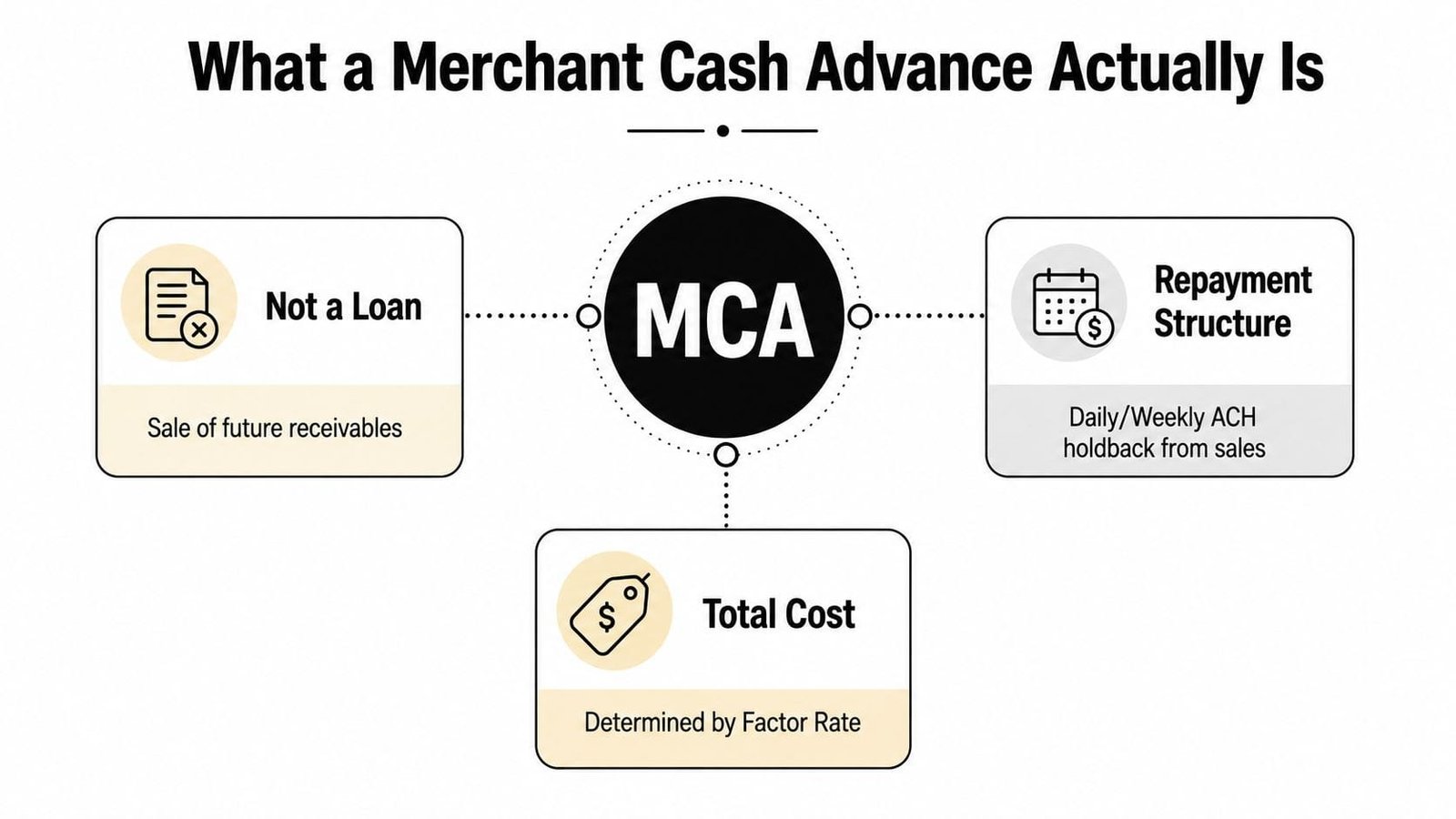
A merchant cash advance is a purchase of future receivables. The provider gives you cash now and collects repayment later as a share of sales or through agreed remittances from your account, rather than through a fixed loan payment schedule. That structure is why MCA underwriting focuses on sales behavior and bank deposits instead of collateral.
You can read it as trading a slice of tomorrow's customer receipts for cash today at a discount. The funder is watching whether future deposits will be strong enough to cover the advance, so the emphasis lands on cash flow, not on a long credit story. Nonbank products like this are commonly offered in amounts below $100,000 (MCA underwriting guide).
How the repayment structure changes the math
MCA repayment usually happens through a holdback, which is a percentage of sales or a fixed ACH withdrawal tied to estimated revenue. Because repayment follows the money moving through the account, the monthly strain can feel different from a term loan payment, even when the total payback is higher. That is why owners hear factor rate, holdback percentage, and remittance so often.
The factor rate is where the total cost sits. Instead of interest compounding on a declining balance, the advance is multiplied by a set factor to determine total repayment. If you are reading an offer sheet, focus on the total payback, the holdback method, and whether the funding schedule matches your actual sales rhythm.
Stable deposits give an underwriter more confidence because the remittance can be pulled without straining operations. Sharp swings in revenue make the same structure more expensive in practice, since the business has less room to absorb the withdrawals. Chargebacks, short deposit runs, and seasonal lulls all shape how risky the file looks, and that risk often affects both approval and pricing.
MCA language sounds unfamiliar because it is built around receivables, not debt. Once that distinction is clear, the rest of the requirements make more sense.
Core Eligibility Thresholds You Should Know
A merchant cash advance application usually starts with a short reality check. Can the business show enough operating history, enough deposit activity, and enough repayment capacity for the advance to make sense? Underwriters care about those answers because MCA approval depends more on receivables and account behavior than on pristine credit.
Most providers start with a few baseline thresholds. Ask Luca notes that many funders want at least some operating history, steady gross deposits, and personal credit that is below traditional bank-lending standards but not so weak that the file becomes unworkable. The MCA underwriting guide and NAV both point to the same general pattern, time in business, monthly deposits, and account activity matter more than a perfect score.
Minimums underwriters tend to check first
| Criterion | Common floor | Why it matters |
|---|---|---|
| Time in business | About 6 to 12 months | Gives the funder enough history to see whether sales are stable or still forming |
| Monthly deposits | Roughly $5,000 to $20,000+, depending on the funder | Shows whether the business can support repayment from regular receivables |
| Personal credit | Often around the low 500s rather than bank-loan territory | Helps with risk pricing, but usually does not override strong deposits |
Those are the front-door requirements, not the whole file. A business can clear the minimums and still get a weaker offer if the deposits are uneven, chargebacks are heavy, or the bank account shows stress from returns, overdrafts, or seasonal dips.
Why revenue quality matters more than a clean score
Underwriters read bank behavior the way a mechanic listens to an engine. They are checking for rhythm, strain, and signs that the business can keep running while repayment comes out of daily cash flow. Strong sales with wild swings can look riskier than moderate sales that arrive consistently.
That is why deposit volatility matters. A file with regular deposits, predictable card volume, and limited chargeback noise usually looks easier to fund than one with the same gross revenue but choppy timing. Seasonality also matters, because a business that earns heavily in bursts may need a different repayment setup than one with steady weekly activity.
Owners coming from asset-heavy financing often expect collateral to do the heavy lifting. MCA underwriting is different, because the focus is cash flow, not pledged equipment. For a useful comparison, see prepare assets for vet practice lending, where tangible assets can play a larger role.
A short checklist helps, but the decision comes from the way the account behaves from month to month.
Documents You Need Before You Apply
A merchant cash advance file usually looks more like an organized folder than a giant loan packet, but the pieces have to line up. Funders commonly ask for 3 to 6 months of business bank statements, recent POS or card processor reports, proof of ownership, a government-issued ID, a voided check for ACH setup, and entity documents such as articles of incorporation or an operating agreement. Many also want the prior year's business tax return or a year-to-date profit-and-loss statement.
Each document answers a different question. Bank statements show deposits, balances, and overdrafts. Processor reports confirm that sales activity matches what the bank shows. Entity documents prove the applicant can legally sign for the business. Tax returns and profit-and-loss statements help explain revenue that bank deposits alone may not fully capture.
A good file works like a matching set of puzzle pieces. If the processor report says one thing and the bank statements say another, the underwriter has to stop and sort out the gap. If the business account also carries personal spending, the review gets slower because the funder must separate company money from everything else.
Practical rule: if the account mixes business and personal spending, expect more questions and a slower decision.
The cleanest way to prepare is to make the revenue easy to verify and the ownership easy to confirm. A simple merchant cash advance document checklist can help you gather the usual stack before you apply.
Common delays usually come from a few avoidable problems:
- Outdated statements: recent activity matters most, so old files do little to show current risk.
- Missing pages: incomplete processor reports make revenue verification harder.
- Bad account hygiene: transfers, cash deposits, or personal spending inside the business account blur the approval picture.
- Weak signatory proof: if the entity paperwork does not match the applicant, the file stalls.
These documents do more than prove you exist. They show how the business behaves, and that behavior helps shape both approval and pricing.
How Underwriters Read Your Numbers
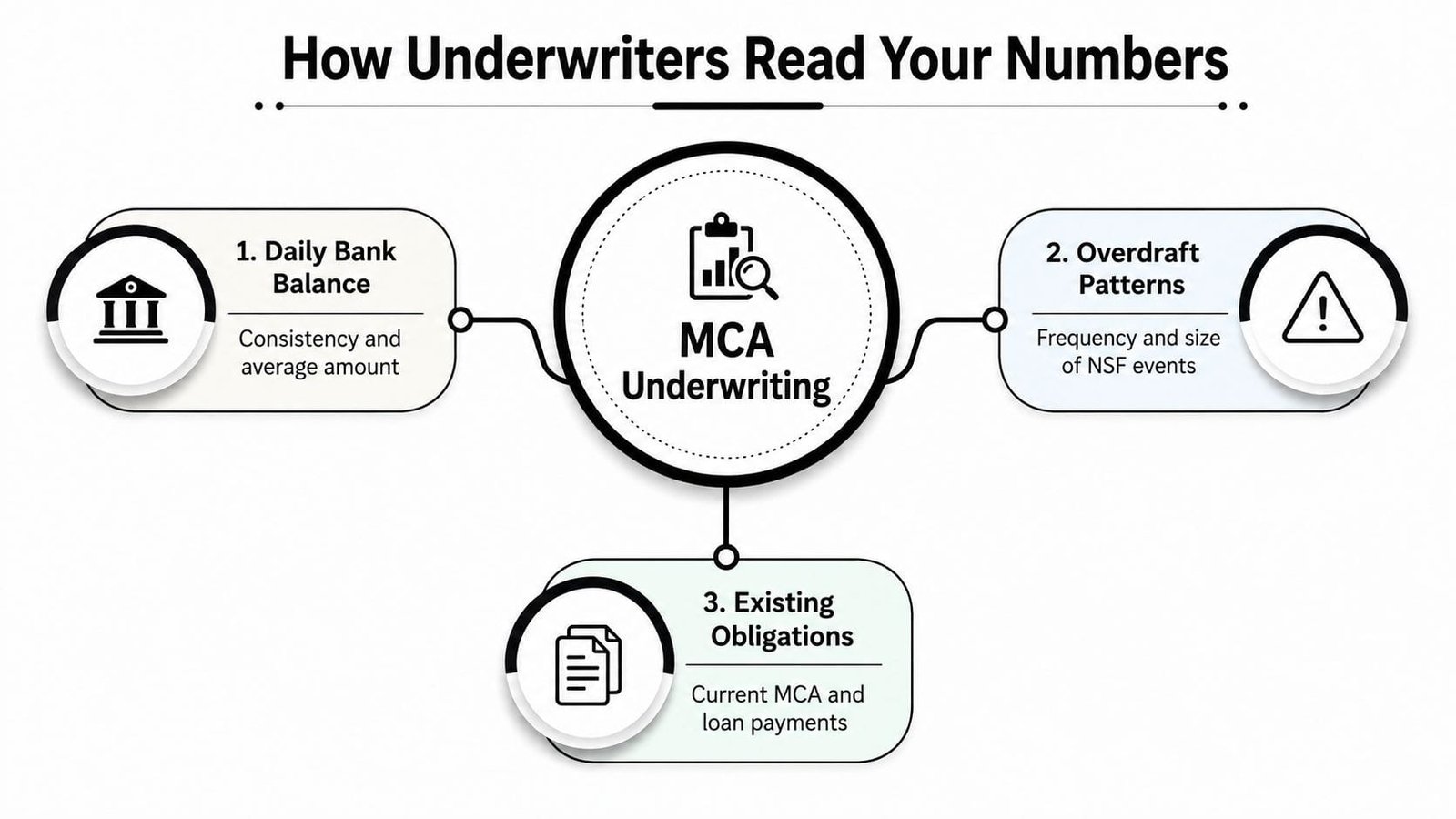
Once the basic thresholds are met, underwriters stop asking whether the business exists and start asking whether the account can handle repayment without strain. Underwriters read patterns, not scores. Two businesses can deposit the same monthly amount and still receive different offers because their bank activity tells different stories.
The signals that matter after the headline revenue
The file starts with the deposits, but it does not end there. Underwriters read daily average bank balance consistency, the frequency and size of NSF or overdraft events, concentration risk, and existing financing obligations, along with chargebacks, seasonality, liens, bankruptcy history, and prior MCA exposure. The question behind all of it is simple, can the business keep sending remittances without repeatedly draining the account? As noted in what is underwriting process, the review is a pattern check, and the pattern can be stronger or weaker even when the revenue number looks the same.
A restaurant with steady weekday deposits and few overdrafts usually reads better than a business with the same monthly volume but lumpier inflows. The first account suggests predictable collection behavior. The second suggests more friction around a fixed or semi-fixed remittance schedule.
A concrete example makes the difference easier to see. Two businesses each deposit 50,000 a month. One has no NSF events, while the other has several. The second file often gets the higher factor rate because the lender has to price in more repayment friction, even though the headline deposits match.
Why volatility changes the factor rate
Pricing follows the shape of the revenue stream. A business with one major customer, one payment processor, or a seasonal burst of revenue can still qualify, but the offer may carry a higher factor rate because the incoming cash is less predictable. The more the account depends on one channel, the more fragile the repayment model looks.
Deposit size tells the funder money is coming in. Deposit consistency shows whether the money will still be there when the holdback hits. That is why clean, steady bank activity matters so much, and why the same revenue can produce a better or worse offer depending on how it arrives.
Three Real Qualification Scenarios
A busy restaurant, a general retailer, and a home-services contractor all need capital today. Underwriters do not read those files the same way. They look past the headline revenue and ask how steady the money really is once it hits the bank.
Three sample MCA qualification scenarios compared
| Profile | Monthly Revenue | Time in Business | Credit Score | Key Risk Marker | Typical Offer Outcome |
|---|---|---|---|---|---|
| Busy restaurant | 60,000 | 2 years | 550 | Minimal chargebacks, steady card sales | Usually competitive approval, with pricing helped by consistent deposits |
| General retailer | 45,000 | 4 years | 620 | Four NSF events over six months | Often approved, but the factor rate may rise because of account volatility |
| Home-services contractor | 30,000 | Varies by season | Recent tax lien | Heavy seasonality and a lien | May be declined, or approved only with added structure such as a co-signer |
The restaurant file is the easiest to read. Card sales arrive regularly, chargebacks stay low, and the bank activity looks like a business that can handle a holdback without much strain. Even with a weaker credit score, that pattern gives the funder a cleaner repayment picture.
The retailer sits in the middle. Revenue clears the basic floor, but NSF events tell a different story about day-to-day cash pressure. That kind of account often still gets reviewed, yet the pricing can move up because the lender has to plan for more friction during repayment.
The contractor is harder to underwrite. Seasonal deposits can work against a fixed remittance flow, and a recent tax lien adds another layer of caution. A lender may still move forward, but only if the rest of the file explains how repayment will stay stable.
Underwriters usually do not reject a file because one item looks imperfect. They reject it when the full story points to uneven deposits, strained bank behavior, or a repayment pattern that may break under pressure.
The lesson is straightforward. Revenue gets the file opened, but revenue quality, deposit stability, chargebacks, and seasonality shape both approval odds and the factor rate attached to the offer.
How to Prepare, Apply, and Budget for Costs
A strong MCA file starts before the application goes out. A month of cleanup often changes the underwriter's view more than a rushed submission ever can. Owners who reconcile deposits early, clear up old obligations, and sort out chargebacks usually present a simpler repayment story.
A practical preparation timeline
Start with the last few months of bank and processor activity. Match deposits to records, separate personal spending from business activity, and look for overdrafts or NSF events that keep showing up on the same dates. Then check any existing MCA balances or short-term debt, because stacking can affect both approval odds and pricing.
Two weeks before applying, tighten the file. If chargebacks are high, be ready to explain why. If deposits come in waves because of one customer or one processor, explain the pattern with operating facts, not broad optimism. If you want a way to sanity-check whether funding ties back to growth, the guide from Growth 4 Trades can help frame whether a customer-acquisition spend has room to support repayment.
Underwriters also read bank behavior like a rhythm section. Steady deposits, few NSF events, and clean transfers suggest a business can handle a holdback without too much strain. Choppy deposits, frequent reversals, or heavy chargebacks usually push the offer toward a higher factor rate.
What the cost can look like
A $50,000 advance at a 1.25 factor rate means $62,500 total repayment. That same factor rate can feel very different depending on the holdback.
At a lower holdback percentage, the daily or weekly remittance is smaller, so cash flow stays looser. At a higher holdback percentage, the same advance gets collected faster, but each draw takes a bigger bite out of sales. The factor rate does not change, but the pressure on the bank account does. For a plain explanation of how that pricing works, see what is factor rate.
A second example makes the point clearer. Two businesses can each take the same $50,000 advance at the same 1.25 factor rate, yet the one with a stronger sales stream and lower holdback may feel the repayment as manageable, while the one with thinner margins and a higher holdback may feel squeezed on ordinary expenses.
Hidden costs deserve attention too. Some offers include origination fees, broker commissions, early repayment discount changes, or stacking penalties if another advance is already active. Those terms matter as much as the headline advance amount.
Pre-application checklist
- Reconcile bank statements: make sure deposits and withdrawals match your records.
- Pull processor reports: confirm the sales data is complete and current.
- Review NSF history: fix obvious cash-management issues before the underwriter sees them.
- Check ownership paperwork: make sure the signer on the application matches the entity records.
- Map existing debt: know exactly what other financing is already being repaid.
The Business Loan Warrior application flow asks for recent bank statements, which is the same kind of document MCA funders use to verify repayment capacity. The closer your numbers are to reality, the easier it is to choose an offer that fits the cash you have.
Key Takeaways and Alternatives Worth Considering
Owners often focus on revenue size first, but revenue quality matters more than gross volume in MCA underwriting. Clean deposits, low NSF activity, and steady account behavior usually carry more weight than a strong sales headline. Documentation accuracy drives offers, and underwriting weighs behavior over credit scores more often than first-time applicants expect.
Three more points deserve attention. Stacking reduces future approvals, total repayment always exceeds the funded amount, and an MCA is different from a bank loan. The requirements are cash-flow focused, not collateral focused.
A lender is reading the story inside your bank account. If deposits swing sharply from week to week, or if sales drop hard in certain seasons, the offer may tighten even when the business is profitable on paper. Chargebacks, NSF returns, and erratic deposit timing can signal higher risk, which can affect both approval and the factor rate.
If speed matters and your deposits are clean, an MCA may still be the right fit. If you can wait and want lower cost, other funding types deserve a closer look.
For owners who sell to other businesses and wait on invoices, invoice factoring can fit better than a general cash advance. If your revenue follows recurring contracts or subscription-style billing, revenue-based financing may line up more naturally with repayment. These options shift the focus from broad daily sales to the way cash arrives.
The right choice depends on urgency, credit profile, current debt load, and how consistent your deposits look over time. A clean file with predictable cash flow can open more doors and improve pricing, while a choppy account often pushes the cost higher. If you are checking merchant cash advance requirements, Business Loan Warrior helps owners compare funding options, review document requirements, and move through a single application flow that fits different capital needs. Visit Business Loan Warrior to review your choices and start from a clearer position.