
You've just closed a strong equity round. The bank balance looks healthy, but your hiring plan, product roadmap, and customer acquisition budget are already competing for it. You can raise another round early, accept whatever valuation the market offers, or add venture debt and buy time to reach a more valuable milestone.
That choice isn't a simple question of eligibility. Venture debt for startups is a capital-allocation decision. Used well, it preserves ownership and gives a proven company more options. Used badly, it turns a temporary runway problem into a repayment crisis. The right question is not, “Can we get debt?” It's, “Will this facility make the next financing or operating milestone more achievable without putting the company at unacceptable risk?”
Table of Contents
- Why Founders Are Turning to Venture Debt Right Now
- How Venture Debt Actually Works
- The Venture Debt Market in 2026
- When Venture Debt Is the Right Move
- Understanding the True Cost of Venture Debt
- Risks and Covenant Traps to Watch
- Choosing a Lender and Negotiating the Term Sheet
- Your Next Steps and Common Founder Questions
Why Founders Are Turning to Venture Debt Right Now
Consider a founder who has just completed a Series A. Her investors are supportive, the product has traction, and the company has enough cash to execute the current plan. She's also looking at a long fundraising process, uncertain valuation expectations, and a hiring roadmap that could consume cash faster than the original model assumed.
An equity round gives her permanent capital, but it also reprices ownership and may bring new governance demands. Venture debt offers a different trade. It adds a repayment obligation and usually includes warrants, yet it can extend the company's cash position without selling a large new ownership stake. That optionality matters most when the company expects to reach a meaningful milestone before raising again.
Founders have become more sensitive to dilution because every financing decision affects employees, early investors, and future fundraising negotiations. A company that raises equity before it needs to may give up ownership at a weak negotiating point. A company that adds debt without a credible repayment or refinancing plan may lose the flexibility it was trying to preserve.
CFO rule: Borrow to reach a milestone, not to postpone an uncomfortable conversation about the business.
The market has also become large enough that venture debt deserves a place in a serious funding strategy. A 2024 industry analysis of venture debt reported worldwide deal value of $83.4 billion, up 46% from the prior year, with the market compounding at 14% annually since 2018. The same analysis points to a meaningful role alongside equity rather than treating debt as a niche bridge product.
That doesn't mean every startup should use it. Adoption remains concentrated. In a sample of 41,568 firms, only 1,431, or 3.44%, were venture-debt backed, according to research on venture debt and startup development. The typical borrower had already operated for years before taking its first facility, which reinforces the practical point: lenders usually want evidence that the company can attract future capital and execute against a plan.
Founders should also treat financing as part of the company's credibility. Strong operating metrics matter, but so does how the CEO communicates the company's direction publicly. Resources on personal branding for startup CEOs can help founders present a consistent market narrative, which supports recruiting, fundraising, and lender conversations without replacing the underlying financial proof.
How Venture Debt Actually Works
Think of startup financing as a spectrum. A SAFE gives an investor a claim on future equity. A traditional bank loan relies more heavily on cash flow, collateral, and conventional credit analysis. Venture debt sits between those models. It's a loan designed for venture-backed companies, with repayment obligations like debt and a small equity-linked warrant that gives the lender upside.
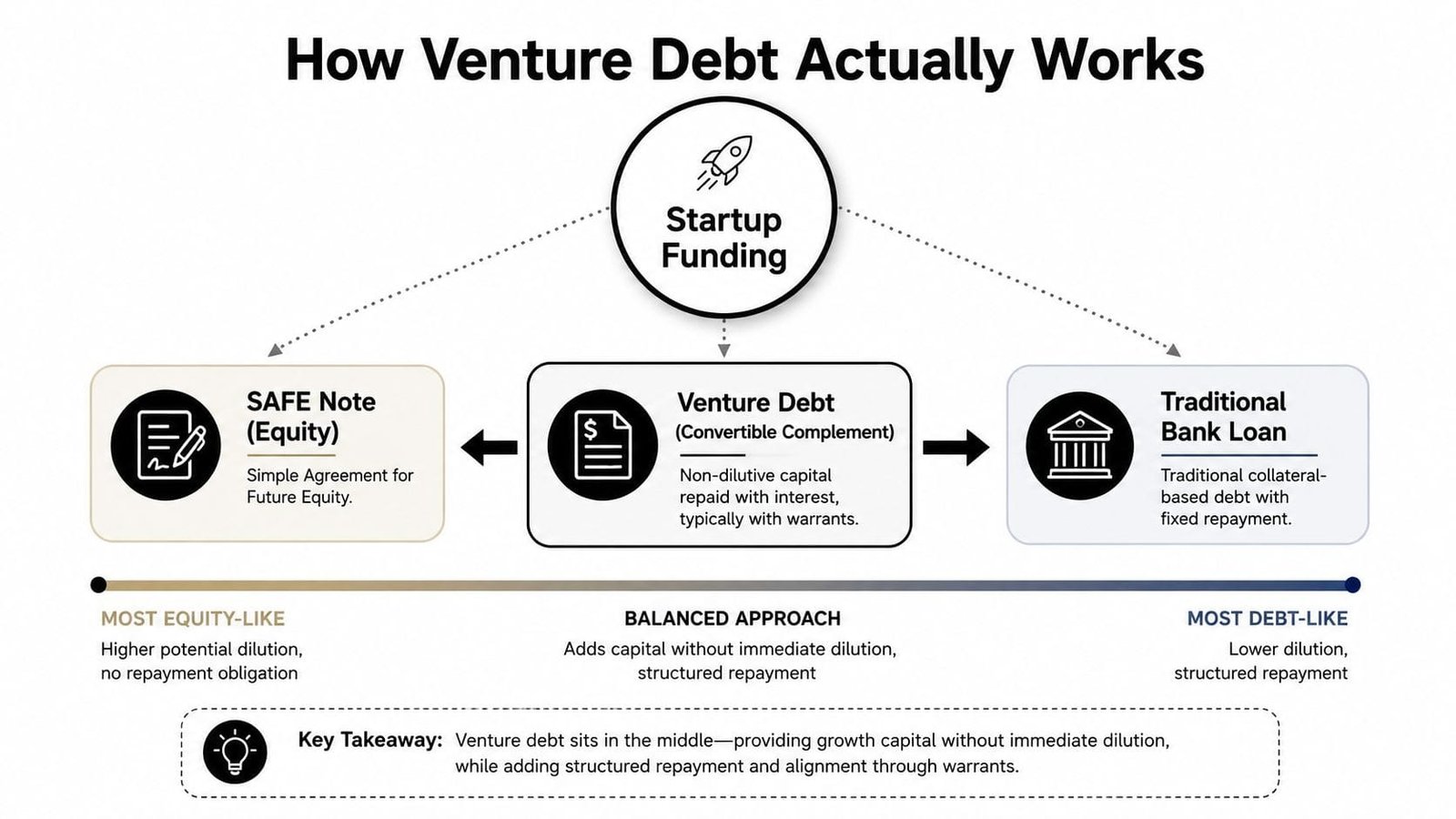
The core terms
- Principal: The amount the lender commits or advances. A facility may be fully drawn at closing or made available in tranches tied to agreed conditions.
- Interest rate: The price paid for using the money. Facilities are commonly floating-rate, based on a benchmark such as SOFR plus a spread. The startup debt cost benchmark guidance places common 2025 to 2026 all-in pricing around 8% to 15%.
- Maturity: The date by which the outstanding balance must be repaid. Your repayment schedule matters as much as the headline maturity because principal payments can begin while the company is still investing for growth.
- Interest-only period: An opening period in which the company pays interest without repaying principal. This preserves cash early, but it doesn't eliminate the later amortization burden.
- Amortization: The process of paying down principal over time. Ask for the exact monthly schedule, not a general description.
- Warrants: The lender's equity kicker. Current market guidance puts warrant coverage around 0.5% to 5% of company equity or loan value, depending on structure and lender.
Lenders underwrite more than a revenue snapshot. They examine the quality of the equity sponsors, monthly burn, ARR trajectory, cash balance, projected liquidity, customer concentration, and the probability that the company can raise equity again. They're asking a practical question: if growth misses plan, does the company still have credible access to capital?
Before you compare term sheets, understand how a revolving or committed facility differs from a single advance. This credit facility overview is useful for clarifying commitments, draws, repayment, and availability.
The facility also needs a defined job. It might fund inventory, a hardware build, selected hires, or runway extension to a planned equity milestone. If the only use is “general growth,” your finance team may struggle to prove that the borrowing created enough value to justify the liability.
The Venture Debt Market in 2026
The market is expanding in size, but not evenly in borrower count. U.S. venture debt reached a reported $68.8 billion in 2025, while annual transaction volume stayed roughly flat at about 1,000 deals, according to Runway Growth's venture debt review. That combination points to larger facilities for existing or later-stage borrowers rather than broad access for every startup.
The reported median deal size was $5.5 million, while the 75th percentile reached $27.7 million. Those figures change how founders should approach the market. The question isn't only whether a lender will approve a facility. It's whether your company needs enough capital to justify a specialist process and can absorb the repayment profile attached to a larger commitment.
| Metric | Median / Typical Range | Notes |
|---|---|---|
| Global venture debt deal value | $83.4 billion in 2024 | Reported worldwide value, up 46% year over year, according to Kearney's industry analysis |
| U.S. venture debt value | $68.8 billion in 2025 | Deal volume stayed roughly flat at about 1,000 transactions, according to Runway Growth |
| U.S. median deal size | $5.5 million | Larger facilities indicate concentration among scaling borrowers |
| U.S. 75th percentile deal size | $27.7 million | Useful reference for later-stage financing discussions |
| Global venture debt growth | 14% annually since 2018 | Reported by Kearney |
| Sample share of venture-debt-backed firms | 3.44% | Based on 1,431 of 41,568 firms in the cited startup sample |
Geography and sector matter. In India, venture debt deployment reached $1.3 billion across 187 deals in 2025, up 12% year over year, according to Fortune India's market coverage. Series A and B companies represented 60% of deals, and fintech attracted nearly $600 million, about 46% of total capital. Lender appetite is therefore not distributed equally across stages, regions, or business models.
That concentration affects bargaining power. A company in a lender's preferred sector with strong institutional backing may negotiate structure, covenants, and draw conditions more effectively than a company that only matches the broad definition of venture-backed startup.
When Venture Debt Is the Right Move
Venture debt is a fit problem, not a prize for reaching a particular fundraising stage. Before you contact lenders, test the decision against cash timing, operating proof, use of proceeds, and covenant capacity.
Start with the cash model
A practical starting point is at least 9 to 12 months of runway after the equity round, but that threshold isn't a guarantee of safety. It gives the company room to absorb lender diligence, deployment delays, and the possibility that the next equity round takes longer than expected.
Your revenue profile must also support the borrowing. Don't copy a SaaS threshold into a hardware or healthcare model. Ask whether recurring revenue, contracted demand, inventory turns, or another reliable commercial signal gives the lender confidence that the company can support its future financing path.
Gross margin matters because interest and principal compete with every other use of cash. If margins are weak and monthly burn is still climbing, debt can magnify the problem instead of solving it.
Use this one-minute screen
| Question | Keep evaluating venture debt | Stop and reconsider |
|---|---|---|
| Runway after equity | You can operate through the lender process and reach a milestone | The facility only prevents an immediate cash shortfall |
| Product maturity | Customers, revenue, or repeatable demand support the plan | Product-market fit remains unproven |
| Use of proceeds | The money funds a specific hire, inventory purchase, build, or financing milestone | The plan is simply “keep going” |
| Next financing | You have a credible path to another equity round, profitability, or strategic outcome | No clear repayment or refinancing route exists |
| Covenants | Finance can model minimum cash, burn, revenue, and debt-service tests monthly | No owner can monitor compliance |
| Dilution | The company accepts a modest warrant in exchange for flexibility | The board treats any warrant as unacceptable |
The capital stacking guide can help frame venture debt alongside equity and other forms of financing, but the conclusion should come from your own cash model.
Decision test: If missing the next milestone makes repayment impossible, size the facility below the amount that funds that milestone. Debt should give you room to execute, not force a binary outcome.
Venture debt is usually the wrong move before product-market fit, during an uncontrolled burn increase, or when management has no realistic plan for the next equity event. A founder who needs debt to disguise a broken equity narrative should raise equity, cut burn, or change the plan instead.
Understanding the True Cost of Venture Debt
Founders often compare venture debt with an equity round by looking at dilution alone. That misses the full price. Interest, fees, warrants, legal work, repayment timing, covenant limits, and lost flexibility all belong in the decision.
Pricing varies by lender type, company quality, facility structure, and risk allocation. Review current venture debt pricing guidance, then build your own model around the proposed term sheet rather than relying on a market range.
| Cost Component | Venture Debt Facility | Priced Equity Round |
|---|---|---|
| Cash interest | Required, commonly floating-rate | None |
| Principal repayment | Required under the facility schedule | None |
| Equity dilution | Usually limited to warrants | Equity issued to investors |
| Upfront and legal fees | Negotiated lender, counsel, and facility costs | Company and investor transaction costs |
| Covenants | May restrict cash, revenue, debt, and operating decisions | Governance and investor rights instead |
| Upside for capital provider | Warrant participation | Ownership of the company |
| Exit impact | Debt must be repaid or settled, warrants may participate | Investors remain equity holders |
The warrant trap
A warrant may look small at signing, yet its economic value depends on the company's future valuation and the exact exercise mechanics. Model both the percentage dilution and the value transferred at several exit outcomes before the board approves the facility.
For example, 1% of equity represents a much larger economic transfer when the company is worth more than it was at the facility close. The board should compare that future warrant value with the ownership sold in an equity round today.
Inspect the less visible charges too. End-of-term payments, amortization, prepayment penalties, unused commitment fees, and default pricing can change the outcome. A facility that appears inexpensive while undrawn may become costly if the company draws late, prepays early, or breaches a covenant.
Debt also changes who controls the capital stack. In a subordinated loan structure, confirm which creditor gets paid first, what consent rights apply, and whether a future lender can refinance the facility without triggering penalties. Put those terms beside the cash model, not in a separate legal folder.
The right comparison is the value of flexibility gained against the cash and control obligations accepted. If repayment depends on a financing event that has no dependable path, the facility is priced too cheaply in the founder's spreadsheet, regardless of its headline rate.
Risks and Covenant Traps to Watch
Venture debt isn't mostly upside. It gives the lender contractual rights that equity investors usually don't have, and those rights can become decisive when performance slips.
Financial covenants may require minimum cash, revenue or ARR levels, debt-service capacity, or limits on burn. The startup debt covenant guidance specifically highlights minimum cash, revenue, debt-service, and negative-balance-sheet tests, and recommends keeping debt service below roughly 25% of net burn and total debt around 6% to 8% of valuation as risk-control benchmarks.
A breach can affect more than the amount already drawn. Depending on the documents, the lender may suspend future availability, charge default interest, demand repayment, or accelerate the entire facility.
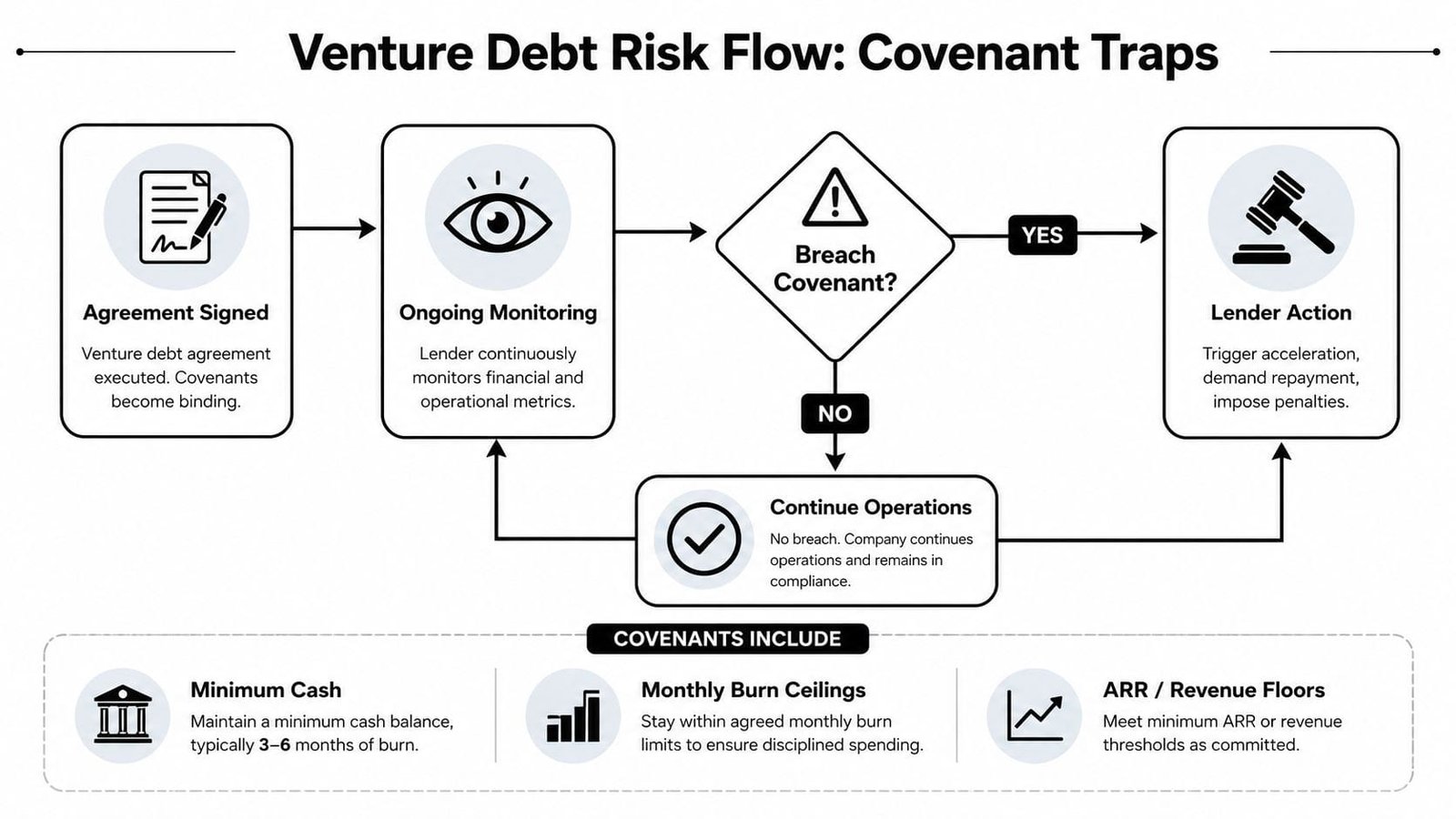
How the default spiral starts
- The company misses a test. A cash balance falls below the required level, revenue misses the floor, or burn exceeds the agreed limit.
- The lender changes posture. Draws may stop while the lender requests updated forecasts, board materials, and a remediation plan.
- The company loses time. Management focuses on waivers or emergency financing instead of customers and product execution.
- Refinancing becomes harder. A lender can demand repayment or use the breach to negotiate harsher economics.
Operational covenants deserve equal attention. Review restrictions on senior or pari passu debt, insurance requirements, intellectual-property security, equity issuance notifications, change-of-control provisions, and cross-default language affecting parent or subsidiary entities.
Your finance routine should include monthly covenant modeling, a 13-week cash forecast, and a written communication protocol for bad news. Tell the lender early when a metric is likely to miss. Silence makes a manageable variance look like a hidden problem.
Choosing a Lender and Negotiating the Term Sheet
Don't send the same deck to every lender and wait for a pricing auction. Run a focused process that matches your company's stage, sector, facility size, and tolerance for covenants.
Five moves that keep the process controlled
- Shortlist the lender archetype. Venture banks may offer banking services and relationship depth. Dedicated venture debt funds can handle companies that don't fit standard bank credit. Revenue-based providers look to recurring revenue performance, while strategic or corporate financing arms may understand a specialized sector but impose their own strategic conditions.
- Ask your board for introductions. Existing investors can explain your financing history and future support. Their reference often matters because lenders underwrite the probability of future equity access.
- Prepare the data room before outreach. Include a 13-week cash forecast, monthly recurring revenue cohorts where relevant, ARR and retention metrics, cap table, current debt, board materials, customer concentration, and a clear use-of-proceeds schedule.
- Run parallel conversations. Keep enough competition to create bargaining power, but don't turn the process into an unmanageable spreadsheet exercise. You need to judge the relationship, not only the lowest rate.
- Have counsel mark the documents. The term sheet is only the beginning. Restrictions often become more precise in the definitive loan agreement.
| Lender Type | Typical Check Size | Fees & Warrants | Covenant Strictness | Best Fit |
|---|---|---|---|---|
| Venture bank | Smaller to mid-sized facilities | Often competitive, with negotiated warrants | Can be structured around banking relationship and financial tests | Venture-backed companies seeking an integrated bank partner |
| Venture debt fund | Mid-sized to large facilities | Pricing and warrants reflect fund return targets | Often detailed and closely monitored | Companies needing flexible specialist underwriting |
| Revenue-based provider | Tied to recurring revenue performance | Repayment economics linked to revenue | Focuses on revenue reporting and payment capacity | Businesses with dependable recurring revenue |
| Strategic or corporate lender | Depends on mandate and sector | Terms vary by strategic context | May include additional relationship conditions | Specialized companies with a clear strategic fit |
Founders commonly push back on seven areas:
- Warrant coverage: The verified market range is roughly 0.5% to 5%, so a request above that range deserves a clear economic explanation, not casual acceptance.
- Original issue discount and facility fees: Ask whether fees apply to committed or drawn capital.
- Amortization: Negotiate the start date and shape of principal repayment.
- Prepayment penalties: Protect the company if a strong equity round or acquisition makes early repayment sensible.
- Material adverse change clauses: Narrow vague language that could let the lender stop funding based on subjective concern.
- Cross-default provisions: Limit the ability of a problem at one entity or facility to infect the rest of the group.
- Information rights: Give the lender useful reporting without creating an operational burden or exposing unnecessary confidential material.
For lender discovery, a US lending investor database can help build an initial list. Treat it as a sourcing tool, then verify each provider's current mandate, fund duration, portfolio construction, and experience in your sector.
The strongest concessions usually come when the company has recent equity backing, clear momentum, and multiple financing options. When lenders hold the advantage, focus less on winning every clause and more on avoiding a structure your forecast can't support.
Your Next Steps and Common Founder Questions
The founder in the opening scenario shouldn't decide by copying another company's facility. She should run a short, disciplined process that answers whether debt improves the next milestone or merely delays the next equity decision.
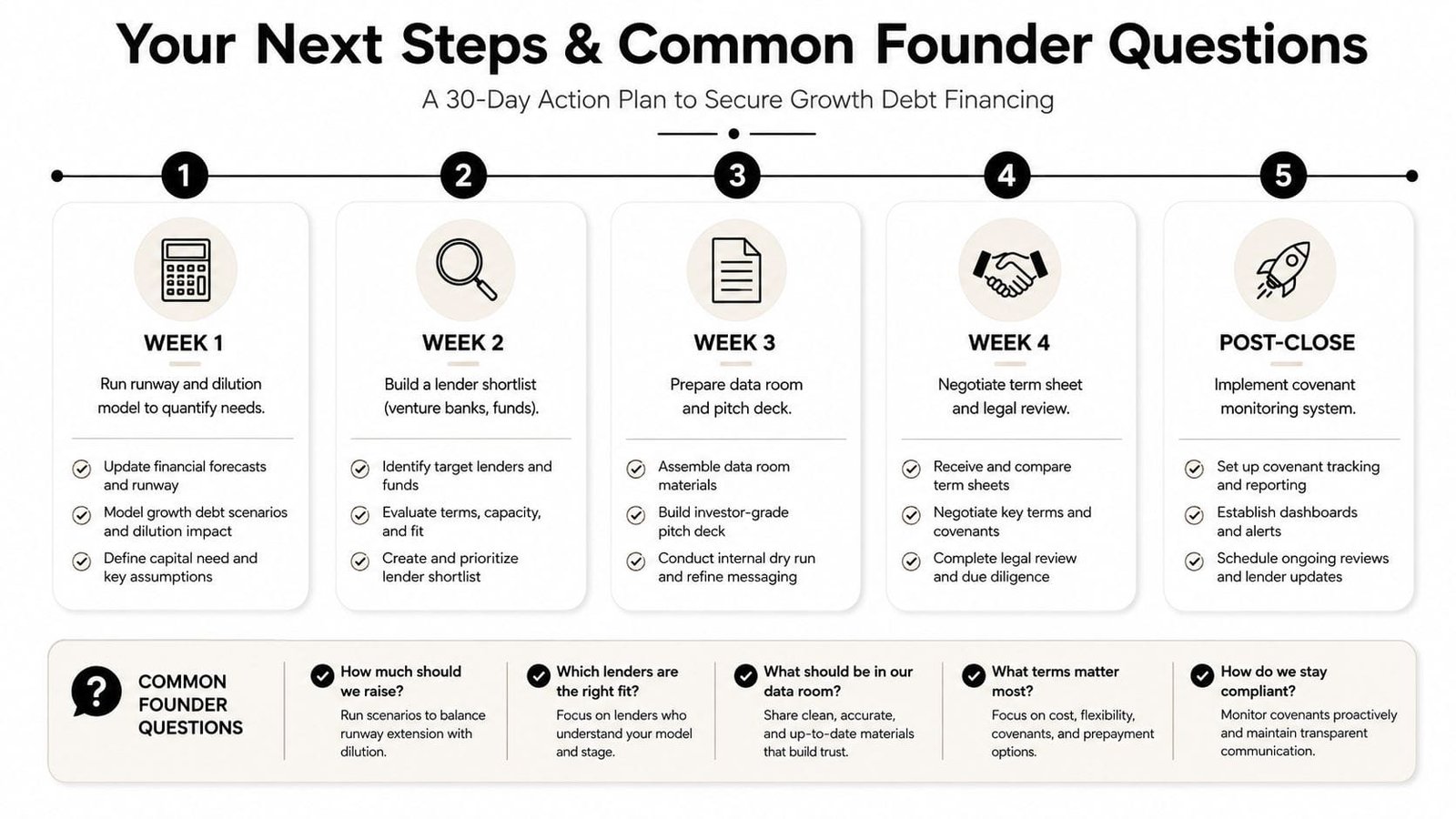
A practical 30-day plan
- Week one, model the trade: Build a runway model with base, downside, and upside cases. Show cash interest, principal repayment, warrant economics, and the equity valuation you'd need at the next round.
- Week two, build the shortlist: Select lenders that understand your sector, stage, geography, and facility size. Include at least one alternative structure so you're not negotiating from a single option.
- Week three, prepare diligence: Organize the forecast, cap table, revenue cohorts, retention data, investor references, debt schedule, board approvals, and use-of-proceeds plan.
- Week four, run the process: Speak with lenders in parallel and compare economics, covenant definitions, draw conditions, reporting obligations, and the people who'll manage the relationship.
- After signing, install controls: Assign covenant ownership, update cash forecasts regularly, and schedule lender reporting before the first test arrives.
Four founder mistakes appear repeatedly. Raising debt to hide a weak equity narrative doesn't repair investor confidence. Ignoring warrant compounding understates the true cost. Treating covenants as paperwork creates avoidable defaults. Assuming a revenue lender will finance an unpredictable or non-recurring revenue base leads to wasted time and poor sizing.
Questions founders ask before signing
How does venture debt interact with the next equity round?
Use debt when the next round has a credible purpose and timing, not as a substitute for investor demand. Tell new investors about the facility early and model how repayment, security interests, and warrants affect the round.
Can a lender require a personal guarantee?
Institutional venture debt is generally structured around the company and its assets, but guarantees can appear in specific arrangements. Never assume they're absent. Have counsel identify every personal obligation before signing.
Does SAFE-style debt exist?
Some instruments blend debt and conversion features, but they don't remove the need to understand maturity, repayment, conversion triggers, and control rights. If you want equity-like risk sharing, compare the instrument with a straightforward equity round.
How are SAFEs and convertibles treated on the balance sheet?
Their accounting and legal treatment depends on the instrument terms and applicable accounting framework. Give the lender a complete capitalization picture and ask counsel and your accountant to explain how each instrument affects debt ratios and covenant calculations.
What happens during an acquisition?
A change of control can trigger repayment, consent rights, or warrant treatment. Review those clauses before accepting an offer, because the facility may affect the buyer's financing model and your proceeds.
Is venture debt available before Series A?
It can be available to some venture-backed companies earlier than founders expect, but access depends on equity sponsorship, traction, cash planning, and lender appetite. The research on startup development indicates that venture debt is concentrated among a small share of firms and often follows demonstrated traction, so pre-product-market-fit companies shouldn't treat availability as evidence of suitability.
The final decision should fit your downside case. If debt lets the company reach a defined milestone while preserving meaningful ownership, it may be the right complement to equity. If repayment depends on everything going perfectly, raise less debt, raise equity, or reduce the plan before signing.
Business Loan Warrior helps businesses compare and pursue funding, including business loans, SBA financing, lines of credit, equipment financing, and working-capital options. Visit Business Loan Warrior to explore funding choices and connect your capital plan with a financing structure your company can realistically repay.