
A chair is aging, patients are asking for digital scans, and a vendor quote is sitting on your desk with more zeros than you'd like to see. You could pay cash and protect the equipment purchase from interest, but that may leave less liquidity for payroll, supplies, marketing, or an unexpected repair. You could also borrow quickly, only to discover that the payment term outlasts the technology's useful life.
That's the core dental equipment finance decision. It isn't just about finding the lowest monthly payment. The structure should reflect how long the asset will produce value, how quickly it should pay for itself, and whether software or upgrades could make it obsolete before the debt is retired.
Table of Contents
- Why Dental Equipment Finance Is the Default Move
- Comparing Your Financing Options
- Evaluating the True Cost of Financing
- The Application Process and Documentation Checklist
- What Underwriters Look For
- Financing Fast-Changing Digital Equipment
- Insider Tips for Securing Better Terms
Why Dental Equipment Finance Is the Default Move
A practice owner reviewing a major equipment quote usually has three competing priorities. The equipment needs to be installed soon, the practice needs enough cash to operate comfortably, and the purchase should support production rather than become a financial drag. Financing exists to balance those priorities, not automatically because the practice can't afford the equipment.
The cost explains why spreading payments has become routine. A basic dental operatory, including the chair, light, and delivery system, can cost roughly $15,000 to $40,000. Once X-ray equipment, sterilization, and digital systems are included, a full fit-out with 2–4 operatories can reach about $100,000 to $300,000 or more, according to dental practice equipment financing guidance. In the UK market, a complete fit-out for 2–3 surgeries has been estimated at £150,000 to £400,000 in equipment investment, reinforcing the same capital-allocation problem.
That's a large amount to remove from working capital, even for a healthy office. A term loan, lease, or equipment finance agreement lets the practice place the asset into service while retaining cash for the operating expenses that keep the asset productive.
Practical rule: Don't ask only whether you can make the payment. Ask whether the equipment will still be generating enough clinical and commercial value when the final payment comes due.
The right structure also depends on the equipment itself. A durable chair, sterilization center, or cabinetry package may justify ownership. A scanner or CAD/CAM system may need a different approach because software, service agreements, and upgrade cycles affect its value. A useful overview of the benefits of equipment financing can help frame the cash-flow decision, but the final choice should come from the asset's expected working life and utilization.
By the end of the financing process, you should know the payment, the total repayment, the expected payback period, and the likely condition of the equipment when the debt ends. That's how dental equipment finance becomes a capital-planning tool rather than a rushed way to accept a vendor quote.
Comparing Your Financing Options
The four routes most practices consider are equipment loans, leases, SBA-backed financing, and vendor or dealer programs. They can all fund equipment, but they don't create the same ownership rights, approval process, or end-of-term obligations.
Equipment loans
An equipment loan or equipment finance agreement gives the practice ownership of the asset, subject to the lender's security interest until repayment. It generally suits chairs, delivery systems, sterilization equipment, or other assets the practice expects to keep for a long productive life.
The trade-off is straightforward. You'll usually pay toward the full equipment cost, so the monthly obligation can be higher than under a fair market value lease. In return, there's no residual-value decision at the end. Once the balance is paid, the practice owns the equipment outright.
Leasing structures
An FMV lease lowers the payment by leaving an assumed residual value at the end of the term. The practice may return the equipment, extend the arrangement, or purchase it at fair market value. That flexibility can be valuable when digital imaging or CAD/CAM technology may change materially before the lease expires.
A dollar-buyout lease follows a different logic. The practice expects to own the equipment after making the scheduled payments and the nominal end-of-term purchase. It behaves more like ownership financing than a technology-refresh lease, so comparing only the monthly payment can be misleading.
SBA-backed financing
SBA-backed financing can make sense when the equipment purchase is part of a larger project involving working capital, an acquisition, or a substantial practice build-out. The broader use of funds can be helpful, but the application is typically more document-heavy than a standalone equipment transaction.
This route tends to fit an established practice with organized financial records and enough time to complete a more involved underwriting process. It isn't automatically the right choice for a time-sensitive replacement or a fast-moving technology purchase.
Vendor and dealer programs
Vendor financing is convenient because the equipment seller can often coordinate the quote and financing in one place. That can reduce administrative friction, especially when installation, training, software, and service are bundled.
Convenience doesn't prove competitiveness. A vendor package may make the rate, fees, buyout, or bundled software cost harder to isolate. Before accepting it, compare the offer against independent commercial equipment lenders and their rates and terms. Even businesses that invest heavily in professional services, such as custom marketing for law firms, generally compare vendor proposals with independent alternatives before committing capital. Dental practices should do the same.
| Financing Option | Typical Term | Typical Cost | Best Fit |
|---|---|---|---|
| Equipment loan | 36–60 months is common for chairs, CEREC systems, and digital scanners | Pricing is commonly 6%–15%, depending on credit, term, and equipment type | Durable equipment the practice expects to own |
| FMV lease | Structured around the equipment's useful life | Lower payments may reflect a residual value and future buyout or return decision | Fast-changing digital equipment and upgrade flexibility |
| Dollar-buyout lease | Structured around the equipment's useful life | Payments support eventual ownership, with a nominal purchase at the end | Equipment the practice plans to keep |
| SBA-backed financing | Varies by program and project | SBA 7(a) equipment borrowing has recently been cited around 10.75%–11.25% | Larger projects combining equipment with broader business needs |
| Vendor financing | Set by the dealer or manufacturer program | Must be evaluated through total repayment, fees, and bundled costs | Fast, coordinated purchases when the offer is competitive |
The table is a shortlist, not a substitute for reading the agreement. The best fit is determined by ownership intent, technology refresh cadence, liquidity needs, and the equipment's expected payback.
Evaluating the True Cost of Financing
A monthly payment is useful because it tells you what the practice must carry every month. It's incomplete because it hides total interest, fees, residual obligations, and the risk of still owing money after the asset stops producing value.
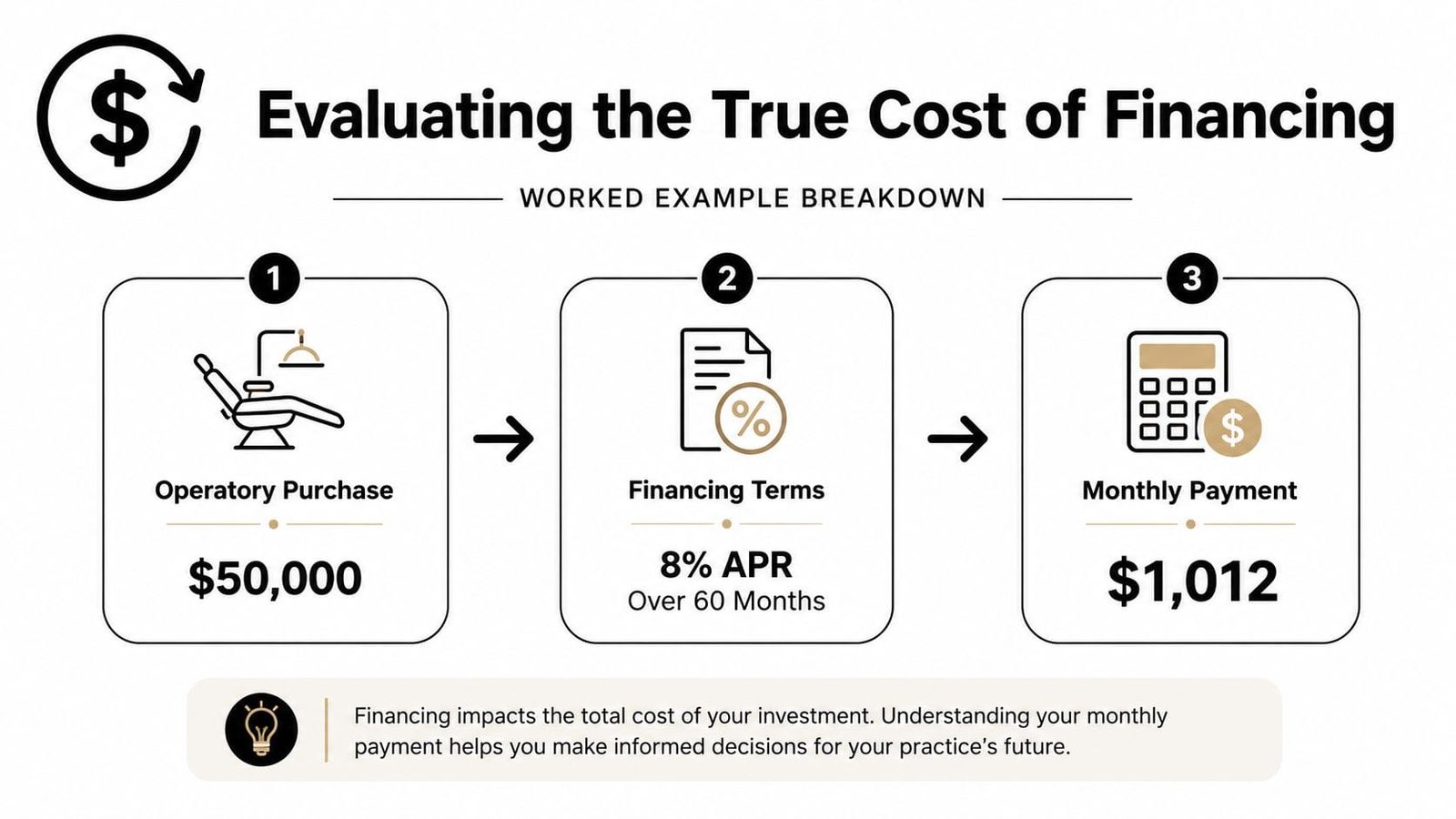
Consider the commonly used example of a $50,000 operatory financed at 8% over 60 months. The resulting payment is about $1,013 per month, according to this dental equipment financing example. That figure turns a large purchase into a predictable operating obligation, but it shouldn't be the final number in your analysis.
Work from payment to payback
Start with the equipment's expected monthly contribution. For a scanner, that could include additional cases completed, reduced outsourcing, faster appointments, or improved case acceptance. For a CBCT unit, the relevant question may involve diagnostic capacity and whether referrals or procedures currently leave the practice.
The calculation is simple in principle:
Payback period = total project cost divided by expected monthly cash contribution.
Use conservative assumptions. Separate revenue from cash contribution, account for software and service costs, and consider reimbursement timing. A purchase that appears attractive on gross production may be weak after staffing, consumables, maintenance, and collection delays.
Match debt life to productive life
The amortization period should fit the asset's productive life. A long-lived chair can support a different repayment horizon than a digital system whose software and hardware may need regular refreshes. Stretching debt beyond the equipment's useful life can create a residual-value problem when the practice needs to trade in or replace the asset.
The pricing environment makes this analysis more urgent. A major bank's 2026 dental industry note says equipment and supplies rose 5% in 2025 because of tariff pressures, which means delaying a purchase, paying cash, or financing it can produce different economic results. The same note cites conventional dental equipment loans around 6%–9% for qualified borrowers and SBA 7(a) equipment borrowing around 10.75%–11.25%, but the lowest quoted rate may not be the best structure if the asset becomes obsolete before repayment.
Compare the full obligation, including:
- Interest and fees: Request the total repayment amount, origination charges, documentation fees, and any prepayment restrictions.
- Residual value: Identify the exact buyout method in an FMV lease and determine whether the practice could realistically afford it.
- Software and service: Separate recurring costs from the hardware payment so utilization remains visible.
- Tax treatment: Ask your CPA how ownership, depreciation, lease expense, and available deductions apply to your specific entity and tax position.
The objective isn't to minimize one line on the quote. It's to finance an asset for no longer than it can reasonably earn its keep.
The Application Process and Documentation Checklist
A clean application usually moves faster than a rushed one. The lender needs enough information to verify repayment capacity, understand the equipment, and identify existing obligations. Missing bank statements or an incomplete vendor quote can create more delay than the credit decision itself.
Start with a preliminary review
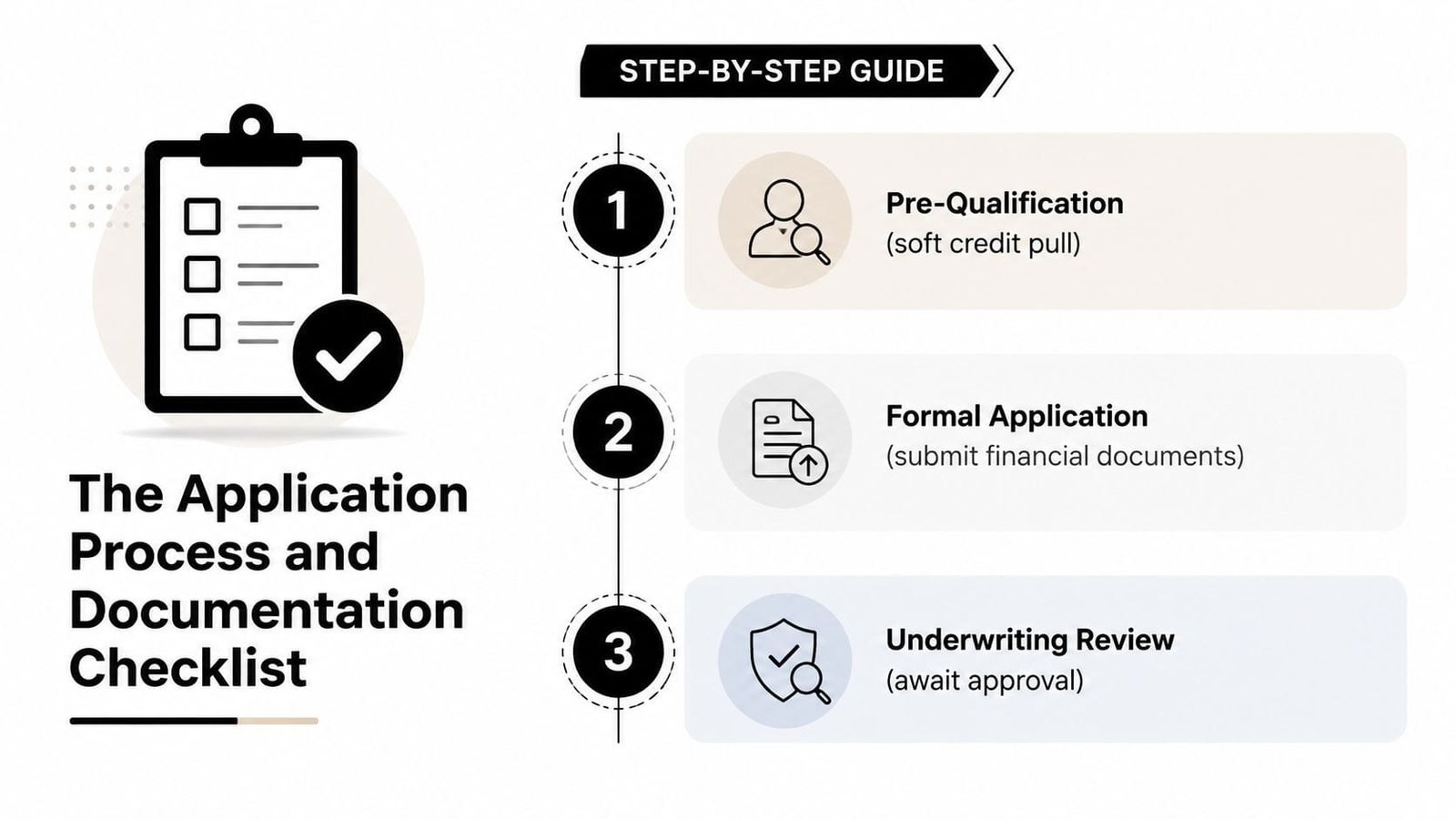
Begin with pre-qualification when available, ideally through a process that uses a soft credit review. This gives you an initial sense of fit without immediately turning every inquiry into a formal application. Ask what information the lender needs before authorizing a hard pull.
The formal application follows once the equipment, amount, entity, and requested structure are clear. Underwriting then reviews credit, cash flow, debt obligations, documentation, and collateral. Industry guidance commonly describes approvals for specialty dental equipment as occurring within 24–48 hours, although the actual timing depends on file quality and transaction complexity, as outlined in this specialty dental equipment financing guide.
Assemble the file before applying
Use this checklist to avoid avoidable back-and-forth:
- Personal and business tax returns: Provide the returns requested by the lender, with all schedules included.
- Business bank statements: Send complete statements rather than screenshots or partial pages.
- Production and collection reports: Show whether clinical output turns into collected cash.
- Entity documents: Include formation records, ownership information, licenses, and required authorizations.
- Equipment quote: Make sure the quote identifies the equipment, installation, software, training, taxes, and delivery costs.
- Current debt schedule: List lender names, original balances, current balances, monthly payments, and maturity dates.
- Accounts receivable information: Include aging detail when the lender requests it, especially for a larger established practice.
A practice that sends a complete file on day one gives the underwriter fewer reasons to pause. If a transaction is expected to take roughly two weeks, complete documents can keep the process moving, while missing records can turn that same period into repeated clarification requests and a delayed vendor installation.
Your goal isn't to overwhelm the lender with documents. It's to present a consistent story. The revenue in the bank statements should make sense beside the production reports, tax returns, debt schedule, and requested payment.
What Underwriters Look For
Underwriters don't approve a dental practice because the profession sounds stable. They approve a specific borrower after testing whether the borrower can support the proposed obligation and whether the equipment provides reasonable collateral value.
Credit tells the first part of the story
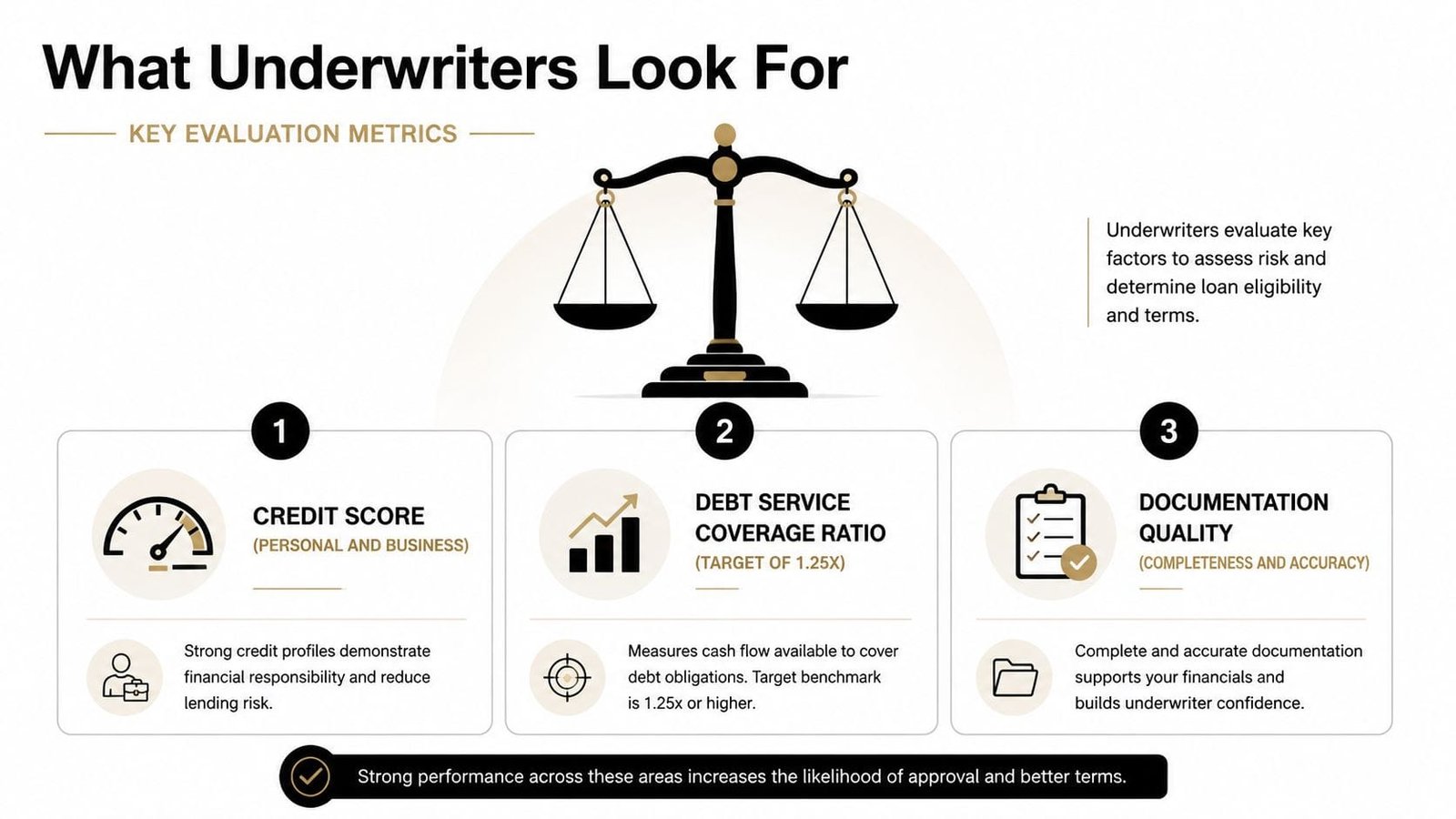
Lenders may review personal credit, business credit, payment history, existing utilization, and public records. Specialty dental equipment guidance commonly identifies 600+ credit as an underwriting threshold for some programs, but a threshold isn't the same as a guaranteed rate or approval. Credit quality affects which lenders will compete, how much cash may be required upfront, and how aggressively the lender prices risk.
Debt service is the second major lever. The lender wants to know how the new payment fits alongside existing loans, leases, owner distributions, payroll, and normal operating expenses. A profitable practice can still be difficult to finance if cash flow is inconsistent or if the new obligation is layered on top of too much existing debt.
Documentation quality changes the conversation
A complete file gives the underwriter confidence that the numbers are reliable. Clean statements, reconciled reports, a current debt schedule, and a precise equipment quote reduce uncertainty. Incomplete records create questions, and unanswered questions can lead to slower decisions, conservative sizing, a larger down payment, or higher pricing.
Established dental practices often underwrite better than the broader healthcare equipment market. One industry benchmark reports 80% or more approval for established dental practices, compared with about 68%–75% for alternative lenders and 42%–52% at traditional banks in overall medical equipment financing, as reported in this medical equipment financing benchmark. The same source reports an SBA default rate of 4.6% for dental practices, versus more than 14% for several riskier sectors.
Those figures describe industry and lender benchmarks, not an individual promise. New practices and lower-credit borrowers can still face materially higher pricing, including 10%–20% down and rates in the 10%–18% range under the cited benchmark.
Before applying, reduce uncertainty. Update the debt schedule, explain unusual deposits or revenue changes, correct credit-report errors, and obtain a vendor quote that separates hardware from recurring services. Those steps don't manufacture stronger cash flow, but they help the lender see the cash flow you already have.
Financing Fast-Changing Digital Equipment
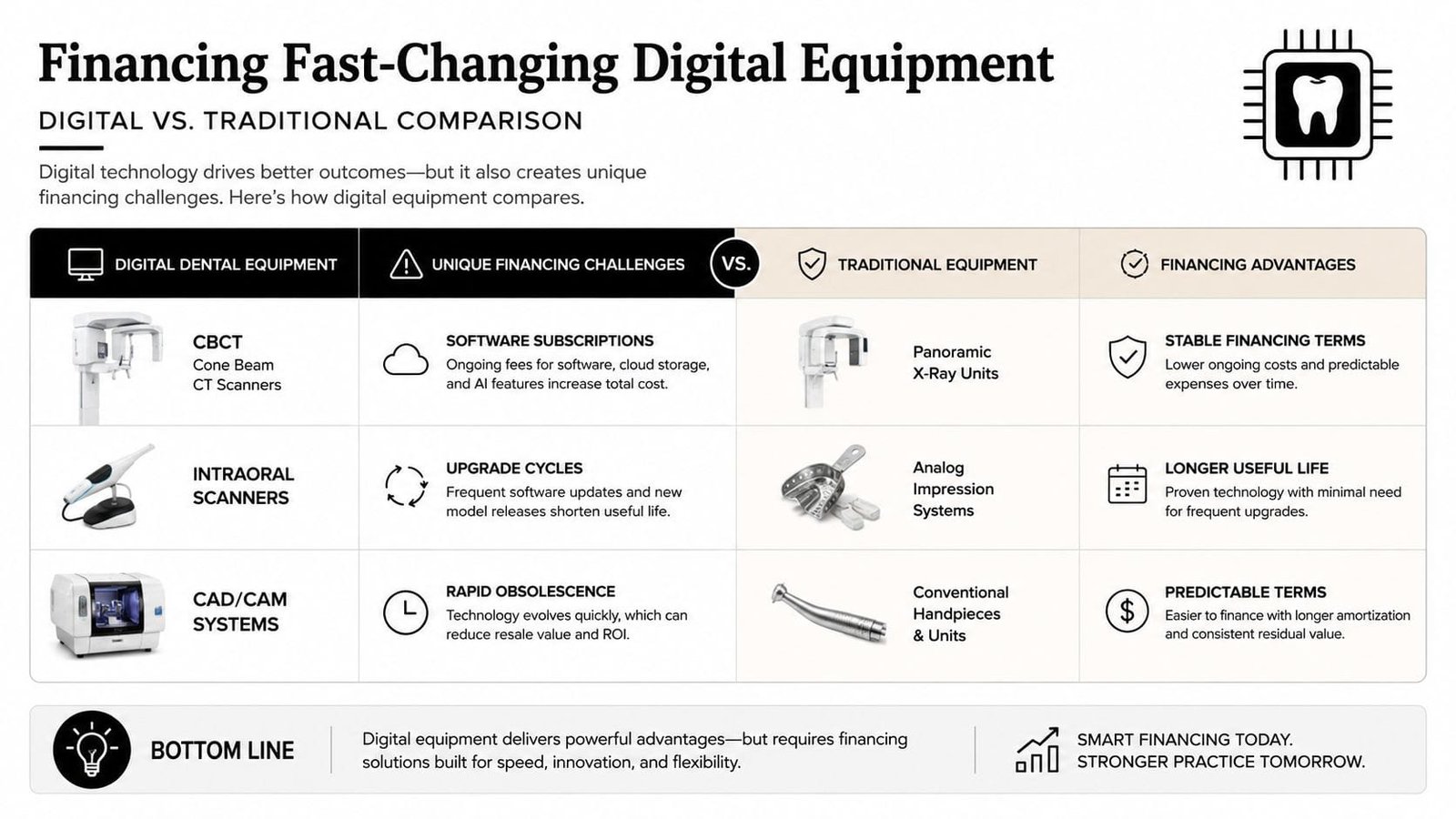
Digital dentistry changes the financing question because the purchase isn't only a physical asset. A scanner, CBCT unit, or CAD/CAM system may include software, training, support, upgrades, and recurring subscriptions. The practice can still owe on the original hardware after the clinical workflow has moved to a newer platform.
Let refresh cadence guide the structure
A conventional equipment loan works well when the practice expects to keep a high-utilization asset for a long service life. Ownership may produce the lower total cost when the equipment remains clinically relevant, serviceable, and productive after the debt is retired.
Leasing can be more rational for fast-refresh technology, even when purchase financing appears cheaper on paper. An FMV lease may preserve cash and create a defined upgrade or return decision, while a dollar-buyout structure better fits equipment the practice expects to own. The key issue is whether the practice wants the asset after the term, not whether the lease payment looks smaller.
Vendor bundles deserve careful review. They may combine hardware, software, implementation, and support, but the practice should separate the recurring technology cost from the financed principal. Otherwise, utilization can look healthy while the technology stack consumes more cash than expected.
Stage purchases when utilization is uncertain
A staged rollout can be more disciplined than financing a complete technology stack at once. Start with the component that removes a clear bottleneck, track utilization and cash contribution, then add the next component when the workflow supports it. This approach can protect liquidity for mid-sized practices where a group of technology purchases may affect cash flow more than the headline APR.
For practices evaluating outsourcing alongside new technology, a smart dental lab portfolio strategy can help clarify which capabilities should remain in-house and which should be purchased through a lab partner. That decision directly affects how much equipment the practice needs to finance.
Tax treatment also needs professional review. Ownership-oriented structures may support depreciation, while some lease arrangements may receive different accounting or tax treatment. Your CPA should review the agreement, software component, service contract, and entity structure before tax benefits influence the financing decision.
The broader market is moving toward technology-heavy purchases. Recent coverage projects equipment-and-software investment to grow 6.2% in 2026, and cites continued expansion in clear aligners, according to this digital dentistry financing analysis. The strategic response isn't to finance every new device. It's to fund the equipment that the practice can use often enough, and long enough, to justify its capital cost. Resources on medical equipment financing can help practices compare structures when the purchase includes both hardware and operational needs.
Insider Tips for Securing Better Terms
The strongest financing applications usually reflect planning that happened before the quote arrived. Apply when your financial statements show the practice clearly, rather than during a month distorted by unusual expenses, delayed collections, or unresolved reporting issues.
Ask each lender for the same information. You need the interest rate, total repayment, fees, payment frequency, prepayment terms, collateral requirements, personal guarantee language, and end-of-term obligations. Comparing two or three offers side by side gives you a clearer negotiating position than accepting the first approval.
Negotiate the details that matter later
A low payment can conceal a long commitment or a residual payment. Confirm that the term ends before the equipment's productive life is exhausted, especially when financing a digital system with uncertain refresh timing. If an FMV lease is under consideration, ask how fair market value will be determined and whether the agreement gives you practical options to return, upgrade, or purchase the asset.
Vendor bundles need the same discipline. Request an itemized quote that separates equipment, installation, software, training, maintenance, and financing charges. Then compare the total cash obligation with an independent loan or lease proposal.
Negotiation point: A lender that explains the end-of-term outcome clearly is giving you more useful information than one that only advertises a low monthly payment.
Avoid unnecessary application volume. Ask about pre-qualification and the type of credit inquiry before submitting a formal application. Multiple hard inquiries can complicate the picture, particularly when they're spread across unrelated lenders and suggest that the practice is seeking capital without a defined transaction.
Your action plan is short:
- Identify the equipment and separate durable assets from fast-changing technology.
- Estimate utilization, cash contribution, and payback period.
- Match the financing term to the equipment's productive life.
- Gather tax returns, statements, operating reports, entity records, quotes, and debt details.
- Compare offers using total cost and end-of-term obligations.
- Use a pre-approval process that lets you assess fit before an avoidable hard credit inquiry.
Business Loan Warrior offers a single application for businesses seeking equipment funding, including a “Purchase Equipment” use-of-funds option, with a dashboard for tracking approvals, repayments, and credit insights. Visit Business Loan Warrior to review whether its equipment financing process fits your next dental technology or operatory purchase.