
On most U.S. federal public construction projects over $150,000, contractors must post performance and payment bonds, each equal to 100% of the contract price, plus a bid guarantee of 5%. Those figures are the starting point, but the practical question is whether your company can qualify for the required bond, preserve enough working capital to perform the work, and satisfy the particular agency issuing the contract.
A mid-sized contractor can price a project accurately, win the apparent low bid, and still face a problem at the pre-award meeting. The solicitation may require a bond package that ties up capacity, requires updated financial information, and exposes weaknesses in backlog management or cash flow. Construction bonding requirements are both legal conditions and underwriting tests.
Table of Contents
- Why Construction Bonding Requirements Catch Contractors Off Guard
- The Three Core Construction Bonds and What Each One Does
- Federal State and Local Bonding Thresholds You Must Know
- How Sureties Decide If You Qualify for a Bond
- Documentation the Documents You Need Before Approaching a Surety
- Bond Amounts Underwriting Factors and Change Order Risk
- Practical Steps and Timelines to Secure Your Construction Bond
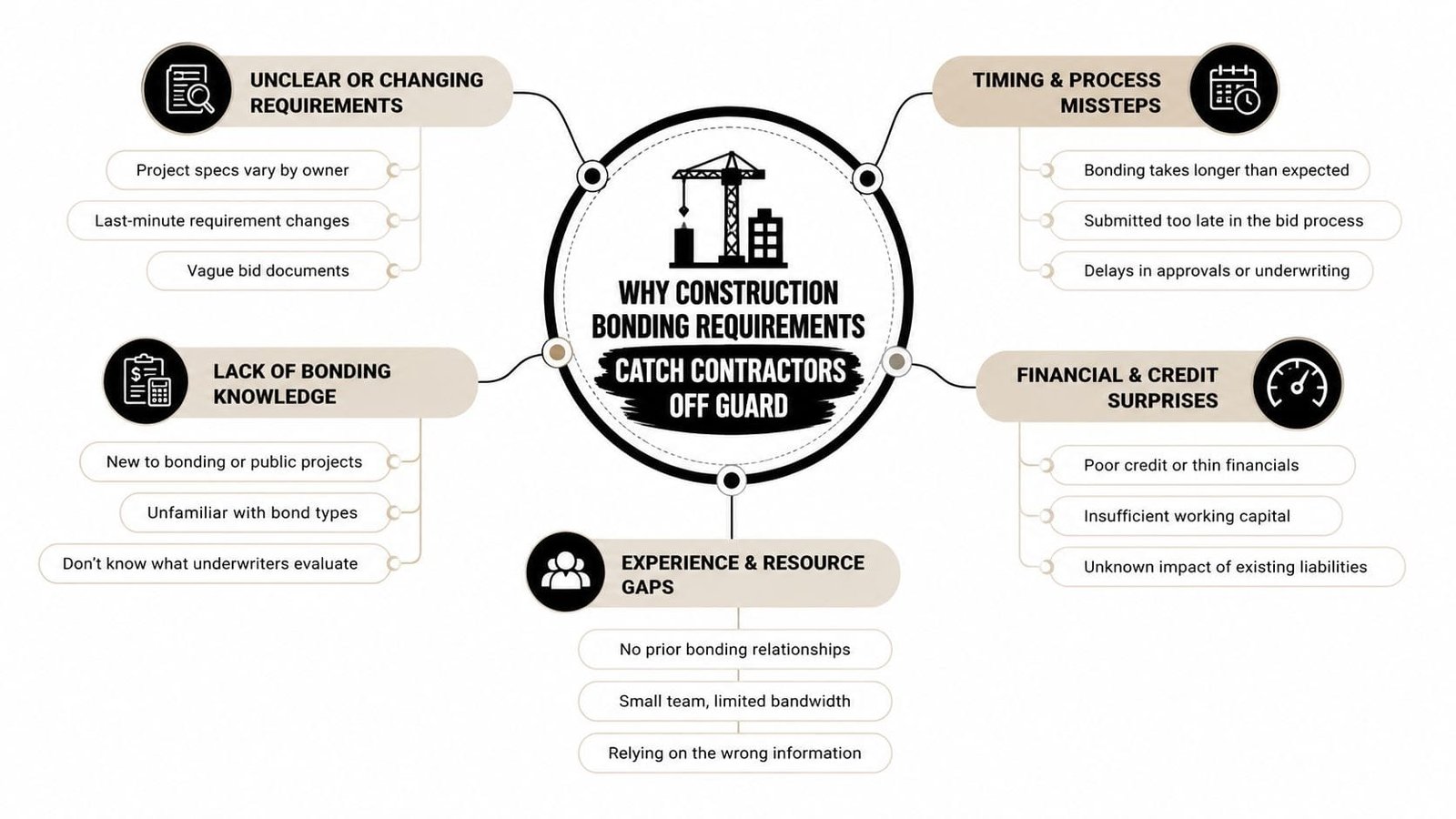
Why Construction Bonding Requirements Catch Contractors Off Guard
Consider a concrete contractor bidding on a $900,000 state transportation project. The estimate is competitive, the crews are available, and the company has completed similar work. At the pre-award meeting, the agency confirms that the contractor must provide a performance bond and payment bond, each for 100% of the contract value, along with a 5% bid guarantee. The contractor has won the price competition, but hasn't yet proved that a surety will support the award.
A surety bond is a three-party guarantee. The principal is the contractor, the obligee is the project owner, and the surety guarantees that the contractor will perform its obligations or that covered losses will be addressed. Federal construction bonding traces back to the Heard Act of 1894, which introduced surety bonding on federal public projects. Congress replaced that framework with the Miller Act in 1935, and states followed with their own versions, commonly called Little Miller Acts. Federal construction bonding history and requirements explain how bonding developed from a federal safeguard into a standard public-procurement control.
Why a bond isn't ordinary insurance
Insurance generally transfers defined risks to an insurer, which prices exposure across a pool of policyholders. A surety evaluates the contractor as a credit risk and expects reimbursement if it pays a claim. That makes the contractor's financial strength, experience, management, and record of completing work central to approval.
Several surprises cause avoidable delays:
- Premiums aren't refundable deposits. Once the surety issues the bond and assumes the obligation, the premium generally represents the cost of that guarantee.
- Capacity is limited. A surety may approve one project but decline another if the new award would exceed the contractor's single-job or aggregate capacity.
- Owner relationships don't replace bonds. Federal public work can require bonding even when the contractor has worked successfully with the agency before.
Practical rule: Treat every solicitation as both a project opportunity and a request for credit support.
Contractors also need to separate two questions. The first is whether the law or contract requires a bond. The second is whether the contractor can obtain it on acceptable terms without starving the project of working capital. A review of construction financing for contractors can help owners consider how bonding obligations fit alongside mobilization, payroll, equipment, and materials funding.
For smaller firms, the compliance question can also be local and practical. A resource on bond insurance for small business in Florida may help a contractor understand how licensing, project, and public-work obligations differ before approaching a surety.
The Three Core Construction Bonds and What Each One Does
The easiest way to understand the bond package is to assign each bond a job. A bid bond protects the owner during the award process. A performance bond protects the owner during construction. A payment bond protects the people and businesses supplying labor and materials.
Bid bonds protect the award process
A bid bond works like a deposit substitute. It tells the owner that the contractor stands behind its bid and will sign the contract and provide the required follow-on bonds if selected. If the contractor refuses to proceed or can't obtain the required performance and payment bonds after award, the obligee may pursue the bid bond for the difference between that bid and the next lowest responsible bid, subject to the bond's terms.
The bid bond usually lasts through the bid evaluation and award period rather than the full construction term. Federal procurement guidance identifies a bid guarantee of 5% of the bid price in the relevant public construction framework, while specific solicitations can state their own required form and amount. Always follow the solicitation, not a remembered percentage from another agency.
Performance bonds support completion
A performance bond is a completion guarantee. If a contractor defaults, the surety may investigate the default, arrange completion, or pay covered damages up to the bond limit, depending on the contract and bond language. The co-signer analogy is useful, but imperfect: the surety doesn't become a business partner and doesn't erase the contractor's obligation to reimburse it.
Payment bonds protect the project chain
A payment bond gives eligible subcontractors, suppliers, and workers a route to seek payment when the general contractor fails to pay. On public projects, that protection matters because private lien remedies generally don't operate against government property in the same way. Federal law pairs performance and payment bonds on qualifying work, and private owners often request the same package through contract terms.
| Bond Type | Purpose | Typical Amount | Beneficiary |
|---|---|---|---|
| Bid bond | Supports the bid and commitment to execute the contract | Often stated in the solicitation, with federal guidance identifying 5% in the applicable framework | Project owner |
| Performance bond | Supports completion and contract performance | 100% of contract price on qualifying federal work | Project owner |
| Payment bond | Supports payment to eligible labor and material claimants | 100% of contract price on qualifying federal work | Subcontractors, suppliers, and workers |
The practical lesson is simple. A contractor doesn't qualify for “a bond” in the abstract. It must qualify for the specific combination, amount, duration, and obligee requirements attached to the project.
Federal State and Local Bonding Thresholds You Must Know
Federal rules provide a clear baseline, but public construction doesn't operate under one nationwide threshold. The Miller Act and FAR framework require performance and payment bonds for federal construction contracts exceeding $150,000. For federal contracts greater than $35,000 but not more than $150,000, the contracting approach uses at least two alternative payment protections, with particular consideration given to an irrevocable letter of credit. FAR Part 28 contains the operative federal procurement rules.
A separate federal bid-guarantee rule can apply to sealed bids. The solicitation controls the precise requirement, so a contractor shouldn't assume that the performance and payment bond percentage answers the bid-bond question. The amount, form, validity period, and delivery method should all be checked before bid submission.
State statutes create a second rulebook
States commonly use Little Miller Acts for state-funded public works. Those statutes can differ in threshold, protected parties, notice procedures, bond amount, and maintenance obligations. A contractor accustomed to federal work may understand the federal trigger and still miss a state or local requirement because the agency uses a lower threshold or a different claim process.
The supplied federal history and procurement materials show the broader pattern. Earlier federal records included a $25,000 requirement, while modern federal practice uses the $150,000 threshold for mandatory performance and payment bonds on qualifying contracts. Government guidance on bonding requirements also notes that many jurisdictions require performance and payment bonds on public construction above $25,000, while state and local rules remain variable.
| Jurisdiction | Performance and Payment Bond Threshold | Bid Guarantee Requirement | Key Notes |
|---|---|---|---|
| Federal | More than $150,000 for mandatory performance and payment bonds | Follow the solicitation and applicable FAR rule | Mid-range contracts may use alternative payment protections |
| State | Varies under each state's Little Miller Act | Varies by statute and solicitation | Thresholds, claim procedures, and coverage can differ |
| City, county, school district, or authority | May be lower than the state floor | Agency procurement documents control | Maintenance, subdivision, electronic submission, or other conditions may apply |
A contractor pursuing Pennsylvania public works should review state-specific guidance, such as this resource on getting bonded for Pennsylvania public works, alongside the actual solicitation.
The safest practice is to pull the bid documents, contract conditions, bond forms, and procurement manual before finalizing a bid. The legal threshold answers whether a bond is generally required. The solicitation answers what this owner expects.
How Sureties Decide If You Qualify for a Bond
A surety's review asks one central question: Can this contractor complete the job, pay its obligations, and withstand ordinary project pressure without defaulting? Revenue alone doesn't answer that question. Two contractors with similar sales can receive different bond support because their cash, backlog, controls, experience, and financial reporting tell different stories.
Capital and financial reporting
The surety examines working capital, debt, liquidity, receivables, payables, cash flow, and the quality of the financial statements. A current work-in-progress schedule helps the underwriter compare contract value, costs incurred, billings, estimated costs to complete, and expected margins across active jobs. Aging receivables, overbillings, retainage, and related-party balances may receive careful scrutiny because book equity isn't always immediately available cash.
Working capital also affects how much work the contractor can support. Industry practice often discusses aggregate capacity as a multiple of adjusted working capital, but the actual benchmark varies by surety and account. A contractor should ask its producer how the surety adjusts working capital rather than treating a multiplier as an entitlement.
Capacity and experience
The underwriter separates single-job capacity from aggregate capacity. A company may handle several moderate jobs but lack the balance sheet or management depth for one unusually large contract. Comparable experience matters too. Completing concrete work is relevant, but completing the same type of concrete work under similar schedule, technical, and public-owner conditions is more persuasive.
Character enters through payment history, disputes, claims, tax issues, and the contractor's candor when problems arise. The surety also considers the banker, CPA, project managers, and owners because those relationships reveal how the company manages pressure.
| Criterion | Typical Benchmark | What It Signals |
|---|---|---|
| Financial statements | Current CPA-prepared reporting appropriate to the account | Whether reported capital and earnings are reliable |
| Working capital | Sufficient adjusted liquidity for the requested program | Ability to fund labor, materials, and retainage |
| Work in progress | Complete, current project-level schedule | Control over active-job performance |
| Experience | Comparable completed work and capable personnel | Likelihood of executing the proposed scope |
| Character | Clear communication and manageable claims history | Willingness to address problems before they become defaults |
| Capacity | Single-job and aggregate limits approved by the surety | Whether the new award fits the total workload |
The process is a credit review, which is why understanding what the underwriting process involves can make the surety conversation less mysterious.
For contractors building their management and licensing credentials, educational resources such as TP Training licensing benefits can provide useful perspective on how formal qualifications support credibility, even though Australian licensing rules don't replace U.S. surety requirements.
The SBA route
The SBA reported record surety bond guarantees in fiscal 2025 and states that its program can guarantee bid, performance, payment, and maintenance bonds for contracts and subcontracts up to $9 million, or up to $14 million when a federal contracting officer certifies necessity. SBA surety bond guarantee information describes this route for contractors that may not fit a conventional surety program. The SBA guarantee doesn't remove underwriting. It changes the risk allocation and can help a participating surety consider a contractor that needs additional support.
Documentation the Documents You Need Before Approaching a Surety
A surety package should let an underwriter understand the company without reconstructing its records from scattered emails. Incomplete submissions create questions, and unanswered questions slow approval. Organize the file into four buckets, then label which documents are annual, interim, or project-specific.
Financial bucket
Start with the financial statements your CPA has prepared, whether audited, reviewed, or another format accepted by the surety. Add current interim financials, aged receivables and payables, a schedule of work in progress, debt schedules, bank information, and explanations for unusual balances.
The WIP schedule deserves special attention. It should show each active project, original contract value, approved changes, costs incurred, billings, estimated cost to complete, and expected gross profit. If the WIP report doesn't reconcile to the general ledger, resolve that issue before submitting the package.
Operational and project history
Give the surety evidence that the team has delivered comparable work. Include resumes for owners and key personnel, an organizational chart, a list of completed projects, owner and architect references, current backlog, and credible pipeline information. A short explanation of each comparable project is more useful than a long list with no context.
Organizational records
Include formation documents, ownership information, business licenses, insurance evidence, bank and CPA letters, and personal financial statements for owners when requested. The surety may also ask about affiliates, guarantees, pending litigation, tax obligations, and related entities.
Project-specific file
For a particular bid, provide the invitation to bid, contract documents, specifications, addenda, schedule, subcontractor list, estimated costs, and anticipated change-order exposure. The surety needs to know what it is guaranteeing, not just who is asking for the bond.
Use a central checklist, such as this guide to documents needed for business underwriting, to identify missing items before the surety requests them.
Some documents need regular updating, especially interim financials, WIP schedules, backlog, and aged receivables. Entity records and completed-project histories may change less often, but they still need review when ownership, management, or licensing changes. Project specifications, addenda, subcontractor information, and bond forms belong in the file for each bid.
A complete package doesn't guarantee approval. It gives the underwriter a coherent basis for making a decision and gives the contractor a chance to correct weak spots before bid day.
Bond Amounts Underwriting Factors and Change Order Risk
Bond sizing starts with the contract, not with the contractor's preferred limit. Under federal rules, performance and payment bonds generally equal 100% of the original contract price, and the required amount also tracks approved contract increases. The payment bond can't be less than the performance bond unless the contracting officer makes the required written determination under the FAR framework. FAR bond amount rules explain why approved changes must be included in the capacity calculation.
That creates two different exposures. Single-job capacity measures whether the surety is comfortable with this contract by itself. Aggregate capacity measures whether the contractor can perform this contract while managing every other bonded and unbonded project already in progress. A company can appear strong on aggregate revenue but still exceed its single-job limit on one complex award.
Change orders are capacity events
A change order can increase direct cost, extend the schedule, raise subcontractor exposure, or require more working capital before payment arrives. The surety may ask for updated cost-to-complete information, revised financials, or an explanation of how the contractor will fund the added scope. Approval isn't always automatic because the owner approved the change.
Before bidding, model the likely pressure points:
- Scope growth: Identify work that could expand and estimate the effect on labor, materials, equipment, and subcontract commitments.
- Timing pressure: Compare when costs will be incurred with when the owner is expected to pay.
- Backlog interaction: Add the possible work to existing commitments, not just to the new contract.
- Closeout exposure: Account for retainage, punch-list obligations, warranty work, and maintenance terms.
- Communication: Tell the surety early when the contract changes or performance begins to diverge from the original plan.
A claim also changes the underwriting conversation. The surety will examine what caused the claim, how the contractor responded, whether controls have changed, and whether additional protection is appropriate. Future support may involve more documentation, collateral discussions, revised terms, or tighter capacity, depending on the facts and the surety's evaluation.
The contractor's objective isn't to avoid every project change. It is to preserve enough financial and management capacity to absorb ordinary change without turning a manageable field issue into a bond problem.
Practical Steps and Timelines to Secure Your Construction Bond
Bonding works best as an ongoing relationship, not an emergency purchase. Start with a surety agent or bond producer who understands construction accounts, then involve the CPA, banker, project team, and underwriter before a major public bid reaches its deadline.
Build the file before the bid appears
Begin prequalification well ahead of the first target bid. Give the producer current financial statements, interim results, WIP schedules, backlog, resumes, ownership records, and project history. The surety can then identify whether the issue is working capital, reporting quality, single-job capacity, experience, or a project-specific concern.
Update financial information before requesting a bond. A stale WIP schedule can hide cost growth or underbilling, while an unresolved tax obligation or unexplained receivable can hold up the review. Ask the CPA to explain unusual balances in plain language, because the underwriter will need a defensible picture of available capital.
Request the bond before bid day
Send the invitation, specifications, addenda, bid form, bond forms, and estimated contract details with enough time for review. Don't assume the surety can issue a bond because it approved an earlier project. Each request must fit the current backlog, current financial position, obligee requirements, and contract terms.
Timing matters: A last-minute request turns a routine issuance into a judgment about whether the surety can verify the file quickly enough to accept the risk.
Keep the relationship active through closeout
After award, provide the executed contract and any required changes. During construction, communicate material disputes, schedule problems, cost growth, and payment concerns before they become surprises. At closeout, retain proof of completion, final payment, releases, and maintenance obligations so the surety can update its records and evaluate the next request with a clean file.
If conventional capacity doesn't fit the project, ask the producer whether an SBA-backed guarantee, a different participating surety, or another acceptable structure could address the gap. The answer depends on the contract, the contractor's records, and the underwriting decision. No alternative removes the need for accurate financials and a credible completion plan.
For a mid-sized contractor, the best time to solve a bonding problem is before bid submission. Assemble the documents, test the project against single-job and aggregate capacity, read every local solicitation condition, and ask the surety to identify the specific obstacle while there is still time to fix it.
Business Loan Warrior helps contractors evaluate working-capital, SBA, equipment, construction, and other business financing options that can support payroll, materials, mobilization, and growth alongside bonding obligations. Visit Business Loan Warrior to explore funding options and begin a no-fee application conversation around your company's project needs.