
An SBA loan is typically in default once a payment is more than 60 days late, the lender may demand full payoff, and the SBA guarantee can be invoked. That means the cure and negotiation clock starts well before Treasury collection.
The restaurant owner usually doesn't experience default as a single dramatic event. First, a payment bounces. Then the lender calls again. A notice arrives, payroll is due, and the owner starts wondering whether “past due” means the loan is already lost.
That uncertainty is dangerous. Defaulting on an SBA loan is a process, not a moment, and each stage removes options. You may still have influence after the first missed payment, but you won't have the same influence after collateral liquidation, a guarantee-purchase request, or Treasury referral.
Table of Contents
- What Default on an SBA Loan Actually Means
- The Default Timeline From Missed Payment to Charge-Off
- Financial and Legal Consequences for the Borrower
- How SBA Lenders and Treasury Pursue Collection
- Negotiating a Workout Before It Gets Worse
- Bankruptcy Implications for SBA Loan Defaults
- Choosing the Right Remediation Path
- Action Plan and Key Questions for Defaulted SBA Borrowers
What Default on an SBA Loan Actually Means
A restaurant owner misses the first 7(a) payment because a large customer paid late. The second payment bounces because sales haven't recovered. The lender's servicing team starts calling, but the owner assumes the account is merely delinquent and that an informal grace period still exists.
That assumption can cost real money. A loan can be delinquent without every default remedy being immediately used, but the loan documents, note, and SBA servicing rules determine when a default has occurred and what the lender may do next. Under the applicable servicing framework, the lender may request that SBA honor its guarantee only after an installment has been in default for more than 60 calendar days, the default remains uncured, and secured business personal property has been liquidated, unless SBA agrees otherwise. The practical consequences of a notice of default are worth reviewing if you're trying to understand what formal notice means.
Read the loan documents, not just the emails
Missed payments are the common trigger, but they aren't the only one. Your note and related agreements may also identify events such as:
- Payment failure: You miss an installment or make only part of it.
- Covenant breach: You fail to meet a reporting, insurance, financial, or operational requirement.
- Collateral problem: You sell, transfer, hide, or materially damage pledged property without authorization.
- Insolvency event: You file for bankruptcy or become subject to another insolvency proceeding.
The lender may accelerate the debt, meaning it demands the entire unpaid balance rather than only the missed installments. It may also enforce liens, pursue pledged property, and pursue the personal guarantee. The SBA guarantee protects the lender's eligible exposure. It doesn't erase your debt.
Practical rule: A lender's temporary silence isn't a waiver. Ask for the account's written status and identify the exact default clause being applied.
Your first job is simple. Get the note, guarantee, payment history, notices, and collateral schedule in one file. Then ask the lender whether the account is delinquent, formally in default, under review by special assets, or being prepared for a guarantee-purchase request. Don't guess based on the tone of a collection call.
The Default Timeline From Missed Payment to Charge-Off
The timeline below is a working model, not a promise that every lender uses identical dates. Loan documents, servicing decisions, collateral, and SBA approval requirements can change the sequence. The important fixed point is the more-than-60-calendar-day default condition that can make a guarantee-purchase request eligible when the default remains uncured and required liquidation has occurred. The SBA servicing rules discussed here also show why the cure window matters.
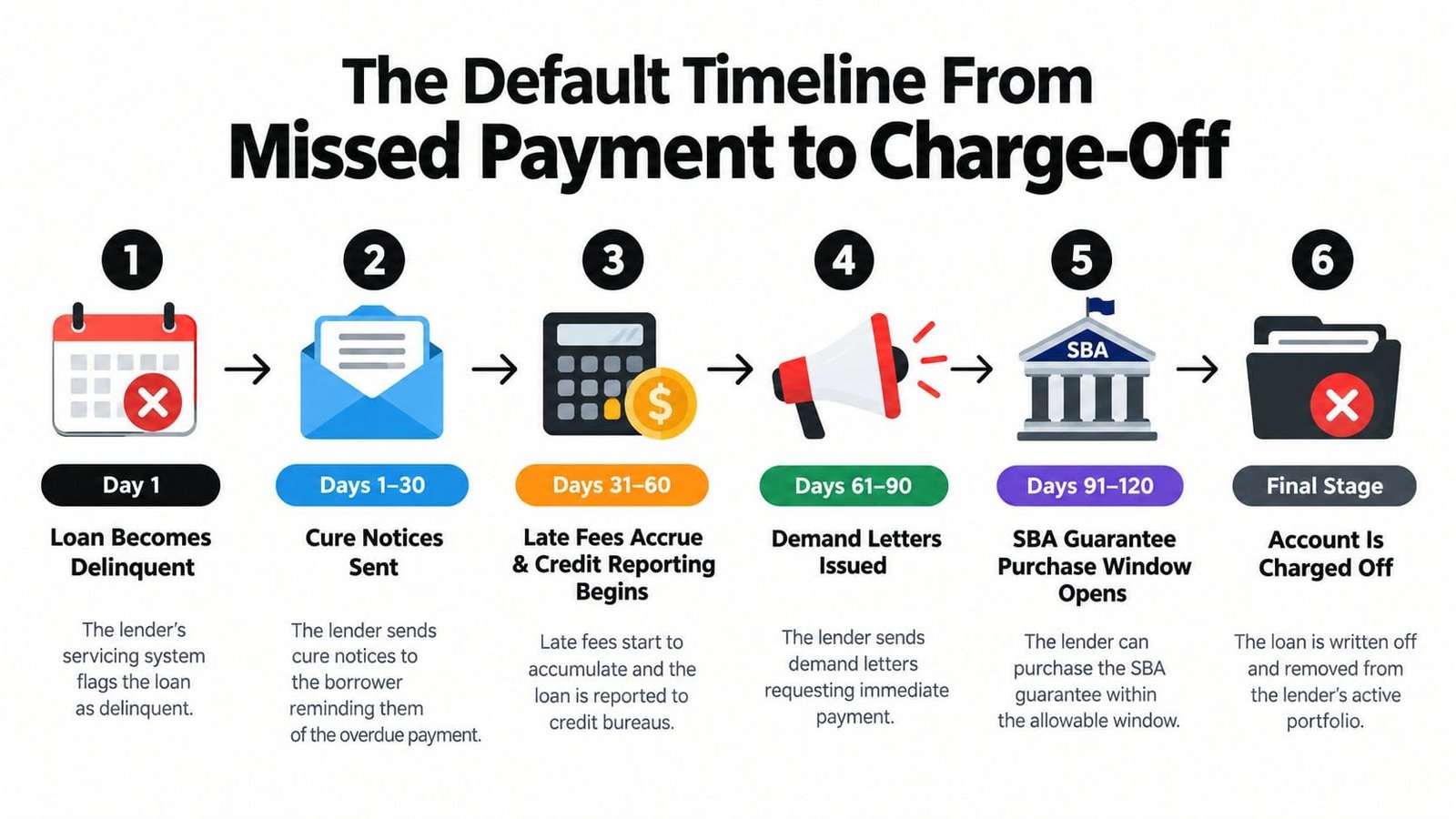
How the file usually progresses
- First missed payment: The account becomes delinquent in the lender's system. Contact the lender immediately, before the file moves to a special-assets or workout team.
- Early collection period: Expect calls, notices, requests for updated financial information, and instructions for curing the missed installment. Keep records of every exchange.
- Beyond 60 days: If the installment remains unpaid and the default isn't cured, the lender may begin the process that can lead to acceleration and an SBA guarantee-purchase request. The lender may demand the full balance.
- Collateral review and liquidation: The lender identifies, takes control of, and liquidates required business personal property. Real estate and personal guarantees may create separate recovery tracks.
- Guarantee purchase and servicing transfer: The lender may submit its request to SBA after meeting the applicable conditions. Once the guarantee is honored, the borrower is dealing with a government recovery process rather than ordinary bank servicing.
- Charge-off and federal collection: Charge-off is an accounting and servicing event, not forgiveness. The government may continue collection, including Treasury referral.
Your strongest leverage is usually before the guarantee-purchase process closes. Cure the arrears if you can, or submit a credible workout package. If the account has already moved toward charge-off, learn what a charge-off on credit means, but don't confuse a credit-report entry with the end of collection activity.
Financial and Legal Consequences for the Borrower
The consequences arrive in layers. The lender handles the first wave, SBA servicing may handle the next, and Treasury can use federal collection tools after referral. Treating all three as “the bank” leads borrowers to send the wrong proposal to the wrong decision-maker.
At the lender stage, the creditor may accelerate the balance, demand payment, enforce a UCC lien against business property, repossess equipment or inventory, sell collateral, and pursue real estate pledged for the loan. The personal guarantee matters because the lender can look beyond the company, subject to the guarantee's terms and applicable law.
The credit damage can spread across the business and the guarantor. A late payment or default may affect commercial and personal credit reporting, which can make future financing harder. For a practical explanation of how payment history can affect credit, review how late payments affect a credit score.
Who does what after SBA loan default
| Party | Trigger point | Typical actions | Borrower impact |
|---|---|---|---|
| Lender | Missed payment, covenant breach, or another contractual default | Notices, collection calls, acceleration, collateral enforcement, guarantee pursuit | Loss of operating assets, full-payoff demand, personal-guarantee exposure |
| SBA | Lender submits an eligible guarantee-purchase request | Reviews the lender's request, services or assigns the debt, pursues recovery | The borrower may lose ordinary lender-workout flexibility |
| Treasury | Debt is referred for federal collection | Offset, garnishment, seizure of bank funds, and other administrative collection tools | Federal payments, wages, and cash can be intercepted |
| Department of Justice or another authorized collector | Collection requires litigation or further enforcement | Civil action or assigned collection activity | Added legal expense and judgment risk |
Treasury referral adds a 28% penalty on the outstanding balance, according to public guidance cited in the provided research, so the amount owed can rise even when the business has stopped drawing on the facility. Treasury can also use wage garnishment, bank-fund seizure, and offsets of federal tax refunds or benefits without first filing a new civil lawsuit. The collection consequences of a defaulted SBA loan make the key point clear: federal referral changes the rules.
Don't wait for a seizure notice to take the account seriously. Once the lender's recovery plan is underway, your business assets, personal assets, income, and access to future federally supported credit may all become relevant.
How SBA Lenders and Treasury Pursue Collection
Lender collection and Treasury collection are different machines. The lender is trying to protect its collateral, document its servicing, and recover enough money to satisfy its obligations before or during the SBA guarantee process. Treasury is enforcing a federal debt after referral, using administrative powers that don't depend on the lender's normal collection preferences.
Before federal referral
The lender may assign the file to special assets, send field representatives, inspect collateral, issue a demand letter, file or enforce UCC remedies, and arrange a sale of equipment, inventory, or other pledged property. If real estate secures the loan, the lender may pursue foreclosure or another state-law remedy. If you signed a personal guarantee, the lender may demand financial information and payment from you personally.
Those actions generally involve notices and procedural requirements, but the exact requirements depend on the collateral, contract, and state law. Don't assume a friendly workout conversation prevents formal enforcement. Ask whether the lender has placed the account in liquidation, whether a demand has been issued, and whether a guarantee-purchase request is being prepared.
After referral to Treasury
Treasury can use offset and garnishment authorities without first filing a new civil lawsuit. Public guidance identifies wage garnishment, seizure of bank funds, and offsets against federal tax refunds or benefits as possible collection tools. The 28% administrative penalty is added when the debt is referred, making early negotiation more valuable. Treasury collection after SBA default describes the practical exposure borrowers should prepare for.
| Collection action | Lender before charge-off | SBA or Treasury after guarantee purchase |
|---|---|---|
| Demand for payment | Yes, under the loan documents | Yes, under federal servicing and collection authority |
| Business collateral recovery | UCC enforcement, repossession, liquidation | Continued recovery or assigned servicing |
| Personal-guarantee claim | Common, subject to the guarantee | May continue through federal servicing |
| Wage garnishment | Usually requires a different legal process | Administrative federal collection may permit it |
| Federal tax refund offset | Not a normal bank remedy | Available after qualifying federal referral |
| Bank-fund seizure | Contract and state-law remedies may apply | Federal collection authorities may apply |
| New federal financing access | Credit underwriting concern | Federal delinquency systems may block or impair access |
The core issue is brutally practical. Before referral, you negotiate with a lender that still wants a documented recovery plan. After referral, you may be negotiating with a federal collector whose mandate is recovery, not preserving your business.
Negotiating a Workout Before It Gets Worse
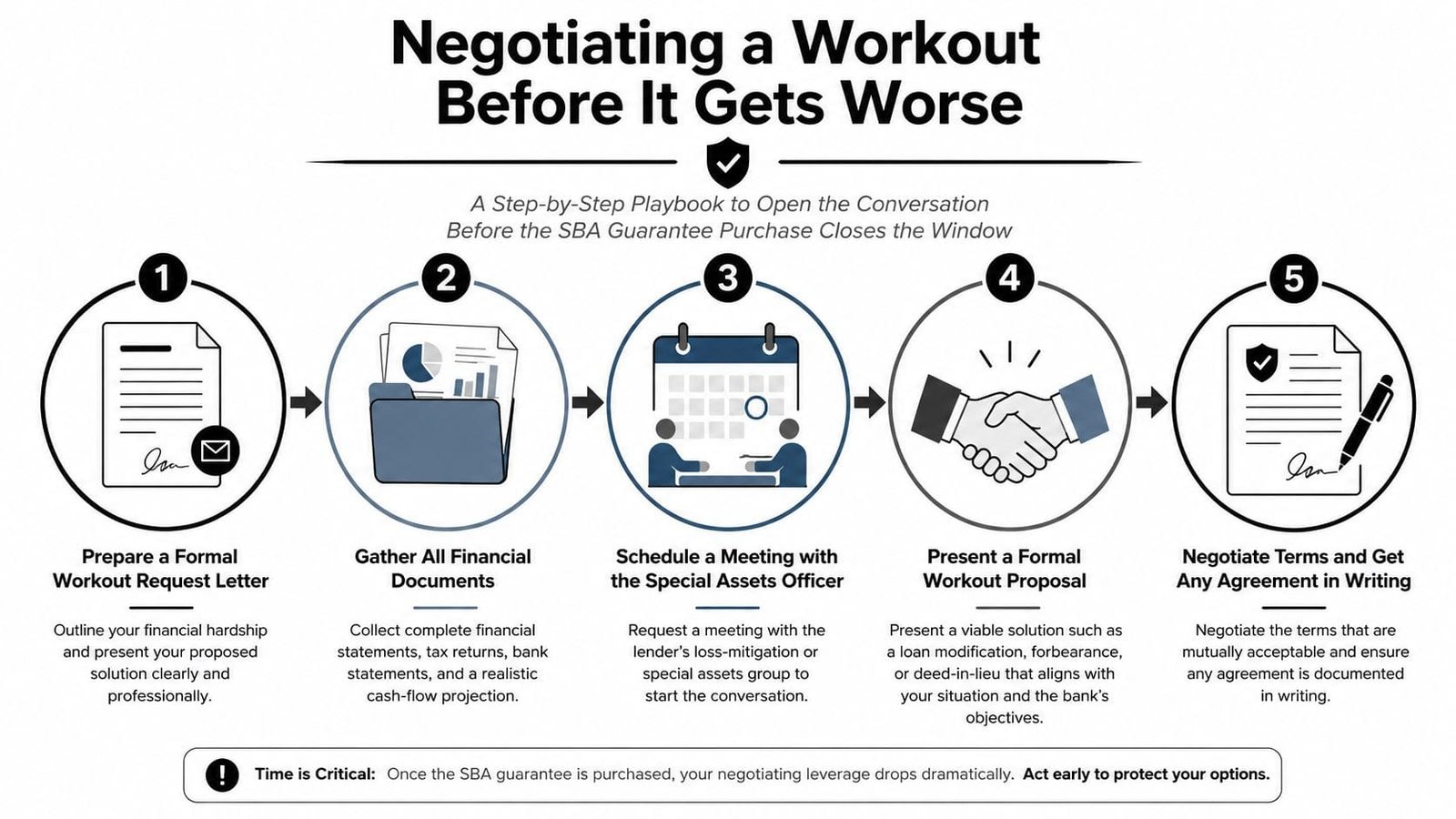
A workout proposal isn't a plea for mercy. It's a credit memo showing the lender why a structured recovery beats immediate liquidation. Send it to the lender's loss-mitigation, special-assets, or workout group, not only to the branch employee who took your original application.
Start with a written request. State what changed, what you can pay now, what caused the shortfall, and what remedy you're proposing. Avoid promises based on hoped-for sales. Lenders can work with bad news if the numbers are honest. They can't work with a cash-flow forecast built on wishful thinking.
Build a package the lender can underwrite
Include:
- Income statement: Show recent performance and separate one-time costs from recurring expenses.
- Balance sheet: Identify cash, receivables, inventory, equipment, real estate, and liabilities.
- Debt schedule: List every creditor, payment, maturity, collateral pledge, and personal guarantee.
- Cash-flow projection: Use conservative revenue assumptions and show the exact payment your business can support.
- Hardship narrative: Explain the cause, the corrective actions, and why the problem is temporary or permanent.
- Collateral schedule: Describe the condition, location, ownership, and realistic liquidation value of pledged assets.
Possible proposals include a payment deferment, an interest-only period, a longer amortization period, or a formal forbearance arrangement. Principal reduction is harder and usually requires strong evidence that liquidation would produce less than your offer. A deed in lieu, partial collateral surrender, or voluntary sale can improve credibility when continued operations aren't viable.
Preserve leverage with speed and documentation
The SBA's more-than-60-day cure condition is the key boundary for guarantee-purchase eligibility, but cure isn't the only issue. The lender must also satisfy servicing and liquidation requirements, and material modifications may require SBA involvement. Get every agreement in writing, including payment dates, interest treatment, collateral restrictions, reporting duties, and what happens if the arrangement fails.
An Offer in Compromise can make sense when you have a defensible lump sum but no path to full repayment. It becomes harder after federal referral, so don't hold back a serious settlement proposal while waiting for the file to become more threatening.
Negotiation standard: Offer what your records support, not what you wish were true. A smaller payment backed by verified cash flow beats a grand promise you'll miss next month.
Bankruptcy Implications for SBA Loan Defaults
Bankruptcy can stop collection pressure, but it doesn't perform magic on collateral. SBA debt often involves a business obligation, a personal guarantee, liens on business property, and sometimes liens on personal assets. You need to analyze each obligation separately.
Chapter 7 may discharge an individual's personal liability for qualifying debt, but a discharge generally doesn't remove a valid lien from collateral you keep. If you want to retain secured business property, you may need to keep paying, negotiate with the secured creditor, redeem the asset, or address the lien through the bankruptcy process. A company that owns the operating assets may require a separate strategy from the owner who signed the guarantee.
Chapter 11 can give an operating business a restructuring framework, but it is expensive and document-heavy. The business must present a feasible plan, deal with secured claims, and address the SBA lender's rights. Material changes to an SBA-backed obligation may also require agency or court attention.
Chapter 13 is available only to qualifying individuals, not every business entity. It can provide a repayment structure for personal obligations, but eligibility, claim treatment, collateral, and discharge rules require a bankruptcy lawyer to examine the actual loan documents. Don't assume that a repayment plan automatically eliminates a lien or protects every business asset.
| Bankruptcy chapter | Treatment of SBA debt | Effect on personal guarantee | Lien on collateral |
|---|---|---|---|
| Chapter 7 | Qualifying personal liability may be discharged | May be discharged, subject to exceptions | Usually survives unless separately avoided or satisfied |
| Chapter 11 | Business may restructure through a confirmed plan | Addressed through the plan and applicable law | Secured claims remain central to the case |
| Chapter 13 | Qualifying individual debt may be treated through a repayment plan | Personal liability may be adjusted under the plan | Treatment depends on lien status, collateral, and plan terms |
A clear comparison of Chapter 7 and Chapter 13 bankruptcy can help you understand the broad differences, but it isn't a substitute for counsel familiar with SBA guarantees. Filing bankruptcy also doesn't mean every pandemic-era obligation receives identical treatment. EIDL debt, fraud allegations, recent advances, and individual conduct can create separate issues.
Before filing, gather the note, guarantee, lien documents, payment history, collection notices, tax returns, asset list, and every communication with the lender or SBA. If you're weighing financing after a case, review the practical issues in getting a loan after bankruptcy only after your attorney explains what remains owed and what liens remain attached.
Choosing the Right Remediation Path
The right remedy depends on where the file sits, whether the business still produces cash, and how much value exists in collateral. A borrower with a temporary cash gap should not use the same strategy as an owner facing liquidation and an unenforceable business model.
The asset above maps the broad decision points. Use this more candid version to choose among them:
| Path | Best fit | Timing | Main trade-off |
|---|---|---|---|
| Catch-up payment | Temporary shortfall with reliable incoming cash | Earliest delinquency | Uses liquidity that may be needed for payroll or inventory |
| Lender workout | Viable business with a credible future cash flow | Before guarantee purchase is finalized | Requires disclosure, monitoring, and strict compliance |
| Refinance | Strong operations, acceptable credit, and available collateral | Before the default becomes entrenched | New debt can postpone rather than solve a cash-flow problem |
| SBA Offer in Compromise | Limited ability to pay after assets and income are reviewed | More useful before or during the transition to federal servicing | Usually requires detailed financial disclosure and a credible settlement source |
| Bankruptcy | Personal-guarantee exposure or collection pressure exceeds repayment capacity | When legal protection is necessary | Costs, public filings, asset risks, and credit consequences |
A catch-up payment is the cleanest answer only when it doesn't leave the business unable to operate. A workout is better when revenue can support a reduced or delayed payment. Refinance is a poor answer if the business is structurally losing money, because expensive replacement credit can deepen the hole.
For a broader debt triage framework, this business debt turnaround guide can help you organize creditors and cash flow. But SBA debt requires special attention to the guarantee, pledged assets, and federal collection risk.
Decision test: If the business can pay a realistic reduced amount and protect collateral, negotiate. If it can't, stop pretending another short-term loan will fix the problem and evaluate an OIC or bankruptcy promptly.
Action Plan and Key Questions for Defaulted SBA Borrowers
Your first 30 days should produce a clean record, not more unanswered voicemails. Work the problem in sequence and preserve evidence.
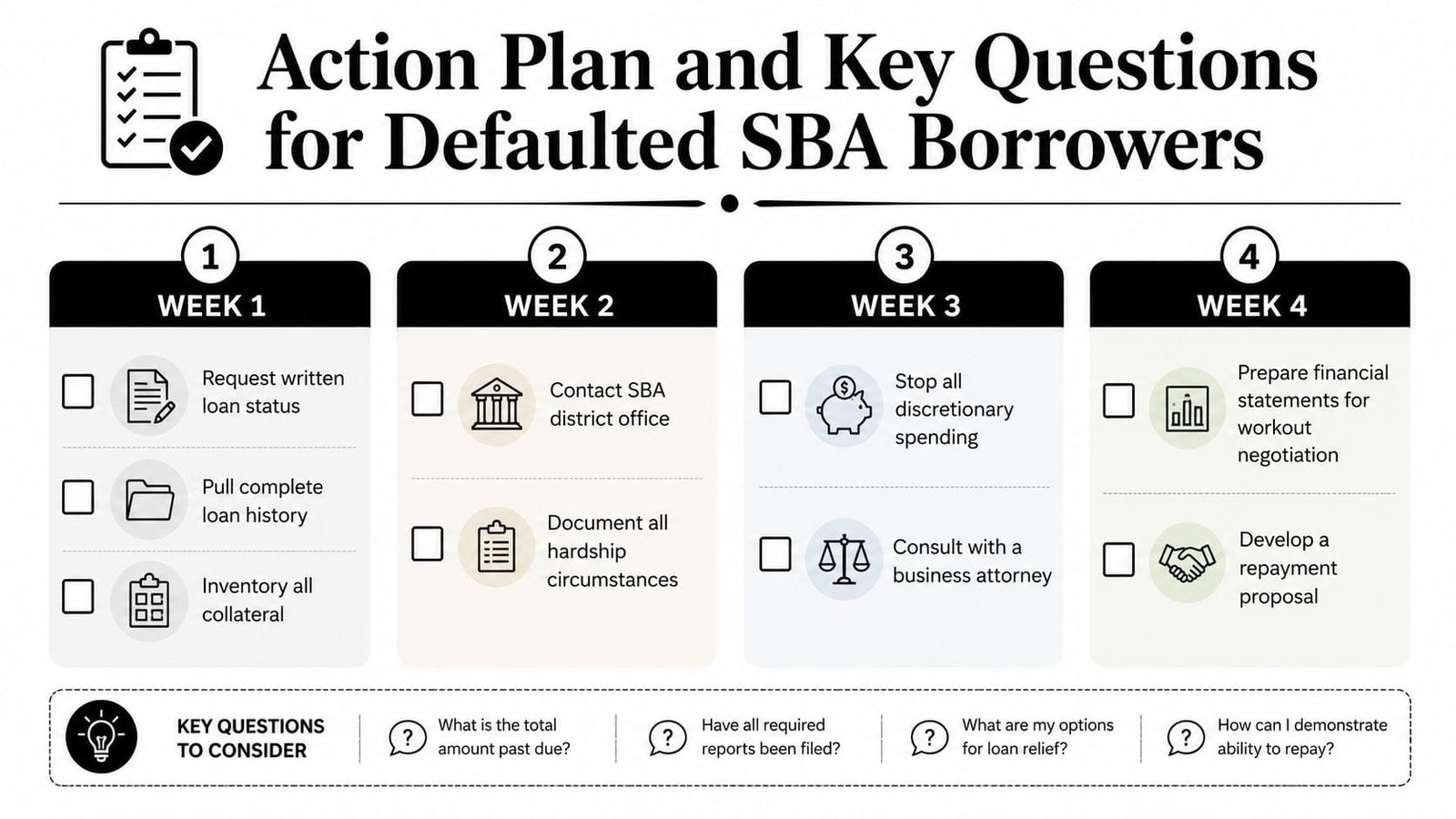
The four-week checklist
- Week 1, establish the facts: Request written loan status, pull the complete payment and transaction history, and inventory every item of business and personal collateral.
- Week 2, document the cause: Contact the SBA district office or servicing contact, preserve proof of the hardship, and collect notices, emails, bank records, and tax documents.
- Week 3, stop the leak: Stop discretionary spending, avoid moving or selling pledged assets without permission, and consult a business attorney or bankruptcy counsel.
- Week 4, submit a credible proposal: Prepare current financial statements, a conservative cash-flow forecast, and a repayment or settlement proposal with supporting documents.
Questions borrowers ask after default
How long does a CAIVRS issue last? The answer depends on the federal debt, reporting, resolution, and agency records. Ask the servicing agency for written confirmation of how the debt is reported and what must occur before future federally supported financing can be considered.
Does EIDL follow the same process as 7(a)? Not necessarily. Pandemic-era EIDL and PPP collections have created a much larger federal recovery workload. One reported April 2026 batch referred 562,000 pandemic-era PPP and EIDL loans worth $22.2 billion to Treasury, while other reporting says more than $47 billion in COVID EIDL loans are in default. Coverage of SBA loan default rates and pandemic collections explains why older SBA-default advice may not fit EIDL borrowers.
Can a spouse become liable? Possibly, depending on who signed the guarantee, how property is titled, state marital-property rules, and whether the spouse received a benefit. Never assume marriage alone creates liability, and never assume it prevents collection against jointly owned property.
What happens if the business closes? Closing doesn't automatically cancel the debt. The lender and government can still pursue collateral and guarantors, subject to bankruptcy, settlement, limitation, and other legal rules.
Is a settlement taxable? A canceled balance can raise tax questions, including possible Form 1099-C reporting. Have a tax professional review the settlement before you sign it.
Don't wait for Treasury to become your first serious conversation. Put the loan file, financial package, collateral list, and proposed remedy in front of qualified counsel and the servicing decision-maker while voluntary options still exist.
If you're defaulting on an SBA loan, Business Loan Warrior can help you assess funding and cash-flow options before you choose another expensive mistake. Visit the platform to review business financing paths, connect with lending specialists, and decide whether stabilization, refinancing, or a workout-supporting capital strategy fits your numbers.