
A charge-off means the lender wrote the debt off as a loss, not that the debt was canceled. You still owe the money, and the charge-off can remain on your credit report for up to seven years.
You're a business owner pulling your personal credit report before an SBA meeting. The report looks manageable until you see “Charged Off” beside a $22,000 business credit card. The account may be closed, the balance may have moved to collections, and the lender reviewing your application may treat the entry as evidence of repayment risk.
That reaction is understandable, but the label needs to be interpreted correctly. A charge-off is an accounting action, not forgiveness. It affects your personal credit, your collection exposure, and the way lenders evaluate a personal guarantee. For owners in the $20 million to $50 million revenue range, the practical issue isn't just whether one account appears on a report. It's whether the balance size, recency, and unresolved status make an underwriter question the strength of the owner behind the business.
Table of Contents
- What a Charge-Off Actually Means
- How an Account Reaches Charge-Off Status
- The Credit Score and Report Consequences
- Your Four Real Response Options Compared
- Disputing, Negotiating, and Pay-for-Delete Letters
- How a Charge-Off Affects Business Financing
- Your 90-Day Recovery Plan and Myths to Ignore
What a Charge-Off Actually Means
A charge-off is the lender removing a delinquent debt from its books and recording it as a loss. The Federal Reserve describes charge-off rates for U.S. commercial-bank credit cards as annualized, net of recoveries, and measured as a percentage of average loans in its credit charge-off data.
That accounting entry doesn't erase your obligation. The lender has changed how it classifies the asset. You may still owe the balance, and the creditor may continue collection efforts, assign the account to a collection agency, or sell it to a debt buyer. The original account is generally closed to new spending, but the debt remains a financial and legal issue until you pay it, settle it, receive a valid release, or resolve it through another legally recognized process.
Practical rule: A lender can write the debt off on its books while still expecting you to repay it.
Why borrowers confuse write-offs with forgiveness
The confusion comes from ordinary language. If someone says a lender “wrote off” a debt, many borrowers hear “the lender gave up.” In credit operations, those are separate events:
- Charge-off: The lender recognizes an accounting loss.
- Settlement: You pay an agreed amount, and the remaining balance may be forgiven under the agreement.
- Cancellation: The creditor formally releases some or all of the obligation.
- Bankruptcy discharge: A court process may eliminate qualifying debt.
Only the latter events can address the obligation itself. A charge-off alone doesn't.
Tax treatment also depends on what happened after the charge-off. A write-off isn't automatically taxable income because you may still owe the money. If a creditor later forgives or cancels more than $600, the canceled amount may be reported on Form 1099-C. That creates a tax question, not an automatic tax result. Insolvency, bankruptcy, and other exceptions can matter, so get advice from a tax professional before accepting a settlement or cancellation.
Why the distinction matters to lenders
A credit committee doesn't read “charge-off” as a neutral bookkeeping note. It reads the entry alongside the balance, dates, payment history, and current obligations. The Federal Reserve's supervisory guidance says open-end revolving credit, including credit cards, should generally be charged off at 180 days past due, while closed-end installment loans should generally be charged off at 120 days delinquent. The account is removed from the books and charged against loss reserves, but the borrower's repayment obligation can remain.
That's why a charge-off on credit can affect both personal borrowing and business financing. The lender may see a historical problem. The underwriter may see a current unresolved liability. Those are different concerns, and you need to address both.
How an Account Reaches Charge-Off Status
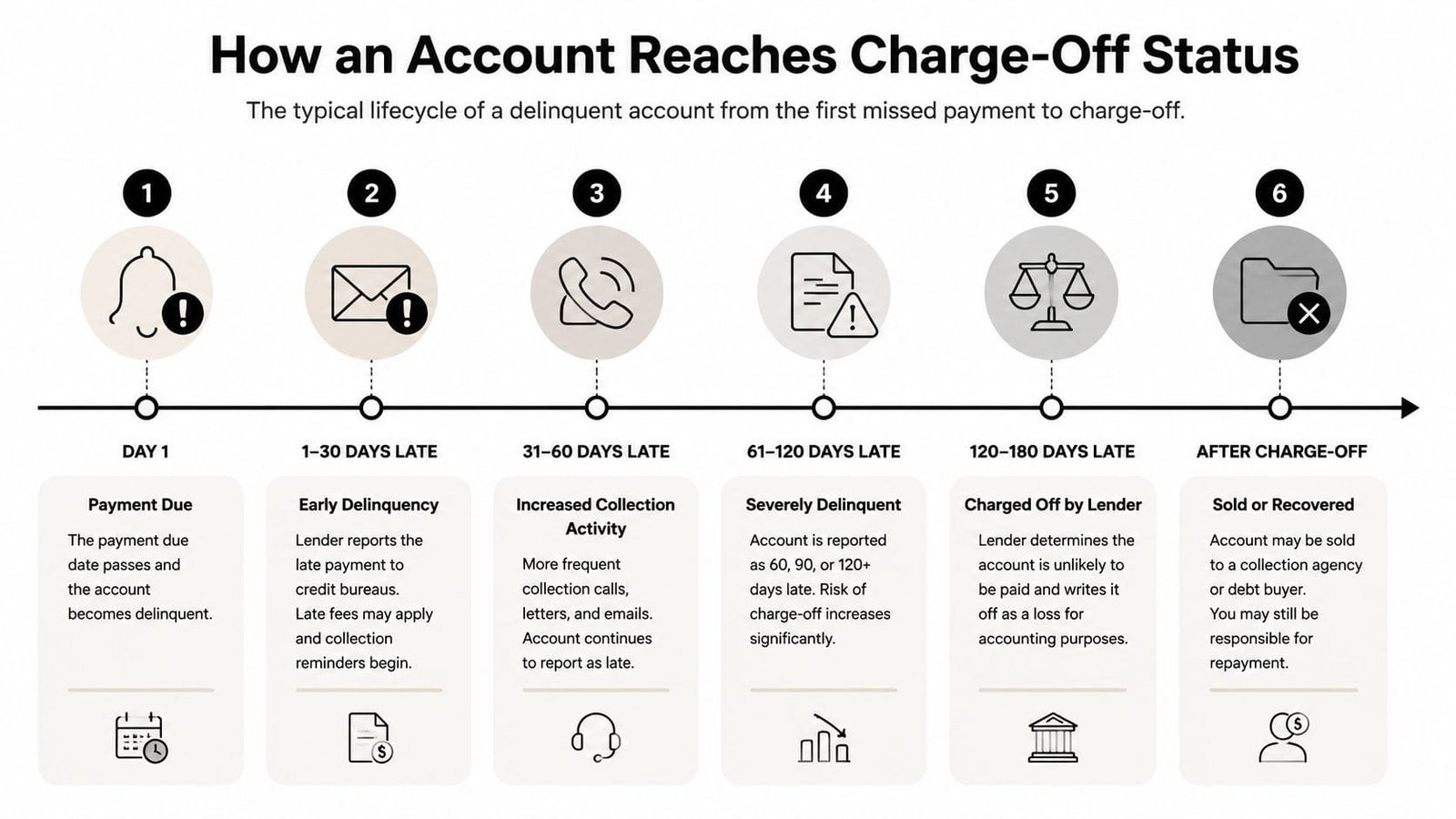
A missed payment can turn into a serious credit problem before the borrower sees a formal charge-off notice. The account first moves through delinquency stages, while reminders and collection contacts increase. If the balance stays unpaid, the lender eventually records the exposure as a loss under its accounting and supervisory procedures.
Consider a cardholder who misses the due date. The account may initially show as past due only in the creditor's internal system. Once the payment reaches 30 days late, the creditor may report the delinquency to the credit bureaus. Continued nonpayment adds further late-payment markers as the account reaches 60, 90, and 120 days past due.
For U.S. bank supervision, the Federal Reserve's charge-off guidance generally places open-end revolving accounts at a 180-day charge-off point. Servicing can vary by creditor, product, and applicable rules, but the sequence stays familiar. Missed payments come first. The accounting write-off follows later.
What happens after the write-off
After the internal charge-off, the original creditor updates its records and may report the status to Experian, Equifax, and TransUnion. It may keep collecting in-house, refer the debt to an agency, or sell the account to a debt buyer.
That change can produce two related entries on one report. The original creditor's tradeline may retain the charge-off history, while a collection agency reports a separate collection account. These entries are not automatically duplicates. They may reflect different parties reporting different stages of the same obligation.
Review every detail before negotiating or paying. Check the original creditor, account number, balance, first delinquency date, charge-off date, payment history, and collection ownership. A collector should substantiate its authority to collect, and its reporting should match the underlying account.
A charge-off can also leave legal collection risk in place. Whether a creditor or debt buyer may sue depends on the applicable statute of limitations, evidence supporting the debt, and state law. Verify an unfamiliar account and understand your rights before acknowledging or paying it. For business owners, the balance matters as much as the account count. A large unresolved personal charge-off can become a liability question when an SBA or term-loan underwriter reviews the owner and the company together.
The Credit Score and Report Consequences
A charge-off is one of the most serious negative entries a lender can find on a credit report because it reflects a sustained failure to repay. The report may show the original creditor, account balance, payment history, charge-off status, and the date connected to the first delinquency. If the account is transferred or sold, a separate collection tradeline may also appear.
The most important timing rule is the reporting window. A charged-off account can remain on a consumer credit report for up to seven years from the date of the first missed or late payment that led to the charge-off, as explained in this Equifax charge-off guide. The clock isn't supposed to restart because you make a payment, settle the account, or speak with a collector.
What payment changes, and what it doesn't
Paying the account can update the status from unpaid to paid. Settling can update it to a settled or paid-settled status, depending on how the creditor reports the agreement. Those updates can help an underwriter understand that the balance isn't being ignored, but they don't automatically remove the historical charge-off.
The report can still preserve the original delinquency history during the permitted reporting period. That means repayment and deletion are separate goals. Paying may reduce collection pressure and improve the lender's view of the unresolved balance. Deletion requires a reporting correction, a negotiated deletion agreement, or the natural expiration of the reporting period.
| Report Field | What It Shows | Duration on Report |
|---|---|---|
| Original creditor | The lender that issued the account | May remain with the charge-off history during the reporting period |
| Payment history | Missed-payment progression and delinquency status | Tracks the account's reported history |
| Charge-off status | The lender's accounting classification of the unpaid account | Up to seven years from the first delinquency that led to the charge-off |
| Current balance | What the creditor or collector reports as owed | Changes as payments, settlements, or transfers occur |
| Collection tradeline | A collector's separate reporting of the same debt | Depends on accurate reporting and the applicable reporting period |
Owners preparing for financing should also review the broader file, not just the score. Lenders may care about the unresolved balance, recent activity, debt obligations, and explanation. If you need a plain-language review of how missed payments affect credit, use this guide on late payments and credit scores.
Your Four Real Response Options Compared
You have four practical choices after a charge-off appears. None is universally correct. The right decision depends on whether the debt is accurate, whether a collector can validate it, how soon you need financing, and whether you can afford resolution without damaging operating cash.
| Option | Effect on Report | Cost | Tax Risk | Best For |
|---|---|---|---|---|
| Wait and monitor | Leaves the negative entry unresolved | No immediate payment, but collection risk remains | Usually no cancellation income while the debt remains owed | Someone with no near-term borrowing need who has verified the account and understands the risks |
| Pay the full balance | Updates the account to paid, but may not delete the charge-off | Highest cash cost | Usually no cancellation issue because the full debt is paid | An owner preparing for an SBA, term-loan, or personally guaranteed application |
| Negotiate a settlement | May update the account as settled or paid-settled | Lower negotiated cash cost than paying in full | Forgiven debt over $600 may lead to Form 1099-C reporting | A borrower who needs resolution but can't justify paying the full balance |
| Attempt pay-for-delete | May remove a collection tradeline if the creditor agrees | Negotiation time plus the agreed payment | Depends on whether any balance is forgiven | A borrower willing to negotiate before payment and obtain written terms |
The blunt decision rule
Waiting is only rational when financing isn't a priority. If you're not applying for credit soon, have verified the debt, and can tolerate calls or legal collection risk, you may decide to let accurate reporting age off. That isn't a free strategy. The balance can remain collectible, and the unresolved account can continue to complicate future underwriting.
Paying in full is the cleanest financing presentation. It doesn't guarantee approval or erase the charge-off, but it gives a lender a simple answer to the question, “Is this obligation still outstanding?” For an owner heading into an SBA meeting, that clarity can matter more than chasing a speculative score improvement.
Settlement is a cash-management decision. It can resolve the balance for less than the amount claimed, but the report may show a settled status, and the forgiven portion may create tax reporting. Don't accept a settlement verbally. Demand the amount, deadline, reporting language, release terms, and treatment of the remaining balance in writing.
Pay-for-delete is worth attempting only before payment. Some collectors may agree to remove their collection tradeline, but creditors aren't required to accept the request. Never pay first and hope the deletion happens later. Without written terms, you may receive a paid update while the negative history stays visible.
Disputing, Negotiating, and Pay-for-Delete Letters
Start with accuracy, not emotion. Pull your reports from all three major bureaus, identify every version of the account, and compare the reported balance, creditor, dates, payment history, and ownership. A valid dispute targets a specific error. “Remove this because it hurts my score” isn't a factual dispute and usually isn't persuasive.
Gather the original account statements, charge-off notice, collection letters, payment records, settlement offers, and any prior correspondence. Send a bureau dispute through Equifax, Experian, and TransUnion using each bureau's official dispute process. Keep copies of everything and record submission dates.
The Fair Credit Reporting Act gives you a way to challenge inaccurate or incomplete information. A bureau generally has a limited investigation period, commonly 30 days, although the timing can depend on the information submitted and the investigation. The Fair Debt Collection Practices Act also gives you rights when a third-party collector contacts you, including the ability to request validation of the debt.
Use precise written requests
A validation request can be short:
I dispute this alleged debt and request validation, including the name of the original creditor, the account documentation, the amount claimed, an itemization of the balance, and evidence that your company has authority to collect. Please cease collection activity that the law requires you to pause until you provide the requested validation.
That request doesn't force a collector to delete an accurate account. It forces the conversation toward documentation and may expose an incorrect balance, wrong owner, duplicate reporting, or unsupported account.
For a settlement, use language that protects the outcome:
I am willing to resolve this account for the stated amount of $[amount], provided you confirm in writing that this payment satisfies the obligation in full, no additional balance will be pursued, and the agreed reporting treatment will be followed. This offer is not an admission that the reported information is accurate.
For pay-for-delete, make the condition explicit:
If you accept payment of $[amount], you agree to request deletion of your collection tradeline from Equifax, Experian, and TransUnion after cleared payment. Please provide the agreement on company letterhead, signed by an authorized representative, before I send funds.
Pay-for-delete isn't illegal, but the creditor or collector doesn't have to accept it. Some furnishers may refuse because they want to report accurate information. The trap is paying a collection agency without written deletion terms, then discovering the account was merely updated to paid.
Don't send money until you understand the agreement, the tax consequences, and the legal status of the debt. If a lawsuit threat is involved, consult a consumer attorney before responding in a way that could affect your defenses.
How a Charge-Off Affects Business Financing
A personal charge-off can follow an owner into business financing when the loan requires a personal credit pull or personal guarantee. That connection is especially important for owners who assume that strong company revenue will completely isolate an old personal problem.
Consider an owner of a company producing $30 million in annual revenue. Her personal report contains a $40,000 charge-off from a failed side venture. The company may have solid deposits and operating history, but an SBA lender, working-capital lender, or term-loan provider may still review her personal credit if she must guarantee repayment.
The underwriter's question isn't just, “Does the company make money?” It's also, “Will the guarantor honor obligations when conditions deteriorate?” A recent or unresolved charge-off can lead to additional questions, a request for collateral, a decline, or less attractive pricing. Don't assume the lender will overlook it because the business is large.
Underwriting reality: Business revenue supports repayment capacity. Personal credit often speaks to guarantor behavior. Lenders may evaluate both.
Personal and business reports are different files
A personal charge-off generally belongs to the consumer credit file unless the business account was personally guaranteed and the creditor reports it to consumer bureaus. A business account may also appear on commercial credit reports when the creditor reports to business bureaus. Those commercial files can include business payment experiences, public records, and trade information.
Dun & Bradstreet, Experian Business, and Equifax Business use commercial reporting systems that aren't identical to consumer FICO or VantageScore files. A personal charge-off doesn't automatically become a business charge-off, and a business charge-off doesn't automatically appear on a personal report. The guarantee, account structure, creditor reporting policy, and underwriting process determine how the information travels.
For owners pursuing financing with damaged personal credit, review the practical differences in business loans with bad credit.
This video can provide additional context for owners evaluating financing after a credit problem:
The balance size deserves special attention. TransUnion reported that in Q2 2025, total credit-card charge-off balances remained near $17 billion, while the number of charged-off accounts fell 9% year over year to 4.7 million, as reported in this credit-charge-off coverage. Fewer accounts don't necessarily mean less underwriting concern. A smaller number of larger balances can still create substantial exposure, which is why an owner should address both account count and dollar severity.
Your 90-Day Recovery Plan and Myths to Ignore
A $20M–$50M owner can lose a financing opportunity because of one large personal charge-off, even with strong business revenue. Lenders review the dollar exposure, repayment history, guarantees, and documentation together. Use the next 90 days to make the file easier to approve.
Days 1 through 30
Pull all three personal credit files. Build a working list of every charge-off, collection account, balance, date, and reported owner. Match each entry against statements, notices, and account records. Dispute factual errors, request validation from collectors, and do not pay an account you cannot identify or verify.
Review the commercial credit files at the same time. The goal is to find inconsistent balances, ownership details, or reporting dates before a lender does.
Days 31 through 60
Set the response around your financing deadline. If an SBA or term-loan application is approaching, obtain a written payoff or settlement agreement and preserve every related record. If the debt is inaccurate, continue the dispute process with organized documentation instead of sending repeated explanations.
Prepare a concise lender memo. State what caused the problem, what action you took, whether a balance remains, and how the business now controls cash flow and obligations. A clear explanation will not erase a charge-off, but silence leaves the underwriter to fill in the gaps.
Days 61 through 90
Rebuild through consistent account management. Pay current accounts on time, keep new obligations manageable, and assemble bank statements, tax returns, debt schedules, and guarantee documents. Confirm that personal and business records tell the same story before submitting an application.
Use this 90-day business credit blueprint to organize the business side of the recovery.
A charge-off reflects an accounting decision. Bankruptcy is a legal process with distinct consequences, so treat them as separate underwriting issues. An old account can still create collection, legal, or approval problems until the matter is resolved or its reporting period ends. Base your plan on verified records and the lender's requirements, not on promises that a quick payment will produce a clean report.