
Invoice factoring rates are typically 1% to 5% of an invoice's face value per 30 days, not an APR. Your effective cost depends on how long the invoice stays unpaid, so the same quoted rate can cost very different amounts over 30, 60, or 90 days.
Your customer says payment is coming, but payroll is due Friday. Suppliers want their money, a new contract needs staffing, and your accounts receivable ledger is full of invoices that may not clear for weeks. The business can be profitable on paper and still feel short of cash.
That gap is where invoice factoring can help. You sell eligible unpaid invoices to a factoring company, receive an advance, and pay a fee for getting access to cash before your customer pays. The arrangement can provide relief, but the headline percentage doesn't tell you the full story.
A quote that says “2%” sounds simple. It isn't complete until you know whether that fee applies once, every 30 days, or for the full collection period, and whether extra charges sit alongside it. You also need to understand how customer credit quality, industry risk, concentration, recourse, and payment speed affect the offer.
This guide starts with the basic mechanics, then compares typical pricing profiles, explains the drivers behind rate changes, works through true-cost calculations, and contrasts factoring with other funding choices. By the end, you'll have a practical way to compare offers instead of choosing the lowest-looking percentage.
Table of Contents
- Introduction to Invoice Factoring Rates and Cash Flow Relief
- How Invoice Factoring Rates Actually Work
- Typical Invoice Factoring Rates by Industry and Risk Profile
- What Drives Your Invoice Factoring Rate Up or Down
- Fee Structures Worked Examples and True Cost Math
- Invoice Factoring Rates Versus Other Funding Options
- How to Evaluate Offers and Negotiate Better Invoice Factoring Rates
Introduction to Invoice Factoring Rates and Cash Flow Relief
A staffing company may invoice after placing workers, yet payroll arrives before the client pays. A freight operator can complete a load today and wait for the approved invoice to clear. A contractor may have money tied up in progress billing while materials, labor, and subcontractor costs continue moving.
Those businesses don't necessarily need more sales. They need better timing between cash leaving the business and cash entering it.
Invoice factoring turns approved receivables into working capital. The factoring company advances part of an invoice's value, then receives payment from the customer or supports the collection process, depending on the agreement. Once the customer pays, the provider releases the reserve after deducting its fee and any applicable charges. The transaction is generally structured as a sale of receivables rather than a conventional loan, but the commercial terms still deserve careful review. This explanation of invoice factoring can help owners understand the basic transaction before comparing providers.
The central pricing fact is straightforward. Industry explainers commonly place factoring fees around 1% to 5% per invoice, with stronger-credit and higher-volume receivables often closer to 1% to 3%, while slower-paying or higher-risk invoices can reach 4% to 5% or more. Paidnice's invoice factoring calculator guide explains why the fee is applied to invoice value and why customer payment speed matters.
The percentage on the quote is only the starting point. The invoice's actual time outstanding determines how expensive the arrangement becomes.
You can also reduce the need for factoring by improving the underlying receivables process. Clear payment terms, accurate invoices, dispute tracking, and consistent follow-up can shorten collection delays. For a practical foundation, review how to optimize collections process before assuming every cash gap requires outside funding.
The goal isn't to make factoring sound cheap or expensive in the abstract. It's to help you judge whether the cash arrives soon enough, whether the fee fits your margin, and whether the contract gives you enough flexibility to grow.
How Invoice Factoring Rates Actually Work
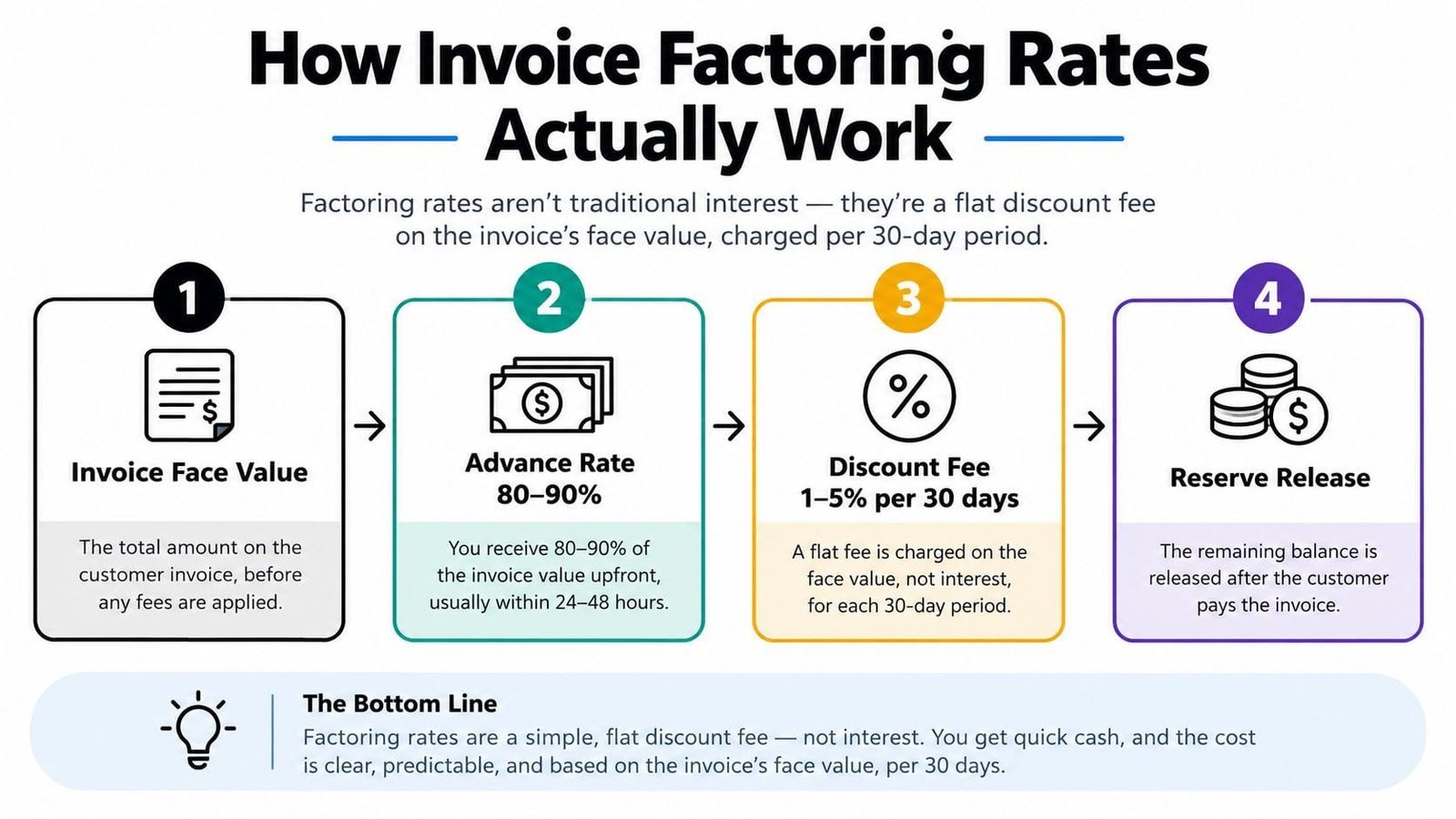
Start with the invoice face value. A factoring company doesn't usually quote a traditional interest rate against a loan balance. Instead, it quotes a discount fee, commonly expressed as a percentage of the invoice face value for each 30-day period. NerdWallet's explanation of invoice factoring describes this distinction and notes that the effective annualized cost changes with payment timing.
Think of the fee as renting access to money secured by an invoice. Renting the money for a short period costs less than renting it for a longer period, even if the provider's monthly price doesn't change. The invoice's face value is the base, and the days outstanding determine how many fee periods apply.
The basic cash movement
The process usually has four moving parts:
- Invoice sale: You submit an eligible business invoice to the factoring company.
- Initial advance: The provider advances an agreed portion of the face value. Industry descriptions commonly use an advance range of 80% to 90%, as outlined in Sage's invoice factoring guide.
- Customer payment: Your customer pays according to the invoice terms, often directly to the factoring company in a disclosed arrangement.
- Reserve release: The provider returns the remaining amount after subtracting the factoring fee and contractually permitted charges.
The advance rate and the discount fee are separate. A higher advance may improve immediate liquidity, but it doesn't automatically mean the deal is cheaper. A lower fee may look attractive, but a large reserve or restrictive release conditions can reduce the cash available when you need it.
Why time changes the effective cost
Suppose a provider quotes a fee per 30-day period. If the customer pays within the first period, you incur one fee period. If payment takes longer, the contract may apply additional fees as the invoice ages. That means a quote can have a modest headline rate and still create a high annualized cost when collection takes longer.
The distinction matters because an APR expresses the cost over a year, while factoring commonly charges according to invoice duration. The comparison isn't perfect, but annualizing the actual fee helps you compare factoring with a line of credit or another financing product.
Recourse also affects price. With recourse factoring, you may remain responsible if the customer fails to pay under defined circumstances. Non-recourse structures transfer more qualifying collection risk to the provider and generally carry higher fees. Read the default, dispute, and eligibility language rather than treating “non-recourse” as unlimited protection.
Typical Invoice Factoring Rates by Industry and Risk Profile
Most factoring quotes fall within a broad 1% to 5% per invoice range, but the range isn't a universal menu. The provider is pricing the quality, predictability, and administration of your receivables. A ledger made up of dependable commercial customers usually presents a different risk than invoices affected by disputes, seasonal delays, or complicated approval processes.
Some market guides place high-volume, investment-grade debtor programs around 0.50% to 1.25% per 30 days. Standard B2B recourse arrangements may sit around 1.00% to 2.50%, while non-recourse structures can reach 1.50% to 3.50%. Spot, single-invoice transactions may reach 2.50% to 4.00% because the provider has less recurring volume and less opportunity to diversify exposure. These ranges come from the market segmentation described by PeerSense's invoice factoring rate guide.
Industry affects the starting point
Industry guides also show representative ranges for particular sectors:
| Industry | Representative rate range |
|---|---|
| Transportation | 1.95% to 4.0% |
| Staffing | 1.95% to 4.5% |
| Construction | 3.0% to 6.0% |
These figures are cited in World Metrics' invoice factoring market coverage. They aren't guaranteed quotes. Transportation invoices may be supported by established shippers but still require document matching. Staffing companies must manage timesheets, payroll timing, and client approvals. Construction receivables can involve retainage, progress billing, change orders, and disputes, all of which can extend collection.
A large company may still receive a higher quote
Revenue size alone doesn't determine pricing. A company generating substantial sales can still have a concentrated customer base, uneven invoice volume, or long payment cycles. If one customer represents a significant share of receivables, the provider may treat that exposure differently from a diversified ledger.
The same principle applies to a company seeking spot factoring. Selling one invoice may be convenient, but the provider is assessing that individual debtor and transaction rather than a recurring portfolio. A whole-ledger arrangement may create more predictable volume, though it can impose broader participation requirements.
The projected global factoring market is expected to reach about $1.8 trillion by 2028, according to the market context cited by World Metrics. That scale helps explain why pricing has become more standardized in major markets, while specialized or riskier receivables still receive more individualized terms.
What Drives Your Invoice Factoring Rate Up or Down
A factoring company is mainly asking one question: how confidently can it turn this receivable into cash, and how much work or risk sits between the invoice date and payment? The answer depends more on the debtor and the receivable than on your personal credit profile.
Payer quality comes first
The customer's ability and willingness to pay is central. A financially strong commercial debtor with a consistent payment record can support a lower quote. A newer, financially opaque, or frequently late customer may push the fee higher or make the invoice ineligible.
Clean documentation helps too. Purchase orders, signed delivery records, approved timesheets, and undisputed invoices give the provider stronger evidence that the receivable is valid.
Payment terms and aging shape exposure
Longer payment terms leave capital tied up for more time. An invoice that routinely takes longer to clear can generate additional fee periods, depending on the agreement. Aging also signals operational risk, especially when an invoice is already past due or subject to a dispute.
Before applying, separate current invoices from troubled receivables. Don't present an aging problem as if it were merely a timing issue.
Concentration changes the risk profile
A ledger dependent on one or two customers can be less resilient than a diversified ledger. If one debtor delays payment, the impact reaches a larger share of your available borrowing base. This is why a sizable company with concentrated customers may not receive the pricing offered to a smaller company with a broader debtor mix.
Structure involves tradeoffs
Recourse generally costs less because you retain more responsibility for nonpayment. Non-recourse can reduce qualifying credit risk but may cost more and include exclusions for disputes, commercial disagreements, or conditions outside the stated protection.
Volume and contract length can also influence negotiations. A provider may prefer recurring invoices and predictable activity over occasional requests, but a long commitment can limit your ability to switch if service or pricing changes.
Before applying: Clean up disputed invoices, document customer approvals, and identify concentration risks. Better information won't eliminate risk, but it can prevent avoidable pricing friction.
Fee Structures Worked Examples and True Cost Math
A factoring quote becomes useful only when you translate it into dollars. The commonly cited fee range is 1% to 5% of invoice value, so a $100,000 invoice may create a factoring fee of roughly $1,000 to $5,000, depending on customer credit quality, industry, volume, and payment speed. Paidnice's factoring calculator provides that face-value framing.
A quote may include more than the discount fee. Ask whether the contract adds origination, wire, lockbox, credit-check, minimum-volume, or account-management charges. Some providers also use tiered pricing, daily accruals, or different rates after a stated aging point.
A simple calculation
Use this starting formula:
Discount fee = invoice face value × stated fee × number of 30-day periods
For a $100,000 invoice at 2% per 30 days:
- A 30-day payment creates a $2,000 discount fee.
- A 60-day payment creates a $4,000 discount fee if the fee applies for each 30-day period.
- A 90-day payment creates a $6,000 discount fee under the same assumption.
The dollar cost rises because the invoice remains outstanding longer. Your contract may calculate partial periods differently, so confirm whether it uses exact daily accrual, a full-period minimum, or another method. For a broader explanation of factor-rate terminology, see this guide to what is factor rate.
Worked effective-cost table
The following table uses the stated 2% per 30 days structure. The APR figures for longer payment periods are presented as the effective annualized ranges identified in the supplied market guidance, not as a universal result for every contract.
| Days Outstanding | Headline Fee | Effective APR Range | Dollar Cost on $100k |
|---|---|---|---|
| 30 | 2% | About 24% | $2,000 |
| 60 | 4% | Depends on contract calculation | $4,000 |
| 90 | 6% | About 18% to 40% for 61 to 90-day invoices | $6,000 |
The supplied guidance also places 91-plus-day invoices around 25% to 45% APR in some examples. Funding Compass' guide to invoice factoring explains why annualized cost can look very different from the advertised periodic fee.
Compare the all-in cost
Two offers can both advertise 2% and still produce different outcomes. One may charge the fee once for the full invoice term, while another may continue charging every 30 days. One may include wires and credit checks, while another adds them separately. One may release the reserve promptly after payment, while another imposes administrative conditions.
Before signing, request a written cost waterfall showing:
- Advance amount: How much cash arrives initially?
- Reserve amount: What remains held back?
- Fee timing: Does the fee apply per 30 days, daily, or once?
- Aging charges: What happens if payment is late?
- Additional fees: Which administrative charges apply?
- Recourse exposure: What happens after a dispute or default?
- Net proceeds: How much do you receive after every deduction?
Invoice Factoring Rates Versus Other Funding Options
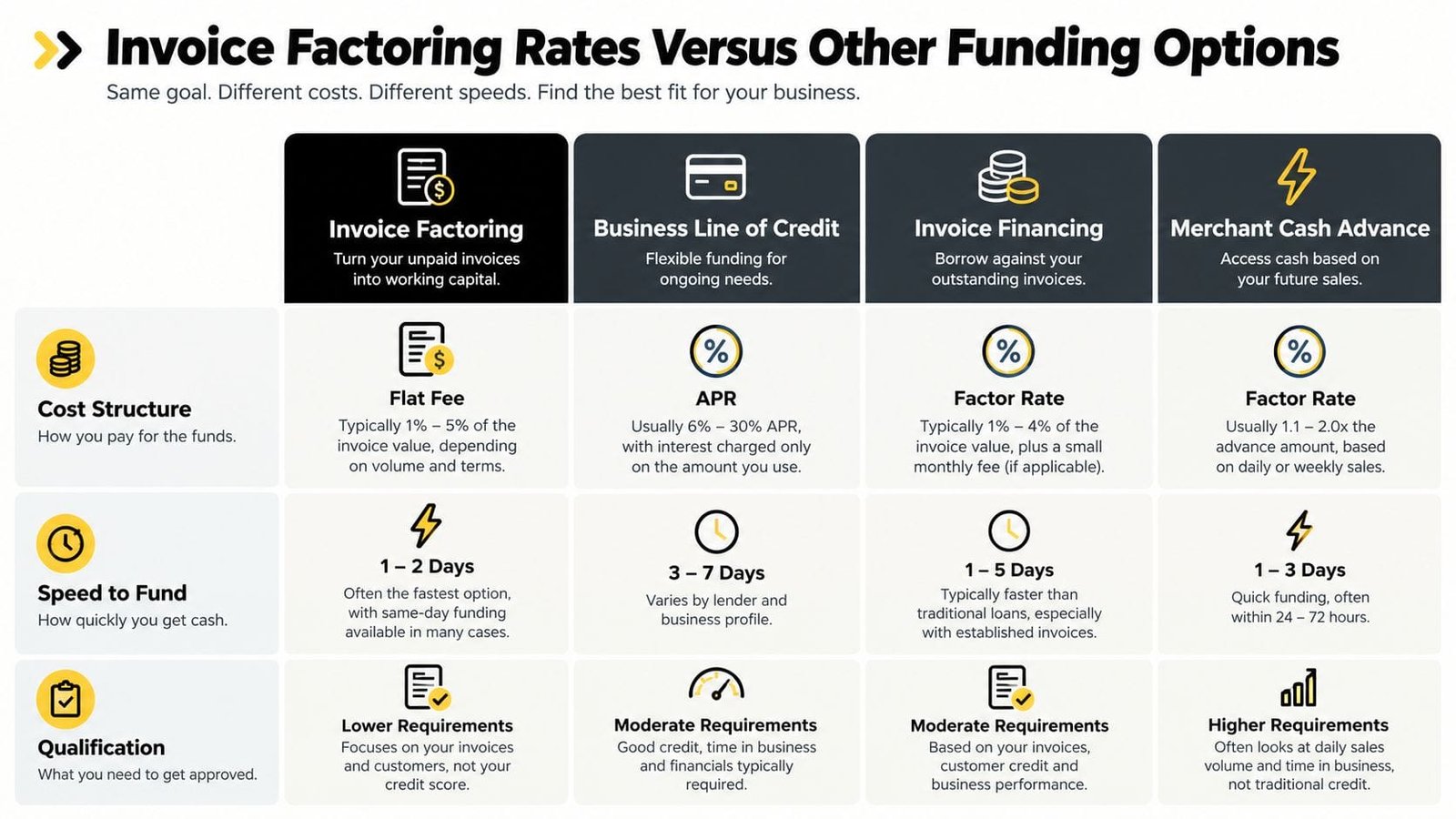
Factoring is not automatically the right answer for every cash-flow problem. The best choice depends on whether your priority is speed, control, predictable pricing, qualification flexibility, or preserving customer-collection ownership.
| Funding option | Cost structure | Speed and qualification | Main tradeoff |
|---|---|---|---|
| Invoice factoring | Discount fee tied to invoice value and payment duration | Often evaluates debtor quality and invoice validity | You give up part of receivable value and may involve a third party in collections |
| Business line of credit | Usually quoted with interest and borrowing terms | Can suit established businesses with stronger financial profiles | Approval and availability may depend more heavily on your business credit and financial statements |
| Invoice financing | Financing secured by invoices, with your business retaining collections | Useful when you want receivables to support borrowing | You generally keep collection responsibility and take on a financing obligation |
| Merchant cash advance | Factor-rate structure tied to purchased future receipts | Can serve businesses with card or recurring sales activity | Repayment can pressure operating cash flow, especially during weaker sales periods |
Invoice factoring can make sense when your customers are credible but your own balance sheet, collateral, or credit history doesn't fit conventional underwriting. It can also be useful when waiting for receivables would cause you to miss payroll, delay a project, or turn down a contract.
A line of credit may be more suitable when cash needs are steady, you qualify for favorable terms, and you want reusable access without selling receivables. Invoice financing may fit when you want to keep control of collections. An MCA can offer speed, but its repayment structure deserves close examination because payments may be tied to revenue.
For a broader comparison of short-term funding choices, review this comparison of short-term loans, MCAs, and invoice factoring.
For owners operating at substantial scale, including businesses with concentrated customers or seasonal working-capital needs, the decision should include operational control. A slightly lower rate may not compensate for poor collections communication, restrictive volume requirements, or reserve rules that leave you short when demand rises.
How to Evaluate Offers and Negotiate Better Invoice Factoring Rates
Treat each proposal as a cash-flow model, not a single percentage. Ask the provider to show what happens when customers pay on time, pay slowly, dispute an invoice, or fail to pay under the recourse terms.
Use this checklist:
- Request total proceeds: Have the provider show the initial advance, reserve, discount fee, and every additional charge.
- Model payment speeds: Calculate the cost for your normal collection period and for a slower scenario.
- Compare structure: Review recourse, non-recourse, spot, and whole-ledger options based on your actual receivables.
- Negotiate with evidence: Bring payment history, customer approvals, invoice volume, and debtor concentration details.
- Trade carefully: A lower fee may come with a larger reserve, minimum volume, longer commitment, or narrower eligibility.
- Review collections: Confirm who contacts customers, how disputes are handled, and whether communication fits your brand.
- Check the exit terms: Understand notice periods, termination fees, lien releases, and obligations for unpaid invoices.
You may have more negotiating power when your ledger has reliable commercial customers, recurring volume, clean documentation, and predictable payment behavior. Don't negotiate only on the discount fee. Ask for clearer aging rules, faster reserve release, fewer administrative charges, and terms that scale with your receivables.
Business Loan Warrior offers a funding application and comparison process across several business financing categories. It can be one option to review alongside direct factoring providers, your bank, and an accountant or finance adviser.
The right offer is the one that leaves you with enough usable cash, a manageable total cost, and clear responsibility when payment problems arise.
Use Business Loan Warrior to review business funding options and compare structures that may support working capital needs. Bring your receivables schedule, customer payment history, and existing funding terms so you can evaluate invoice factoring rates against alternatives with a clearer view of total cost.