
Retail lending is closed- and open-end credit extended to individuals for household and personal use, including mortgages, auto loans, credit cards, and personal loans. It's distinct from commercial lending, which is designed primarily to finance business operations, assets, and growth.
That distinction matters when you own a small business. You might use a personal credit card to cover an unexpected supplier bill, consider a home equity product to fund renovations, or apply for a business line of credit to support hiring. The lender may describe each option as “credit,” but the underwriting rules, repayment risks, and effect on your personal finances can be very different.
Table of Contents
- Why Retail Lending Matters Before You Borrow
- What Retail Lending Really Means in Plain Language
- How Retail Lending Differs From Commercial Lending
- Common Retail Lending Products You Will Encounter
- How Underwriting and Risk Work in Retail Lending
- What Retail Lending Means for Small Business Owners
- Choosing Your Next Funding Move With Confidence
Why Retail Lending Matters Before You Borrow
A small-business owner named Maya needs to replace a commercial refrigerator. Her business has steady sales, but cash is temporarily tied up in inventory. She could place the purchase on a personal credit card, use a personal loan, apply for equipment financing, or seek a business line of credit.
Those choices may solve the same immediate problem, but they don't create the same financial relationship. A personal product belongs to the retail lending system. A business loan belongs to commercial lending. If Maya uses personal credit for a business expense, her personal credit profile and household assets may carry the risk even though the purchase supports her company.
Practical rule: Match the type of credit to the person or entity that will receive the benefit and carry the repayment obligation.
Retail lending can affect business owners in several ways:
- Personal borrowing capacity: A new card balance or personal installment loan can affect how another lender views your outstanding obligations.
- Asset exposure: A home-secured product may place personal property behind a business decision.
- Recordkeeping: Mixing personal and business expenses makes accounting, tax preparation, and cash-flow analysis harder.
- Funding flexibility: A retail credit line may be convenient for short-term purchases, while commercial financing may better fit equipment, expansion, or working capital.
- Relationship history: Lenders often consider how borrowers manage applications, payments, balances, and servicing over time.
The central question isn't, “Can I get the money?” Ask instead, “Which borrowing channel fits the purpose, repayment source, and risk I'm willing to accept?” The answer starts with a clear understanding of what retail lending includes, where it differs from commercial credit, and how lenders evaluate each product.
What Retail Lending Really Means in Plain Language
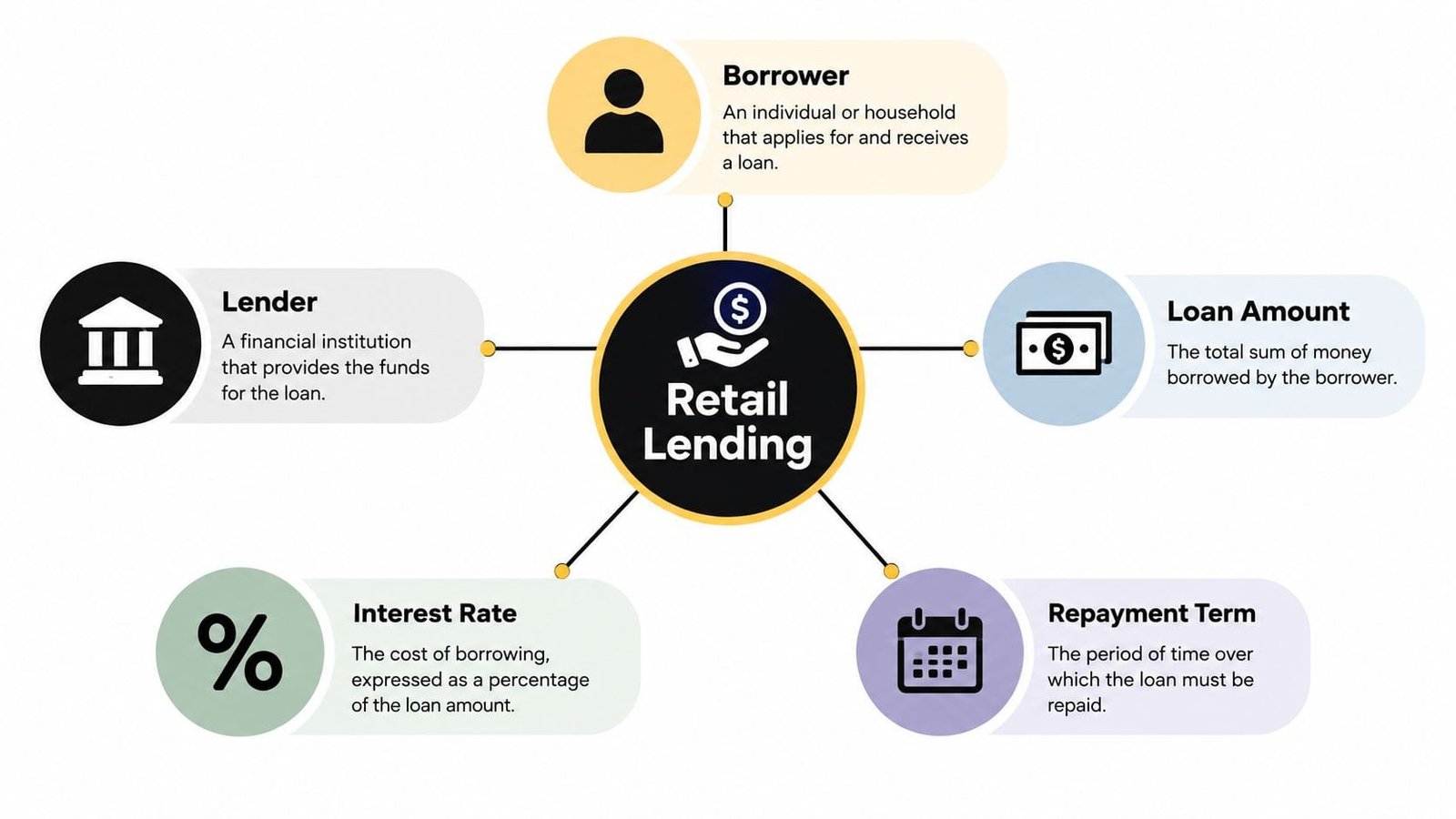
Retail lending is the consumer-credit side of banking. The Office of the Comptroller of the Currency's retail lending handbook defines it as closed- and open-end credit extended to individuals for household, family, and other personal expenditures.
“Closed-end” means the borrower receives a defined amount and repays it over an agreed schedule. An auto loan and a standard personal loan generally fit this structure. “Open-end” means the borrower receives access to a reusable credit line, such as a credit card, and can borrow, repay, and borrow again within the account terms.
The household side of the map
Think of a household budget rather than a company balance sheet. Retail lending can finance:
- Housing: First mortgages, home equity products, and home-improvement loans.
- Transportation: Auto loans and some consumer leases.
- Education: Student loans.
- Everyday spending: Credit cards and other revolving accounts.
- Flexible personal needs: Installment personal loans.
That broad scope is why retail lending isn't just a synonym for credit cards or personal loans. It includes the largest borrowing commitment many households make, a mortgage. In Canada, retail lending balances reached $2,074.6 billion in 2024, while mortgage credit accounted for $1,639.9 billion, or 79.0% of the market, according to Canada retail lending market data.
The same source reports that Canadian retail lending balances grew at a 5.2% CAGR from 2019 to 2024. Those figures demonstrate why analysts measure the category through balances outstanding and growth, not just the number of accounts. A single mortgage can represent far more borrowed money than many small revolving accounts combined.
A useful mental model
Retail lending answers this question: How does a lender provide credit to an individual for personal or household use? Commercial lending answers a different question: How does a lender finance a business and assess its ability to repay from business activity?
A business owner can appear in both systems. Your personal mortgage and credit card are retail products. Your company's equipment loan or operating line is commercial credit, even if you personally guarantee it. For a broader explanation of credit without pledged collateral, see this guide to what unsecured credit means.
How Retail Lending Differs From Commercial Lending
A small-business owner can use both retail and commercial credit, sometimes for the same overall goal. The dividing line usually comes from who borrows, why the funds are needed, and what evidence supports repayment. Retail lending generally evaluates an individual through standardized consumer information and product rules. Commercial lending examines the business as an operating entity, including its revenue, cash flow, assets, liabilities, and plan for using the funds.
| Criteria | Retail Lending | Commercial Lending |
|---|---|---|
| Primary borrower | An individual or household | A company, partnership, or other business entity |
| Typical purpose | Personal, household, housing, transportation, education, or everyday spending | Working capital, equipment, inventory, expansion, acquisition, or construction |
| Underwriting focus | Personal credit history, income, existing obligations, product terms, and collateral | Business cash flow, financial statements, industry conditions, collateral, ownership, and repayment capacity |
| Common structure | Credit cards, mortgages, auto loans, student loans, and personal loans | Business lines of credit, equipment loans, SBA financing, term loans, and invoice financing |
| Repayment source | Personal income or household resources | Business revenue and operating cash flow, sometimes supported by a personal guarantee |
| Risk segmentation | Product type, collateral, loan-to-value profile, and borrower behavior | Industry, customer concentration, cash flow stability, debt levels, collateral, and management experience |
The boundary gets less clear when a small-business owner applies for credit. A sole proprietor may borrow personally because the owner and business are not legally separate in the same way as a corporation. A corporation may seek a commercial loan while the lender still requires the owner's personal guarantee. The loan serves a business purpose, yet the owner's credit history and personal assets can remain part of the risk assessment.
That structure affects more than the application form. It can determine which income is reviewed, where repayment pressure appears, and whether missed payments affect personal credit, business credit, or both. Compare the full structure in this guide to a business loan and a personal loan before choosing based only on speed or approval odds.
Why definitions vary
The OCC definition centers on credit to individuals for household and personal expenditures, including mortgages and auto loans. Some industry explainers use “retail lending” more broadly for direct lending through banks or online channels to consumers and small businesses, as discussed in this retail lending glossary explanation.
As a result, retail lending does not have one universal boundary across every market or organization. Before comparing products, check the lender's definition, the named borrower, the permitted use of funds, and whether the obligation reports to personal or commercial credit files. Those details show where the loan sits in practice, even when the product label sounds familiar.
Common Retail Lending Products You Will Encounter
Retail lending becomes easier to recognize when you connect the label to products you already see in everyday financial life. The key differences are whether credit can be reused, whether the balance has a fixed payoff date, and whether an asset secures the obligation.
Revolving products
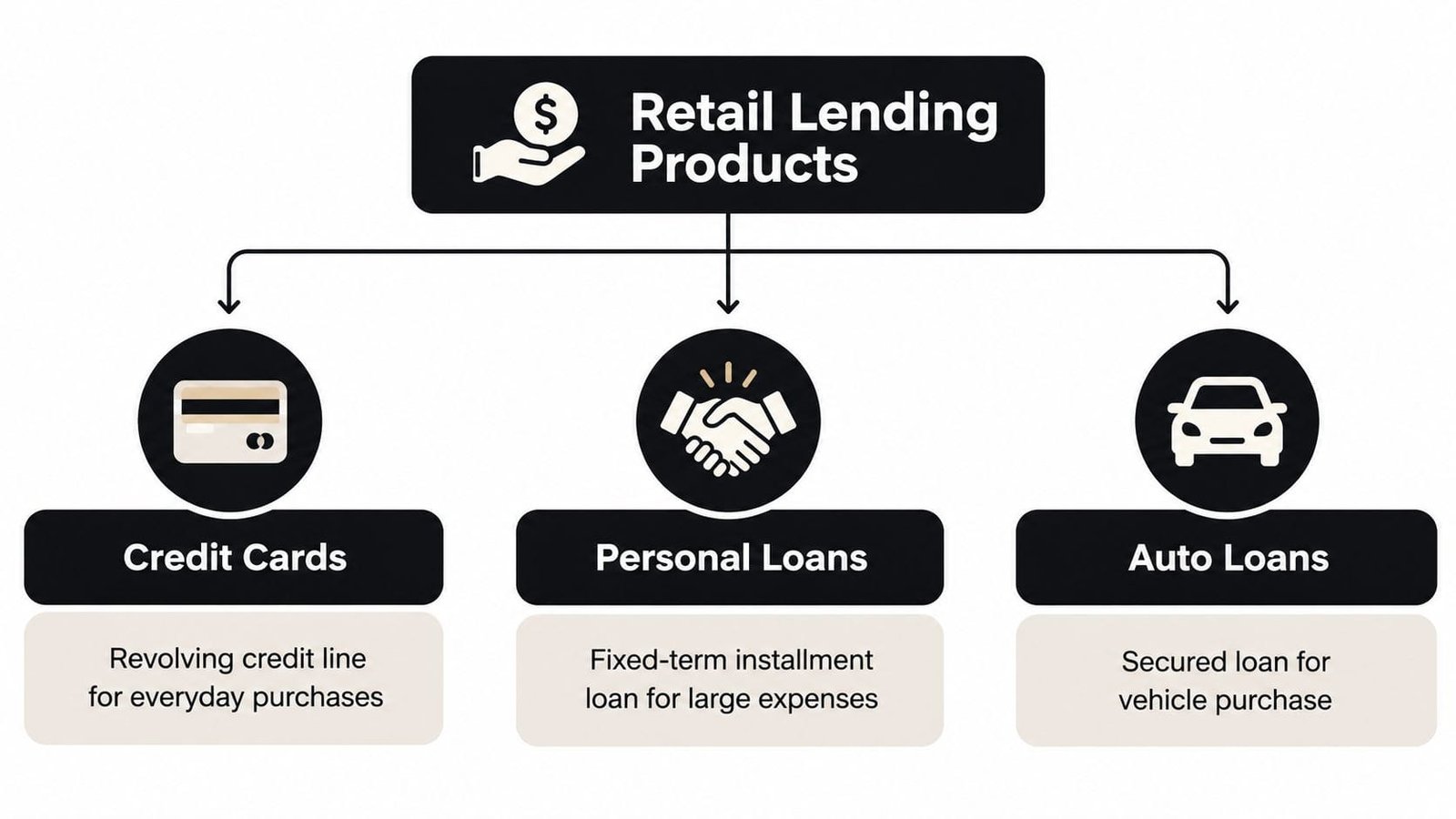
Credit cards provide open-end access. You can use the account for purchases, repay part or all of the balance, and continue using available credit under the account agreement. A card might help a business owner handle a short timing gap, but personal use for business spending can complicate records and expose personal credit to company volatility.
Store financing uses a retail purchase channel to offer installment credit or a revolving account for a specific merchant relationship. The product remains personal credit if the individual applies as the borrower for a household purchase.
Buy-now-pay-later products generally divide a purchase into scheduled payments. The exact structure and reporting treatment can vary by provider, so read the repayment terms, fees, authorization language, and consequences of a missed payment before accepting the offer.
Installment products
Personal loans provide a defined amount that the borrower repays through scheduled installments. A household might use one for a major expense or debt consolidation. A business owner may be tempted to use one for inventory or advertising, but the personal obligation remains even if the business revenue doesn't arrive as planned.
Auto loans finance a vehicle and are commonly secured by that vehicle. The lender's collateral position helps shape the loan terms, while the borrower's income and credit history help determine repayment capacity.
Student loans finance education-related costs and typically follow a structured repayment arrangement. They belong in the retail category because the individual, rather than a company, is the borrower.
Home-secured products
A first mortgage finances a home purchase or refinance. A home equity loan or home equity line of credit uses available home equity for another borrowing purpose. Home-improvement financing can also be secured by the residence or structured as a separate personal obligation.
The OCC notes that retail portfolios are commonly segmented by product type and collateral or loan-to-value profile. It has historically identified higher risk in areas such as high-LTV home equity, consumer leasing, and indirect consumer lending, as described in its retail lending risk guidance. The important lesson is that a borrower isn't “safe” or “risky” in the abstract. Risk changes with the product, collateral, and distribution channel.
How Underwriting and Risk Work in Retail Lending
Retail underwriting turns a personal application into a risk decision. The lender wants to estimate whether the borrower can repay, how much loss might occur if repayment fails, and what price or structure fits that risk.
The information lenders review
A typical review can include:
- Credit history: Payment patterns, current accounts, balances, and recent applications help show how the borrower has managed credit.
- Income and obligations: The lender compares documented income with existing debt and the proposed payment. A borrower with strong earnings can still face pressure if required payments already consume too much cash.
- Collateral and loan-to-value: For a secured loan, the lender considers the asset's value relative to the amount borrowed. More borrowing can leave less protection if the asset must be sold.
- Product behavior: A credit card, mortgage, auto loan, and home equity line carry different repayment patterns and loss risks.
- Origination channel: Direct applications and indirect channels, such as dealer-arranged vehicle financing, can produce different operational and risk considerations.
A credit score matters, but it doesn't tell the entire story. The same person might look stronger on a well-secured mortgage than on a heavily used revolving account because the lender is evaluating different collateral, payment structures, and borrower behavior.
Why funding conditions affect availability
Borrower demand isn't the only factor behind retail credit growth. Banks also need stable funding and must manage the performance of the loans already on their balance sheets. The ECB's July 2025 funding update reported that euro area banks' access to retail and wholesale funding improved slightly in the second quarter of 2025, led by short-term retail funding, money markets, and debt securities, while securitization access was broadly unchanged.
That matters because a lender may tighten approval standards even when consumers still want to borrow. Funding costs, portfolio performance, and delinquency trends influence how much credit a lender is willing to extend and to which borrower segments.
A borrower can improve an application by organizing income records, listing every existing obligation, checking credit reports for errors, and requesting only an amount supported by a realistic repayment plan. If a lender conducts a hard inquiry, understand its purpose and timing through this explanation of what a hard credit pull is.
The underwriting process is also a consumer-protection issue. Borrowers should receive clear information about payment obligations, collateral, fees, and the consequences of missed payments. Before signing, compare the total repayment burden, not just the advertised monthly payment.
What Retail Lending Means for Small Business Owners
Retail lending can be useful for a business, but personal credit shouldn't become the default funding system for every company expense. The right choice depends on the size of the need, the repayment source, the duration of the cash gap, and the personal risk attached to the product.

When personal credit may fit
A personal retail product may be reasonable for a very small, short-term expense when the owner can repay it from personal income without relying on uncertain business revenue. It may also be the only available option for a new venture that lacks business credit history or established financial statements.
That convenience has a cost. The owner may carry the debt personally, affect personal borrowing capacity, and lose the separation between household and company finances. A home-secured product carries an especially serious consideration because a business decision can be tied to a personal residence.
When commercial financing deserves priority
Commercial financing is generally more aligned with expenses that generate business revenue over time. Examples include equipment, inventory, expansion, construction, acquisition, and recurring working capital. A commercial lender can assess the company's cash flow and structure repayment around the business rather than placing every obligation on the owner's consumer profile.
Use this decision test:
- Identify the beneficiary: Does the purchase primarily support your household or your company?
- Name the repayment source: Will payments come from personal income, business revenue, or both?
- Measure the time horizon: Is the need a brief cash-flow bridge or a long-lived asset?
- Review personal exposure: Does the product place personal assets or credit capacity at risk?
- Separate the records: Can you keep the proceeds, expenses, and repayments clearly documented?
Retail lending is also a relationship model. Lenders manage the account from application through servicing and payoff, while borrowers build a record through payment behavior, repeat borrowing, and communication during financial stress. That history can influence future access, but repeated borrowing isn't automatically healthy. A company that repeatedly uses personal cards to cover operating deficits may be masking a structural cash-flow problem.
Business Loan Warrior offers a no-fee application, pre-approval checks designed not to affect credit, bank-account connection, a dashboard for approvals and repayments, credit insights, and access to underwriter conversations. For an owner comparing personal retail credit with business funding, those features can help organize the decision before accepting a new obligation.
Choosing Your Next Funding Move With Confidence
Retail lending is the broad system of personal and household credit. Commercial lending is the business-focused route. The two can overlap when an owner personally guarantees a business loan, but they shouldn't be treated as interchangeable.
Before borrowing, write down:
- The purpose: household purchase, emergency, inventory, equipment, expansion, or another need.
- The borrower: you personally, your company, or both through a guarantee.
- The repayment source: personal income, business cash flow, or a defined combination.
- The security offered: unsecured credit, a vehicle, equipment, real estate, or another asset.
- The full obligation: payment schedule, interest, fees, reporting, and consequences of default.
If the expense belongs to the business and will be repaid by business revenue, start by investigating commercial options. If you use personal retail credit, record the transaction carefully and consider how the obligation could affect your household even under a weak sales period.
Understanding what retail lending is gives you a practical advantage. You can ask better questions, compare the right products, and avoid treating fast access to money as proof that a loan fits your situation.
Business Loan Warrior helps small-business owners compare funding options, including business loans, SBA financing, lines of credit, equipment loans, construction financing, and other commercial products. Visit Business Loan Warrior to review your business funding path, submit a no-fee application, and move forward with clearer information about the obligation you're considering.