
$50,000 is the SBA Microloan ceiling for eligible borrowers, while the 2020 Paycheck Protection Program let qualifying 501(c)(3) and 501(c)(19) nonprofits borrow up to $10 million. For most 501(c) organizations today, however, the practical route is narrower, usually an SBA Microloan intermediary, a CDFI, a credit union, or foundation-backed Program Related Investment rather than a conventional bank SBA loan.
You may be in that position right now. Your nonprofit has a sound program, committed staff, and a budget that looks substantial on paper, but a bank officer tells you the requested financing doesn't fit the standard small-business box. The problem isn't necessarily your mission or repayment capacity. It's that loans made to nonprofits and loans made by nonprofit intermediaries are different markets, with different eligibility rules and underwriting.
This guide focuses on the borrower side. It explains what a 501(c) organization can realistically pursue, which documents will slow you down, how mission-driven lenders evaluate repayment, and when debt should be replaced or supplemented by grants and PRI capital. Expect a narrower process than a normal commercial loan, with documentation that proves both governance quality and reliable unrestricted cash flow.
Table of Contents
- The Real Situation for Nonprofit Borrowers in 2026
- What Counts as a Nonprofit Business Loan
- Comparing the Main Loan Channels for Nonprofits
- Eligibility and Documentation for 501(c) Organizations
- How Mission-Driven Underwriting Actually Works
- Two Nonprofit Loan Stories Worth Learning From
- Applying for a Nonprofit Business Loan Step by Step
- Choosing the Right Funding Path and Next Steps
The Real Situation for Nonprofit Borrowers in 2026
A community health nonprofit with a $1.2 million operating budget needs $75,000 to complete a clinic buildout. The executive director walks into a bank expecting an SBA-backed solution and discovers that the lender has no standard product designed for the organization's tax-exempt structure. The nonprofit has contracts, donors, and a strong board, but it doesn't have the conventional collateral or business classification the bank's process expects.
That eligibility confusion is the first obstacle. Most federal small-business loan programs technically exclude nonprofits, while certain targeted programs and intermediaries can still serve particular nonprofit borrowers. The SBA's loan guidance confirms that Microloans can reach certain nonprofit childcare centers and that the 2020 PPP specifically included qualifying 501(c)(3) and 501(c)(19) organizations. PPP was an exceptional federal channel, not a template for ordinary nonprofit borrowing.
The practical map has four routes:
- SBA Microloan intermediaries, generally suited to smaller working-capital or equipment needs.
- SBA Community Advantage, a mission-focused product for underserved markets, subject to current program availability.
- CDFI direct loans, where repayment capacity, mission, and organizational context receive substantial attention.
- Foundation PRIs, which can provide patient, subordinate, or below-market capital when a foundation's objectives align with the project.
Advisor's rule: Don't apply to a dozen banks first. Identify the lender type that is allowed and motivated to understand a nonprofit borrower.
For planning purposes, borrowers should expect a process that can take 60 to 120 days, with rates often discussed in the 5% to 9% range and first-time applicants facing approval odds below 40%. Those planning figures aren't guarantees, and the final offer depends on the lender, product, organization, and use of funds. The important point is operational: nonprofit business loans aren't fast cash, and a board should authorize the process before a cash crisis forces rushed borrowing.
What Counts as a Nonprofit Business Loan
A nonprofit business loan is debt capital extended to a tax-exempt organization that must repay principal and interest under a written agreement. The borrower might be a 501(c)(3), religious organization, community service provider, or another eligible nonprofit entity. The lender usually looks to operating cash flow, receivables, contracts, grants, or other repayment sources, rather than assuming the organization owns valuable commercial property.
The phrase creates confusion because it can describe two opposite transactions. A nonprofit intermediary may lend to a for-profit entrepreneur, while a nonprofit organization may borrow for its own programs, facilities, or working capital. The SBA lender framework identifies nonprofit organizations as intermediary lenders in certain programs, but that doesn't mean every nonprofit can borrow through a conventional SBA product.
This article addresses loans made to nonprofits. The lender will classify your entity according to the program's rules, then underwrite its ability to repay. Tax-exempt status doesn't remove the need to show reliable revenue, disciplined expenses, enforceable contracts, and authority to incur debt.
Match the loan structure to the need
The use of funds matters more than a headline rate. A short working-capital bridge should have a repayment source that arrives soon, while equipment financing should match the useful life of the equipment. Real estate debt needs a different structure from a line of credit, and a line of credit should not become a permanent substitute for operating reserves.
Common purposes include:
- Working capital, for payroll timing, contract reimbursement gaps, or seasonal expenses.
- Bridge financing, where an executed grant, government contract, or receivable is expected but delayed.
- Equipment financing, for vehicles, medical equipment, technology, or program assets.
- Real estate financing, for acquisition, renovation, or mission-related facilities.
- Program expansion, when the new activity creates dependable earned or contributed revenue.
A personal guarantee from an executive director isn't automatically the defining feature of nonprofit debt. Lenders may instead require board authorization, collateral assignments, funder support, or other credit enhancements. Before comparing rates, decide whether the organization can support the proposed payment from unrestricted operations and whether the term matches the asset or revenue cycle.
Comparing the Main Loan Channels for Nonprofits
The four channels don't compete on equal terms. An SBA Microloan may work for a modest equipment purchase, while a CDFI direct loan may better fit a facility project or complex bridge. PRIs can be attractive because a foundation may accept a lower return or longer repayment structure, but the organization must fit the foundation's mission and investment rules.
The SBA says Microloans can reach $50,000 for eligible borrowers, including certain nonprofit childcare centers, and nonprofit intermediaries administer the program through the SBA loan network. Community Advantage loans can reach $350,000 and target underserved markets, but borrowers must generally show that conventional credit isn't available on reasonable terms. Because program availability can change, confirm the current status of Community Advantage with the intermediary before building a financing plan around it. A current overview of the program is available through SBA Community Advantage loan guidance.
| Channel | Loan Size | Max Term | Typical Rate | Ideal Use Case | Time to Fund |
|---|---|---|---|---|---|
| SBA Microloan | Up to $50,000 | Up to 7 years | Often competitive | Small equipment, working capital, startup-stage needs | 30 to 60 days |
| SBA Community Advantage | Up to $350,000 | Up to 10 years | Often competitive | Underserved-market expansion and fixed assets | 60 to 120 days |
| CDFI direct loan | Varies by lender | Flexible | Often 5% to 9% | Working capital, facilities, equipment, bridge financing | 60 to 120 days |
| Foundation PRI | Varies by foundation | Often patient | Often below market | Mission-aligned growth and subordinate capital | Varies by foundation |
CDFIs deserve special attention. The CDFI Fund's FY 2024 Annual Report reported $99.7 million in awards to 40 recipients committed to serving small businesses and farms, alongside $54.5 million in another award category. Separate research cited in the same verified data found an average CDFI business-loan size of $101,700, with 72% of business loans below $100,000. That profile makes CDFIs particularly relevant to nonprofits seeking financing that falls below conventional facility-loan thresholds.
For a $50,000 bridge, start with an SBA Microloan intermediary or local CDFI, then test whether a PRI or recoverable grant can reduce senior debt. For a $250,000 facility purchase, start with a CDFI or an eligible SBA channel, and involve a Certified Development Company if a fixed-asset structure fits. Don't force a small working-capital product to finance a long-lived building.
Eligibility and Documentation for 501(c) Organizations
Before contacting lenders, confirm that the organization can prove legal existence, governance authority, operating continuity, and repayment capacity. A mission lender may be flexible about collateral, but it won't be casual about documentation. The lender is protecting public, philanthropic, and sometimes federally supported capital.
Clear the basic eligibility screen
Prepare evidence of:
- IRS status: An active IRS determination letter confirming tax-exempt classification.
- State standing: Current registration and good standing in the organization's home state.
- Operating history: At least one year of actual operations with financial records.
- Governance: A functioning board, current bylaws, and documented authority to borrow.
- Federal registration: A clean SAM.gov registration with no active exclusions.
If the organization is still being formed, governance and financial systems deserve attention before borrowing. A practical primer on starting a nonprofit that lasts can help founders understand the structural work that lenders later expect to see.
Build the file before submitting
The standard package commonly includes three years of Forms 990, audited or reviewed financial statements, current-year actual-versus-budget reporting, a 12-month cash-flow projection, an aging of receivables and pledges, a debt schedule, and a written narrative connecting the loan to program expansion. You should also include major contracts, grant agreements, board-approved budgets, and a clear sources-and-uses schedule.
Use this nonprofit loan document checklist to organize the file, then have your finance committee review it before the lender does.
Certain problems can stop an otherwise promising request:
- Unresolved IRS matters, especially issues affecting exempt status or filings.
- Missing board minutes, showing that borrowing was authorized.
- Payroll-tax arrears, particularly stale obligations extending beyond normal payment cycles.
- Extreme grant concentration, such as more than 60% of revenue from one grantor without a documented diversification plan.
Don't hide weaknesses. Explain them, show the corrective action, and document the repayment source. Mission lenders respond better to a controlled problem than to a surprise discovered during diligence.
How Mission-Driven Underwriting Actually Works
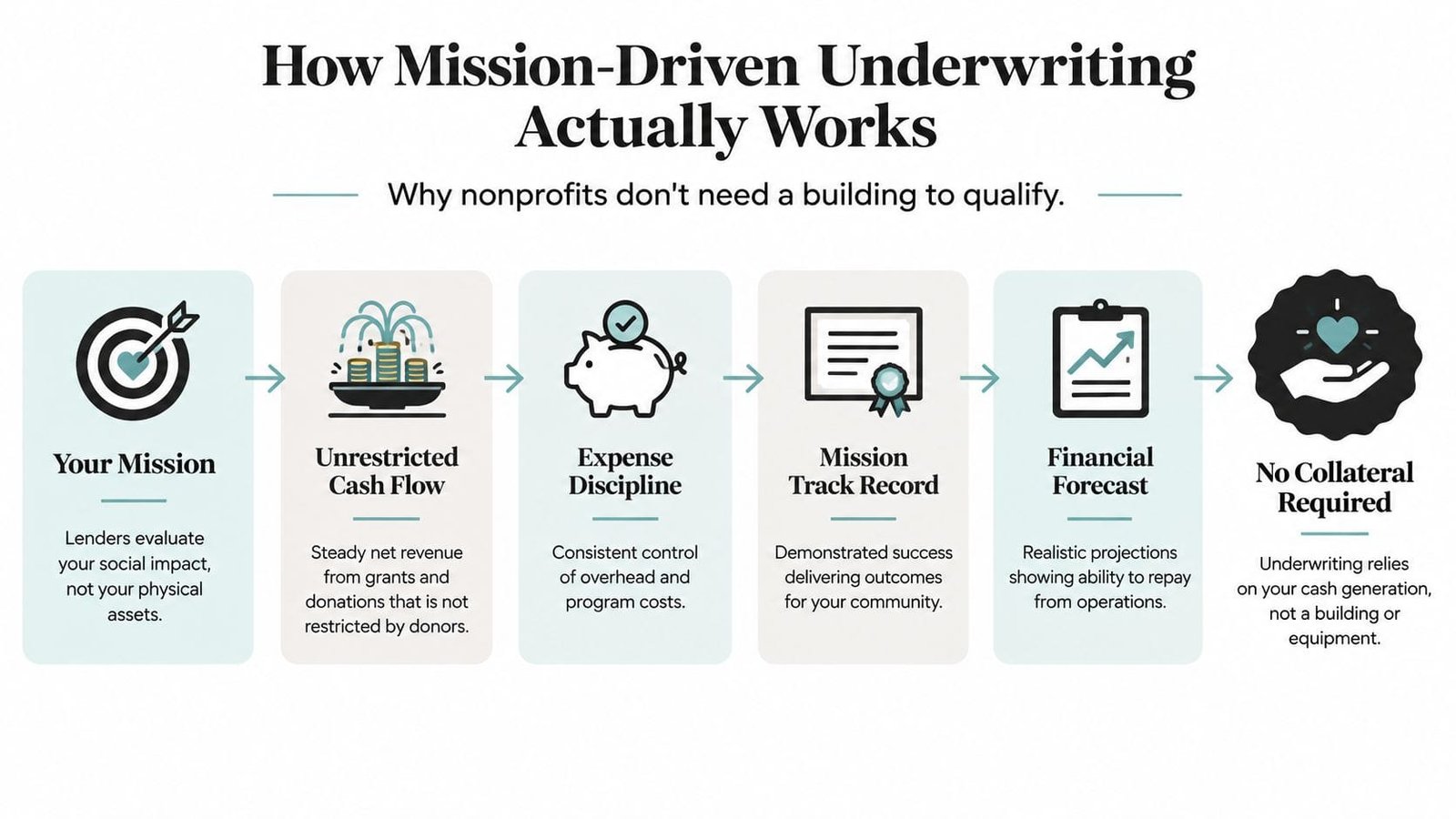
A CDFI or similar mission-driven lender often asks a different question from a conventional asset-based lender. Instead of asking, “What can we liquidate if the borrower fails?” the lender asks, “Can this organization generate enough unrestricted cash to repay while continuing its mission?”
The Duke analysis of CDFI support describes this distinction clearly. Mission-driven lenders may prioritize cash flow and management strength over traditional collateral, which suits nonprofits with limited hard assets. It also creates a need for close monitoring of DSCR, liquidity runway, and concentration risk.
The four questions underwriters ask
First, the lender examines the trend in unrestricted operating reserves. A nonprofit can have strong total assets and still lack cash available for debt service if most funds are restricted. Next comes revenue concentration. A government contract or major grant can be valuable, but dependence on one funder creates renewal and timing risk.
Expense discipline matters because a lender needs evidence that management can protect cash when revenue slips. Leadership tenure matters too. A stable executive team and capable finance function reduce execution risk, especially when the loan supports expansion.
Don't confuse flexible collateral policy with relaxed underwriting. A restricted-grant assignment, funder letter of credit, or board-designated reserve may strengthen the package, but the lender still needs a credible repayment model. Before applying, model debt service against revenue volatility, delayed reimbursements, and the loss or renewal delay of a major contract.
For broader context on the underwriting process, focus on the lender's decision sequence rather than collecting documents. Your goal is to show that repayment survives a reasonable operating setback without cutting essential services.
Two Nonprofit Loan Stories Worth Learning From
Consider a small community health nonprofit that needed working capital while waiting for a Medicaid contract payment. The organization approached a local CDFI with a specific bridge request, documented the expected receivable, and offered a restricted-grant assignment as a credit enhancement instead of relying on a building or equipment pledge.
The resulting structure used a 7.5% rate, 36-month amortization, and a 1% origination fee. The nonprofit retired the loan nine months early after bridge funds arrived. The lesson is straightforward: a lender can accept a temporary liquidity problem when management identifies a concrete repayment event and documents the path clearly.
A second example involves a workforce development nonprofit purchasing a commercial kitchen and delivery vans. The organization used a $500,000 SBA Microloan through a Community Advantage intermediary, with an 84-month term and an 8% blended rate. A participating foundation supplied credit enhancement, while repayment was tied to earned revenue from the expanded operation.
These examples illustrate different structures, not promises of available terms. The health nonprofit had a short-duration timing problem, so its application centered on the receivable and exit plan. The workforce organization had a long-lived asset and an earned-revenue strategy, so it needed a longer amortization and additional mission-aligned support.
A strong nonprofit loan request has three parts: a defined use, a dependable repayment source, and a board that understands the downside.
Apply those lessons to your own request:
- Name the repayment event: Identify the contract, receivable, earned revenue, or unrestricted funding that will make each payment.
- Use credit enhancement deliberately: A grant assignment or foundation support should reduce a specific lender concern, not decorate the application.
- Match term to purpose: Don't use a short bridge for permanent expansion or a long amortization for a temporary cash gap.
Applying for a Nonprofit Business Loan Step by Step
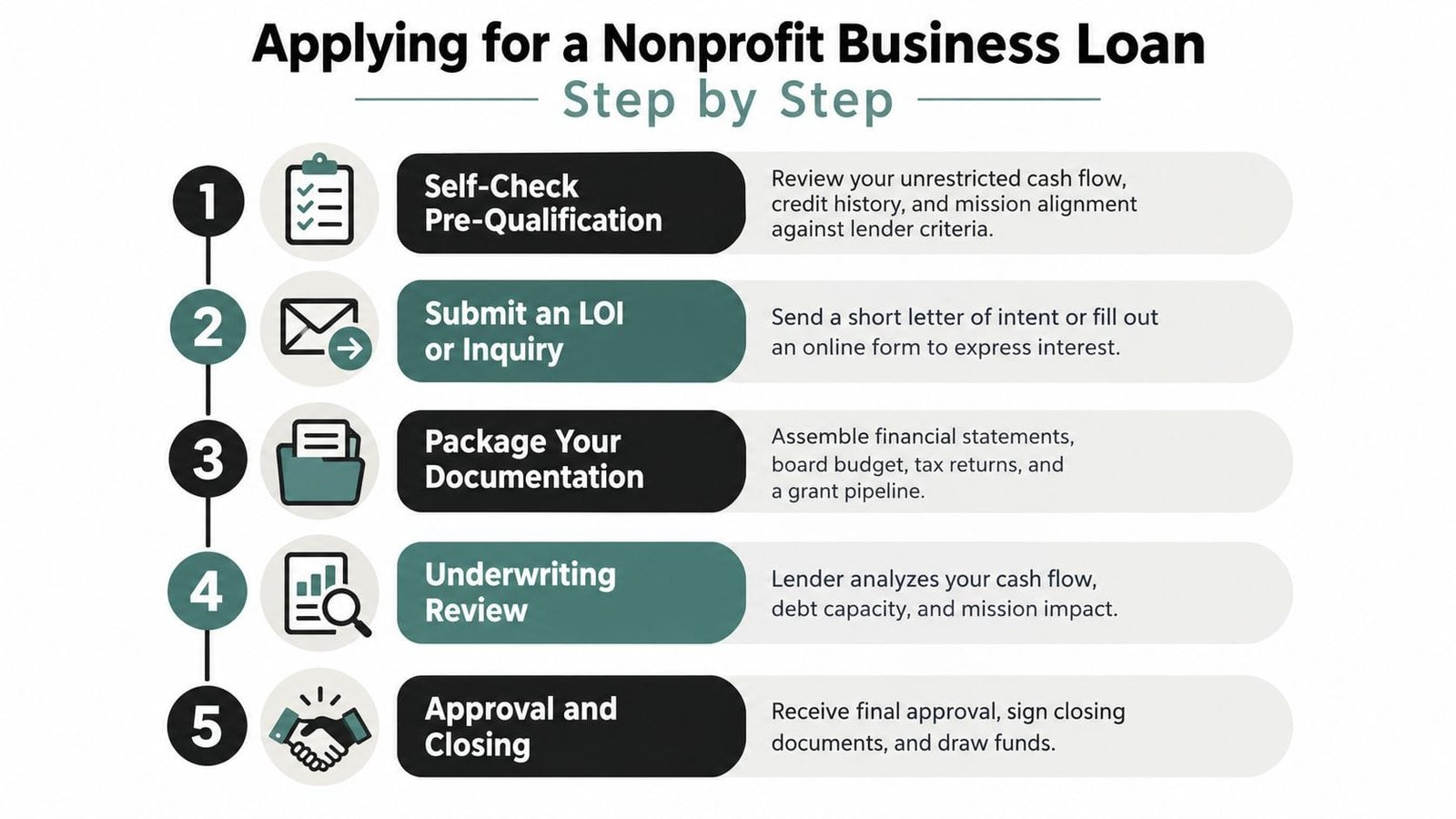
Start with a self-check, not an application. Review unrestricted cash flow, current debt, revenue concentration, board authority, and the exact use of funds. If the organization can't explain how repayment works during a delayed grant or contract reimbursement, it isn't ready for underwriting.
Follow the lender's sequence
- Pre-qualify with the right channel. Contact an SBA Microloan intermediary, CDFI, or foundation PRI team whose stated mission matches your organization and project.
- Submit an inquiry or LOI. Give the lender a concise description of the borrower, amount, use, repayment source, and requested closing window.
- Package the documents. Assemble financial statements, Forms 990, budgets, projections, debt schedules, contracts, board resolutions, and grant information before full underwriting.
- Prepare for management review. Expect questions about cash restrictions, staffing, program economics, funder renewals, and downside scenarios. A site visit or management call may be part of the process.
- Negotiate and close. Review rate, amortization, covenants, collateral assignments, reporting obligations, default provisions, and fees before signing.
SBA Microloan intermediaries may close in 30 to 60 days, while CDFI transactions often take 60 to 120 days. Those timeframes vary by lender and file quality. Missing board minutes or inconsistent numbers between the budget and projection can create avoidable delays.
Federal grants aren't loans, and they're rarely the correct tool for an urgent working-capital gap because application and award cycles don't align with payroll needs. A PRI can work better when a foundation wants mission impact and can accept subordinate, patient capital. In a blended structure, a recoverable grant may sit alongside a senior loan, lowering the amount of commercial debt.
If the lender stalls, ask for a written list of outstanding items and a clear decision date. Don't resubmit a revised package with unexplained changes. Reconcile every figure, label restricted and unrestricted funds separately, and explain any variance before the underwriter finds it.
Choosing the Right Funding Path and Next Steps
The right first channel depends on three things: your operating scale, the funding purpose, and your tolerance for a slower close. A small community nonprofit with payroll gaps shouldn't start with a facility lender. A larger organization buying property shouldn't rely on a short working-capital line.
| Organization Profile | Primary Need | Best First Channel | Expected Close |
|---|---|---|---|
| Smaller community nonprofit | Payroll or reimbursement gap | SBA Microloan intermediary or CDFI | 30 to 120 days |
| Growing nonprofit with modest equipment need | Vehicles, technology, or program equipment | SBA Microloan intermediary or CDFI | 30 to 120 days |
| Established organization pursuing a facility | Real estate or major renovation | CDFI or eligible SBA fixed-asset channel | 60 to 120 days or longer |
| Mission-aligned growth project | Expansion with foundation interest | PRI, possibly blended with senior debt | Foundation-dependent |
| Urgent, non-repayable program need | Innovation or rapid-response funding | Grantmaker rather than lender | Grant-cycle dependent |
A sub-$500,000 organization with a payroll timing problem should begin with an SBA Microloan intermediary or local CDFI. An organization with a $1 million to $5 million budget pursuing a facility should discuss CDFI financing and SBA 504 eligibility through a Certified Development Company. Growth capital tied closely to a foundation's priorities belongs in a PRI conversation. If repayment depends on uncertain future revenue, pursue grants before debt.
Use the next seven days productively:
- Pull three years of financial statements and Forms 990.
- Reconcile current-year actuals to the approved budget.
- Confirm board authority to incur debt and schedule the resolution.
- Separate restricted and unrestricted cash.
- Build a 12-month repayment forecast.
- Request introductions to at least two CDFIs.
- Contact one SBA intermediary and ask which nonprofit borrowers it can serve.
Business Loan Warrior offers a single application, bank-statement intake, lender matching, and a dashboard for tracking approvals and repayment information, though a nonprofit should confirm that a proposed product accepts its entity type before proceeding. Visit Business Loan Warrior to review funding options and begin a conversation about whether its lending network fits your organization's request.