
A 14-month-old landscaping company has just landed a commercial contract worth $95,000. The owner needs $40,000 for a second crew truck and three months of payroll before the first invoice clears. The money is necessary, the opportunity is real, and choosing the wrong funding product could turn a profitable contract into an expensive cash-flow problem.
That's the practical business loan vs credit card decision. A business loan delivers a lump sum that you repay on a fixed schedule with a defined end date. A business credit card gives you revolving access to funds, with a variable balance, variable rate, and minimum payment. The right choice depends less on which product sounds convenient and more on when the cash leaves your business and when revenue comes back in.
A card can be efficient for expenses you'll repay quickly. A loan is usually the disciplined choice for equipment, expansion, refinancing, or any balance that will remain outstanding beyond a short billing cycle. Recent market data places traditional bank business loans around 6.37% to 10.98% APR, while average business credit card APRs were about 20.97% in early 2026 and around 19.56% by September 2026, according to NerdWallet's business loan rate guide. That gap can make a revolving balance roughly twice as expensive as a bank loan before fees and compounding.
Table of Contents
- Why the Business Loan vs Credit Card Question Matters Right Now
- How the Two Products Actually Work Side by Side
- Real Cost of Each Option Including the APR Spread
- Amounts, Terms, and the Interest-Free Window
- Best Use Cases for Each Product in Real Businesses
- Qualification, Credit Impact, and Pre-Qualification
- Choosing the Right Path and Tracking It After Funding
- Practical Answers to Common Funding Decisions
Why the Business Loan vs Credit Card Question Matters Right Now
The landscaping owner doesn't need “access to capital” in the abstract. The business needs a truck now, payroll during the contract's opening period, and a repayment plan tied to commercial receivables. Those are three related needs, but they don't necessarily belong on the same product.
Putting the truck on a credit card creates a long-lived balance for an asset that should produce revenue over a much longer period. Charging payroll during the invoice gap may be reasonable if the owner has a clear collection date and can clear the balance promptly. Treating both expenses identically would be a mistake.
A business loan gives the owner the full approved amount upfront. The lender establishes the repayment schedule, and the business makes installments until the balance reaches its scheduled end date. This structure creates a predictable obligation, which helps an owner match debt service to the revenue generated by the equipment or expansion.
A business credit card behaves differently. The owner draws only what's needed, repays some or all of the balance, and can use the available credit again. The flexibility is valuable, but the balance can remain open indefinitely, and the rate is generally variable. Federal Reserve consumer credit data released in January 2026 showed an average interest-bearing credit card account at 22.30%, a figure that highlights the cost of carrying revolving debt relative to business loan benchmarks, as summarized by Nav's business credit card APR analysis.
Practical rule: Use the repayment schedule to match the financing product to the revenue schedule. Borrow long for assets that earn money over time, and borrow short for costs that disappear when the next receivable arrives.
The broader financing pattern supports that distinction. A summary of UChicago BFI research reports that 55% of small businesses used a business credit card in the prior 12 months, compared with 26% that used a loan, according to Fund&Grow's discussion of small-business credit card borrowing. Cards are not merely emergency tools. Owners use them because they're fast, reusable, and practical for recurring expenses.
That popularity doesn't make cards suitable for every need. The question is whether the business has a short, reliable path from spending to repayment. If the answer is no, a loan's lower cost and fixed schedule usually win.
How the Two Products Actually Work Side by Side
The simplest comparison starts with structure, not marketing language. A loan is a committed repayment arrangement. A credit card is a reusable spending facility.
| Criterion | Business Loan | Business Credit Card |
|---|---|---|
| Funding speed | Often requires underwriting and document review | Usually faster for qualified applicants |
| Typical amount range | Varies by lender, purpose, and financial strength | Set revolving limit determined by issuer |
| Repayment structure | Fixed installments over a defined term | Minimum payments or full-balance payment |
| Interest model | Fixed or variable APR, charged according to loan terms | Usually variable APR on carried balances |
| Fee profile | May include origination and other loan fees | May include annual, late, cash advance, or transaction fees |
| Qualification floor | Stronger documentation and repayment analysis | Often relies heavily on owner and business credit |
| Ideal use case | Equipment, expansion, acquisition, or refinancing | Short-cycle purchases, recurring expenses, and working capital |
A business loan converts a defined financing need into a scheduled obligation. The lender advances the money, and the owner repays principal and interest according to the agreement. Longer repayment windows can make a large project easier to budget, but the owner remains responsible for the payment even during a weak month.
A business credit card puts the owner in charge of timing. The company can use part of the limit, pay it down, and reuse the available credit. That makes the card useful when expenses change from week to week, but it also makes the debt easier to prolong.
The month-to-month difference
Loan payments are designed to be predictable. The amount due on day one should follow the same repayment formula as the amount due later in the schedule, subject to the loan's specific terms.
Card payments move with the balance. A month with heavy inventory purchases can produce a larger payment, while a month with light spending can produce a smaller minimum. That flexibility helps with uneven operations, but minimum payments can conceal how long repayment will take.
Owners comparing revolving tools should also distinguish a credit card from a business line of credit. A business line of credit and credit card cash-flow comparison can help clarify when a revolving facility with different underwriting and pricing may fit better than a card.
Choose the loan when predictability matters more than reuse. Choose the card when the spending pattern is variable, the balance will be cleared quickly, and the ability to draw repeatedly has real operating value.
Real Cost of Each Option Including the APR Spread
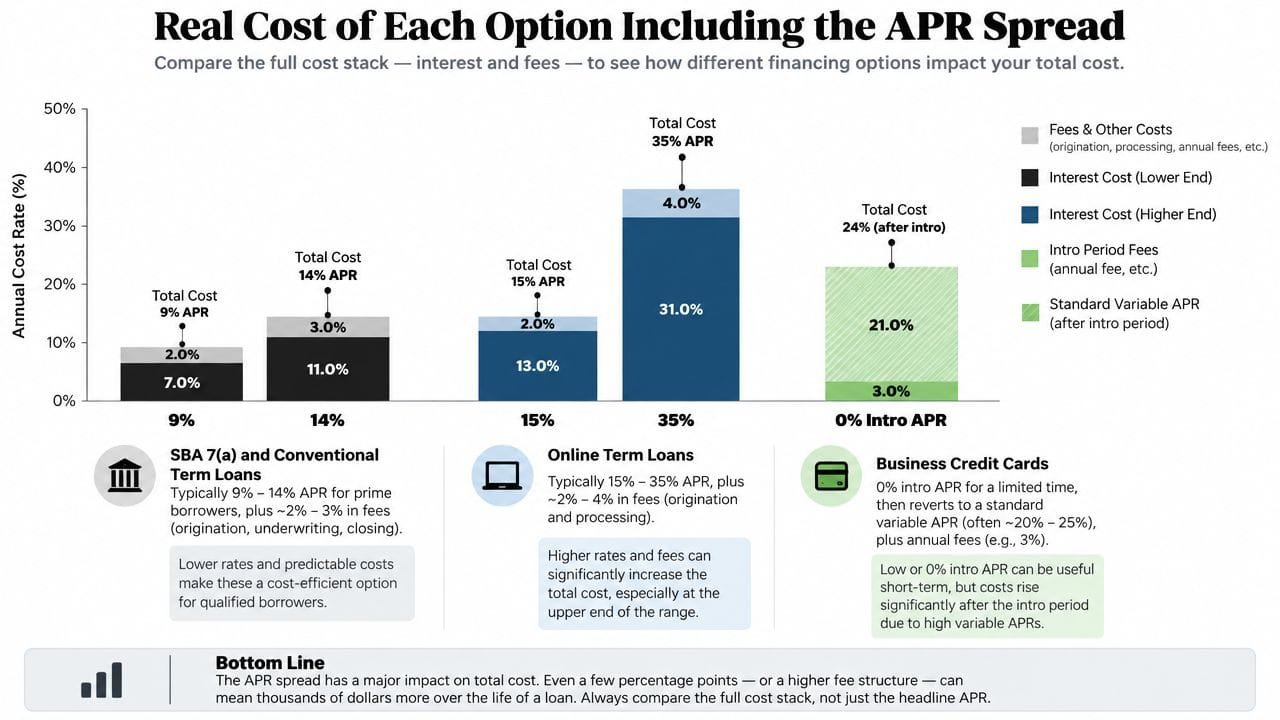
APR is the first cost to compare, but it isn't the entire cost. Loans may include origination charges, while cards can add annual fees, cash advance charges, late fees, and the cost of carrying a balance month after month.
Recent market data places traditional bank business loans around 6.37% to 10.98% APR, while independent comparisons commonly place business loan APRs around 6% to 30% and business credit card APRs around 16% to 34%, according to SoFi's business loan versus business credit card comparison. The exact offer depends on the lender, borrower, collateral, cash flow, and product type, but the direction is clear: cards are usually more expensive when balances revolve.
What the rate spread means
A loan's lower rate can outweigh its less flexible structure when the business expects to carry debt. A card can still win when the owner pays the statement balance in full, because interest may not apply to purchases during the grace period. Once the balance rolls forward, the variable APR becomes the central cost.
The comparison should include more than the advertised rate:
- Loan pricing: Review the APR, repayment term, origination charge, collateral requirements, and any prepayment conditions.
- Card pricing: Check the purchase APR, annual fee, late fee, cash advance fee, foreign transaction fee, and promotional expiration date.
- Cash advances: Avoid using a card for cash unless the cost is fully understood. Cash advances often carry separate fees and different interest treatment.
- Compounding: A balance that remains unpaid keeps generating interest, increasing the amount that must be cleared later.
Owners who want cleaner records should use a dedicated expense process and review a practical Ledgerly credit card tracking guide for organizing card payments, dates, and balances.
The right comparison question
Don't ask only, “Which product has the lower APR?” Ask, “How long will this exact expense remain financed?”
The answer determines the winner. A card paid in full quickly can provide flexibility and rewards without creating interest expense. A card used as a long-term substitute for a loan usually creates a costly, unstable payment obligation.
For a deeper explanation of how the stated rate and total borrowing cost relate, review this guide to APR versus interest rate. The practical conclusion is firm: if repayment won't happen inside a short cycle, price a loan before swiping the card.
Amounts, Terms, and the Interest-Free Window
Funding size and repayment horizon should narrow the decision quickly. A business loan fits a defined amount that the company needs upfront. A card fits repeated draws that vary with operating activity.
| Dimension | Business Loan | Business Credit Card |
|---|---|---|
| Funding access | Lump sum delivered after approval | Reusable limit available for purchases |
| Amount suitability | Better for larger, defined capital needs | Better for smaller or recurring expenses |
| Repayment period | Fixed term, from short periods to extended schedules | No preset payoff date while the account remains open |
| Payment behavior | Scheduled principal and interest payments | Minimum payment, partial payment, or full payment |
| Interest trigger | Interest applies under the loan agreement from funding | Interest generally applies to balances carried beyond the grace period |
| Best timing pattern | Planned expense with predictable revenue | Short-cycle expense with quick repayment |
| Main risk | Paying for capital you no longer need | Carrying debt indefinitely at a variable rate |
A card's grace period can be powerful when the timing works. For example, if a business charges inventory and pays the balance in full before the statement obligation requires interest, the company may avoid purchase interest. The opportunity disappears when the business can make only the minimum payment.
Loans work differently because amortization begins according to the loan agreement. The payment doesn't depend on whether the owner spent the entire proceeds during the previous month. That commitment is exactly why a loan suits a truck, renovation, equipment package, or expansion budget with a defined scope.
Match the term to the asset
Use a short repayment horizon for a short-lived expense. Payroll, supplies, and advertising can make sense on a card when receivables arrive soon and the owner has protected enough cash to clear the balance.
Use a longer, structured term for an asset that supports revenue over time. Equipment and expansion costs shouldn't depend on minimum card payments. The business should know the required payment, the expected useful period of the asset, and the revenue source assigned to debt service.
The Xero guide to business credit cards versus loans describes this same structural distinction: loans are fixed-term instruments, while cards are revolving facilities that can remain open without a scheduled payoff date.
A card's interest-free window is a timing tool, not a permanent financing strategy.
The owner's job is to write down three facts before applying: the amount required, the date the expense will be repaid, and the revenue source that will fund repayment. If those answers are uncertain, a fixed loan or another structured facility deserves priority over a revolving card balance.
Best Use Cases for Each Product in Real Businesses
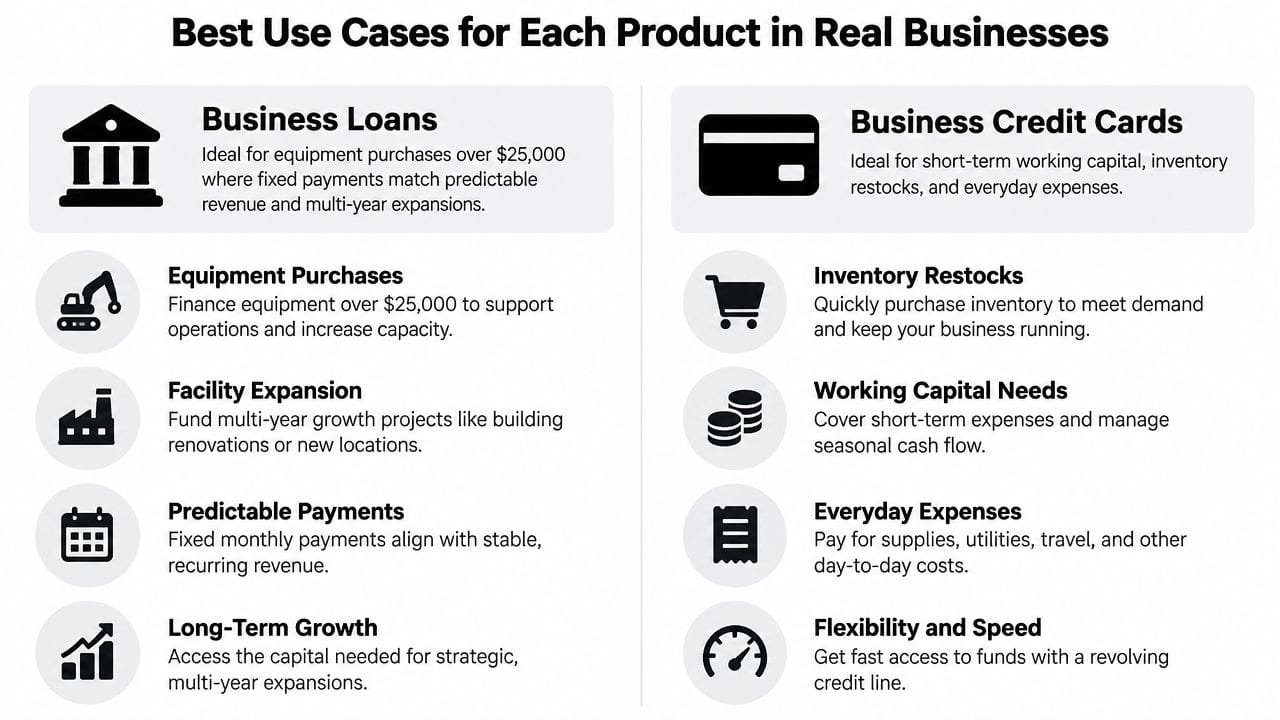
The best product follows the business's cash-flow pattern. Loans support planned, durable spending. Cards support fast, recurring, or variable spending that can be repaid before interest becomes the dominant cost.
Where a business loan earns its place
An equipment purchase belongs in the loan column when the item will generate revenue over an extended period. A delivery vehicle, commercial kitchen upgrade, construction equipment, or production system creates a fixed capital need, so fixed debt service gives the owner a clearer operating budget.
Expansion also points toward a loan. Opening another location, adding a production area, or building a second crew requires coordinated spending across labor, equipment, permits, and materials. A loan provides the planned capital in one transaction rather than forcing the owner to manage several card balances.
Debt consolidation is another strong use. If a company has expensive revolving balances, replacing them with a lower-cost structured facility can simplify payments and reduce exposure to variable card rates. The owner should compare the total cost, fees, and repayment schedule before moving any balance.
Where the card performs better
Cards work well for purchases that move through the business quickly:
- Recurring software and advertising: Use a card when monthly charges fluctuate and the company pays the balance from operating receipts.
- Inventory restocks: A retailer or distributor can use revolving access for short-cycle inventory when sales replenish cash promptly.
- Travel and client expenses: A card can centralize receipts and provide rewards when the business already has the cash to pay.
- Receivable gaps: Payroll or materials may fit a card when a contracted customer's payment is imminent and collection risk is controlled.
A mixed strategy can be smarter than choosing one product. A company might use a structured loan for a major expansion and keep a separate card for variable inventory or travel expenses. The separation matters. Each product should have a defined job, a spending limit, and a repayment source.
Never put a vehicle, buildout, or long-lived equipment purchase on a card while planning to make minimum payments indefinitely. That turns a flexible operating tool into expensive term debt without the predictability of an actual loan.
Qualification, Credit Impact, and Pre-Qualification
Approval depends on the product, the lender, and the strength of the business and owner. A bank or SBA application usually requires a deeper review of revenue, tax filings, cash flow, existing obligations, and repayment capacity. A card application often leans more heavily on the owner's personal credit and the issuer's internal risk model.
What lenders and issuers review
Loan underwriting focuses on whether the business can repay a defined obligation. Expect the lender to examine business financial statements, bank activity, tax returns, time in business, debt obligations, and the reliability of operating cash flow.
Card underwriting focuses on whether the applicant can responsibly use revolving credit. The issuer may review personal credit, business information, the business bank relationship, and existing credit behavior. Reporting practices differ by issuer, so confirm whether payment activity reaches commercial bureaus, personal bureaus, or both.
Keep business and personal borrowing separate where possible. This business credit versus personal credit guide explains why that separation matters for financial records, credit development, and future borrowing decisions.
Use pre-qualification before a full application
A soft-pull pre-qualification can show potential rate and term ranges without creating the same hard inquiry associated with a full application. That lets the owner compare realistic options before committing to a formal submission.
Prepare the basic file first:
- Financial records: Recent business bank statements, income information, and tax documentation.
- Operating details: Legal business name, ownership structure, industry, time in business, and federal tax identification information.
- Debt picture: Current balances, minimum payments, and the purpose of the new funds.
- Repayment explanation: A short description of how the expense will create or preserve cash flow.
If the first offer is thin, don't immediately stack applications. Improve the file, clarify the funding purpose, reduce unnecessary balances where possible, and ask whether a smaller amount or different product better matches the business. Owners who want additional guidance on reducing balances and organizing repayment can browse these payoff-plan credit articles from The Money Maniac.
Choosing the Right Path and Tracking It After Funding
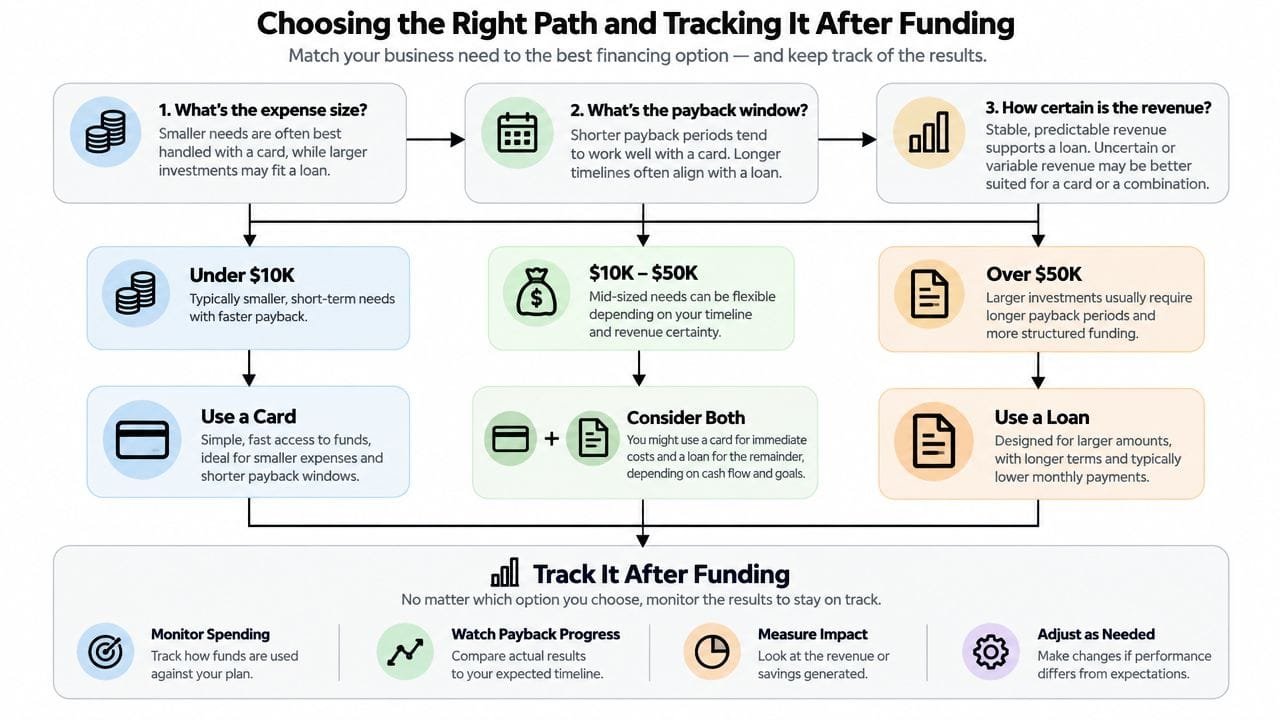
The decision becomes straightforward when you rank three variables: expense size, repayment speed, and revenue certainty. Product labels matter less than the timing pattern behind the request.
Use this decision path
- Small and short-lived: If the expense is under $10,000, changes from month to month, and the business can repay it quickly from known receipts, a credit card is usually the first option to evaluate.
- Large and defined: If the need is over $50,000, tied to equipment, expansion, or refinancing, start with a business loan. The amount and purpose justify structured underwriting.
- Large but variable: If the project needs substantial capital and operating expenses will fluctuate, use both products with separate roles. Put the fixed project on a loan and reserve the card for controlled, short-cycle expenses.
- Uncertain repayment: If revenue timing is unclear, don't rely on minimum card payments. A lender should help identify a structure that fits the actual cash-flow risk.
The middle ground requires judgment. A modest equipment purchase may still deserve a loan if repayment will take a long time. A larger working-capital need may fit a revolving product if the business repeatedly draws and repays against dependable receivables.
Track the decision after funding
Funding approval isn't the finish line. Owners need to see upcoming payments, outstanding card balances, remaining availability, and the dates when promotional or introductory terms change. A dashboard that consolidates approvals, repayments, and credit insights helps prevent one product from disappearing inside day-to-day bookkeeping.
Business Loan Warrior offers a single, no-fee application for pre-qualification, bank-account connection, funding comparisons, and a secure dashboard for tracking approvals, repayments, and credit insights. Treat that workflow as an evaluation tool, not a reason to borrow more than the business can repay. The best offer is the one that matches the expense's timing and leaves room for ordinary operating volatility.
Practical Answers to Common Funding Decisions
Can you use a card while an active business loan is outstanding? Yes, if each product has a separate purpose and the combined payments fit the cash-flow forecast. Use the loan for the fixed asset or planned project, and reserve the card for expenses that turn back into cash quickly. Don't use the card to conceal a loan payment shortfall.
What should you do when pre-qualification returns weak offers? Stop and diagnose the reason. Review personal and business credit records, check for reporting errors, organize bank statements, reduce unnecessary revolving balances, and reconsider the amount requested. A smaller, purpose-specific request may produce a more workable structure than a broad application for maximum funding.
Can using both products hurt your credit? It can if balances rise, payments become late, or applications accumulate without a repayment plan. Keep card spending well below the available limit, pay on time, and avoid opening several accounts for the same need. Route predictable advertising, software, and travel purchases through the card only when the business can pay them, while reserving term debt for fixed assets.
The decisive rule is simple: choose the product that matches the time between spending and repayment. Cards reward control and speed. Loans reward planning and payment certainty.
Business Loan Warrior helps owners compare business loans, SBA financing, lines of credit, equipment funding, and other capital through a single pre-qualification application. Visit Business Loan Warrior to review funding options, see potential terms without an initial credit impact, and track repayment after you choose the structure that fits your cash flow.