
You've submitted the application, uploaded the financial statements, and explained exactly what the money will fund. Then the lender asks for another bank statement, a debt schedule, and clarification about several deposits. Suddenly, the business loan underwriting process feels less like a review and more like a locked room.
It isn't a mystery, though. Underwriting is a structured attempt to answer one practical question: Will this business generate enough reliable cash to repay the proposed debt while continuing to operate? Credit history matters, but lenders also examine deposits, expenses, existing obligations, documentation quality, and the story connecting all of those details.
A clear understanding helps you avoid the most common delays. You'll know what lenders check, why a strong revenue number can still create concern, how DSCR fits into the decision, and which documents deserve attention before you apply. Business Loan Warrior helps simplify that path by connecting borrowers with funding options and organizing application information, but the strongest improvement still starts with understanding your own cash-flow story.
Table of Contents
- Introduction to the Business Loan Underwriting Journey
- What Business Loan Underwriting Really Means
- The Five Pillars Lenders Evaluate Before Approval
- How the Underwriting Workflow Moves From Application to Funding
- How Underwriting Differs by Lender Type and Loan Product
- Documents Cash Flow Checks and Tactics to Strengthen Your File
- Final Takeaways for Navigating Underwriting With Confidence
Introduction to the Business Loan Underwriting Journey
A restaurant owner preparing to replace aging kitchen equipment has healthy sales, steady customer demand, and a clear repayment plan. The application looks promising until the lender spots irregular deposits, several overdraft-related transactions, and financial statements that do not match the tax returns.
The lender is not automatically deciding that the restaurant is failing. The underwriter is reconciling the evidence. Are deposits recorded consistently? Do reported earnings reflect the cash available for debt payments? Can the unusual transactions be explained, or do they suggest a deeper working-capital problem?
That distinction matters because underwriting is not a pass-or-fail credit-score test. It is the assembly of a financial story from several records. The lender reviews business history, current obligations, projected repayment ability, owner involvement, industry conditions, and the requested use of funds. A convincing file makes those details support one another.
Practical rule: Underwriters trust a complete, consistent explanation more than an impressive number that cannot be verified.
A strong credit score may help open the conversation, but bank-statement behavior and debt-service coverage show whether the business can carry the new payment. Frequent overdrafts, unexplained transfers, or uneven deposits can weaken an otherwise healthy application. Before applying, reconcile statements, label unusual deposits, update the debt schedule, and explain any gap between tax returns and current financial reports.
Banks often use multiple approval layers for small-business loans. The FDIC's 2024 Small Business Lending Survey found that 79% of banks use at least one approval level, while 73% use three or more levels. Among banks using three or more, 41% use three levels, 20% use four, 6% use five, and 6% use six or more. Each layer may view the same file differently, so missing information can trigger repeated questions.
This guide explains the journey in plain English, from underwriting's purpose to the five risk pillars, application workflow, lender and product differences, and preparation steps. The goal is to help you see what the lender sees and correct weak documentation before it slows your request.
What Business Loan Underwriting Really Means
Underwriting is a structured review built around one question: can the business reliably repay the proposed debt? The lender assembles a financial narrative from bank statements, tax returns, financial reports, credit records, and the application. Each document should support the others, much like matching pages in the same story.
The reviewer may be a bank employee, an SBA lending specialist, or a hybrid team using software alongside human judgment. Automated systems can screen applications, verify data, and apply preset rules quickly. A human underwriter may still need to explain unusual deposits, adjust earnings for one-time events, assess industry conditions, and prepare a credit memo for approval.
The question behind the review
Underwriters are establishing four connected facts:
- Repayment ability: The business generates enough operating cash flow to cover existing and proposed debt.
- Information reliability: Financial statements, tax returns, bank activity, and application details describe the same business reality.
- Risk tolerance: The business, industry, collateral, and owner profile fit the lender's policy.
- Recovery protection: Guarantees or collateral may reduce the lender's potential loss if performance weakens.
Cash flow sits at the center because an operating business is generally expected to repay debt from its operations, not from selling collateral. SBA-focused guidance explains that lenders primarily assess debt-service capacity, often through a global view that includes the proposed loan and relevant guarantor obligations. Bank-statement behavior therefore matters more than a static credit score alone. Overdrafts, irregular deposits, unexplained transfers, or timing gaps can change how the lender reads the file.
Why lender models differ
A traditional bank may request detailed financial statements and send the file through several review layers. An SBA lender must also document eligibility, repayment ability, equity injection, and compliance with applicable SBA procedures. A fintech lender may depend more on connected transaction data and automated decisions, while still requesting documents when the data creates questions.
Pre-qualification is therefore an early screen, not final approval. Full underwriting verifies the evidence, measures repayment capacity, and sets the amount, structure, and conditions the lender can support. If the file contains weak documentation, correcting the records and explanations before applying can make the review clearer and reduce avoidable questions.
The Five Pillars Lenders Evaluate Before Approval
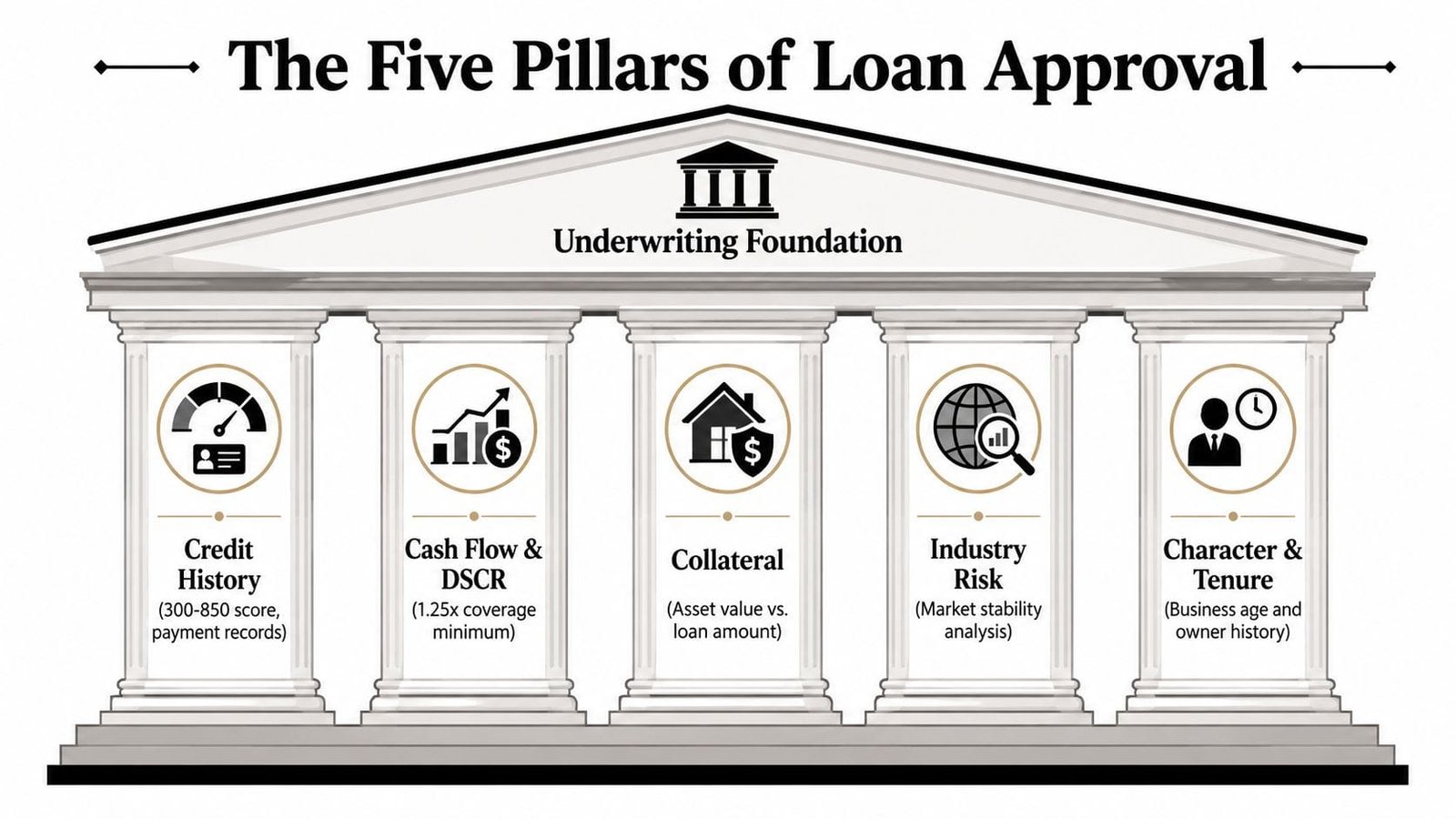
Lenders may label their frameworks differently, but most business loan reviews revolve around five risk lenses. They don't carry identical weight in every application. A borrower with limited collateral may still qualify if cash flow is strong, while a high-revenue business can struggle if deposits and records are unreliable.
Credit history and repayment behavior
Personal and business credit reports show how you've handled borrowed money. Underwriters may review payment history, outstanding balances, utilization, liens, judgments, and recent inquiries. A clean profile helps, but a less-than-perfect score doesn't automatically erase a viable application.
The underwriter wants context. A temporary issue caused by a documented business disruption may be viewed differently from repeated late payments combined with rising obligations. Be ready to explain material issues without minimizing them.
Cash flow and DSCR
Debt-service coverage ratio, or DSCR, compares operating cash flow with total debt service. For SBA 7(a) small loans of $350,000 or less, the underwriting floor moved to at least 1.10:1 effective March 1, 2026, according to SBA-focused underwriting guidance. Many lenders still target approximately 1.25x to preserve a larger cushion.
For example, a DSCR of 1.25x means the business generates enough cash flow to cover annual debt service, plus an additional quarter of that debt-service amount. Lenders may adjust owner compensation, add back non-cash expenses, and test projected cash flow against the proposed repayment schedule rather than accepting reported net income without review.
Global DSCR can also include relevant obligations outside the business itself. Independent SBA lending guidance notes that many lenders want global DSCR at or above 1:1, while approval standards commonly fall around 1.15x to 1.25x. The practical lesson is simple: revenue must become dependable cash after expenses and debt commitments.
Collateral and guarantees
Collateral gives the lender a potential secondary recovery source. Equipment, real estate, vehicles, or other assets may be evaluated for ownership, condition, marketability, liens, and value. A personal guarantee is different. It represents the owner's promise to repay if the business cannot, while collateral is a specific asset pledged to secure the obligation.
Industry and operating risk
An underwriter studies the business model, seasonality, customer concentration, competition, regulation, and sensitivity to economic changes. Restaurants, retailers, contractors, and service firms may have strong demand but volatile deposits, uneven margins, or substantial working-capital needs.
That doesn't make approval impossible. It means the file needs a clearer explanation of how the business handles slow periods, supplier costs, payroll, and other predictable pressure points.
Character and tenure
Lenders also evaluate management experience, time in business, ownership structure, legal standing, and the borrower's explanation of the loan purpose. The broader 5 C framework provides useful background on character, capacity, capital, collateral, and conditions in CEFCore's 5 Cs of credit guide. For a business loan, those ideas become practical questions about repayment behavior, cash reserves, equity invested, pledged assets, and the operating environment.
Cash-flow information increasingly helps lenders distinguish between businesses that look risky on paper and businesses that can repay. FinRegLab's 2025 study found that electronic cash-flow data can improve predictive accuracy and expand access, particularly for early-stage and financially constrained borrowers.
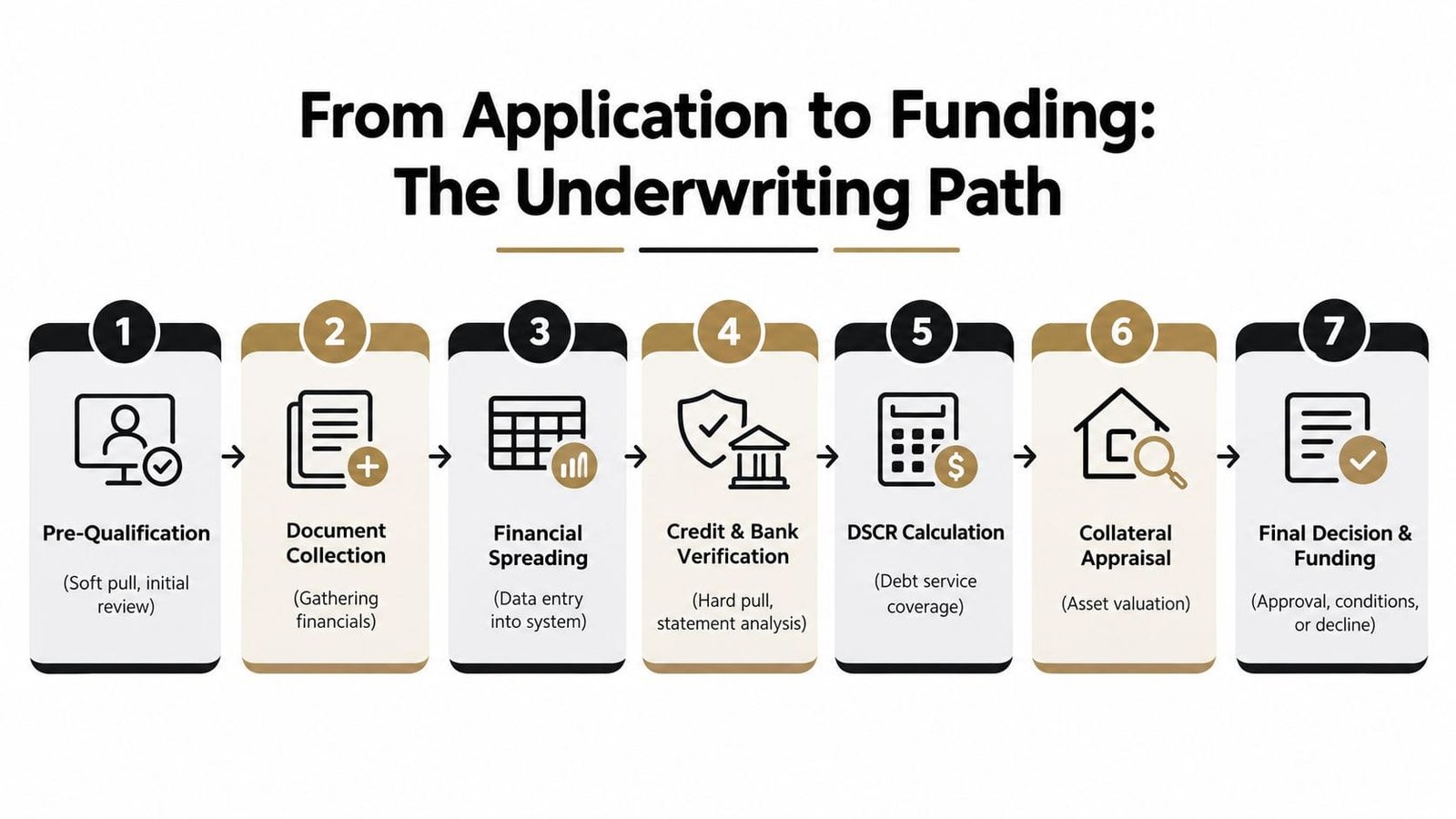
The following video offers another visual explanation of how a lender can move from initial review through decisioning:
How the Underwriting Workflow Moves From Application to Funding
A lender does not approve a business loan from one number. The business loan underwriting process builds a cash-flow story in stages, checking whether the money coming into the business can support the requested payment. Each review creates the evidence needed for the next decision.
Initial screening and document collection
A loan officer or intake system first checks whether the application is complete and meets basic eligibility requirements. The lender may ask about ownership, time in business, revenue, existing debt, industry, requested amount, and use of funds.
Document collection follows. Common requests include business bank statements, tax returns, a current profit and loss statement, a balance sheet, debt schedules, formation records, and proof of equity injection when applicable. Lenders can review simpler requests faster when the file is complete and standardized, while missing or inconsistent records require follow-up.
Spreading, verification, and repayment analysis
“Spreading” means entering financial data into the lender's analysis system. This lets the underwriter compare revenue, expenses, assets, liabilities, and cash flow using a consistent format. The reviewer then checks those figures against bank activity, credit reports, tax filings, and existing debt.
Bank statements show how the business operates between reporting periods. The reviewer may examine deposit consistency, recurring expenses, average balances, returned payments, overdraft-related activity, and unusual transfers. Strong reported sales can still raise questions if deposits arrive irregularly or available cash disappears into other obligations.
The underwriter calculates DSCR, reviews collateral when required, confirms the loan purpose, and records exceptions. DSCR connects the business's available cash flow to its proposed debt payments, so it often explains repayment capacity more clearly than a static credit score. For SBA-backed requests, the credit memo should connect the decision to applicable SBA standards and explain why repayment appears reasonable.
Approval, conditions, and closing
The completed file moves through the lender's approval structure. Decision-makers may approve the request, approve it with conditions, offer a different amount or structure, or decline it. Conditions can include updated insurance, lien searches, additional ownership documents, a corrected financial statement, or proof of a required contribution.
After the conditions are satisfied, the lender prepares closing documents, confirms final terms, and schedules disbursement. A guide to the movement from application to cash in your account can help you plan for each handoff.
Mismatched dates between tax returns and bank statements can force the lender to pause and request reconciliation. Unexplained transfers, missing signatures, unclear use of funds, and incomplete debt information create similar stops. Review the file as one connected story before submitting it. Consistent dates, traceable deposits, and a clear repayment path give the underwriter fewer questions to resolve.
How Underwriting Differs by Lender Type and Loan Product
The same business may receive different results from different lenders because each institution uses a different risk model. A bank may emphasize detailed historical statements and relationship information. An online lender may emphasize current transaction data and speed. An SBA lender adds program eligibility and documentation requirements to the credit review.
Federal Reserve small-business credit survey data summarized in recent industry reporting indicate that small banks fully approve about 54% to 57% of applicants, compared with about 44% at large banks, while online and fintech lenders tend to make faster decisions but fully approve fewer applicants. The figures are summarized in the FDIC's full small-business lending survey, which also reflects how lender type affects access to capital.
| Lender Type | Typical Timeline | Key Decision Drivers | Best Fit |
|---|---|---|---|
| Traditional bank | Often deliberate, especially for complex requests | Historical financials, relationship, credit, cash flow, collateral, and policy fit | Established businesses with organized records and strong repayment capacity |
| SBA lender | Detailed review with program compliance | DSCR, eligibility, global obligations, equity injection, credit, collateral, and documented use of funds | Businesses seeking structured, SBA-backed financing and able to provide thorough documentation |
| Online or fintech lender | Usually faster for data-rich applications | Recent deposits, transaction patterns, revenue consistency, existing obligations, and automated risk rules | Businesses that value speed and can support repayment through visible current cash flow |
Approval percentages should not be treated as a promise for your application. Industry, loan size, documentation, debt burden, and lender policy can change the result. The comparison is most useful as a matching exercise.
A restaurant with seasonal deposits and incomplete statements may need a lender comfortable with transaction-level analysis, while an established manufacturer seeking equipment financing may benefit from a bank that can evaluate assets and detailed financial history. Before applying, compare the product's repayment structure with your cash cycle. A fast decision doesn't help if the payment schedule creates pressure during your slow season.
For SBA-specific preparation, this guide to qualifying for an SBA loan can help you organize eligibility questions and supporting information before submitting a request.
Documents Cash Flow Checks and Tactics to Strengthen Your File
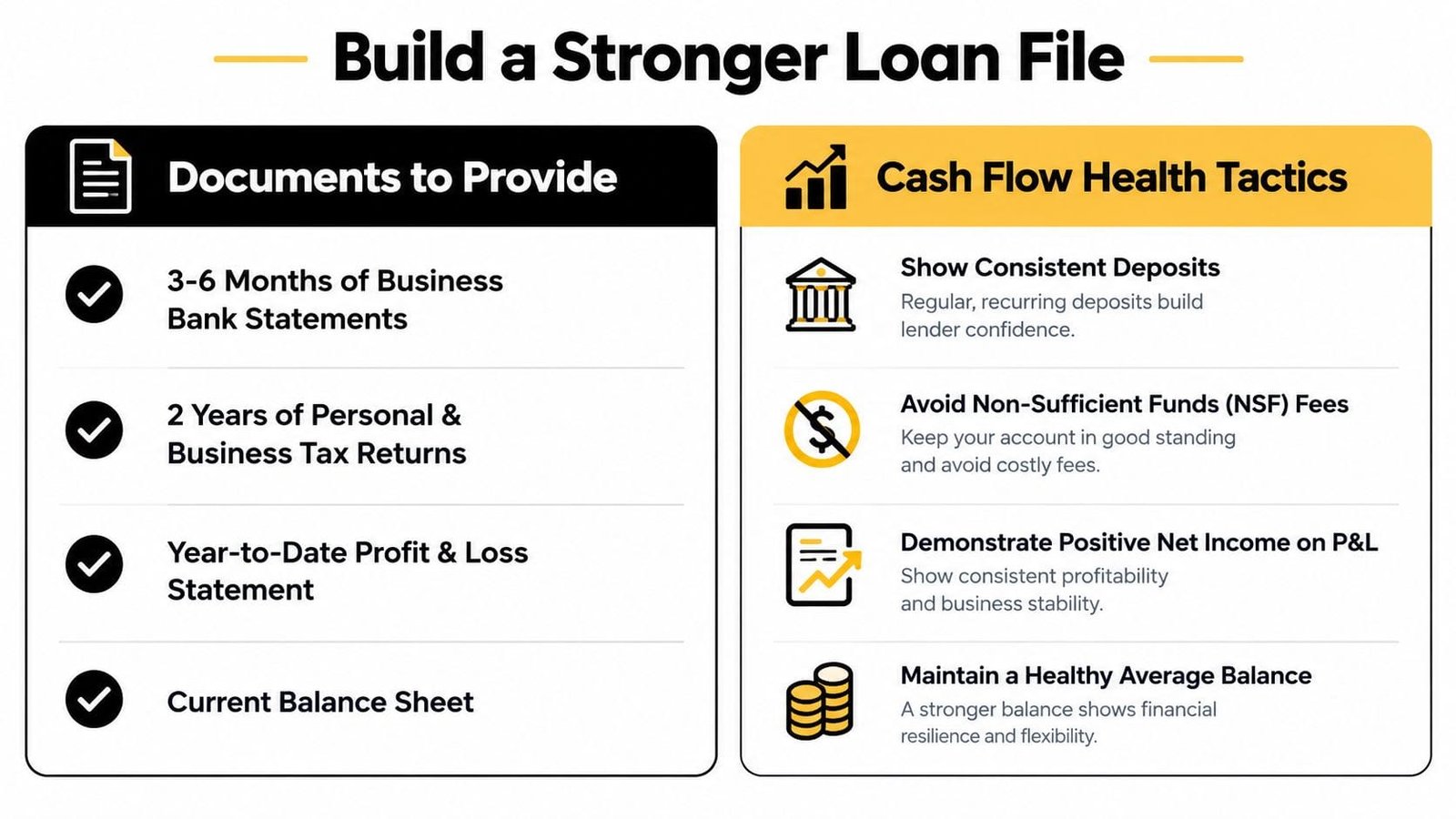
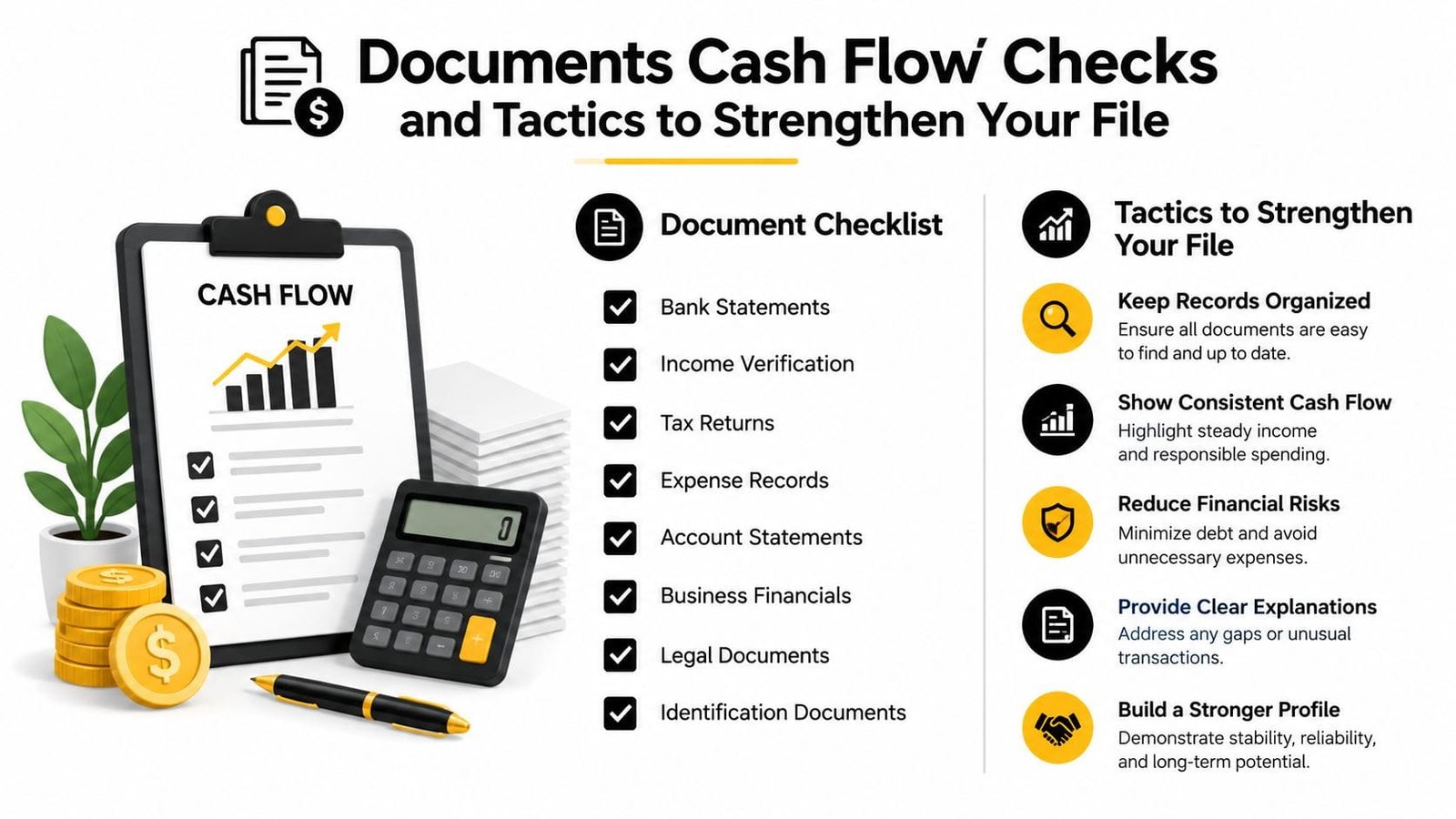
A strong application file lets an underwriter verify the story without reconstructing it from fragments. Gather recent business bank statements, personal and business tax returns, a current profit and loss statement, a balance sheet, a debt schedule, ownership records, licenses, and documents showing how you'll use the funds.
For many small-business applications, lenders review two to six months of bank activity, including deposit consistency, nonsufficient-funds frequency, and DSCR-related information, as described in industry guidance on AI underwriting and bank-statement review. The point isn't to make every month look identical. It's to make normal variation understandable and demonstrate disciplined cash management.
Fix the common evidence gaps
Strong revenue can fail to convert into approval when the records create uncertainty. Separate personal and business spending where possible, label transfers, reconcile deposits to sales records, and prepare a short explanation for unusual payments or one-time events.
Review your statements before sending them. Look for recurring overdrafts, returned payments, large unexplained cash deposits, sudden balance drops, and debt payments that don't appear on the application. If your profit and loss statement shows income that bank activity doesn't support, ask your accountant to reconcile the difference before the lender finds it.
Prepare the repayment picture
Build a current debt schedule showing each obligation, outstanding balance, payment, maturity, and lender. Include business debt and relevant personal obligations when the lender evaluates global repayment capacity. Confirm that the proposed loan payment fits after payroll, rent, taxes, inventory, owner compensation, and existing debt service.
Keep evidence of equity injection or required cash contribution organized. Don't move money between accounts without preserving a clear paper trail. Underwriters can work with complexity, but they need to understand it.
Document automation offers a useful parallel. Teams exploring how technology handles verification and classification can review document processing use cases for insurers, where the same broad principle applies: structured records reduce manual review and make exceptions easier to identify.
You can also review practical guidance on business bank statements before connecting accounts or submitting records. Business Loan Warrior offers a single application, bank connection, pre-approval checks that don't affect credit, and a dashboard for tracking approval information, repayments, and credit insights. Those features can simplify verification, but they can't replace accurate bookkeeping or explain away weak cash discipline.
Final Takeaways for Navigating Underwriting With Confidence
Underwriting becomes easier to manage when you stop treating it as a score contest. Credit history is one signal. The lender also wants to see dependable cash flow, a DSCR that supports the proposed payment, coherent documentation, manageable obligations, a credible use of funds, and an owner who understands the business's risks.
Before applying, complete a short readiness review:
- Reconcile the records: Make sure tax returns, financial statements, and bank deposits agree.
- Map every obligation: Prepare a current business and personal debt schedule where relevant.
- Test repayment capacity: Calculate DSCR using realistic operating cash flow, not optimistic revenue alone.
- Explain irregularities: Write concise notes for unusual deposits, transfers, losses, or one-time expenses.
- Match the lender: Choose a bank, SBA lender, or online platform that fits your documentation and cash cycle.
- Respond promptly: Treat every follow-up request as part of the approval process, not as a sign that the application has failed.
The strongest borrowers don't hide every imperfection. They identify the weak spots, explain them clearly, and show how the requested capital supports repayment. Underwriting works best as a partnership between an informed owner and a lender who has enough reliable evidence to make a responsible decision.
Business Loan Warrior can help you compare funding paths, complete one no-fee application, connect business bank data, and track approval activity in a secure dashboard. Prepare your statements and debt schedule first, then visit Business Loan Warrior to explore a financing option that fits your cash-flow story.