
You've found a business opportunity, identified the equipment or working capital you need, and started looking at SBA financing. Then a lender asks for ownership records, proof that you couldn't obtain comparable credit elsewhere, current financial statements, and evidence that the business can repay the debt. Many owners discover at that point that SBA qualification is more than a credit-score exercise.
Learning how to qualify for an SBA loan means clearing two separate hurdles. First, your business must fit the SBA's eligibility rules. Then, an SBA-approved lender must feel comfortable with your cash flow, credit history, documentation, loan purpose, and ownership structure. The hidden issues matter, especially citizenship and indirect ownership, while the loan amount can change guarantee coverage and upfront fees.
Table of Contents
- Understanding the Seven Core SBA Eligibility Requirements
- Choosing the Right SBA Loan Program for Your Business
- The Underwriting Metrics That Actually Determine Approval
- Ownership and Citizenship Rules That Catch Applicants Off Guard
- Building Your Documentation Package and Timeline
- Tactics to Strengthen a Borderline Application
- Your SBA Loan Readiness Checklist and Next Steps
Understanding the Seven Core SBA Eligibility Requirements
A profitable business owner can still fail the first screening if the company isn't eligible under SBA rules. For example, a lender may find that the business isn't operating in the United States, doesn't meet the applicable size standard, or hasn't shown that conventional credit is unavailable on reasonable terms. The SBA identifies seven core conditions that shape eligibility from the beginning, as explained in its guidance for SBA lenders.
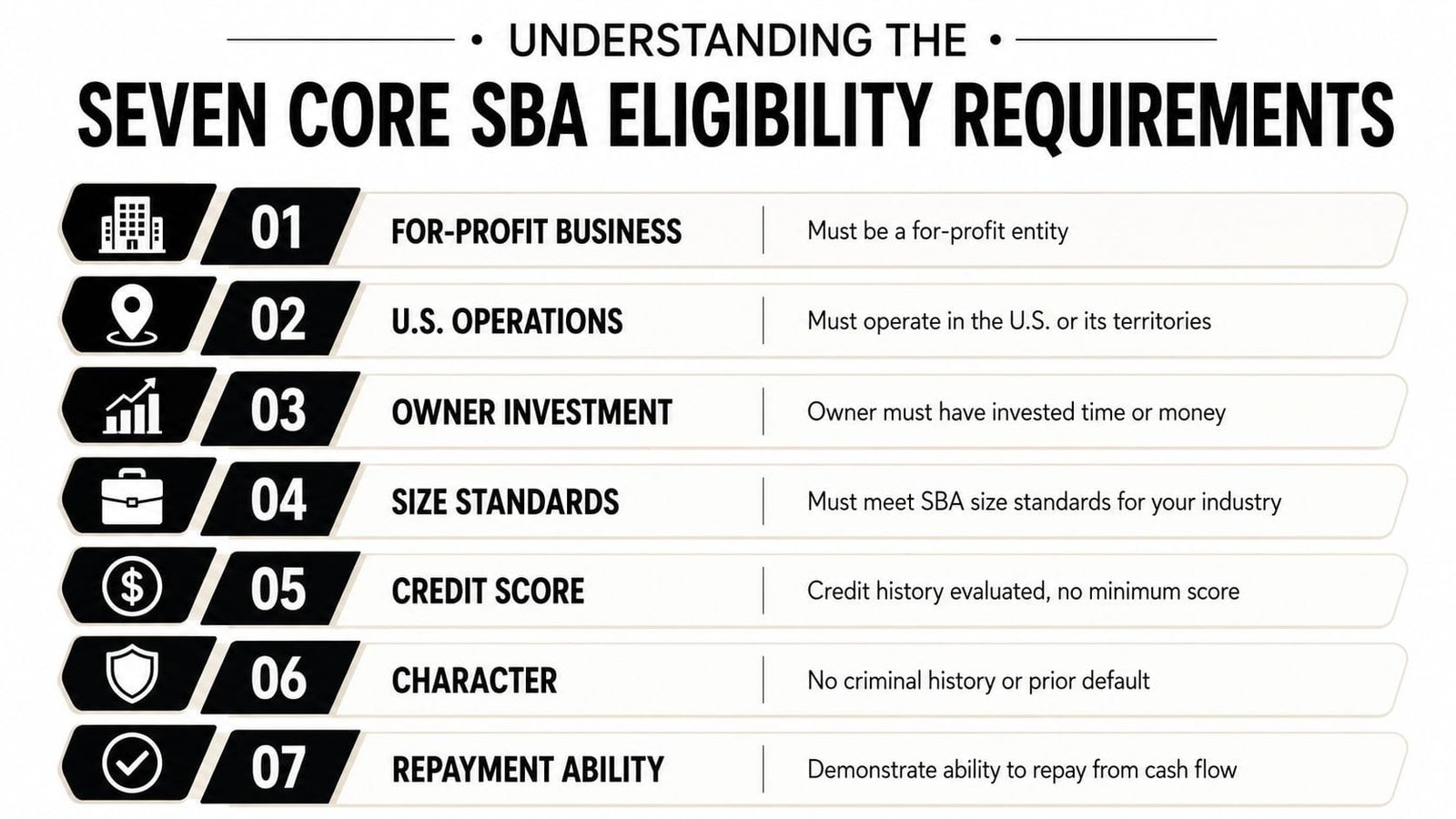
The eligibility checklist
Operating business: Your company must be an operating business, not merely an inactive entity holding an idea or an asset.
For-profit purpose: The applicant must be organized for profit. A nonprofit or an entity that doesn't operate for profit won't satisfy this core condition.
United States location: The business must be located in the United States. The lender will examine where the company operates and whether the requested financing supports an eligible U.S. business.
Small-business status: Your company must qualify as small under the SBA's size standards. The relevant test depends on the industry, so strong sales alone don't determine whether the business fits.
Eligible business type: Some industries and activities are excluded from SBA financing. Review your company's actual revenue-producing activity, not just its legal entity name, before applying.
Credit elsewhere: You must demonstrate that you can't obtain the desired credit on reasonable terms from non-federal, non-state, or non-local government sources. That makes SBA financing a last-resort financing option, not just a cheaper first choice.
Creditworthiness and repayment ability: The lender needs a reasonable basis to believe the business can repay the loan. Revenue helps, but the lender also evaluates obligations, operating performance, and the relationship between available cash flow and the proposed payment.
Practical rule: Treat eligibility as a pre-application audit. If one foundational condition fails, polishing the rest of the package won't solve the underlying problem.
The SBA's framework explains why collateral and sales don't tell the whole story. A business can have meaningful revenue and still miss the program because of its legal status, size, location, industry, credit availability, or repayment capacity. Use this SBA disqualification red-flag guide to check obvious problems before requesting lender term sheets.
Choosing the Right SBA Loan Program for Your Business
The right program starts with the use of funds, not the maximum amount advertised. A service company that needs working capital, inventory, or eligible debt refinancing usually has a different financing problem from a restaurant purchasing owner-occupied real estate or heavy equipment. Applying for the wrong program can create unnecessary underwriting friction even when the business itself is sound.
Match the financing to the project
| Program | Best fit | Core trade-off |
|---|---|---|
| 7(a) | Working capital, general business purposes, acquisitions, and other eligible needs | Flexible, but underwriting must support the full use of proceeds and repayment plan |
| CDC/504 | Major fixed assets, commercial real estate, and equipment | Built for fixed assets, so it isn't the natural choice for ordinary working capital |
| Microloan | Smaller funding needs and businesses that may benefit from community-based support | Smaller financing structure, with program and intermediary requirements that differ from 7(a) |
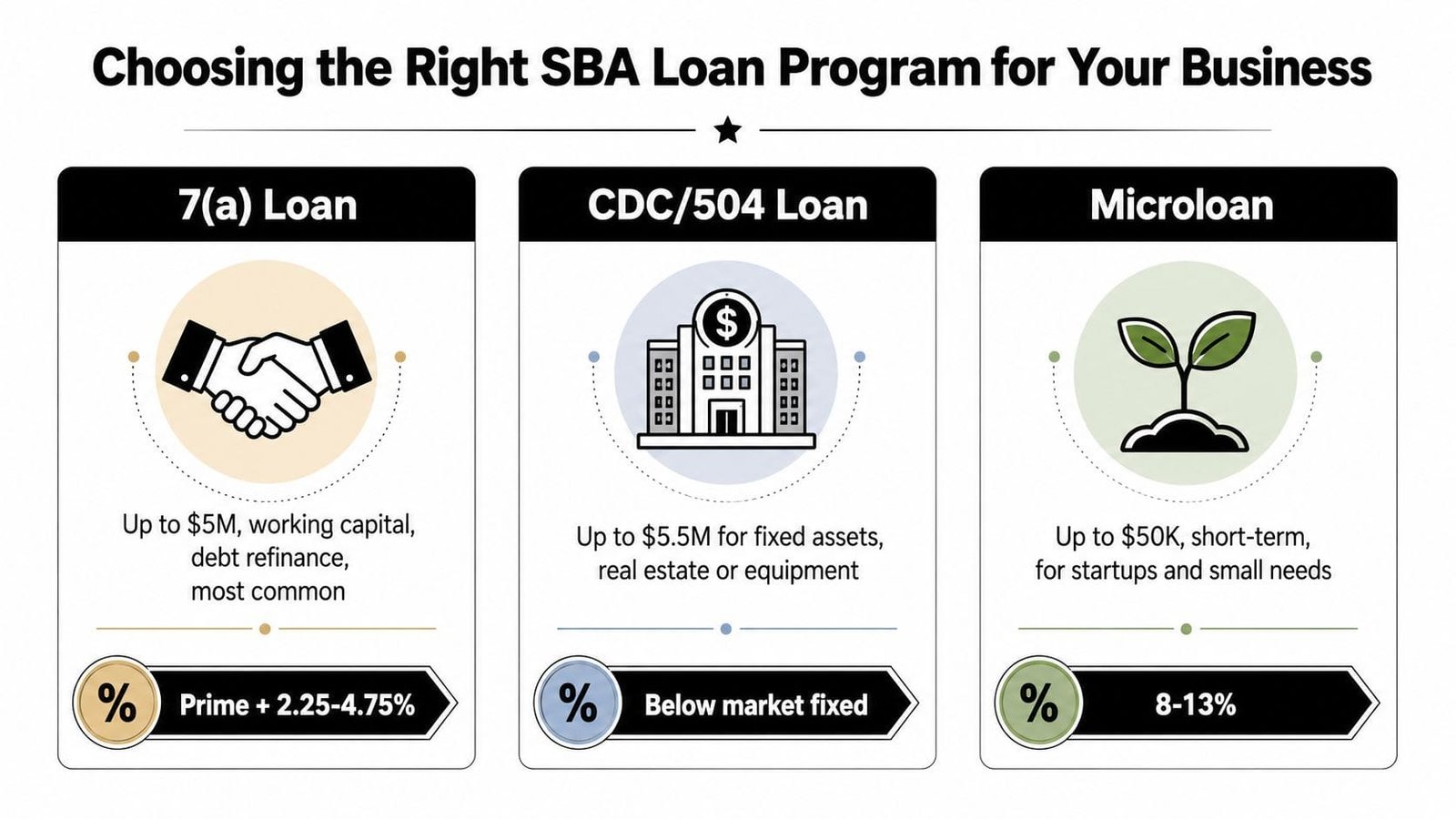
The 7(a) program is the most adaptable of the three. In FY 2026, its loan cap is $5 million, with a maximum guaranteed amount of $3.75 million, according to the FY 2026 7(a) guarantee and fee overview. It can suit a company funding working capital, an acquisition, equipment, or another eligible general-purpose need.
The guarantee economics change with loan size. For loans of $150,000 or less, the FY 2026 guarantee can reach 85%. For loans above $150,000, it can reach 75%. Upfront guaranty fees also vary, with separate FY 2026 tiers for loans at or below $150,000, loans from $150,001 to $700,000, and larger loans. Qualification may be the same basic yes-or-no question, but the cost and risk-sharing structure aren't identical across the program.
A 504 loan is a better fit when the project centers on long-term fixed assets. A Microloan may be more appropriate when the funding request is modest and the borrower can work with a nonprofit, community-based intermediary. Compare the programs in this guide to 7(a), 504, and Microloan options before you prepare a full package.
The Underwriting Metrics That Actually Determine Approval
Eligibility gets your file considered. Underwriting determines whether the lender can defend an approval. The lender is trying to answer a practical question: after paying operating expenses and existing obligations, will the business produce enough reliable cash flow to support the new debt?
Financial evidence carries the most weight
A recent business-lending study found that 68.4% of businesses denied in Q1 2025 identified financials as the main reason, compared with 21.5% citing credit history and 5.7% citing collateral, according to LendingTree's denial analysis. Those figures point to a common preparation mistake. Owners often spend their time asking about a minimum credit score while their bookkeeping, tax returns, profit-and-loss statements, and cash-flow explanation remain inconsistent.
Lenders typically examine:
- Cash-flow coverage: Historical and projected cash flow must support the proposed payment alongside existing debt.
- Credit behavior: Personal and business credit histories help the lender assess how obligations have been handled.
- Debt load: Existing loans, leases, credit cards, and other fixed payments reduce the cash available for new debt.
- Collateral: Assets can strengthen a structure, but collateral doesn't replace repayment ability.
- Business performance: Revenue quality, margins, volatility, and the reason for any major changes all affect the lender's confidence.
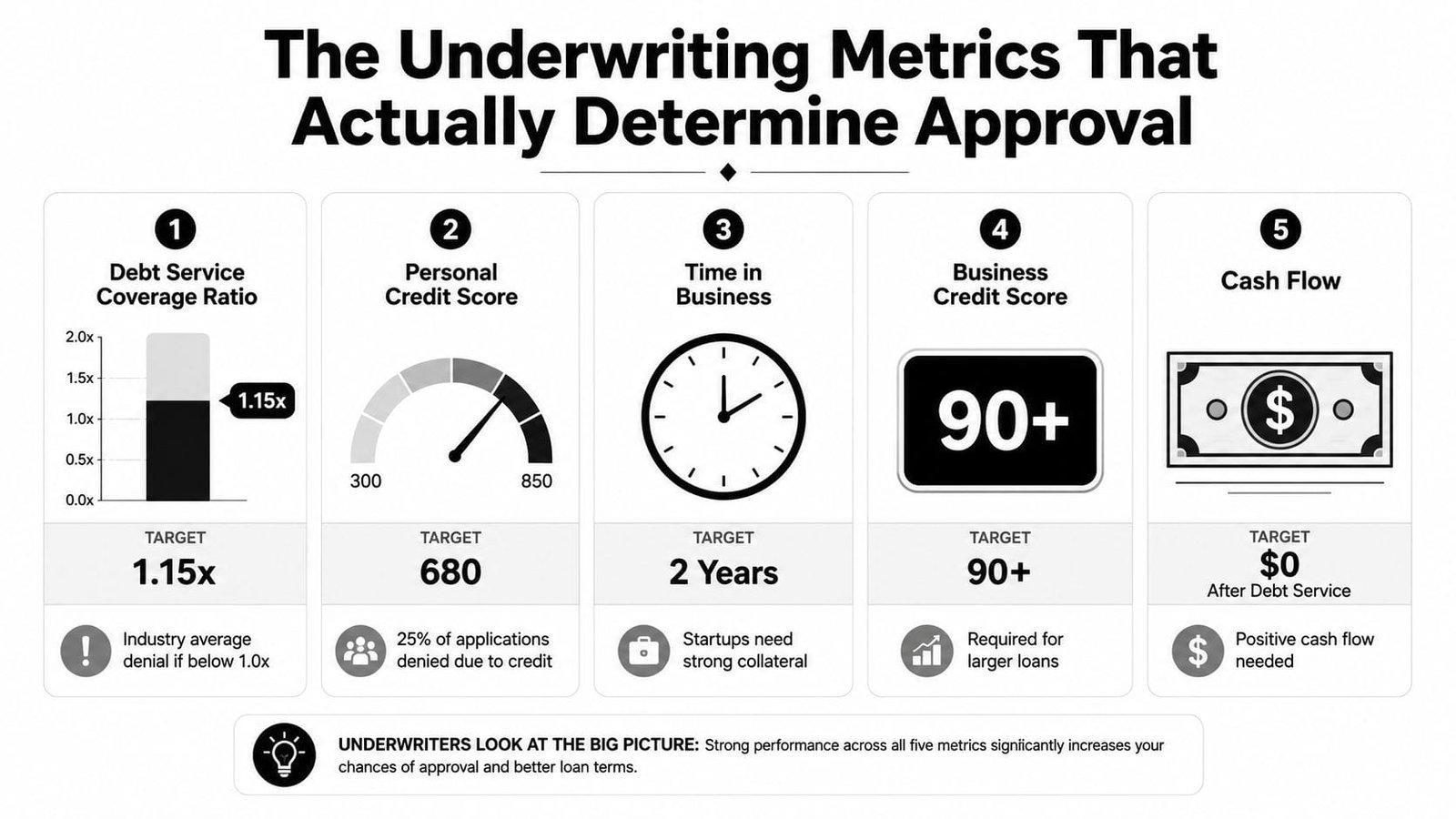
SBA disaster-loan data reinforces the same underwriting lesson. Since 2001, 90% of denials in that data were attributed to unsatisfactory credit history, lack of repayment ability, or both, as reported in the same LendingTree study. The practical takeaway is to treat credit, collateral, and cash flow as a three-part gate. A weakness in one area can materially damage the file, even if the other two look acceptable.
Watch the video below for an additional explanation of the metrics lenders use when assessing business financing.
Don't submit financial statements that can't be reconciled to filed returns. Explain unusual deposits, owner draws, declining margins, or recent debt before the underwriter has to ask. Clear explanations won't erase weak performance, but unexplained inconsistencies create avoidable doubt.
Ownership and Citizenship Rules That Catch Applicants Off Guard
Ownership composition can end an SBA application before the lender reaches the cash-flow discussion. The current SBA rule described in the verified guidance requires 100% of direct and indirect owners, loan guarantors, and key employees to be U.S. citizens, U.S. nationals, or lawful permanent residents. The same guidance identifies visa holders, DACA recipients, refugees, and asylees among excluded categories, making this a critical pre-screen for immigrant-owned and multi-owner companies.
Audit every ownership layer
A simple operating agreement review isn't enough if another entity owns part of your company. Trace ownership through parent companies, family investment entities, trusts, and passive investors. A person with no day-to-day management role may still matter if they hold a direct or indirect interest.
Loan guarantors and key employees also deserve separate review. Don't assume that a person can remain outside the ownership discussion just because they aren't a majority owner or don't sign the loan documents. The rule reaches beyond the individual who submits the application.
Ownership check: Build a plain-language ownership chart that names every direct owner, indirect owner, guarantor, and key employee. Confirm eligibility before collecting lender forms.
Sole proprietors face a simpler structural question because the business and owner are closely connected. A clear explanation of how that structure works is available in BookkeepDIY on sole proprietorships. Partnerships, LLCs, and corporations should prepare an ownership ledger, governing documents, and records showing any recent transfers.
Fix the structure before the application
If an ineligible person appears in the cap table, don't wait for the lender to discover it during underwriting. Speak with qualified legal and tax professionals about whether changing ownership, voting rights, management roles, or guarantor responsibilities is appropriate and lawful. A restructuring should reflect the actual business arrangement, not a temporary paper adjustment designed only to pass a loan review.
Acquisition transactions need extra care. The buyer, sellers who remain involved, investors, and any entity above the operating company should be mapped before the letter of intent becomes difficult to change. Ownership eligibility is a deal-structure issue, not an administrative detail.
Building Your Documentation Package and Timeline
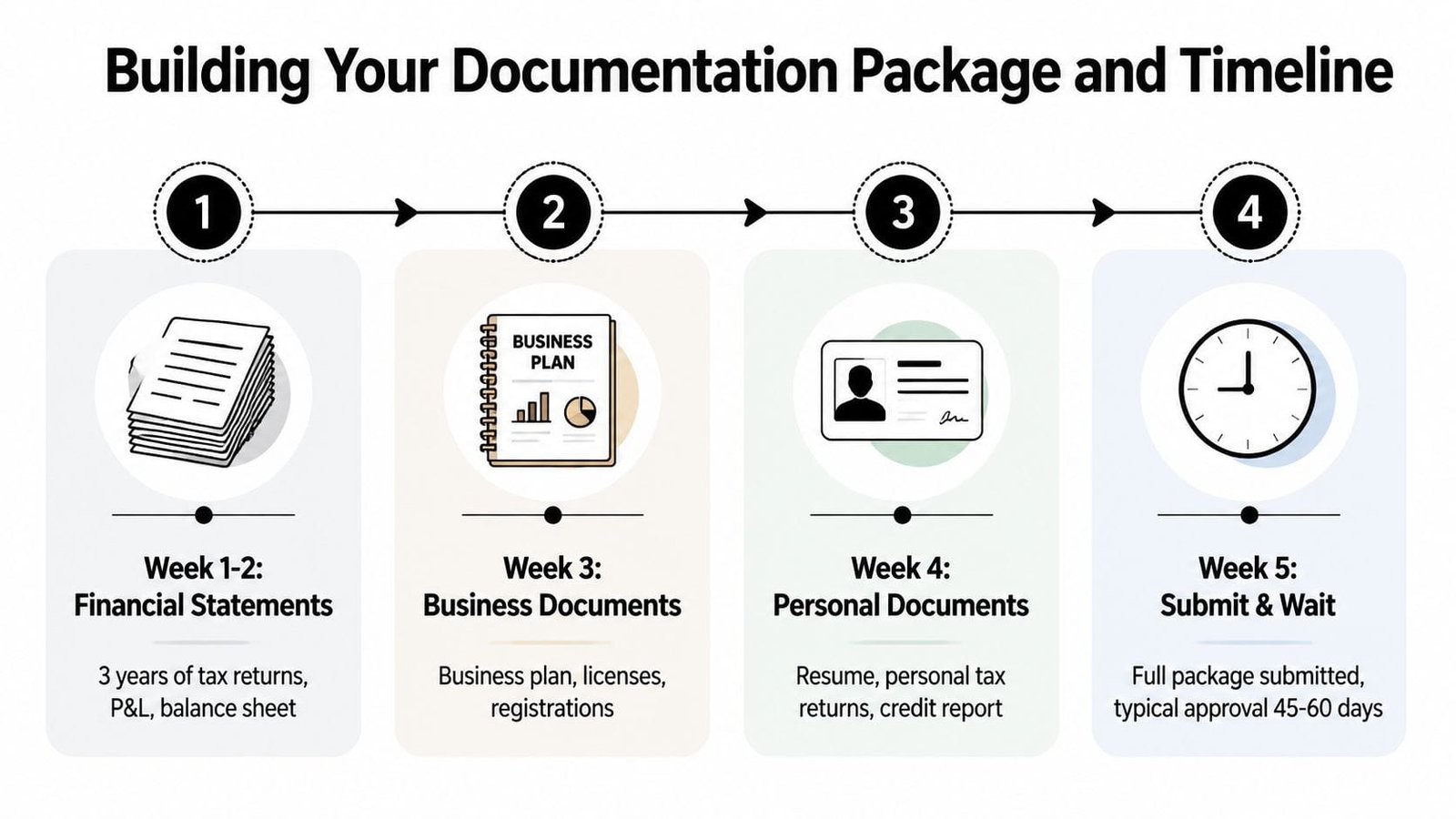
A complete application tells one consistent story through every document. Tax returns, accounting records, ownership papers, and projections should agree on revenue, debt, ownership, and the intended use of funds. Missing documents slow the file, while unexplained differences can prompt deeper questions.
Start with the financial record
Gather business tax returns, personal tax returns, current profit-and-loss statements, balance sheets, debt schedules, and supporting bank information. If the loan funds an acquisition, include the target company's financial history, purchase details, projections, and a letter of intent. If it funds equipment or construction, identify the assets, vendor quotes, project costs, and ownership or occupancy details relevant to the request.
Use a folder structure that lets the lender find the answer quickly:
- Financial folder: Tax returns, interim statements, bank records, and debt schedules.
- Legal folder: Formation documents, licenses, registrations, leases, and ownership records.
- Purpose folder: Purchase agreements, equipment quotes, construction budgets, or a working-capital explanation.
- Personal folder: Identification, resumes, personal financial information, and requested tax records.
Prepare in the right order
Pull documents that already exist first. Tax returns and formation records can usually be located quickly, while clean interim financials may require your bookkeeper or accountant to reconcile accounts. A business plan and projections take more judgment because they must explain how the requested funds produce revenue or preserve operating capacity.
The SBA process is document-intensive, so use a business loan document checklist to identify gaps before submission. Name files clearly, use consistent dates, and don't send multiple conflicting versions of the same statement.
Underwriter's perspective: Organization doesn't make a weak business strong, but disorganization can make a viable business look risky.
Build time for follow-up questions. Lenders may request clarification about transfers, tax differences, ownership changes, outstanding obligations, or the exact destination of proceeds. A package that anticipates those questions is easier to evaluate than a collection of disconnected attachments.
Tactics to Strengthen a Borderline Application
A borderline application usually improves through better evidence, not optimistic storytelling. Start by identifying the specific weakness. If cash flow is tight, reducing discretionary draws or paying down expensive obligations may help, but only if the change is sustainable and visible in the financial records.
Improve the file before requesting a decision
Clean bookkeeping is often the highest-return preparation step. Reconcile bank accounts, separate personal and business spending, classify expenses consistently, and make sure current statements tie to filed tax returns. Then create a simple debt schedule showing every existing payment, balance, maturity, and lender.
If repayment capacity is the concern, adjust the request rather than forcing an unsupported amount. A smaller loan, a different eligible use, or a structure that aligns payments with the business's actual cash generation may be more credible than a large request built on aggressive projections.
Address past credit problems directly. Provide a short timeline, identify the cause, show that the issue is resolved or being managed, and attach supporting evidence where appropriate. Silence makes an underwriter reconstruct the story from a credit report, which rarely helps.
Use support strategically
Additional collateral or a qualified guarantor may strengthen a deal, but neither substitutes for a viable repayment plan. Bringing in another person also creates legal and financial consequences, so discuss the obligation clearly before asking anyone to guarantee debt.
The same principle applies to projections. Show the assumptions behind pricing, customer volume, staffing, rent, inventory, and debt service. A lender can challenge a forecast, but a transparent model gives them something specific to evaluate.
For an early screening option, Business Loan Warrior offers a digital business-financing application that can collect information such as requested amount and average monthly sales, with a process designed to support qualification screening before a full lender application. It's one way to organize an initial financing conversation, not a substitute for SBA underwriting or a guarantee of approval.
Your SBA Loan Readiness Checklist and Next Steps
You're ready to approach lenders when the eligibility and underwriting stories agree. The business should be operating, for-profit, U.S.-based, small under the applicable SBA standard, eligible by industry, unable to obtain comparable credit elsewhere on reasonable terms, and able to support the requested debt.
Use this final review:
- Ownership: Confirm every direct and indirect owner, guarantor, and key employee meets the applicable SBA rule.
- Purpose: Describe exactly how the proceeds will be used and select the program that fits.
- Financials: Reconcile current statements with tax filings and list every existing debt obligation.
- Repayment: Explain where the new payment comes from under realistic operating assumptions.
- Credit: Review personal and business credit history and prepare explanations for adverse items.
- Documents: Assemble legal, financial, personal, and transaction records in a consistent file.
- Structure: Decide whether 7(a), 504, Microloan, or an alternative product matches the request.
Apply now if the package is complete and the lender can understand the repayment case without filling in missing information. If ownership, bookkeeping, credit explanations, or cash flow remain unclear, spend the next preparation period fixing those issues rather than submitting a rushed application and creating an avoidable decline.
Business Loan Warrior can help you organize an initial business-financing application, review funding needs, and connect your request with available financing options, including SBA-related support. Visit Business Loan Warrior to begin with your business details and take the next qualification step before committing to a full application.