
A $28,000 client invoice is sitting in your accounts receivable system, but the customer won't pay for another 60 days. Payroll is due in seven. A vendor deposit could keep the next project on schedule, yet paying it now may leave the operating account dangerously thin.
That's the situation a business line of credit is designed to manage. But a line of credit application isn't just a request for backup cash. It's a proposal for how your business will sequence revenue, expenses, borrowing, and repayment. The lender is deciding not only whether to approve you, but also how much flexibility to offer and under what terms.
The Federal Reserve's 2026 report on employer firms shows that credit lines remain part of mainstream small-business financing demand. The application deserves the same planning you'd give a major contract or equipment purchase.
Table of Contents
- Why a Line of Credit Application Deserves Real Preparation
- What Lenders Actually Score on Your Application
- Documents and Financials to Prepare Before You Apply
- Banks, Fintechs, and SBA Lines of Credit Compared
- Walking Through a Realistic Application Timeline
- Common Application Mistakes and How to Avoid Them
- Deciding Whether to Apply Now or Wait
Why a Line of Credit Application Deserves Real Preparation
A weak application says, “I want access to money.” A strong one says, “Here's the timing problem, here's how I'll use the facility, and here's the cash flow that will repay each draw.”
That distinction matters because underwriters review patterns, not isolated figures. They look at whether deposits match reported sales, whether revenue rises and falls with a predictable season, whether a few customers create concentration risk, and whether the owner's personal credit behavior supports the business's borrowing request. They also want to know whether the line will fund short-term operating needs or cover a structural cash deficit.
Build the application around the cash cycle
Start by mapping the obligation that created the need. Write down:
- The dated expense: Payroll, inventory, contractor payments, or a vendor deposit.
- The expected inflow: Which invoice, contract, or recurring sales cycle will replenish cash.
- The draw period: When you expect to use the line.
- The repayment event: The specific deposit or collection that reduces the balance.
- The requested limit: The largest likely gap, not an arbitrary round number.
This turns a vague request into an operating plan. If you're asking for a $100,000 line, a projection showing a gradual draw followed by repayment is more persuasive than a flat forecast that leaves the balance unchanged indefinitely.
Practical rule: Apply before the cash crunch, not during it. A lender has more confidence in a business managing a temporary timing gap than one seeking emergency liquidity after payments have already been missed.
Treat the file as a documented narrative
Your documents should tell the same story. Bank statements should support the sales shown on tax returns. Your profit-and-loss statement should explain seasonal dips rather than conceal them. Accounts receivable aging should show which invoices are collectible and which are already deteriorating.
The rest of the process follows four questions. First, do your credit, operating history, revenue, and industry profile fit the lender? Second, can you produce complete financial evidence in the order an underwriter needs it? Third, have you selected a lender whose risk appetite matches your business? Finally, are you applying early enough to compare offers without stacking rushed inquiries?
What Lenders Actually Score on Your Application
A line of credit application can look complete and still fail if the lender cannot connect your credit profile, operating history, current revenue, and industry risk to a clear repayment plan. Underwriters score those four areas together, then adjust the limit and pricing according to the strength of the evidence.
Industry guides often cite broad market references such as a 625-plus personal FICO score, one to two years in business, and about $10,000 in monthly revenue. Treat those figures as orientation, not approval requirements. A lender's product, risk appetite, and documentation standards matter just as much.
Four gates that shape the decision
Credit sets the starting point. Your personal FICO score may matter even when an LLC submits the application. Check utilization, recent inquiries, late payments, collections, and business trade accounts before applying. A score that meets a lender's published minimum can still lead to a smaller limit or higher pricing if the rest of the file is thin.
Operating history gives deposits context. Lenders need enough activity to separate durable sales from a short-lived spike. Newer companies may need an online lender, collateral, stronger owner liquidity, or a lower initial limit. Choose the lender before you apply, because a bank's preference for established operations differs from a fintech's willingness to use recent bank data.
Revenue must be current and verifiable. Underwriters compare tax returns, interim financial statements, and bank deposits. If your statements stop well before the review period, the gap creates uncertainty even when historical revenue is solid. Put the newest reliable numbers in the file first, then reconcile them to the supporting records.
Industry affects the questions. Construction, restaurants, retail, and other businesses exposed to project timing, inventory, or seasonal swings often receive closer review. These sectors are not automatically excluded. Your application must show margins, contracts, customer concentration, and the timing of collections clearly enough for the lender to assess repayment.
The application should also show why the requested limit fits your cash cycle. A lender is evaluating more than whether you qualify. It is deciding how much exposure the business can carry and whether the line will support short-term working capital rather than cover a permanent loss.
Common avoidable weaknesses include recent credit pulls, high revolving utilization, inconsistent deposits, and financial statements that end before the period under review. Before submitting, review this practical line of credit eligibility guidance and compare it with the lender's own requirements.
| Criterion | Banks | Online Lenders | SBA Lines |
|---|---|---|---|
| Credit review | Usually deeper, with close attention to owner and business history | Often more flexible, but pricing reflects added risk | Detailed personal, business, and guarantor review |
| Business history | Established operations usually help | May consider newer businesses with adequate revenue | Established operations and repayment capacity matter |
| Revenue evidence | Tax returns, statements, and bank activity are commonly reviewed | Bank-link data and recent statements can carry substantial weight | Extensive financial documentation is typical |
| Industry review | Often conservative for volatile or specialized sectors | Automated screening may be faster, followed by verification | Purpose, eligibility, and repayment structure receive detailed review |
| Best fit | Owners seeking relationship pricing and larger conventional facilities | Owners prioritizing speed or lacking conventional bank fit | Owners willing to accept a longer process for structured financing |
Documents and Financials to Prepare Before You Apply
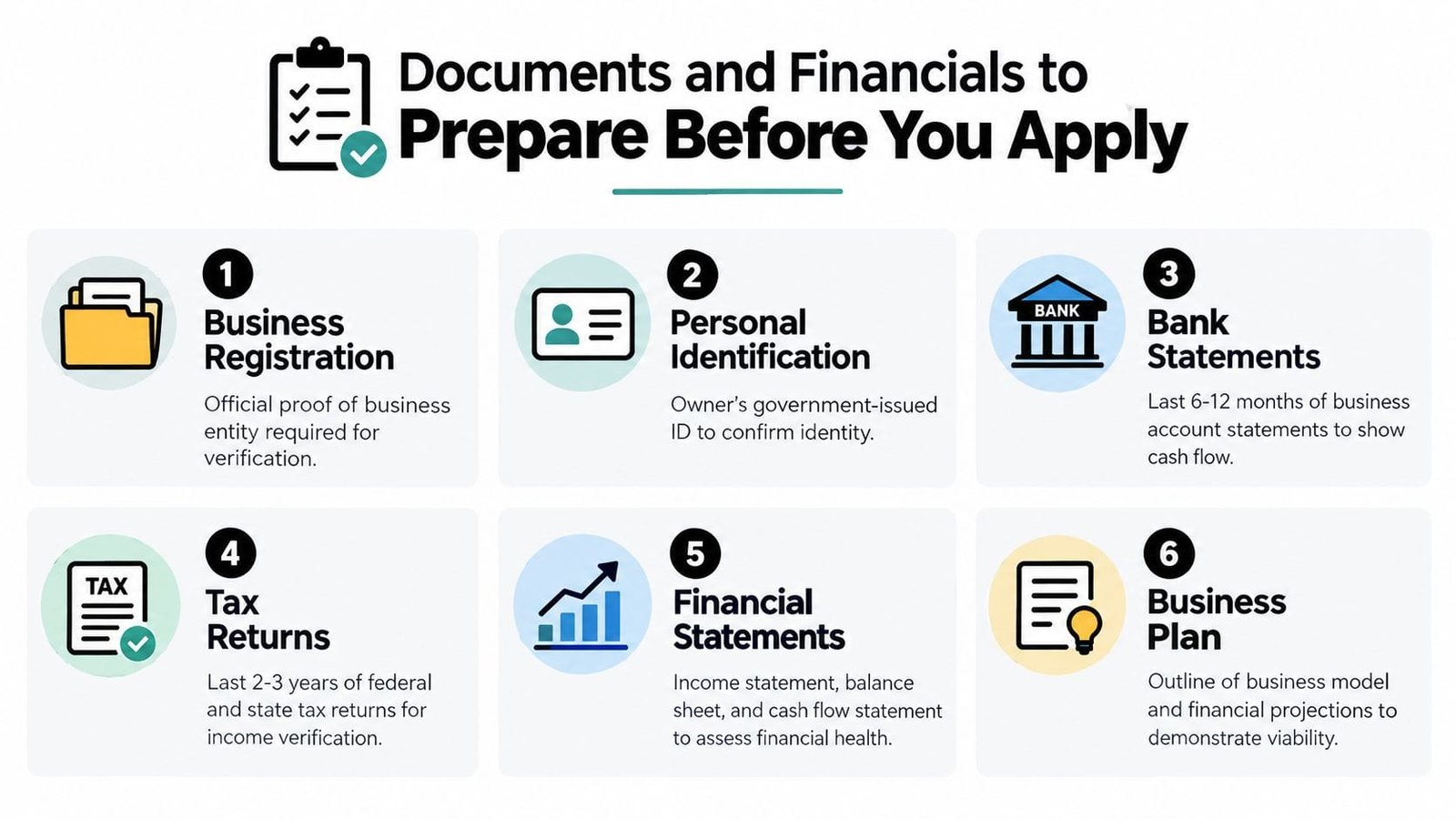
A lender should be able to understand your business and repayment plan without chasing missing files. Assemble documents in underwriter order, so ownership, cash flow, financial performance, and the requested facility support one clear story.
Start with identity and business verification
Prepare your government-issued ID, EIN confirmation, formation documents, and current business registration. These records confirm who owns the company and whether the applying entity matches its bank accounts, tax filings, and contracts.
Collect business bank statements next. They should make operating revenue, payroll, existing debt payments, transfers, and unusual withdrawals easy to identify. Errors or inconsistent information can delay review or contribute to a denial. Bluevine's application guidance cites a survey in which 25% of SMB owners believed mistakes or issues in their latest financing application caused a delay or denial. Review every uploaded file before submission, especially account numbers, legal names, dates, and totals.
Add tax returns and current financials
Include the most recent two years of business and owner tax returns, then add a current profit-and-loss statement and balance sheet. Tax returns show reported revenue and taxable income. Interim statements show what changed after the last filing, while the balance sheet displays debt, working capital, receivables, and liabilities.
Prepare a 90-day cash-flow projection that connects the request to repayment. Show when you expect to draw, what the funds will cover, when customer receipts should arrive, and how the balance will decline. A $100,000 request with a six-month ramp-down presents a different risk profile from one that keeps the full amount outstanding.
Borderline files need supporting evidence. Add an accounts receivable aging report, signed contracts, purchase orders, recurring service agreements, or records of a seasonal booking cycle. These documents do not replace weak repayment capacity, but they can explain a temporary timing gap between expenses and collections.
Put the repayment logic in writing. Each document should reinforce why the requested limit fits your cash flow.
Banks, Fintechs, and SBA Lines of Credit Compared
The lender you choose shapes more than approval speed. It affects documentation, pricing, renewal pressure, reporting, and the credit limit you can realistically obtain. Shortlist the channel before completing a full application, then match it to your cash-flow pattern and operating history.
A conventional bank can offer a lower-cost relationship facility for a company with established financials, clean deposits, strong credit, and a clear borrowing purpose. Expect detailed statements, tax returns, ownership records, collateral information, and possible covenant reporting. The slower review can pay off when you need a larger, durable facility rather than quick access to cash.
Online and fintech lenders rely more heavily on recent bank activity, automated verification, and current revenue signals. That can suit a business with limited collateral, a nontraditional profile, or an urgent working-capital gap. The trade-off is usually higher pricing, tighter renewal requirements, frequent monitoring, and less room to negotiate terms.
SBA lines, including CAPLines and standard SBA revolving structures, fit established borrowers who can supply extensive records and tolerate a more demanding review. They work better as planned operating facilities than as emergency funding. Before choosing one, browse commercial credit terms and compare how each repayment structure affects monthly cash flow.
Match the channel to the business
| Criterion | Traditional Banks | Online / Fintech Lenders | SBA Lines |
|---|---|---|---|
| Approval pace | Deliberate review with relationship and credit analysis | Faster digital intake and bank-data verification | Longest process because of documentation and program review |
| Documentation | Detailed tax, financial, ownership, and collateral records | Recent statements, identity, revenue, and bank-link data | Extensive business, owner, guarantor, and eligibility records |
| Pricing profile | Often more competitive for strong borrowers | Often higher to compensate for speed and flexibility | Structured pricing can suit qualified established businesses |
| Limit approach | May support larger conventional facilities when repayment capacity is strong | Limits often reflect recent deposits and automated risk signals | Facility size depends on repayment capacity, purpose, and program fit |
| Ongoing obligations | Possible covenants, reporting, and relationship expectations | Frequent monitoring or renewal review may apply | Formal reporting, eligibility, and documentation requirements |
| Best use | Planned working capital with strong financial history | Fast liquidity or a nontraditional borrower profile | Longer-term operating flexibility for a prepared borrower |
Use the comparison to set an application sequence, not to collect offers. A new LLC may start with an online lender or a secured bank facility. An established company with collateral should compare SBA and conventional structures. A mid-stage operator can review all three, then submit only after checking eligibility, renewal terms, reporting duties, and total borrowing cost.
The documentation order matters. If your recent deposits clearly support the requested draw and repayment cycle, a fintech review may be efficient. If your strength lies in collateral, long operating history, or a relationship with a local bank, lead with those facts and prepare for a fuller review. The right channel can improve both approval odds and the limit offered.
A lender comparison such as this guide to line of credit lenders can help organize the shortlist. Do not apply everywhere at once. Choose the channel whose underwriting method best reflects how your business generates and collects cash.
Walking Through a Realistic Application Timeline
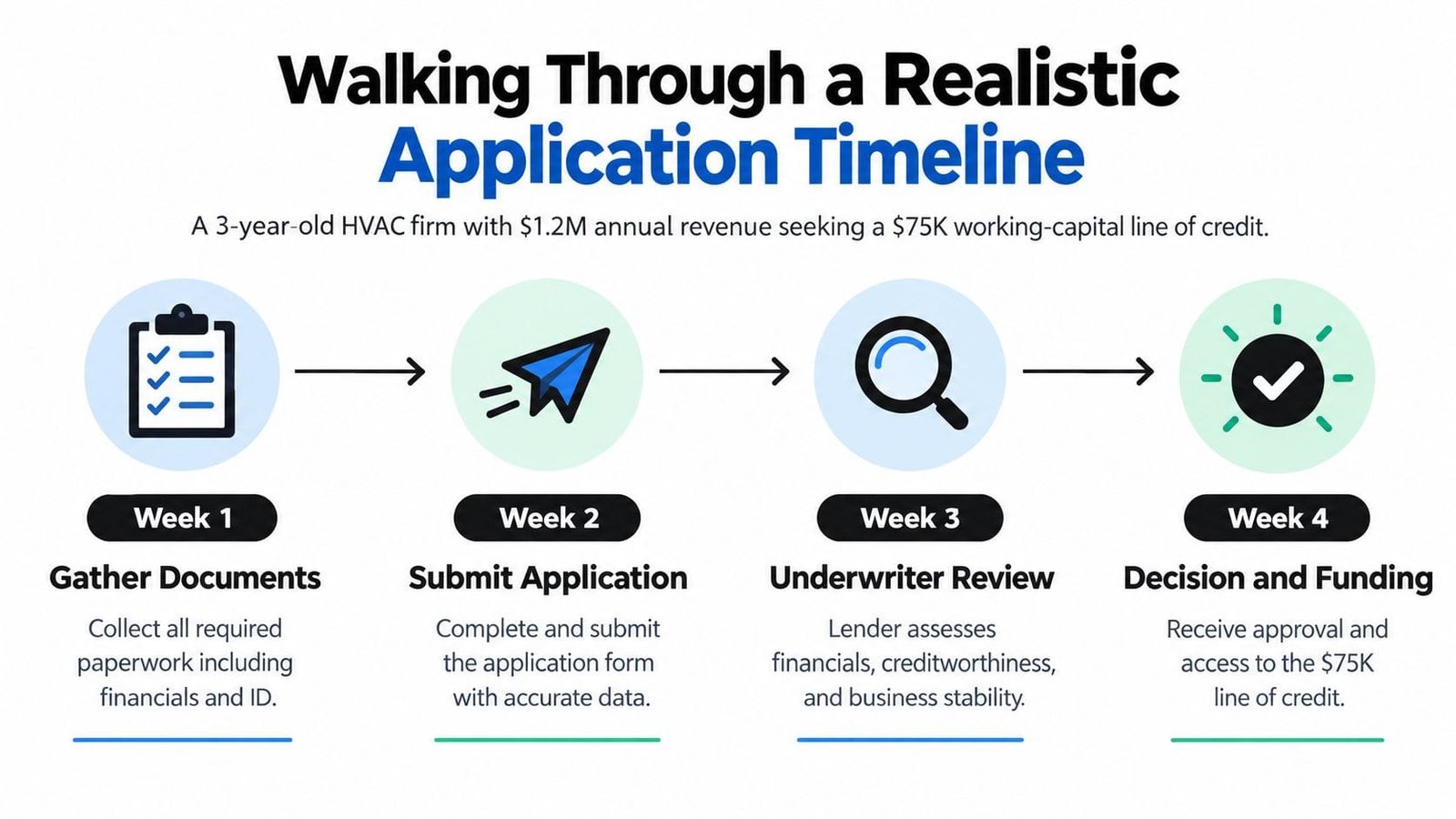
Consider a three-year-old HVAC company with roughly $1.2 million in annual revenue seeking a $75,000 working-capital line. The owner has recurring maintenance contracts, seasonal installation revenue, and a temporary gap between completed jobs and customer payments.
The first step is pre-qualification. A lender may ask for basic revenue, time-in-business, ownership, and use-of-funds details, then offer an initial indication before a full review. Don't treat that indication as a commitment. Use it to decide whether the lender's product matches the company's timing and documentation profile.
What happens after submission
During the first few days, the owner completes the full form and uploads financial statements, tax returns, identification, and bank records. A bank portal may request a bank-link verification, while another lender may ask for a written use-of-funds statement.
Underwriting can take several weeks, depending on the channel and file complexity. The reviewer may ask why revenue dipped, request a missing profit-and-loss statement, investigate an undisclosed UCC filing, or reconcile deposits that don't match reported sales.
A prepared owner shortens the process by checking for liens before applying, labeling every document, and explaining unusual transactions upfront. A sudden decline isn't automatically fatal, but unexplained volatility creates avoidable friction.
The offer stage is where the owner should negotiate thoughtfully. Review the approved limit, draw fees, repayment frequency, renewal rules, personal guarantee, collateral requirements, and any restrictions on additional debt. If the lender offers less than requested, ask whether a lower initial draw, additional documentation, or a secured structure could support a larger facility later.
For a bank, expect a slower relationship review. A fintech may move more quickly through automated verification. An SBA route requires the most patience and document control. The Business Loan Warrior timeline guide provides another reference point for planning the approval process.
A realistic sequence looks like this:
| Stage | What the owner does | Where applications stall |
|---|---|---|
| Pre-qualification | Provides basic business and revenue details | The request doesn't match lender criteria |
| Full submission | Uploads complete records and explains the purpose | Missing current financials or inconsistent figures |
| Underwriting | Answers verification questions | Unexplained revenue dips, liens, or deposit issues |
| Offer review | Compares limit, cost, repayment, and conditions | Accepting the first structure without checking cash flow |
| Closing and access | Signs documents and confirms the facility | Ownership, bank-link, or final verification problems |
Common Application Mistakes and How to Avoid Them
An owner can submit accurate records and still weaken a line of credit application through poor timing. The lender choice, order of submissions, and explanation of cash flow affect whether the file receives a clean review or a reduced offer.
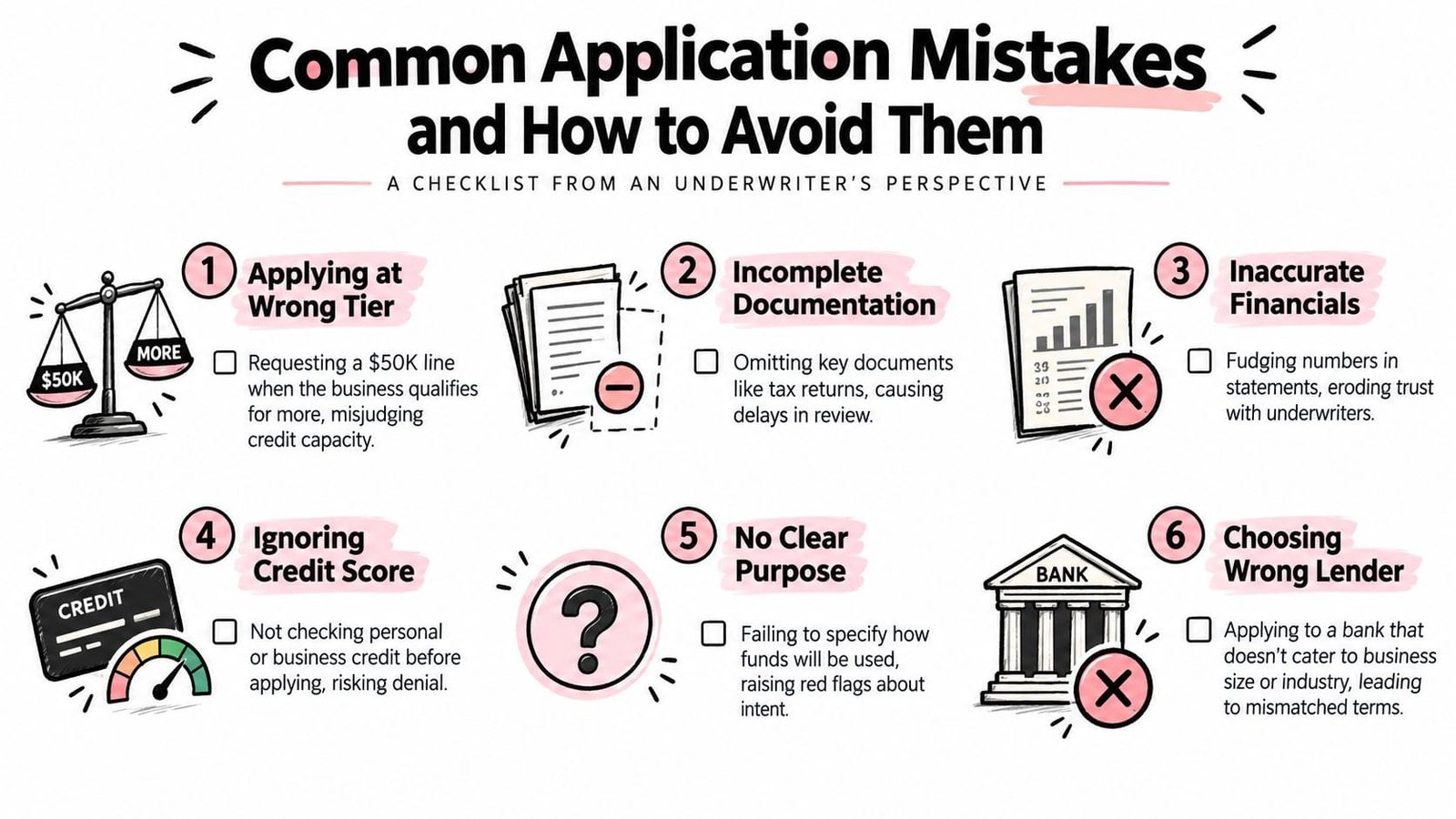
Six controllable errors
Applying at the wrong tier. Owner A sends a modest request to a bank focused on larger established borrowers, then waits through a review that was unlikely to fit. Check the lender's target customer and verification method before choosing the channel.
Mixing personal and business expenses. Owner B submits statements filled with household charges and personal transfers. The underwriter must separate operating cash from noise, delaying review and weakening confidence. Clean account activity before submission.
Applying after a cash squeeze is already visible. Owner C waits until card balances rise and deposits tighten, then asks for a line to cover pressure. Prepare while cash flow is stable enough to show a clear repayment path.
Leaving the purpose vague. “Working capital” gives the lender little to assess. State the expense, timing, expected inflow, and repayment source in a short use-of-funds explanation. That sequence connects the request to the company's cash cycle.
Disclosing obligations too late. An undisclosed lien, tax issue, or existing facility can stop verification after the lender has invested time in the file. Review obligations before applying and explain anything that could affect repayment capacity.
Stacking applications in one week. Owner D submits three applications, triggering repeated bank-data requests and confusing credit activity. Start with the best-fit channel, wait for a clear outcome, and submit elsewhere only when the next lender adds a realistic option.
The Bluevine guidance on preparation mistakes also emphasizes preparation before submission. Use that principle to set an application order, not to repeat a generic checklist.
Underwriter's view: A clean file supports a faster decision. A poorly timed or poorly sequenced file gives the lender reasons to reduce the limit or stop the review.
Deciding Whether to Apply Now or Wait
Apply now when the line solves a defined timing problem and your recent financial evidence supports repayment. Wait when you're seeking a vague safety net, your statements don't match your reported sales, or your credit profile has changed for the worse.
Use these three questions:
- Is there a specific, dated obligation? An inventory purchase, payroll gap, or seasonal ramp gives the request a clear purpose. “I want cash available just in case” is a weak application narrative.
- Do recent deposits support the trend? Revenue should be moving in a direction you can explain, and bank activity should broadly match your financial statements.
- Is your credit profile ready? Check the lender's published floor, recent inquiries, new debt, utilization, and any unresolved derogatory items before submitting.
If two answers are yes, apply now with the lender that fits your stage and industry. If only one answer is yes, spend 60 to 90 days strengthening the weakest signal before a full application. Use that period to clean business accounts, update financials, resolve liens, and document contracted revenue.
A line isn't always the right product. A short-term loan can fit a one-time expense with a known payoff date. Equipment financing is usually cleaner for a specific asset. A merchant cash advance may be available when sales are strong but conventional credit is weak, although repayment can place heavy pressure on daily or weekly cash flow.
The market data supports a selective approach. Federal Reserve reporting indicates that 46% of small firms were fully approved for a business line of credit, while 43% of applicants were denied at least part of what they requested, according to CreditSuite's reporting based on Small Business Credit Survey data. Approval isn't automatic, and receiving the full requested amount is a separate outcome from receiving any offer.
Your playbook is straightforward. Pick the channel before the paperwork, gather documents in underwriter order, match the application story to a real cash-flow need, and avoid stacked inquiries. Make the decision this week based on the cash event you're solving, not on a general fear of running short.
Business Loan Warrior offers a single application for business funding, including lines of credit, with pre-approval checks designed not to affect credit, bank-account connection, document tracking, and access to underwriter support. Visit Business Loan Warrior to compare a line of credit with other working-capital options and prepare an application around your actual cash-flow need.