
Maria's restaurant has outgrown its kitchen at the worst possible moment. The combi ovens fail during service, the walk-in cooler is unreliable, and a ventless hood could make a larger menu possible. The full upgrade costs $95,000, arrives in six weeks, and Maria has only $40,000 in cash after two line cooks quit over the broken equipment.
She isn't choosing between a loan and a lease in the abstract. She's deciding whether to borrow against the equipment, rent it for a fixed term, or abandon a growth opportunity that may not come back. The answer depends on three levers: the monthly payment, ownership at the end, and what the arrangement does to her financial statements and tax position.
A restaurant owner in this position should compare structures before signing a vendor quote. This practical guide to financing your kitchen and getting the best restaurant equipment loan is a useful starting point, but the decision requires more than finding the lowest payment.
Table of Contents
- A Kitchen Upgrade That Changes Everything
- What Equipment Financing and Leasing Actually Mean
- Loans vs Capital Leases vs Operating Leases Compared
- How Taxes and Accounting Change the Math
- Three Real Cost Examples You Can Model Today
- Qualifying and Applying for Equipment Financing
- Common Myths That Lead Owners Into Bad Deals
- Your Decision Framework and Next Steps
A Kitchen Upgrade That Changes Everything
Maria's lender asks whether she wants to buy the kitchen equipment or lease it. The vendor says the lease will keep her payment manageable. Her accountant asks whether she wants the equipment on the balance sheet. Maria wants one answer, but each professional is optimizing for a different outcome.
A loan could make her the owner immediately, give the lender a claim on the equipment as collateral, and leave her with an asset after repayment. A lease could reduce the initial cash burden and make it easier to replace the ovens if the restaurant's menu changes. Neither option is automatically cheaper, and neither one solves a weak cash-flow forecast.
Practical rule: Don't compare only the monthly payment. Compare the cash paid, the asset retained, the tax treatment, and the cost of getting out.
The kitchen's useful life matters too. A heavy-duty hood and walk-in cooler may serve the business for years. Controls, software, and certain cooking technologies can become less attractive much sooner. If Maria finances everything under one long contract, she could still be paying for equipment that no longer matches her operation. If she leases everything, she may surrender ownership of durable assets that could have retained meaningful resale value.
Her choice also affects future borrowing. A lender reviewing the restaurant's statements will look at liabilities, assets, coverage, and available cash. A lease may look lighter in a sales conversation while still creating a right-of-use asset and lease liability in the accounts. The contract's classification, buyout terms, maintenance obligations, and residual assumptions matter more than the label printed at the top.
Maria should ask four questions before approving the order:
- How long will we use each item?
- Who carries repair and residual-value risk?
- What will ownership cost after taxes and fees?
- What happens if we want to upgrade, return, or buy the equipment?
The next step isn't choosing the most flexible structure. It's matching each asset to the way the business will use it.
What Equipment Financing and Leasing Actually Mean
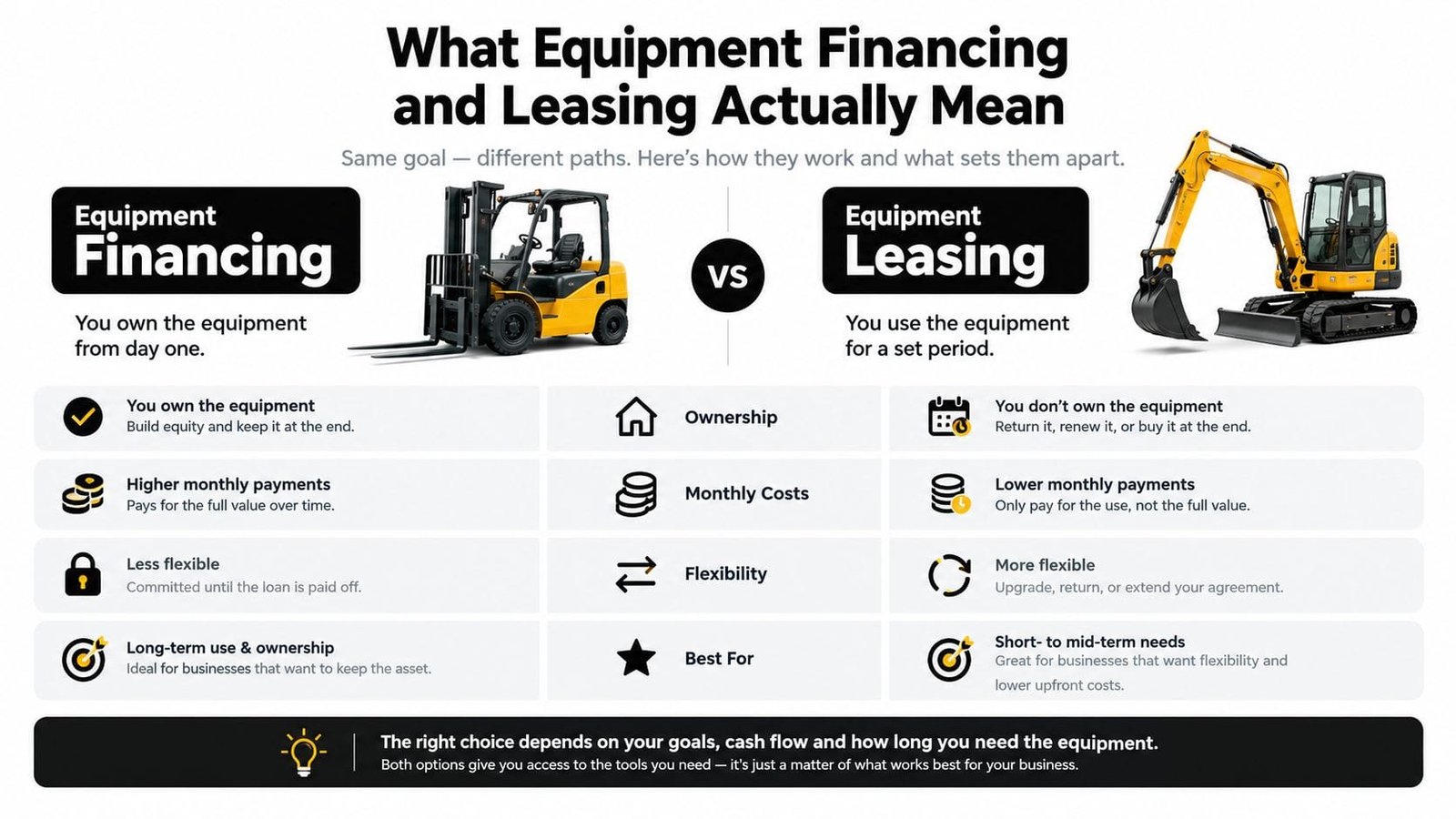
Equipment financing usually means borrowing money to purchase a specific asset. The equipment secures the debt, and the business makes scheduled payments until the balance is repaid. Ownership generally transfers at purchase, even though the lender may have a security interest until the loan is satisfied.
Equipment leasing usually means paying for the right to use an asset during a defined term. The lessor owns the equipment during that period, while the business pays for use. At the end, the contract may require a return, offer renewal, or provide a purchase option.
The truck analogy makes the distinction clear. Financing is like taking out a loan to buy a delivery truck. You use it, maintain it, and own it from the beginning, subject to the lender's claim. Leasing is closer to a long-term rental. You use the truck for the agreed period, then return it, renew the arrangement, or buy it if the contract permits.
Why the terms get mixed together
Lenders and vendors often place loans and leases on the same application because both solve an equipment purchase problem. That packaging creates confusion. A quote may advertise a payment without making ownership, residual value, or tax classification obvious.
The structures diverge in three important ways:
- Ownership: A loan gives the business the asset. A lease gives the business use of the asset, with ownership depending on the end-of-term terms.
- Tax treatment: A conditional sale generally treats the business as the purchaser, while a qualifying lease can support rental-expense treatment. The IRS explains the distinction in its guidance on lease and conditional-sale treatment.
- Long-term cost: A lower lease payment can conceal a larger total outlay if the business repeatedly renews leases or pays a substantial buyout.
A contractor comparing a trailer purchase with a rental arrangement can also review this practical resource on trailer financing for contractors. The same questions apply to trailers, vehicles, kitchen equipment, and machinery.
The one-question test is simple: Will your business own the equipment when the contract ends, and at what total cost? If the answer isn't written plainly in the offer, you haven't compared the deal yet.
Loans vs Capital Leases vs Operating Leases Compared
The three structures serve different operating plans. An equipment loan suits a business that expects to keep the asset. A capital lease, often treated economically as a financed purchase, can offer scheduled payments with ownership or a preset purchase path. An operating lease suits a business that values use and replacement more than residual equity.
| Feature | Equipment Loan | Capital Lease | Operating Lease |
|---|---|---|---|
| Ownership at signing | Business owns the equipment, lender holds a security interest | Lessor owns legal title during the term, economics resemble ownership | Lessor owns the equipment |
| Ownership at end | Business keeps the asset after repayment | Often transfers through a nominal or preset buyout, depending on contract | Asset is returned, renewed, or purchased under the contract |
| Monthly payment profile | Often higher than a lease with a residual value, but principal builds equity | Structured payment with ownership economics | Often lower upfront and monthly burden, but payments buy use rather than equity |
| Relationship to useful life | Best when the term fits a durable asset's life | Best when the business expects long use and eventual ownership | Best when the term is shorter than the asset's practical or technological life |
| Balance-sheet treatment | Asset and liability recorded | Asset and liability generally recorded | Right-of-use asset and lease liability generally recorded under ASC 842 |
| Typical buyout | No buyout after scheduled repayment | Nominal or preset purchase amount may apply | Fair-market-value, fixed-price, or no purchase option, depending on contract |
| Best fit | Long-life machinery, vehicles, construction equipment | Durable assets where payment structure and ownership timing matter | Fast-changing technology, upgrade cycles, and uncertain long-term use |
An operating lease isn't automatically a bargain. It can carry a higher implied financing cost because the lessor is pricing in flexibility, residual risk, and administrative overhead. The payment may be easier to carry, but the business may pay again when it renews or replaces the equipment.
A loan commonly produces the lowest total cost when the company keeps the asset well past the repayment term. A capital lease can sit between a loan and an operating lease, especially when the business wants a defined ownership path. The right answer changes if maintenance, downtime, resale value, or replacement timing dominates the economics.
End-of-term language deserves scrutiny
Owners often focus on the first payment and skim the final page. That's where contracts hide practical consequences. Check the purchase option, return condition, delivery responsibility, inspection process, renewal rate, and early-termination formula.
For technology assets, disposal and data handling create additional work. Beyond Surplus offers a useful IT lease playbook for end-of-lease equipment disposal, particularly when a return requires secure data removal and documented chain of custody.
Businesses also use sale-leaseback arrangements to turn owned equipment into cash while retaining use. That can help liquidity, but it creates a new lease obligation and may increase lifetime cost. Owners should understand the sale-leaseback definition and structure before treating it as a simple cash-out strategy.
How Taxes and Accounting Change the Math
The tax answer depends on what the contract really is, not what the salesperson calls it. The IRS treatment of leases and conditional sales separates rent-style treatment from purchase treatment. If the agreement is a lease, payments are generally treated as rent. If it operates as a conditional sale, the business is treated as the purchaser and generally recovers cost through depreciation.
That distinction affects timing. A purchase or finance-style arrangement can create an asset, depreciation deductions, and potentially deductible interest. A true operating lease generally gives the business rental-expense treatment rather than ownership depreciation.
Tax ownership and residual risk
A true lease requires the lessor to retain genuine residual risk. Technical guidance commonly points to an initial lessor investment of 20%, at least 20% of the asset's original life or one year remaining, whichever is longer, and a purchase option set at fair market value rather than a nominal amount. Those benchmarks are discussed in this commercial equipment financing tax guide.
The practical point is more important than memorizing a test. A short term, nominal buyout, and near-certain transfer can make the arrangement look like debt in substance. That can change depreciation and interest treatment, even if the document uses the word lease.
ASC 842 also changed the old assumption that operating leases disappear from the balance sheet. Most leases now create a right-of-use asset and lease liability, subject to applicable exemptions and accounting policies. The financial statement may therefore show a lease even when the tax return uses a different treatment.
| Structure | Ownership | Balance sheet under ASC 842 | Depreciation | First-year deduction | Interest deductible |
|---|---|---|---|---|---|
| Equipment loan | Business owns the asset | Asset and debt recorded | Business generally depreciates the equipment | Depends on applicable depreciation rules and elections | Generally tied to the debt, subject to tax limitations |
| Capital or finance lease | Economics substantially transfer to the lessee | Asset and lease liability recorded | Lessee generally depreciates the asset | Depends on tax classification and available elections | Finance component may generally be deductible, subject to limitations |
| Operating lease | Lessor remains tax owner | Right-of-use asset and lease liability generally recorded | Lessor generally claims tax depreciation | Lessee generally deducts qualifying rental payments | Usually embedded in the lease expense rather than separately claimed by the lessee |
Section 179, bonus depreciation, and MACRS can materially change the purchase comparison, but eligibility, limits, business use, and current tax law must be checked with a tax professional. Owners should not approve a structure based on a promised deduction without confirming who owns the asset for tax purposes.
For a practical refresher on asset write-offs, review this guide to depreciation of equipment, then ask your accountant to model the actual tax year rather than relying on a generic example.
Three Real Cost Examples You Can Model Today
The cleanest comparison separates cash cost, ownership, and operational risk. The examples below use the figures supplied for each scenario. They illustrate how the answer can flip, but they aren't tax advice or lender quotes.
The espresso machine
A café needs a $50,000 espresso machine. Under the supplied loan example, the business uses a 60-month loan at 9%, with $10,400 in interest over the loan term. The alternative is a 36-month operating lease with a $1 buyout and $7,200 in total lease cost.
The lease wins on the stated financing cost and gives the café a short replacement cycle. But the numbers need a careful reading. If the lease cost is the full cost of use and the $1 buyout is enforceable without additional fees, the café gets a compelling path to ownership. If maintenance, delivery, insurance, or end-of-term charges sit outside the quoted figure, the apparent advantage shrinks.
Recommendation: Choose the lease if the café expects to upgrade quickly and the contract includes clear maintenance and buyout language. Choose the loan if the machine will remain productive well beyond the loan term and the owner wants durable equity.
| Equipment | Price | Term and rate | Monthly payment | Total cost | End-of-term option | Recommended structure |
|---|---|---|---|---|---|---|
| Espresso machine | $50,000 | 60-month loan at 9% or 36-month lease | Not provided | Loan includes $10,400 interest, lease includes $7,200 lease cost | Lease includes $1 buyout | Lease for rapid replacement, loan for long retention |
The excavator
A contractor finances a $250,000 excavator over 84 months at 7.5%, with a 10% balloon payment. The supplied scenario produces $97,200 in interest and allows full Section 179 deductibility in the first year, assuming the business qualifies and the deduction is available.
This is a long-life asset with real residual value. The balloon lowers scheduled payments but creates a large maturity obligation. The contractor should forecast the balloon from the first day, not hope a future project will cover it.
Recommendation: Finance the excavator when utilization is steady, maintenance is manageable, and the company intends to keep it. A capital lease with a $1 buyout can work when payment design matters, but the tax and residual terms must be reviewed closely.
The IT refresh
A company deploys $1.2 million of IT hardware through a 39-month operating lease, with predictable payments of $33,800 per month in the supplied example. The case favors leasing because rapid hardware obsolescence can leave a company making payments on equipment that no longer supports its needs.
Recommendation: Lease technology when upgrade timing, disposal, and uptime matter more than residual ownership. Buy or finance stable infrastructure only when the equipment's useful life comfortably exceeds the repayment period.
| Equipment | Price | Term and rate | Monthly payment | Total cost | End-of-term option | Recommended structure |
|---|---|---|---|---|---|---|
| Excavator | $250,000 | 84 months at 7.5%, 10% balloon | Not provided | $97,200 interest plus balloon and principal | Balloon maturity, ownership subject to repayment terms | Equipment loan or capital lease |
| IT refresh | $1.2 million | 39-month operating lease | $33,800 | Not provided beyond scheduled payments | Return, renew, or purchase under contract | Operating lease |
| Espresso machine | $50,000 | 60-month loan at 9% or 36-month lease | Not provided | $10,400 loan interest or $7,200 lease cost | $1 lease buyout | Lease or loan based on retention period |
The math flips when residual value, maintenance, obsolescence, and exit costs change. Model those items before comparing APRs.
Qualifying and Applying for Equipment Financing
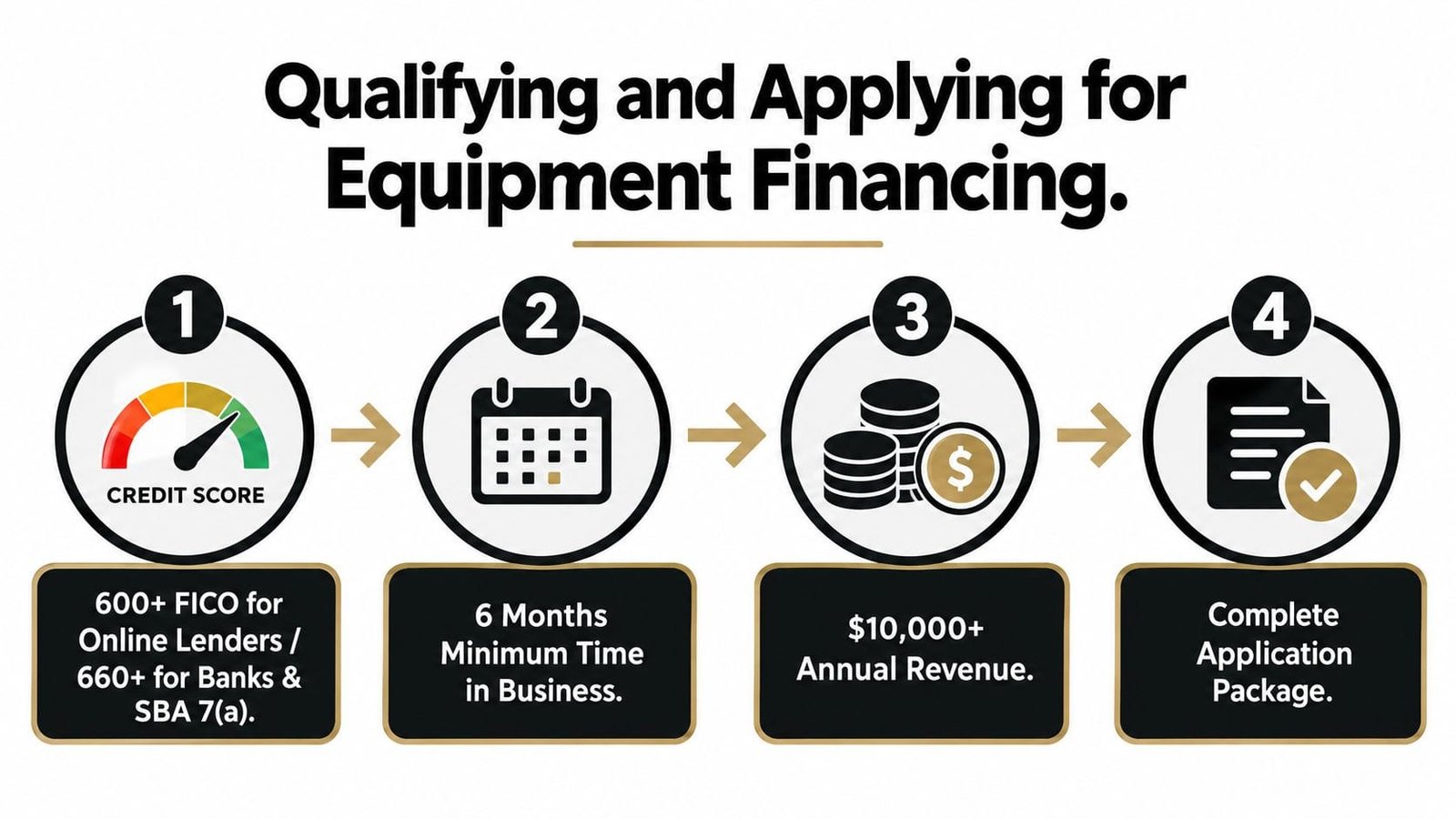
Lenders look at both the business and the asset. Because the equipment often secures the transaction, a credible quote with clear specifications can matter almost as much as the revenue story. It won't replace credit or repayment capacity, but it gives underwriting something identifiable to value and recover.
Assemble the application before shopping rates
Prepare the core file first:
- Credit profile: Know which owner guarantees the debt and whether the lender uses a soft or hard inquiry.
- Business history: Have formation documents and evidence of operating history ready.
- Financial records: Organize business tax returns, current profit and loss statements, and bank statements.
- Equipment quote: Include the vendor, model, price, delivery terms, serial number, VIN, or other identifying information.
- Use case: Explain how the asset generates revenue, replaces failed equipment, or reduces operating friction.
A vague quote slows the process. A detailed quote helps the lender understand collateral, installation, freight, accessories, and the exact amount requested.
Follow the deal from prequalification to funding
The application usually moves through a predictable sequence:
- Prequalification: Submit basic business and owner details, ideally through a soft-credit review.
- Document collection: Upload financial statements, identification, entity records, and the equipment quote.
- Underwriting: The lender tests cash flow, credit, collateral, industry risk, and guarantor strength.
- Term-sheet review: Compare payment frequency, fees, collateral requirements, prepayment terms, residuals, and guarantees.
- Approval and contract: Confirm the legal borrower, ownership language, insurance requirements, and default provisions.
- Vendor verification: The lender validates the seller, asset, pricing, and delivery details.
- Funding: Funds go to the vendor or borrower according to the agreement after closing conditions are met.
Don't accept a payment quote without the amortization schedule or lease schedule. The final contract controls, including fees and the end-of-term obligation.
A video walkthrough can help owners visualize the general application process:
Common Myths That Lead Owners Into Bad Deals
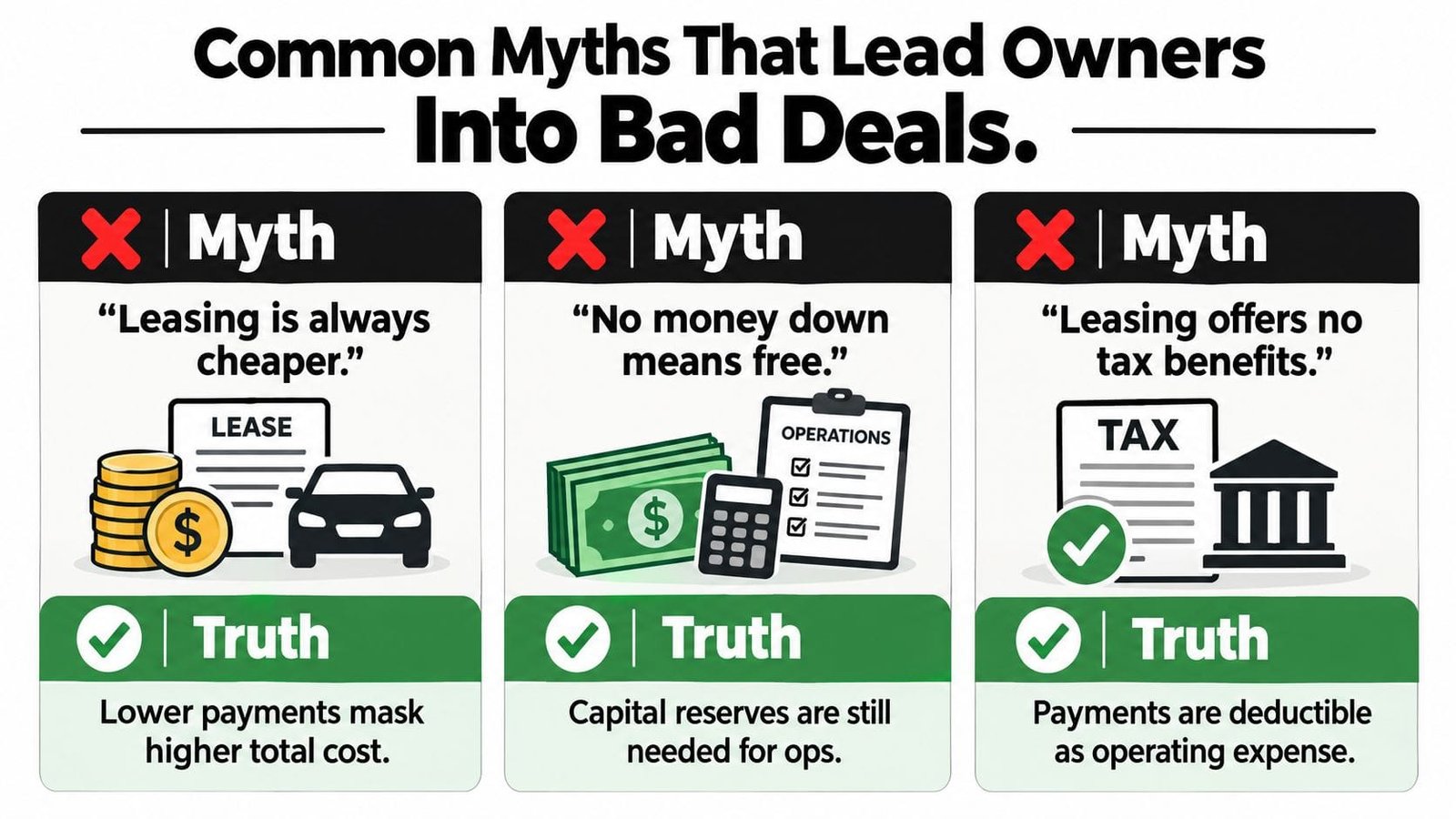
Myth one, leasing is always cheaper. A lower payment can hide a higher lifetime cost, repeated renewal charges, no residual equity, and end-of-term fees. A copier lease that eventually costs twice the equipment's retail price isn't cheap because the monthly invoice looks comfortable.
Myth two, buying is always smarter. Ownership can become expensive when technology becomes obsolete, maintenance is specialized, or revenue is seasonal. A company that purchased a server and stranded $40,000 in obsolete hardware learned the cost of owning the wrong asset at the wrong time.
Myth three, every lease stays off the balance sheet. ASC 842 generally puts operating leases into right-of-use assets and lease liabilities. A five-year truck lease can therefore appear in the financial statements when a bank reassesses financial gearing and borrowing capacity.
Before signing, run this test:
- Add every payment: Include deposits, fees, insurance, maintenance, shipping, and taxes.
- Price the exit: Write down the return, renewal, buyout, and early-termination obligations.
- Value the asset: Estimate what ownership or resale is worth after the planned use period.
- Stress the cash flow: Test a slow season, delayed customer payment, or repair bill without assuming perfect revenue.
The deal that looks cheapest on page one often changes after those four checks.
Your Decision Framework and Next Steps
Start with the equipment's life cycle, not the lender's product menu. Fast-obsolete assets with a short practical life, such as point-of-sale systems and certain IT hardware, generally fit an operating lease when predictable spending and replacement flexibility outweigh ownership.
Durable assets with stable technology, such as excavators, commercial vehicles, and manufacturing machinery, usually favor an equipment loan or a capital lease with a clear ownership path. Residual value belongs in the calculation. So do maintenance responsibility, downtime, insurance, installation, and the cost of disposing of the asset.
Business maturity also changes the menu. A company with established financial records can usually compare more structures than a young or thin-file business. A newer company may need vendor financing or a lease designed around the asset because conventional lenders have less operating history to evaluate.
Take these steps before requesting final terms:
- Estimate usage, revenue contribution, useful life, and replacement timing.
- Model a loan, capital lease, and operating lease using total cash cost.
- Collect bank statements, tax returns, current financials, and a detailed equipment quote.
- Compare APR or implied rate, residual value, buyout, maintenance, guarantees, and exit rules.
- Ask your accountant to verify tax ownership and deduction timing.
Business Loan Warrior offers an online application for equipment purchase financing and can help applicants compare funding options based on their business and equipment needs. Use the application process to organize competing offers, but read each final contract independently.
Business Loan Warrior offers equipment and business financing options for owners comparing a purchase, loan, or lease structure. Visit Business Loan Warrior to review equipment funding possibilities, submit one application, and compare terms before committing your cash.