
A sale-and-leaseback is when a business sells an asset and immediately leases it back, so it keeps using the asset while turning ownership into cash. The paperwork says sale, but the cash-flow effect usually looks a lot like a long-term loan.
You might be staring at a building, a piece of equipment, or a facility that's valuable on paper but tied up in the business. Maybe you need cash for expansion, payroll cushion, or a second location, and you don't want to interrupt operations to get it.
Table of Contents
- What a Sales and Leaseback Actually Is
- How the Transaction Works Step by Step
- Accounting Treatment Under IFRS 16 and ASC 842
- Sale-Leaseback Compared to Other Funding Options
- Benefits and the Risks Most Owners Underestimate
- Evaluating an Offer and How a Fintech Lender Helps
- Key Takeaways and Your Next Move
What a Sales and Leaseback Actually Is
A restaurant owner with a paid-off building often reaches this fork in the road. The dining room is busy, the estate has value, and the business needs capital for growth. Instead of taking on another conventional loan, the owner sells the property to an investor and signs a lease so the restaurant can keep operating in the same place.
That's the plain-English sales and leaseback definition. You sell an asset you own, then rent it back so you can keep using it while converting an illiquid asset into working capital. Statistics Finland's concept note treats sale-and-leaseback as a financing activity that's been tracked separately in official statistics, with a shift from separate collection through 2008 into broader financial leasing activity from 2009 onward Statistics Finland.
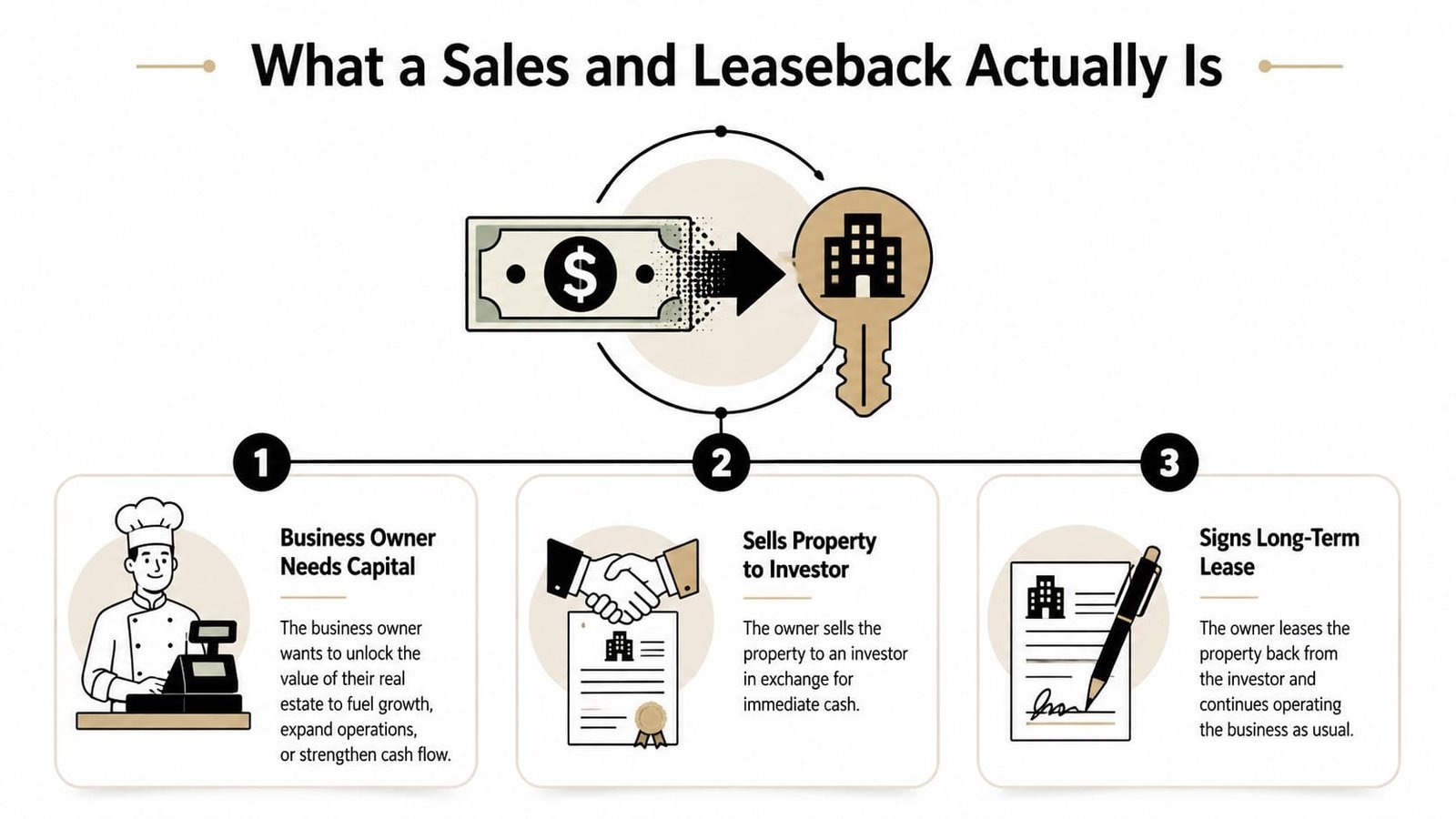
Working definition: a sale-and-leaseback is a transaction where the same business sells an asset and then becomes the tenant, keeping operational use while giving up ownership.
Why the structure feels familiar to owners
Owners usually understand it fastest when they compare it to a house sale with a lease attached, except the asset is part of a business. The seller gets cash up front, then starts making regular lease payments. That's why many people experience the deal as a financing move, not a true exit from the asset Investopedia.
The official and accounting language matters because the asset can be real estate, but it can also be movable or immovable property Statistics Finland. That's one reason the concept shows up in property-heavy businesses, equipment-heavy businesses, and operations that can't afford a shutdown.
For a landlord-level view of the lease side of the deal, a practical overview like lease agreements legal guide can help readers think about the contract terms that make or break the arrangement.
How the Transaction Works Step by Step
The mechanics are simple, but every step has a price attached to it. The seller wants the most cash possible up front. The buyer wants enough rent over time to earn a return while protecting downside if the tenant weakens.
The deal starts with valuation
First, the asset gets priced. For a building, that usually means an appraisal and a look at the property's condition, location, tenant profile, and how easy it would be to re-lease if things go wrong. For equipment, it's the same logic in a different wrapper, because the buyer still needs to know what the asset is worth and how long it will hold value.
The buyer checks the tenant, not just the asset
Then the buyer digs into the business itself. In a sale-leaseback, the buyer is underwriting both the property and the company that will keep paying rent. That's why credit strength, operating stability, and the durability of the rent stream matter so much.
The lease gets negotiated before closing
The lease terms usually decide whether the deal feels manageable or painful later. Rent, term length, renewal options, maintenance duties, repair obligations, and any restrictions on remodeling all need to be clear before the asset changes hands. If those terms are vague, the owner can end up with cash today and constraints tomorrow.
A clean way to think about it is this, the buyer and seller are negotiating between two numbers, the cash the seller needs now and the rent the buyer needs later. That's why sale-and-leasebacks can feel like a balancing act between liquidity and future operating flexibility.
Closing changes the relationship, not the operation
At closing, the sale funds move, title transfers, and the lease is signed. The business becomes the tenant, and the investor becomes the landlord. The business usually keeps running in the same location, but the ownership rights have changed hands.
If you want a separate walkthrough of how the paperwork gets recorded, this journal entry guide is useful for seeing how accountants think about the movement of value.
The cleanest way to explain the deal to a teammate is this, ownership moves, operations stay put.
Accounting Treatment Under IFRS 16 and ASC 842
A sale-and-leaseback can look like a straightforward cash deal, yet the accounting treatment is where the test begins. Under IFRS 16 and ASC 842, the parties have to determine whether the transfer counts as a sale or whether it is really financing, as explained in KPMG. The same contract can leave the balance sheet looking very different depending on that answer.
Why the sale test matters
The standards require two separate checks. First, the asset transfer has to meet the sale criteria. Second, the leaseback has to qualify as a lease. If control never really leaves the seller, the accounting does not treat the deal as a sale.
That is the point many owners miss. A contract can be labeled a sale in legal terms, but if the accounting test fails, the cash received is not treated as the clean disposal of an asset. It behaves more like borrowed money, because the business still has an ongoing obligation tied to the asset.
A plain-English example
Suppose a company sells a building and keeps using it under a lease, but the sale criteria do not hold up. The business cannot record the arrangement as a true sale for accounting purposes, so the cash received is shown as a financing liability instead of sale proceeds. That changes the company's financial structure, affects the appearance of debt, and can change how lenders and covenant tests read the balance sheet.
If you want to see how accountants trace that movement step by step, the journal entry walkthrough shows the mechanics in plain language.
The practical warning is simple. The contract can make the balance sheet look lighter while the economic substance adds debt-like pressure through future payments. That is why owners and controllers need to look past the legal label and ask what the transaction is really doing economically.
Under both systems, the rules are technical for a reason. They are trying to separate a genuine transfer of control from a financing arrangement that only wears a sale label.
Sale-Leaseback Compared to Other Funding Options
The best way to place this structure is to compare it to the other tools on the small-business shelf. A sale-and-leaseback can be a useful source of capital, but it doesn't behave like a conventional loan, and it doesn't preserve ownership the same way. If you want a broader map of financing choices, this bridge financing guide gives a useful comparison point.
Side-by-side comparison
| Funding Option | Main Collateral | Typical Funding Speed | Balance-Sheet Impact |
|---|---|---|---|
| Sale-Leaseback | The asset itself and the future lease stream | Often faster than a fully negotiated property refinance once the buyer is ready | Ownership is sold, and the operating obligation shifts to lease payments |
| Traditional Term Loan | Business assets, sometimes real estate, sometimes equipment | Depends on underwriting and documentation | Debt stays on the balance sheet |
| SBA Loan | Often business assets and personal guarantees | Usually slower than a sale-leaseback style transaction | Debt stays on the balance sheet |
| Line of Credit | Receivables, cash flow, or general business credit | Can be fast once approved | Revolving debt stays on the balance sheet |
| Equipment Financing | The specific equipment being purchased | Usually tied to the purchase process | Debt stays on the balance sheet |
A worked example in plain language
If a business owns a $500,000 property and sells it for $450,000, then signs a 10-year lease at $4,500 a month, the owner has traded ownership for liquidity and future rent. If the same business raises $450,000 through a 10-year SBA loan at 7%, the business keeps the property but adds a debt obligation instead of rent.
The comparison isn't only about monthly cash outflow. It's also about who owns the asset at the end. In a sale-and-leaseback, the investor owns the building and the business rents it. In a loan, the business keeps the building and just owes the lender.
For office and equipment owners looking to convert value back into operating cash, a resource like office equipment buyback programs can help frame the difference between selling an asset outright and financing against it.
Benefits and the Risks Most Owners Underestimate
The upside is real. A sale-and-leaseback can deliver a lump sum of cash without adding a new lender relationship in the same way a bank loan does. The business keeps using the asset, which is why this structure is attractive for owners who need liquidity but can't afford to move.
The benefits owners usually understand quickly
The first benefit is obvious, immediate access to capital. The second is operational continuity, because the business usually stays in the same building or keeps using the same equipment. There can also be tax implications tied to lease payments, depending on the structure and jurisdiction, so many owners run the deal through both finance and tax review before signing.
The risks are where the real cost shows up
The most overlooked risk is the long lease obligation. Once the contract is signed, the payment stream behaves like debt even if the document says lease. The business also gives up future appreciation in the asset, which can matter a lot if the property sits in a location that may become more valuable over time.
Another risk is control. Lease terms can limit renovations, relocations, expansion plans, and even how quickly a business can exit the space. That can turn a seemingly flexible financing tool into a long-term operating constraint.
Buyers usually care less about the bricks and mortar than owners expect. They're often underwriting the tenant's credit and rent stream, which means the tenant's reliability can matter more than the building itself Cleary Gottlieb.
That's why the true cost of capital can be higher than it first appears. Rent, residual risk, and exit terms all sit in the background, and they should be priced like a financing package, not treated like free cash.
Evaluating an Offer and How a Fintech Lender Helps
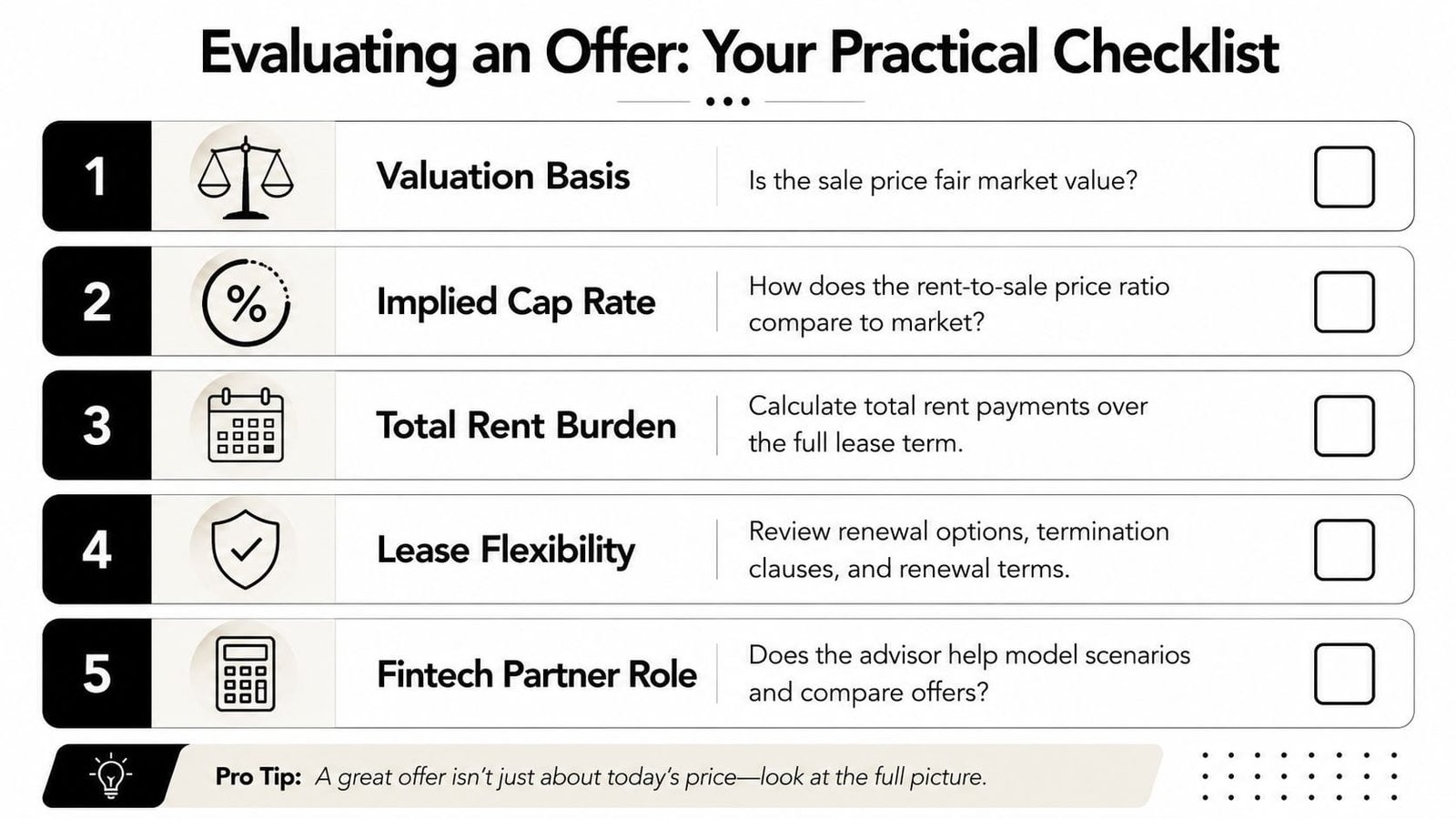
A good offer isn't just the highest number on the front page. It's the offer that makes sense after you test the rent, the contract, and the flexibility you're giving up. Before you sign anything, ask a few practical questions.
Use this checklist before you commit
- Valuation basis. Is the sale price tied to fair market value, or is the buyer discounting the asset because the lease is too restrictive?
- Implied rent economics. Does the rent level make sense against the cash you're getting, or does it create an expensive financing burden?
- Lease flexibility. What happens if you need to renew, expand, relocate, or exit early?
- Operational responsibilities. Who handles maintenance, repairs, and capital expenditures?
- Change of ownership. If the business is sold, can the lease be assigned, and on what terms?
The most useful habit is to compare the offer against a clean lending alternative, not against your current cash shortage. That's where many owners discover the tradeoff.
A fintech-enabled platform can help by collecting offers in one place, letting you pre-qualify without the same friction as a traditional bank process, and modeling the leaseback alongside loan alternatives in a dashboard. That side-by-side view matters because owners usually don't need one more pitch, they need an apples-to-apples comparison.
Business Loan Warrior is one example of a platform that offers a no-fee pre-approval flow, bank-level security, and underwriter chat for businesses doing up to $100M in annual sales, which can make it easier to compare structured financing options without losing time to scattered applications.
For owners comparing bank underwriting against faster digital review, this fintech versus banks guide is a helpful companion.
Key Takeaways and Your Next Move
A sales and leaseback definition is simple, a business sells an asset and leases it back so it can keep using it. The harder truth is that the paperwork says sale, but the cash-flow shape often looks like long-term financing, so owners should price it that way.
The three questions that matter most are straightforward. Is this the cheapest source of capital for what you're trying to do? Does the lease fit your real operating horizon? Does the buyer understand your industry well enough to be a stable long-term landlord?
The best next step is to gather the asset details, run the numbers against an SBA loan or line of credit, and compare the leaseback offer against other funding paths before you commit. If you want one place to sort through those options, a single application can save you from chasing scattered quotes and help you see the tradeoffs clearly.
If you're weighing a sale-and-leaseback against a loan, line of credit, or equipment financing, Business Loan Warrior can help you compare the options in one secure place. Visit Business Loan Warrior to run a no-fee pre-approval and talk through the numbers before you decide.