
Your commercial loan is coming due, your current rate looks attractive on paper, and the replacement quote appears higher. At the same time, the lender is asking for a fresh appraisal, updated financials, more reserves, and possibly a personal guarantee. The obvious question is, “Can I get a lower rate?” The more important question is, how much cash, collateral, and repayment capacity will this refinance consume?
Refinancing a commercial loan only works when the new structure solves a real problem. It should improve cash flow, extend a dangerous maturity, restore workable collateral coverage, or place the debt with a lender whose risk appetite matches the property. A lower rate by itself can be irrelevant if a valuation shortfall forces an equity contribution or the new amortization creates a larger balloon later.
Table of Contents
- Reading the Market and Your Asset Class
- Running the Real Underwriting Math
- Avoiding Fatal Execution and Timing Traps
- Choosing the Right Lender and Loan Structure
- Navigating the Documentation and Closing Timeline
- Making the Final Go or No-Go Decision
Reading the Market and Your Asset Class
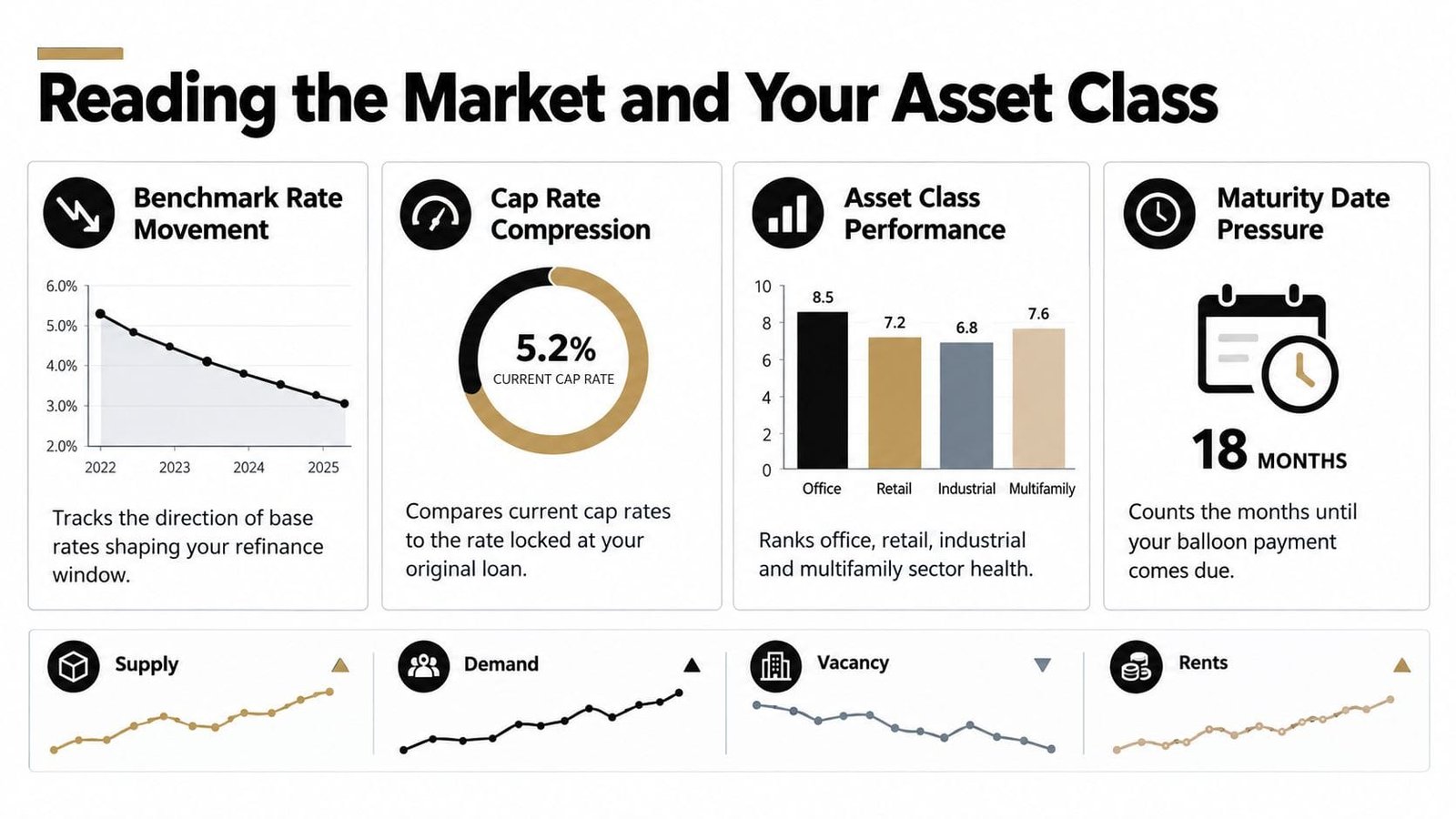
The market is dealing with a recurring maturity wall, not a one-time refinancing event. S&P Global estimated that roughly $946 billion of U.S. commercial real estate mortgages matured in 2024, about $998 billion in 2025, and $1.148 trillion in 2026. Other market estimates based on Mortgage Bankers Association data placed 2025 maturities at $957 billion and 2026 maturities at $875 billion. The difference between estimates matters less than the conclusion, refinancing has become a core capital-markets function for a multi-trillion-dollar asset class. (Market maturity analysis)
Many owners are also refinancing debt originated when borrowing costs were materially lower. Market commentary cited loans written at 3% to 4% that now face refinancing around 6% to 7%, making the borrower's property income, loan structure, and lender selection much more important than the old coupon. (Commercial real estate refinancing market context)
Your property type sets the starting point
Lenders don't underwrite every building the same way. Industrial and multifamily properties generally attract stronger refinance interest when occupancy, tenant quality, and operating income hold up. Office and retail require more scrutiny because lenders may assume weaker leasing prospects, greater tenant-concession needs, or a larger valuation discount.
Fitch reported that the U.S. commercial real estate refinancing or repayment rate reached 78% in the first quarter of 2026, compared with 75% in 2025 and 68% in 2024. Its 2025 review of $28.8 billion across 1,723 non-defaulted, non-defeased U.S. CMBS conduit and Freddie Mac loans found that borrowers repaid $19.9 billion, producing a 69% refinance rate by balance and an 84% rate by count. (Fitch refinancing analysis)
The sector split tells you how a lender may classify your collateral:
| Property type | 2025 refinance rate |
|---|---|
| Industrial | 100% |
| Multifamily | 96% |
| Hotel | 86% |
| Retail | 62% |
| Office | 59% |
These results don't guarantee an approval. They show that asset class is a major underwriting variable. A well-leased industrial building can receive a very different response from lenders than an office property with rollover risk, even when the requested loan balance is similar.
Establish your leverage position before requesting quotes
Pull your current payoff statement, maturity date, prepayment language, property income, and recent valuation evidence. Then ask whether your requested proceeds are supported by both current cash flow and current collateral value. Owners often discover that the refinance problem isn't the rate. It's the gap between the old balance and the amount a new lender is willing to advance.
Use current market pricing as a reference point, not as a promise. Commercial real estate loan rates can help frame the conversation, but your final terms will depend on debt service coverage, loan-to-value, property condition, tenancy, sponsorship, recourse, and the lender's execution certainty.
Practical rule: Treat your maturity date as a financing deadline, not an administrative date. Start modeling before the lender's process becomes your emergency.
Running the Real Underwriting Math
A refinance model should answer one question: does the new loan improve repayment capacity after every cost and structural change? Don't start with the proposed interest rate. Start with the cash available for debt service, the proposed annual debt service, and the appraised value supporting the new lien.
The core formula is straightforward:
DSCR = cash flow available for debt service ÷ annual debt service
If your property or business generates less cash relative to the replacement payment, the refinance may be weaker even if the rate looks competitive. A longer amortization can reduce the payment, but it also changes how quickly principal is repaid and may leave a larger balance at the next maturity.
Build a downside case, not just a rate case
Run at least three versions of the transaction:
- Base case: Use realistic current income, expenses, vacancy, and the lender's proposed payment.
- Stress case: Reduce income or increase expenses qualitatively in your model to test whether coverage still holds.
- Closing case: Add appraisal fees, legal work, title costs, environmental work, lender fees, reserves, prepayment charges, and any required equity contribution.
The objective is to identify the point where the transaction stops working. OCC guidance supports using DSCR and LTV cushions in refinance underwriting rather than relying only on a borrower's historical payment record. A property that paid its old loan on time can still fail a new underwriting test if its value or net operating income has deteriorated. (SBA lender guidance and underwriting resources)
For SBA-supported structures, lender commentary and SBA guidance identify a minimum 10% cash-flow improvement in qualifying refinance situations. That benchmark should be treated as a modeling hurdle, not as permission to stretch the loan. (SBA refinance requirements overview)
LTV determines whether you bring money to closing
LTV = proposed loan amount ÷ appraised property value
If the appraisal comes in below your expectation, the lender may reduce proceeds even when your requested amount only matches the old payoff. That difference becomes an equity requirement. Add the possible funding gap to your closing-cost estimate before you decide whether refinancing is affordable.
A useful worksheet should show:
- Old payoff: Include the exact payoff date and any prepayment charge.
- New proceeds: Separate debt repayment, eligible expenses, reserves, and cash-out.
- New payment: Use the proposed rate and amortization, not a headline rate alone.
- Coverage cushion: Test the payment against current and stressed cash flow.
- Collateral cushion: Test the loan against a conservative valuation.
- Total cost: Include every fee and required equity contribution.
For a deeper explanation of how lenders test repayment capacity, collateral, guarantor strength, and property performance, review this commercial real estate underwriting guide. You should also obtain an independent valuation view before ordering a lender appraisal, using resources such as commercial real estate valuation guidance.
The rate sheet is not the deal. The deal is the payment, proceeds, collateral support, recourse, and cash you must contribute to close.
Avoiding Fatal Execution and Timing Traps
A strong refinance can fail because the borrower closes in the wrong order. This is especially dangerous in SBA 504 transactions, where eligibility depends on the age and purpose of the existing debt, the operating history of the business, payment performance, collateral, occupancy, and the sequence of payoff and authorization.
Before pursuing the transaction, verify that:
- The existing debt is at least two years old.
- The business has operated for at least two years.
- The borrower has remained current for the last 12 months.
- The original debt funded 504-eligible fixed assets.
- The business occupies at least 51% of the property for an SBA 504 real-estate refinance.
- The proceeds don't refinance excluded obligations, such as merchant cash advances.
These conditions aren't paperwork preferences. They determine whether the new loan qualifies. Debt purpose and collateral eligibility must be documented before the lender structures proceeds around the transaction. (SBA lender resources)
Payoff sequencing can decide eligibility
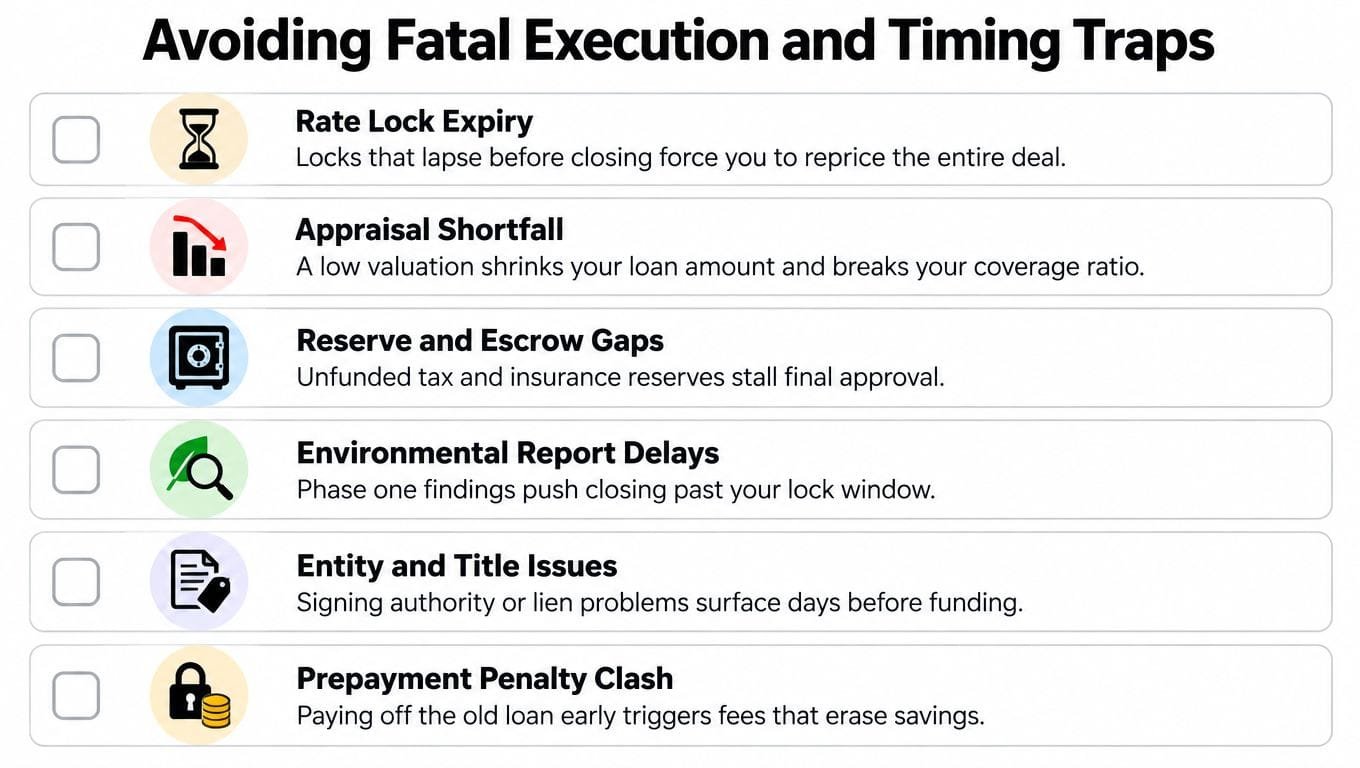
The most serious timing trap is allowing a new lender to pay off the existing debt before SBA approval or authorization. Under the stated SBA 504 workflow, that error can make the refinance ineligible until six months after the final advance. A borrower can have adequate cash flow, acceptable collateral, and a willing lender, yet still lose the intended program because the payoff occurred too soon. (SBA lender guidance)
Put the sequence in writing. Confirm who issues authorization, who controls the payoff, when the final advance occurs, and which closing conditions must be satisfied before funds move. Don't let a title company, existing lender, or new lender assume that an early payoff is harmless.
Proceeds must match the program
If the refinance includes eligible business expenses, the SBA 504 structure is capped at 85% LTV. A pure debt-only refinance can reach 90% LTV under the stated guidance. (SBA lender guidance) That distinction can change the required equity contribution, so separate eligible expenses from prohibited debt and avoid vague use-of-funds descriptions.
Ask for a written payoff schedule and a written proceeds schedule. Include taxes, insurance, reserves, repairs, legal costs, and any lien releases. A last-minute reserve gap or title issue can delay funding long enough to trigger a maturity problem, a rate-lock expiry, or a default under the existing loan.
Never authorize an early payoff in an SBA refinance until the program lender confirms the authorization and timing in writing.
Choosing the Right Lender and Loan Structure
The right lender depends on the property's stability and the weakness you need the capital structure to absorb. A conventional bank may offer favorable pricing for a stabilized property with low debt and dependable income. It may be less useful when the building needs lease-up time, the appraisal has fallen, or the borrower needs speed before a maturity date.
Match the channel to the problem
| Lending channel | Usually fits | Main tradeoff |
|---|---|---|
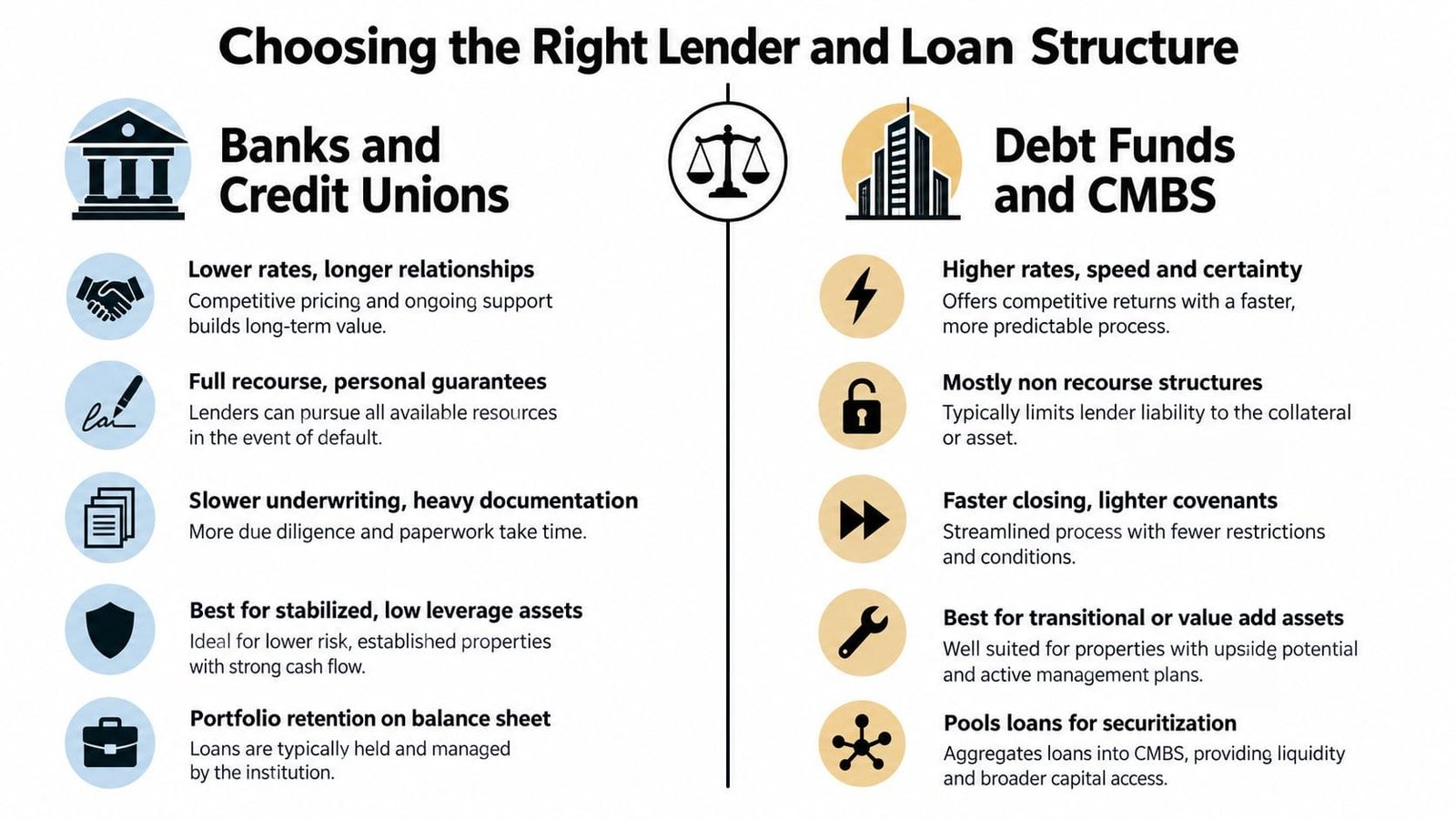
| Banks and credit unions | Stabilized properties, strong sponsors, lower leverage | Often requires fuller recourse, personal guarantees, and extensive documentation |
| SBA 504 | Eligible owner-occupied fixed assets and qualifying refinance structures | Strict eligibility, occupancy, use-of-funds, and payoff sequencing rules |
| SBA 7(a) | Business and real-estate debt that fits the program and needs a broader structure | Program eligibility and underwriting requirements still control proceeds |
| Debt funds | Transitional, value-add, or time-sensitive situations | Higher pricing can be the cost of speed and flexibility |
| CMBS | Properties that fit standardized, securitizable underwriting | Less flexibility when operations or collateral performance changes |
| Bridge lenders | A temporary solution while leasing, construction, or stabilization occurs | A bridge only works if the permanent takeout is credible |
Banks and credit unions often keep loans on their balance sheets, which can support relationship-based judgment but also produce slower underwriting and heavier documentation. Debt funds may move faster and offer more flexible structures, but borrowers should examine extension fees, exit assumptions, reserves, and recourse carefully.
The choice also changes the risk you retain. Ask whether the proposed loan is full recourse or nonrecourse, whether a bad-boy carve-out applies, how cash management works, whether reserves are funded at closing, and what happens if performance misses projections.
Office borrowers need a structure-first conversation
As of March 31, 2026, Northmarq reported 60% to 65% LTV permanent-loan spreads of approximately 154 basis points for multifamily, 162 basis points for industrial, 176 basis points for retail, and 220 basis points for office. At a 4.25% 10-year Treasury, the corresponding implied coupons were about 5.79%, 5.87%, 6.01%, and 6.45%. (Northmarq 2026 debt market outlook)
Those figures don't tell you which loan to accept. They show why office owners must model proceeds, amortization, recourse, leasing costs, and equity infusion alongside the coupon. A lender offering a higher rate with sufficient proceeds may be more useful than a lower-rate lender that creates an immediate funding gap.
For lenders building a pipeline or improving borrower outreach, a practical commercial loan lead generation guide can help organize prospect qualification around property type, maturity pressure, and funding need.
Navigating the Documentation and Closing Timeline
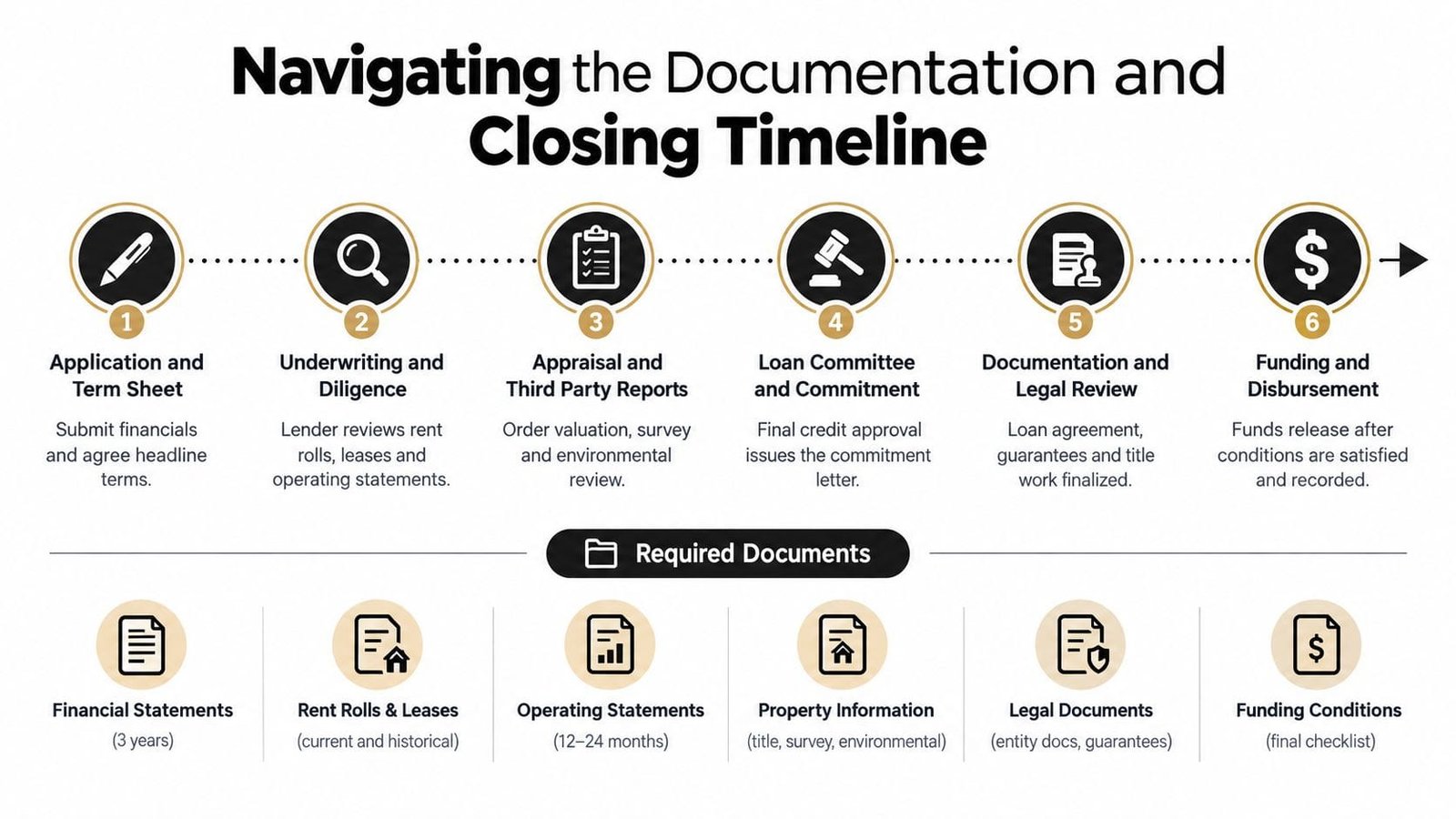
A refinance closes faster when the borrower treats underwriting as a controlled data-room process. Give the lender one complete package, label every file clearly, and reconcile the numbers before submission. Missing documents create questions, and unresolved questions delay the appraisal, credit approval, legal review, and funding sequence.
Prepare the file before the term sheet
Start with the existing note, payoff statement, maturity date, prepayment terms, and lien information. Add business financial statements, tax returns, year-to-date results, personal financial statements for guarantors, property operating statements, rent rolls, leases, insurance, property tax records, entity documents, and evidence of major repairs or improvements.
SBA 504 borrowers must prove the business and debt history described in the eligibility requirements. That means showing at least two years of business operation, debt that has been outstanding for at least two years, and 12 months of current payments. (SBA lender guidance) Don't wait for the lender to discover a missing year, an unexplained transfer, or a mismatch between the tax return and the operating statement.
Move through the six closing stages
- Application and term sheet: Submit complete financials and confirm the proposed rate, amortization, proceeds, recourse, reserves, and maturity.
- Underwriting and diligence: The lender tests cash flow, collateral, guarantor strength, tenant concentration, lease rollover, and repayment sources.
- Appraisal and third-party reports: Order the appraisal, survey, title work, insurance review, and environmental report. Resolve adverse findings immediately.
- Loan committee and commitment: Credit approval turns the preliminary terms into a formal commitment with conditions.
- Documentation and legal review: Counsel finalizes the loan agreement, guarantees, entity authority, title endorsements, lien releases, and closing certificates.
- Funding and disbursement: The lender releases proceeds only after every condition is satisfied and the new lien is properly recorded.
Use a document checklist such as this business loan documents resource to organize the data room, but tailor it to the property and program. A commercial refinance also needs property-specific materials that a general business-loan file may not cover.
The video below provides another visual reference for organizing the closing process.
Keep a live closing tracker with one owner for each condition. Rate locks, appraisal orders, environmental reviews, title corrections, insurance certificates, and payoff figures should all have deadlines. If a condition changes the loan amount or lien position, send the revision to every party before signing.
Making the Final Go or No-Go Decision
The final decision should compare three paths, not two: refinance with a new lender, modify or extend with the existing lender, or contribute equity and restructure the asset. The refinance wins only when its benefit survives the full-cost model.
Use this decision screen:
- Cash flow: Does the replacement payment improve coverage after realistic expenses and reserves?
- Proceeds: Does the loan pay off the existing balance without an unacceptable equity contribution?
- Value: Does the appraisal support the requested LTV with a usable cushion?
- Cost: Do prepayment charges, lender fees, legal work, appraisal, title, environmental work, and reserves erase the savings?
- Structure: Does the amortization reduce payment pressure without creating a worse future balloon?
- Recourse: Are you accepting personal liability or guarantees that expose the operating business?
- Execution: Can the lender close before maturity without violating a program timing rule?
- Alternative: Would an extension, maturity modification, reserve agreement, or negotiated payoff solve the immediate problem at lower total cost?
When an extension deserves serious consideration
An extension can be sensible when the property is sound in fundamentals but the current market makes a refinance temporarily punitive. It may preserve a favorable existing rate, avoid a new appraisal shortfall, and give the borrower time to improve occupancy or operating income. It can also fail if the existing lender demands a large paydown, adds restrictive covenants, or merely postpones the same balloon problem.
Ask the current lender for written terms, including the extension period, pricing, required principal reduction, reserves, reporting obligations, collateral changes, and default consequences. Compare that proposal with the complete refinance closing statement, not just the new lender's interest rate.
The decision should protect future flexibility
A refinance that solves this quarter's payment but removes operating liquidity isn't a successful refinance. Required equity, funded reserves, recourse, and prepayment restrictions can matter more than a modest rate difference. For office and highly indebted assets, Northmarq's outlook identified a continuing maturity wall, with about $875 billion projected to mature in 2026 and another $652 billion in 2027. (Northmarq 2026 debt market outlook)
Make the decision early enough to negotiate. If the model shows durable cash-flow improvement, acceptable collateral coverage, manageable costs, and a clean closing sequence, proceed. If the refinance depends on an optimistic appraisal, uncommitted cash, or a payoff step that could invalidate the program, stop and renegotiate before signing.
Business Loan Warrior offers a no-fee application flow that includes refinancing an existing loan as a funding purpose, along with a dashboard for tracking approvals, repayments, and credit insights. Visit Business Loan Warrior to submit your refinance details and compare a potential new structure with an extension from your current lender.