
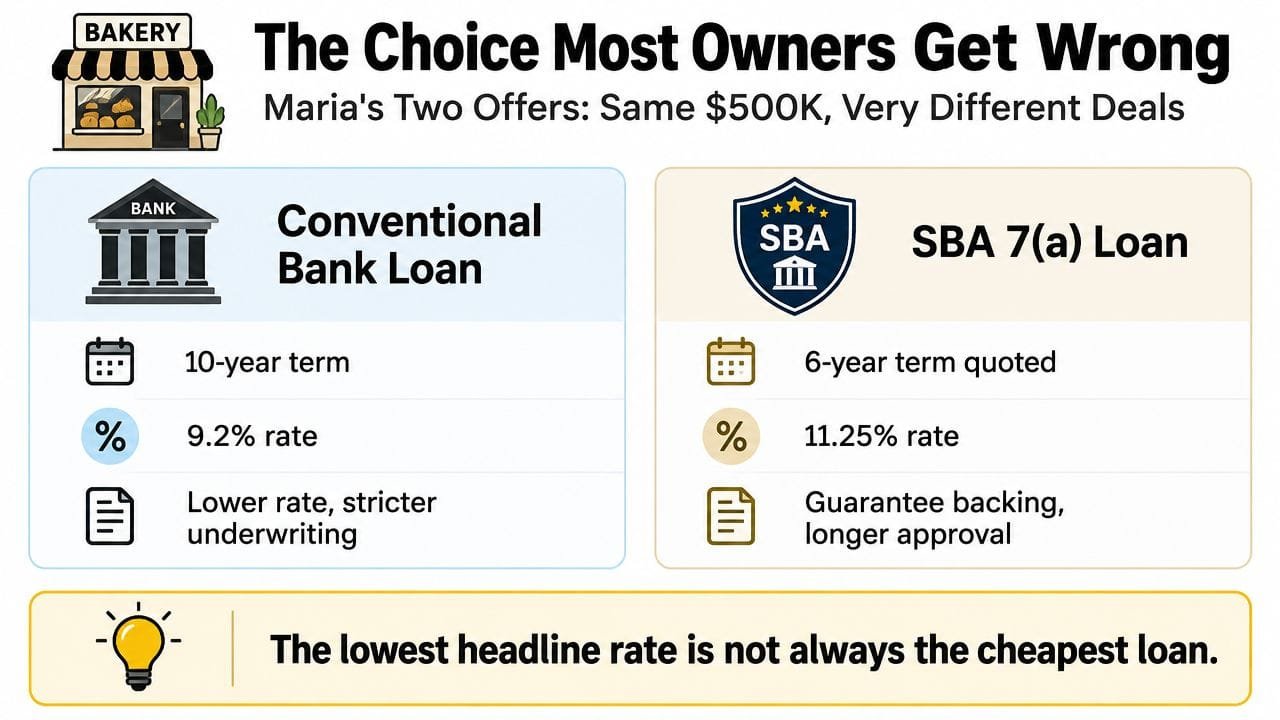
Maria, a second-generation bakery owner in Cleveland, is staring at two offers for the same $500,000 expansion. Her conventional bank proposal carries a 10-year term at 9.2%. The SBA 7(a) quote is 11.25%, with a six-year deal length and eligibility subject to a 210% cap in the quoted structure. On the surface, the SBA option looks wrong. The rate is 203 basis points higher, and the term is shorter.
But Maria isn't choosing between two rates. She's choosing between two probabilities: the chance that each loan closes, funds the expansion, and gives her enough breathing room to repay it. A denied $500,000 loan has no cost of capital because it produces no capital. It also has a serious business cost if the bakery has already committed to equipment, construction, inventory, or a new lease.
That's the lens for this comparison. The right question in an SBA loan vs bank loan decision is not just, “Which offer has the lower APR?” It's, “Which structure gives this business the highest probability of closing at an acceptable total cost?”
Table of Contents
- The Choice Most Owners Get Wrong
- What SBA Loans and Bank Loans Actually Are
- How Lenders Underwrite Each Option
- Rates, Terms, and Total Cost Compared
- Which Path Fits Your Business Profile
- A Worked Example With Real Numbers
- Your Decision Checklist and Next Steps
The Choice Most Owners Get Wrong
Maria's objection is reasonable. A conventional loan at 9.2% appears cheaper than an SBA loan at 11.25%, and a longer bank term appears more comfortable than a six-year SBA quote. If both offers were equally certain, equally flexible, and equally suitable for the bakery's cash flow, the bank loan would deserve the first call.
They aren't necessarily equal. Conventional banks make decisions with their own balance sheets at risk. An SBA lender still evaluates repayment ability, but the government guarantee can improve the lender's risk position. That distinction matters most when collateral is incomplete, the business has an unusual use of proceeds, or the bank's credit committee sees a weakness that doesn't invalidate the business but does make the conventional deal harder to approve.
The SBA 7(a) program has become a major small-business finance channel, growing from about 18,000 loans worth $4.3 billion in 1991 to about 70,000 loans worth $31.1 billion in 2024, according to Yale's analysis of the SBA 7(a) program%20Loan%20Program.pdf). Yet bank lending remains much larger overall. SBA Office of Advocacy data reported that banks provided over $644 billion in small-business loans in 2019, also documented in that Yale reference.
Advisor's rule: Compare the loan you can close with the loan you wish you could close. The first one deserves the serious analysis.
Don't mistake this argument for permission to accept any expensive SBA offer. If your company has strong cash flow, substantial collateral, clean financial reporting, and an established relationship with a bank, conventional financing may be both cheaper and faster. If the bank has already declined you or offered a structure that strains cash flow, the guarantee may be worth the added process.
A business under financial pressure should also avoid treating either approval as a rescue plan. If debt problems are already severe, owners may benefit from speaking with qualified counsel, including a hire a business bankruptcy lawyer resource, before adding another obligation.
What SBA Loans and Bank Loans Actually Are
An SBA loan isn't a check from the government. The Small Business Administration guarantees a portion of a loan made by an approved lender, such as a bank, credit union, or participating non-bank lender. The lender provides the money, collects payments, and remains responsible for underwriting and servicing the credit.
The SBA 7(a) is the flagship general-purpose product. Owners commonly use it for working capital, equipment, real estate, acquisition financing, or eligible debt refinancing. The SBA also supports specialized structures, including 504 financing for major fixed assets and Microloans for smaller borrowing needs. Each program has its own eligibility, use-of-proceeds, collateral, and documentation rules, so the product name alone doesn't determine whether a lender will approve the deal.
A conventional bank loan works differently. The bank lends its own funds without an SBA guarantee and sets its credit standards, pricing, collateral expectations, covenants, and approval authority. The product might be a fixed-rate term loan, a revolving line of credit, or a commercial mortgage. The bank's relationship with the borrower can influence the process, but the institution still carries the direct credit risk.
The product definitions that matter
| Feature | SBA Loan, 7(a) flagship | Conventional Bank Loan |
|---|---|---|
| Capital source | Approved lender funds the loan, with an SBA guarantee supporting the lender | Bank or credit union funds the loan directly |
| Typical uses | Working capital, equipment, real estate, acquisition, eligible refinancing | Working capital, equipment, real estate, and revolving credit |
| Risk structure | Lender underwrites repayment, with government-backed risk sharing | Lender bears the full credit risk |
| Pricing | SBA interest-rate ceilings and program fees may apply | Lender sets pricing based on credit, collateral, and relationship |
| Process | Lender underwriting plus SBA program compliance | Direct institutional underwriting |
| Best fit | Borrowers who need flexible structure or longer repayment | Borrowers with strong credit, cash flow, and collateral |
Owners who want a plain-language overview can review this simple guide to SBA loans for small-business owners, then ask a participating lender to confirm current program rules. The SBA doesn't remove underwriting. It changes the risk-sharing arrangement behind the underwriting.
That difference determines which door you should knock on first. For a conventional loan, start with a bank that understands your industry and already sees your deposits. For an SBA loan, look for a participating lender with meaningful experience in the 7(a) product and your type of transaction.
How Lenders Underwrite Each Option
Conventional underwriting starts with one question: can the business reliably produce enough cash to service the proposed debt? Banks typically test debt service coverage, review tax returns and financial statements, examine existing obligations, and assemble a collateral package. The founder's personal guarantee is often part of the credit structure for a small business.
The bank's credit memo also considers concentration risk, customer dependence, margins, industry conditions, management depth, and the purpose of the money. A business can have valuable assets and still lose the approval if projected cash flow doesn't support repayment. Collateral protects the lender after a default. It doesn't replace repayment capacity.
SBA underwriting still centers on cash flow. The guarantee doesn't turn an unviable business into an acceptable borrower. It can, however, soften the collateral problem and make a lender more willing to approve a file that doesn't fit a conventional credit box cleanly.
What the lender usually needs
| Underwriting area | Conventional bank | SBA 7(a) |
|---|---|---|
| Financial history | Business tax returns, profit and loss statements, balance sheets, and debt schedule | Similar financial documentation, plus SBA-specific forms and program support |
| Cash flow | Debt service analysis and lender-defined coverage requirements | Debt service analysis remains central, with the guarantee supporting lender risk |
| Collateral | Often expects a stronger collateral package | May tolerate less complete collateral coverage, subject to lender and program rules |
| Ownership | Personal guarantees and ownership disclosures | Personal guarantees and SBA eligibility disclosures |
| Use of funds | Bank validates the stated business purpose | Lender validates the purpose against SBA rules |
| Approval authority | Bank credit committee or delegated lender authority | Participating lender, with SBA processing requirements where applicable |
Recent Federal Reserve survey data shows that applicants at small banks had a 57% full-approval rate in 2025, as reported in the Federal Reserve Small Business Credit Survey. FDIC survey data also found that three in four banks can approve a small, simple loan within five business days, which helps explain why a straightforward conventional request can beat an SBA loan on speed.
The SBA channel has scale, but scale doesn't mean instant funding. SBA lenders commonly need 30 to 90 days to approve and fund a transaction, according to Bank of America's SBA loan guidance. That period can stretch when ownership is complex, financial statements need cleanup, appraisals are required, or the lender has to resolve eligibility questions.
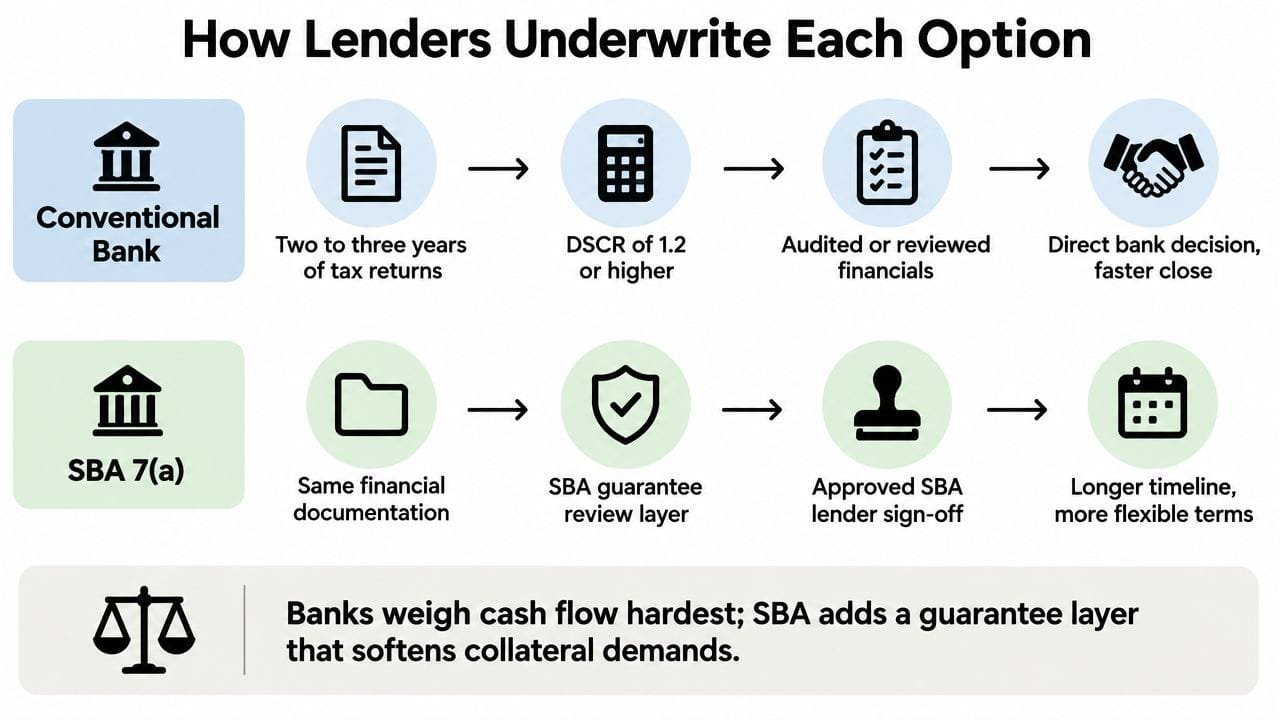
The planning implication is direct. Submit a complete file before you need the money, keep the bank and SBA document sets organized separately, and ask each lender what would cause a decline. A low quoted rate is irrelevant if the lender's credit policy makes approval improbable.
Rates, Terms, and Total Cost Compared
SBA pricing is more controlled than conventional bank pricing. The SBA establishes maximum interest-rate ceilings for 7(a) loans, and the lender prices within the applicable program limits. The guarantee is commonly capped at 75% on many standard transactions, while the borrower may receive longer amortization, subject to the purpose and structure of the loan, as described in SBA lender guidance.
A conventional bank can offer a lower rate to a top-tier borrower because it doesn't have to build the SBA process into the transaction. That lower rate may come with shorter amortization, tighter covenants, more collateral, or a larger equity contribution. The monthly payment can therefore be higher even when the nominal rate is lower.
The cost and term snapshot
| Metric | SBA 7(a) Loan | Conventional Bank Loan |
|---|---|---|
| Rate structure | Rate ceilings apply, and lenders may offer fixed or variable structures within SBA rules | Bank sets pricing based on borrower risk and market conditions |
| Term potential | Can run up to 25 years for eligible uses | Varies by lender, purpose, and collateral |
| Average size | Average 7(a) loan size was about $443,097 in fiscal year 2024 | Banks offer a broad range of small-business loan sizes |
| Recent program volume | Lenders approved more than 78,000 7(a) loans totaling $37.2 billion in fiscal year 2025, with an average of $447,571 | Conventional lending remains the larger overall bank-credit universe |
| Fees | Guarantee and packaging costs may apply | Origination, appraisal, legal, or other bank fees may apply |
| Primary advantage | Longer repayment and risk-sharing can improve payment fit and approval viability | Strong borrowers may receive lower pricing and a simpler process |
The SBA 7(a) lender study also reports relatively low annual default rates in its Yale analysis, 1.22% for business-acquisition loans and 1.64% for non-acquisition loans. That finding helps explain why lenders participate in the program, but it isn't a promise that an individual borrower will qualify or repay successfully.
Don't compare only the interest rate. Compare total dollars repaid, monthly debt service, guarantee fees, packaging fees, prepayment terms, collateral, and covenants. Owners deciding whether they should choose between a loan and a line of credit should also match the structure to the cash-flow pattern. A term loan suits a defined project. A line of credit suits recurring working-capital swings, provided the lender offers enough availability.
For a practical rate reference, review current market context in this business loan interest-rate guide, then request written term sheets. My rule is simple: a strong borrower should challenge an SBA premium, while a weaker collateral profile should price the value of access, not just the rate.
Which Path Fits Your Business Profile
The best structure changes sharply with the borrower's situation. Revenue matters, but so do operating history, urgency, collateral, ownership complexity, and the lender's confidence in the repayment story.
Four profiles and four recommendations
| Borrower profile | Main constraint | Better first path | Advisor's reasoning |
|---|---|---|---|
| Pre-revenue or early-stage startup | Limited business history, even with strong owner credit and 10% to 20% down | Bank line of credit or SBA Microloan | Keep the request small and preserve flexibility. A full SBA transaction may take too long for an unproven operation |
| Established SMB with $1M to $10M in revenue | Needs equipment, working capital, or debt refinancing | SBA 7(a) | The guarantee and longer potential term can produce a more workable structure |
| Growth company with $20M to $50M in revenue | Size, affiliates, complex ownership, and larger capital needs | Conventional bank term loan or SBA 504 | This bracket is often too complex for a simple 7(a) comparison. Asset-backed or conventional financing may fit better |
| Borrower needing funds in under 30 days | Timing dominates every other factor | Direct bank loan, if relationship and file are strong, or an alternative product | A standard SBA process commonly takes longer than the deadline |
The startup recommendation deserves nuance. A pre-revenue company may have strong owner credit and meaningful equity, but lenders still need evidence that the business can repay. An SBA Microloan can be more proportionate than a large 7(a) request, while a bank line may work if the owner has a credible relationship and sufficient support.
The $20M to $50M revenue bracket deserves special attention. Owners in this range often have better financials than startups but still face lender-selection bottlenecks, affiliate analysis, and documentation complexity. The largest 7(a) loan is subject to program limits, and eligibility can become complicated when related entities share ownership or operations. A conventional term loan may close more cleanly, while SBA 504 may fit a qualifying fixed-asset purchase better than 7(a).
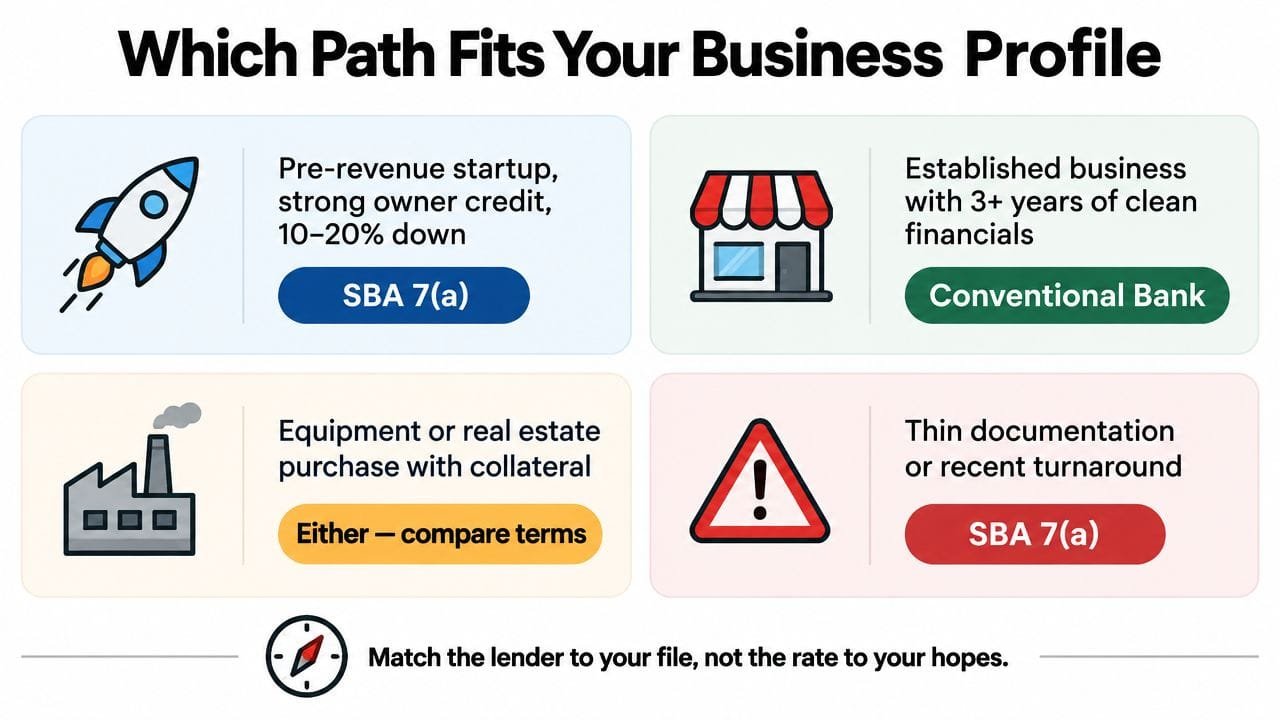
Use this checklist before requesting applications:
- Time horizon: If missing the funding deadline would damage the project, don't lead with SBA.
- Collateral: If the loan is poorly secured but cash flow is sound, SBA deserves priority.
- Purpose: Match working capital, equipment, real estate, acquisition, or refinancing to the correct product.
- Complexity: Multiple affiliates and large growth plans often require a more specialized credit strategy.
- Close probability: Ask each lender to identify the specific weakness that could stop funding.
A Worked Example With Real Numbers
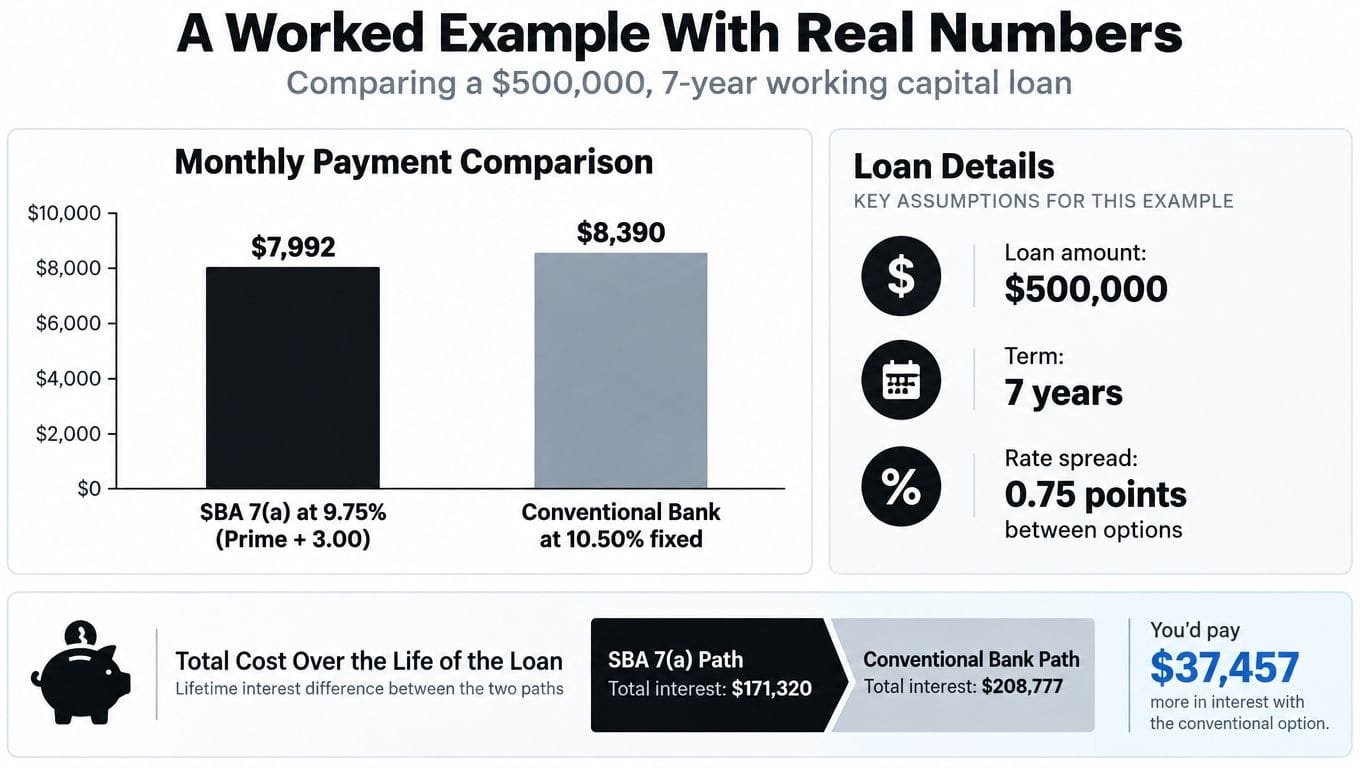
A clean comparison helps, but the math must use the actual proposed terms. Consider a $500,000, seven-year working-capital loan, with an SBA 7(a) rate of 9.75% and a conventional bank loan at 10.50% fixed. These are illustrative terms for the comparison, not a promise of current pricing or approval.
Using standard monthly amortization, the SBA payment is approximately $8,232 per month. The conventional payment is approximately $8,418 per month. The SBA rate is lower in this example, so its payment is lower, but the difference is modest because both loans use the same seven-year amortization.
The SBA loan's program costs then matter. A 2% guarantee fee on $500,000 equals $10,000, and the example assumes a $2,500 packaging fee. If the guarantee fee is financed, the payment calculation uses $510,000 rather than $500,000, producing an approximate payment of $8,396 per month before considering the packaging fee. The exact fee treatment depends on the lender and transaction.
The comparison at a glance
| Item | SBA 7(a) example | Conventional bank example |
|---|---|---|
| Original principal | $500,000 | $500,000 |
| Interest rate | 9.75% | 10.50% fixed |
| Term | 7 years | 7 years |
| Approximate payment before financed fee | $8,232 monthly | $8,418 monthly |
| Approximate scheduled interest before financed fee | $190,000 | $206,000 |
| Illustrative SBA guarantee fee | $10,000 | Not applicable |
| Illustrative packaging fee | $2,500 | Not included |
| Economic conclusion | Lower interest, but added SBA fees | Higher interest, potentially simpler structure |
The approximate interest difference is about $16,000, not the $35,000 to $45,000 sometimes claimed for a comparison of this size and term. Those larger savings would require different assumptions, such as a wider rate spread or a longer SBA amortization. A responsible advisor should show the actual math rather than force a preferred conclusion.
For a smaller $150,000 equipment loan, fixed fees and guarantee charges can consume more of the SBA rate advantage. A conventional bank loan may win economically if the bank offers competitive pricing, the equipment provides strong collateral, and the borrower can close without the SBA process.
The decision rule is practical. For larger loans, longer projects, limited collateral, or cash flow that benefits from extended amortization, calculate SBA costs carefully before rejecting the structure. For smaller, well-secured, urgent purchases, conventional financing often deserves priority.
Your Decision Checklist and Next Steps
Start with eligibility, not lender shopping. Confirm that the business fits the applicable SBA size standard, industry rules, ownership requirements, and permitted use of proceeds. Then ask whether the business has the operating history and personal credit profile needed for a credible lender review.
Build the file before the application
Gather the documents that both paths will need:
- Tax returns: Pull the last two years of business returns and the relevant personal returns.
- Current financials: Prepare a recent profit and loss statement and balance sheet.
- Debt schedule: List every existing loan, lender, balance, rate, payment, maturity, and collateral commitment.
- Purpose evidence: Collect purchase agreements, equipment quotes, construction budgets, lease documents, or acquisition materials.
- Ownership records: Organize entity documents, ownership percentages, affiliate information, and personal-guarantee details.
- Cash-flow explanation: Write a short explanation of unusual expenses, recent changes, seasonality, or one-time events.
A clean file improves more than speed. It lets the lender judge the business instead of spending the first conversations repairing missing information.
Run both paths in parallel
Request a soft-credit prequalification from a local bank for the conventional path, especially if the business already maintains deposits or borrowing history there. At the same time, submit the SBA request through a participating lender and include the required borrower information, financial statements, and business-plan appendix when the transaction calls for it.
Ask each lender five direct questions:
- What part of my file is most likely to stop approval?
- What collateral and personal guarantees will you require?
- What is the realistic time from complete submission to funding?
- Which fees are paid upfront, financed, or deducted from proceeds?
- What covenant or reporting obligations continue after closing?
The lender's answers reveal close probability better than a headline rate. A bank may quote an attractive number while requiring collateral you don't have. An SBA lender may quote a higher rate but provide a structure that preserves cash flow and gives the transaction a clearer route to approval.
Business Loan Warrior can run bank and SBA application paths from one dashboard, with a unified document vault, lender matching, and status tracking that helps owners compare which offer is likely to fund first. Use that type of workflow as a coordination tool, not as a substitute for reading the final term sheet.
The winning offer is the one that funds the stated purpose, keeps repayment manageable, and leaves the business with enough operating cash to perform after closing. Choose the lowest-cost structure when approval is highly probable. Choose the more flexible structure when the guarantee materially improves the chance of funding.
Business Loan Warrior helps owners compare SBA loans, bank financing, lines of credit, and other business funding options through one application and dashboard. Visit Business Loan Warrior to organize your documents, review matched options, and determine which funding path is most likely to close for your business.