
Most U.S. founders underestimate start up business costs by tens of thousands of dollars because they budget only for launch expenses and ignore ramp-up and survival capital. A useful starting point is the gap between the roughly $28,000 Americans estimate they need and the near-$12,000 median actual cost reported in another dataset, although neither figure applies equally to every business model.
That gap doesn't mean starting a business always costs more than expected. It means a single startup number is usually the wrong planning tool. A service company, online store, retail location, and restaurant carry completely different fixed costs, compliance burdens, staffing needs, and cash-flow pressures.
The practical answer is to divide your funding requirement into three phases: launch capital, ramp-up capital, and survival capital. Launch capital gets you legally formed, equipped, staffed, stocked, and ready to sell. Ramp-up capital pays the bills while sales build. Survival capital protects the owner and the business when revenue is still inconsistent.
Table of Contents
- Why Most Founders Misjudge Their Start Up Business Costs
- The Core Categories Every Startup Budget Must Cover
- How Start Up Business Costs Differ by Industry and Model
- Building a One-Time vs Ongoing Cost Budget
- The Hidden Costs That Derail Even Careful Budgets
- Funding Options to Cover Start Up Business Costs
- Your Launch Budget Checklist and Final Takeaways
Why Most Founders Misjudge Their Start Up Business Costs
Founders often ask for one number because lenders, search results, and planning templates encourage a simple answer. That approach breaks down quickly. One 2026 dataset found that 75% of respondents said running a business cost more than expected, while 30% reported that costs rose 25% to 50% in the past year. Those figures come from InCorp's 2026 startup trends analysis, and they point to a planning problem rather than a single universal price tag.
The most common mistake is treating the opening date as the finish line. A founder pays for formation, equipment, inventory, branding, and a deposit, then assumes customer revenue will immediately cover payroll and overhead. In practice, the business may open on schedule while sales, repeat customers, collections, and margins take longer to develop.
The three phases that belong in every funding plan
| Phase | Typical duration | What it covers | Common blind spot |
|---|---|---|---|
| Launch | Before opening and around opening | Formation, permits, deposits, equipment, technology, inventory, branding, and initial staffing | Assuming every pre-opening cost has been identified |
| Ramp-up | Early operating period | Payroll, rent, utilities, software, replenishment, marketing, taxes, and supplier payments while revenue develops | Believing the first sales will cover the full monthly burn |
| Survival | Until the owner and business can reliably support themselves | Household runway, debt payments, emergency repairs, compliance work, and continued operating expenses | Taking owner pay too early or having no personal cash reserve |
Labor and product inputs deserve special attention. In one major startup-cost survey, product costs represented 31.6% of first-year spending and team costs represented 18.8%, meaning those two categories together accounted for 50.4% of the reported budget. The same startup-cost survey summarized by Flair found that businesses with 1 to 4 employees spent about $60,000 in their inaugural year, including salaries.
Practical rule: If your budget ends on opening day, it isn't a first-year budget. It's a shopping list.
Mispricing one launch item can hurt, but underfunding payroll, rent, taxes, insurance, or the owner's basic living expenses can stop an otherwise viable company before it has enough time to prove demand. Build the model around cash needs by phase, not around the amount required to open the doors.
The Core Categories Every Startup Budget Must Cover
A sound budget starts with an inventory of cost categories, not a guess at the total. Write every expected expense down, assign it to a phase, identify when payment is due, and then request a quote or verify the fee. Don't total the plan until each line has an owner, a payment date, and an assumption.
| Category | Low range | High range | Planning note |
|---|---|---|---|
| Legal and registration | Varies | Varies | Include entity formation, contracts, filings, and registered-agent requirements |
| Licensing and permits | Varies | Varies | Confirm local, state, and industry obligations before signing a lease |
| Location and buildout | $0 for a home-based model | Can exceed $3 million in some industry-specific launches | Physical premises, code work, deposits, and construction can dominate the budget |
| Equipment and technology | Varies | Varies | Separate essential operating equipment from upgrades that can wait |
| Initial inventory or supplies | Varies | Varies | Match the opening purchase to realistic demand and replenishment timing |
| Marketing and branding | Varies | Varies | Budget for customer acquisition after opening, not just a logo and website |
| Insurance | Varies | Varies | Price liability, property, vehicle, workers' compensation, and required riders |
| Professional services | Varies | Varies | Include accounting, legal review, payroll setup, and compliance support |
| Working capital reserve | At least a defined multi-month reserve | Depends on monthly burn | Calculate from actual operating expenses, not from a round guess |
The verified benchmarks show why these categories can't be reduced to a standard checklist total. Service businesses may start with $5,000 to $25,000, while retail stores commonly require $50,000 to $150,000. Some industry-specific launches can exceed $3 million, depending on equipment, inventory, licensing, and buildout, according to Business.org's business startup cost benchmark.
Build the budget from payment events
For each line, record:
- What you're buying: Name the asset, service, fee, or obligation.
- When payment occurs: Deposits and prepaid expenses can arrive before revenue.
- Whether it repeats: Mark monthly, annual, seasonal, or one-time obligations.
- What triggers it: Hiring staff may trigger payroll systems, tax accounts, insurance, and compliance work.
- What happens if it rises: Identify which items can be deferred and which are mandatory.
A spreadsheet becomes useful when it reflects cash timing. A startup financial modeling guide can help you structure assumptions, cash-flow projections, and scenario planning before you approach a lender.
Don't hide professional fees, taxes, or compliance inside a broad “miscellaneous” row. If a cost is necessary to open or operate, it deserves its own line. That visibility makes it easier to negotiate, compare vendors, and explain the request to a lender.
How Start Up Business Costs Differ by Industry and Model
The same cost categories produce radically different totals because operating models carry different fixed commitments. A consultant working from home may need formation work, a computer, software, insurance, and a basic customer-acquisition plan. A restaurant needs a location, equipment, staff, inventory, permits, and a long list of pre-opening obligations before the first transaction.
For U.S. businesses, Xero's startup-cost guide places service businesses around $3,000 to $10,000, online businesses around $5,000 to $50,000, retail businesses around $50,000 to $150,000, and restaurants around $175,000 to $750,000 or more.
| Business model | First-year range | Primary cost drivers |
|---|---|---|
| Service business | $3,000 to $10,000 | Professional tools, lead generation, insurance, contractors, and basic technology |
| Online business | $5,000 to $50,000 | Website or platform, software, digital marketing, inventory, shipping, and fulfillment |
| Retail business | $50,000 to $150,000 | Lease, deposits, buildout, inventory, equipment, POS systems, and staffing |
| Restaurant | $175,000 to $750,000 or more | Kitchen equipment, buildout, permits, inventory, payroll, insurance, and occupancy costs |
Fixed costs decide how much risk you carry
Location is usually the dividing line. A home-based service operation can delay rent and buildout, while a storefront commits the owner to a lease, utilities, signage, security, insurance requirements, and staffing before demand is proven.
Inventory creates a second major difference. An online company may avoid a customer-facing location but still need cash tied up in products, packaging, shipping, returns, and replenishment. A restaurant faces a different pressure, because perishable stock, specialized equipment, health requirements, and staffing all arrive before reliable sales.
Independent benchmarking also shows that online-only businesses average about $35,000, mobile businesses about $92,500, and storefront businesses about $100,000 in first-year spending. The cited expense mix concentrates on equipment, location, taxes, utilities, and payroll in the Business.org operating-format benchmark.
Choose the model you can finance through its slowest realistic revenue period. A cheaper launch isn't automatically safer if it leaves you unable to restock, pay staff, or maintain service quality.
Building a One-Time vs Ongoing Cost Budget
Separate one-time spending from recurring burn before you choose a funding amount. One-time costs generally include equipment, buildout, initial inventory, formation work, launch branding, and setup fees. Ongoing costs include rent, payroll, utilities, software, insurance, taxes, marketing, maintenance, and supplier payments.
The distinction matters because a founder can pay a one-time invoice once, but a monthly obligation continues whether sales arrive or not. A lease deposit may be paid before opening, while rent begins immediately. A website may be a launch expense, while hosting, software, customer support, and marketing continue after launch.
Add dates, not just categories
Use a budget with four working columns:
| Cost category | One-time amount | Monthly ongoing | Six-month total |
|---|---|---|---|
| Formation, legal, and permits | Enter quoted amount | Enter renewal or compliance cost | One-time amount plus applicable recurring spend |
| Equipment and technology | Enter purchase or installation cost | Enter subscriptions and maintenance | One-time amount plus six months of ongoing cost |
| Inventory and supplies | Enter opening purchase | Enter replenishment estimate | Opening stock plus six months of expected purchases |
| Location and occupancy | Enter deposit and setup cost | Enter rent, utilities, and related charges | Deposit and setup plus six months of occupancy |
| Payroll and contractors | Enter hiring or training cost | Enter wages, taxes, and contractor payments | Hiring cost plus six months of payroll |
| Marketing and sales | Enter launch work | Enter monthly acquisition budget | Launch work plus six months of marketing |
| Insurance and professional services | Enter setup fees | Enter premiums, accounting, and legal support | Initial fees plus six months of recurring obligations |
Assign each line a trigger date, such as “before lease signing,” “before first hire,” “opening week,” or “after first customer.” This prevents a month-six expense from disappearing because it wasn't needed on day one.
Calculate the cash bridge
Forecast cash by month, not just annual profit. Start with the opening balance, subtract launch payments, add expected collections, and subtract the operating burn that remains even if sales disappoint. Run a conservative case in which revenue arrives later and costs rise.
Keep a separate survival reserve. The reserve isn't a vague contingency bucket. It's the cash that allows the owner to continue paying personal obligations while the company reaches dependable cash flow. If you combine it with launch funds, you may spend the money on equipment and discover later that you can't afford to keep operating.
The right question isn't “Can I open?” It's “Can I keep operating if sales take longer to build?”
The Hidden Costs That Derail Even Careful Budgets
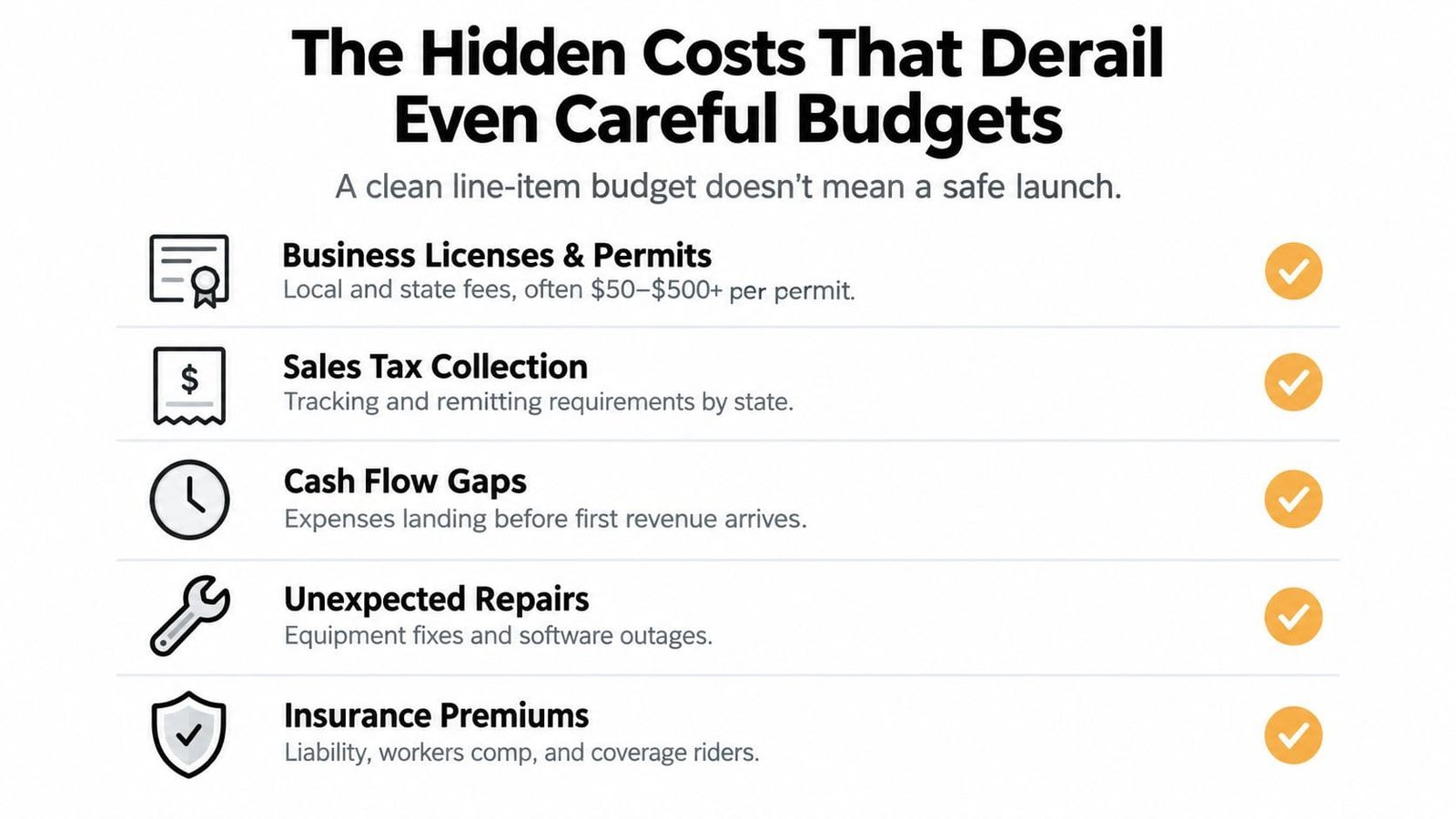
A tidy spreadsheet can still produce a dangerous funding request. Founders commonly budget for a website, equipment, inventory, and advertising while overlooking the operational and regulatory requirements that must be paid before the business can trade normally.
A 2026 survey covering more than 200,000 active accounts and 776 U.S. small-business owners found that 51% of founders encountered expense categories they hadn't budgeted for, while 54% reported startup costs they were completely unaware of beforehand. The most common surprises were equipment and physical space at 37%, business insurance at 35%, and licensing, permits, and compliance at 34%, according to the Bluevine survey release.
Check the obligations behind the invoice
A permit fee may be only one part of the cost. You may also need inspections, plan revisions, code upgrades, professional drawings, or a delayed opening that extends payroll and rent without revenue.
Review these items before committing capital:
- Licenses and permits: Verify every local, state, and industry requirement before signing a lease or advertising an opening.
- Sales tax registration: Set up collection, tracking, filing, and remittance processes before taking taxable payments.
- Lease deposits and guarantees: Ask whether the landlord requires multiple deposits, personal guarantees, prepaid rent, or tenant improvements.
- Insurance certificates: Confirm the coverage limits and policy endorsements required by landlords, clients, lenders, or regulators.
- Payroll compliance: Include payroll-tax setup, workers' compensation where applicable, onboarding, and employment documentation.
- Professional review: Pay for an accountant or attorney to review contracts, entity structure, licenses, and tax treatment.
- Compliance software: Include recurring tools for filings, payroll, bookkeeping, sales tax, and required reporting.
The cash-flow trap is timing. A business may owe a deposit, insurance premium, equipment payment, permit charge, or supplier invoice before its first meaningful customer payment. Underbudgeting those items by a few thousand dollars can force an owner to delay opening, use expensive short-term credit, or cut essential operating cash.
The risk is particularly pronounced in construction and trade businesses, where licensing, permits, and compliance surprised 46% of surveyed owners. Treat every “small” obligation as a possible opening condition until a qualified professional or regulator confirms otherwise.
The following video provides another practical overview of startup-cost planning and common expense categories.
Funding Options to Cover Start Up Business Costs
Match the funding source to the phase it covers. Using long-term debt for a short cash gap can be inefficient, while using a credit card for equipment or a buildout can create repayment pressure before the asset produces revenue.
Personal savings offer speed and control, but they put the founder's household balance sheet at risk. Friends-and-family funding can be flexible, yet it still needs written terms, repayment expectations, and a clear explanation of what happens if the launch takes longer than planned.
Compare the trade-offs before applying
| Funding option | Typical speed | Relative cost | Best for |
|---|---|---|---|
| Personal savings | Immediate | No lender interest, but high personal exposure | Small launch purchases and owner contributions |
| Friends-and-family debt | Often flexible | Negotiated financial and relationship cost | Defined early expenses with written repayment terms |
| SBA loan | Slower application process | Generally structured for longer repayment | Larger launch or expansion needs with a documented plan |
| Conventional business loan | Varies by lender | Depends on credit, collateral, and terms | Established borrowers or well-supported applications |
| Business line of credit | Faster once approved | Interest applies to drawn funds and terms vary | Revolving working capital and uneven cash flow |
| Business credit card | Fast after approval | Can be expensive if balances revolve | Short-term float for controlled, rewards-eligible spending |
| Merchant cash advance | Fast | Often expensive | A last-resort bridge when other capital isn't available |
SBA loans, including 7(a) and Microloan programs, can offer a more suitable structure for borrowers who can handle the documentation and timeline. Conventional loans and lines of credit may move faster, but lenders typically expect stronger credit, repayment capacity, collateral, or operating evidence.
Don't treat a merchant cash advance as normal startup capital. It can bridge an urgent gap, but repayment tied to sales can drain cash from a business that hasn't reached stable margins. Use it only after comparing the full repayment obligation with every slower and less expensive alternative.
For founders without current revenue, this guide to startup funding without revenue offers additional ways to think about capital access. The right sequence is usually personal contribution for a manageable launch, appropriately structured debt for durable assets, and a line of credit for working-capital volatility.
Your Launch Budget Checklist and Final Takeaways
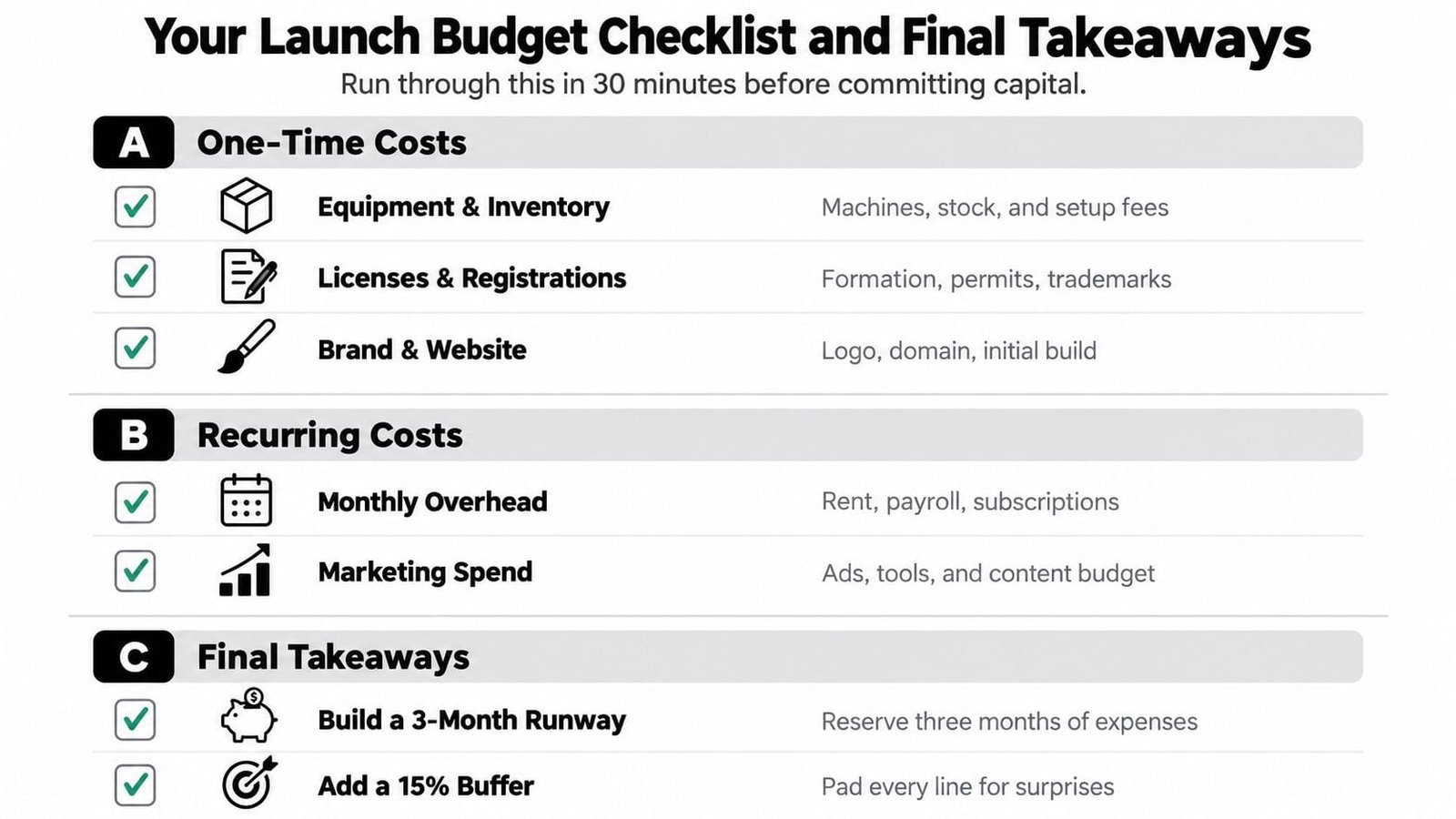
Before committing money, force the plan through a short approval process. Conservative assumptions beat optimistic forecasts, especially when the business has a lease, payroll, inventory, equipment, or regulatory dependencies.
Run this checklist before you commit capital
- Price the launch phase: List formation, permits, deposits, equipment, technology, initial inventory, insurance, professional services, and launch marketing.
- Map the ramp-up phase: Forecast monthly payroll, rent, utilities, software, taxes, replenishment, marketing, and debt payments against conservative collections.
- Protect survival capital: Keep personal living needs separate from operating cash so the owner isn't forced to draw money before the business can support it.
- Check every hidden obligation: Confirm licenses, sales-tax registration, insurance certificates, payroll compliance, lease requirements, repairs, and filing tools.
- Add payment dates: Mark when each invoice is due, then calculate the lowest cash balance rather than relying on a total budget figure.
- Match capital to purpose: Use savings for controlled early costs, structured loans for durable assets, and revolving credit for short-term working-capital gaps.
- Test the downside: Delay revenue in the forecast, increase unavoidable expenses, and confirm the business can still pay its essential bills.
A working budget worksheet can make this review faster. Use the small-business budget worksheet to organize one-time costs, recurring expenses, and the cash reserve that sits between opening and dependable revenue.
Frequently asked questions
How much cash should I keep in reserve?
Keep a separate reserve based on your actual ongoing expenses and personal obligations. The correct amount depends on your model, fixed costs, and revenue timing, not on a universal startup percentage.
Should I use savings or debt?
Use savings when the amount is manageable and losing it won't threaten your household. Use debt for assets or working capital only when projected cash flow can support repayment under a conservative scenario.
What do lenders look at?
Expect attention on credit history, business structure, collateral where relevant, documented expenses, repayment capacity, owner contribution, and the assumptions behind your projections. A clear use-of-funds schedule is stronger than a round request with no supporting detail.
How long should first-year runway last?
Build the runway around the time required to reach reliable collections, then add protection for delays, repairs, compliance work, and uneven demand. If your model depends on immediate profitability, the budget is too optimistic.
Start by itemizing every launch payment today, then build the ramp-up and survival cases before you apply for capital. Business Loan Warrior offers a single application for tailored small-business funding, including loans, SBA processing, lines of credit, equipment financing, and other financing options. Visit Business Loan Warrior to review available funding paths and match the request to the specific cash phase your business needs to finance.