
An emergency credit line is a pre-arranged revolving facility that lets a business draw cash quickly against approved collateral or credit, then repay and reuse it, so a sudden revenue gap, repair, or vendor event doesn't become a solvency event. The right time to arrange it is before the crisis, because in 2025, 60% of small firms applied for financing, yet only about 4 in 10 received all the financing they sought. (Federal Reserve data)
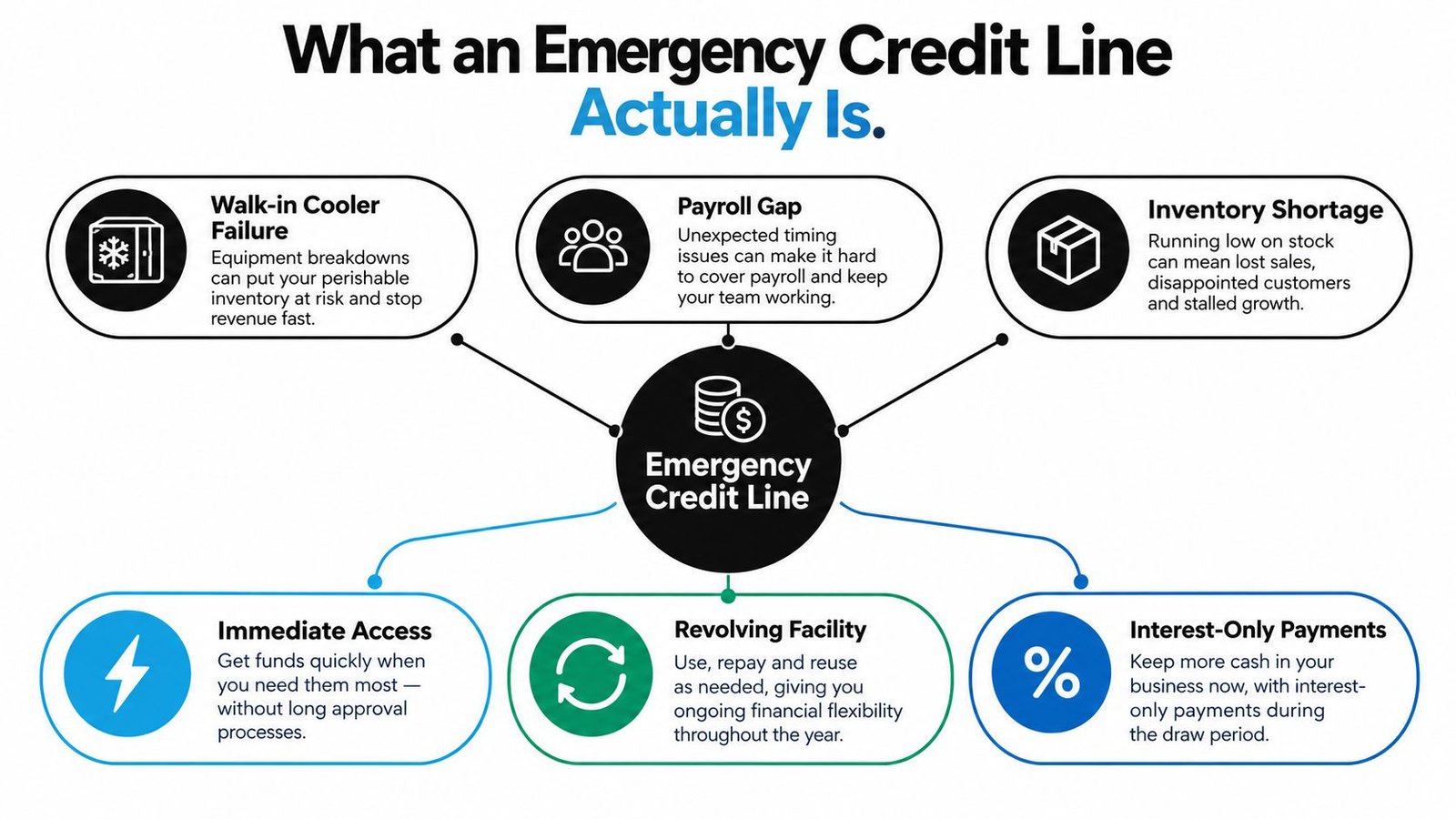
A walk-in cooler dies on Friday. Payroll is due Monday. A key supplier wants cash before releasing the next shipment, and the balance in the operating account is lower than expected. That's when many owners start searching for “fast business funding,” only to discover that lenders still want bank statements, debt schedules, tax filings, collateral details, and evidence that the business can repay.
That timing is backwards. An emergency credit line is liquidity insurance, not a rescue product. You arrange the facility while the business is healthy enough to qualify, understand its cost while you still have negotiating power, and draw only when a defined short-term disruption threatens operations.
Table of Contents
- What an Emergency Credit Line Actually Is
- How Emergency Credit Lines Became a Crisis Tool
- Emergency Lines Versus Other Urgent Funding Options
- What Lenders Actually Check Before Saying Yes
- Setting Up a Standby Facility Before You Need One
- What Drawing in a Crisis Actually Costs
- Three Crises Where an Emergency Line Pays Off
- Sizing and Using an Emergency Line the Right Way
What an Emergency Credit Line Actually Is
The owner with the failed cooler doesn't necessarily need a large permanent loan. They need enough available cash to repair or replace equipment, cover immediate operating obligations, and keep serving customers while normal revenue catches up.
An emergency credit line is built for that pattern. A lender approves a maximum amount, and the business draws only what it needs. As the business repays principal, availability can return, subject to the agreement's terms. It works more like a business credit card than a term loan, although the pricing, collateral, covenants, and repayment rules can be much stricter.
A term loan deposits a lump sum once and schedules repayment against the full balance. A revolving line gives you access to a pool of capital, so borrowing and repayment can match the timing of your cash cycle. That flexibility is useful when the amount or duration of the disruption isn't perfectly predictable.
Committed and uncommitted access
A committed facility gives you a contractual right to borrow, provided you meet the stated conditions. An uncommitted line gives the lender more discretion to approve or decline each request. “Pre-approved” language on an online application often means a preliminary screen, not a binding promise that the full amount will be available during a downturn.
The practical borrowing base matters more than the headline limit. A lender may size a secured line against eligible receivables, inventory, equipment, securities, or other assets, then apply advance rates and valuation discounts. The Federal Reserve explains that emergency lending is constrained by collateral quality, legal eligibility, and loss-absorption design, not just by the borrower's stated need. Acceptable collateral can include government and agency securities, municipal and corporate debt, commercial paper, bank assets, and performing commercial or consumer obligations. (Federal Reserve collateral guidance)
For a broader explanation of revolving facilities and their mechanics, review this guide to business credit facilities. The mental model is simple: standby liquidity sized before the emergency, with clear rules for drawing, repayment, reporting, and availability.
How Emergency Credit Lines Became a Crisis Tool
Emergency liquidity became prominent because short-term funding markets can fail faster than a normal business can adjust. During the 2007–2009 global financial crisis, private lenders sharply reduced lending, leaving financial institutions unable to rely on routine funding channels.
The Federal Reserve responded with secured facilities designed to keep credit moving. Its Term Securities Lending Facility reached $235.5 billion in outstanding loans on October 1, 2008, while the Commercial Paper Funding Facility reached $348.2 billion on January 21, 2009. Other programs, including the Primary Dealer Credit Facility and the Asset-Backed Commercial Paper Money Market Mutual Fund Liquidity Facility, also supplied liquidity against collateral. (Congressional Research Service overview)
The confidence effect
The important lesson isn't that a business should compare itself with a central bank. It's that a backstop can change behavior before the borrower uses all of it.
A lender, supplier, employee, or owner acts differently when reliable liquidity is already available. The line can prevent a temporary collection delay from forcing missed payroll, rushed asset sales, or an expensive last-minute financing decision. The facility's availability can reduce panic even when the borrower draws little or nothing.
Practical rule: Treat the undrawn portion of a line as protection, not as spare money to spend.
The COVID-19 crisis adapted this model for operating companies. In April 2020, the Federal Reserve announced the Main Street Lending Program for small and mid-sized companies that were too large for many small-business relief programs but often too small to access public bond markets easily. By November 15, 2020, its five facilities had funded approximately $5.0 billion against $600 billion of authorized capacity, less than 1% of potential lending capacity. (Congressional Research Service analysis)
That low utilization didn't make the backstop irrelevant. Announced liquidity encouraged private lenders to continue extending credit, and the broader effort showed that committed funding can stabilize confidence without every approved dollar being drawn. Business owners can apply the same principle at a smaller scale by arranging a facility before revenue interruption becomes a financial emergency.
A disciplined cash flow guide for small businesses can help identify the operating gaps a standby line should cover. Cash-flow forecasting should come before the credit application, not after the first missed payment.
Emergency Lines Versus Other Urgent Funding Options
The product label matters less than the repayment mechanics. A fast facility can still be the wrong choice if its payment schedule drains cash every day while revenue recovery takes longer than expected.
| Product | Typical funding speed | Repayment structure | Collateral or guarantee | Total cost risk |
|---|---|---|---|---|
| Emergency credit line | Can be quick after approval and documentation | Draw-based repayment, often reusable when principal is repaid | May be secured, unsecured, or supported by a personal guarantee | Variable pricing, fees, and reduced availability can raise the effective cost |
| Term loan | Usually slower than an already-open line | Fixed installments against the full borrowed amount | May require business assets, collateral, or a guarantee | Predictable payments, but you pay for funds you may not immediately need |
| Merchant cash advance | Often marketed as rapid | Daily or weekly remittance tied to receivables or a fixed schedule | Commonly relies on business cash flow and a personal guarantee | High repayment burden can worsen a temporary cash shortfall |
| Invoice financing | Depends on invoice verification | Advance is repaid when customers pay, with fees deducted or charged | Specific invoices and customer quality are central | Concentration, slow-paying customers, and repeated fees can erode margin |
| Disaster loan | Timing depends on program rules and eligibility | Structured installments over an agreed term | Program-specific collateral and guarantee requirements may apply | Lower pricing may come with slower access and extensive documentation |
An emergency line usually fits a short, uncertain cash gap. A term loan fits a defined purchase or project with a clear repayment schedule. Invoice financing fits a business with strong outstanding receivables but delayed customer payments. A merchant cash advance may provide speed, but its remittance structure can punish a company whose sales are already unstable.
For a deeper look at alternatives, compare short-term business financing options by payment behavior rather than by advertised approval speed. Ask how much cash leaves the account after a draw, whether repayment changes with revenue, and whether the facility remains available after partial repayment.
Four questions to ask before signing
- How quickly can usable cash arrive? A line that requires a fresh underwriting review for every draw may not function as emergency liquidity.
- What happens during a slow month? Fixed, daily, and weekly payments behave very differently when sales fall.
- What supports the lender's recovery? Review personal guarantees, blanket liens, receivable controls, and collateral reporting.
- What is the total repayment amount? Don't compare rates alone. Include every fee, required minimum, and payment triggered by the draw.
Owners who want peer discussion about financing structures can also explore a CFO community for practical finance conversations. The useful question isn't “Which product is fastest?” It's “Which repayment design leaves the business alive while it recovers?”
What Lenders Actually Check Before Saying Yes
Lenders don't approve an emergency line because an owner says the business needs one. They approve it when the documents show a credible repayment source, acceptable risk, and enough collateral or cash flow to absorb a bad month.
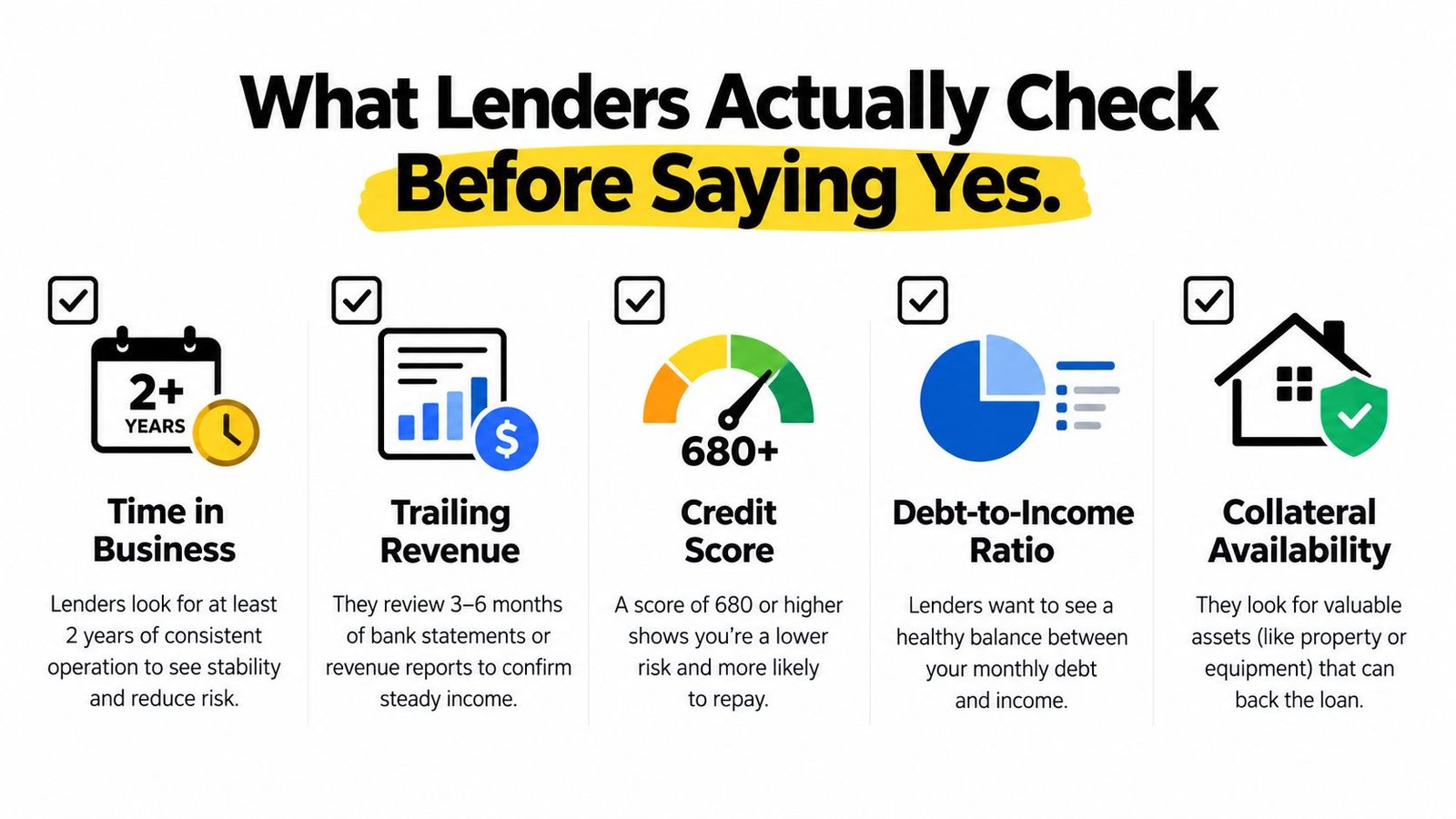
Underwriting usually starts with recent deposits and operating history. The lender wants to see whether revenue is consistent, seasonal, concentrated in a few customers, or already weakening. Time in business matters because a longer operating record gives the lender more evidence about how the company handles ordinary volatility.
The five underwriting buckets
- Recent cash movement: Bank statements show deposits, withdrawals, overdrafts, returned payments, and whether reported revenue reaches the operating account.
- Credit profile: Owner and business credit histories can affect pricing, structure, and approval. A score alone won't explain the whole file.
- Existing debt: Current loans, credit cards, advances, tax obligations, and leases compete for the same cash flow.
- Borrowing base: For a secured facility, the lender tests receivable aging, customer concentration, inventory quality, liquidation value, and reporting reliability.
- Industry and operating risk: Restaurants, contractors, retailers, and seasonal companies can have strong revenue while facing sharp timing gaps. The lender still needs to understand the cycle.
In 2024, approximately 48% of U.S. applicants for loans, lines of credit, or merchant cash advances did not receive the full amount requested. Reported reasons included low credit scores, excessive existing debt, and weak sales. (Federal Reserve small-business credit survey)
A soft online pre-qualification doesn't override those checks. Before sizing a real facility, a credit team may request recent bank statements, tax filings, accounts-receivable aging, a debt schedule, ownership information, and collateral reports. Keep those files together before applying.
Watch for quiet approval killers: repeated nonsufficient-funds events, a large share of revenue from one customer, undisclosed tax liens, rapidly stacked obligations, and receivables that look profitable on paper but aren't collectible. If you're comparing products for a difficult credit profile, use a resource that helps you compare short-term loan options without ignoring repayment risk.
This business loan underwriting process is the right mental model. Qualification isn't a marketing checkbox. It's a documented argument that the business can repay under stress.
Setting Up a Standby Facility Before You Need One
Arrange the line while operations are stable. Once vendors are pressing for payment, payroll is near, or equipment has failed, your negotiating position is weaker and the facility may arrive too late.
Start with the latest bank statements. Separate owner transfers from operating activity, explain large deposits, correct avoidable overdrafts, and reconcile every figure to the bookkeeping. Prepare a one-page credit memo covering the business model, cash sources, likely disruptions, requested limit, and repayment plan.
A practical setup sequence
- Map the cash gap: List fixed payroll, critical suppliers, debt service, insurance deductibles, and delayed collections. Size the minimum facility around obligations that cannot wait, then challenge the limit for unnecessary capacity.
- Build a borrowing-base worksheet: Document eligible receivables, exclusions, aging, customer concentration, inventory, and available collateral. Apply conservative values rather than optimistic book figures.
- Choose the structure: Compare secured and unsecured access. Secured credit may provide more capacity, but default can put business assets at risk.
- Review the agreement: Confirm whether the line is committed or uncommitted, whether unused fees apply, how often reporting is required, and what can freeze or reduce availability.
- Test access: If allowed, draw a small amount and repay it. Check the process, funding time, dashboard balance, and how restored availability is calculated.
Treat the facility as liquidity insurance, not emergency rescue funding. The practical question is how to size and time standby access without paying for capacity the business will not use.
Keep bank statements, tax returns, aged receivables, debt schedules, insurance records, and key contracts in one secure folder. Add current ownership information and the latest financial reports. Update the folder on a set schedule, because a lender cannot assess documents you cannot produce quickly. Before signing, ask exactly which documents must be refreshed and how long approval remains valid. That preparation turns a stressful funding request into a defined operating process.
What Drawing in a Crisis Actually Costs
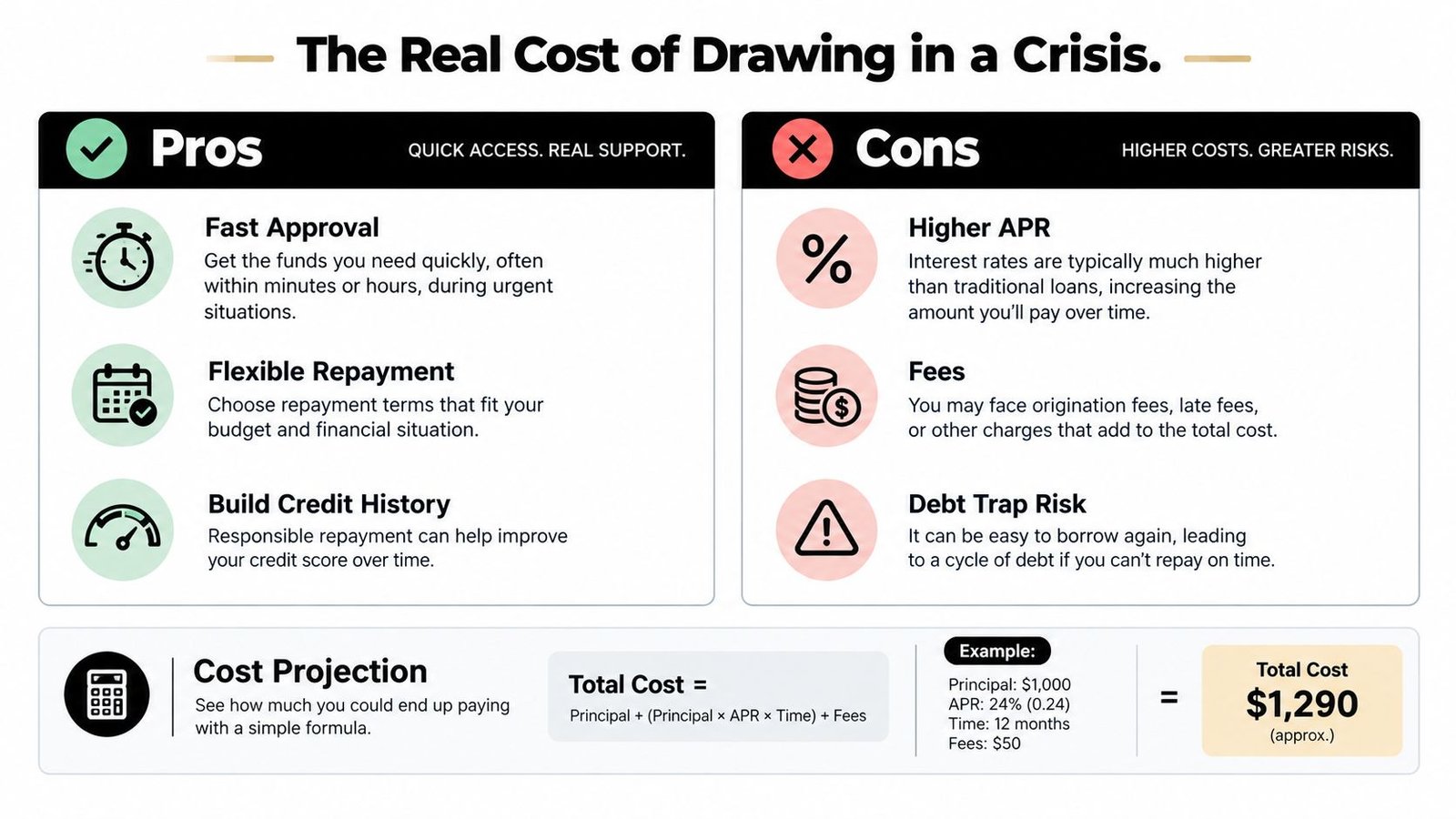
Fast approval matters only when the repayment plan can survive the disruption. Owners often compare interest rates first because rates are easy to line up. Fees, guarantees, liens, minimum charges, and default provisions can have a greater effect on future cash flow.
A survey of 774 U.S. business owners found that 15.6% avoided accessing capital because total cost was unclear, while 25.6% said capital was difficult to access. The survey also reported that affordable small-business credit declined. (Bluevine small-business cash-flow survey)
Model the draw, not just the approval
Before drawing, document:
- The amount and date of the draw.
- The interest rate and what happens if it changes.
- Origination, maintenance, draw, wire, and unused-line fees.
- Minimum payments and how partial repayment affects the balance.
- Whether interest accrues daily or on another schedule.
- Any personal guarantee or blanket lien.
- Covenants tied to revenue, liquidity, reporting, or debt.
- The lender's right to reduce availability or request more collateral.
Run three operating cases: revenue recovers quickly, recovery takes longer than expected, or another disruption arrives. Base repayment on a credible case, not the best case. If the line works only when every customer pays on time, it is not a dependable emergency plan.
Read the default section before the pricing page. A clause allowing the lender to freeze availability can cost more than a higher stated rate when cash is tight.
Partial repayment needs close review. Some facilities restore availability as principal returns. Others reduce the limit, require another review, or keep the borrowing base constrained. Repaying a draw can still leave the business with less usable liquidity than expected.
Personal guarantees and blanket liens change the risk as well. If the line protects the company while placing personal assets at risk, the owner must understand that trade before signing. Arrange standby liquidity before pressure peaks, then size it around a defined gap and repayment source. Speed has value, but it does not justify unclear economics.
Three Crises Where an Emergency Line Pays Off
A restaurant owner with a failed walk-in cooler may draw enough to cover the repair, protect perishable inventory, and bridge the next collection cycle. The decision isn't based on panic. The owner checks expected deposits, confirms that the repair restores normal sales, and begins repayment as operating cash returns.
A contractor may face a materials supplier that requires cash before releasing an order. If the project has a credible payment source and the purchase keeps the job moving, a standby line can cover the timing mismatch. The owner should watch billed-versus-collected cash, not just the contract's total value, and repay from customer receipts rather than stacking another product.
A retailer may have a key supplier switch to cash on delivery after a credit review. Drawing can make sense when the inventory is proven, demand is visible, and the line prevents a broader sales interruption. It's a poor choice when the retailer is using borrowed money to hide weak margins or unsold stock.
The right draw has a defined exit. You should know which customer receipt, operating surplus, insurance payment, or cost reduction will repay it.
In each case, the line works because the problem is temporary and the repayment source is identifiable. A permanent operating loss needs restructuring, cost reduction, equity, or a different financing plan. Borrowing can bridge a gap. It can't turn an unprofitable business into a profitable one.
Sizing and Using an Emergency Line the Right Way
Set the minimum limit from fixed payroll + critical suppliers + debt service + insurance deductibles + expected collection delays, then add a conservative buffer. Don't size it from annual revenue alone.
Before applying, assemble bank statements, tax filings, aged receivables, a debt schedule, collateral details, and a short cash-flow forecast. Confirm whether the line is committed, what fees apply while unused, and what conditions can reduce availability.
Don't draw yet if margins are weak, tax liabilities remain unresolved, revenue depends heavily on one customer, or the proposed repayment source is only an optimistic forecast. Expand the line when recurring cash flow supports it and documented operating needs consistently exceed availability. Reduce or replace it when the facility stays unused, fees outweigh the insurance value, or a cheaper and more stable structure becomes available.
The cooler still fails on Friday. The prepared owner has already negotiated the facility, tested access, and knows exactly how much to draw. That's the difference between liquidity planning and emergency borrowing.
Business Loan Warrior offers revolving business lines of credit alongside term loans, SBA processing, equipment financing, invoice financing, and other funding options. Review your standby-liquidity needs, compare available structures, and submit an application through Business Loan Warrior before a cash-flow shock forces you into a rushed decision.