
You've built a healthy business, paid suppliers on schedule, and kept enough cash moving through the company to fund daily operations. Then you apply for financing and discover that the lender doesn't just want to see your bank balance. It wants to know what your company's business credit profile says about its history of paying obligations.
That moment creates confusion for many first-time owners. Business credit isn't just your personal credit score with a company name attached. It's a separate commercial record, although your personal credit can still matter when the business is new, closely held, or backed by a personal guarantee. Understanding the difference helps you choose financing carefully, avoid expensive credit-building mistakes, and prepare before you need capital.
Table of Contents
- The First Time a Lender Looks at Your Business
- What Actually Goes Into a Business Credit File
- Business Credit vs Personal Credit
- How Business Credit Scores Are Calculated
- Building Business Credit From a Standing Start
- The Hidden Cost of Building Credit With Debt
- How Lenders Read Your Profile Across Financing Types
- Monitoring, Repair, and Your 90-Day Credit Readiness Plan
The First Time a Lender Looks at Your Business
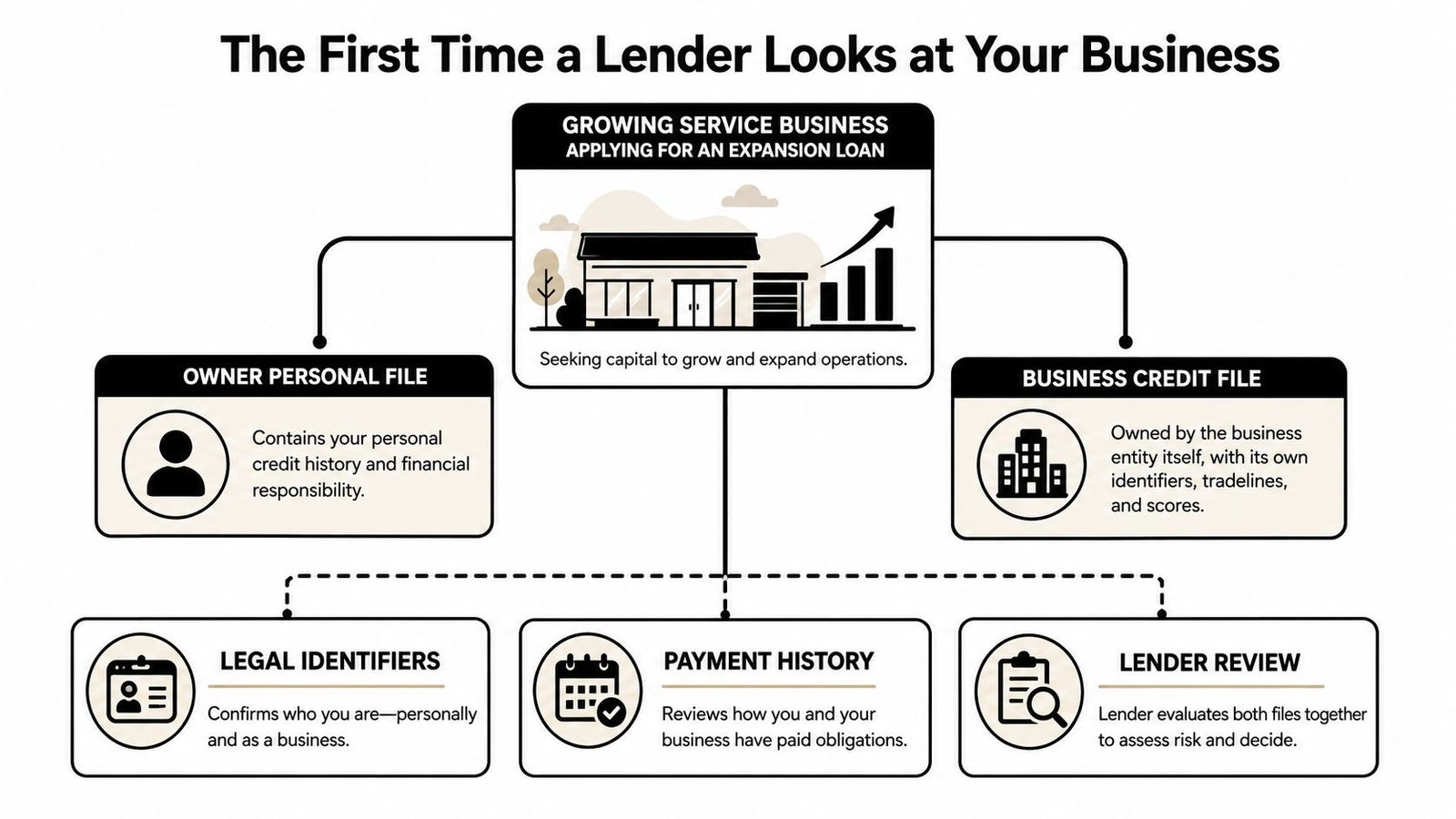
Maya owns a growing commercial cleaning company. Her contracts are stable, her clients pay regularly, and she wants financing to purchase equipment and hire another crew. She expects the lender to review her personal credit because she signed the original lease and funded the company herself.
The lender does review it, but then opens another file. That file belongs to the company. It contains the business's legal identity, reported supplier accounts, payment behavior, outstanding obligations, and any relevant public records. Maya's personal history may still influence the decision, but it isn't the whole picture.
A working definition
Business credit is a record of a company's financial reliability and repayment behavior. Lenders, suppliers, landlords, and other counterparties use it to judge whether the company can meet obligations such as loan payments, vendor invoices, leases, and other debts. The FDIC's explanation of business credit describes it as a record of financial reliability and repayment history used to assess creditworthiness.
That definition matters because business credit is better understood as an information system than as one universal number. Bureaus collect information from creditors, suppliers, public records, and company filings. They organize those details into reports and scoring products that help another party estimate repayment risk.
Practical rule: Treat your business credit file as the company's financial résumé. Paying on time helps, but the payment must be visible in the file to influence a lender's view.
A lender may use this information during the broader business loan underwriting process. Suppliers may consult it before offering payment terms, and leasing companies may consider it before approving a commercial agreement. A late payment, collection, lien, judgment, or bankruptcy-related record can weaken confidence, while consistent payment creates evidence that the company manages obligations responsibly.
What Actually Goes Into a Business Credit File
Think of a business credit file as a stack of receipts that a lender can retrieve when it needs to assess your company. The receipts come from different places, and some never arrive unless a creditor or supplier chooses to report them.
The four main inputs
Legal and company identifiers connect the file to the correct entity. These can include the company's legal name, business address, registration details, and employer identification information. If a bureau confuses your company with another business, accurate financial behavior may not appear in the right file.
Trade experiences are records supplied by suppliers and lenders. They can show the amount owed, payment terms, balances, and whether the company paid as agreed. A supplier account that never reports may still be valuable operationally, but its payment history may not strengthen the bureau profile.
Public records add another layer of risk information. Collections, court records, liens, judgments, and bankruptcies can appear alongside ordinary payment activity. These records can affect how a lender interprets otherwise positive business performance.
Company-background information gives the file context. Bureaus may incorporate information about the company and its obligations in addition to individual account activity. Experian's explanation of business credit scores notes that commercial files can include supplier and lender trade experiences, outstanding balances, payment behavior, utilization, collections, legal records, and company-background information.
| Data Category | Examples | Typical Source |
|---|---|---|
| Legal identity | Legal name, address, business identifiers | Government filings and company records |
| Trade activity | Supplier terms, balances, payment behavior | Reporting vendors and lenders |
| Risk records | Collections, liens, judgments, bankruptcies | Courts, public records, and creditors |
| Company background | Entity and obligation details | Bureau research and reported information |
Why strong cash flow can still produce a thin file
A profitable company may pay every invoice on time and still have limited commercial credit data. The reason is simple: bureaus generally need reported information, and trade data often comes from participating creditors rather than appearing automatically for every account.
That creates an important distinction. A thin file means the bureau has limited evidence to evaluate. It doesn't automatically mean the company is financially weak. Before applying for financing, confirm that the bureau has identified the right legal entity and that the accounts you rely on report commercial payment activity.
Business Credit vs Personal Credit
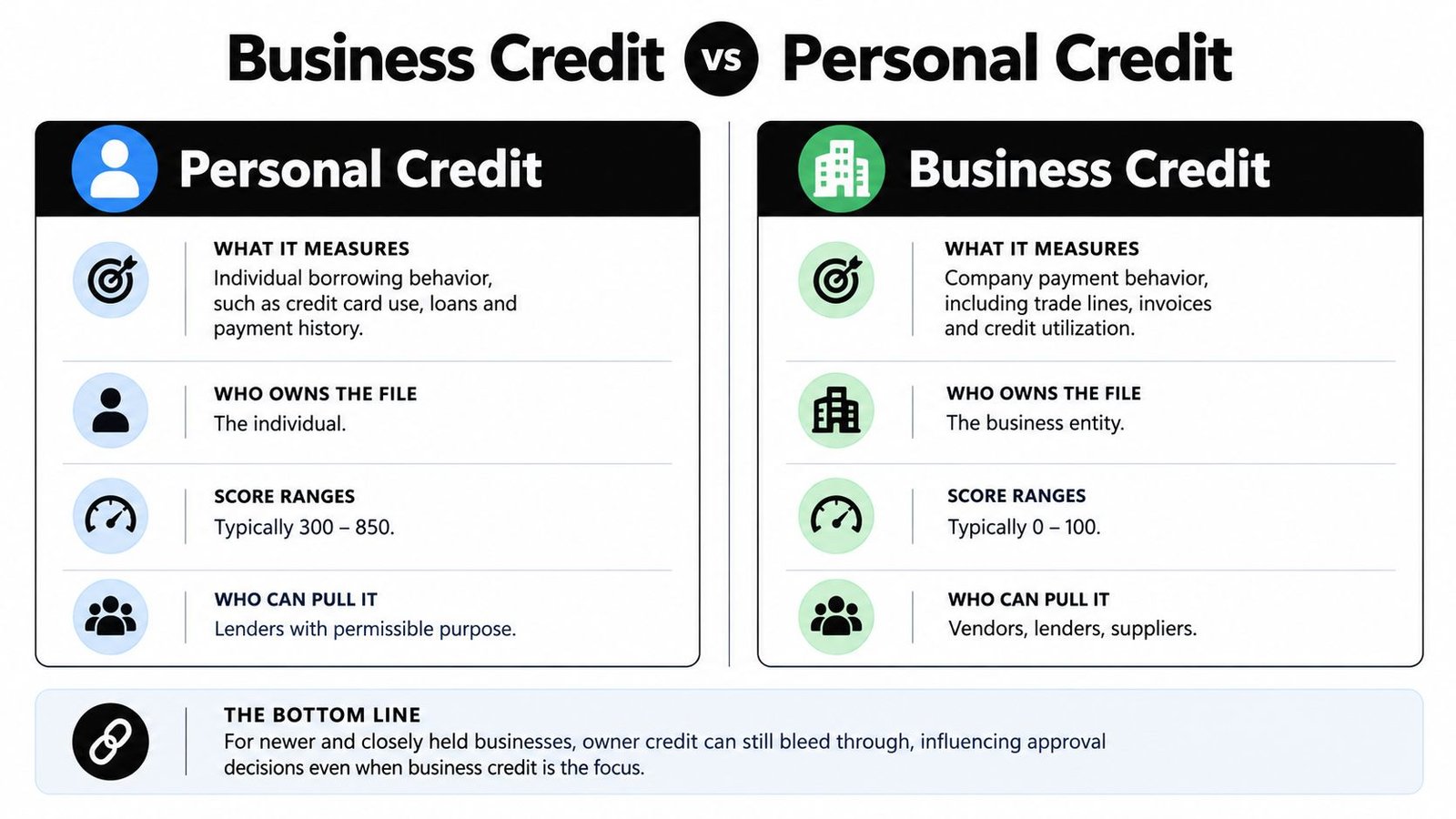
Personal credit follows an individual's borrowing behavior. Business credit follows the company's commercial obligations. The two systems can influence the same financing decision, but they answer different questions.
| Personal Credit | Business Credit |
|---|---|
| Measures an individual's borrowing and repayment behavior | Measures a company's commercial payment behavior |
| Belongs to the individual | Belongs to the legal business entity |
| Common consumer scores use a 300 to 850 range | Experian's business score uses a 1 to 100 range |
| Access is generally limited to parties with a permissible purpose | Vendors, suppliers, lenders, and other commercial counterparties may review it |
Where the boundary gets blurry
A corporation or limited liability company can have its own credit identity, but the owner may still enter the decision. Lenders often review personal credit when a business is new, closely held, or requesting a personal guarantee. A personal guarantee means the owner agrees to be responsible if the company fails to repay, so the lender has a reason to examine both sides.
Sole proprietors face an even less distinct boundary because the business and owner may not be separate legal entities in the same way. Even established companies can encounter blended reviews when applying for an SBA-backed loan, signing a commercial lease, or opening a supplier account with payment terms.
Why the distinction changes your preparation
Suppose your personal score is strong but your company has no reported trade history. A lender may still want more commercial evidence. Conversely, a company can have a well-developed business file while an owner's personal guarantee introduces a separate personal-credit review.
The practical answer to what is business credit isn't “the score a bank pulls instead of your personal score.” It's a company-owned record that works alongside personal credit when the transaction, business structure, or guarantee requires both. For a more detailed side-by-side explanation, review this guide to business credit versus personal credit.
How Business Credit Scores Are Calculated
Commercial scores don't all use the same scale or formula. A lender might review a payment-focused score, a broader risk model, or a financing-specific assessment. That's why one dashboard number shouldn't be treated as the company's permanent financial identity.
The models use different lenses
Dun & Bradstreet PAYDEX focuses heavily on reported payment performance against agreed terms. It's most useful when suppliers and lenders report enough trade experiences to show how promptly the business pays.
Experian Intelliscore Plus uses a broader commercial risk approach. Experian's business scoring information describes a 1 to 100 range, where higher values indicate lower modeled risk and scores above 75 are generally treated as excellent. The model can consider payment trends, utilization, outstanding obligations, collections, legal records, and other company details.
FICO Small Business Scoring Service is designed for small-business lending decisions and can combine business and owner information, depending on the lender and application. It isn't interchangeable with a consumer FICO score, and lenders may apply their own underwriting standards on top of it.
A score translates reported history into a risk estimate. It doesn't replace a lender's review of cash flow, collateral, debt obligations, and business purpose.
What moves a commercial score
Across scoring systems, the signals usually come from a few practical areas:
- Payment timing: Late payments, defaults, and collections can weaken the profile.
- Reported balances: High outstanding obligations or heavy utilization can increase perceived risk.
- Public records: Liens, judgments, and bankruptcy-related records can change the risk picture.
- File depth: A company with little reported activity gives a scoring model less evidence to evaluate.
- Entity accuracy: Misidentified or duplicated information can distort the result.
Owners researching a business card should also separate general commercial scoring from issuer-specific approval criteria. A resource covering credit score requirements for Amex can help explain why a particular card application may involve both business and personal considerations.
The score's real value lies in what it helps a lender decide. Stronger signals can make a profile easier to evaluate, while limited or negative data may lead to additional documentation, tighter terms, or a different product recommendation.
Building Business Credit From a Standing Start
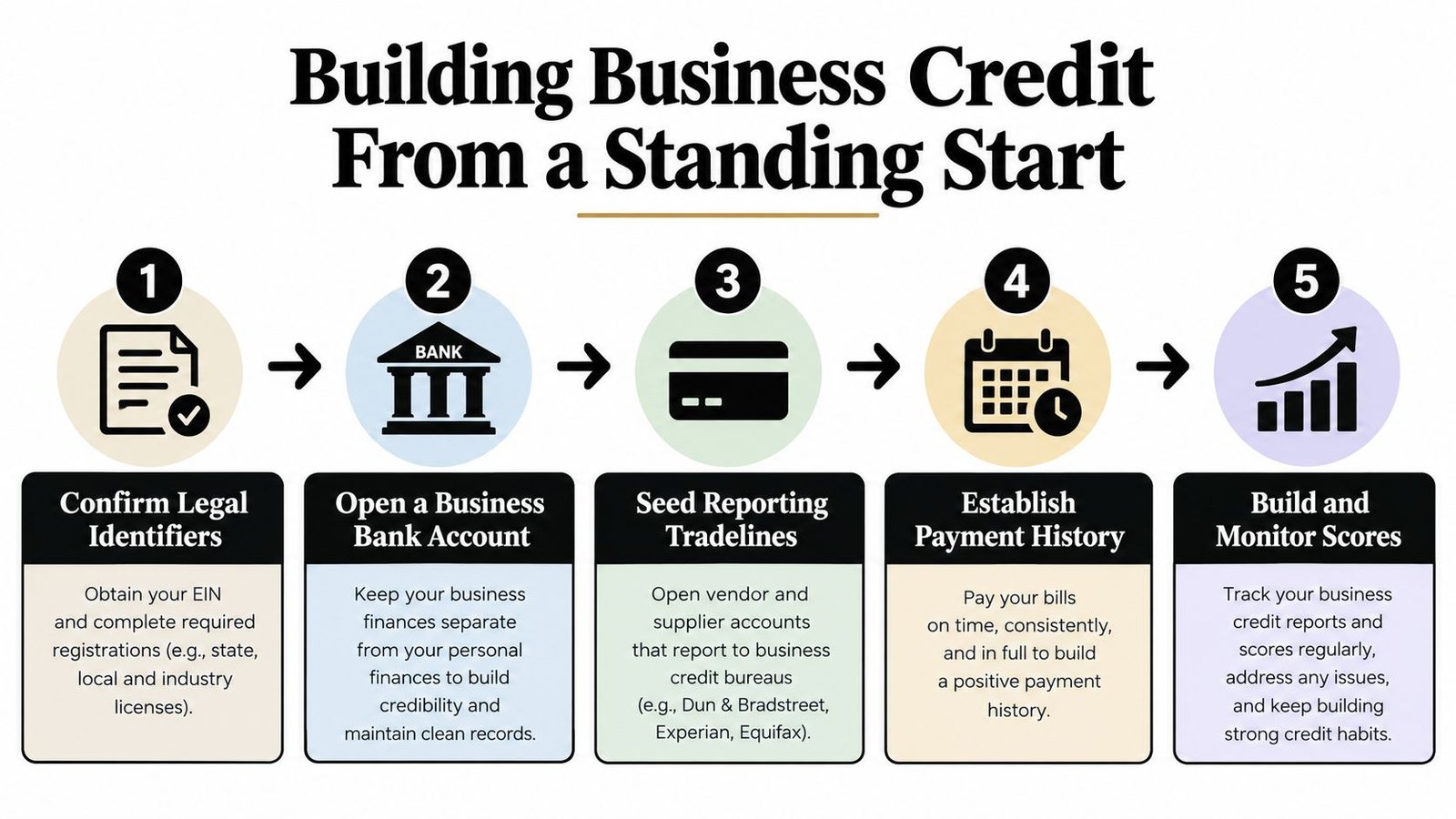
A profitable company can still look unproven to a lender if its accounts are missing from commercial bureaus. Start by making the business visible, then build a record with obligations it can repay.
Establish the foundation
Confirm legal identifiers. Check the company's legal name, address, registrations, and EIN across bank, supplier, and bureau records. Fix mismatches before applying for financing. A lender cannot confidently assess a file that may belong to another entity.
Open a dedicated business bank account. Separating company and personal transactions keeps bookkeeping cleaner and shows lenders the company's operating cash flow more clearly. It also prevents personal spending from hiding the business's actual obligations.
Choose reporting tradelines deliberately. Ask suppliers and lenders whether they report commercial payment activity and which bureaus receive it. A net-30 account does not automatically strengthen the profile. If it does not report, the business may pay reliably without gaining useful bureau history.
Use the first three months as a controlled test
During the first month, establish the file and verify the identifiers. Open only accounts the company needs, record their terms, and set payment reminders before the first due date.
During the second month, use reporting accounts modestly. Track invoices, statement dates, balances, and payments. The goal is a clean record of ordinary business obligations, not manufactured activity. Borrowing solely to create a tradeline can add interest expense and raise utilization, even when payments are on time.
During the third month, compare the reports with your ledger. Confirm the correct entity, accurate balances, expected tradelines, and public records that belong to the company. Dispute errors with the relevant bureau and creditor, and retain supporting documents.
A strong cash-flow business can still face delays or less useful terms when its bureau file is thin or inaccurate. Preparation matters before a modest funding request becomes urgent. The Federal Reserve's 2023 Small Business Credit Survey found that 37% of small employer firms applied for a loan, line of credit, or merchant cash advance during the previous 12 months, while 50% of applicants sought $100,000 or less and 30% sought $50,000 or less. These figures appear in the Federal Reserve survey discussion. A clean, identifiable file gives the lender better evidence to review when that request arrives.
The Hidden Cost of Building Credit With Debt
“Take out credit so you can build credit” sounds efficient. It can also be expensive advice, especially when the account carries a revolving balance that the business doesn't need.
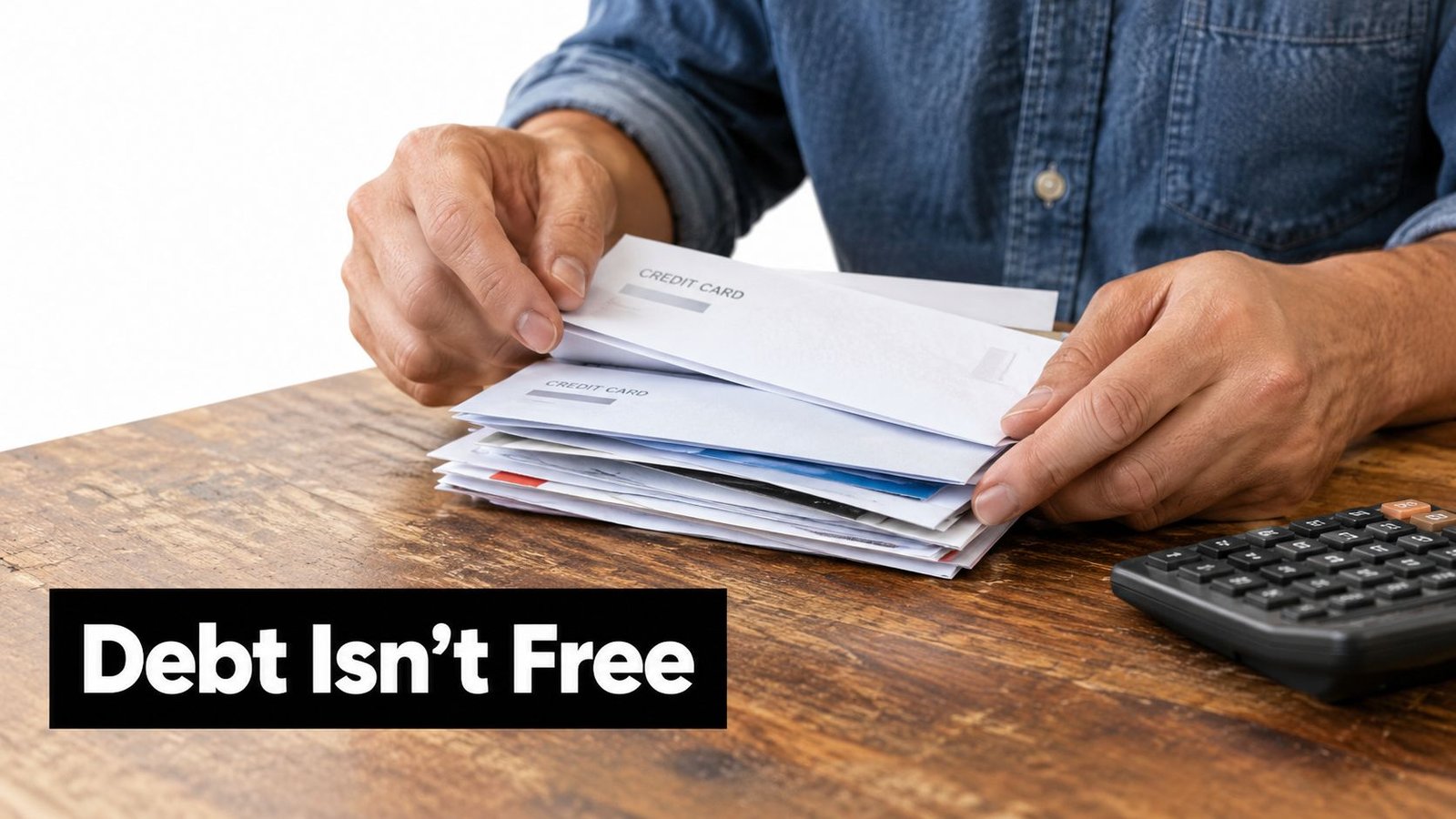
Experian's Q2 2025 Main Street Report says average business credit-card APRs exceeded 25%, and commercial-card delinquency was 2.8%. The same report describes businesses shifting from revolving credit toward structured financing, including term loans and merchant cash advances. It also notes that small-business loan originations were level through the first half of 2025 while banks continued tightening credit standards. Read the Experian Main Street Report for that market context.
Credit-building can consume operating margin
If a company carries a balance at an APR above 25%, the financing cost can overwhelm the value of adding another reported account. High utilization can also make the company appear dependent on available credit, even when every payment arrives on time. A late payment creates a more serious problem because it adds risk evidence while the business is already paying for access to capital.
Use debt to solve a business need, not to decorate a bureau file. A reporting supplier account that supports ordinary purchasing may make sense if the company can repay it comfortably. A card used for necessary expenses and paid according to a reliable cash-management plan can also serve a practical purpose.
The calculation should include more than the interest rate:
- Reporting value: Does the creditor report to the relevant bureau?
- Repayment capacity: Can the company repay without delaying payroll, taxes, suppliers, or reserves?
- Utilization pressure: Will the balance regularly sit close to the available limit?
- Total financing cost: Do interest, fees, and possible late charges outweigh the benefit of new history?
- Alternative funding: Would a structured product better match the duration and purpose of the expense?
The safest credit-building account is one your business would use responsibly even if the bureau never recorded it.
Here's the distinction many owners miss: no score isn't the same as bad credit. A strong-cash-flow company may have a thin file because its vendors don't report. That business needs better visibility, not necessarily more debt. A company with delinquencies, collections, liens, or judgments faces a different repair problem.
How Lenders Read Your Profile Across Financing Types
A company with steady deposits can receive very different answers from different financing providers. The product determines which evidence matters most. A supplier deciding whether to offer ordinary payment terms may need trade references and operating details. A lender funding a long expansion project will usually examine repayment capacity, documentation, and the company's credit history more closely.
Match the product to the evidence
Consider a service company with reliable cash flow but little reported commercial history. A supplier may approve terms after reviewing references and operating information. An equipment financier may focus on the asset, expected cash flow, and repayment structure. A bank term-loan lender may request deeper records because the commitment lasts longer and exposes the lender to more risk.
An SBA loan can involve both business and personal review, especially when owners provide guarantees. The business profile helps show how the company has handled obligations. Personal credit, tax records, financial statements, and other documentation may still shape the application.
A business line of credit serves a different purpose. It can bridge timing gaps between receivables and expenses, but the lender wants evidence that the company can draw and repay without turning a short-term tool into permanent debt. Clean reported activity supports the application. It does not replace cash-flow analysis.
A strong cash-flow business can still lose options when its vendors fail to report. The company may be financially healthy, yet a lender sees too little bureau evidence to price or approve the request confidently. That gap can push the owner toward a personal guarantee, more paperwork, or a more expensive product.
Product choice affects the consequences of a mistake
A missed supplier payment can damage future purchasing terms and may enter the commercial file if the supplier reports. A late revolving-card payment can raise concern about liquidity, especially when the balance already uses much of the limit. A default on structured financing can create broader consequences because the agreement may involve collateral, guarantees, or other remedies.
Merchant cash advances may be available to companies that struggle to qualify for conventional financing. Availability does not make them inexpensive. Compare the total repayment obligation, payment frequency, effect on daily cash flow, and consequences of weak sales before signing.
Approval outcomes also vary by institution. As noted earlier, small banks approved at least some financing for a larger share of applicants than large banks in the Federal Reserve survey. The practical lesson is simple: match the application to the lender, product, and evidence your profile can support.
Monitoring, Repair, and Your 90-Day Credit Readiness Plan
Credit readiness is a maintenance habit, not a one-time application task. Pull the available business reports, verify the legal identity, confirm that expected tradelines appear, and check balances, payment status, collections, liens, judgments, and duplicate entries.
A practical 90-day sequence
Weeks one through four: Gather entity documents, standardize the company name and address across accounts, and list every lender and supplier that might report. Create a payment calendar tied to invoice and statement dates.
Weeks five through eight: Confirm which accounts have begun reporting. Compare bureau data with accounting records, then dispute inaccurate information with the creditor and bureau. Don't open new accounts just because an existing file feels thin.
Weeks nine through twelve: Review utilization, outstanding obligations, and payment trends. Decide whether the company is ready for a specific financing product, or whether it needs more clean operating history first.
Security deserves attention too. Owners who store financial credentials or share sensitive company information with online services may find a guide to dark web monitoring for resellers useful when reviewing broader exposure risks.
Track one north-star measure each month: the number and accuracy of reporting trade lines supported by on-time payments and manageable balances. That measure keeps you focused on visible, sustainable behavior instead of chasing a score you can't fully control.
For a concise implementation checklist, use this 90-day business credit blueprint. Start tomorrow by confirming your identifiers, asking your key vendors whether they report, and scheduling a report review before you apply for capital.
Business Loan Warrior helps small businesses compare and pursue funding, including business loans, SBA financing, lines of credit, equipment loans, invoice financing, and merchant cash advances. If you're preparing your business credit profile or need capital for working capital, equipment, expansion, or debt consolidation, visit Business Loan Warrior to explore your options and start a no-fee application.