
You're looking at your first payroll report. The gross wages seem straightforward, but the report shows employee withholding, employer contributions, Social Security, Medicare, federal income tax, and perhaps unemployment taxes. The natural question is simple: why are there so many tax lines, and which ones cost the business money?
The difference between payroll tax and income tax matters because the two systems use different tax bases, serve different purposes, and affect cash flow in different ways. An employee's income-tax withholding may change because of a Form W-4, while the employer's payroll-tax obligation can remain tied closely to wages. A worker may take home less because of income-tax withholding, yet the business may owe additional payroll taxes that never appear as a deduction from that worker's paycheck.
Table of Contents
- Understanding the Core Purpose of Each Tax
- How Payroll and Income Taxes Are Calculated
- Employer and Employee Responsibilities
- Managing Compliance and Filing Timelines
- Hidden Labor Costs and Cash Flow Shifts
- The Historical Reasons Behind the Divide
- Common Small Business Mistakes to Avoid
Understanding the Core Purpose of Each Tax
A new founder often sees payroll as one large expense. In practice, payroll combines several obligations that belong to different tax systems. Income tax is generally connected to a person's taxable income and broader financial circumstances. Payroll tax is tied more directly to wages and employment.
Federal individual income tax primarily raises general government revenue. The government calculates a person's liability using taxable income, which can be affected by adjustments, deductions, exemptions, credits, filing status, dependents, and other income. The amount withheld from a paycheck is an advance payment toward the employee's eventual income-tax liability, not a separate tax paid by the employer.
Payroll taxes serve a different policy purpose. FICA, the Federal Insurance Contributions Act, supports Social Security and Medicare. The system connects employment and covered wages with social insurance financing and benefit eligibility. That employment connection is why payroll tax calculations generally begin with wages rather than the employee's complete financial profile. The Congressional Research Service explains the distinction between payroll taxation and individual income taxation.
A simple payroll example
Suppose your company hires an employee on a salary. The employee's paycheck may show federal income-tax withholding based on the employee's Form W-4. Another set of deductions covers the employee's share of Social Security and Medicare. Separately, your business owes its own employer share of Social Security and Medicare, even though that amount doesn't reduce the employee's displayed gross pay.
That separation creates two different questions:
- What does the employee owe? The worker has personal income-tax liability and employee payroll-tax withholding.
- What does the business owe? The company must remit withheld amounts and pay its employer payroll-tax share.
- What does each tax fund? Payroll taxes primarily support Social Security and Medicare, while income taxes support general government financing.
Practical rule: Treat employee income-tax withholding as money held for remittance, but treat the employer payroll-tax share as a genuine labor expense.
The distinction also explains why a low income-tax withholding amount doesn't necessarily mean the employee is lightly taxed overall. Payroll taxes can still apply to wages, and the company may owe a matching contribution. Conversely, a higher income-tax withholding amount doesn't automatically increase the employer's payroll-tax rate. The systems interact on a paycheck, but they aren't interchangeable.
How Payroll and Income Taxes Are Calculated
The calculation begins with the tax base, meaning the amount to which a tax rate applies. Payroll taxes generally use gross wages with few deductions. Federal income tax uses taxable income after relevant adjustments, deductions, exemptions, and credits. That difference is the foundation of the answer to “what is the difference between payroll tax and income tax?”
For 2026, the employee share of FICA generally consists of 6.2% Social Security tax and 1.45% Medicare tax, while the employer generally matches those amounts. The standard employee FICA deduction is therefore 7.65%, and the employer's direct FICA cost is generally 7.65% before other obligations. The Social Security portion applies only up to the $184,500 annual wage base for 2026, while Medicare has no wage ceiling. These figures are set out in the IRS Form 941 instructions.
Federal individual income tax works differently. It uses graduated brackets rather than one payroll percentage, and withholding depends on information supplied through Form W-4 and applicable tax tables. Two employees earning the same gross salary can have different federal income-tax withholding because their filing status, dependents, deductions, or other income differ. Their standard FICA calculation is much more closely tied to the wages themselves.
Payroll Tax vs Income Tax Calculation Factors
| Feature | Payroll Tax (FICA) | Federal Income Tax |
|---|---|---|
| Primary base | Gross wages | Taxable income |
| Main purpose | Social Security and Medicare financing | General government revenue |
| Rate structure | Largely flat components | Graduated federal brackets |
| Employee factors | Primarily wages and applicable wage limits | Filing status, Form W-4 information, adjustments, deductions, exemptions, and credits |
| Employer effect | Employer generally pays a matching share | Employer generally withholds the employee's money |
| Wage ceiling | Social Security has an annual wage base, while Medicare has no wage ceiling | No equivalent Social Security-style wage ceiling |
| Year-end reality | Payroll reporting and withholding must be reconciled | Final liability is determined through the employee's tax return |
The wage ceiling creates an important forecasting issue. Social Security withholding doesn't continue indefinitely on every dollar of high compensation. Medicare, however, continues after the Social Security wage base is reached, and federal income-tax withholding continues according to the employee's taxable-income situation.
Payroll teams also need to distinguish FICA from other paycheck items. State disability insurance, for example, can have its own withholding and taxability rules. A practical guide to SDI reporting and withholding basics can help employers separate state-specific disability obligations from federal payroll and income taxes.
Employer and Employee Responsibilities
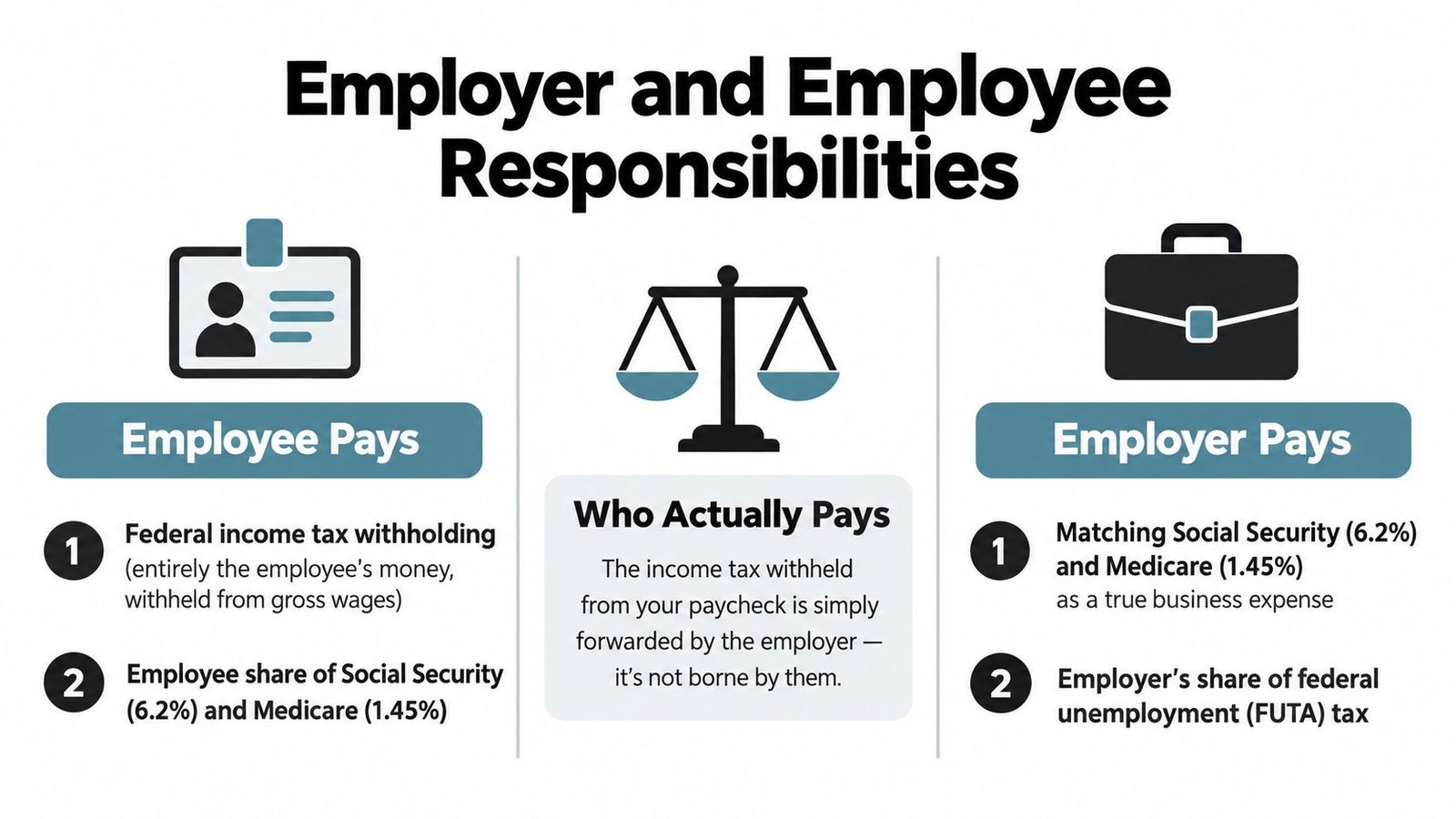
The cleanest way to understand responsibility is to follow the money. Income-tax withholding comes out of the employee's wages. The employer calculates and withholds it, then sends it to the government on the employee's behalf. The business performs an administrative role, but the withheld amount isn't normally an extra company expense.
Payroll tax creates a second obligation. The employer withholds the employee's FICA share and also pays a matching employer share. That matching amount is an out-of-pocket cost that belongs in the company's labor budget, even though the employee may never see it on a paycheck.
What employees see
The employee's pay statement may show:
- Federal income-tax withholding: An advance payment based on the worker's personal tax information.
- Employee Social Security tax: The employee's share of FICA.
- Employee Medicare tax: The employee's share of FICA.
- State and local items: Additional obligations that depend on the employee's work location and applicable rules.
The employer sends withheld amounts to the appropriate agencies, but forwarding an employee's withholding doesn't make that money the employer's income or expense. The company must keep those funds separate in its accounting process because they belong to the government once withheld.
What employers add
For 2026, the employer's direct FICA cost is generally 7.65% of applicable wages before other obligations, based on the matching Social Security and Medicare shares. The IRS Form 941 instructions describe the federal employment-tax reporting framework and the employer-side amounts that must be reported.
Self-employed people face a different cash-flow experience. A sole proprietor or a qualifying owner reporting self-employment income generally bears both sides of Social Security and Medicare taxes, producing a 15.3% self-employment-tax rate before applicable adjustments and additional taxes, as described by the Congressional Research Service. That doesn't mean the person pays an employer tax to a separate employer. It means the self-employed individual carries the combined obligation personally.
Owners should also keep payroll tax separate from business income tax. A company may have its own income-tax obligations on profits, while employee withholding and employer payroll taxes arise from compensation. If you're reviewing deductible operating costs, a structured business tax deductions list can help you distinguish compensation expenses from taxes withheld for employees.
Payroll errors can become expensive quickly, especially when an employer misses deposits or misstates worker status. Owners handling social-contribution compliance in other systems may also find practical guidance on gestire le sanzioni INPS, although U.S. employers must follow U.S. federal and state requirements.
Managing Compliance and Filing Timelines
A payroll calendar protects cash flow better than a year-end scramble. Each pay run requires the employer to collect current employee information, calculate withholding, record employer taxes, deposit the amounts by their deadlines, and prepare the required reports.
Start with each employee's Form W-4. It provides the information used to calculate federal income-tax withholding. The employer applies that information and the applicable withholding method to each paycheck. The employee remains responsible for determining final federal income-tax liability on the individual return.
Accurate records connect every payroll run to every filing. Track gross wages, employee withholding, employer payroll-tax costs, year-to-date wages, and deposits. A clean payroll register should reconcile with the amounts reported to tax agencies.
A practical compliance sequence
- Confirm worker status. Classify each person as an employee or independent contractor using the facts of the working relationship, not only the payment method.
- Collect current forms. Store Form W-4 and required state forms with the employee's payroll records.
- Calculate each payroll run. Apply wage-based payroll taxes separately from income-tax withholding.
- Track year-to-date wages. Monitor each employee's progress toward the Social Security wage base, since the employer's payroll-tax cost can change after the ceiling is reached.
- Deposit withheld amounts. Follow the assigned federal schedule along with applicable state and local deadlines.
- File employment-tax reports. Use Form 941 where applicable, then reconcile the reported totals with the payroll records.
A quarterly employment-tax return does not necessarily mean deposits can wait until quarter-end. Federal deposit schedules vary according to the employer's payroll profile. Withheld employee taxes remain trust-fund money. Spending them on operating costs can expose the business and responsible individuals to serious consequences.
Income-tax withholding is reconciled throughout the year, while the employee's individual return determines final federal income-tax liability. Payroll administration therefore remains a recurring business duty, not a replacement for personal tax filing.
Keep a separate payroll-tax liability account in your books. A profitable month does not make withheld employee taxes available for spending.
Cash planning becomes harder when payday, deposit deadlines, and other bills arrive at different times. Before arranging working capital, identify whether the funds will support regular payroll, tax deposits, or a temporary timing gap. A guide to tax-savvy business financing offers a broader framework for assessing borrowing alongside tax planning.
Hidden Labor Costs and Cash Flow Shifts
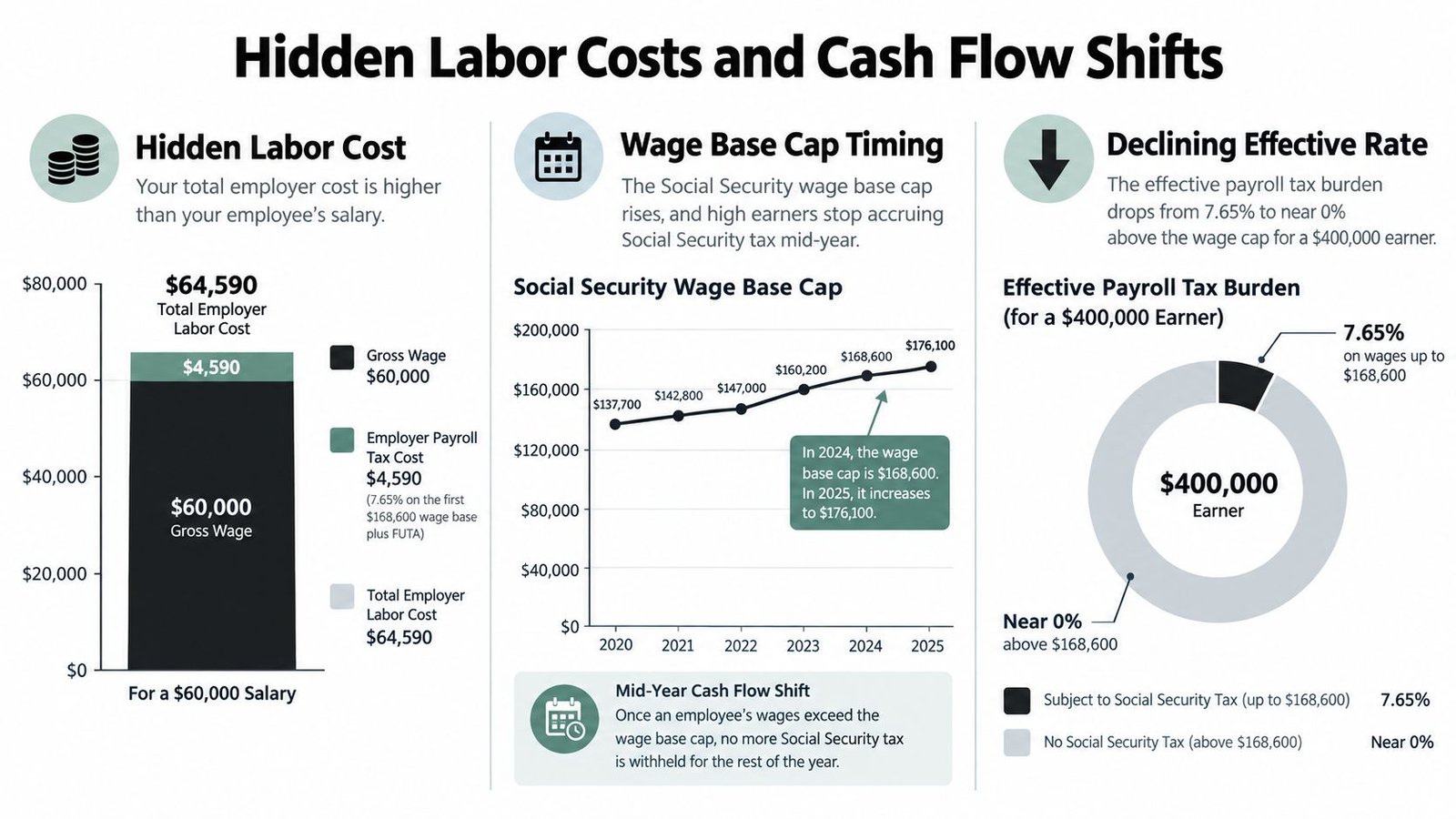
A new hire may earn a stated salary, yet the business pays more than that figure. Gross wages sit alongside employer payroll taxes and other employment obligations. The OECD describes the combined effect of personal income tax, employee and employer social contributions, and payroll taxes as the tax wedge. This measure compares those taxes and contributions with total labor cost, rather than judging cost from the employee's paycheck alone. The OECD's Taxing Wages brochure explains the tax-wedge framework.
For the United States, the OECD reported that the average single worker's tax wedge rose from 30.0% in 2023 to 30.1% in 2024, compared with an OECD average of 34.9%. It also reported that income tax and employer social-security contributions represented 76% of the U.S. wedge. These figures do not calculate the cost of a particular hire, but they show why take-home pay understates the employer's labor burden. The OECD's Taxing Wages brochure explains the tax-wedge framework.
Why the wage ceiling changes the monthly picture
Suppose a highly paid employee reaches the Social Security wage base during the year. Before that point, the employer generally pays its matching Social Security share on covered wages. After the employee reaches the annual ceiling, that Social Security charge stops applying to additional covered wages for that employee. Medicare obligations continue, so the payroll-tax mix changes rather than disappearing.
The result can be a mid-year cash-flow shift. Employer payroll-tax spending may fall for that employee during the remaining pay periods, then rise again when the new calendar year begins and wage-base tracking resets. The short-term improvement affects cash timing, not necessarily the employee's full-year labor cost.
The 2026 Social Security wage base is $184,500, while Medicare has no wage ceiling, according to the Congressional Research Service's explanation of payroll taxes. A forecast based only on one payroll-tax percentage can therefore mislead a company with varied compensation.
Better forecasting practice
Track payroll cost by employee and pay period. Record:
- Gross wages for each pay period.
- Employer Social Security amounts before the wage base is reached.
- The pay period when each employee reaches the wage base.
- Continuing Medicare obligations afterward.
- Recalculated obligations when the next calendar year starts.
Payroll funding also needs room for timing changes. A temporary reduction for one high earner may not cover seasonal hiring, bonuses, or several new employees. If customer payments arrive after wages and employer obligations fall due, review funding options for payroll before the shortage becomes urgent.
Policy proposals sometimes discuss a reform that lowers taxes on work. Whatever the policy outcome, the accounting lesson remains practical: model employer costs separately, monitor wage ceilings through the year, and do not treat gross salary as the complete cost of labor.
The Historical Reasons Behind the Divide
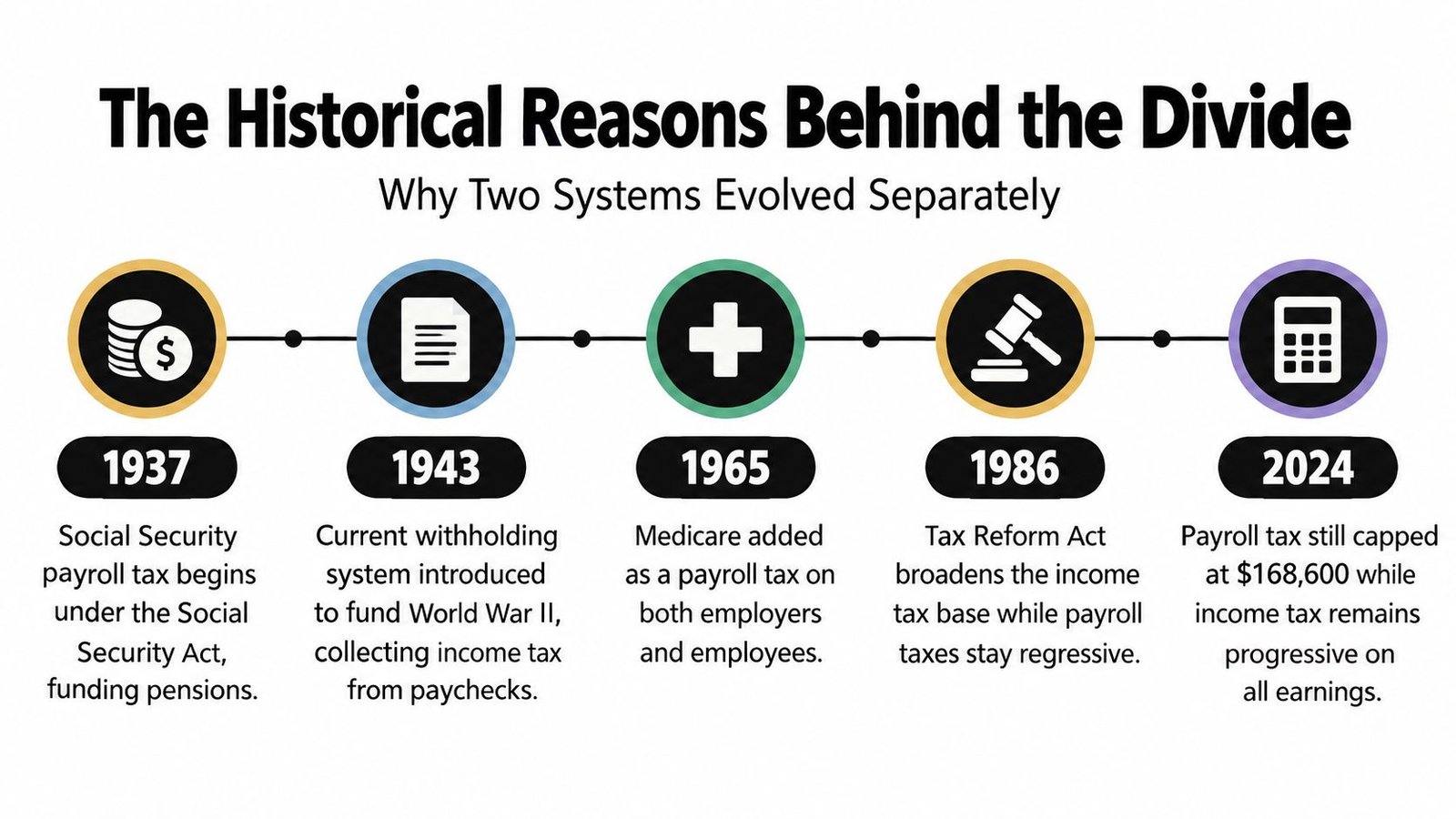
The two systems look different because they were built for different purposes. Social Security payroll taxation began in 1937 at 2% of covered payroll, split between employees and employers, and applied to the first $3,000 of annual earnings. Congress later expanded the system and increased rates, with the combined Social Security rate reaching 12.4% in 1990, where it remains under current law. The Tax Foundation's historical overview describes the development of Social Security and Medicare payroll taxation.
Medicare came later. After Medicare was enacted in 1965, payroll taxation was added to help finance the program. The initial employer and employee Medicare rate was 0.35% each on a limited earnings base. The employee and employer rate later became 1.45% each, creating the Medicare component used in modern FICA calculations.
Insurance financing versus general revenue
Payroll taxes were designed around employment-linked social insurance. The connection between wages, contributions, and eligibility helps explain why the tax base is comparatively rigid. The calculation focuses on covered earnings, and Social Security uses a wage base rather than applying indefinitely to every dollar of compensation.
Modern federal individual income tax serves a broader fiscal purpose. It raises general government revenue rather than earmarking each dollar for a specific insurance benefit. The tax can therefore account for a wider picture of taxable income and apply deductions, credits, and graduated rates.
That historical difference gives founders a useful mental model. Payroll tax behaves more like a wage-linked contribution with defined components. Income tax behaves more like a broader assessment of taxable financial capacity. Neither label is merely a different name for the other.
Federal revenue data also illustrates the scale of the systems. The Congressional Budget Office reported approximately $2.8 trillion in individual income-tax receipts and $1.8 trillion in payroll-tax receipts in its federal-revenue breakdown, as summarized by the Congressional Research Service. The amounts reinforce the practical point, but they don't change how an individual payroll run must be calculated.
Common Small Business Mistakes to Avoid
The most damaging payroll mistakes usually begin with a reasonable but incomplete assumption. An owner sees money withheld from a paycheck and assumes the company has paid the full tax cost. Or the owner sees a small income-tax deduction and assumes the worker is inexpensive to employ. Both conclusions can distort cash planning.
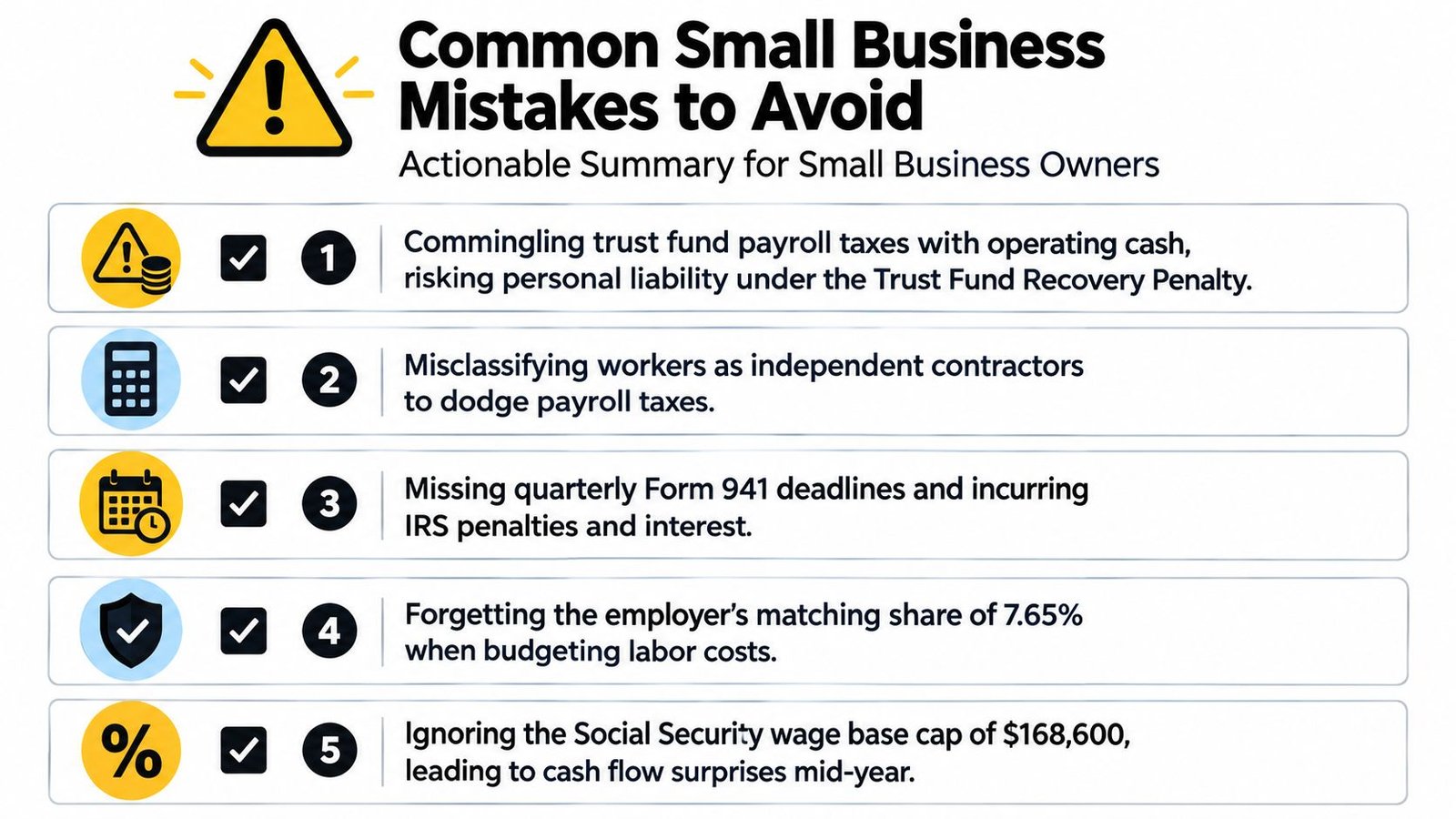
Mistakes that deserve an immediate review
- Spending withheld tax money: Employee income-tax and payroll-tax withholdings are liabilities awaiting remittance. Keep them out of operating cash and reconcile the liability account after each payroll.
- Budgeting only gross wages: Add the employer's payroll-tax share to compensation forecasts. The employee's paycheck won't show the full employer cost.
- Treating low withholding as low tax: Income-tax withholding reflects the employee's personal information and isn't a complete measure of payroll burden.
- Ignoring wage-base timing: Track year-to-date Social Security wages for each employee. A high earner may move from Social Security-taxable wages to Medicare-only payroll treatment during the year.
- Misclassifying workers: Don't label a worker an independent contractor just to avoid employer payroll taxes. Classification depends on the actual relationship, and errors can lead to unpaid taxes, penalties, and other obligations.
- Missing filing or deposit dates: A quarterly Form 941 filing doesn't necessarily mean every payroll-tax deposit can wait until the return is due. Use a calendar based on the assigned deposit schedule.
A founder's payroll review
Pull one recent payroll register and compare four columns: gross wages, employee withholding, employer payroll-tax cost, and cash remitted. Then compare the payroll register with the general ledger and bank activity. Differences often reveal an omitted employer match, an incorrect wage-base calculation, or a deposit that was recorded in the wrong period.
Review the process whenever compensation changes. Bonuses, new hires, departing employees, and changes in worker classification can affect withholding and employer costs. Ask your payroll provider or accountant to explain how the system handles year-to-date wage ceilings, especially for employees who may reach the Social Security limit before year-end.
The core checklist is straightforward:
- Confirm every worker's classification.
- Separate employee withholding from employer expenses.
- Record payroll liabilities when payroll runs.
- Deposit withheld amounts on schedule.
- Reconcile Form 941 reporting with payroll records.
- Forecast wage-base changes by employee.
- Preserve Forms W-4 and supporting payroll records.
The difference between payroll tax and income tax becomes manageable once you stop treating payroll as one undifferentiated deduction. Income tax follows the employee's taxable-income situation. Payroll tax follows wages, employment, and the employer's matching responsibility.
Business Loan Warrior helps small businesses evaluate funding for payroll, equipment, expansion, and other working-capital needs through a single application and a secure dashboard. If employer payroll costs or wage-base timing are creating a cash-flow gap, visit Business Loan Warrior to review financing options and plan before the next payroll deadline.