

If payday is coming up and receivables are still sitting in customer inboxes, you're not dealing with a rare problem. You're dealing with a timing gap, and that gap can hit hard when wages, payroll taxes, and benefits are due on a fixed schedule while client cash arrives on net-30 or net-60 terms. The right move is usually not to panic, it's to choose funding for payroll that keeps people paid without hiding a deeper working-capital problem.
Table of Contents
- The Reality of Cash Flow Gaps and Payday
- Why Payroll Consumes So Much Capital
- Comparing the Best Financing Options
- Qualification Requirements and Underwriting
- Strategic Bridge Versus Structural Cash Gap
- Sizing Funding for Nontraditional Payroll Cycles
- Executing a Fast and Secure Application
The Reality of Cash Flow Gaps and Payday
The pressure usually shows up in the same way every time. Payroll date is fixed, invoices are still outstanding, and the bank balance looks too thin for comfort. That doesn't mean the business is failing. It means the business is carrying the burden of labor before the customer settles up, which is exactly why cash flow management matters so much in payroll-heavy operations.
A strong owner stops treating that gap as a crisis and starts treating it as a financing decision. Funding for payroll exists because payroll is a recurring obligation, not because the business has made a mistake. The key question is whether you need a short bridge, a revolving cushion, or a receivables-based structure that matches the way money moves through the business.
Practical rule: If you know the gap will repeat, don't borrow like it's a one-time emergency. Match the facility to the cycle.
The pattern behind the stress
This is especially obvious in service businesses, where labor costs move before revenue does. Restaurants, healthcare practices, staffing firms, construction businesses, and professional service companies all feel the same squeeze in different forms. They can be busy, growing, and still short on cash at payday.
That's why the emotional reaction is often louder than the financial one. Owners see payroll pressure and assume something is broken, but the more useful interpretation is simpler. The business may just need a cleaner bridge between earning revenue and paying labor.
Why Payroll Consumes So Much Capital
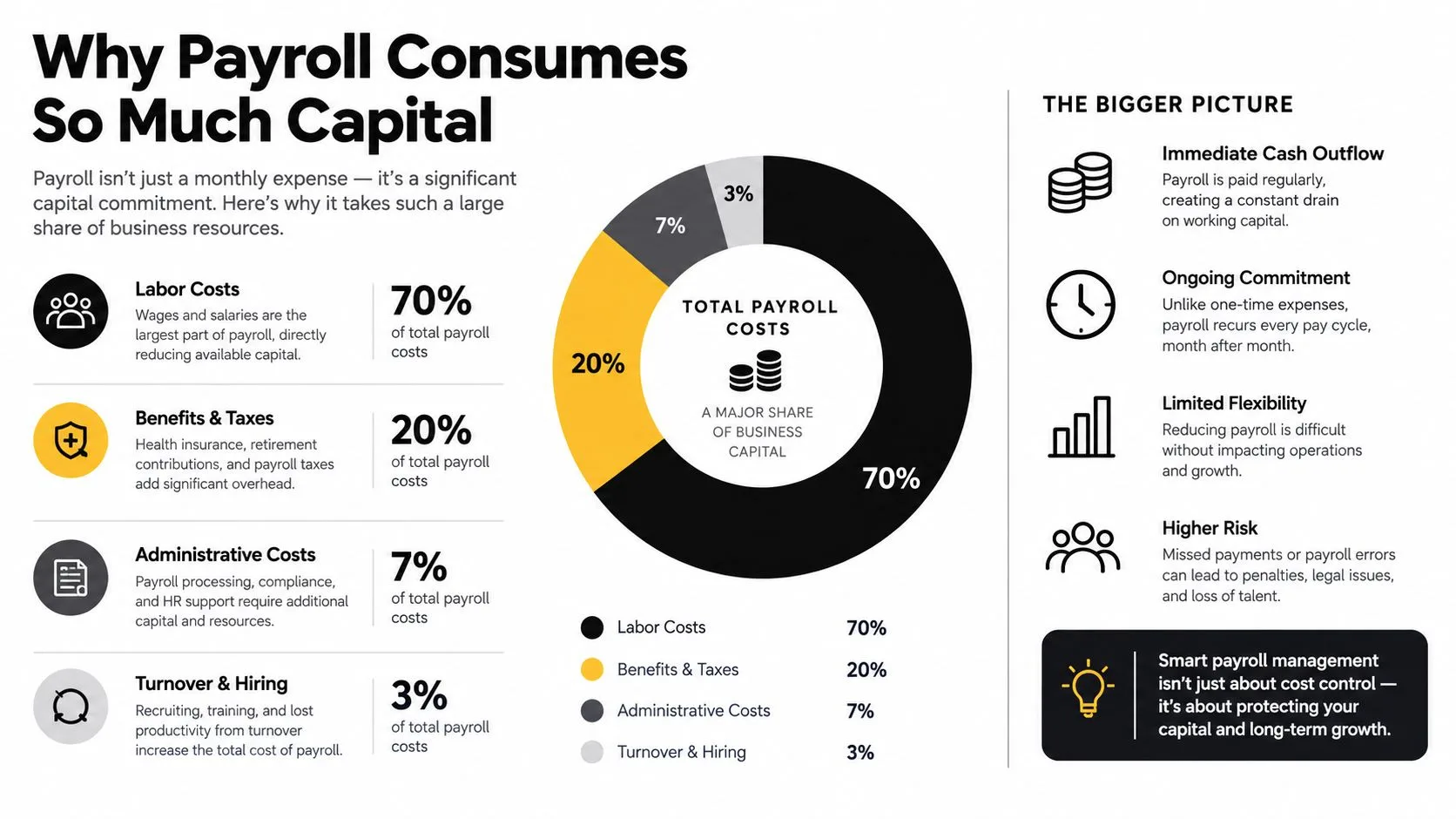
Payroll is expensive before you even count the hidden layers. Base wages are only the starting point, because employer payroll taxes add another layer of cost, and labor-heavy businesses also carry benefits, overtime, and compliance-related timing pressure. Independent industry guides place payroll at roughly 15% to 30% of gross revenue for many SMBs, and employer payroll taxes alone can add 7.65% to 15% on top of gross wages in many cases, which is why payroll funding is usually a working-capital issue, not a one-off expense issue (OnPay).
Labor intensity changes the math
In service businesses, payroll and related labor costs may reach 40% to 70% of gross revenue, while some broad small-business benchmarks still show payroll can consume 50% to 60% of total operating expenses in labor-heavy models (Stealth Agents). That's not a rounding error. It means the business economics themselves are built around labor, so payroll financing isn't exotic, it's structural.
The same logic explains why integration matters. If payroll data, HR records, and timekeeping live in separate systems, owners end up managing timing problems manually. A resource like UK HR and payroll system integration is useful because it shows the operational side of reducing friction between people data and pay runs.
Payroll-heavy companies don't just need money. They need visibility into when labor costs hit, when taxes come due, and when customer cash is actually collectible.
What this means for owners
The more labor-heavy the business, the less useful vague “just cut costs” advice becomes. You can't eliminate payroll without damaging delivery, and you can't safely fund it without knowing how much working capital the model really consumes. Start by treating payroll as a fixed-date liability that deserves its own funding plan.
That is the key shift. Once you see payroll as a capital commitment, you stop choosing financing emotionally and start choosing it operationally.
Comparing the Best Financing Options
Choose financing by matching the repayment structure to the cash-flow gap. A business line of credit handles recurring payroll shortfalls with flexibility. A fixed-term loan suits a defined lump sum and a predictable amortization schedule. Invoice factoring fits businesses with reliable receivables and slow-paying customers, because repayment follows the invoices instead of relying solely on the balance sheet (Nav).
How to think about each option
A revolving line of credit is the strongest fit when the same gap returns each pay cycle. You draw what you need, repay it as customer cash arrives, and access the facility again without submitting a new application. Set the limit below your actual maximum need, leaving room for taxes and operating expenses.
Fixed-term loans work better when the funding requirement is clear and one-time. You receive a defined amount and follow a set repayment plan. That predictability helps with budgeting, but scheduled payments can strain cash flow when payroll gaps recur weekly or biweekly.
Merchant cash advances provide speed, though the effective cost is usually high. Use one only when payroll timing creates a short, high-pressure window and the business has a clear repayment source. Repeated use can turn a timing issue into a persistent drain on operating cash.
Invoice financing is appropriate when receivables are the business's strongest asset. It converts eligible invoices into immediate cash and aligns repayment with customer payment timing. That structure suits B2B companies billing on Net 30, 60, or 90 terms.
| Financing Type | Funding Speed | Cost Profile | Best Use Case |
|---|---|---|---|
| Revolving line of credit | Fast once approved | Usually lower than emergency options | Recurring payroll gaps |
| Fixed-term business loan | Moderate | Predictable, often lower than fast cash products | One-time lump sum with planned repayment |
| Merchant cash advance | Very fast | Usually high effective cost | Short emergency bridge |
| Invoice financing | Fast when receivables are strong | Depends on invoice quality and terms | Slow-paying B2B customers |
My view on the trade-off
Reserve premium speed for payroll dates that cannot move. Faster funding typically carries a higher effective cost, so paying for it makes sense only when delay could cause missed pay or operational damage. For repeatable gaps, arrange a revolving facility or invoice-based structure before the next crunch arrives.
Study short-term business financing with your cash conversion cycle in view. Compare the draw schedule, total repayment, fees, renewal terms, and consequences of a slow customer payment. The safest facility covers the measured gap without hiding a deeper working-capital problem.
Qualification Requirements and Underwriting
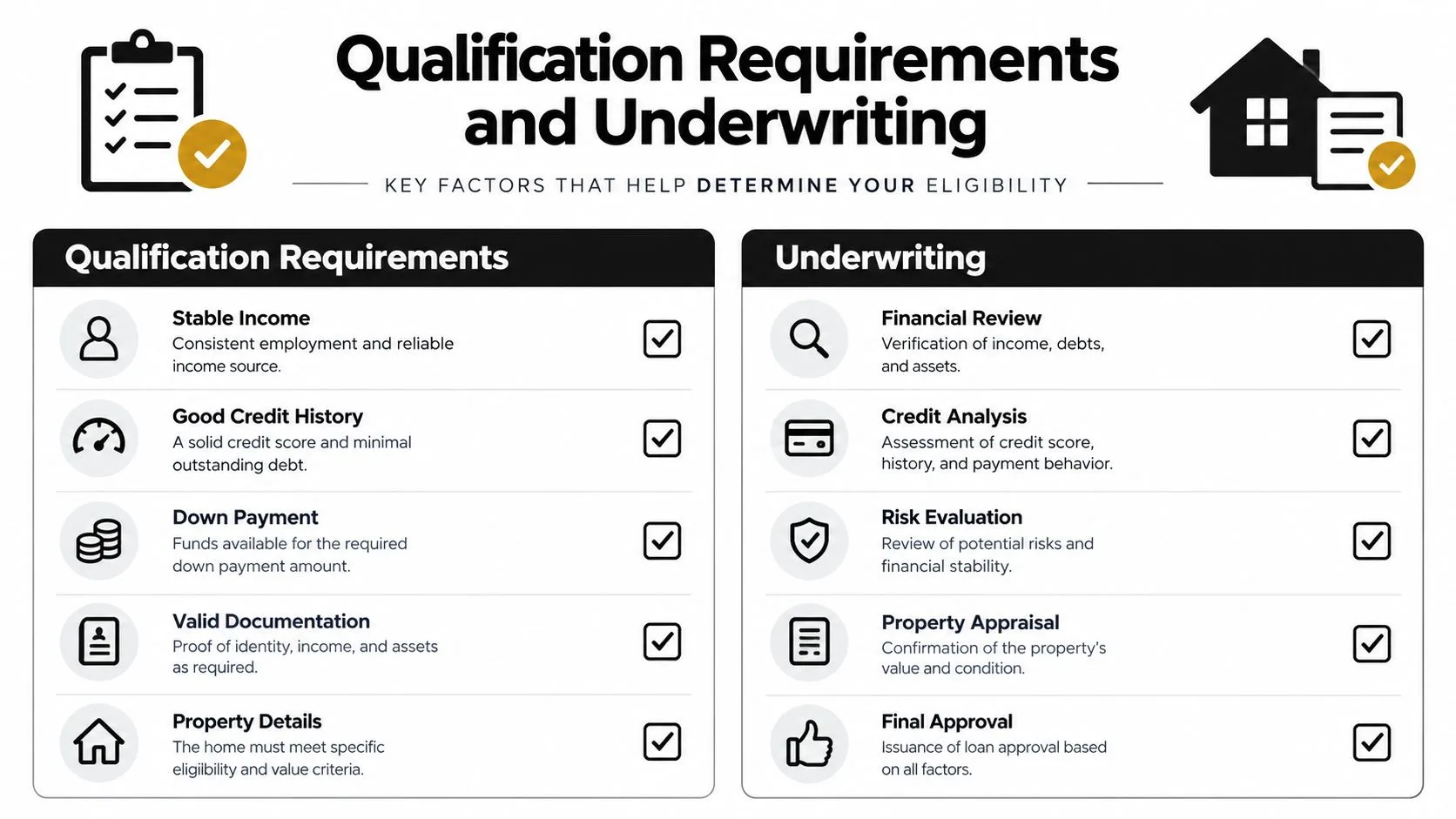
Lenders keep coming back to the same core questions. How long has the business been operating, how much revenue comes in, and what does the credit profile look like, personal credit, business credit, or both. The answer shapes approval for a line of credit, a short-term loan, an SBA-backed loan, or invoice factoring.
What underwriters actually want
Underwriters want stability, predictability, and enough margin to believe payroll can be covered without a scramble every cycle. If revenue is uneven, the statements need to explain the pattern clearly. They should never try to hide it.
Learn how lenders evaluate risk in our guide to the underwriting process.
Modern underwriting gives lenders more flexibility. Bank-statement analysis and cash-flow review can show whether a business can service the funding without forcing everything into a rigid scorecard. Traditional banks still matter, but they usually move slower and ask for more paperwork.
Bring clean statements, a clear receivables picture, and a simple explanation of why the funding is needed. Messy files raise the cost of capital.
A practical approval checklist
- Business age: Show time in business clearly. Newer firms usually face tighter scrutiny.
- Revenue consistency: Expect questions about annual revenue and deposit patterns, since those are the easiest signs of repayment capacity.
- Credit profile: Know where both personal and business credit stand before you apply.
- Banking history: Keep business and operating accounts clean, because statement quality affects underwriting speed.
- Use of funds: State the payroll need plainly. Lenders prefer a clear timing gap over a vague working-capital story.
The goal is not to look perfect. It is to look understandable. Underwriters fund businesses they can explain to themselves in a few minutes, so make the payroll story simple, factual, and easy to verify.
Strategic Bridge Versus Structural Cash Gap
Borrowing for payroll is not automatically a warning sign. In many businesses, it's just the cost of growth arriving before the cash does. Neutral industry evidence shows 56% of employer firms that sought financing did so to meet operating expenses, and 46% sought funds to pursue expansion or a new opportunity, which tells you payroll pressure often sits right next to growth, not just distress (Bay Street Lending).
The mistake is using the same financing logic for both cases.
When payroll funding is rational
If customer payments are predictable, the business can usually justify short-term payroll funding as a bridge. A seasonal spike, a new contract, or a temporary invoice lag can all create a gap that looks scary but is manageable. In those cases, the right facility lets the business keep operating while revenue catches up.
That doesn't mean debt is free or harmless. It means the cost of missing payroll, losing workers, or stalling growth can be worse than the financing cost. The discipline is in sizing the facility to the cycle, not the fear.
When the gap is structural
A dangerous gap repeats without improving. If every payroll run requires new borrowing and receivables never close the hole, the business isn't bridging, it's drifting. That's when owners need to ask whether margins, pricing, collection timing, or labor mix are broken.
You don't fix a structural cash gap by layering more debt on top of it. You fix it by changing how money moves through the business, or by resizing the business to match reality.
If the funding need keeps growing faster than revenue quality, the problem isn't timing anymore. It's the model.
The contrarian view is the right one here. Borrowing for payroll can be a smart operating decision during growth, but it becomes expensive and risky when it's hiding a deeper conversion problem. Use debt to bridge, not to pretend the gap doesn't exist.
Sizing Funding for Nontraditional Payroll Cycles
Staffing firms and contractor-heavy businesses face a different problem from standard payroll companies. They often pay workers on a weekly or biweekly cadence while waiting far longer for clients to pay invoices, so the cash gap grows with every placement. Recent independent coverage notes that if a firm spends $100,000 per week in payroll and clients pay in six weeks, it needs at least $600,000 in funding just to stay current (Crestmont Capital).
Why the standard formula breaks down
That example is useful because it shows how quickly the required liquidity compounds. It's not just wages, either. Overtime, taxes, and benefits have to be part of the sizing exercise, or the business ends up underfunded halfway through the cycle. For seasonal businesses, the same logic applies, only the pressure comes in waves instead of every week.
The point is to size the facility against the worst part of the cycle, not the average week. Average-week planning creates surprise shortfalls. Peak-cycle planning gives you a real buffer.
A safer way to think about the number
Start with the full payroll burden, not just gross wages. Then add the timing lag between worker pay and customer collections. If that lag repeats, your funding amount should absorb the whole cycle, not just one paycheck.
- Weekly payer with slow collections: Size for the full overlap between payroll runs and open invoices.
- Seasonal operator: Size for the busiest stretch, not the quiet one.
- Contractor-heavy model: Include tax timing and any classification-sensitive costs in your cash estimate.
That approach keeps you from borrowing too little and scrambling again before the first advance is even repaid. It also protects you from borrowing too much and turning working capital into dead weight.
The best payroll funding decision is often the one that looks slightly conservative on paper. In volatile businesses, conservative sizing beats optimistic forecasting every time.
Executing a Fast and Secure Application
Once you've chosen the structure, speed matters. A modern lending platform can shorten the gap between application and funding by keeping the process centralized, transparent, and easy to track. Business Loan Warrior does that with a single no-fee application, pre-approval checks that don't affect credit, bank account connection, and a dashboard that lets owners follow approvals, repayments, and credit information in one place.

What to do before you apply
Get your documents organized first. Bank statements, payroll history, receivables records, and a simple explanation of the funding need should all be ready before you submit anything. The cleaner the file, the faster the response.
Then choose the product you truly want, not just the one that sounds easiest. If you need recurring payroll support, don't apply as if you need a one-time emergency loan. If your receivables are the genuine source of repayment, say that clearly.
The fastest applications are the ones with no confusion. Underwriters move faster when they can see the repayment logic immediately.
What a strong process looks like
- Submit one clean application. Keep the story simple and specific.
- Connect bank accounts securely. Let the cash-flow data do part of the work.
- Review the options side by side. Compare speed, structure, and repayment terms.
- Ask questions early. Human underwriters should be able to explain the trade-offs.
- Fund, then monitor. A good facility should help you stabilize payroll, not distract you from running the business.
The right platform should make the process easier without making it vague. Fast funding matters, but transparent funding matters more, because payroll is too important to leave to guesswork.
If you're trying to cover payroll without creating a bigger problem later, use a platform that matches the funding to the cash-flow reality. Visit Business Loan Warrior to compare options, check pre-approval, and move from payroll stress to a funding structure that fits your business.