
Construction loan closing costs commonly run 3% to 6% of the total project or loan cost. On a $500,000 construction loan, that range implies approximately $15,000 to $30,000, before considering which expenses are financed, paid by you, or absorbed by the lender.
You may be looking at the loan amount, down payment, contractor deposit, and contingency reserve and still feel prepared. Then the lender sends a closing statement that adds appraisal work, title updates, surveys, legal review, inspections, and draw administration. The surprise isn't necessarily that the lender is charging unusual fees. It's that building requires the lender to verify a project that doesn't exist yet.
That distinction matters for a business borrower. You need enough cash for the closing table, enough liquidity for recurring draw costs, and enough reserve capacity to keep payroll, materials, deposits, and change orders moving while reimbursements are processed. Treating all of those items as one vague “closing cost” can leave a sound project short of cash before the first wall goes up.
Table of Contents
- Why Your Cash to Close Is Bigger Than Expected
- How Construction Loan Closing Works
- Core Closing Cost Line Items Explained
- Who Pays What and One Time Close Compared
- Timing That Changes Your Real Borrowing Cost
- Sample Cost Scenarios by Project Size
- Smart Ways to Lower and Finance Closing Costs
Why Your Cash to Close Is Bigger Than Expected
A commercial contractor signs the loan documents expecting the approved facility to cover the build. The lender's final worksheet includes an origination charge, appraisal, title insurance, recording, legal review, a survey, construction inspections, and other project checks. The borrower hasn't exceeded the approved budget, but the amount needed before the first advance is still larger than expected.
That happens because a construction closing combines two systems. The first is the familiar mortgage process, with charges for origination, appraisal, title insurance, credit reports, and settlement. The second validates the construction plan through surveys, plans review, legal documentation, environmental or soils work, inspections, and draw administration. The lender is underwriting both the borrower's ability to repay and the value and feasibility of the completed project.
In the U.S. consumer construction-loan market, closing costs commonly fall between 3% and 6% of the total project or loan cost. On a $500,000 loan, that means approximately $15,000 to $30,000, although the actual amount depends on the structure, location, complexity, lender requirements, and payment responsibility. A construction loan draw schedule can help you see how the approved proceeds will move through the project instead of treating the facility as one lump sum.
The three cash buckets
Separate the financing worksheet into three practical buckets:
- Cash due at closing: Origination, appraisal, title, recording, legal, survey, and other one-time charges that must be paid or funded before the facility becomes usable.
- Per-draw costs: Inspection, draw processing, title-update, or handling charges that arise as the lender releases money during construction.
- Reserves: Interest reserves and other amounts set aside inside the facility or paid separately. They protect payment capacity, but they also reduce the proceeds available for labor and materials.
Your down payment belongs in a separate line. So do contingency funds, contractor deposits, retainage, and the operating cash your business needs for payroll. A lender may allow certain expenses to be financed, but financed doesn't mean free. The cost may be deducted from proceeds, placed in a reserve, or increase the amount you repay.
Practical rule: Ask for the amount required before the first draw, not just the loan amount and headline origination fee.
The range is a planning benchmark, not a nationwide statutory cap. A one-time-close product may avoid duplicating some underwriting and settlement expenses, while still requiring construction inspections, title updates, and surveys. A separate construction loan followed by permanent refinancing may create another round of settlement work.
How Construction Loan Closing Works
A standard mortgage funds against a completed property. A construction loan funds a sequence of completed stages, so the lender needs a process for releasing money safely.
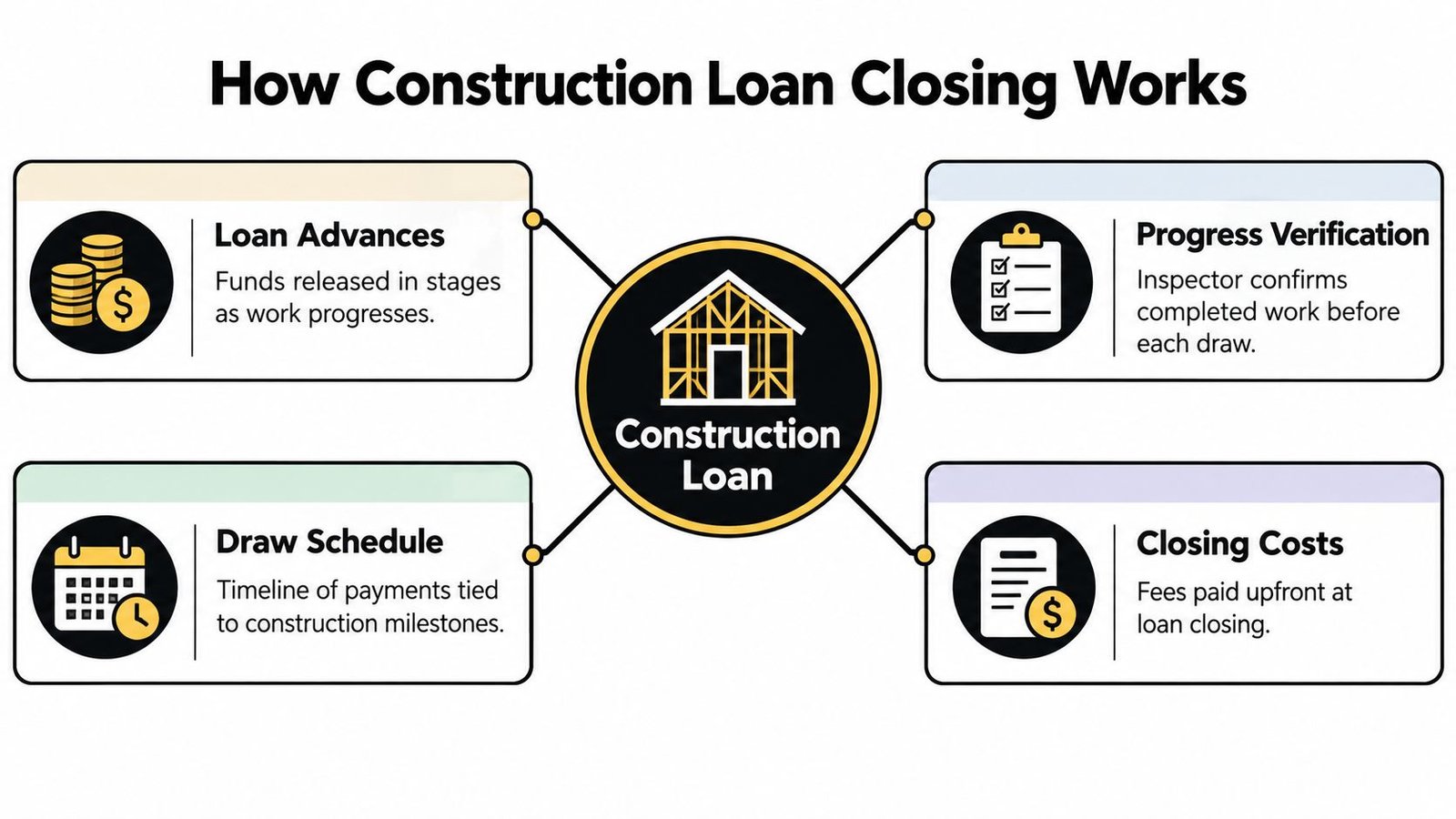
Building on a foundation works this way. Before the lender commits funds, it checks the borrower, land, plans, budget, builder, and expected completed value. After closing, the lender releases advances as work progresses. An inspector or other reviewer confirms that the completed work supports the requested draw, and the lender updates its records before sending the next payment.
That process creates four moving parts:
- Loan advances: Funds are released in stages rather than all at once.
- Progress verification: The lender checks completed work before each advance.
- Draw schedule: Payments follow construction milestones set out in the loan and budget.
- Closing costs: Upfront and transaction-related charges support the lender's underwriting and administration.
Why the lender checks more than credit
The lender isn't only asking whether your business can repay. It also needs confidence that the collateral will be worth the expected amount when complete and that the construction budget supports the scope of work. That can require an appraisal or completion-value analysis, plans-and-specifications review, title work, a survey, environmental reports, and periodic inspections.
The Consumer Financial Protection Bureau's TILA-RESPA Integrated Disclosure framework generally covers closed-end consumer mortgage loans used to finance home construction when secured by real property. Covered creditors disclose applicable charges on the Loan Estimate and Closing Disclosure, including transaction costs the creditor absorbs rather than bills directly to the consumer. The framework also supports good-faith estimates and applicable tolerance standards. It doesn't establish one nationwide percentage for commercial construction loans, and many business-purpose facilities fall outside those consumer rules.
Business borrowers should still request comparable transparency. Ask for an itemized closing statement that identifies every charge, who receives it, when it's due, and whether it reduces loan proceeds. If the project requires property coverage during construction, a resource explaining Florida builders risk coverage can help clarify a separate insurance obligation that shouldn't be confused with lender fees.
For a broader explanation of the funding cycle, review how construction loans work. The key is to connect the approved budget to the actual timing of each reimbursement.
Core Closing Cost Line Items Explained
Every fee should answer a simple question: What risk or service does this charge address, and when will I pay it? Construction-loan closing costs vary because lenders validate both the borrower and the project.
| Fee | What it covers | When paid |
|---|---|---|
| Origination | Lender underwriting and arranging the facility | Usually at closing or deducted from proceeds |
| Appraisal or completion-value analysis | Estimated value of the completed collateral | During underwriting, often before closing |
| Title search and insurance | Ownership, liens, and title protection | Before or at closing, with updates during construction |
| Survey | Boundary, site, or construction-related verification | Before closing, and sometimes when changes require it |
| Legal review | Loan documents, construction agreements, and related legal work | Before or at closing |
| Environmental or soils reports | Site conditions that could affect value or construction | During due diligence |
| Plans and specifications review | Scope, budget, and feasibility of the proposed work | Before approval and when material changes occur |
| Recording charges | Public filing of mortgages and related documents | At closing |
| Inspections | Verification of completed work before advances | During construction |
| Insurance and taxes | Required coverage or prepaid transaction items | Before closing or as required by the lender |
What each line is buying
Origination pays for the lender's work to structure, underwrite, document, and close the facility. It isn't the same thing as every construction-specific charge.
Appraisal may focus on current value, projected completion value, or both. A complex project can require more analysis because the lender must assess an asset that hasn't been completed.
Title and recording protect the lender's position and establish the public record. Construction also creates lien risk, so title updates and documentation can continue after the initial closing.
Survey, environmental, and soils work test the physical and legal assumptions behind the build. An ALTA/NSPS land survey, environmental report, or soils test may be more important for a complicated site than for a straightforward project.
Legal and plans review confirm that the documents, scope, budget, and construction arrangements fit together. The lender may also require architectural or construction inspections as work proceeds. A public housing-finance term sheet illustrates how broad the list can become, including appraisal review, environmental reports, title and recording, surveys, insurance, legal and architectural fees, credit reports, soils tests, taxes, and other closing expenses. See an explanation of a commitment fee if that charge appears on your worksheet.
The origination fee is only one line. The project-validation costs often determine how much cash you need before the first reimbursement.
Permits may be part of the project budget rather than a lender closing fee, and prepaid insurance or taxes may be handled as settlement items. Don't assume that a familiar label tells you who pays. Require a written description for every item.
Who Pays What and One Time Close Compared
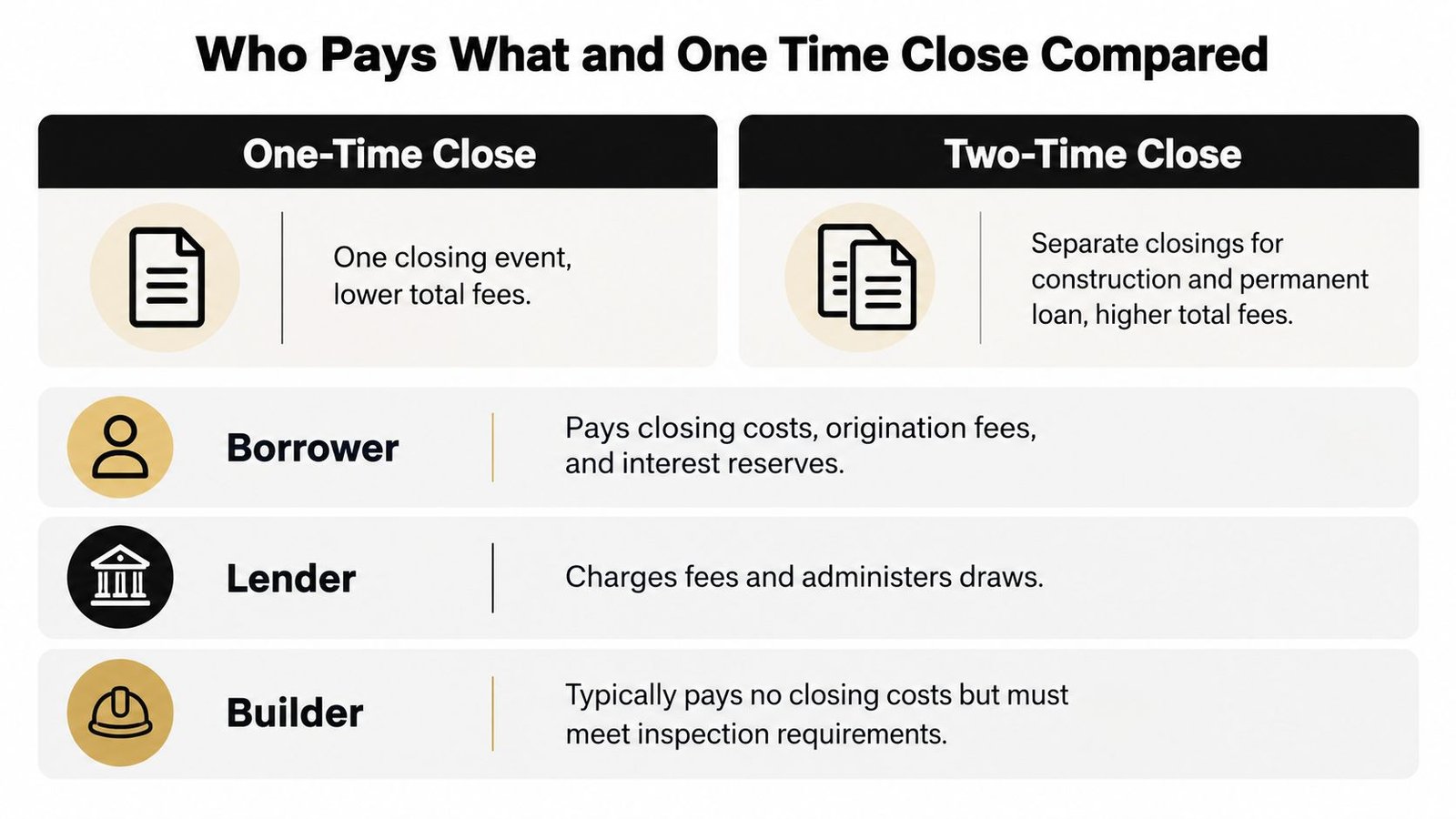
Responsibility doesn't follow the fee label automatically. A charge listed in the loan package may be paid by the borrower, included in the project budget, deducted from proceeds, absorbed by the lender, or addressed in the construction contract.
VA guidance shows why this distinction matters. It separates a construction fee from the ordinary origination charge and identifies inspection fees, commitment fees, title updates, and hazard insurance as costs normally associated with an interim construction loan. That doesn't mean every program assigns them to the borrower in the same way.
Use a fee-allocation checklist
Ask the lender and builder to classify each item as one of four responsibilities:
- Borrower: Paid directly from business cash or personal funds committed to the project.
- Lender: Absorbed as a credit or included in the lender's pricing.
- Builder: Covered under the construction contract or builder's obligations, where agreed.
- Project budget: Funded from the facility, which reduces money available for hard and soft construction costs.
Then add a second classification:
- Paid upfront at closing
- Deducted from proceeds
- Charged with each draw
- Held in an interest or other reserve
Get both answers in writing. “Included” can mean funded from the loan, not waived. “Paid by the lender” can mean a pricing adjustment rather than a free service.
One-time close versus two closes
A one-time-close loan combines construction financing and permanent financing into one closing event. It can reduce duplicated underwriting, appraisal, title, and settlement work, although construction inspections, title updates, and surveys may still apply.
A two-close structure separates the construction facility from the permanent loan. That may offer flexibility if the final financing terms or lender will be selected later, but it can create a second appraisal, title, underwriting, and recording cycle. The right comparison isn't "Which option has the lower upfront fee?" Compare total settlement work, draw administration, conversion terms, interest treatment, and the cash required at each stage.
For a business, flexibility may justify a second closing. A one-time close may be more attractive when preserving liquidity matters more than keeping the permanent financing decision open.
Timing That Changes Your Real Borrowing Cost
A fee can look small on the closing worksheet and still matter if it repeats throughout the build. A lender may quote an attractive origination charge, but recurring inspections and draw handling can increase the facility's measured borrowing cost and consume cash each time funds move.
The timing question is straightforward:
- At closing: You pay or finance one-time charges before construction begins.
- At each draw: You may pay inspection, handling, or administration charges.
- In reserves: The lender sets aside funds for interest or related obligations, reducing the amount available for construction.
Why draw frequency matters
Construction lenders release money after checking progress. If your project uses many small advances, you may face more inspection and handling events than a project with fewer, larger draws. Schedule changes, incomplete work, or disputed invoices can also delay reimbursement while your business continues paying workers and suppliers.
For U.S. consumer-purpose multiple-advance construction loans, CFPB Regulation Z guidance generally treats inspection and handling charges, including draw fees, as finance charges rather than merely administrative expenses. When applicable, those charges must be included in the disclosed finance-charge and annual-percentage-rate calculations. The classification matters because a fee that feels operational can affect the measured cost of borrowing.
Request a schedule showing the per-draw inspection fee, expected number of draws, treatment of unused funds, title-update charges, and consequences of a rescheduled inspection. Compare that schedule with the construction-loan agreement and the disclosure documents. A low upfront fee shouldn't win the comparison if recurring charges make the facility harder to use.
An interest reserve deserves the same scrutiny. It can help the project cover construction-period interest, but it isn't additional spendable construction cash. Model the facility twice, once as approved and once after subtracting closing charges, draw costs, and reserves.
The useful question isn't only “What does this loan cost?” Ask, “How much of the approved facility can actually pay for construction?”
Sample Cost Scenarios by Project Size
Project size affects the worksheet, but complexity and timing often matter just as much. The following examples are planning illustrations, not quotations. They show how to organize the review without inventing a universal fee for every build.
A smaller renovation or addition
A business renovating an existing location may have a simpler appraisal and title profile than a ground-up project, but it can still face plans review, legal documentation, inspections, and draw administration. The owner should identify cash due before work begins, then confirm whether each reimbursement carries an inspection or handling charge.
If the project includes specialized site work, the lender may request additional documentation about scope and completion. That makes a clear contractor budget important. For example, a business coordinating residential and commercial concrete work should make sure concrete mobilization, deposits, inspections, and payment milestones appear consistently in both the construction contract and draw schedule.
A mid-size commercial buildout
A commercial buildout may involve more parties, more detailed plans, and more opportunities for revisions. The lender could require title work, a survey, environmental review, legal analysis, and recurring inspections. A business should ask whether a change in scope triggers another plans review or appraisal analysis.
The cash question is practical: what must be paid before the first reimbursement, and which costs will be deducted from the facility? Payroll and supplier obligations don't pause while the lender processes a draw, so the operating account needs a separate cushion.
A larger ground-up project
A larger or technically complex project can require broader due diligence and more coordination among the lender, builder, architect, title company, and inspectors. Even if the stated origination fee doesn't change, additional reports and review can increase the cash needed at closing.
Draw inspections may cost approximately $100 to $250 each, and a typical project can require multiple inspections. That means recurring charges may materially change the total economics, especially when the project uses many advances or experiences schedule changes. The planning worksheet should show three separate totals:
- Cash due at closing
- Expected per-draw charges
- Reserves that reduce usable proceeds
Don't compare a project only against a headline percentage. Compare the cash required before the first reimbursement, the amount available for hard costs after reserves, and the fee exposure created by the draw schedule.
Smart Ways to Lower and Finance Closing Costs
Start by turning the lender's worksheet into a negotiation document. You can't eliminate every third-party requirement, but you can identify duplication, timing problems, and charges that differ between offers.
Reduce avoidable friction
- Compare complete offers: Review origination, appraisal, title, legal, inspection, draw, and reserve treatment together. A lower origination fee may not produce the lower total cost.
- Request vendor estimates: Ask the lender to identify the expected providers and obtain written estimates for surveys, reports, legal work, and inspections.
- Coordinate draw timing: Align draw requests with meaningful construction milestones so the lender isn't sent to inspect incomplete or very small work packages.
- Tighten the plans: A clear scope and consistent budget can reduce re-review caused by unexplained changes. Keep allowances, change orders, and contractor invoices organized.
- Ask about lender credits: A lender may offer a credit in exchange for pricing, structure, or other terms. Compare the credit against the full economics, not the headline benefit.
- Clarify financing treatment: Confirm which eligible costs can be included in the facility or interest reserve, and calculate how that affects usable proceeds and repayment.
Businesses evaluating financing for a roof, addition, or major repair can also compare roof loan plans with attention to total repayment and timing rather than the first advertised payment.
Before signing, reconcile the final disclosure against the construction-loan agreement. Confirm the amount due at closing, every recurring draw charge, reserve deductions, unused-funds treatment, title updates, insurance requirements, and the process for approving change orders. Then keep enough separate operating cash for deposits, payroll, materials, retainage, and surprises.
Business Loan Warrior helps established businesses evaluate construction loans and other custom funding through a single, no-fee application, with pre-approval checks that don't affect credit and a dashboard for tracking the process. Visit Business Loan Warrior to compare funding options and connect your project budget with a financing structure you can manage.