
Your sales are holding steady, but the lender says there's less room to draw on your credit line. That can happen even when the business looks healthy on paper. A late-paying customer, a disputed invoice, or inventory that's harder to sell than expected can reduce the collateral the lender is willing to count.
A borrowing base certificate (BBC) helps explain the gap. It reports which receivables and inventory qualify as collateral and calculates the amount of credit those assets support. Treating it as a forward-looking liquidity control, rather than a form to rush through at month-end, can help you spot a shortfall before it disrupts payroll, purchasing, or other plans.
Table of Contents
- What a Borrowing Base Certificate Does for Your Business
- Inside the Borrowing Base Formula
- Why a Strong Sales Quarter Can Quietly Shrink Your Availability
- Reporting Cadence, Certification, and the Audit Trail
- A Working Template for Your Borrowing Base Certificate
- Risk, Default Triggers, and How to Prevent an Innocent Mistake
- Putting It All Together With a Pre-Submission Checklist
What a Borrowing Base Certificate Does for Your Business
A distributor can make steady sales and still find that its available credit has fallen. The reason may not be a change in sales at all. If customers are paying more slowly or the inventory mix has shifted toward goods the lender considers less liquid, fewer assets may qualify to support borrowing.
A borrowing base certificate is the operational document that turns eligible collateral into a current borrowing limit. The Office of the Comptroller of the Currency's asset-based lending guidance defines the borrowing base as a collateral base agreed upon by borrower and lender that limits advances. In practice, the borrower reports eligible receivables and inventory, applies the advance rates in the loan agreement, and deducts reserves or other lender-imposed amounts.
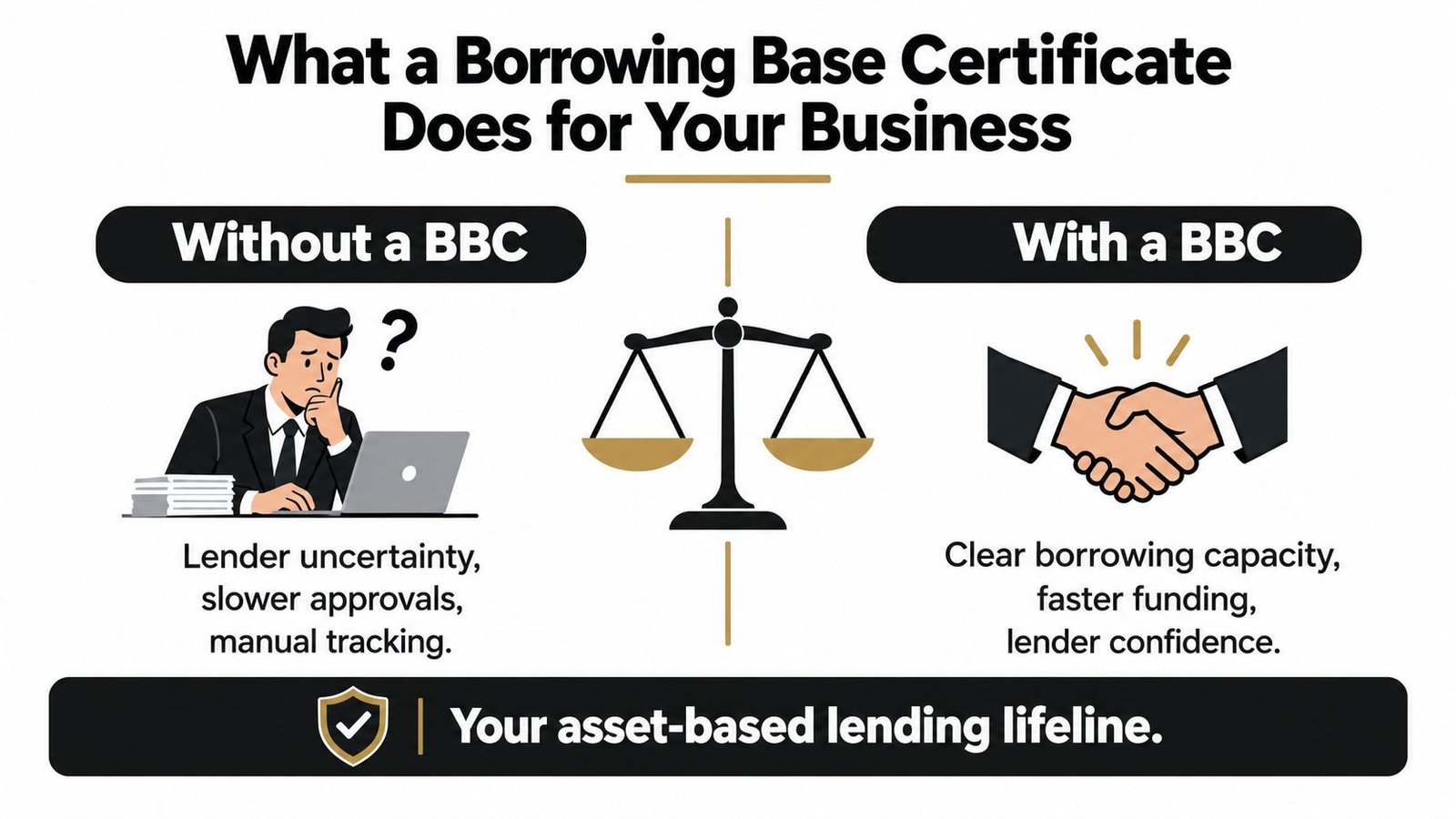
That makes the BBC different from a fixed loan amount. A term loan is generally agreed as a set amount, while an asset-based revolving facility adjusts borrowing capacity to the collateral reported and accepted under the loan documents. The difference matters when your working-capital needs and eligible assets change during normal operations.
How a borrowing base replaces a fixed loan limit
| Feature | Traditional Term Loan | Borrowing Base Facility |
|---|---|---|
| What supports availability | The agreed loan amount and repayment terms | Eligible collateral, advance rates, and deductions |
| How availability changes | Generally follows the loan's repayment schedule | Changes when the eligible collateral calculation changes |
| What the borrower reports | Requirements set out in the loan agreement | Regular collateral reports and supporting schedules |
The certificate isn't just a lender's record. It's a recurring calculation that can determine how much your business may draw under the facility. The loan agreement sets how often that calculation happens and what records must support it, so the certificate's timing and accuracy can have a direct effect on day-to-day cash access.
Inside the Borrowing Base Formula
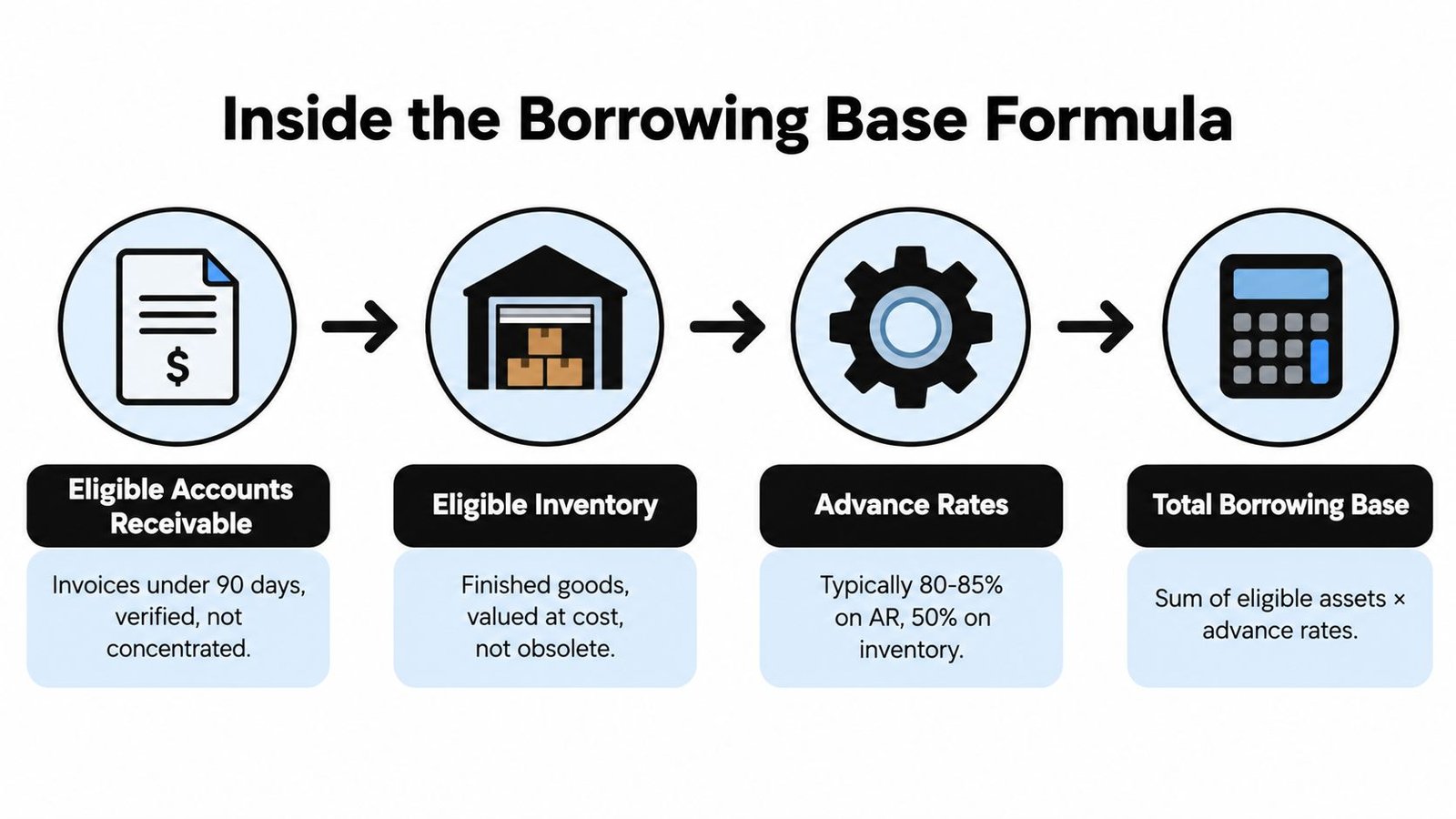
A borrowing base calculation starts with assets the lender agrees to recognize, not every asset on your balance sheet. The agreement defines what counts as eligible and how much the lender will advance against it. Those rules matter because a dollar of collateral value doesn't necessarily provide a dollar of borrowing capacity.
Start with eligible assets
First, identify eligible accounts receivable and inventory using the definitions in your loan agreement. Receivables that are too old, disputed, owed by an affiliate, or above a customer concentration cap may be excluded. Inventory can also be restricted or discounted based on its condition, type, and likely marketability.
Next, apply the advance rate to each eligible asset category. It's the contractual percentage used to calculate how much credit the lender will extend against that collateral. The rate can differ between receivables and inventory because the lender assesses their liquidity and recovery prospects differently.
The OCC's asset-based lending handbook gives a clear example: $10 million in eligible receivables at an 80% advance rate produces $8 million, while $4 million in eligible inventory at a 50% rate produces $2 million. Before reserves, the combined borrowing base is $10 million. Those amounts illustrate the arithmetic, not a promise that any particular borrower will receive the same rates.
Then account for deductions
Reserves and other deductions reduce the calculated amount. A lender may impose them under the facility's terms, so the certificate should show how each deduction was determined rather than presenting a final figure without explanation.
For example, the formula can be written as:
Eligible receivables × applicable rate + eligible inventory × applicable rate − reserves and other deductions = borrowing base
The loan agreement governs both the calculation and its supporting documents. For accurate source records, a company may also want to review its business inventory management process so inventory records can be traced to the certificate.
The calculation looks simple once the inputs are settled. The work is making sure those inputs reflect the lender's eligibility rules and reconcile to the company's books. The video below offers another visual walkthrough of the mechanics.
Why a Strong Sales Quarter Can Quietly Shrink Your Availability
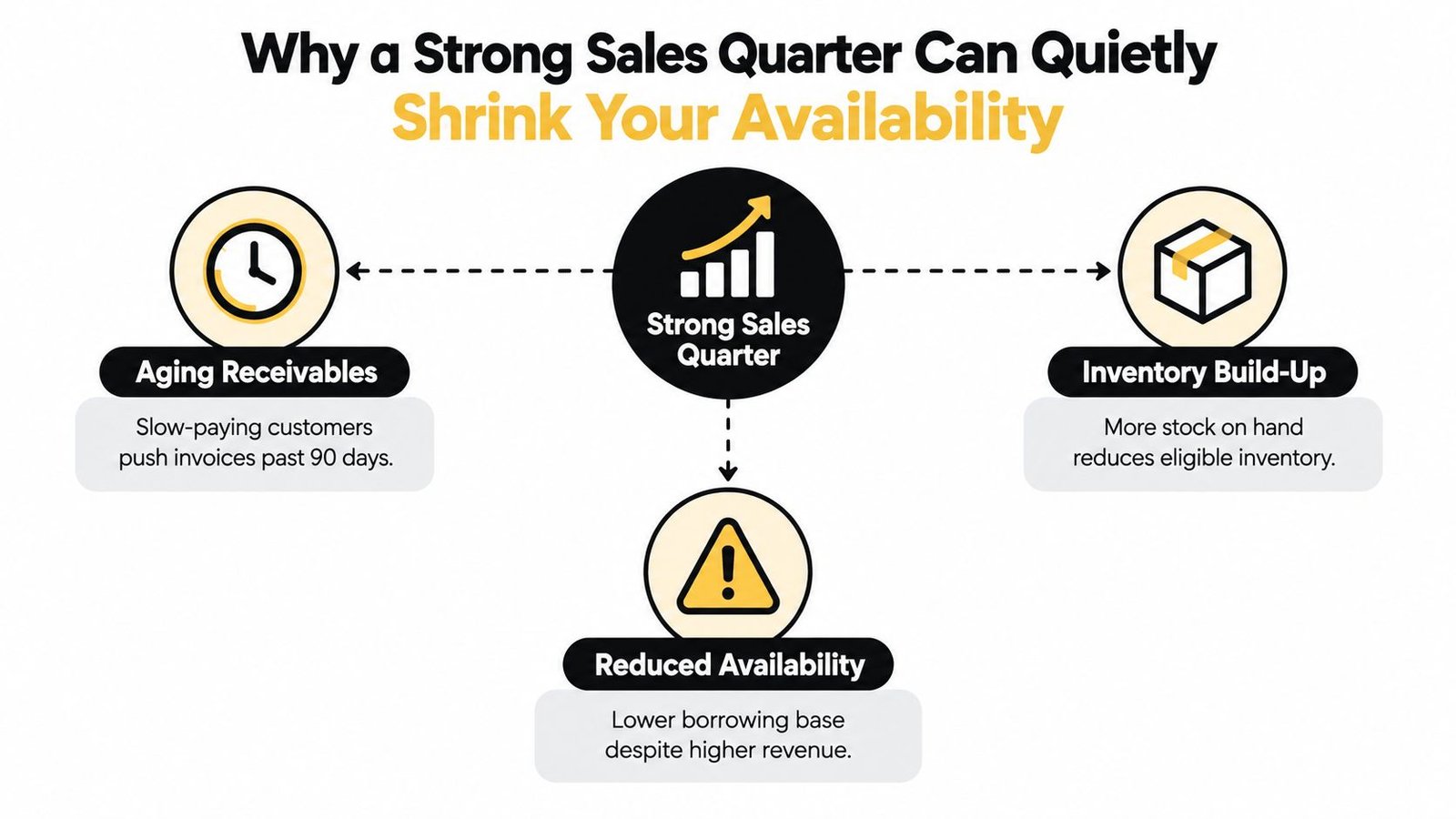
Higher sales don't automatically mean more borrowing capacity. A sale may create an invoice, but that invoice only helps the borrowing base if it meets the lender's eligibility requirements and can reasonably convert to cash. If collections slow or the customer mix becomes more concentrated, the reported sales growth may not translate into additional availability.
Watch for pressure in receivables
Aging is one place a shortfall can begin. If invoices pass the lender's eligibility window, they may no longer count, even if the customer has a history of paying. A growing balance of overdue receivables can therefore reduce the collateral base while reported revenue continues to rise.
Customer concentration can create a similar result. When too much of the receivables pool depends on one buyer, the agreement may limit how much of that customer's balance counts. A large customer's late payment can then affect both collections and eligibility.
Credits, returns, and disputes also matter. They reduce or call into question the amount the business expects to collect, so the gross accounts-receivable figure may overstate the value available to support borrowing.
Check the inventory mix
Inventory growth isn't always helpful either. Finished goods that can be sold may be more liquid than raw materials or work-in-process, which can be harder to turn into cash. As the borrowing base formula and collateral considerations explain, lenders may discount less-liquid inventory and exclude receivables that don't meet eligibility criteria.
A useful check is a cash-conversion stress test. Review receivables by aging and eligibility category, measure the portion tied to major customers against the agreement's concentration rules, reconcile credits and disputes, and separate inventory by type and liquidity. Then consider how the calculation changes if a major payment arrives late or more inventory becomes slow-moving.
Strong sales support borrowing capacity only when the underlying assets remain eligible and can convert to cash.
This exercise is more useful before you submit the certificate than after the lender identifies a decline. It turns the BBC into an early warning for working-capital pressure, not merely a summary of the period that just ended.
Reporting Cadence, Certification, and the Audit Trail
The lender relies on more than the final borrowing-base number. It needs enough detail to trace that number back to the company's records, and the loan agreement sets the required delivery schedule. Some facilities call for monthly reporting; an increased-reporting event can require delivery within three business days after each week-end, as described in a publicly filed credit agreement.
The package commonly includes a certificate signed by a responsible financial officer, accounts-receivable and accounts-payable agings, inventory reports with aging detail, and additional information requested by the administrative agent. The agreement also determines how long the submitted calculation remains effective. In one disclosed agreement, the reported borrowing base applies from delivery until the succeeding certificate.
Make the submission traceable
A reliable process begins with the source records. Reconcile the certificate to the general ledger, check customer balances against the accounts-receivable aging, and compare inventory figures with the underlying inventory report. Document exclusions, reserves, and judgment calls so a reviewer can understand how you reached each figure.
The officer's signature makes review and evidence important. If a certificate is too conservative, the company may limit its own access to working capital. If it overstates eligible collateral, the lender may advance more than the assets support, creating an overadvance or other loan-document concern.
For finance teams improving their close and documentation routines, these financial reporting best practices can help frame a repeatable process. A clear accounts-receivable aging narrative for your lender can also make exceptions easier to explain and follow up.
Before submission, give someone who didn't prepare the calculation a chance to review it. That person should be able to trace material figures to source schedules and understand why any balances were excluded or reserved.
A Working Template for Your Borrowing Base Certificate
A useful working template mirrors the sequence of the calculation and makes each number traceable. Your lender's required form and loan agreement take precedence, but a structured draft can help the controller or bookkeeper gather the right records before completing the official certificate.
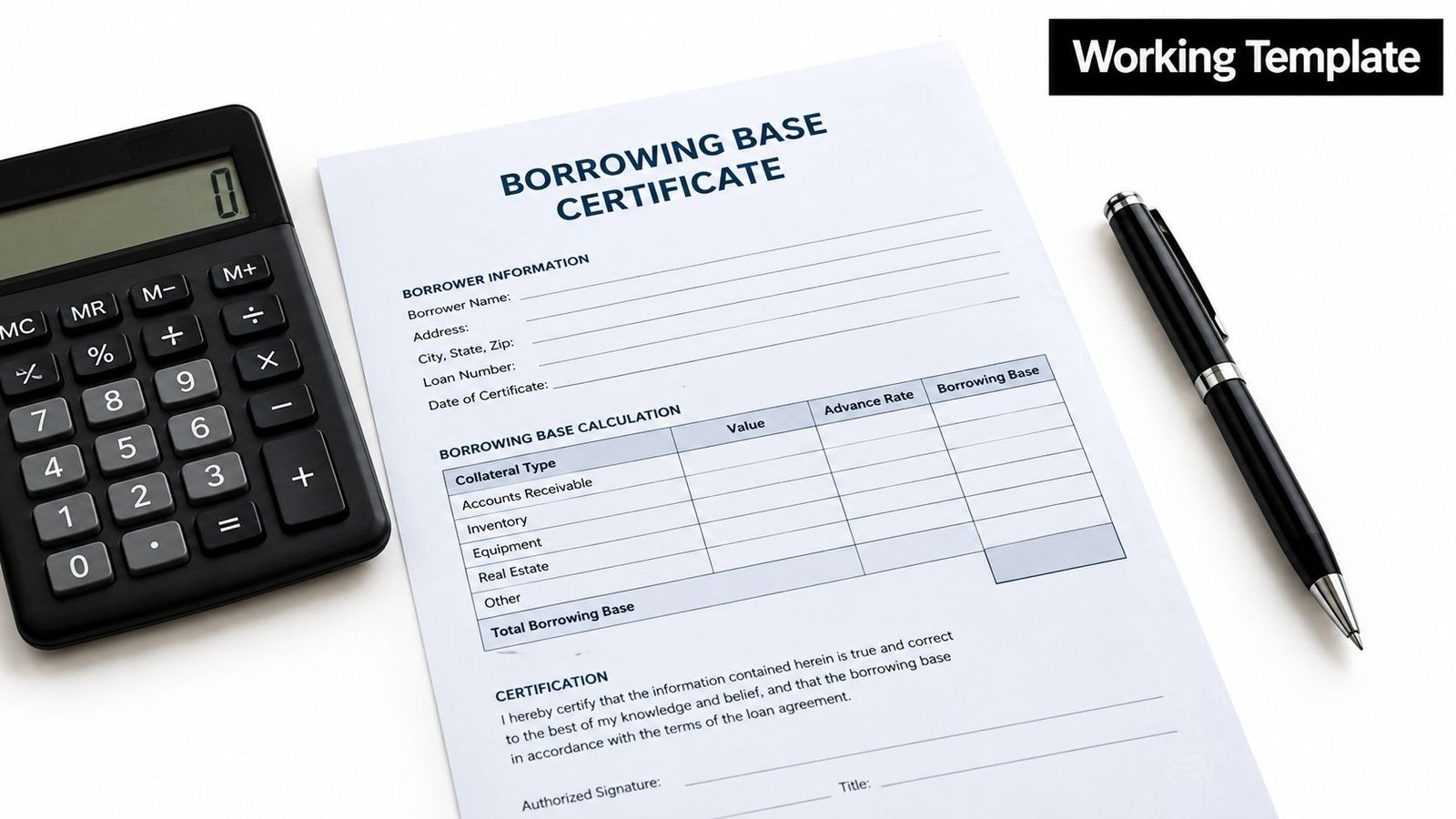
Build the certificate in blocks
Start with a header containing the borrower's name, reporting date, and the responsible officer's certification. The reporting date should match the cutoff used for the supporting schedules. If it doesn't, the certificate and backup may describe different snapshots of the business.
For receivables, list the gross balance and then show each ineligible category required by the agreement. Depending on the facility, that may include aged, disputed, affiliate, or concentrated balances. The result should be a clearly calculated net eligible receivables figure, supported by the accounts-receivable aging and an exclusion schedule.
The inventory block should follow the lender's categories, which may distinguish raw materials, work-in-process, and finished goods. Tie each balance to the inventory report and identify any required deductions or exclusions. Don't assume that an accounting value automatically qualifies as eligible collateral.
Tie the numbers to evidence
Add the applicable advance rates beside each eligible balance. Then include reserves and other deductions as separate lines, with a supporting schedule that explains their source. The final summary should combine the adjusted receivables and inventory amounts and show how the resulting borrowing base compares with the amount already drawn, using the format required by your lender.
For a worked calculation, use the OCC example from the formula discussion: $10 million in eligible receivables at 80%, plus $4 million in eligible inventory at 50%, gives a $10 million base before reserves. The calculation is useful only if the balances, eligibility decisions, and rates all follow the actual loan agreement.
A draft can be organized like this:
- Certificate details: Borrower, reporting date, preparer, and officer certification.
- Receivables: Gross balance, exclusions by category, net eligible amount, and source aging.
- Inventory: Balances by agreed category, eligibility adjustments, and inventory report.
- Rates and deductions: Contractual advance rates, reserves, and supporting schedules.
- Availability summary: Calculated borrowing base and comparison with the amount drawn.
Have the reviewer trace every line to a source report. That's the simplest way to spot a number that looks plausible but doesn't tie to the books.
Risk, Default Triggers, and How to Prevent an Innocent Mistake
A signed borrowing base certificate isn't just a spreadsheet. It supports the lender's assessment of collateral availability under the loan documents, so an error can have consequences even when nobody intended to mislead the lender. The response depends on what happened, how the agreement treats it, and whether the figures can be reconciled.
A clerical mistake, such as missing a credit note, may call for a correction and further review. An accounting-policy difference, such as how the company presents returns or credits, can require the borrower and lender to reconcile their treatment. Knowingly including an ineligible asset is more serious because it can be treated as misrepresentation.
Treat the process like a financial control
If stated availability falls below the amount borrowed, the difference may need to be repaid immediately. A lender that discovers ineligible assets may also increase monitoring or pursue default remedies, depending on the loan documents. Borrowers should therefore resolve eligibility questions before signing, not rely on a later explanation to cure an unsupported figure.
A documented close process can reduce avoidable mistakes:
- Lock the reporting date so the certificate and schedules use the same cutoff.
- Reconcile receivables to the general ledger and investigate differences.
- Keep an invoice-level exclusion log for aging, disputes, credits, and other ineligible items.
- Support judgment calls with evidence and a record of the eligibility rule applied.
- Require a second-person review before the officer signs and submits the certificate.
Automation can make data gathering faster, but it doesn't decide whether an invoice is eligible under the agreement. Inconsistent rules, stale reserves, and unexplained changes can still produce a weak certificate.
A clean audit trail should let another reviewer follow the number from the source report to the final calculation.
For a broader view of how reporting and credit decisions fit into identifying financial risks for SMEs, consider how collateral reporting connects to the company's other liquidity exposures. A covenant early-warning dashboard can also help teams track issues before they become a submission or borrowing-base surprise.
Putting It All Together With a Pre-Submission Checklist
A certificate can look sound on submission day and still reveal a shortfall that began weeks earlier. A large customer may pay late, older invoices may fall outside the eligibility window, or inventory may shift toward items that are harder to sell. Use the certificate as a forward-looking liquidity check: ask what could reduce availability by the next reporting date, then decide who will respond and when.
Before submission, focus on decisions and timing that prevent a surprise:
- Set a sensitivity-check date: Schedule an internal check at least one week before the formal deadline, leaving time to investigate a potential shortfall and discuss options with the lender.
- Choose an escalation owner: Name the person who will contact the lender if projected availability approaches a borrowing limit. Agree on what information that person needs to share.
- Test a realistic cash-flow pinch: Model a delayed payment from a major customer or a shift toward less-liquid inventory. Compare the result with expected payroll, supplier payments, and other near-term needs.
- Plan the response: Decide which actions are available if headroom narrows, such as accelerating collections, adjusting purchases, or arranging a lender discussion. Confirm that any proposed action fits the loan agreement.
Match reporting frequency to collateral movement
A monthly certificate may not show a developing issue soon enough when sales are seasonal or billing depends on project milestones. Ask whether internal sensitivity checks between formal submissions would give the business more time to act. The goal is to spot pressure early, not to create another paperwork cycle.
The OCC describes asset-based borrowers that may need daily loan advances and lenders that make daily adjustments to available credit. Its 2014 asset-based lending bulletin distinguishes traditional asset-based lending from highly indebted company lending when the facility is tightly controlled, secured by specific assets, and governed by a borrowing formula.
Keep a short forward-looking view alongside the certificate: expected collections, significant customer payment risks, and changes in inventory liquidity. Before the next deadline, ask the controller to compare that outlook with projected availability and raise concerns while there is still time to plan. A certificate is more useful when it informs a decision before cash becomes tight.
If your business is comparing working-capital options or needs financing suited to its cash-flow needs, Business Loan Warrior offers a no-fee application and options including lines of credit, SBA loans, and invoice financing. Visit Business Loan Warrior to explore options and check pre-approval without affecting your credit.