
Your seller won't hold the building past quarter-end. The equipment vendor wants a deposit in six weeks. You call three lenders about an SBA loan and get three different closing dates.
For a complete application, the agency's review runs about 5–10 business days for standard 7(a) processing, and 7(a) Small loans of $350,000 or less may take roughly 2–10 business days, depending on the processing channel (SBA lender guidance). The full journey is longer: plan roughly 30–90 days for a 7(a) loan and 60–120 days for a 504 loan.
The SBA is rarely the stage that eats your calendar. Lender underwriting, document collection, third-party reports, and closing consume most of it. The agency stamps the guarantee; the lender builds the file. If that lender is still waiting on clean financials or an appraisal, the SBA clock has barely started.
Ask the question that moves your funding date: where is my file, who owns the next step, and what is blocking it. Borrowers who choose a lender with delegated SBA authority, deliver a complete package on day one, and run the process through a fintech-enabled application stack compress that window far more than any status call to the agency ever will.
Table of Contents
- What SBA Loan Processing Time Really Means
- The Three Stages That Make Up SBA Loan Processing
- Typical SBA Timelines by Loan Program
- What Actually Slows SBA Loan Processing Down
- Documents and Choices That Keep Your File Moving
- A Realistic Week by Week Walkthrough
- How to Speed Up Approval and Your Next Questions
What SBA Loan Processing Time Really Means
A lender says your SBA loan could close in six weeks. That estimate means little until you know which stage the lender has counted. “Processing time” can include document preparation, lender underwriting, SBA review, closing, and disbursement. Approval is only one milestone; funds arrive after closing requirements are met.
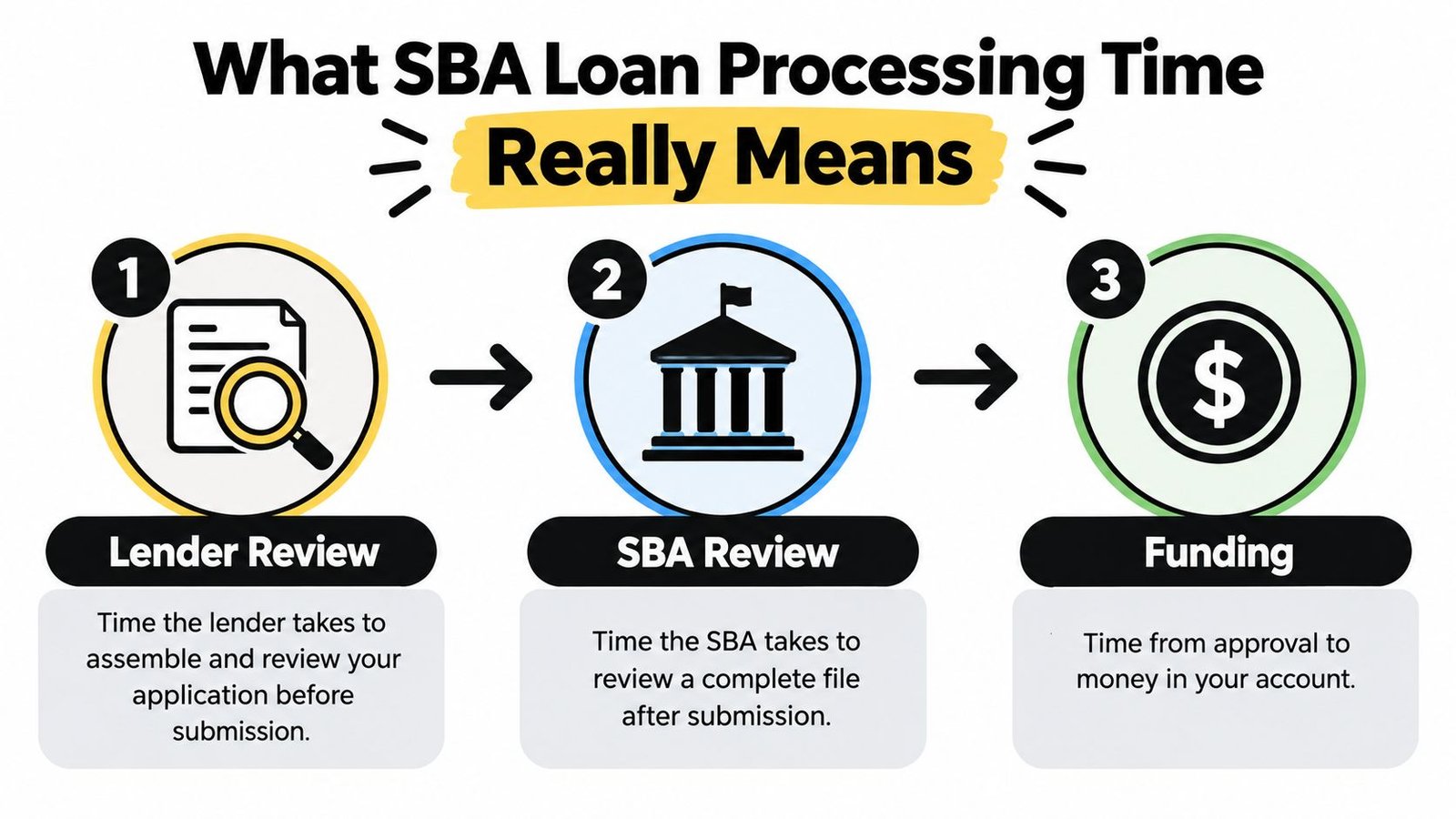
Lender underwriting usually takes the largest share of the calendar. The lender assembles the application and resolves underwriting questions before submission. The SBA reviews the complete file for its guarantee decision, then the lender handles closing conditions before disbursing funds. A quick SBA decision cannot make an unfinished lender review or closing disappear.
Where the days actually go
| Stage | Who owns it | Typical range |
|---|---|---|
| Borrower preparation and lender review | You and the lender | Several weeks, depending on file readiness and underwriting needs |
| SBA review | SBA or delegated lender | About 5–10 business days for standard 7(a) processing |
| Closing and funding | Lender, borrower, and relevant third parties | Several weeks when closing conditions or reports remain outstanding |
The SBA-stage estimate reflects the 7(a) processing guidance cited earlier. The other ranges are planning estimates, not guaranteed service windows. A straightforward file may move faster; unresolved questions, delayed reports, or slow document responses can extend the process.
Practical rule: Ask your lender which stage the file is in, who owns the next action, and what specific item is outstanding. “It's with the SBA” does not tell you whether the lender has submitted a complete package.
Cash-flow timing matters, too. Sellers managing Amazon payout cycle capital needs should plan around lender review and closing, not just the agency decision window.
The Three Stages That Make Up SBA Loan Processing
A file usually moves through borrower preparation, lender underwriting, and SBA review. The SBA can't review what the lender hasn't assembled, and a fast agency decision won't resolve an open appraisal, a missing tax return, or a question about how the business will use the proceeds.
Borrower preparation comes first
The lender needs enough information to understand the business, its owners, repayment ability, and the requested use of funds. That commonly includes business and personal tax returns, current financial statements, existing debt details, ownership records, collateral information, and a clear explanation of how the loan proceeds will be used.
Preparation is the stage you control most directly. When a statement is missing or financial figures don't reconcile, the lender has to ask follow-up questions, and the application may sit while you locate records or clarify the discrepancy. To see how the lender evaluates and documents the file, review this guide to the SBA loan underwriting process.
Lender underwriting is where files stall
The lender tests whether the business can repay the debt, whether the borrower and transaction meet program requirements, and what conditions need to be satisfied before approval and closing. That can involve follow-up requests, ownership or eligibility questions, lien searches, appraisals, or environmental reviews. These aren't interchangeable tasks, and a third-party report can become the critical path even when the financial analysis is complete.
The SBA's own review typically begins only after the lender has signed off and submitted a complete package. In testimony published in July 2019, the agency said it had reduced processing for small loans to 2–3 days from 6 days and for regular loans to about 7 days from 15 days, attributing the improvement to better procedures and electronic processing (SBA testimony). Those are historical SBA-side figures, not a promise about how long your full loan journey will take.
SBA review is one stage, not the finish line
After the SBA or an authorized lender completes the guarantee review, the lender still has to satisfy closing requirements, finalize loan documents, and coordinate disbursement. If a condition remains open, “approved” doesn't necessarily mean “ready to fund.”
Get the lender to name the outstanding items and distinguish between items needed for submission, SBA review, and closing. That simple breakdown shows whether a delay is caused by missing borrower information, lender analysis, a third-party provider, or an agency queue.
Typical SBA Timelines by Loan Program
A 7(a) working-capital request and a 504 real-estate project do not run on the same calendar. The SBA's published processing benchmarks cover its review stage, not the full period from application to funding. Lender underwriting and transaction complexity account for much of the difference.
| Program | Best use | SBA stage | End-to-end range |
|---|---|---|---|
| 7(a) | Flexible business purposes, including working capital and expansion | About 5–10 business days for standard processing | Roughly 30–90 days |
| 7(a) Small | Qualifying smaller financing needs | Roughly 2–10 business days, depending on channel | Roughly 30–90 days |
| 504 | Major fixed assets, such as real estate or equipment | Depends on the transaction and review path | Roughly 60–120 days |
| SBA Express | Smaller requests where an expedited pathway may fit | Some Express pathways have historically allowed SBA review in as little as two business days | Varies by lender and transaction |
| CAPLines | Revolving or seasonal working-capital needs | Depends on the specific 7(a) processing channel | Varies by lender and transaction |
The standard 7(a) and 7(a) Small agency benchmarks come from the SBA lender guidance cited earlier. Historical Government Accountability Office benchmarks for basic 7(a) review also reported 5–7 business days, with some Express pathways taking as little as two business days; those figures describe agency review, not funding. The end-to-end ranges are planning estimates, not official SBA processing guarantees. Compare the structures and use cases of 7(a), 504, and other SBA loan options before choosing based on speed alone.
Match the structure to the need
For working capital or a broader business purpose, 7(a) may offer more flexibility, while the lender underwrites both the business and the transaction. A 504 loan finances fixed assets and uses a project structure that can require more coordination, so budget for a longer calendar than a straightforward 7(a) request. SBA Express can shorten the SBA review component for eligible applications; lender underwriting and closing still take time.
CAPLines suit working-capital needs that fit a line-of-credit structure. Ask the lender which processing pathway it plans to use and whether its estimate includes closing and funding. A timeline without a named program and stage is incomplete.
What Actually Slows SBA Loan Processing Down
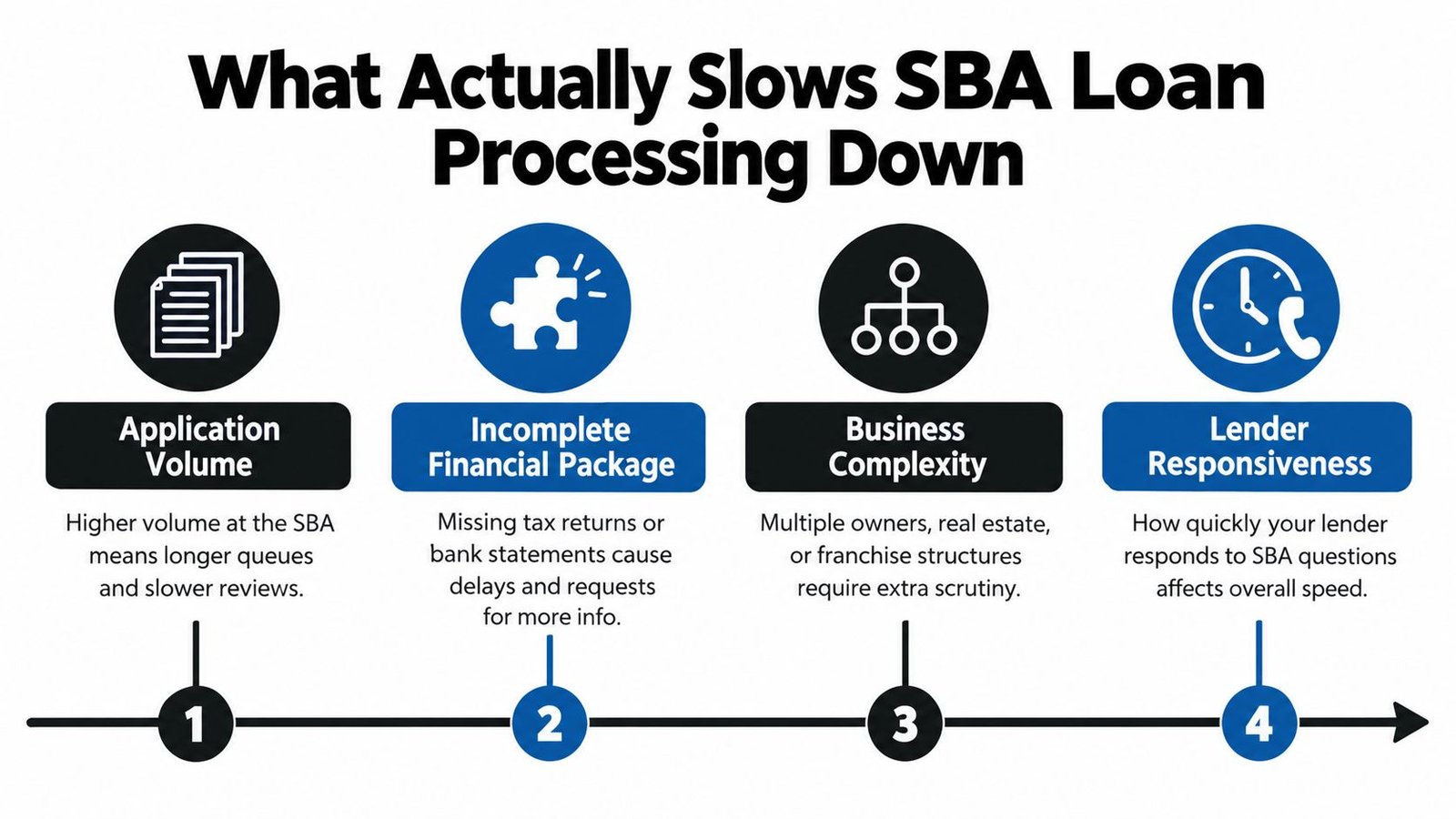
Most delays have an owner. The borrower may be late with tax returns, the lender may need to resolve cash-flow questions, an appraiser may not have completed a report, or an application may be waiting in a review queue. Treating all of that as “the SBA taking too long” makes it harder to fix the actual problem.
Volume can change agency timelines
Disaster lending shows how sharply application volume can affect review queues. A Congressional Research Service summary of SBA disaster-loan standards describes targets of roughly 2–3 weeks below 50,000 annual applications, 3–4 weeks at 50,001–250,000, and more than 4 weeks above 250,000. The same summary reports an average 43.3 days for business disaster-loan applications in an SBA Office of Inspector General study.
These figures concern disaster loans, not ordinary 7(a) lending. They're useful as evidence that high demand can extend an agency timeline, not as a forecast for a standard business loan. The same CRS summary notes that the SBA met its applicable disaster-loan standard less often in FY2013, a period affected by increased applications after Hurricane Sandy.
Delegation removes an approval handoff
Preferred SBA lenders can use delegated authority to approve qualifying loans on the agency's behalf. SBA testimony reported that more than 80% of 7(a) guaranteed lending was submitted through Preferred SBA lenders under delegated authority, enabling agency turnaround in a matter of days (SBA testimony on delegated authority). A non-delegated application instead goes to an SBA loan-processing center for review.
Delegation can reduce an approval handoff and queue exposure. It doesn't waive underwriting. The lender still has to document eligibility, repayment ability, credit quality, collateral where applicable, and appropriate use of proceeds.
For a candid look at which problems tend to add calendar time, watch this overview of common SBA processing delays:
A clean, complete file won't make an appraisal or environmental review disappear, but it keeps avoidable document gaps from becoming another source of delay. Ask the lender which reports are needed and when they'll be ordered. Then send condition responses together, clearly labeled, instead of answering one question at a time and reopening the file repeatedly.
Documents and Choices That Keep Your File Moving
Underwriting slows down when the lender can't verify the story your application tells. Prepare the financial package before intake, use the lender's requested format, and check that business names, ownership details, debt balances, and reported income agree across documents.

Build a lender-ready package
Gather the documents the lender needs to understand repayment, ownership, and the transaction:
- Tax returns and financial statements: Business and personal tax returns, plus current interim profit-and-loss and balance-sheet statements.
- Debt and cash-flow details: A schedule of existing business debt and any supporting information the lender requests to understand payments and obligations.
- Ownership and entity records: Current ownership details and formation or governance documents that match the application.
- Use of proceeds: A specific description of what the loan will pay for, supported by quotes or transaction details when relevant.
- Collateral information: Details about assets offered as collateral and any related liens or records.
- Third-party requirements: Ask early whether the transaction calls for an appraisal, environmental review, lien search, or other outside report.
A detailed SBA loan document checklist can help you organize the package before the lender starts asking for individual items. Don't guess at formats or acceptable alternatives. Ask the loan officer to confirm what's required for your program and transaction.
Ask questions before you choose a lender
Find out whether the lender will use delegated processing, which program and processing channel it expects to use, and which third-party reports are needed. Ask what conditions commonly arise for a transaction like yours and who will coordinate those reports. More than 80% of 7(a) guaranteed lending was submitted by Preferred lenders under delegated authority in the testimony cited earlier; that structural difference makes the lender's processing approach worth confirming at the start.
A fintech-enabled application stack can reduce borrower-side friction when it lets you connect business bank accounts, complete a soft-pull pre-approval, upload documents securely, and track outstanding requests in one place. It doesn't replace underwriting or make a weak application stronger. It can, however, cut avoidable back-and-forth by helping you submit a coherent file and respond to conditions in a consolidated package.
A Realistic Week by Week Walkthrough
Consider an established company seeking financing for an expansion. The owner has a clear use for the funds but hasn't yet gathered current financial statements, verified the debt schedule, or confirmed which third-party reports the lender will require. The calendar begins moving faster once those decisions stop sitting in email.
Intake and underwriting
During the first stretch, the borrower completes intake, shares financial records, and answers initial questions about ownership, cash flow, and the planned use of proceeds. If bank information can be connected securely and documents are uploaded to a shared dashboard, the lender can begin reviewing the package while the borrower tracks what remains outstanding.
Next, the underwriter tests repayment ability and checks the file for gaps. The lender may request clarification, refine the loan structure, and order reports needed for the transaction. If a real-estate component calls for an appraisal or environmental review, that work can continue alongside lender analysis, but it may still determine when the file is ready to close.
Submission, closing, and funding
Once underwriting is complete, a delegated lender may approve on the SBA's behalf, while a non-delegated application goes to an SBA processing center. After the guarantee decision, the lender still has to clear closing conditions, finalize documents, and complete any needed lien work before disbursement. A quick response to a consolidated condition list can preserve momentum; scattered answers can keep the file open while the lender reconciles what's missing.
The calendar isn't a promise that every file follows the same weekly pattern. It's a working model: preparation and underwriting come before submission, and approval comes before closing and funding. Borrowers planning a separate home purchase or refinance can compare the stages with this guide to the mortgage loan approval timeline, but an SBA business loan has its own underwriting and closing requirements.
How to Speed Up Approval and Your Next Questions
If timing matters, don't wait for a vague status update. Ask for the current stage, the unresolved items, and who owns each next step. Then act on the parts you control.
- Confirm the processing path: Ask whether the lender uses delegated authority and which SBA program and channel fit the request.
- Submit a complete package: Provide the requested financial, ownership, debt, use-of-proceeds, and collateral information together.
- Consolidate condition responses: Return one organized package instead of sending partial answers that trigger another review cycle.
- Surface third-party work early: Find out which appraisals, environmental reviews, or lien searches apply and who will order them.
- Choose for fit, not a headline speed claim: Match the program to the financing need and confirm whether the quoted timeline includes closing and funding.
Does SBA Express mean immediate funding? No. An expedited SBA review pathway can reduce the agency-stage wait, but the lender still has to underwrite and close the loan.
Why can a file sit in conditions? The lender may be waiting for documents, clarification, or a third-party report. Ask for a single list of open items and send a complete response.
Does an SBA refinance move faster? Not automatically. Timing depends on the program, transaction details, lender review, and any closing requirements. Get a stage-by-stage estimate before relying on the proceeds for a deadline.
Business Loan Warrior helps small businesses compare funding options and move through an application using a single, no-fee process with pre-approval checks that don't affect credit, secure document tools, and access to underwriters. If you want to discuss an SBA loan or another financing route and get clear on what could hold up your file, visit Business Loan Warrior.