

A restaurant owner has a term sheet open beside the week's sales report. The advance amount looks useful, but the repayment figure doesn't resemble a bank loan payment, and the owner can't tell whether a slow stretch would leave enough cash for payroll and suppliers. That uncertainty is exactly why a merchant cash advance application should be treated as a cash-flow test, not just a form to complete.
The strongest applications make it easy to verify how money enters the business, what already leaves the account, and whether the proposed remittance remains manageable when sales soften. Approval matters, but the funded amount, total repayment, and day-to-day effect on operating cash matter more.
Table of Contents
- What a Merchant Cash Advance Actually Is
- How Underwriters Read Your Application
- Documents and Data Lenders Want to See
- Approval Odds and Where Approval Gets Stuck
- Stress Testing the Deal Before You Sign
- What the Funding Timeline Actually Looks Like
- Pre-Submission Checklist and Disclosure Requirements
What a Merchant Cash Advance Actually Is
A restaurant owner comparing an MCA term sheet with a bank offer may see a factor rate where a loan would show interest, and a frequent remittance rather than a monthly installment. Those differences reflect a different product structure. An MCA provider advances funds in exchange for an agreed amount of future receivables, with collection commonly linked to sales or handled through scheduled withdrawals.
The Federal Reserve describes merchant cash advances and related revenue-based financing as products generally offered by nonbank providers, typically in amounts below $100,000. Unlike a conventional loan with fixed installment payments, repayment is linked to a percentage of business sales or revenue. The distinction matters: an MCA's stated payback obligation is set in advance, while the pace of remittance depends on the arrangement and the business's receipts. The Federal Reserve's overview of small-business financing places these products within a broader market where 37% of small employer firms applied for a loan, line of credit, or merchant cash advance, and 50% of applicants sought $100,000 or less.
What the factor rate tells you
A factor rate is a multiplier used to calculate the total amount to be remitted. It isn't an interest rate, and it doesn't tell you on its own how much the advance will cost in annualized terms. To evaluate an offer, put the advance, total payback, collection method, fees, and expected duration on the same page. Ask what happens if actual sales differ from the estimate used to set withdrawals.
The sales-linked structure may suit a business seeking short-term working capital for inventory, repairs, or another near-term need. It can be a poor fit if the business can't absorb frequent deductions or if the expected benefit arrives later than the repayment burden. Revenue-based remittance doesn't eliminate risk in a slow period, particularly when withdrawals are fixed rather than adjusted to actual receipts.
Practical rule: Don't judge an offer by the advance amount alone. Judge it by the cash the business receives, the full amount it must return, and what remains after each remittance.
How Underwriters Read Your Application
Underwriters want to see whether the business can support the proposed collection schedule. A strong file reconciles the owner's description of sales with bank and processor records, then tests whether the cash left after existing obligations can carry the new remittance.
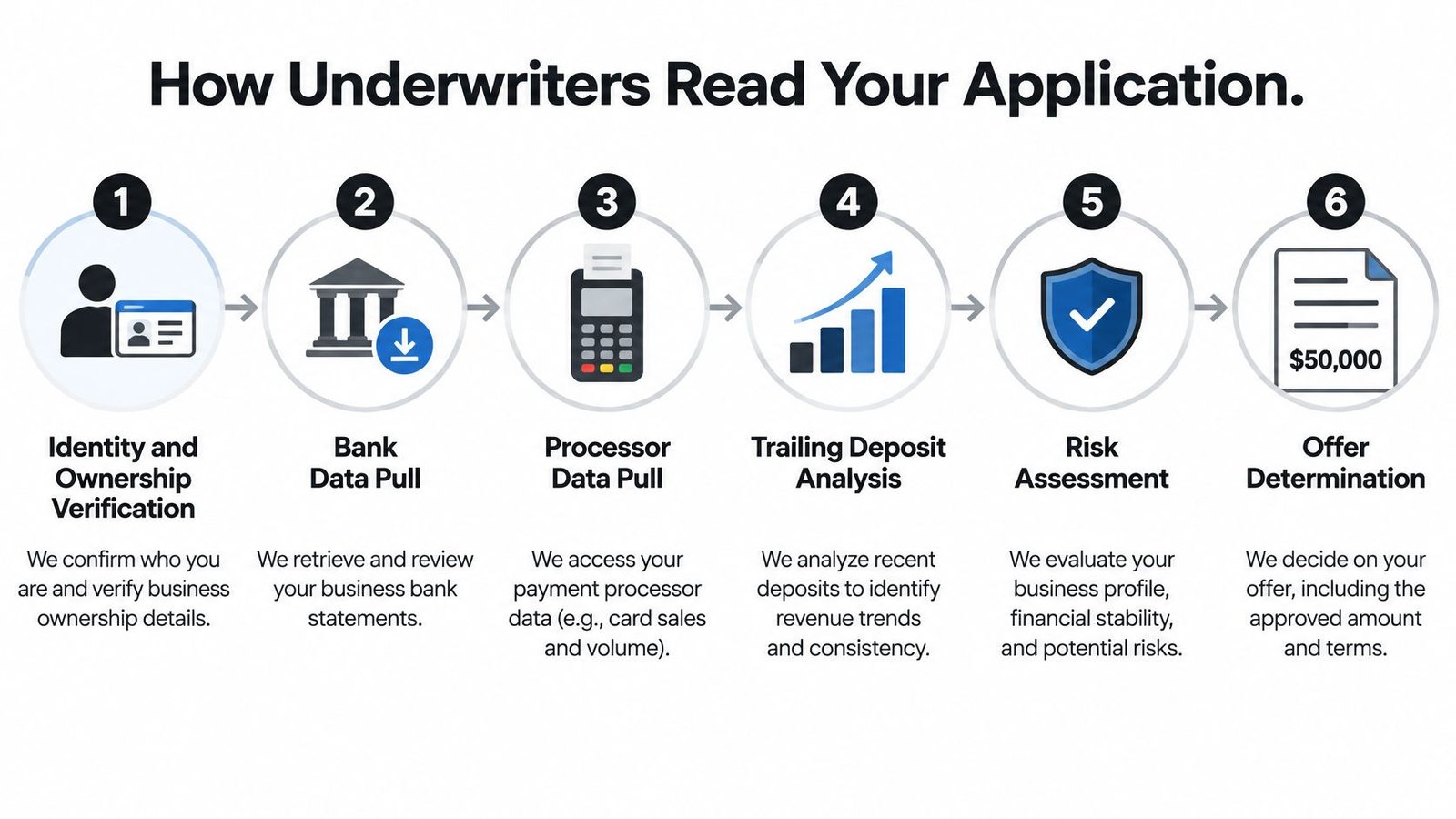
The review, in plain English
Verify the business and its owners. The provider checks the business identity, ownership, industry, time in business, and stated purpose for the funds. Conflicting entity names or unclear ownership can delay review.
Review bank and processor records. Read-only access may let an underwriter examine the business account and payment-processing activity. Bank deposits show incoming cash; processor statements help explain card sales and settlement timing.
Measure the pattern, not just the headline revenue. An underwriter may assess deposits over a trailing period, volatility, average balances, negative-balance frequency, existing withdrawals, and seasonality. A business with steady deposits may support a different structure from one with similar sales but sharp peaks and troughs.
Reconcile the application against the records. Stated revenue should match the documents after accounting for timing, transfers, refunds, and other deposits that aren't sales. Unexplained gaps invite more questions.
Test a weaker period. The reviewer asks whether withdrawals would still leave enough cash for ordinary expenses if sales fall. An offer that works only during peak weeks may not be safe.
Show the actual terms. Before acceptance, the business should be able to identify the factor rate, purchased receivables, estimated payback, collection percentage, expected duration, and fees in dollars.
The Federal Reserve's survey of online-lender applicants found that 70% received at least some financing, while 31% were fully approved; 67% reported at least one lender challenge. These figures cover financing products together, not MCAs alone, but they underline why a clean, reconcilable file matters. The survey's online-lender findings offer context, not a promise of an MCA outcome.
Documents and Data Lenders Want to See
A lender can't assess cash flow from a polished revenue claim alone. The application needs records that show where sales land, what obligations already draw from the account, and who has authority to sign.
Build a file that reconciles
- Business bank statements: Provide the requested recent statements in full, including every page. Separate business and personal activity where possible. Commingled deposits and unexplained transfers make it harder to distinguish revenue from money moved between accounts.
- Processor statements: Include these when card receipts are material to sales. They help explain settlement timing, refunds, and the difference between gross card volume and bank deposits.
- Tax returns or financial statements: Larger or more complex businesses may be asked for these to clarify revenue and operating performance. Flag any material difference between reported sales and deposits rather than waiting for the reviewer to ask.
- Ownership and business records: Have the entity's legal name, registration details, and ownership information ready. Inconsistent names across documents can create avoidable verification delays.
- Current debt obligations: List existing advances, loans, and recurring remittances. Omitting an obligation can make the cash-flow picture look stronger than it is.
- Use-of-funds note: State what the money will pay for and when the expense is due. A concise explanation helps the reviewer connect the requested amount to a business need.
A clean application tells one consistent story across the form, bank records, processor data, and debt schedule. A messy one might label transfers as sales, omit an existing debit, or show frequent overdrafts without context. Those issues don't automatically decide an application, but they can lead to follow-up questions, a smaller offer, or a different repayment structure.
Approval outcomes also vary by channel. In the Federal Reserve's 2023 survey, at-least-partial approval was 70% for online lenders, 75% at small banks, and 76% at credit unions and other nonbank finance companies. Full approval was 31% online versus 52% at small banks. The accessible survey findings combine loans, lines of credit, and cash advances, so treat them as broad benchmarks, not MCA-specific odds.
Approval Odds and Where Approval Gets Stuck
There isn't a dependable public approval rate for merchant cash advances alone in the Federal Reserve figures. The survey groups MCAs with loans and lines of credit, which means its results describe the wider financing environment, not the probability that a particular business will receive an MCA offer.
One useful distinction is approval versus full funding. A business may receive an offer that covers only part of its request. That can count as at least some financing in survey results while still leaving the owner short of the capital needed for the intended purchase or operating need.
The 2024 Small Business Credit Survey found that about 48% of businesses that applied for financing didn't receive the full amount requested. The finding covers loans, lines of credit, and merchant cash advances, not MCAs by themselves. The Chicago Fed's summary of the survey is a reminder to compare the funded amount with the actual need, rather than treating an offer as a complete solution.
Common points where review stalls
Revenue concentration can make a business look vulnerable if much of its sales depends on a narrow customer base, channel, or trading period. Seasonal swings create a related concern: a strong month doesn't necessarily prove the business can carry the same withdrawal in a slower one.
Existing remittances also matter. Several daily or weekly obligations can compete for the same operating cash, even when each advance looked manageable on its own. Disclose affiliate or related-business debt too, since an underwriter needs an accurate picture of the obligations that affect the applicant's cash flow.
Before applying, review the merchant cash advance requirements and compare them with the records you can substantiate. If the requested amount exceeds what the business can repay comfortably, reducing the request may be wiser than seeking an offer that leaves little room for routine expenses.
Stress Testing the Deal Before You Sign
A fast offer isn't automatically an affordable one. The useful question is whether the remittance remains manageable when sales weaken, expenses arrive as expected, and the business still has to pay staff and suppliers.
Start with the contract, not a sales estimate. Confirm the total payback, how collections are made, whether they adjust with actual sales, and what fees apply. Then compare the expected remittance with the cash available after existing obligations and essential operating costs. If the provider uses a fixed daily or weekly withdrawal, don't assume it will shrink just because sales do.
Run a practical weak-month test
Use the business's own deposit history to identify a softer period. Estimate receipts for that kind of month, subtract existing debt withdrawals and the proposed remittance, then set aside payroll, rent, inventory, taxes, and other unavoidable expenses. If the remainder is too thin, the offer may be too large or the structure too aggressive.
| Sample MCA Affordability Stress Test | Monthly Volume | Estimated Weekly Remittance | Cash Available After Remittance | Total Payback |
|---|---|---|---|---|
| Typical sales period | Use verified bank and processor data | Use the written offer terms | Calculate after essential costs and existing obligations | Confirm in the contract |
| Weaker sales period | Use a lower-revenue period from the business's records | Keep the contractual withdrawal if it is fixed | Recalculate after essential costs and existing obligations | Confirm in the contract |
| Sales decline scenario | Model a further decline based on the business's own risk tolerance | Test whether the withdrawal remains payable | Identify any shortfall before accepting | Confirm in the contract |
This table deliberately leaves the amounts to be filled with your records and the provider's written terms. A generic example can't show whether your restaurant, shop, or service company can carry a remittance; your actual deposit pattern and obligations can.
Before signing: Ask what happens if collections exceed the agreed percentage of actual sales, and get the answer in writing. Don't rely on a verbal assurance when the contract describes a different method.
A cash-flow forecast can help organize that comparison. A cash flow tool guide from ThriveXDNA may help you assess forecast options, but the forecast should still use reconciled business records and the offer's actual terms. You can also use a merchant cash advance calculator to examine the costs and repayment figures before deciding.
What the Funding Timeline Actually Looks Like
A restaurant owner submits an application while arranging inventory for an upcoming busy period. The pace depends on whether the records are complete, whether bank and processor activity reconcile, and how quickly the owner reviews the written terms. “Fast funding” describes a possibility, not a guarantee that every file will move on the same schedule.
From application to first collection
Submission and data access: The owner provides business details, the funding request, and the intended use, then connects or supplies the requested financial records. Missing pages or unclear ownership can prompt follow-up.
Underwriting and offer review: The provider reviews deposits, sales activity, balances, existing obligations, and the proposed repayment capacity. If the data conflicts with the application, the underwriter may request clarification before making an offer.
Term-sheet review: The owner checks the advance amount, total payback, collection method, fees, and expected duration. This is the point to ask about reconciliation, fixed withdrawals, and what happens if sales fall. Don't treat a preliminary offer as a commitment to accept.
Contract and bank verification: Once the owner chooses to proceed, the provider may need signed documents and confirmation of the destination account. Errors in account details or incomplete signatures can delay disbursement.
Funding and first remittance: Funds arrive after the provider completes its review and transfer process. The first withdrawal depends on the contract and funding schedule, so the owner should know when collections begin before signing.
A provider may advertise rapid approval or funding, but underwriting checks and bank-transfer settlement can extend the practical process. Keep the supplier or payroll deadline separate from an optimistic estimate, and don't commit the same dollars to multiple needs while waiting for funding. For a fuller planning reference, review realistic timelines for small-business funding.
Pre-Submission Checklist and Disclosure Requirements
Before submitting, make sure bank statements are ready, processor reports are exported, the use of funds is written down, current obligations are listed, and a weak-month cash-flow check is complete. These steps help you spot a mismatch before an underwriter does.
The National Community Reinvestment Coalition reports that a 2026 CFPB Section 1071 change removed MCA reporting requirements, reducing public visibility into the market. It also reports that California's SB 362, effective January 1, 2026, requires providers to disclose annualized cost when pricing or financing amounts are presented. The NCRC's analysis of the rule changes provides context, but read each offer's actual disclosures and contract before accepting.
Business Loan Warrior offers a single application to check pre-approval, review funding options, and connect with underwriters, including for merchant cash advances and other business financing. If you're preparing a merchant cash advance application, visit Business Loan Warrior to compare available options and organize your next step.