

What does a factor rate tell you if your card sales fall sharply before the advance is repaid? A quoted 1.2 or 1.4 may look easy to compare, but it doesn't reveal how quickly money will leave your operating account, how long repayment may last, or whether a supposedly cheaper offer will create a larger cash-flow problem.
A merchant cash advance calculator is useful only when it goes beyond multiplying an advance by a factor rate. The stronger approach calculates the fixed total payback, estimates the APR-equivalent based on repayment speed, and tests what happens when sales are strong, ordinary, or disappointing. That distinction matters because an MCA's affordability depends on both its price and the revenue used to repay it.
Table of Contents
- Why You Need a Merchant Cash Advance Calculator
- How to Calculate Your MCA Repayment Cost
- The Impact of Sales Velocity on Effective Cost
- Comparing Basic Calculators to Stress-Test Tools
- Essential Inputs for Accurate MCA Estimation
- Interpreting Results for Better Decisions
- Next Steps in Your Funding Journey
Why You Need a Merchant Cash Advance Calculator
Could two MCA offers with similar headline terms create very different cash-flow problems? Yes. The funding amount and factor rate show only part of the agreement. They do not show the fixed amount ultimately collected, how quickly remittances may leave the business, or what happens when card sales weaken.
That distinction matters because owners often compare a factor rate directly with a loan interest rate. The pricing structures differ. A factor rate sets a fixed payback, while collection speed affects the annualized cost. The next section shows how to calculate the contractual amount without confusing it with interest.

Turn contract language into operating figures
A useful calculator puts three figures side by side:
- Total repayment, the amount the provider expects to collect.
- Dollar cost, the amount retained by the provider above the cash advanced.
- APR-equivalent, an estimate that accounts for how quickly collections repay the obligation.
The third figure requires a stress test. MCA pricing is usually quoted without APR, and the annualized equivalent can change substantially as sales velocity changes. A lower factor rate may still produce a higher effective cost if strong sales cause rapid repayment. Nav's MCA financing guidance notes that higher factor rates can reach roughly 350% APR-equivalent or more, depending on repayment speed.
Test at least three operating conditions: strong sales, ordinary sales, and a weak period. Compare not only the resulting effective cost, but also the cash left for inventory, wages, rent, taxes, and unexpected expenses.
Practical rule: Never choose from the factor rate alone. Confirm the fixed payback, model repayment speed, and check whether the remittance remains workable when sales fall.
A calculator cannot make an expensive advance affordable. It can expose the cash-flow drag hidden behind a seemingly cheaper offer and give you a clearer basis for comparing other funding options.
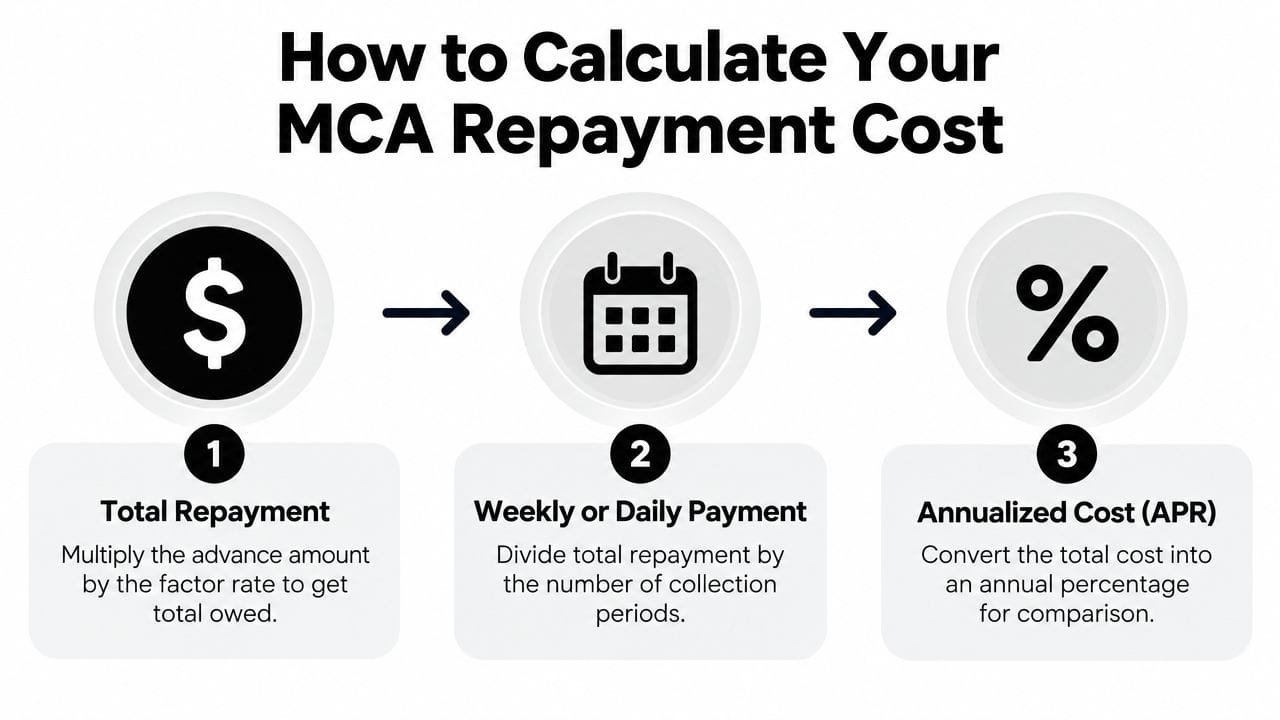
How to Calculate Your MCA Repayment Cost
Start with the contract's fixed obligation. Then isolate the dollar cost. Only after that should you estimate the annualized equivalent, because collection speed can change the result materially.
Step one: calculate total repayment
Multiply the advance amount by the factor rate:
Total repayment = advance amount × factor rate
A 1.5 factor rate means the provider expects $1.50 for every dollar advanced. The factor is not an interest rate, and the charge does not decline as the balance is collected. For a plain-language explanation, see this guide to factor rates.
Step two: calculate dollar cost
Subtract the advance from the total repayment:
Dollar cost = total repayment − advance amount
This shows what the contract charges above the cash delivered. It gives you a clear price measure without treating the MCA like a loan with amortizing interest.
Step three: estimate the APR-equivalent
The annualized estimate depends on how quickly the fixed repayment is collected. A holdback takes a stated share of card sales, so stronger sales can shorten the repayment period while weaker sales can extend it. A basic calculator may use only one expected remittance period, which can hide the cash-flow drag during volatile sales months.
Use a worked scenario to expose that sensitivity. A $50,000 advance at a 1.3 factor requires $65,000 in total repayment, creating a $15,000 dollar cost. If collections finish in 6 months rather than 9 months, the APR-equivalent shifts from roughly 60% to 40%. The factor rate stays unchanged, but faster collection raises the annualized cost and reduces cash available for inventory, wages, rent, and taxes.
Treat the output as an APR-equivalent, not a contractual APR. It supports funding comparisons, but it cannot erase the difference between a fixed MCA obligation and scheduled loan amortization.
The Impact of Sales Velocity on Effective Cost
Sales velocity is the variable that most static calculators understate. Two businesses can accept offers with the same advance amount and factor rate, yet experience different annualized costs because their card revenue moves at different speeds.
A business with steady card volume may satisfy the fixed obligation quickly. A seasonal retailer may see collections spread across a longer period, while the holdback still reduces the cash available from each sale. The factor rate doesn't change, but the time value of the money does.
Why one revenue estimate isn't enough
Average daily card sales can conceal the exact period that creates risk. A business may have a strong average across the year but face a weak season, a channel shift, or uneven performance between locations. If a calculator uses only the average, it may show an attractive repayment period that doesn't match the months when cash is tight.
That matters particularly in retail and e-commerce. Industry calculator commentary from Zolvo identifies North America as the largest MCA market and retail and e-commerce as major use cases, while noting that both are exposed to demand volatility and changes in payment mix. The same source cites a 2026 projection of USD 22.17 billion for the global MCA market in 2026 and USD 41.81 billion by 2035. Those projections reinforce the need for tools that test risk rather than merely display payback.
Compare repayment behavior, not just price
Consider two hypothetical businesses with the same quoted factor rate. One has card sales that remain reliable through the collection period. The other depends on seasonal demand and experiences a prolonged decline. The first may repay faster, while the second may carry the obligation for longer and experience a heavier cumulative cash-flow drag.
The most useful output is therefore a range of repayment periods under different sales conditions. Model a strong month, a normal month, and a weak month, then record:
- Collection speed, how long each scenario takes to satisfy the fixed payback.
- Cash-flow drag, how much of card receipts is unavailable for operations.
- Refinancing pressure, whether a slow period could encourage another advance.
- Break-even sales, the level at which the remaining receipts can still cover essential costs.
Use the result alongside a disciplined cash-flow management approach. The question isn't only whether sales cover the holdback. It's whether the business can continue funding inventory, payroll, rent, and taxes after the holdback is removed.
Comparing Basic Calculators to Stress-Test Tools
A basic calculator answers a narrow question: What fixed amount will I repay, and what might that cost annualized? That's valuable as a first screen, especially when a contract presents a factor rate without an APR.
Its weakness is the single-scenario assumption. You enter one revenue figure, one holdback, and one repayment pattern, then receive an output that can look precise even though the underlying sales estimate may be unstable.
The basic model
A static model typically includes:
- Advance amount
- Factor rate
- Remittance frequency
- Average daily card revenue
It can expose an offer's fixed dollar cost, but it won't necessarily show whether the holdback becomes disruptive during a weak period. It also may not distinguish between revenue that belongs to the business and deposits that pass through the account.
The stress-test model
A stress-test tool runs the same offer through several operating conditions. Rather than asking for one average, it asks what happens when sales accelerate, track normally, or fall short. That approach reveals whether repayment speed changes the APR-equivalent and whether the business can preserve enough working cash throughout the collection period.
A useful comparison also includes the broader financial picture. Business owners assessing growth plans may benefit from reviewing FedEx ISP business valuation tips alongside cash-flow projections, because a funding decision should reflect the value and earning capacity of the business, not just its immediate deposit volume.
A polished output isn't the same as a reliable decision. The model is only as credible as the sales assumptions and cash obligations behind it.
For a retailer, the stress test should reflect seasonal demand and payment-mix changes. For a service business, it should account for uneven bookings and delayed collections. The stronger tool doesn't promise certainty. It exposes the conditions under which the offer stops working.
Essential Inputs for Accurate MCA Estimation
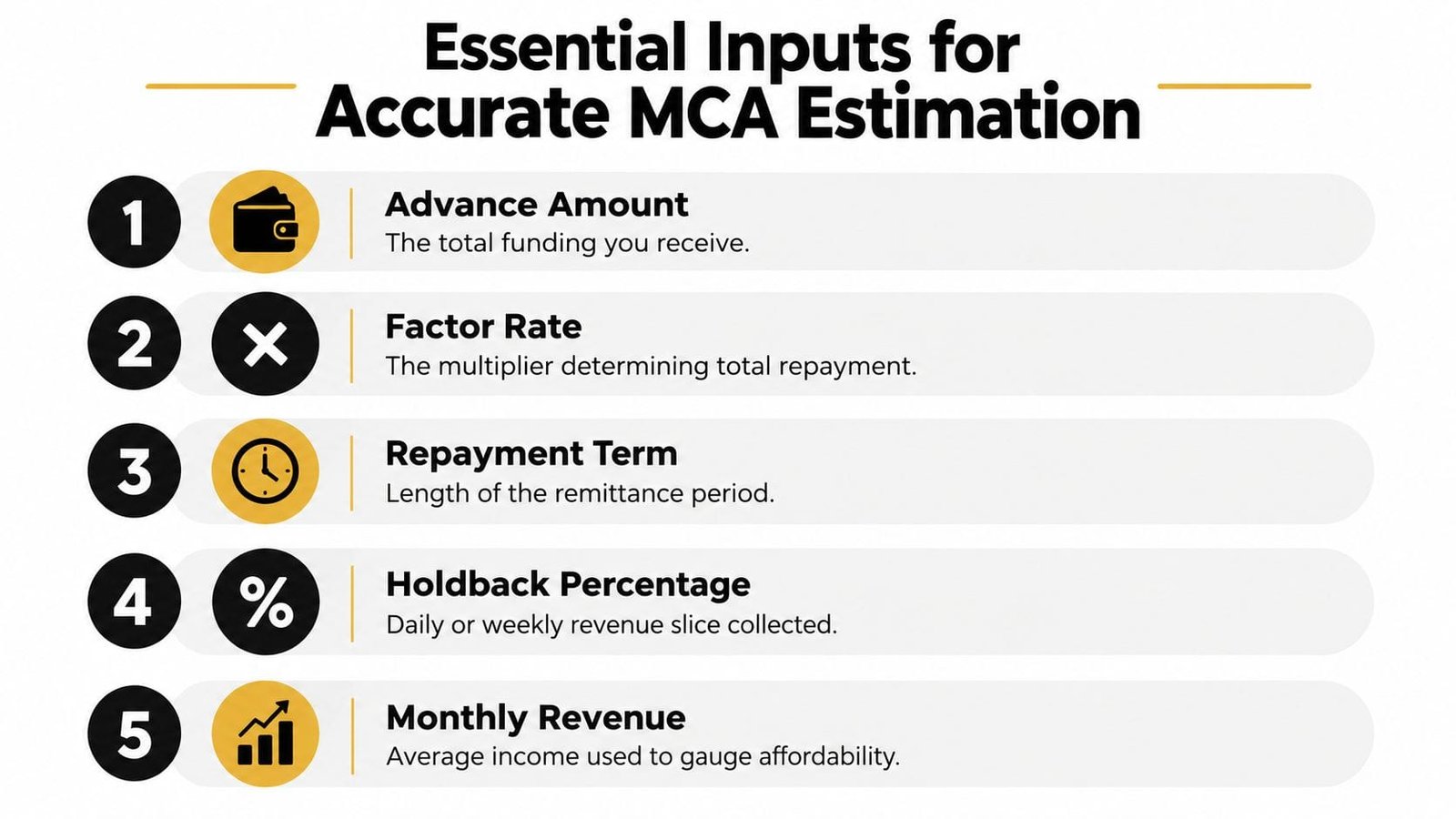
A calculator can't correct poor inputs. Before entering figures, gather the agreement, recent bank statements, card-processing records, and a schedule of existing funding obligations. The purpose is to create a picture of external revenue and available cash, not merely the largest possible deposit total.
Start with the agreement
Record the advance amount, factor rate, holdback percentage, and whether collections occur daily or weekly. Also look for fees, minimum remittances, reconciliation language, personal guarantees, and provisions governing default. A calculator can estimate the central economics, but it won't interpret every contractual obligation.
Rebuild revenue from the bank activity
Gross deposits aren't automatically revenue. Remove transfers between accounts owned by the same business, proceeds from earlier advances, refunds, and other non-operating movements before estimating repayment capacity. Nav's underwriting guidance highlights the importance of reviewing NSF counts, overdrafts, negative balances, deposit volume, recurring funding debits, and existing advances.
Use this checklist before running the estimate:
- Funding need: Enter only the amount that supports a defined business purpose.
- Pricing: Copy the factor rate exactly as written in the offer.
- Collection method: Identify the daily or weekly remittance and the stated holdback.
- Card revenue: Estimate external card sales, not total bank deposits.
- Existing obligations: Include current advances and recurring debits.
- Volatility: Separate strong, ordinary, and weak sales periods instead of relying on one average.
The final input is judgment. Ask whether the sales figure reflects recent trading and the next repayment window, not merely a favorable historical period. If the business has several advances already outstanding, calculate capacity after those deductions, or the result will overstate affordability.
Interpreting Results for Better Decisions
A calculator result isn't a recommendation. It is evidence that needs to be read in the context of the business's liquidity.
The first figure to inspect is total repayment. It establishes the fixed obligation and prevents the factor rate from remaining an abstract multiplier. Next, examine the dollar cost, then compare APR-equivalents across different repayment speeds rather than treating one annualized figure as permanent.

Read the output through cash flow
A low factor rate can still produce a severe operating burden when collections happen quickly. Conversely, a slower repayment period can make the APR-equivalent look higher, while the flexible remittance may still affect the business differently from a fixed loan payment. Neither interpretation is sufficient by itself.
The practical test is whether enough cash remains after each collection to meet obligations that keep the business open:
- Payroll and contractor commitments
- Inventory and supplier payments
- Rent, taxes, and essential overhead
- Existing financing remittances
- A reserve for weaker sales periods
MCA pricing usually isn't presented as APR, and an APR-equivalent can mislead because repayment isn't amortized like a loan. Credible's MCA calculator discussion explains this disconnect and supports a more useful comparison, whether the structure preserves enough operating cash to avoid missed obligations or another round of financing.
Watch for the refinancing trap
If the base scenario works only when sales remain strong, the offer is fragile. If the weak scenario leaves no room for essential expenses, the business may respond by taking another advance, increasing the number of simultaneous deductions and reducing future flexibility.
A better decision rule is simple: accept the structure only when the stress-tested scenarios leave a credible path to operate without relying on new funding. For a broader overview of the product and its trade-offs, review merchant cash advance considerations for businesses, then compare the result with alternatives that may require more documentation but impose a different repayment burden.
Next Steps in Your Funding Journey
Use the calculator before speaking with a provider, not after you've become attached to a quoted offer. Bring the total repayment, dollar cost, and scenario results into the conversation, and ask the provider to explain any difference between your assumptions and its underwriting model.
Ask direct questions about the collection mechanics:
- What revenue is subject to the holdback?
- How does reconciliation work if sales fall?
- Are there fees outside the factor rate?
- What happens if card volume shifts to another processor or channel?
- How are existing advances included in the affordability assessment?
- What contractual events trigger default or additional remedies?
A provider that can't explain the obligation in plain language isn't giving you enough information to evaluate it. Request the agreement early, verify every figure in the calculator, and have an accountant or attorney review terms that affect personal liability, account access, or default.
Use the result as negotiating evidence
Your analysis can change the discussion from “How much can I receive?” to “What repayment structure can the business sustain?” You may decide to reduce the advance, seek a lower holdback, request clearer reconciliation language, or delay funding until a less expensive option becomes available.
Businesses with online sales should also evaluate financing against inventory cycles, advertising commitments, and payment-platform concentration. A focused resource on funding growth for ecommerce can help frame that decision within the broader needs of an expanding digital operation.
The right conclusion may be that an MCA fits a short, clearly defined cash need. It may also be that a line of credit, term loan, equipment facility, invoice financing, or another structure better protects liquidity. The calculator's greatest value is not producing a single attractive number. It is showing the conditions under which the funding supports operations and the conditions under which it undermines them.
Run the offer through strong, ordinary, and weak sales assumptions before signing anything. Then take the results, the full agreement, and your existing obligations to Business Loan Warrior for help comparing business funding options and repayment structures. Visit Business Loan Warrior to review your choices and start a no-fee application without committing to an advance.