
You've agreed on a business purchase, checked your savings, and started thinking about closing. Then your lender asks for an equity-injection schedule, evidence of the source of funds, and a revised project budget. Suddenly, the SBA loan down payment looks less like a simple percentage and more like a financing decision you haven't fully worked through.
Table of Contents
- A Realistic Starting Point for SBA Loan Down Payment
- What an SBA Equity Injection Actually Means
- How the August 2023 Rule Change Reshaped SBA Loan Down Payment
- SBA 7(a) Versus 504 Down Payment Requirements
- Calculating Down Payment on Total Project Cost
- When a Bigger SBA Loan Down Payment Quietly Hurts You
- Practical Strategies to Fund Your Equity Injection
- Putting It All Together Before You Talk to a Lender
A Realistic Starting Point for SBA Loan Down Payment
Suppose you're buying an established service business. You've negotiated the purchase price and set aside what you believe is enough cash. Your lender's preliminary request comes back higher than expected because the financing package also includes working capital and transaction expenses.
That's a hypothetical situation, not a borrower case study. But it illustrates the right starting point: don't estimate your contribution from the purchase agreement alone. Start with the lender's complete transaction structure.
Separate the questions before calculating the answer
You need distinct answers to these questions:
- Program requirement: What equity contribution does the applicable SBA policy require for this transaction?
- Lender requirement: What additional contribution does this lender require under its underwriting standards?
- Project budget: Which expenses belong in the financing package?
- Funding eligibility: Which proposed sources will the lender accept toward your contribution?
Those aren't interchangeable questions. A lender can accept the proposed purchase price while rejecting your funding source. It can also accept your source of funds but conclude that your remaining liquidity is inadequate.
Practical rule: Ask for the required injection, its calculation base, and the acceptable funding sources in writing before treating your cash budget as settled.
Your objective isn't to find the lowest advertised down payment. It's to assemble a transaction you can fund, document, and operate after closing.
Request a preliminary sources-and-uses schedule, not just a loan estimate. Ask the lender to identify unresolved assumptions beside each line item. That gives you something useful to negotiate with the seller, review with your accountant, and compare against another lender's proposal.
A percentage without those details isn't a closing plan. It's an incomplete estimate.
What an SBA Equity Injection Actually Means
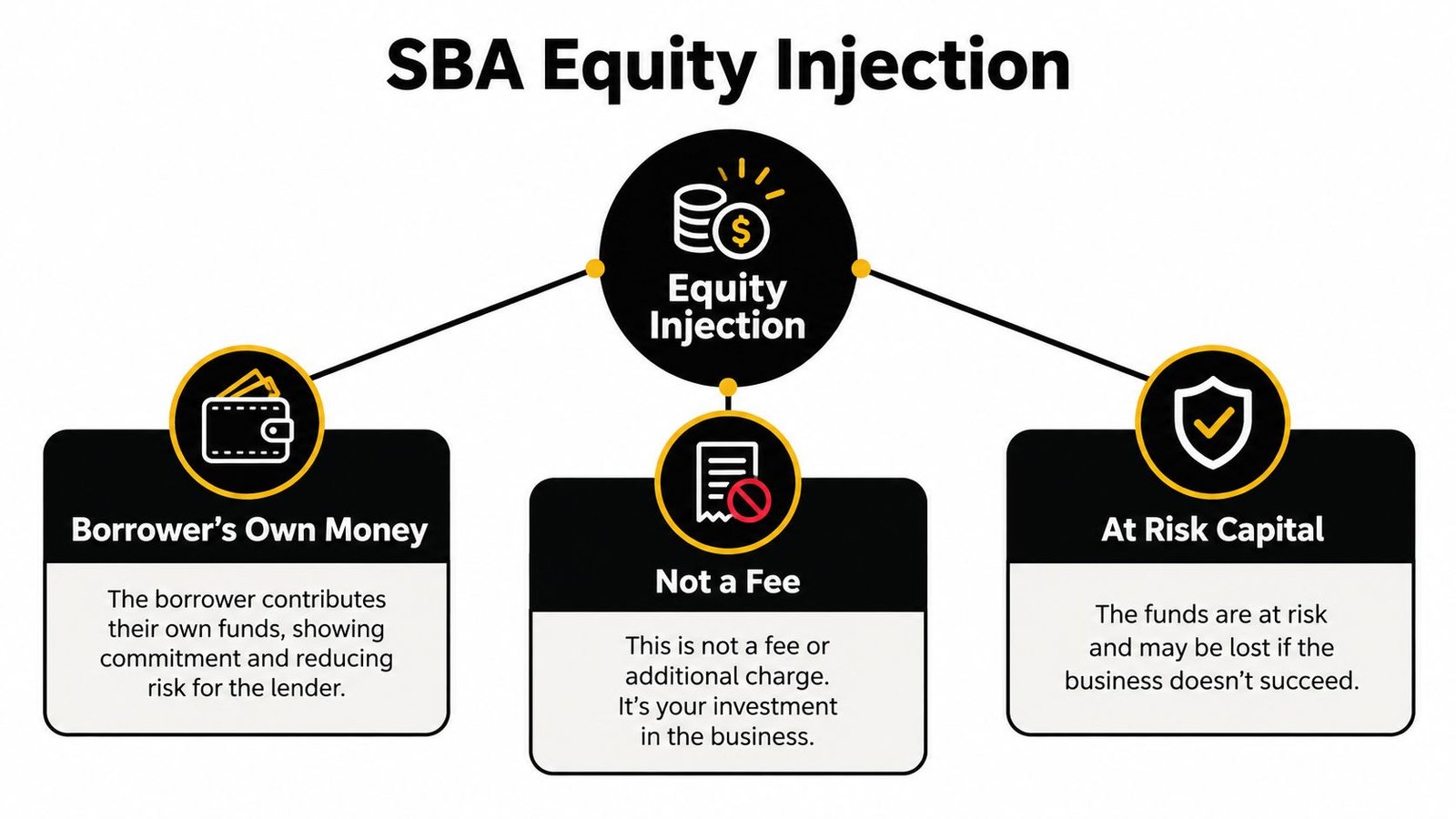
An equity injection is capital committed to the project, not a fee paid to obtain the loan. The central underwriting question is whether you're contributing genuine, supportable capital rather than temporarily making your bank balance look stronger.
The distinction is straightforward in concept.
The source matters as much as the balance
SBA equity-injection guidance recognizes unborrowed cash, allows certain appropriately valued non-cash assets, and generally treats personal borrowing as additional debt rather than equity. It also describes an exception where repayment comes from sources outside the business's cash flow, along with circumstances in which standby debt can qualify.
That means a personal loan deposited into your savings account doesn't automatically become acceptable equity. The lender must evaluate the underlying obligation, not just the account receiving the money.
The same guidance explains why a promissory note, gift letter, or financial statement alone generally doesn't substantiate a cash injection. The lender needs evidence of the money's source and availability, supported by the actual transaction trail.
| What you present | What still needs to be established |
|---|---|
| A savings-account balance | Where the money originated and whether it remains available |
| A gift letter | Whether the transfer occurred and the contribution is genuine |
| A proposed asset contribution | Whether the asset qualifies and its value is supportable |
| A personal borrowing arrangement | Whether the repayment structure meets the applicable exception |
Don't confuse disclosure with verification. Listing a contribution on your personal financial statement tells the lender what you claim to have. Supporting records allow the lender to establish what can be credited.
Send the underlying documents with your explanation. A clear funding narrative backed by records is more useful than a reassuring email saying the money will be available before closing.
How the August 2023 Rule Change Reshaped SBA Loan Down Payment
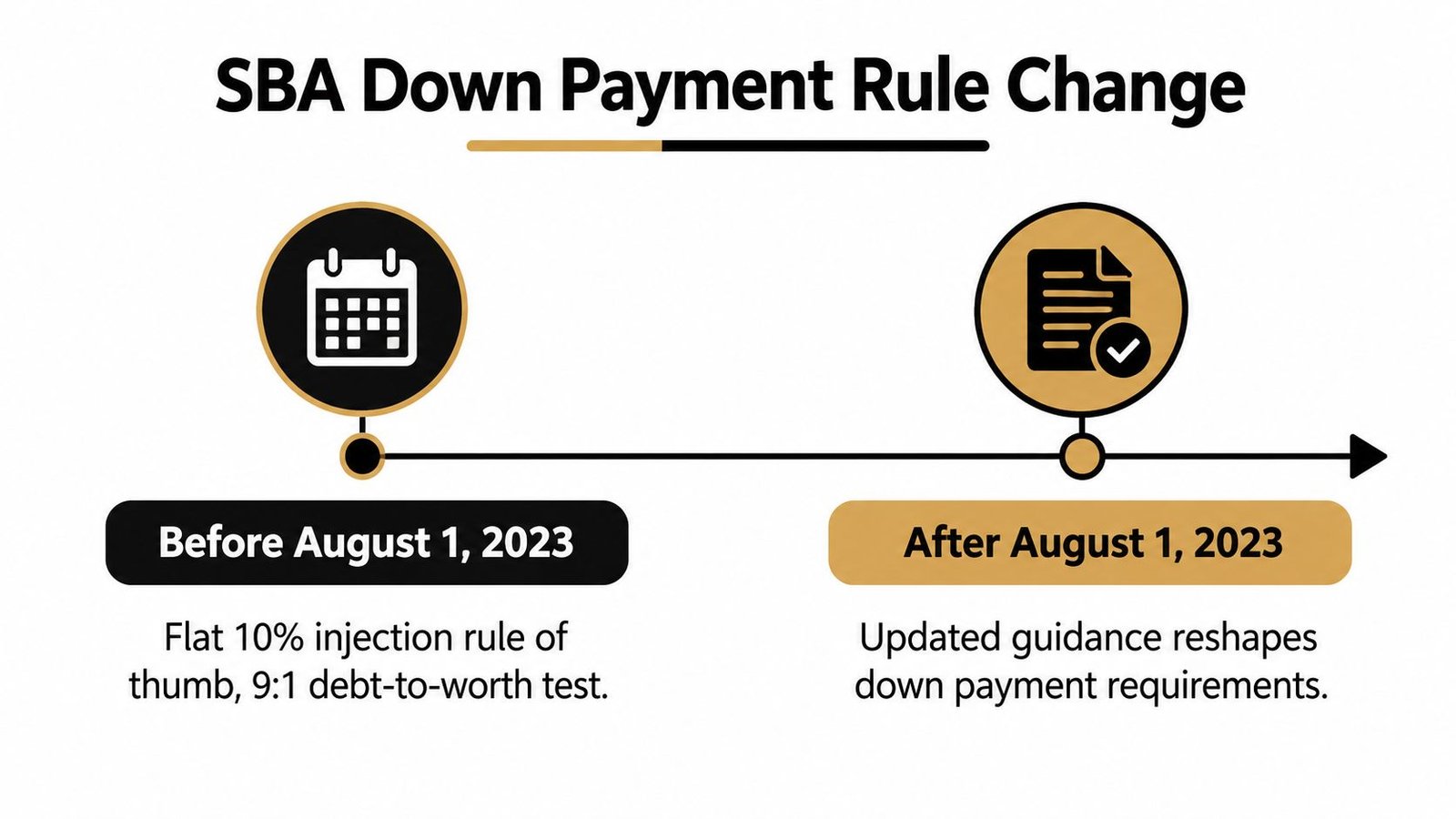
The widely repeated down-payment shorthand leaves out an important policy change. Under the SBA's August 2023 business-loan program revisions, effective August 1, 2023, the previous framework generally required a 10% injection for startups and complete ownership changes, while existing-owner ownership changes faced a 9:1 debt-to-worth limit. The revised framework removed a universal injection requirement for 7(a) loans of $500,000 or less, allowing lenders to apply policies used for similarly situated private-sector loans; above that threshold, the stated injection remained required for complete ownership changes, but not generally for other purposes unless lender policy required it.
The change is easier to understand as a shift in decision-making responsibility.
More discretion doesn't mean automatic financing
Under that revised framework, the SBA minimum and the lender's approval standard could produce different answers. A transaction without a blanket SBA percentage could still require borrower cash under the lender's comparable-loan policy.
That isn't necessarily a contradiction. The lender is making a credit decision within the program's framework.
The revision also gave lenders greater flexibility to follow comparable documentation policies for verification. Flexibility in process shouldn't be mistaken for permission to contribute unsupported funds.
- Ask about the policy basis: Have the lender distinguish the applicable SBA requirement from its own underwriting requirement.
- Ask about classification: Confirm how the lender treats the transaction's ownership structure and intended use of proceeds.
- Ask about applicability: Request the governing guidance for your application rather than assuming a historical announcement settles every current transaction.
Compare explanations, not just percentages
A lender that requests more borrower capital should explain why. You need to know whether the concern is transaction structure, repayment capacity, business risk, or an internal policy that applies regardless of your individual strengths.
Don't argue that another website promises a smaller contribution. Ask what would need to change for the lender to approve a different structure.
Policy announcements explain how a framework changed. Your lender's written transaction analysis should explain how the guidance applicable to your deal produces the actual requirement.
SBA 7(a) Versus 504 Down Payment Requirements
Don't carry an injection assumption from one SBA program into another. A proposal labeled SBA financing still needs to identify the program, the project it supports, and the contribution the financing parties expect from you.
The ownership-change framework discussed above concerns SBA 7(a) lending. It isn't a basis for calculating a 504 contribution. Treat a 504 proposal as a separate financing structure requiring its own written explanation.
SBA 7(a) vs 504 Down Payment at a Glance
| Dimension | SBA 7(a) | SBA 504 |
|---|---|---|
| Starting point | Identify transaction purpose and applicable injection policy | Obtain a program-specific contribution calculation |
| Down-payment assumption | Don't assume a universal percentage | Don't import the 7(a) calculation |
| Funding-source review | Obtain approval for each proposed source | Confirm which borrower sources the proposed structure permits |
| Proposal review | Separate SBA minimums from lender overlays | Identify each financing participant's conditions |
| Closing preparation | Reconcile contribution, financing, and uses | Reconcile the complete funding structure and borrower obligations |
For an initial orientation, use this comparison of SBA 7(a) and 504 financing, then request transaction-specific terms. A general comparison helps you ask better questions; it doesn't replace a lender-approved budget.
Make the financing proposal match the transaction
If you're acquiring a business, ask the financing team to explain how the proposed program addresses the acquisition and its associated funding needs. If you're considering an asset-focused project, request the same explanation for the assets, related expenses, and cash you must retain outside closing.
Don't choose a program solely because someone describes its down payment as lower. Compare the complete proposal, including the expenses you must pay separately and any contribution sources that remain subject to approval.
Ask who is responsible for confirming the borrower contribution and who signs off on the final sources-and-uses schedule. Where a proposal involves a Certified Development Company, ask it to coordinate that answer with the participating lender rather than leaving you to reconcile inconsistent instructions.
Compare complete funding plans, not isolated down-payment claims.
The useful result is a documented answer to a practical question: after every financing component is accounted for, what must you contribute, when must you contribute it, and what money will remain available afterward?
Calculating Down Payment on Total Project Cost
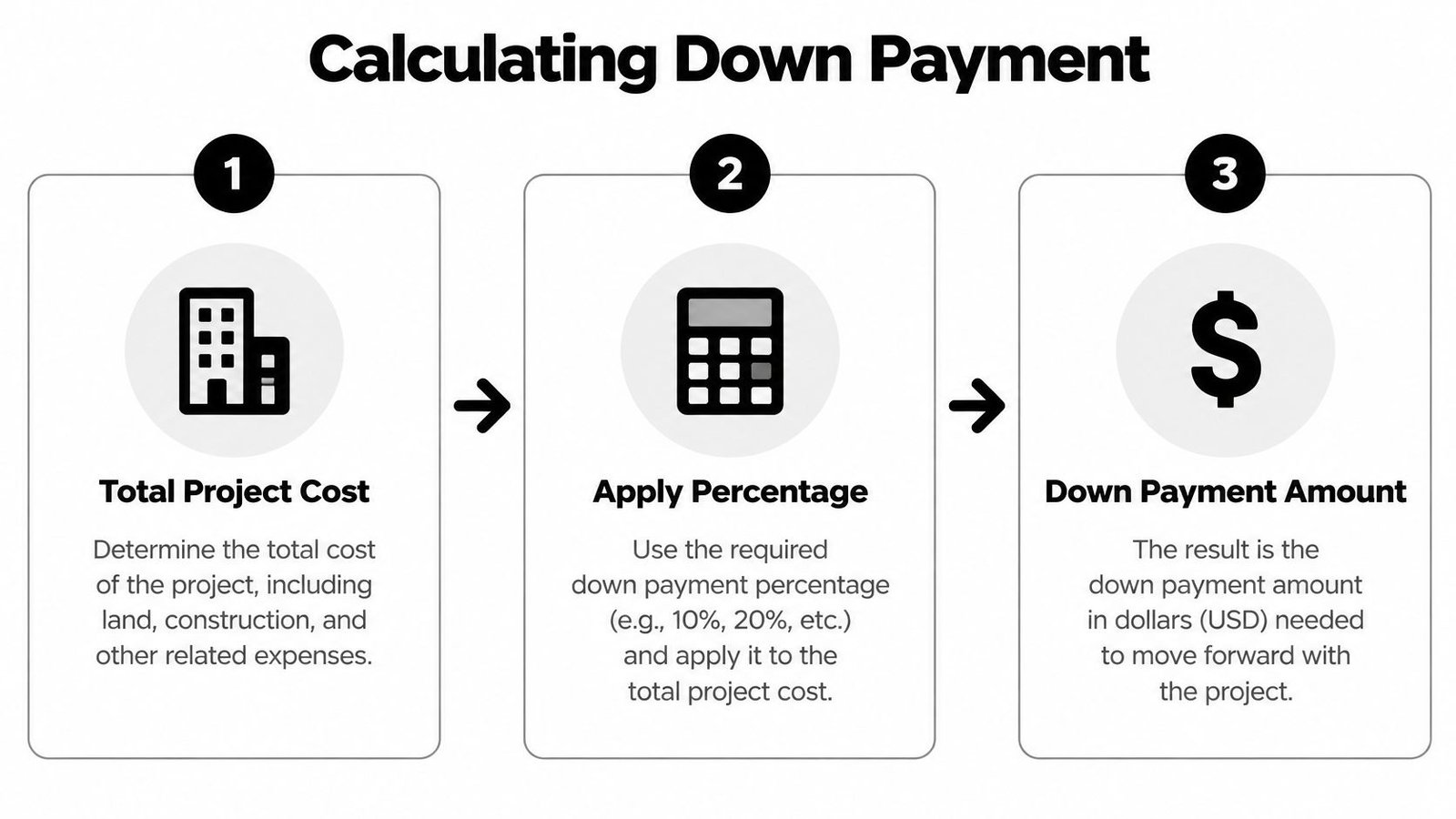
The purchase price is not necessarily the injection base. For an acquisition, the MBBA's SBA 7(a) program overview%20Program%20Overview%20-%20MBBA%20April%202026.pdf) describes an injection calculated on total project cost, potentially including closing costs, working capital, inventory, equipment, and other eligible uses; where a 10% requirement applies, those additional uses increase the required contribution. The overview also describes qualifying seller financing on full standby during the SBA loan term and a limit under which limited-source financing covers no more than half the required injection.
Start with the complete budget before applying the lender-confirmed requirement.
Build a transaction-level worksheet
Use actual estimates and avoid counting an item separately if it's already included in the negotiated price.
| Project use | Amount to enter | Supporting record |
|---|---|---|
| Business purchase | Agreed consideration | Purchase agreement |
| Eligible closing expenses | Current transaction estimate | Professional and closing estimates |
| Working capital | Approved operating funding | Cash-flow budget |
| Inventory | Amount not already included elsewhere | Inventory schedule |
| Equipment | Separately funded purchases | Quotes or purchase documents |
| Other eligible uses | Individually identified expenses | Relevant supporting records |
| Total project cost | Sum of approved uses | Reconciled project budget |
The calculation is:
Required equity injection = approved total project cost × applicable injection percentage.
Don't use the requested loan amount as the denominator. Also, don't assume that financing an expense removes it from the project budget.
Compare the funding structures
| Scenario | Injection structure | Effect on buyer cash |
|---|---|---|
| Cash-only | Accepted borrower cash satisfies the injection | Buyer cash funds the entire required contribution |
| Cash plus qualifying seller note | Accepted standby seller debt covers the permitted portion | Buyer cash funds the remaining requirement |
| Cash plus other eligible sources | Approved contributions supplement borrower cash | Buyer cash covers the balance after accepted contributions |
These are worksheet structures, not automatic approvals. A seller note that the lender doesn't accept as injection remains financing, not a substitute for the contribution.
Cash needed at closing is a separate calculation. Reconcile the accepted cash injection, expenses payable outside financing, and approved cash already contributed. Keep your post-closing reserve separate so it doesn't get counted as money available for the transaction.
Once the lender has confirmed that target, Fintrack's financial-goals calculator can help you plan your savings timeline. Base the plan on your documented cash obligation, not an online estimate built around the purchase price alone.
When a Bigger SBA Loan Down Payment Quietly Hurts You
Putting in more cash can reduce financing needs. It can also leave you owning a business without enough money to operate it. A larger contribution isn't automatically a stronger transaction.
Review the application and the operating budget together.

The SBA lender application's sources-and-uses framework separates SBA financing, other financing, applicant equity, and total project cost. That reconciliation is the starting point for evaluating the transaction, not proof that the remaining operating cash is sufficient.
Underwrite the business after your contribution
My recommendation is to test the proposed injection against the cash demands you'll face after ownership transfers. Don't assume a lower loan balance compensates for an empty operating cushion.
- Payroll timing: Map cash availability against payroll dates, not just expected monthly revenue.
- Customer collections: Test what happens if customers pay later than planned.
- Operating commitments: Include inventory purchases, occupancy costs, maintenance, and other unavoidable payments.
- Owner obligations: Review personal debt and living expenses alongside business cash needs.
A borrower can look well-capitalized at closing and still have a fragile operating plan. If every ordinary cash shortfall requires emergency borrowing, you haven't preserved meaningful flexibility.
Use the video as a discussion prompt, then apply the analysis to your own budget.
Challenge the proposed structure constructively
If the requested contribution consumes your available liquidity, bring the lender a revised operating forecast. Show the payment timing, expected collections, and reserve you propose retaining.
Ask whether the lender can support a different allocation of financing and borrower cash. If not, consider renegotiating the transaction or postponing it rather than forcing an underfunded closing.
Advisor's view: The right contribution is the amount that supports an approvable transaction without leaving you unable to manage ordinary operating uncertainty.
Don't fix a liquidity shortage by taking on personal debt. Disclose any new obligation before proceeding so the lender can evaluate the full repayment picture.
Practical Strategies to Fund Your Equity Injection
Start with unborrowed personal cash, then evaluate alternatives that solve a specific gap. Don't assemble a complicated funding structure just because each component sounds possible in isolation.
Your funding plan should name the source, the amount available, the evidence required, and the condition that must be satisfied before the lender will count it. Keep proposed sources separate from approved sources.
Choose sources you can substantiate
Personal savings are a sensible starting point because you can organize the account history and transfer records directly. This guide to using personal savings to fund a business can help you assess the personal-finance trade-off before committing the money.
For seller financing, negotiate the lender-required standby terms before treating the note as part of your contribution. The seller needs to understand the payment restrictions already described, not discover them after agreeing to an informal financing arrangement.
For gifts, ask the lender what evidence it needs beyond the letter. Don't move money first and assume the paperwork can be reconstructed later.
Non-cash assets require a separate eligibility and valuation review. If you propose rolling existing equity into an expansion or ownership transaction, obtain explicit confirmation that the proposed treatment is permitted. Existing ownership value isn't automatically a new eligible contribution.
Assemble a verification package
Organize the file around the path of the money:
- Source records: Statements and supporting documents explaining where the contribution originated.
- Transfer trail: Records connecting the originating account, receiving account, and eventual project payment.
- Closing evidence: Documentation showing that the approved contribution was applied.
- Special-source support: Gift documentation, lender-approved seller-note terms, or asset valuation materials, as applicable.
Use consistent descriptions across the funding schedule and supporting documents. If an account transfer has an explanation, put that explanation beside the relevant record instead of making the underwriter infer it.
Don't shuffle funds between accounts merely to produce a cleaner-looking balance. Preserve the original statements and make the transfer trail easy to follow.
The best funding plan isn't the one with the most possible sources. It's the one where every credited contribution has a clear eligibility basis, complete evidence, and a realistic path to closing.
Putting It All Together Before You Talk to a Lender
Bring a complete transaction picture to the lender early. You should be able to distinguish the purchase price, total project cost, and required equity injection without treating them as interchangeable.
Then connect the contribution to source records, transfer evidence, and any necessary valuation support. Use this explanation of the SBA loan underwriting process to prepare for the broader review rather than focusing exclusively on the down payment.
Your lender-meeting checklist
- Budget: Bring the purchase agreement and an itemized project-cost schedule.
- Policy: Ask which requirements come from SBA guidance and which come from lender underwriting.
- Sources: Identify approved funds separately from sources still awaiting review.
- Evidence: Organize source documents, transfers, and special-source support.
- Liquidity: Show the operating and personal cash you expect to retain.
- Open issues: List unresolved seller-note terms, valuations, and closing estimates.
Don't wait until the closing instructions arrive to discover that your funding plan needs approval. Get the structure reviewed while you still have room to change it.
Business Loan Warrior offers SBA loan processing and funding options through a single, no-fee application. Visit Business Loan Warrior to check pre-approval without affecting your credit and start reviewing funding options against your project budget and proposed equity contribution.