
Invoice financing turns unpaid business-to-business invoices into cash before the customer pays. In factoring, the provider collects the money later and charges a fee. In invoice discounting, your business keeps collecting from its customers and forwards the payment. You get that cash without waiting the full 30, 60, or 90 days many commercial customers take to pay.
Your crew finished the job. Payroll hits Friday. The client's invoice doesn't come due for two months, and the cash isn't in the account yet. That gap is what owners feel first, long before they compare products.
Treat this as one piece of a working-capital system, not an automatic fix. A fee can bridge a real timing mismatch. Financing the same slow customer every month can hide a collections problem that costs more than the fee. The advance, the risk of non-payment, and the accounting label all change whether the deal helps or just rearranges the strain.
Table of Contents
- What Invoice Financing Is and How It Differs From a Loan
- Factoring vs Invoice Discounting Compared
- How Money Moves From Invoice to Cash
- What Invoice Financing Actually Costs
- Who Qualifies and When It Fits Small Businesses
- Whether Financing Counts as Debt on Your Books
- Fix the Payment Gap Before Financing It
- Compare Offers and Apply for Invoice Financing
What Invoice Financing Is and How It Differs From a Loan
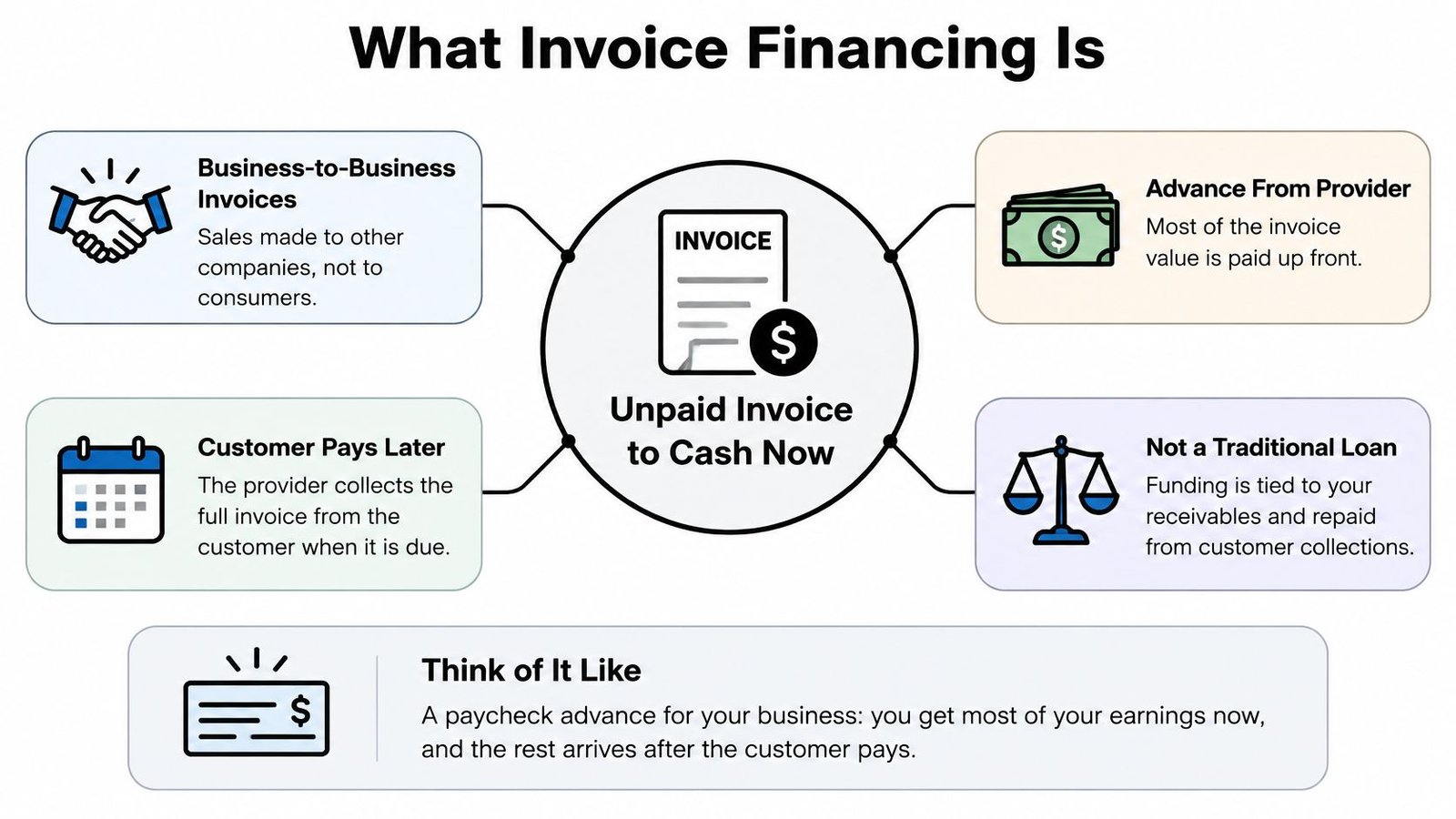
Invoice financing is a working-capital method that turns unpaid business invoices into cash before customers pay. It works much like cashing a signed IOU early at a bank, minus a fee. You don't wait for the payer to settle on the original date.
In the factoring form, you sell one or more business-to-business invoices to a financing provider at a discount. The provider advances funds, contacts the invoiced customer, and collects the full amount when it comes due. After it keeps its financing fee, it returns any remaining reserve to you. The Federal Reserve's community context note on factoring points out that costs are commonly quoted as a factor rate or fee, not as an interest rate or annual percentage rate. You have to read the advance, the fee, the reserve, the payment timing, and any extra charges together.
A conventional term loan is different because repayment follows a fixed amortization schedule. Here, repayment follows the customer's invoice payment. If that customer pays slowly, the cost usually rises, because the fee is tied to how long the money is outstanding.
The fit is strongest for manufacturers, wholesalers, staffing firms, contractors, and professional-service businesses with reliable commercial customers and long payment cycles. The provider's review leans on the customer's credit quality and payment behavior, not mainly on the owner's personal score. You can be a solid operator and still get turned down if the invoice is disputed or the payer looks weak.
Three parts make the product easy to state in one sentence. There is the invoice (what the customer owes), the advance (cash you receive up front), and the reserve minus the fee (what comes back after collection).
You're a candidate if you sell to other businesses on terms, the work is already done, and the payer is creditworthy. You're not a candidate if you mostly sell to consumers and get paid at the register.
Factoring vs Invoice Discounting Compared
The split that matters first is simple. Who collects from the customer?
Invoice factoring means you sell the invoices. The provider takes over collection and usually tells the customer to pay them, not you. Invoice discounting means you borrow against invoices while you keep the sales ledger, collect the payments yourself, and keep the arrangement confidential. Customers still think they're paying you on the original terms.
| Feature | Invoice factoring | Invoice discounting |
|---|---|---|
| Who collects the customer payment | Provider collects from the customer | Business collects and forwards payment |
| Customer told about the arrangement | Usually yes | Usually no, kept confidential |
| Who bears non-payment risk | Depends on recourse terms; nonrecourse shifts it to the provider | Usually the business under recourse terms |
| Control of customer contact | Shared, provider contacts the customer | Business remains the point of contact |
| Administration load | Low, provider runs collections | Higher, business runs the ledger and chasing |
| Best suited to | Businesses without a collections team or with weaker credit control | Established firms with strong credit control and in-house finance staff |
Recourse decides who eats the loss
A factoring deal can be with recourse or without recourse. In nonrecourse factoring, the factor generally assumes the customer's collection risk. In a recourse deal, an invoice that becomes uncollectible leaves the business exposed. Deloitte's roadmap on transfers of financial assets frames the tradeoff plainly. Faster cash can shorten the cash-conversion cycle, but recourse and customer-credit terms decide how much default risk stays with you. Discounting is usually written on recourse terms, so a refusal to pay often comes back to your books. Recourse language varies by provider. “Nonrecourse” sometimes covers only the customer's insolvency, not a dispute about the work.
Practical rule: Choose factoring if you want collections handled. Choose discounting if you want control and confidentiality. Confirm recourse terms in both cases before you compare the fee.
Cash in the account doesn't automatically mean you sold the receivable for accounting purposes. That label is a separate question, covered later, and it can change how much debt a lender thinks you carry.
The customer-facing choice often settles the product. A contractor who doesn't want a general contractor to see a finance company on the remittance usually looks at discounting. A staffing firm without a collections desk often prefers factoring, because someone else chases the aging.
How Money Moves From Invoice to Cash
Keep one invoice in view. A staffing firm bills a commercial client $50,000, due in 60 days, after the hours are worked and the timesheets are signed. The graphic below shows one pricing path for that same invoice. The fee in the picture is only an illustration. The next section walks a separate 2% example so you can see how the math changes when the quote changes.
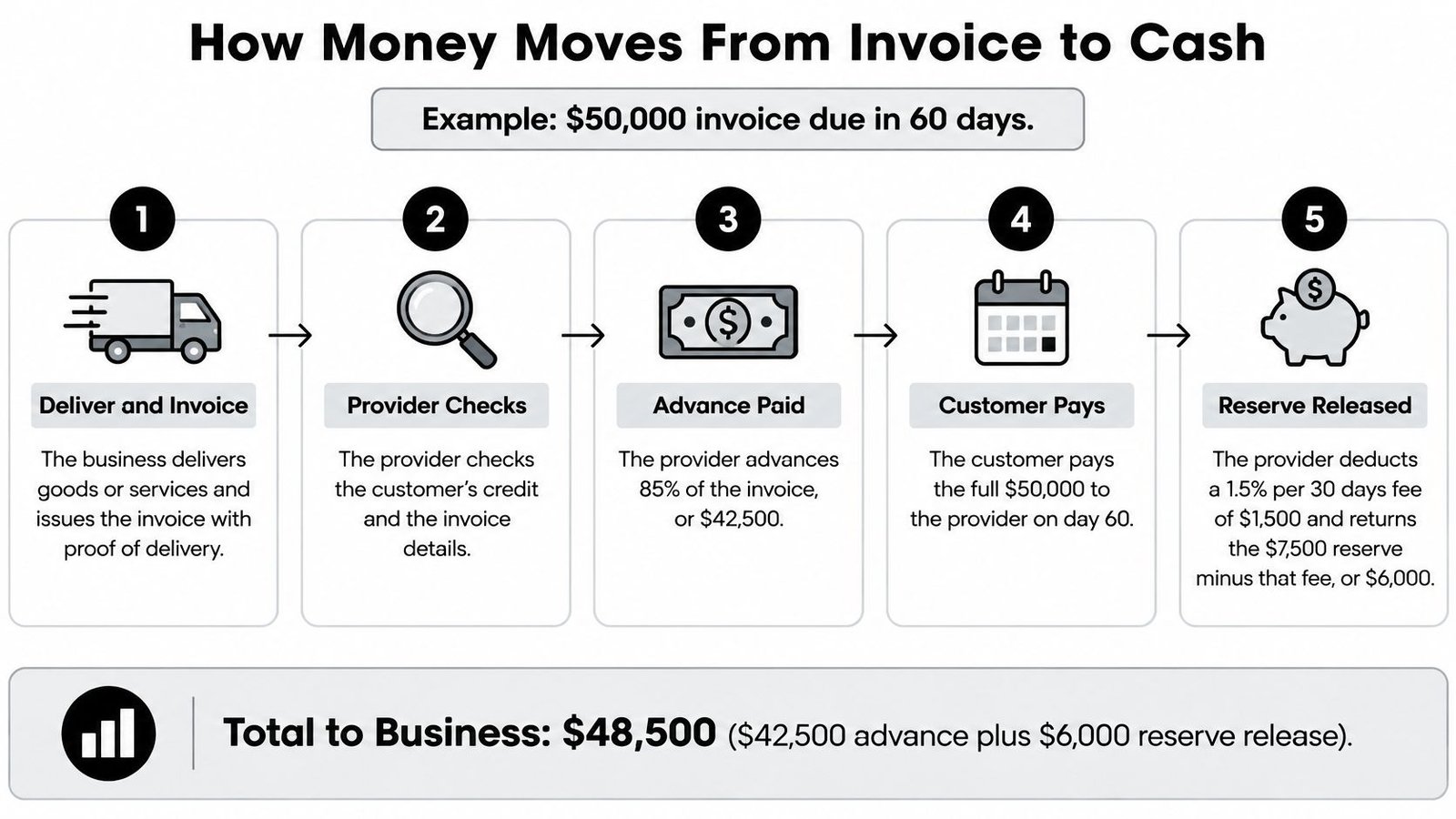
- Deliver and invoice. The firm places the staff, the client accepts the hours, and the invoice goes out with proof of delivery and written payment terms. Without that packet, there is nothing eligible to finance, so the cash date never starts.
- The provider checks the file. Credit on the client, whether the invoice is real and undisputed, and whether the same receivable is already pledged somewhere else all get reviewed. Those checks set the ceiling on what you can draw, not your hope for the full face value.
- The advance arrives. After approval, the provider pays most of the face value, often within days. That deposit is the working-capital gain. Payroll and suppliers get paid while the client's clock is still running.
- Someone collects. In factoring, the provider contacts the client and collects. In discounting, your team collects and forwards the payment. The path changes who your client talks to, and it changes how much staff time you still spend on chasing.
- The client pays the full $50,000. On a clean file that happens on day 60. If the client pays late, the reserve stays locked longer and the fee usually keeps running.
- The fee comes out and the reserve comes back. The provider deducts its fee from the amount it held back and releases what's left. Until this step, you have not seen the rest of the invoice.
What the gap between advance and reserve actually is
The window between step 3 and step 6 is the point of the product. You traded a fee for earlier cash. The reserve is the slice you don't touch until the client pays, and it is also the cushion the provider uses for its fee and for dilution if the invoice shrinks.
Watch the approval checks as closely as the rate. A disputed timesheet, a missing acceptance, or a receivable already pledged to a bank can shrink the draw to zero. A late client doesn't cancel the advance you already took. It stretches the time the reserve sits with the provider, and it can raise the total fee.
A short walkthrough of the same cash cycle is here if you want the sequence in motion before you price a quote.
What Invoice Financing Actually Costs
Providers don't quote this product the way a bank quotes a loan. You may see a factor rate, a discount per period, a reserve, and a stack of extra charges. The headline rate alone isn't comparable. On the same $50,000 invoice due in 60 days, here is one clean example at an 85% advance and a 2% fee on face value, before any extras.
| Line item | Example amount | What it means |
|---|---|---|
| Invoice face value | $50,000 | Amount the customer owes, due in 60 days |
| Advance at 85% | $42,500 | Cash received on approval |
| Reserve held back | $7,500 | Held until the customer pays, then released less fees |
| Factoring fee at 2% for 60 days | $1,000 | Charged on face value |
| Effective fee | About 12% a year | 2% for 60 days, annualised, before extra charges |
| Reserve returned | $6,500 | Reserve minus the $1,000 fee |
| Total cash received | $49,000 | Advance plus the reserve returned |
| Extra charges | Not in this example | Varies by provider; get the full list before signing |
How to annualise a short fee
Divide the fee by the face value, then scale it to a year. A $1,000 fee on $50,000 is 2% for 60 days. Six stretches like that fit in a 360-day year, so the example lands near 12% a year before wire fees, minimums, or late add-ons. That figure is arithmetic on this quote, not a market average. A different advance rate or a fee that ticks up every two weeks will not match it.
A lower advance means more of the invoice waits in reserve. You feel that on day one, when payroll needs $42,500 and the other $7,500 is still parked. You feel it again on day 60, when only $6,500 of that reserve comes home.
Charges that don't show up in the 2%
Ask for every line, not just the factor fee.
- Setup or application fees: Charged once when the account opens, sometimes before any invoice is funded.
- Service or administration fees: A monthly charge for running the ledger, separate from the discount.
- Wire charges: A few dollars per advance that add up if you fund many small invoices.
- Late-payment add-ons: Extra cost when the customer misses the original due date.
- Minimum monthly volume fees: You pay them even when sales dip and you fund less.
- Termination fees: The cost of leaving before the contract ends.
The same invoice costs more the longer the customer takes to pay. A client who drifts from 60 days to 90 days doesn't just delay your reserve. They extend the period the fee covers.
Ask each provider for the total cost on three scenarios, a customer who pays at 30, 60, and 90 days, on the same invoices. Compare total cash received, not the opening percentage.
Who Qualifies and When It Fits Small Businesses
Eligibility is about the invoice and the payer, not a personal credit story. Providers typically want business-to-business invoices, creditworthy customers, goods or services already delivered and accepted, no open dispute, documented payment terms, and receivables that aren't already pledged. The customer's payment record often outweighs the owner's personal score. A young firm with a reliable commercial client can clear a review that a long-established firm with messy, disputed bills will fail.
Three situations show the fit without turning the product into a cure-all.
A staffing agency pays weekly payroll against client invoices due in 60 days. The advance covers wages for people who already worked. Waiting for the client would mean missing payroll or dipping into a costly card.
A contractor buys materials for a project billed in milestones. The first milestone is approved, the invoice is clean, and the next delivery of steel can't wait for the owner's pay cycle. Financing that one invoice bridges the materials bill. It doesn't replace a deposit on the next phase.
A wholesaler funds a large order before the retailer pays. The product shipped, the invoice is undisputed, and the retailer's credit is known. The advance restocks the shelf. If that retailer always pays 30 days late, the fee becomes a standing tax on a weak account, which is a working-capital financing problem, not only an invoice problem.
Why owners say yes
- Speed: Cash can arrive in days, in time for payroll and suppliers.
- It scales with sales: More eligible invoices usually mean more available funding.
- No fixed-asset pledge: The invoices themselves are the collateral.
- Less admin in factoring: The provider runs the chase, which matters if you don't have a credit controller.
Why owners walk away
- Cost: It is usually more expensive than a bank line once you annualise the fee.
- Customer contact: Factoring puts a third party in front of your client.
- You inherit the payer's habits: Slow customers make the product slower and pricier.
- Consumer sales don't fit: Retail tickets and pay-on-delivery work aren't the raw material.
If you sell to other businesses on terms of 30 days or longer and you run short in that gap, compare a quote with the prevention steps in the next sections. If you sell mainly to consumers or you're paid on delivery, this product isn't built for you.
Whether Financing Counts as Debt on Your Books
A common assumption is that invoice financing sits off the balance sheet because cash arrived and the invoice “was sold.” Under U.S. GAAP, that isn't automatic.
ASC 860 generally allows sale treatment, and removal of the receivables from your books, only when three control conditions are met. SEC filing disclosure on receivables transfers lines them up this way. The receivables must be legally isolated from you and your creditors, even in bankruptcy. The purchaser must be able to pledge or exchange them. You must not keep effective control or significant continuing involvement.
When the advance is still a liability
Miss any one of those tests and the arrangement is a secured borrowing. The receivable stays on the balance sheet. The cash advance is recorded as a liability. Financing costs are recognized over the life of the deal, not as a one-time discount you can ignore.
Before you sign, read four clauses with your accountant, not only with the salesperson.
- Repurchase obligations: A duty to buy the invoice back if the customer doesn't pay.
- Guarantees: A promise that makes you whole the provider if collection fails.
- Servicing rights: You still collect, which can look like ongoing control.
- Recourse clauses: Language that puts default risk back on you.
A debt-like liability can trip bank covenants, change borrowing-base calculations, and raise the reported debt ratio. The headline advance doesn't tell you that. Compare the full financing liability with a revolving credit line on the same receivables before you decide which one is truly lighter. This framing is U.S.-specific. Other countries apply different sale-versus-loan tests, so don't export the three conditions into a contract governed elsewhere.
Fix the Payment Gap Before Financing It
Invoice financing treats the symptom. The cash gap usually starts because customers pay late, and a fee charged every cycle can cost more than closing the gap itself.
Scale shows why this matters. Sage's 2025 late-payments research, which reviewed more than 1.2 million invoices from over 31,000 UK small businesses, found that 44% were paid late, leaving roughly £112 billion locked in overdue invoices. The average firm with fewer than 10 employees was owed £42,000. Businesses that grant longer terms report cash-flow strain more often than those paid on delivery, so the terms you set shape the financing bill you end up paying.
Run the comparison on your own books. Say a firm refinances £40,000 of invoices every month at a 2% fee. That is close to £9,600 a year spent renting money to bridge a gap that deposits or shorter terms could shrink for free. Ask one more question while you total it: if the late payer eventually defaults, who absorbs the loss? On a recourse facility, the answer is you, after months of fees on their invoices.
Levers that cost less than a standing fee
- Tighter payment terms: Move reliable customers from 60 days toward 30 where your market allows it.
- Deposits: Collect a portion before you buy materials or schedule labor.
- Milestone billing: Invoice accepted stages instead of waiting for the whole project.
- Automated reminders: Chase before the due date, not three weeks after it.
- Credit checks: Look at the payer before you extend terms, not after the third late invoice.
Electronic invoicing supports each of these levers. Structured invoices reach customers faster and tend to shorten the wait between billing and settlement, though smaller firms still face real setup costs and customer-side resistance. Pair it with accounts receivable management so reminders, credit limits, and dispute logs live in one place.
Finance an occasional timing gap from customers who pay as agreed. If the same names keep paying late, fix customer selection and collections first. Repeated financing hides the true cost inside a fee you start treating as normal.
Compare Offers and Apply for Invoice Financing
Two lenders can quote on the same $50,000 invoice and hand you different amounts of cash under different risk terms. An invoice isn't financeable just because it has a dollar amount. Eligibility turns on the customer's credit, whether the bill is disputed, whether the goods or services were accepted, whether terms are documented, and whether the receivable is already pledged. Price the offer only after those gates are open.
Read each offer as a contract first and a rate second.
| Offer term | What to check | Red flag |
|---|---|---|
| Advance rate | Percentage paid upfront and whether it changes by customer | Rate drops after the first invoices |
| Fee structure | Flat fee, per-period rate or factor rate, annualised | Only a monthly rate is quoted with no total cost |
| Reserve release | Timing of release and how fees are deducted | Reserve held with no fixed release date |
| Recourse terms | Who absorbs an unpaid or disputed invoice | Recourse buried in the fine print |
| Notification | Whether and when your customers will be contacted | Customers contacted without your agreement |
| Concentration limits | Caps on the share of receivables from one customer | Cap below your largest customer's share |
| Exit and minimums | Notice period, exit fees and monthly volume minimums | Long lock-in with volume minimums you cannot meet |

A short procedure before you sign
- Pull an accounts-receivable aging report and rank customers by share of revenue. Concentration limits bite hardest on your biggest name.
- Pick the invoices and confirm each one is undisputed, has documented terms, and isn't already pledged.
- Request quotes from at least three providers on that same set. One path is a written invoice finance quote you can line up next to bank and specialty offers.
- Turn each quote into an annual cost and a total-cash-received figure, using the $50,000 worked example as the template.
- Run the loss cases. If the customer refuses to pay because of fraud, a dispute, set-off, returned goods, or poor performance, the contract's recourse terms, representations, dilution reserves, concentration limits, and notice rules decide who absorbs it. Ask each provider who carries the loss in each scenario and get the answer in writing.
- Read notification, concentration, and exit terms against your actual customer list.
- Have an accountant confirm whether the arrangement books as a sale or a borrowing before you sign.
Sage's note on e-invoicing and controls reports that only 37% of SMBs had fully adopted e-invoicing, while 43% cited staff training or integration complexity as a significant barrier. The same Sage research reports that 79% of SMEs had received a fraudulent invoice in the prior year. Changed bank details and fake payment instructions are the practical risk. Call a known number before you pay a new account or accept new instructions. Faster digital processing doesn't make a weak control safer.
Get each quote in writing. Compare total cost with a revolving credit line on customers paying at 30, 60, and 90 days. Pick the option whose fee, risk, and balance-sheet label you can explain without guessing.
Business Loan Warrior helps small businesses compare working-capital options, including invoice financing, through a single no-fee application and a dashboard for offers and repayments. If unpaid invoices are squeezing payroll or supplier bills, you can check pre-approval and set a written quote next to a line of credit on the same payment dates. Visit Business Loan Warrior when you're ready to see what those invoices can fund.