
Your profit and loss says you made money last month. Your bank account disagrees. That gap is where owners get caught short on payroll or a tax bill they thought they could cover, and it's exactly what a cash flow statement explains. Learning how to prepare cashflow statement reports properly means you can trace every dollar to operations, asset purchases, or borrowing, then spot a shortage weeks before the account goes empty.
Table of Contents
- Sorting Every Cash Movement into Three Sections
- Choosing Between Direct and Indirect Methods
- How to Prepare the Statement Step by Step
- Reconciling the Statement to Bank Statements
- Common Pitfalls and How to Fix Them
- Making the Statement Lender and Investor Ready
- Confirm Ending Cash Before You Share It
Sorting Every Cash Movement into Three Sections
Say a bakery owner shows a healthy quarterly profit. Orders are up, margins look fine, yet the checking balance keeps falling and a flour supplier has to wait for payment. The income statement recorded sales when invoices were issued. The bank only cares when catering clients pay, and in the meantime the owner bought ingredients, covered payroll, and put a deposit on a second oven.
A cash flow statement sorts that mess into three buckets so you can see which part of the business produced cash and which part consumed it. Per the U.S. Securities and Exchange Commission, in its Beginner's Guide to Financial Statements, a cash flow statement is prepared by organizing cash receipts and payments into operating, investing, and financing activities.
What belongs in each bucket
Operating activities cover your main revenue producing work. That's cash collected from customers, and cash paid to suppliers and employees, plus rent, interest, and income taxes. If collections lag, this section shows it first, which is why service firms that invoice after the work look closely at tools and habits to get paid faster as a tutoring business, for example automated billing and reminders that shorten the wait between a lesson delivered and cash received.
Investing activities cover buying and selling long term assets. Think delivery vehicles, kitchen equipment, property, or major software you capitalize rather than expense. Financing activities cover how the business is funded, including loan proceeds, principal repayments, owner contributions, owner draws, issuing shares, and dividends.
| Section | Typical cash movements | What a lender reads from it |
|---|---|---|
| Operating | Customer collections, supplier payments, wages, rent, interest, taxes | Core operations generate enough cash to repay debt |
| Investing | Equipment and vehicle purchases, proceeds from selling assets | Growth spending is planned and properly funded |
| Financing | New loans, principal repaid, owner contributions and draws, dividends | Repayments are covered by operations, not new borrowing |
A rising bank balance proves nothing by itself. A lender wants to know whether operations put the money there or a new loan did.
I read the three totals in that order for a reason. Positive operating cash flow in most periods is the main repayment source a lender trusts. Investing outflows during growth are normal and often healthy, provided they aren't funded by stretching supplier payments. Financing inflows that keep rescuing weak operations are the warning sign.
The practical build is straightforward. You compare two balance sheets, review the income statement, identify every cash transaction, classify each one, and calculate the net for each section. Add the three nets together and you get the net change in cash, which must bridge your beginning cash balance to the ending balance on the balance sheet. If it doesn't bridge, something is missing or misclassified, and you keep looking until it does.
Choosing Between Direct and Indirect Methods
Both methods calculate the operating section. Both arrive at the same operating cash total. They differ in what they show you on the way there, and that difference matters when a lender starts asking questions.
The direct method shows actual cash in and out
Under the direct method, you list major classes of gross cash receipts and payments. Cash collected from customers sits at the top, followed by cash paid to suppliers, wages paid, rent, interest, and taxes. An owner who tracks collections daily can read this format instantly, and a lender can see exactly where money came from without working backward from profit.
The trade off is effort. You need your bookkeeping, whether that's QuickBooks Online, Xero, or a tidy set of bank feeds, to tag receipts and payments by class as they happen. Reconstructing that detail at quarter end from accrual records is slow work.
The indirect method starts from profit
Under the indirect method, you start with net income and adjust it into cash. The SEC statement on cash flow classification sits alongside International Accounting Standard 7, originally issued in December 1992 and adopted by the International Accounting Standards Board in April 2001, which permits either method for operating activities. So the choice is presentation, not compliance.
The adjustments follow a simple logic. Depreciation is added back because it reduced profit without spending cash in the current period. An increase in accounts receivable is deducted because you recorded revenue you haven't collected. An increase in accounts payable is added because you recorded an expense you haven't paid yet.
| Feature | Direct Method | Indirect Method |
|---|---|---|
| Starting point | Gross cash collected and paid | Net income or operating profit |
| Main adjustments | Lists major cash receipts and payments by class | Adds back depreciation and adjusts for receivables, inventory and payables |
| Best fit | Simple cash-based businesses that track collections closely | Businesses whose accounting system already produces accrual-based statements |
| What it shows clearly | Actual collection and payment pressure | Reconciliation between profit and cash |
| What it can hide | Less visible link to profit | Pressure hidden in growing receivables or inventory |
My practical rule is to prepare whichever statement your accounting system produces cleanly, which for most small businesses is the indirect one, then build a direct style summary alongside it for your own decisions and lender meetings. You get the compliance friendly reconciliation and the plain language view of collections versus payments.
One check saves embarrassment. If you prepare both views and the operating totals disagree, don't average them and don't pick the nicer number. The gap is a timing or classification error. Find it before you go further, because every later calculation inherits it.
How to Prepare the Statement Step by Step
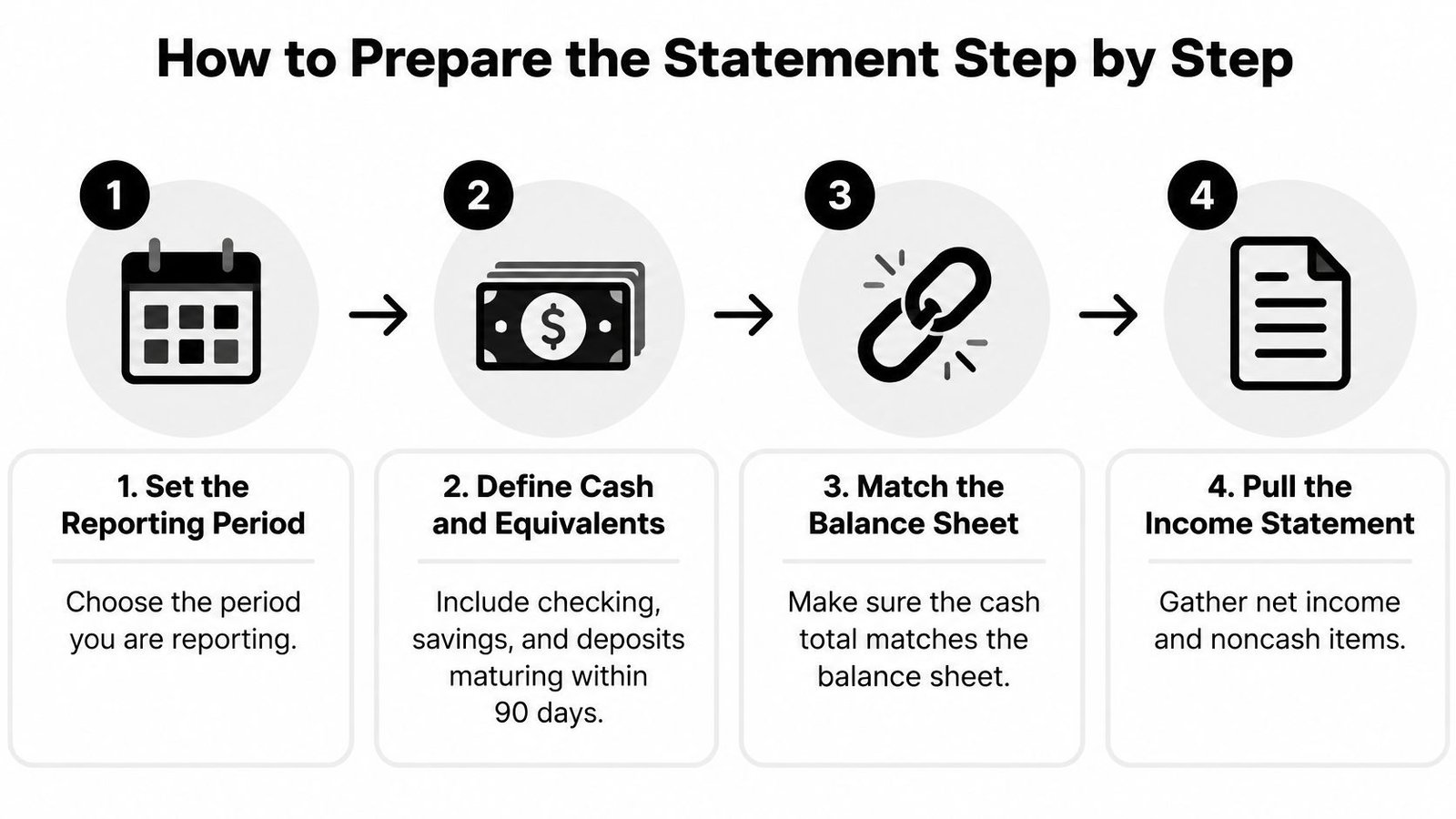
A business can show a profit and still face a cash shortfall if customers pay late or inventory builds up. Prepare the statement in a fixed order, then use the completed figures to look ahead: the historical cash movement can reveal which payments and collections may squeeze cash in the next period. The IAS 7 standard text requires disclosure of the components of cash and cash equivalents and reconciliation to the balance sheet, so finish by checking that the figures agree.
The visual below shows the preparation sequence before the final checks.
The eight steps
Set the period and define cash: Use the same definition as your balance sheet, typically checking, savings, and deposits maturing within 90 days. If the reports define cash differently, their balances will not match.
Pull your source reports: Gather the income statement for the period and balance sheets for the start and end dates. The balance sheet changes provide the starting point for most adjustments.
Start with net income: Under the indirect method, this is the first line in operating activities. The adjustments that follow convert accrual profit into cash movement.
Add back noncash charges: Include depreciation and similar items, such as provisions and unrealized foreign currency losses. These reduce profit without a cash payment in the period.
Adjust for working capital: Subtract increases in receivables and inventory, which tie up cash through uncollected sales or purchases. Add increases in payables, which reflect bills not yet paid.
List investing movements: Record equipment and vehicle purchases as negative amounts and proceeds from asset sales as positive amounts. Check the fixed asset register so purchases financed or traded in are not overlooked.
List financing movements: Record loan proceeds as positive amounts, and principal repayments and owner draws as negative amounts. Under U.S. GAAP, interest paid is an operating activity. IAS 7 permits interest paid to be classified as either operating or financing, so apply the accounting framework consistently.
Total and tie out: Add the three section totals to beginning cash. The calculated ending balance should equal cash on the balance sheet. If it does not, investigate the difference before using the figures.
Working capital example: If receivables rise by $30,000 during the period, operating cash is $30,000 lower relative to profit, even when all the sales were recorded correctly.
That adjustment makes the effect of credit sales clear. A bakery can report growth while customers still owe for their purchases, leaving less cash available for payroll, suppliers, or other bills. Compare the receivables movement with expected collections to see whether the same pressure may continue next period.
Sample statement layout with the worked example
| Line item | Section |
|---|---|
| Net income | Operating |
| Add back depreciation | Operating |
| Change in receivables and inventory | Operating |
| Change in payables | Operating |
| Operating cash flow after fee correction | Operating |
| Delivery van purchase | Investing |
| Loan proceeds | Financing |
| Principal repaid | Financing |
| Owner draws | Financing |
| Financing cash flow | Financing |
| Net change in cash | All sections |
| Beginning bank cash | Opening |
| Ending cash | Closing |
Keep the layout consistent from period to period. A lender comparing your last four quarters can follow the same lines, and you can spot an unusual movement without relearning the format. Use the historical changes in receivables, inventory, and payables as inputs to a short-term cash view: estimate when expected collections will arrive, then compare them with planned payments. That turns the statement from a record of past activity into an early warning for a cash shortfall.
Reconciling the Statement to Bank Statements
Reconcile the statement against bank records before sharing it. A deposit, fee, or check recorded in the wrong period can leave ending cash out of balance, even when the section totals look reasonable. Use the same reporting date for both records.

A worked example with a deliberate gap
Start with beginning bank cash of $48,200. The business reports operating cash flow of $31,400, investing cash flow of negative $18,000 for a delivery van, and financing cash flow of $7,000. That financing total combines a $25,000 loan, $12,000 of principal repaid, and $6,000 in owner draws.
The net change in cash is $20,400, which puts calculated ending cash at $68,600. The bank statement shows $66,900, leaving a $1,700 gap. Don't round away the difference or force it into a suspense line. Match transactions and dates until you find the cause.
Tracing the bank charges reveals a monthly merchant processing fee of $1,700 missing from the books. Record it as an operating payment, reducing operating cash flow to $29,700. Recalculate, and ending cash is $66,900, matching the bank.
The three-way check
- Statement arithmetic: Beginning cash plus the three section totals, with any separately identified exchange rate effects, equals ending cash.
- Bank agreement: Ending cash matches the reconciled bank balance on the same date, accounting for deposits in transit and outstanding checks.
- Balance sheet agreement: The same cash figure appears on the balance sheet. Flag restricted cash separately rather than blending it with available cash.
For businesses holding other people's money, rental trust bookkeeping with CS Outsource illustrates the need to trace each balance to source records before sign-off. Lenders also scrutinize deposits and fees in business bank statements and what underwriters check in them. Keep the reconciliation beside the statement so you can explain unusual movements without reconstructing the trail later.
The video below demonstrates how to match statement lines to bank activity.
Keep noncash items out of cash receipts and payments. An equipment lease signing or accrued interest should be disclosed separately, not presented as money moving through the account. Treat an unexplained difference as an error until the records show otherwise.
Reconciliation protects against honest posting mistakes and makes questionable entries easier to spot. The ACFE press release on its Report to the Nations describes financial statement fraud as among the costliest types of occupational fraud. Document each reconciliation and have someone independent review it when possible. Once historical ending cash ties to the bank, carry that confirmed balance into a short-term cash forecast. Add expected receipts and payments by date, and the owner can see a likely cash shortfall before it appears in the account.
Common Pitfalls and How to Fix Them
The most common small business error in draft statements isn't exotic: the whole loan payment gets booked as an operating expense, principal and all. This overstates operating expenses and understates operating cash, so a lender may see weaker operating performance than the business really has.
Errors that distort the operating section
Loan proceeds recorded as revenue create the opposite problem. A $25,000 lender deposit coded as sales makes operating cash look stronger than it is. Record the proceeds in financing instead, so operating activity reflects cash generated by the business rather than new borrowing.
Owner draws recorded as wages or expenses distort operating results too. A draw is a distribution of cash, not a cost of running the business, so classify it under financing. Owners may rely on draws like a salary, but that does not change how the transaction belongs on the statement.
Split each debt payment between its two parts. The interest portion stays in operating, while the principal portion moves to financing. This keeps operating cash and expenses from being distorted by loan repayment. Check the lender statement or amortization schedule for the split instead of estimating it.
Errors that hide in timing and assets
A profitable month can still bring a cash squeeze when receivables or inventory grow. The statement may be accurate: cash has not arrived from customers, or it has gone into stock. Compare balances at both period end dates to identify the increase and reflect its effect on operating cash. Use that pattern in a short-term cash view too, so you can see whether collections are likely to fall behind upcoming payments.
Equipment bought through financing needs careful treatment. The cash deposit and payments are actual cash flows, while the financed amount at signing is a noncash transaction to disclose separately. Recording the entire purchase price as cash paid and the full loan as cash received inflates both sections. Keep the cash movement separate from the noncash financing, then check how later payments are split between principal and interest.
| Symptom | Likely Cause | Fix |
|---|---|---|
| Ending cash does not match the bank balance | Unrecorded fees, transfers or deposits in transit | Reconcile each account line by line and record missing items |
| Operating cash looks strong but the bank balance is falling | Loan proceeds or owner draws mixed into operating activities | Move loan proceeds and draws to financing and recalculate |
| Net income is high but operating cash is low | Growing receivables or inventory not adjusted | Compare balances at both dates and deduct the increases |
| Operating expenses jump after loan payments | Loan principal recorded as an expense | Split each payment into interest and principal |
| Cash rises only after new borrowing | Financing masking weak operations | Show operating cash separately and flag it in the lender summary |
Work from the symptom to its likely cause before recalculating the whole statement. If operating cash looks unusually strong while cash on hand falls, check for borrowing or owner draws classified as operating activity. If net income is high but cash is tight, check receivables and inventory changes first. These checks point to the lines most likely to need correction and help you carry the right opening cash and expected collections into a short-term view.
After every correction, re-tie the ending balance before you move on. A fix that breaks the tie out isn't a fix.
Making the Statement Lender and Investor Ready
A historical cash flow statement may be accurate yet still leave a lender unable to see when cash will run short. Pair it with a forward view: actual results show what happened, while projected weekly balances show when you may need financing and how much time you have to act.
The FDIC Money Smart for Small Business instructor guide distinguishes a historical cash flow statement from a forward looking cash flow projection. A funding package is stronger when it includes both. Build the projection around customer collection dates and the dates bills are paid, rather than invoice issue dates.
Build a rolling 13 week schedule
Start each week with opening bank cash. Add expected receipts on the dates you realistically expect to collect them, then subtract supplier payments, payroll, taxes, and debt service on their expected payment dates. The result is ending liquidity for that week, which becomes the next week's opening balance. This links the historical statement to the weeks ahead, so you can see a cash gap before it arrives.
Then run a downside case where collections slip by two weeks. If a normal delay from your two biggest customers pushes a week's balance below zero, you can identify both the borrowing need and its timing. Show borrowing headroom under both cases so the lender can assess how much room remains if receipts arrive late. For a closer look at how lenders read these figures, see this cash flow statement analysis for a loan application.
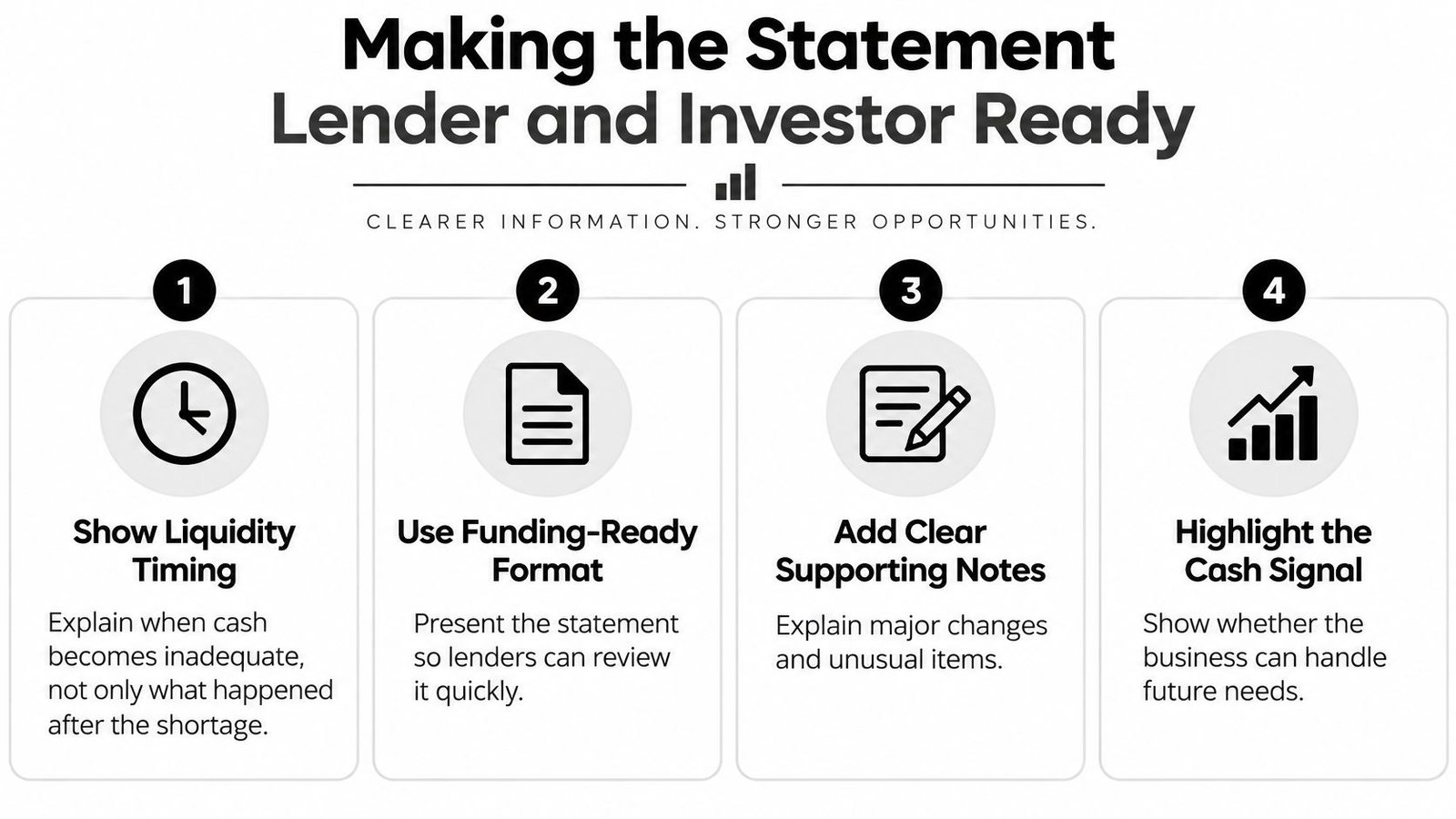
The checklist below summarizes what makes a statement easier to assess as part of a funding package.
Presentation details lenders notice
- Label actual versus estimated figures: Mark projections clearly. If estimates are mixed with actuals without labels, a reviewer cannot tell which figures are confirmed.
- State your tax treatment: Specify whether amounts include or exclude sales and indirect taxes, and apply that treatment consistently.
- Show cash available before financing: Operating cash minus essential capital spending and taxes helps the lender assess what remains for debt service.
- Explain unusual items in notes: A one-off asset sale or a large deposit needs a brief explanation. Clear supporting notes also matter in trust reporting explained by Reliance Property Accounts, where material balances are explained.
Seasonal businesses and construction firms should refresh the schedule monthly. A delayed progress payment or a slow season can quickly shift the week when cash is tight. Profitable growth can also strain cash temporarily if receivables and inventory rise faster than collections. Explain that timing effect with figures, so the lender can distinguish growth-related pressure from a persistent cash shortfall. Expect the lender to compare the statement with bank records.
Confirm Ending Cash Before You Share It
Run this go or no go test before the statement leaves your desk. Every item is a yes or no question, and a single no sends you back to work.
The six checks
- Sections add up: Do the operating, investing, and financing totals sum exactly to the net change in cash?
- Bank tie out: Does beginning cash plus that net change equal the reconciled bank balance on the same date?
- Adjustments trace: Does operating cash start from net income, with every adjustment traceable to a balance sheet change or a noncash charge?
- Debt in the right place: Do loan proceeds and principal sit in financing, with interest in operating?
- Draws classified correctly: Do owner draws sit in financing rather than inside expenses?
- Noncash items disclosed: Is every equipment lease or financed purchase shown separately instead of as cash in and out?
If any answer is no, return to the step that produced that line, fix it, and re-tie the ending balance before you continue. Fixing one classification often moves two section totals, so a fresh tie out after each correction isn't optional.
If every answer is yes, pair the statement with your 13 week forward schedule and send both together. A lender who can see last quarter's actual cash generation beside next quarter's week by week liquidity has far fewer reasons to hesitate. Building that forward view is its own skill, and a structured cash flow forecast built to support your loan strategy turns the historical statement into a borrowing plan.
Where the forward schedule shows a shortfall, size any financing request against the repayment capacity in your operating cash, not against the size of the gap alone. Borrowing to cover a timing gap that collections will close is sound. Borrowing to cover operations that don't generate cash just schedules a bigger problem.
Set a quarterly refresh and keep it. The next lender conversation, equipment decision, or tax payment should start from current, tied out numbers, not from a statement you scramble to rebuild under pressure.
Once your statement ties to the bank and your 13 week schedule shows exactly where cash runs tight, you're ready to talk funding from a position of clarity. Business Loan Warrior lets you check pre-approval through a single no fee application without affecting your credit, compare options from working capital lines to SBA and equipment loans, and track everything in one secure dashboard. Visit today, bring your reconciled statement, and match the right financing to the repayment capacity your operating cash already proves.