
You've got a business that needs a clean start, and the filing choice is already affecting your next move, whether you're opening a bank account, applying for working capital, or bringing on a partner. Too many owners treat this as paperwork trivia. It isn't. The document you file now becomes the first thing lenders, state agencies, and future investors use to understand who owns the company, how it's governed, and what they can expect from your records.
The short version is simple. Articles of Incorporation create a corporation. Articles of Organization create an LLC. Those are not interchangeable forms with different names, they set up different legal structures with different ownership rules, compliance burdens, and financing consequences.
| Dimension | Articles of Incorporation (Corporation) | Articles of Organization (LLC) |
|---|---|---|
| Legal entity created | Corporation | LLC |
| Ownership structure | Shareholders hold stock | Members hold membership interests |
| Governance | Board of directors and officers | Member-managed or manager-managed |
| Core filing detail | Often includes authorized shares and board structure | Usually focuses on entity name, registered agent, and business purpose |
| Ongoing formalities | More formal recordkeeping and resolutions | Typically lighter administrative burden |
| Funding posture | Better aligned with equity issuance and investor expectations | Better aligned with simpler ownership and management |
Table of Contents
- Why the Filing Choice Matters Before You Sign Anything
- What Each Filing Actually Creates
- Governance, Ownership, Tax, and Liability Side by Side
- Filing Steps, Required Disclosures, and What Goes on the Public Record
- State Variations, Filing Costs, and Hidden Compliance Friction
- What Lenders and Underwriters Actually Ask For
- Choosing the Right Filing by Business Scenario
- Common Questions About Switching, Naming, and Going Back to Fix It
Why the Filing Choice Matters Before You Sign Anything
A founder walks into formation thinking the state filing is a box to check. A year later, the bank asks for bylaws, a stock ledger, or an operating agreement that was never drafted because the owner filed the wrong entity type for the way the business runs. That’s where the cheap choice gets expensive. The filing is the first document in a chain that banks, investors, and regulators will keep extending long after the state stamps it.
The decision starts with how you expect the business to behave
If you’re forming a company for the first time, or switching because you’re about to borrow, the question is not which form is shorter. The question is whether you want a corporate record built around stock, a board, and officers, or an LLC record built around members and an operating agreement. Those paths lead to different ownership documents, different governance expectations, and different lender questions later.
Core insight: the filing is the start of a governance and financing record, not just a registration receipt.
That matters because the state filing doesn’t stay in a drawer. It becomes the baseline proof of existence, and everything from ownership changes to loan packages gets measured against it. If your company is planning to raise equity, admit partners, or deal with more formal underwriting, the filing needs to match that reality from day one.
Why this hits borrowers harder than casual owners
Borrowers feel the mismatch first because underwriting is document-driven. Lenders want to see how the entity is formed, who controls it, and whether the internal documents line up with the state filing. If they don’t, the underwriter slows down, asks follow-up questions, or pushes the file back for cleanup. That delay often matters more than the filing fee itself.
This is also why the old “LLC is always simpler” advice misses the point. Simpler for filing doesn’t always mean simpler for funding. If your business is heading toward equity investors, larger credit needs, or a more formal cap table, the corporation path can fit better even if it asks for more upfront structure.
What Each Filing Actually Creates
The easiest way to understand articles of incorporation vs articles of organization is to stop treating them like alternate labels. They create different legal entities with different internal rules. One brings a corporation into existence. The other brings an LLC into existence.
Corporation paperwork builds a stock-based entity
Articles of Incorporation are the formation document for a corporation. A corporation typically has shareholders, a board of directors, and officers, and the filing often asks for more structural detail because the state needs to know how the entity will issue ownership and who will govern it. In practice, that means the filing is tied to equity, board authority, and the formal corporate chain of command.
That history goes back to the older corporate model, while the LLC is much newer. LLCs first appeared in Wyoming in 1977, then expanded after Revenue Ruling 88-76 in 1988 confirmed pass-through tax treatment for Wyoming LLCs, and the IRS later made classification simpler nationwide with the 1996 check-the-box regulations. That timeline explains why the two filing documents exist separately in the first place. They were built for different legal structures, not for two versions of the same structure. Historical filing background
LLC paperwork builds a membership-based entity
Articles of Organization are the formation document for an LLC. An LLC is usually member-managed or manager-managed, and it commonly relies on an operating agreement instead of corporate bylaws. The state filing is usually lighter because it focuses on the entity’s identity, not on a stock structure or board hierarchy.
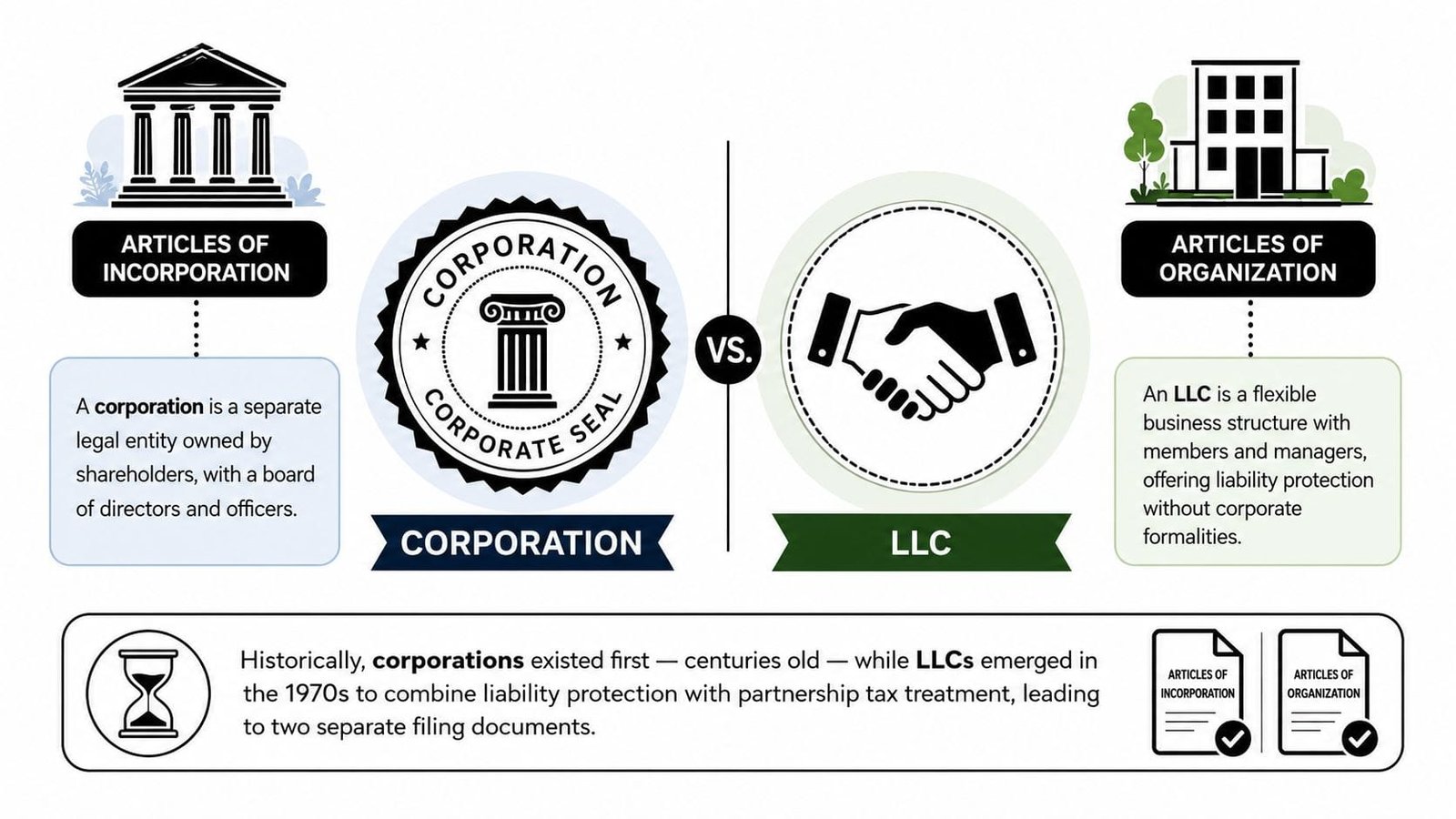
The practical takeaway is blunt. Swapping the words in the filing name doesn’t swap the underlying legal entity. If you want a corporation, you file incorporation documents. If you want an LLC, you file organization documents. If you’re explaining the difference to a partner or accountant, start there and don’t overcomplicate it. The structure determines the rules that follow.
Governance, Ownership, Tax, and Liability Side by Side
The comparison most owners need is not “which one is better.” It’s which one aligns with how they plan to own, run, finance, and document the business. The differences show up fast when money enters the picture.
| Dimension | Articles of Incorporation (Corporation) | Articles of Organization (LLC) |
|---|---|---|
| Governance model | Board, officers, and formal corporate action | Member-managed or manager-managed |
| Ownership representation | Stock and share classes | Membership interests |
| Default management style | More formal, resolution-driven | More flexible, agreement-driven |
| Recordkeeping | Minutes, resolutions, stock records | Operating agreement, membership records |
| Liability shield | Separate entity status, if formalities are respected | Separate entity status, if formalities are respected |
| Tax posture | Often used where corporate tax treatment and stock issuance matter | Often used where pass-through style flexibility is preferred |
Ownership changes are not handled the same way
This is the single most missed point. Corporations issue stock, and ownership lives in shares. LLCs allocate membership interests, and ownership lives in percentages or units defined by the operating agreement. That difference changes how control changes hands, how transfers get documented, and what a lender expects to see when it reviews the cap table.
Practical rule: if you expect investors to ask for stock, board seats, or a clean equity story, a corporation is usually the cleaner fit. If you want flexible ownership with fewer formalities, the LLC structure is usually easier to live with.
Tax and compliance shape the day-to-day burden
The entity choice also affects how much formality the business has to respect after formation. Corporations tend to come with more recordkeeping. LLCs usually come with lighter administrative demands. That matters because owners don’t feel compliance in the abstract, they feel it when they have to produce minutes, resolutions, or a current operating agreement for a loan file.
For lenders, the practical effect is even more direct. A corporation can look better when the funding story revolves around equity and a formal governance stack. An LLC can look cleaner when the borrower is a closely held operating business that wants simple internal control and simpler ongoing paperwork. The right answer depends on the business model, not on what sounds easier in a blog post.
Filing Steps, Required Disclosures, and What Goes on the Public Record
The filing process looks similar at a high level. You pick a name, prepare the formation document, and file it with the state. The details are where owners get tripped up, because corporations and LLCs ask for different disclosures and the public record ends up reflecting that difference.
Corporations usually disclose more upfront
For a corporation, the filing often includes the company name, registered agent, principal address, and share structure. That’s where authorized shares and board-related details show up, which is why articles of incorporation are typically denser than LLC filings. Formation disclosure comparison
LLC filings are usually narrower. They often focus on the entity name, registered agent, business purpose, and basic organizational details. In some states, that filing is called a certificate of formation, certificate of organization, or charter, which is why first-time filers assume they’re looking at different entity types when they’re really seeing different state terminology.
What gets public and what stays internal
The state filing is public record in both cases. The operating agreement or bylaws are where you keep the detail you don’t want sitting in a public database. That distinction matters more than most owners realize, because public filings should be clean, accurate, and minimal.
- Corporation filing: public-facing information usually includes basic identity data and stock structure.
- LLC filing: public-facing information usually includes basic identity data and registered agent details.
- Internal documents: bylaws or operating agreements carry the rules that govern the company.
If you’re also dealing with local licensing, you need to treat the formation filing as only one step. The business still has to line up registrations, permits, and other local requirements. A good reference point is the business license requirements guide if you’re mapping the full launch checklist.
The main mistake is over-disclosing in the filing itself. State documents should establish existence, not expose every internal detail. Put the governance mechanics where they belong, inside the company records.
State Variations, Filing Costs, and Hidden Compliance Friction
The biggest filing headaches usually don’t come from the form itself. They come from state-by-state variation. Articles of Organization can require different signatures, different content, and different filing names depending on the jurisdiction, and that creates avoidable delay for founders who assumed every state plays by the same rules.
The headline fee is rarely the full cost
Formation fees vary by state and are commonly in the $50 to $300 range for formation filings. That number sounds manageable, but it leaves out the friction. You can still run into registered agent fees, DBA filings, permits, licenses, and foreign qualification if you expand into another state. The filing fee is only the first bill.
A cheap filing can still become an expensive structure if the business crosses state lines too soon or picks the wrong entity for its growth path.
Expansion creates paperwork you can’t ignore
Multi-state operators feel the friction faster because every new state may require a separate qualification step. That means the business has to stay organized enough to prove it exists at home and is allowed to operate elsewhere. If you skip that cleanup, the cost is usually delay, not just another filing fee.
The cleanest way to think about this is simple. The Secretary of State filing gets the entity started, but it does not solve every compliance issue that follows. Once the business grows, you’re also dealing with annual reports, state-specific renewal rules, and the paperwork that keeps the entity in good standing. Owners who budget only for the formation fee are almost always underestimating the workload.
The structural choice matters more than the filing receipt. A corporation can create more formality, while an LLC can create more flexibility. But both can trigger state-specific friction if the owner assumes one filing works everywhere without adjustment.
What Lenders and Underwriters Actually Ask For
The state filing proves the entity exists. It doesn’t prove the borrower is organized enough to take on debt. That’s why the funding file includes more than the formation document. Underwriters want the operating agreement or bylaws, EIN confirmation, current ownership documentation, and often the most recent annual report. If a business can’t produce those quickly, the application slows down.
Corporation borrowers and LLC borrowers are reviewed differently
For a corporation, lenders usually want to see stock records, board authority, and resolutions that show who can borrow on behalf of the company. For an LLC, they look for membership percentages, management authority, and an operating agreement that spells out who can act for the business. The filing type shapes the document stack.
That difference matters because lenders aren’t just checking legality. They’re checking whether the people signing the loan papers have authority that matches the entity’s own records. If those documents conflict, the underwriter has a problem, and the borrower feels it in timing.
If you file as the wrong entity and later need to convert, expect fresh paperwork. Lenders often want the updated formation documents, the revised ownership records, and a clean internal authorization trail before they move the deal forward.
Equity plans can force an expensive cleanup
Many owners get burned. They form an LLC because it’s simple, then later decide they want equity investors. That can work, but it often forces a conversion or restructuring that creates new records the lender or investor will want to review from scratch. If equity financing is in the business plan, it’s smarter to choose the structure that matches that path now.
The funding rule is straightforward. Borrowers need consistency. The state filing, the internal governance documents, and the ownership records all need to tell the same story. If they don’t, the underwriter gets cautious, and caution delays funding.
Choosing the Right Filing by Business Scenario
The best filing choice depends on what the business is trying to do next, not just what feels cheapest today. I’ve seen owners save a little at formation and lose time later because the structure didn’t fit the financing plan. Use the scenario that matches your reality, not your hope.
Match the filing to the actual business model
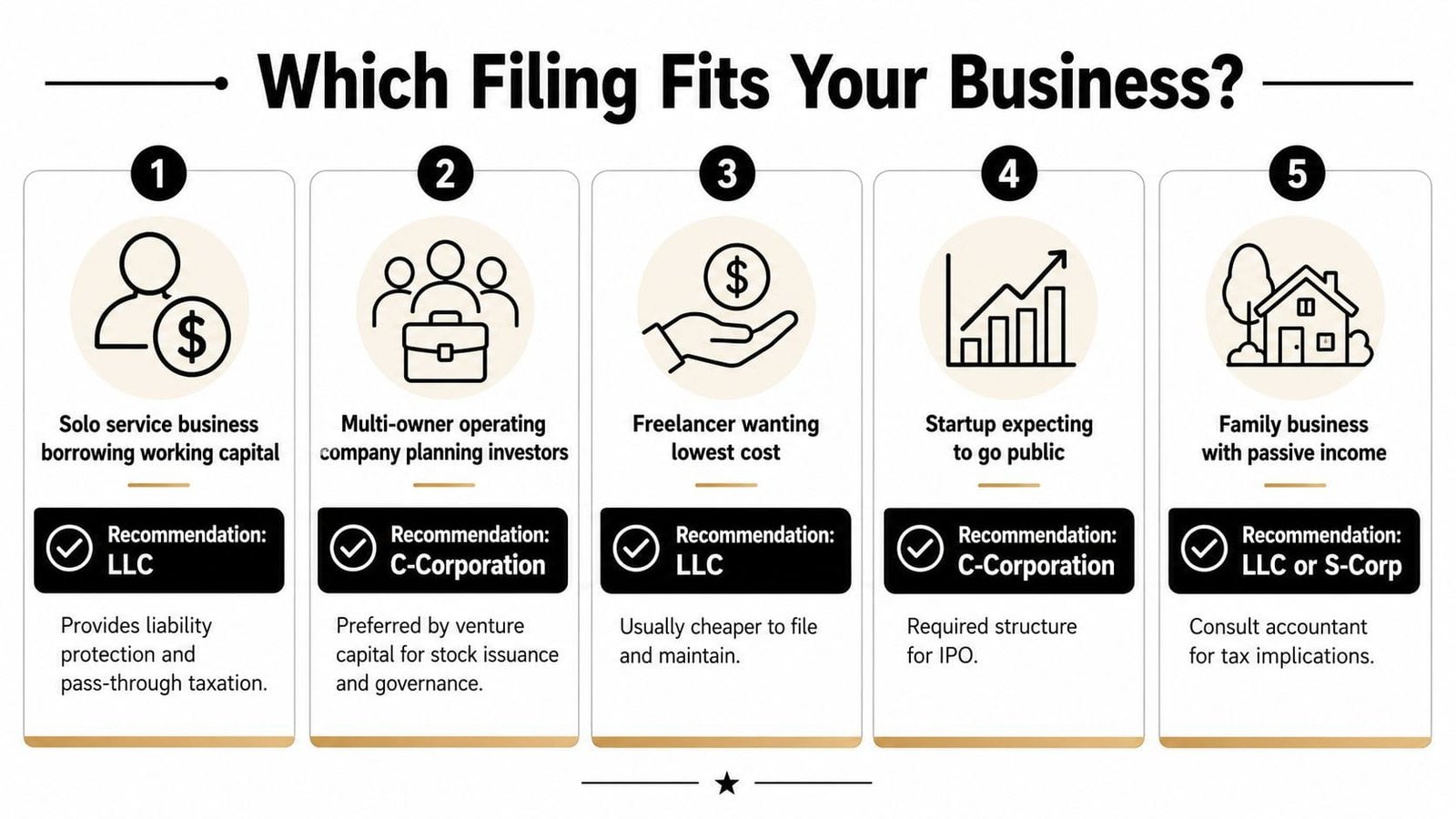
| Scenario | Recommended Filing | Key Prep Before Applying for Funding |
|---|---|---|
| Solo service business borrowing working capital | LLC | Operating agreement, EIN letter, current banking records |
| Multi-owner operating company planning investors | Corporation | Bylaws, board structure, stock records |
| High-growth venture planning venture financing | Corporation | Clean share authorization, governance documents |
| Established company applying for SBA 7(a) or 504 loans | LLC or Corporation, based on ownership plan | Authority documents, ownership records, lender-ready internal approvals |
| Multi-state operator expanding beyond home state | Depends on growth path, but choose the structure you can maintain cleanly | Foreign qualification plan, state filings, registered agent coverage |
The recommendation I’d make in each case
- Solo service business: file as an LLC if you want a straightforward operating structure and you’re borrowing working capital against an operating business.
- Investor-ready company: file as a corporation if you expect outside equity, formal board action, or stock-based ownership.
- High-growth venture: file as a corporation if you’re building toward venture financing, because the stock framework fits that conversation.
- SBA-bound established business: file the structure that matches your records and ownership story, then keep every approval document aligned.
- Multi-state operator: choose the structure you can maintain consistently across states, because expansion makes sloppy filings more painful.
The screenshot version is simple. Choose LLC when you want flexibility, cleaner internal control, and simpler ownership. Choose corporation when you need stock, formal governance, and a structure that investors already understand.
Common Questions About Switching, Naming, and Going Back to Fix It
Yes, businesses can usually convert from an LLC to a corporation or go the other direction, but that doesn’t erase the original filing. It usually creates a new legal trail and a new set of records that has to be reconciled with contracts, bank files, and ownership documents. That’s why conversion should be a planning move, not a cleanup move.
Name rules and filing names cause the most confusion
States can reject a filing if the name is already taken or too similar to an existing entity. That’s a naming problem, not a structure problem. It still stops formation until the owner picks a usable name and clears the state’s requirements.
The terminology also confuses people. Some states don’t say “articles of organization” at all. They use labels like certificate of formation or charter, which makes founders think they’re filing the wrong thing when they’re just dealing with state-specific wording. If you need to change a business name later, the mechanics matter, and the process is worth reviewing in the business name change guide.
Don’t file the wrong entity just to move faster
A sole proprietor usually doesn’t need either document unless they’re creating a separate legal entity. If you’re staying unincorporated, the state formation filing doesn’t apply the same way. If you’re creating liability protection, borrowing, or building something that needs a clear ownership record, you do need to choose one structure and commit to it.
The cleanest summary is this. The formation filing is the foundation of every downstream relationship your business will have with banks, state agencies, and investors. Choose it deliberately, keep the records consistent, and you’ll spend far less time fixing paperwork later than you would if you guessed at the start.
If you’re deciding between an LLC and a corporation for a loan, a growth plan, or a state filing you need to get right the first time, start with a funding-ready structure review at Business Loan Warrior.