
A distribution company can look healthy on paper while its cash account tells a different story. Customer invoices are arriving late, the factoring line is running behind, payroll is due Friday, the secured lender wants a field exam, and a key supplier has stopped extending terms. No single event caused the crisis. The pressure accumulated through thinner margins, slower collections, rising finance costs, and promises that were repeatedly pushed into the next week.
That is the point at which business debt negotiation becomes a management decision, not a desperate request for mercy. You need to know exactly who can take what, how much cash the company can devote to debt service, and which concession would effectively restore the business. Asking every creditor for “a discount” without that preparation usually produces delay, confusion, and worse terms.
Table of Contents
- When Business Debt Negotiation Becomes Urgent
- Mapping Every Dollar You Owe Before You Call Anyone
- Ranking Creditors by Leverage and Risk
- Negotiation Strategies That Actually Move Lenders
- Settlement Versus Restructuring and When Bankruptcy Wins
- Legal Landmines Most Owners Miss
- After the Deal Tracking the Metrics That Matter
When Business Debt Negotiation Becomes Urgent
The owner may still be shipping orders and booking revenue when the company's negotiating position starts to disappear. A factor demanding larger reserves, a lender threatening enforcement, and a supplier switching to cash on delivery can drain operating cash before the financial statements show a formal default.
Debt distress usually builds through several small failures. A late customer payment forces a draw on the credit line. A low-margin contract absorbs more working capital than planned. Management postpones a principal payment, then takes another short-term advance to cover payroll. By the time a creditor sends a default notice, the owner may face cross-default provisions, personal guarantees, and several creditors competing for the same limited cash.
The signals that require action
Act while the company can still present a credible recovery plan. Watch for these triggers:
- NSF events: A returned payment shows that available liquidity has become unstable.
- Default notices: A notice can start a cure period or preserve the lender's right to accelerate the balance.
- Court filings: A lawsuit, judgment, garnishment, or foreclosure threat sharply reduces private negotiating room.
- Factoring reserve demands: Higher reserves remove cash from the business even when sales continue.
- Merchant cash advance recalls: Daily ACH withdrawals or an immediate payoff demand can disrupt payroll and key vendors.
- Third-party collectors: Escalating collection calls often mean the account has moved beyond ordinary servicing.
Create a creditor-by-creditor liability map as soon as these signals appear, then test every proposed payment against a 13-week cash-flow envelope. That discipline shows which obligation threatens operations first and prevents an owner from promising cash twice. Do not wait until every account is delinquent. The best negotiation usually starts while reporting is reliable and some operating cash remains.
Business bankruptcy remains an infrequent endpoint compared with the broader population of business and nonbusiness filings. For the year ending December 31, 2025, U.S. courts recorded 24,737 business bankruptcy filings, up from 23,107 in 2024 and 18,926 in 2023, while business cases represented about 4.3% of 574,314 total bankruptcy filings. The U.S. Courts bankruptcy filing report supports a practical conclusion: companies often address payment pressure through extensions, settlements, covenant changes, or refinancing before entering court.
Advisor's rule: Start the conversation before the creditor has exhausted its patience, remedies, and internal workout authority.
Early outreach can produce an interest-only period, revised amortization, or covenant waiver when the company supplies reliable reporting and a workable recovery plan. Late outreach becomes triage. Equity value may fall, personal liability may activate, and suppliers may reject any proposed schedule.
If legal notices have arrived, review what defaulting on an SBA loan entails before relying on a general debt-relief conversation. Have a restructuring lawyer review the documents, identify cure deadlines, and protect the business while commercial negotiations continue.
Mapping Every Dollar You Owe Before You Call Anyone
Don't call a lender until you can explain the entire capital structure without searching through email. A creditor will test whether your numbers reconcile. If you give one payoff figure on Monday and a different figure on Friday, the conversation shifts from solving the problem to questioning your credibility.
Build two documents: a creditor-by-creditor liability map and a rolling 13-week cash-flow forecast. A useful business debt schedule can help organize the first document, but the schedule must reflect signed agreements and current statements, not estimates copied from an old accounting file.
Build the liability map
Create one row for every obligation, including debts that aren't yet in default. Record:
- Creditor and borrower: Identify the legal entity that owes the money and any related entity named in the agreement.
- Balance information: Record original principal, current payoff, accrued interest, default interest, fees, and the date each figure was obtained.
- Payment terms: Note the interest rate, payment frequency, maturity, amortization, balloon payment, and any repayment sweep.
- Security position: Identify UCC filings, mortgages, equipment liens, deposit-account control, receivables assignments, and other collateral.
- Personal support: List every owner or affiliate guarantor, indemnitor, co-borrower, and pledge provider.
- Contract restrictions: Capture covenants, reporting duties, cure periods, default provisions, cross-defaults, confession-of-judgment language, and side letters.
- Status: Mark current, late, formally in default, under a forbearance, in litigation, or assigned to collections.
Then add obligations that don't appear on a conventional loan statement. Include trade payables by aging category, payroll and sales tax liabilities, corporate tax exposure, leases, customer deposits, pending litigation, and merchant cash advance arrangements with daily or weekly remittances. A debt map that omits taxes, lease arrears, or contingent claims isn't a debt map. It's a partial list that can produce a false cash-flow conclusion.
Source each figure from the underlying record. Use bank statements for actual withdrawals, loan agreements for legal terms, payoff letters for current balances, accounts-payable aging reports for vendors, tax notices for government claims, and lease documents for remaining exposure. Reconcile the totals to the general ledger and bank activity. If the lender's payoff differs from your accounting balance, preserve both figures and investigate the difference before negotiating.
Build the 13-week cash envelope
The forecast should show, by week:
- Opening cash: Reconcile the starting balance to bank statements and identify restricted or unavailable funds.
- Inflows by source: Separate customer collections, factoring proceeds, new sales, refunds, owner contributions, and other receipts.
- Operating outflows: Include payroll, taxes, inventory, rent, utilities, insurance, shipping, essential software, and supplier payments.
- Debt outflows: Show each scheduled payment, ACH withdrawal, interest charge, reserve increase, and proposed workout payment.
- Minimum operating buffer: Define the cash required to keep payroll, taxes, and essential operations functioning.
- Closing cash: Calculate the balance after every inflow and outflow, then test the result against the minimum buffer.
- Covenant headroom: Measure whether projected earnings, liquidity, debt levels, or coverage remain within each agreement's requirements.
Use conservative revenue and margin assumptions. The forecast isn't a sales presentation. It's the maximum sustainable debt-service amount, your resource envelope. A proposal that requires more cash than this envelope can support isn't a negotiation strategy. It's a delayed default.
Practical rule: Never offer a payment because it sounds reasonable. Offer the amount the forecast can sustain after payroll, taxes, essential suppliers, and the operating buffer.
Give the creditor supporting schedules, but don't casually hand over irrelevant personal or customer information. Your lawyer or restructuring advisor can help determine what to disclose, when to disclose it, and how to exchange information under a confidentiality arrangement.
Ranking Creditors by Leverage and Risk
The creditor with the largest balance isn't automatically the creditor you address first. Negotiation order follows legal standing, security, and operational importance, not the emotional volume of collection calls.
Start with a simple triage matrix. Score each creditor internally, then adjust the order after reviewing the agreements. A senior secured lender with a blanket lien and personal guarantees may pose more immediate risk than several unsecured vendors with larger combined balances. The IRS and state tax agencies also deserve immediate attention because tax obligations can threaten operations and create personal exposure in circumstances that differ from ordinary commercial debt.
Creditor Triage Matrix
| Creditor Type | Security | Legal Leverage | Operational Priority | Negotiate Order |
|---|---|---|---|---|
| Senior bank lender | Often broad collateral and guarantees | Acceleration, foreclosure, asset remedies | High if tied to core assets or banking | First |
| Factoring company | Receivables assignment and reserves | Control of collections and reserve account | High where receivables fund payroll | First or second |
| Tax authority | Statutory collection rights may apply | Levies, liens, collection actions | Essential because taxes cannot be ignored | Immediate |
| Merchant cash advance provider | Receivables or UCC claims may appear | ACH withdrawals, litigation, guaranty enforcement | High if daily pulls drain operating cash | Immediate review |
| Equipment lender | Specific equipment collateral | Repossession or liquidation remedies | High if equipment generates revenue | Early |
| Essential supplier | Usually unsecured, sometimes retaining rights under contract | Delivery suspension, collection action | High if replacement supply is difficult | Early |
| Landlord | Lease rights and site control | Eviction or enforcement under lease | High for location-dependent operations | Early |
| Unsecured vendor | Usually no specific collateral | Lawsuit and collection remedies | Varies by operational dependence | Later, unless essential |
MCAs and online lenders deserve a separate review because daily ACH withdrawals can pull cash before payroll and essential vendors are paid. Don't assume a daily debit is merely a payment schedule. Read the contract for reconciliation rights, default triggers, UCC language, guaranties, and any provision that allows the creditor to demand immediate repayment.
Ranking isn't a license to ignore lower-priority creditors. It tells you where to spend limited negotiating time first and which conversations must be coordinated. A supplier may be unsecured, but losing it could stop production. A lender may have a modest balance, but a blanket lien could affect every operating asset.
Negotiation Strategies That Actually Move Lenders
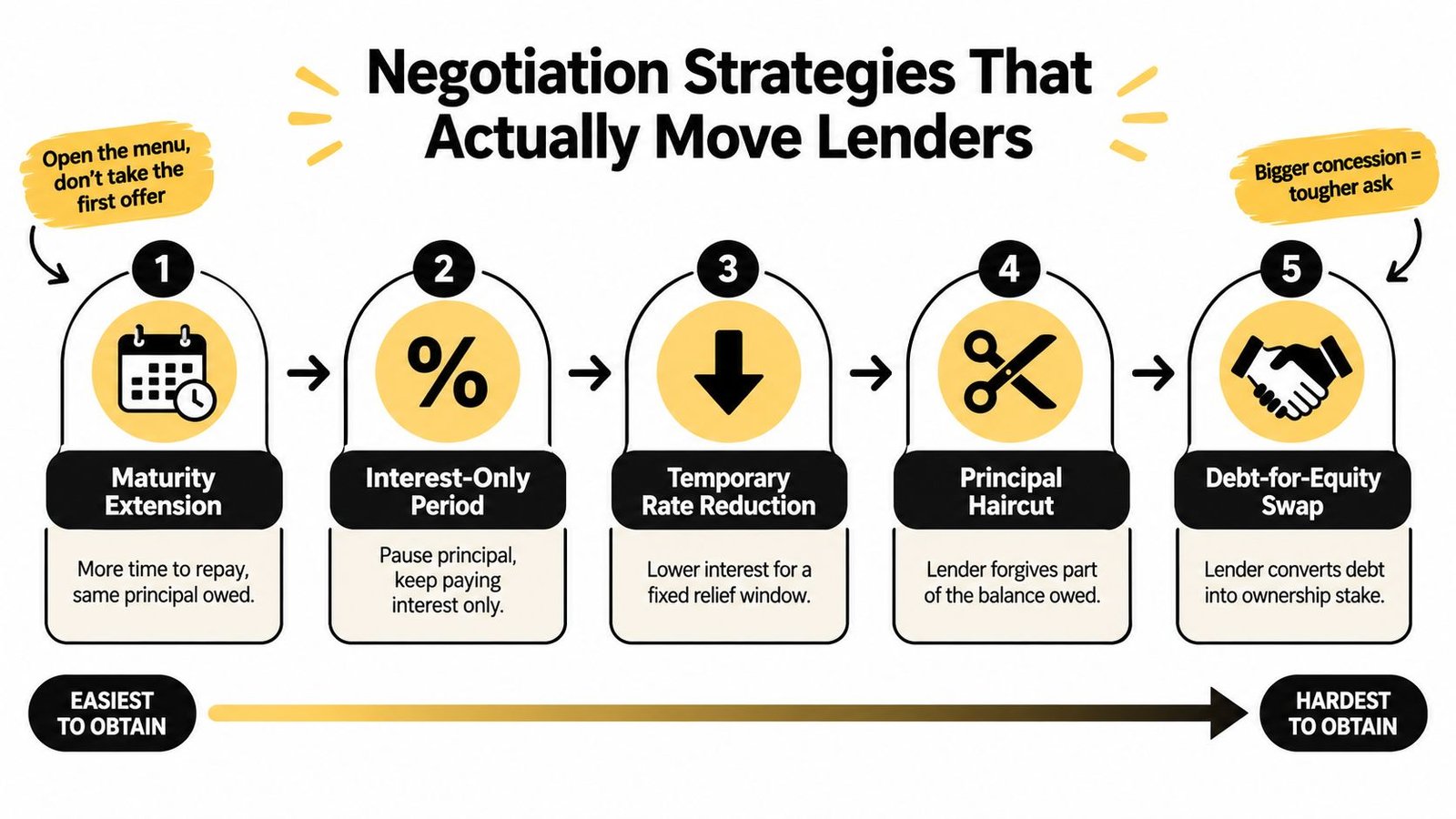
Creditors rarely approve a vague request for relief. They approve a defined transaction that gives them a better recovery path than immediate enforcement. Bring a menu of concessions, lead with the request most likely to receive a yes, and reserve the hardest ask for the point at which the lender understands why it is necessary.
Choose the concession that matches the problem
Maturity extension is usually the cleanest first request. The company keeps paying principal and interest under a longer schedule, giving cash flow more room without asking the lender to reduce the balance. It fits a business with a viable operation but a repayment schedule that is too aggressive.
Temporary interest-only payments can help when principal amortization, rather than the total interest burden, is causing the immediate squeeze. Define the start date, end date, payment amount, and what happens afterward. Don't accept a verbal promise that the lender will “work with you.”
Temporary rate reduction may be appropriate when the business can service a reduced cost but cannot carry the current rate during a defined recovery period. Tie the request to a documented operating forecast and specify whether the rate returns automatically or requires a new agreement.
Principal reduction is harder. A lender may consider a short-pay settlement when enforcement would produce a poor recovery, the company has a credible funding source, or the borrower can make a defined payment promptly. Never offer a settlement figure without identifying where the funds will come from and what release the creditor will provide.
Debt-for-equity conversion can preserve a business that has enterprise value but insufficient debt capacity. It may fit a subordinated lender, insider, or investor more readily than a senior secured lender. Offering equity to a lender that already controls valuable collateral can add complexity without solving the senior claim.
Academic restructuring research links negotiation sequencing and conditional agreements to the coordination problem among creditors. The research on corporate financial distress and creditor bargaining supports a practical conclusion: concessions often need to be connected, so one creditor doesn't grant relief while another captures the benefit through immediate enforcement.
Use a disciplined opening
A first call should establish facts, not produce an improvised confession. Use language like this:
“We want to resolve the account before enforcement becomes necessary. We have prepared a creditor schedule, a rolling cash-flow forecast, and a specific proposal that preserves operating cash while improving your recovery. I'd like to review the numbers with the person who has authority to approve a workout and agree on the information and standstill terms needed for that review.”
Don't threaten bankruptcy, blame the lender, or promise a payment that the forecast can't support. Ask who has decision authority, what documents the lender needs, whether collection activity can pause during review, and whether the lender will consider a written standstill.
Put the proposal in writing
A credible proposal should contain:
- Executive summary: Explain the cause of the shortfall, current operating condition, and requested outcome.
- Current obligation: State the balance, payment, collateral, guaranties, and default status as you understand them.
- Modified terms: Set out the exact payment, timing, maturity, interest treatment, collateral treatment, and reporting requirements.
- Recovery rationale: Explain why the proposal produces a better recovery than immediate enforcement.
- Supporting schedules: Attach the liability map, 13-week forecast, aged receivables, aged payables, and a concise operating plan.
- Conditions: Define the required waiver, release, standstill, consent, and consequences if the forecast misses target.
A payment holiday without a written covenant waiver can leave the default intact. A settlement without a release can leave the balance open. A lender's email saying “approved” isn't a substitute for signed documents that state the modified terms and remedies.
Settlement Versus Restructuring and When Bankruptcy Wins
A settlement closes an account for an agreed amount, usually through a lump-sum payment or a defined short-pay arrangement. A restructuring keeps the relationship alive but changes timing, interest, amortization, covenants, or security terms. Neither is automatically superior.
| Factor | Settlement | Restructuring (Workout) | Bankruptcy / Reorganization |
|---|---|---|---|
| Primary objective | Close the claim for an agreed amount | Restore sustainable repayment | Create a binding process for broad distress |
| Payment pattern | Lump sum or short defined schedule | Modified ongoing payments | Court-supervised plan or liquidation path |
| Creditor coordination | Often difficult across many creditors | Requires consent from participating creditors | Court process can address coordination |
| Business control | Usually remains with management | Usually remains with management | Depends on chapter and court structure |
| Personal guarantees | Need an express release | May remain unless modified | Requires specific legal analysis |
| Enforcement pressure | Stops only if documents say so | May pause under forbearance terms | Formal protections may apply |
| Best fit | One or a few resolvable claims | Viable business with temporary or structural mismatch | Remedies, holdouts, or debt load exceed private solutions |
Informal workouts include private amendments, forbearance letters, creditor compositions, and coordinated settlements. They can be faster and more private, but they fail when every creditor has a separate timetable and a separate enforcement right. One holdout can seize collateral or terminate a critical facility while the other creditors wait.
Formal options require legal analysis. Chapter 11 is designed to allow an eligible business to reorganize and continue operating, while Chapter 7 generally liquidates a business. Subchapter V may offer a structured reorganization route for qualifying companies, but eligibility and strategy depend on current law and the company's facts. An assignment for the benefit of creditors or a state-court receivership may also fit some businesses, particularly when an orderly asset sale or independent control is more valuable than continued operations.
The right comparison is not “bankruptcy is bad, settlement is good.” Ask four direct questions:
- Can the proposed workout keep the company above its minimum operating cash requirement?
- Can the required creditors be coordinated before a lender accelerates or seizes assets?
- Does the business have enough enterprise value and repayment capacity to justify continued operation?
- Is a formal process needed to stop foreclosure, asset seizure, garnishment, or a cascade of defaults?
Bankruptcy may win when private talks have become a revolving door of extensions with no sustainable payment. It may also win when a court's authority creates more value than another month of bilateral calls. U.S. court data shows that business filings and the broader bankruptcy cycle rise and fall over time, which is one reason owners should evaluate formal reorganization as a strategic tool rather than a moral verdict. The Kons Law resource on how to navigate debt restructuring offers additional context for comparing restructuring paths.
Legal Landmines Most Owners Miss
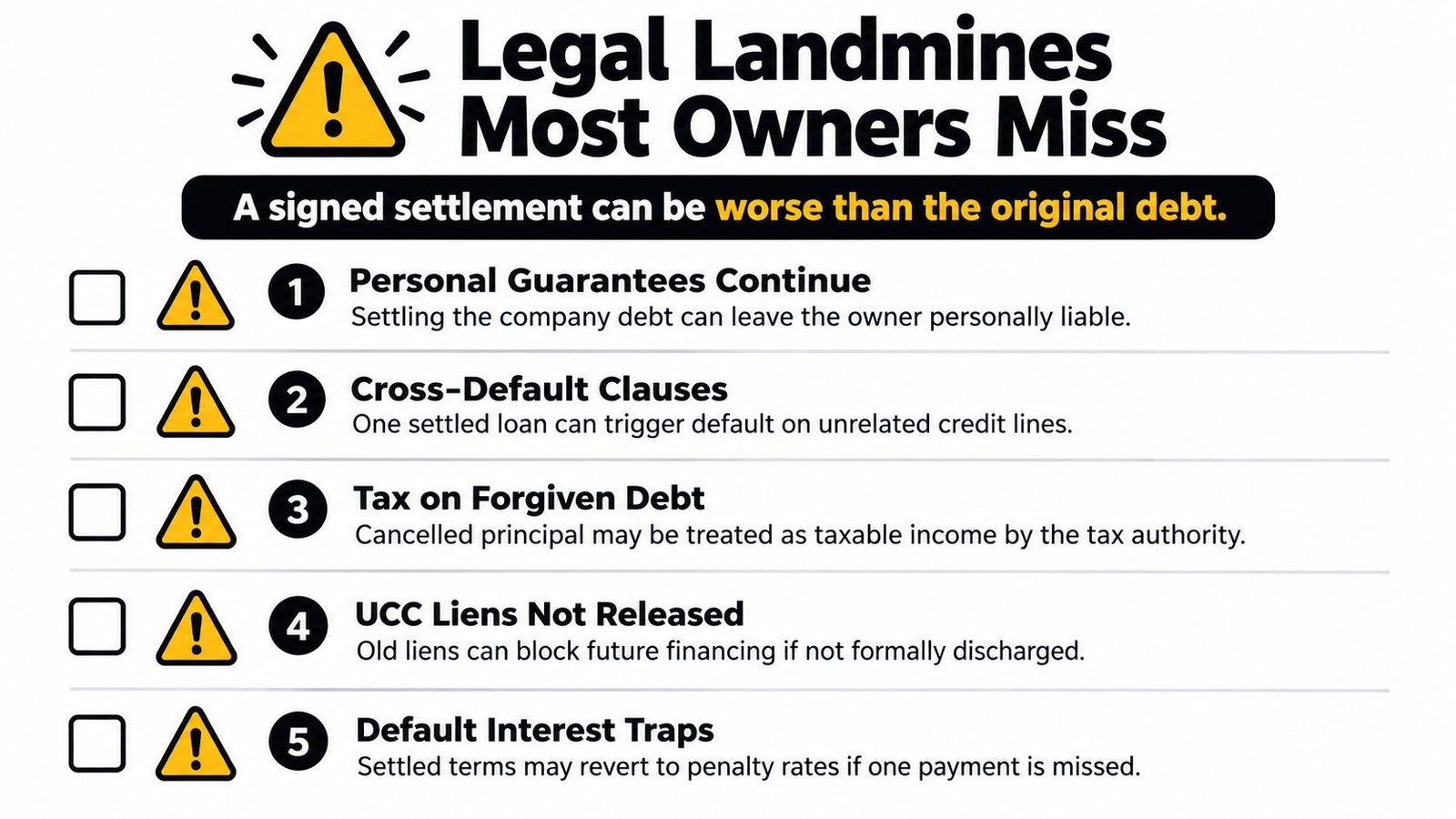
The cheapest settlement can be the most expensive outcome if it preserves personal liability, triggers another loan, or leaves a lien blocking future financing. Owners often focus on the amount forgiven and ignore the legal mechanics that determine whether the deal ends the problem.
Read beyond the settlement amount
A business settlement doesn't automatically release an owner who signed a personal guaranty. The agreement should identify each released party, each released obligation, and each enforcement right being surrendered. If the owner remains liable, the company may be relieved while the creditor continues pursuing personal assets.
Cross-default and cross-collateralization provisions can create a second crisis. One missed payment or settlement may trigger default on an unrelated credit facility, especially when the same lender holds multiple agreements or a blanket lien. Have counsel review every loan, guaranty, security agreement, and intercreditor document together rather than reviewing the settlement in isolation.
Confession-of-judgment or cognovit language deserves immediate legal review. These provisions can affect the owner's ability to contest a lawsuit and may appear in documents involving merchant cash advance providers or other commercial finance companies. Don't sign an admission, consent judgment, waiver of defenses, or stipulated judgment because a representative says it's “standard.”
Cancellation of debt can also create tax consequences. Under IRC Section 108, forgiven debt may be treated as income in some circumstances, while insolvency or bankruptcy exclusions can require proper documentation and filing, including Form 982 where applicable. A tax professional must analyze the entity's tax position before the owner treats the settlement amount as pure savings.
The FTC Non-Compete Rule may affect the review of owner obligations and related agreements, but its application depends on current legal developments and the contract involved. Treat it as a reason to obtain current legal advice, not as a reason to assume a restriction disappears.
Finally, partial payments or written acknowledgments can affect limitation periods depending on governing law. A payment that seems harmless may change the creditor's ability to pursue an old claim. Review the governing-law clause before sending money or making a written admission.
Signing rule: Any document involving personal liability, tax treatment, a waiver of defenses, collateral, or a release belongs with a qualified attorney before signature.
Use the underlying agreement, not a summary, as the source of truth. A practical business loan agreement guide can help you identify provisions to locate, but it isn't a substitute for legal review of your documents.
This video provides another visual explanation of risks owners should consider before agreeing to new debt terms.
After the Deal Tracking the Metrics That Matter
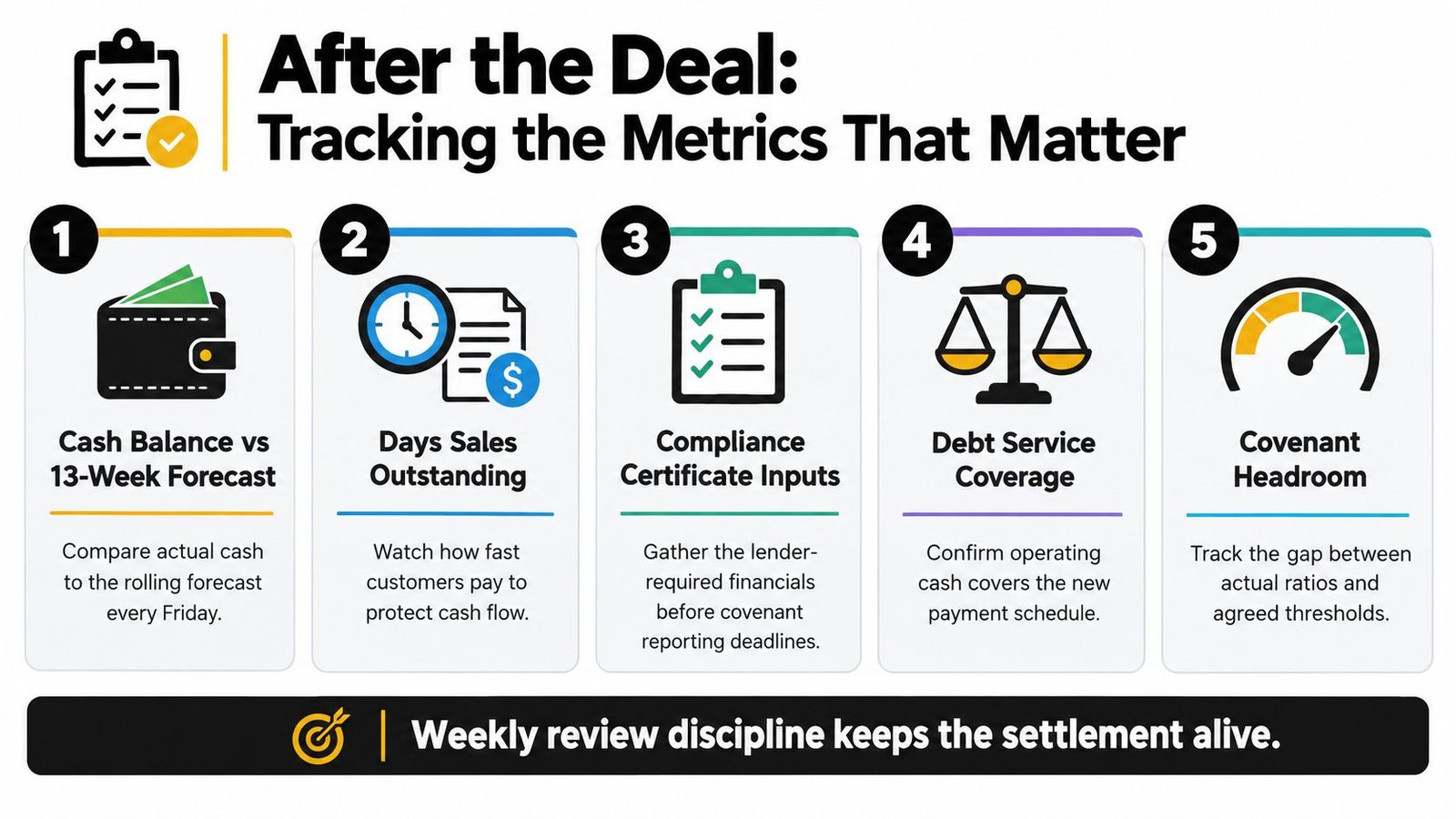
A signed agreement is not a recovery. It is a set of operating conditions that the company must meet every week. Assign one person to maintain the forecast, one person to verify payments and reporting, and one decision-maker to contact creditors when performance slips.
Run a weekly scorecard
Review the following every Friday:
- Cash against forecast: Compare actual bank cash with the rolling 13-week projection and explain every material variance.
- Days sales outstanding: Track collection speed by customer group and identify invoices that threaten the next payment cycle.
- Compliance inputs: Gather the financial statements, borrowing-base reports, certificates, and other items required by the agreement before the deadline.
- Debt service coverage: Confirm that operating cash supports the modified payment schedule after essential expenses.
- Covenant headroom: Measure the gap between actual performance and each negotiated threshold before the lender has to ask.
Set written escalation rules in advance. If cash falls materially below forecast, collections slow, a major customer disputes an invoice, or a covenant approaches its limit, notify the designated creditor contact and advisor immediately. Don't wait for the next missed payment. The agreement should state what information the creditor receives, how quickly the parties meet, and whether a temporary cure or additional funding is available.
Keep the liability map current as balances, liens, guarantors, and payment terms change. Save proof of every payment, reporting delivery, waiver, and creditor acknowledgment. Revisit the creditor ranking matrix regularly because a supplier can become operationally critical, a lender can acquire additional collateral, or a new default can change the enforcement order.
The workout survives on reporting discipline. A forecast miss is manageable when you disclose it early. A hidden miss turns a manageable variance into a credibility problem.
Business Loan Warrior can help owners evaluate funding and debt-consolidation options while organizing the cash-flow information lenders need to review a request. Visit Business Loan Warrior to explore business financing built around your needs and take the next step before a temporary cash problem becomes a formal default.