
Most borrowers assume the interest rate and repayment term decide whether a business loan works. That advice is incomplete. A loan with an attractive rate can still become dangerous if the agreement lets the lender accelerate the balance after an unrelated default, demand repayment after a vague business setback, or force a dispute into an inconvenient arbitration process.
A business loan agreement is an operating rulebook, not merely a payment schedule. Read the sections that control default, remedies, reporting, collateral, dispute resolution, and future borrowing with the same attention you give the pricing page. Those clauses determine how much control you retain after the money reaches your account.
Table of Contents
- Why Most Borrowers Focus on the Wrong Clauses
- Core Components of Every Business Loan Agreement
- Understanding Interest Rate Structures and Pricing
- Comparing Common Business Loan Types
- The Hidden Risk in Covenant-Lite Agreements
- Red Flags That Signal Trouble Ahead
- Negotiation Strategies That Actually Work
- Your Signing and Implementation Checklist
Why Most Borrowers Focus on the Wrong Clauses
The interest rate is visible, easy to compare, and psychologically compelling. The covenant package is buried in definitions, exhibits, and cross-references. That imbalance causes owners to spend an hour negotiating pricing and almost no time asking what happens if revenue drops, a financial statement arrives late, or another creditor claims a default.
A lower rate won't protect you from an aggressive acceleration clause. A longer term won't help if a material adverse change provision gives the lender broad discretion to declare that your business condition has deteriorated. The agreement's less exciting language often controls the moments when the relationship becomes adversarial.
The clauses that change your leverage
Start with four questions:
- Can the lender accelerate the loan? Identify every event of default and determine whether the lender must provide notice and an opportunity to cure.
- Can another obligation trigger this loan? A broad cross-default clause may connect the agreement to leases, credit cards, vendor debt, or other financing.
- Can you challenge lender conduct? Arbitration, venue selection, jury-trial waivers, and complaint procedures can determine the cost and location of a dispute.
- Can you keep operating normally? Negative covenants may restrict additional debt, acquisitions, distributions, asset sales, or equipment purchases.
A missed payment on an unrelated obligation shouldn't automatically threaten a major term loan unless the language clearly says it will. Ask for a materiality threshold, a final judgment requirement, or a meaningful cure period. Otherwise, a minor administrative problem can become a contractual crisis.
Practical rule: Never evaluate a loan solely by asking, “What will my monthly payment be?” Ask, “What can this lender stop me from doing, and what can trigger immediate repayment?”
Dispute resolution deserves special attention. Recent coverage of a Fourth Circuit decision involving a PPP-related small-business loan dispute shows that arbitration clauses can control whether a borrower proceeds in court or before an arbitrator, as reported by the American Bankers Association Banking Journal. The contract may also select governing law, dictate venue, and limit available remedies.
The right review order is simple: defaults and remedies first, covenants second, dispute provisions third, collateral fourth, and pricing last. Price matters, but control matters more.
Core Components of Every Business Loan Agreement
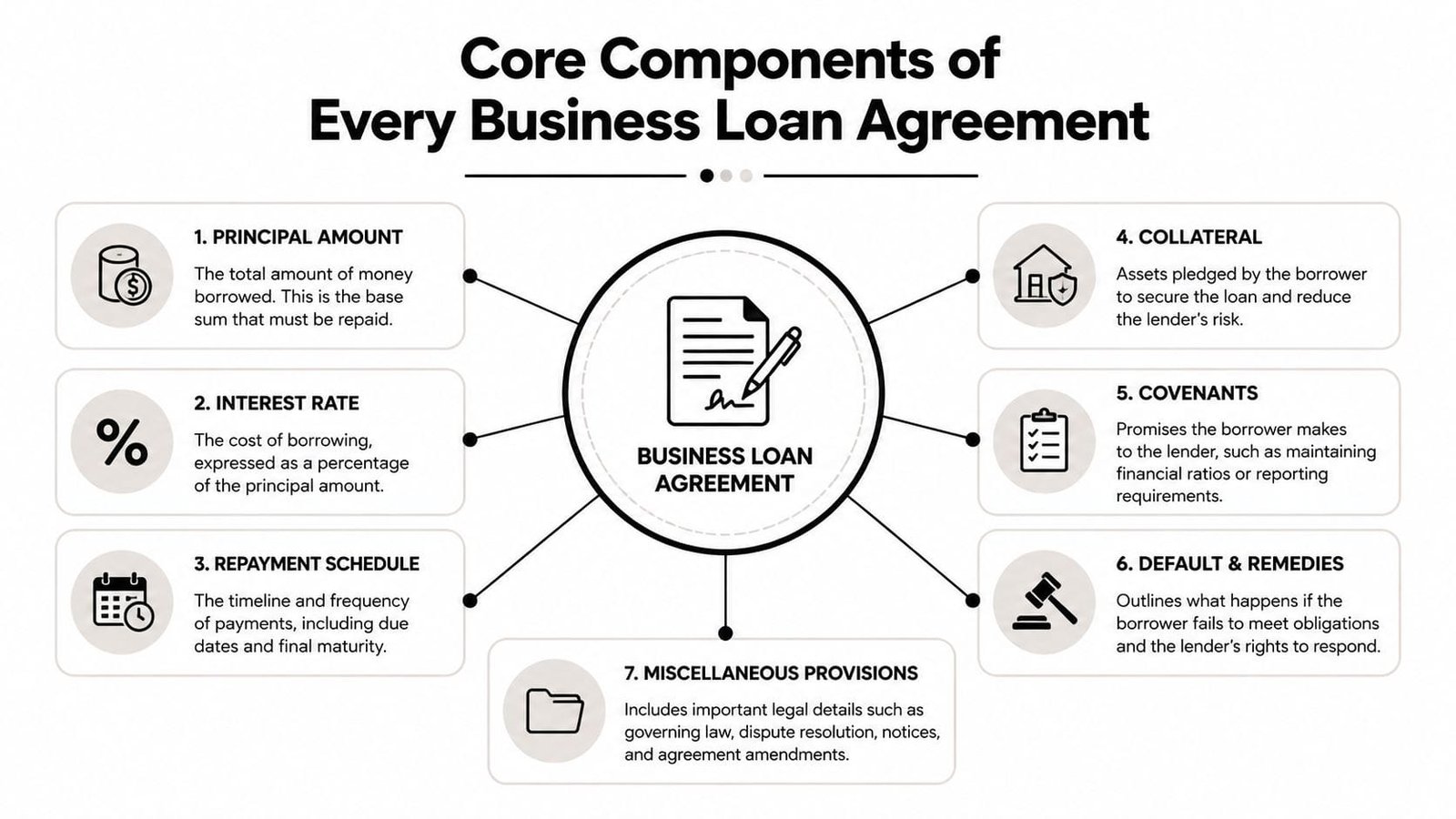
The clauses that determine your power are rarely the ones borrowers read first. A business loan agreement has a predictable structure, but its definitions, schedules, exhibits, and enforcement terms can determine whether you retain operating flexibility or face an avoidable dispute. Review each component separately, then confirm that the same terms carry the same meaning throughout the document.
The payment promise
The promissory note states the principal, interest method, payment dates, maturity, late charges, and amortization. Confirm whether payments fully amortize the balance, remain interest-only for a period, or leave a balloon balance at maturity. A manageable payment schedule can still conceal a large final obligation.
Representations and warranties are factual statements made at signing. They may address ownership, authority, taxes, litigation, financial statements, licenses, and compliance with other agreements. If a representation says no litigation is pending, a later material lawsuit may create a breach even when the statement was accurate on the signing date. Limit these statements to matters accurate in all material respects and qualify them by your knowledge where appropriate.
The operating restrictions
Affirmative covenants specify what you must do, including maintaining insurance, paying taxes, delivering financial statements, preserving licenses, and reporting significant events.
Negative covenants specify what requires lender consent. They can restrict additional debt, liens, asset sales, acquisitions, dividends, ownership changes, or affiliate transactions. A broad debt prohibition could block an equipment lease or short-term working-capital facility. Request precise permitted-debt exceptions.
Events of default define enforcement rights. Review inaccurate representations, covenant breaches, insolvency, judgments, cross-defaults, and missed reports alongside payment defaults. Ask whether unrelated obligations require a materiality threshold, final judgment, or cure period.
The lender's security
The collateral description identifies the assets securing repayment. A specific equipment lien is narrower than a blanket lien covering substantially all business assets, after-acquired property, and proceeds. Read the security agreement, guaranty, UCC authorization, and landlord or deposit-account arrangements together.
Dispute terms also deserve a close review. Arbitration, governing law, venue selection, jury-trial waivers, and notice procedures can determine whether you challenge lender conduct in court or before an arbitrator, as well as the cost and location of that dispute. For actionable tips for managing contracts, track versions, obligations, deadlines, and approval authority. Attachments often contain the restrictions owners overlook after closing.
Understanding Interest Rate Structures and Pricing
A fixed rate gives you payment predictability, but you may pay for that certainty through a higher starting price or a prepayment restriction. A variable rate typically combines a benchmark, such as Prime or SOFR, with a lender margin. The benchmark can move independently of your business performance, so model the payment under more than one rate environment before signing.
For SBA 7(a) loans, the contractual maximum varies by loan size. Loans of $50,000 or less are capped at base rate plus 6.5%, loans from $50,001 to $250,000 at base rate plus 6.0%, loans from $250,001 to $350,000 at base rate plus 4.5%, and loans above $350,000 at base rate plus 3.0%, as summarized in this SBA 7(a) interest-rate explanation. The lender and borrower can negotiate within those limits, so focus your negotiation on the spread, reset mechanics, and fees.
The rate isn't the full cost. Review origination charges, closing costs, unused-line fees, late charges, default-rate increases, prepayment premiums, and fees for amendments or financial reviews. Use an APR versus interest rate comparison to separate the stated coupon from the total borrowing cost.
| Cost Component | Loan A: Fixed 9.5% | Loan B: Variable Prime + 2.5% |
|---|---|---|
| Rate behavior | Payment predictability | Payment changes when Prime changes |
| Main risk | Potentially expensive if market rates fall | Cash-flow pressure if Prime rises |
| Negotiation focus | Margin, fees, prepayment terms | Margin, benchmark definition, reset dates |
| Extra costs to review | Origination, late, amendment, prepayment fees | The same fees, plus rate-reset exposure |
| Best fit | Predictable budgeting | Borrowers prepared for changing payments |
Don't compare Loan A and Loan B using the initial rate alone. Compare the benchmark definition, reset frequency, floor, ceiling, default rate, and payoff formula. A lender may permit prepayment but still charge a make-whole amount that makes refinancing uneconomic.
Comparing Common Business Loan Types
The right structure depends on how the business uses capital. A term loan funds a defined project and usually follows a scheduled amortization plan. A line of credit supports recurring working-capital needs, but availability may depend on receivables, inventory, reporting, and borrowing-base calculations.
SBA financing adds program rules and documentation. The SBA 7(a) and 504 datasets contain approved loans dating back to FY1991 and are updated quarterly, typically about one month after each quarter ends, according to the SBA loan-data resource. An AWS-hosted version notes more than 1.6 million SBA-guaranteed loans to small businesses, which illustrates how formal loan agreements operate at scale. SBA structures can include personal guarantees, eligibility certifications, collateral requirements, and lender-specific covenants.
Equipment financing usually ties the lender's security to the purchased asset. That can preserve other business assets, but the agreement may allow repossession after default and may accelerate the remaining balance. A construction facility often adds inspection, draw, completion, and lien-waiver requirements.
| Loan Type | Typical Terms | Collateral Required | Best For |
|---|---|---|---|
| Term loan | Scheduled installments and a defined maturity | Business assets, specific collateral, or guarantees | Expansion, refinancing, or a major purchase |
| Line of credit | Revolving availability subject to conditions | Receivables, inventory, deposits, or a blanket lien | Variable working capital |
| SBA loan | Program-backed structure with added eligibility and guaranty requirements | Business assets and potentially personal guarantees | Eligible acquisition, expansion, or long-term investment |
| Equipment financing | Payments linked to a specific purchased asset | The financed equipment | Vehicles, machinery, and specialized equipment |
Don't assume a line of credit is safer because you draw only what you need. The lender can reduce availability when collateral values or reporting metrics change. Conversely, don't assume an equipment loan is narrow because it names one asset. Check for cross-default language that connects it to the rest of your debt.
The best agreement matches repayment to the asset's cash-flow contribution. Short-lived working capital shouldn't carry a structure designed for a long-lived facility, and a long-term expansion project shouldn't depend entirely on callable revolving availability.
The Hidden Risk in Covenant-Lite Agreements
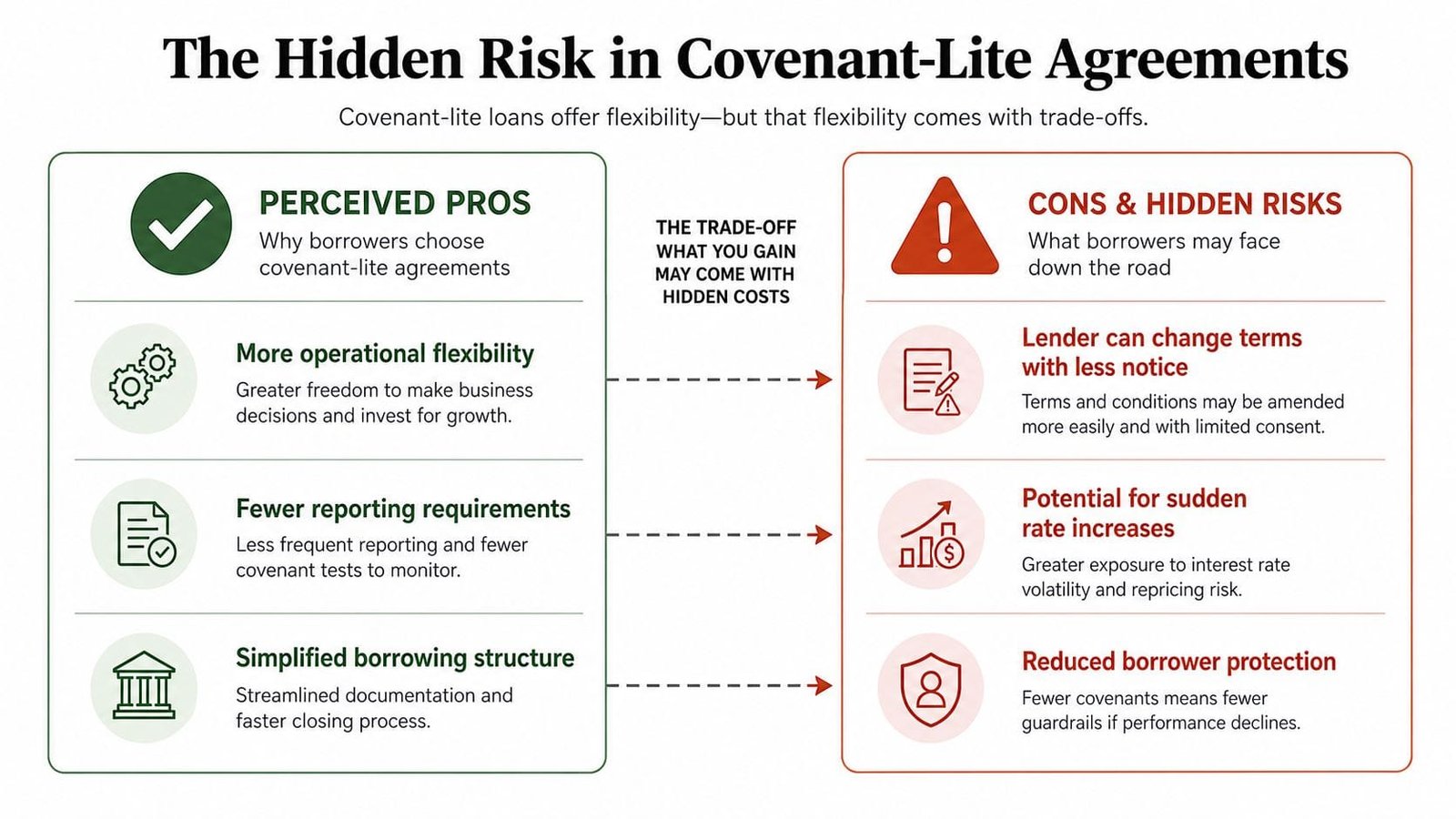
Fewer maintenance covenants sound borrower-friendly. They aren't automatically safer. A lender that removes a routine financial test may rely more heavily on reporting obligations, broader default definitions, springing tests, or subjective material-adverse-change language.
Market commentary is moving in this direction. One 2025–2026 analysis describes covenant dilution and limited-conditionality provisions becoming more common in syndicated and middle-market loans, while reporting that private-credit covenant-lite structures rose to 21% in 2025 from 4% in 2023, with average closing debt multiples increasing to 5.0x, as discussed by DLA Piper's syndicated-loan market analysis. Those figures concern larger private-credit and middle-market transactions, not every small-business facility, but they show why document structure deserves scrutiny.
Flexibility can move the risk elsewhere
A covenant-lite agreement may let you operate without testing a debt-to-EBITDA ratio every quarter. But the lender may demand more frequent reporting, retain broad consent rights, or use a springing covenant when availability falls below a specified condition. That trigger often arrives during a downturn, exactly when management needs breathing room.
The document may also shorten cure rights. A reporting error that could have been corrected under a traditional agreement may become an immediate default if the contract treats delivery timing as strict. Read the definitions of Default, Event of Default, Material Adverse Effect, and Permitted Debt together.
A missing maintenance covenant doesn't remove lender power. It can relocate that power into remedies, definitions, and consent rights.
Use a compliance calendar or an early-warning dashboard for surprise covenant breaches to monitor reporting dates, borrowing-base availability, and approaching triggers. The objective isn't to eliminate every covenant. It's to identify the test before the lender does.
Red Flags That Signal Trouble Ahead
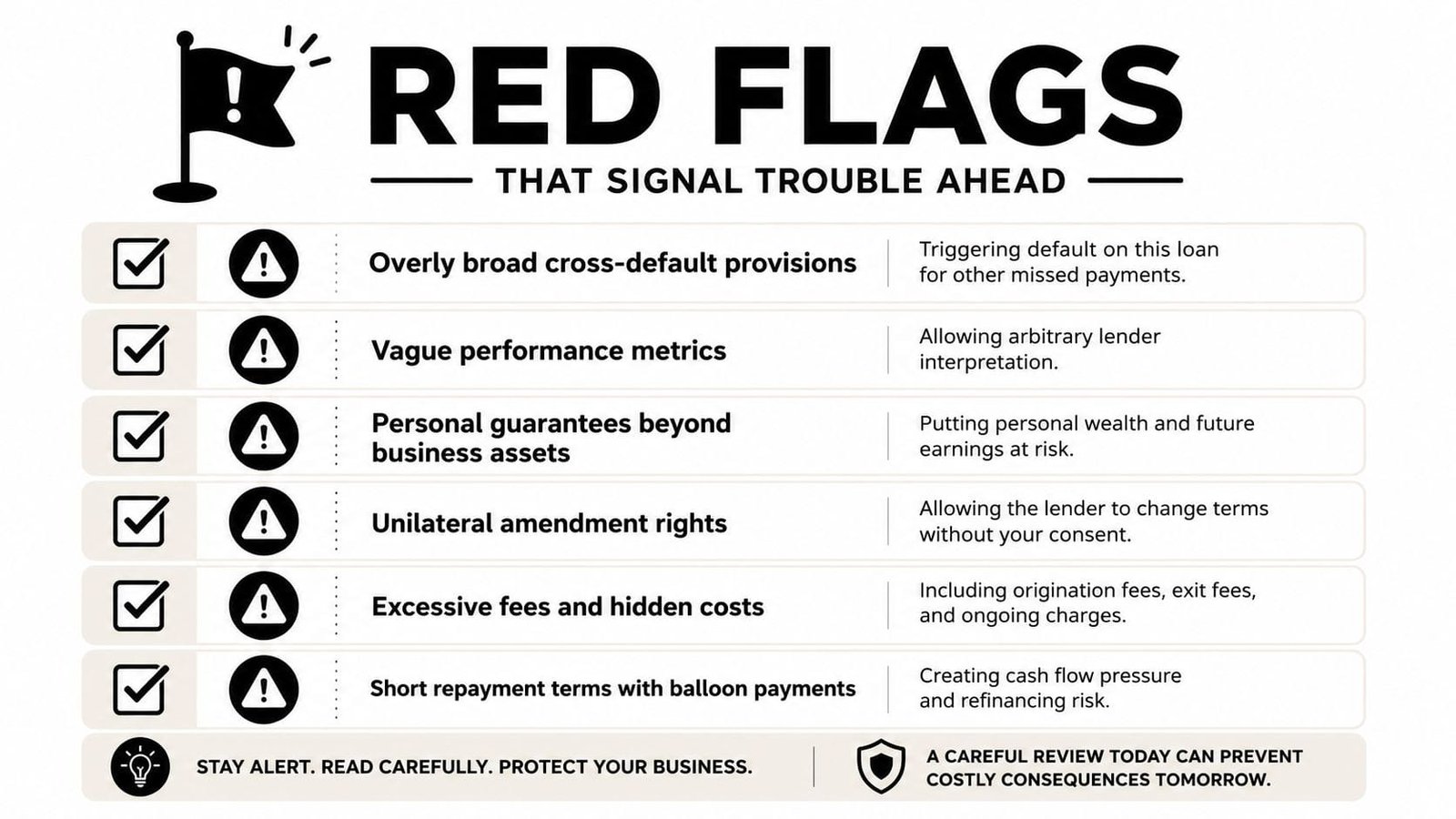
Read the agreement with a highlighter and mark every phrase that expands lender discretion. The most concerning language usually appears in definitions rather than in the rate section.
Language that deserves revision
- “Any default under any other obligation” creates a broad cross-default. Ask for a materiality threshold, notice, and an opportunity to cure before this loan becomes eligible for acceleration.
- “In the lender's sole discretion” gives the lender unusually wide control. Request “reasonable commercial judgment” and objective standards tied to the agreement.
- “Material adverse change” without measurable criteria can turn a temporary revenue decline, management transition, or dispute into a claimed default. Limit the clause to material impairment of repayment ability or collateral value.
- “Immediately due and payable” without a cure period removes valuable time. Separate payment defaults from nonmonetary breaches and negotiate different cure periods.
- “All assets, now owned or later acquired” may create a blanket lien that reaches future equipment, accounts, inventory, and proceeds. Confirm exactly what collateral the lender needs.
Reporting provisions deserve the same skepticism. A requirement to deliver monthly financials on a tight deadline may be manageable for a finance department and unrealistic for a smaller company. If the lender demands audited statements, ask whether internally prepared statements, accountant-reviewed statements, or annual audits are appropriate for the facility.
Don't overlook the forum
An arbitration clause may specify a distant venue, restrict discovery, waive a jury trial, or limit the time available to bring a claim. It may also direct servicing complaints through a lender-controlled process before any formal dispute begins. Ask who pays arbitration fees, where the hearing occurs, and whether emergency court relief remains available for collateral or account issues.
Then examine prepayment language. A declining charge can be understandable, but yield maintenance or make-whole provisions may calculate the payoff by reference to a theoretical lost return. If refinancing is part of your plan, demand a clear formula and a realistic exit cost.
Negotiation Strategies That Actually Work
Treat the first draft as a starting position, not a final verdict. Lenders protect their templates, but prepared borrowers can often improve the provisions that create operational or enforcement risk.
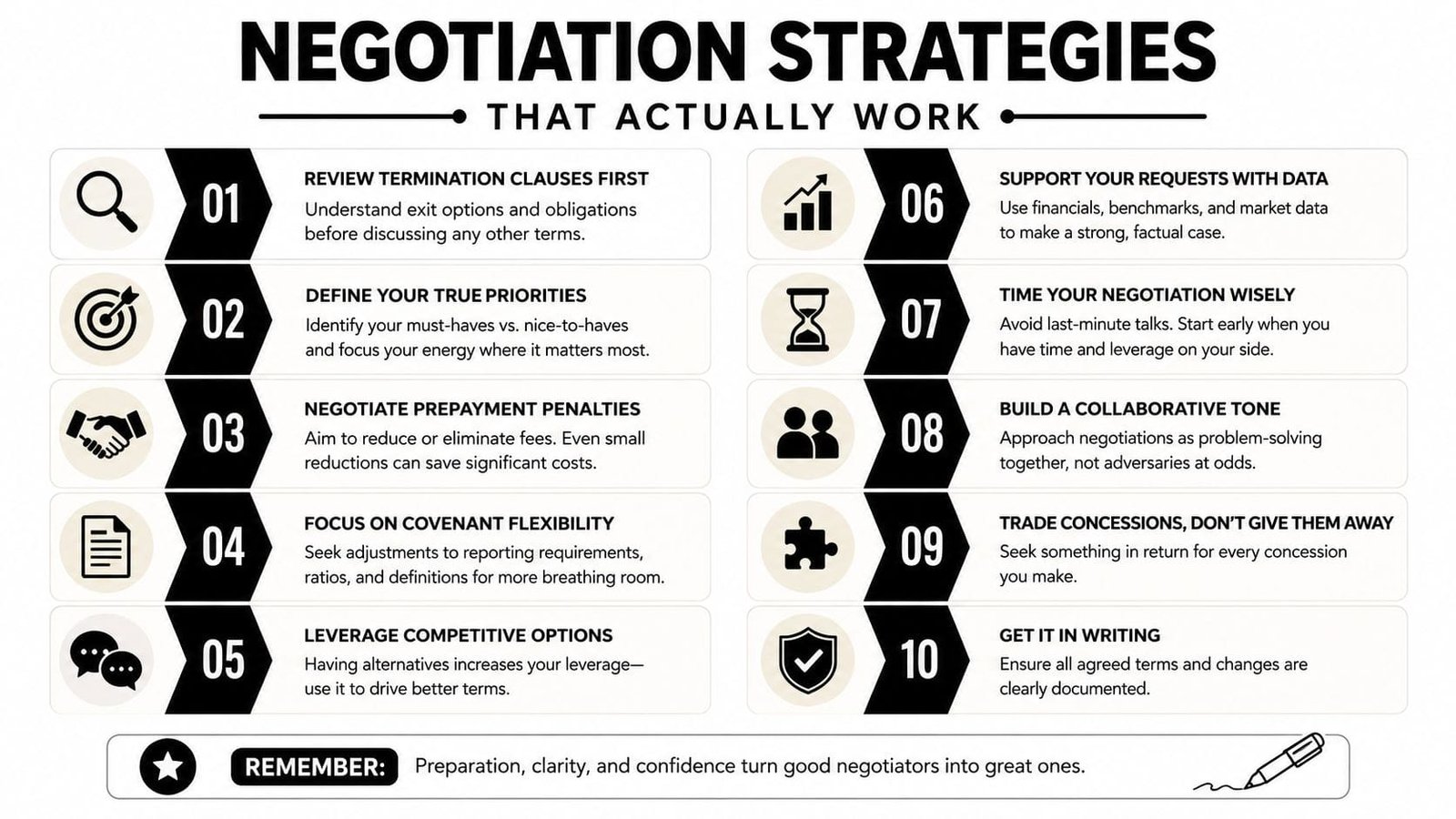
Prioritize terms in this order:
- Default cure rights. Ask for written notice and a meaningful cure period. A 30-day cure period gives management time to correct a nonpayment or reporting problem that a 10-day period may turn into a technical default.
- Cross-default limits. Tie cross-defaults to material obligations and final, uncured defaults.
- Covenant thresholds. Use definitions that exclude extraordinary items and avoid tests that punish temporary timing differences.
- Prepayment protection. Request no penalty, a declining fee, or a clearly defined cap on the payoff charge.
- Collateral releases. Build release mechanics for sold assets, replaced equipment, and completed project phases.
- Consent standards. Replace “sole discretion” with a reasonable commercial judgment standard wherever possible.
- Reporting practicality. Match delivery deadlines to the company's actual close process and accounting resources.
- Dispute location. Seek a convenient venue and a fair allocation of arbitration costs.
- Ownership flexibility. Preserve room for succession planning, minority investment, or an internal reorganization.
- Amendment control. Require written amendments signed by authorized representatives and reject informal changes through casual email.
Some lenders will hold firm on the base-rate framework, underwriting model, or certain fees. That doesn't mean every point is fixed. Borrowers usually have more bargaining power when they bring competing term sheets, demonstrate clean reporting, and explain precisely how a requested change reduces avoidable risk.
Don't threaten to walk away over every clause. Give the lender a ranked list, explain the business reason, and trade low-priority points for protections that matter more. A narrower cross-default or longer cure period is often worth more than a modest pricing concession.
Your Signing and Implementation Checklist
Approval isn't closing. Before signing, compare the final agreement against the term sheet line by line. Check the principal, rate formula, fees, maturity, payment dates, collateral, guarantees, conditions to funding, and every incorporated exhibit.
Before the signature
- Reconcile exhibits: Confirm that the note, security agreement, guaranty, authorization resolutions, and schedules use consistent names, amounts, dates, and definitions.
- Limit guarantees: Determine whether each guaranty is unlimited, capped, joint, several, or subject to release conditions.
- Verify collateral: Remove assets that aren't part of the negotiated security package and confirm that future-property language is intentional.
- Review insurance: Identify required policies, coverage limits, lender endorsements, renewal evidence, and delivery deadlines.
- Map funding conditions: For a line of credit, document how draws are requested, what evidence is required, and when the lender can reject availability.
Create a compliance calendar before the first payment. Record financial-testing dates, reporting deadlines, insurance renewals, borrowing-base certificates, permitted-debt limits, and maturity or renewal dates. Assign each item to a specific person, with a backup, rather than leaving compliance as an assumed responsibility.
Within the first month after funding, establish a lender communication protocol. Keep written records of approvals, waivers, notices, draw requests, payoff quotes, and servicing corrections. Retain the fully executed agreement and every exhibit in a secure location, alongside amendments and lender correspondence. You should be able to reconstruct the contract without relying on a lender portal that may later become inaccessible.
For a practical document-preparation reference, review this guide to documents needed for business financing. Missing paperwork can delay funding, but inaccurate paperwork can create a representation breach after closing.
Watch for lender-side failures too. A lender that changes payment instructions without secure confirmation, refuses to provide required statements, applies payments inconsistently, or ignores a negotiated release process may be violating the agreement or creating a dispute record. Escalate in writing, preserve proof, and involve qualified counsel before withholding payment or taking any unilateral action.
Business Loan Warrior helps owners compare funding options, apply through a single no-fee process, and track approvals, repayments, and credit information through a secure dashboard. If you're reviewing a business loan agreement or refinancing existing debt, visit Business Loan Warrior to explore financing options and connect with its lending team.