
You've built a profitable business, but your tax return doesn't make it look that way. Legitimate deductions, depreciation, reinvestment, and seasonal expenses may leave reported net income too low for a conventional lender, even while deposits continue arriving every day. A bank declines the application, and you're left wondering how a business with customers, sales, and cash movement can still look unfinanceable.
Business loans based on bank statements solve that mismatch by shifting the underwriting focus from tax-reported income to actual account activity. The lender studies deposits, balances, withdrawals, overdrafts, and existing debt to decide whether your cash flow can support another payment. That approach can open a financing path for businesses whose financial reality is stronger than their tax paperwork.
Table of Contents
- The Reality of Cash Flow Financing
- How Lenders Underwrite Your Bank Deposits
- Eligibility Criteria and Required Documentation
- Comparing Bank Statement Loans to Traditional Financing
- The Application Process and Fintech Automation
- Red Flags and Tips to Improve Approval Odds
- Securing Your Business Growth with Confidence
The Reality of Cash Flow Financing
A contractor finishes a strong month, pays suppliers, covers payroll, and moves the remaining cash into the next project. The business may show modest taxable income because the owner claimed legitimate expenses and reinvested in equipment. A conventional lender sees the tax return, treats the income as insufficient, and declines the term-loan request.
That rejection does not automatically mean the business is weak. It may mean the lender is measuring taxable income for a request that depends on current repayment capacity. Tax returns calculate taxable income. Bank statements show how money moves through the business now.
Bank-statement lending developed to assess repayment capacity from account activity instead of relying entirely on tax returns or audited financial statements. Many lenders request 3 to 6 months of recent business bank statements, while traditional bank and SBA lenders often ask for 12 months or more. Some programs review as much as 24 months to assess seasonality and consistency, as explained in the overview of bank statement business loans.
The method matters because access to conventional financing remains uneven for small businesses. A lender may accept lower reported taxable income when the statements show recurring customer receipts, manageable obligations, and enough cash left after operating expenses. The opposite is also true. Strong gross deposits will not rescue an account that repeatedly falls to zero or depends on overdraft protection.
Commercial lending reality: A high deposit total can get your application reviewed. Consistent usable cash flow is what gets the debt approved.
Deposits are evidence, not free money
An underwriter does not add every incoming dollar and label it revenue. The review separates customer receipts from owner transfers, loan proceeds, refunds, tax credits, and transfers between accounts. That classification can determine whether the file looks financeable.
Commingled accounts create a quiet documentation trap. If personal spending, owner contributions, multiple business entities, and customer receipts run through one account, the lender has to reconstruct the operating story. Unclear transactions may be excluded, delayed for explanation, or treated as evidence that the stated revenue is less reliable than reported. Keep business activity in a dedicated account and label transfers consistently before applying.
Account behavior matters alongside deposit volume. A business collecting payments regularly and preserving a reasonable balance presents less repayment risk than one receiving occasional large deposits, draining the account immediately, and relying on overdraft coverage until the next billing cycle.
Cash-flow forecasting exposes that pattern before the lender sees it. Use how to forecast cash flow to map expected receipts, operating costs, taxes, and upcoming debt payments. Then decide whether financing covers a temporary timing gap or merely postpones a deeper shortage.
Bank statement financing is not a workaround for unaffordable debt. It is a different measurement system. The lender wants to know what cash can service the payment now and whether that cash appears consistently. If balances collapse after expenses, reduce the requested amount or address the cash shortage before submitting an application.
How Lenders Underwrite Your Bank Deposits
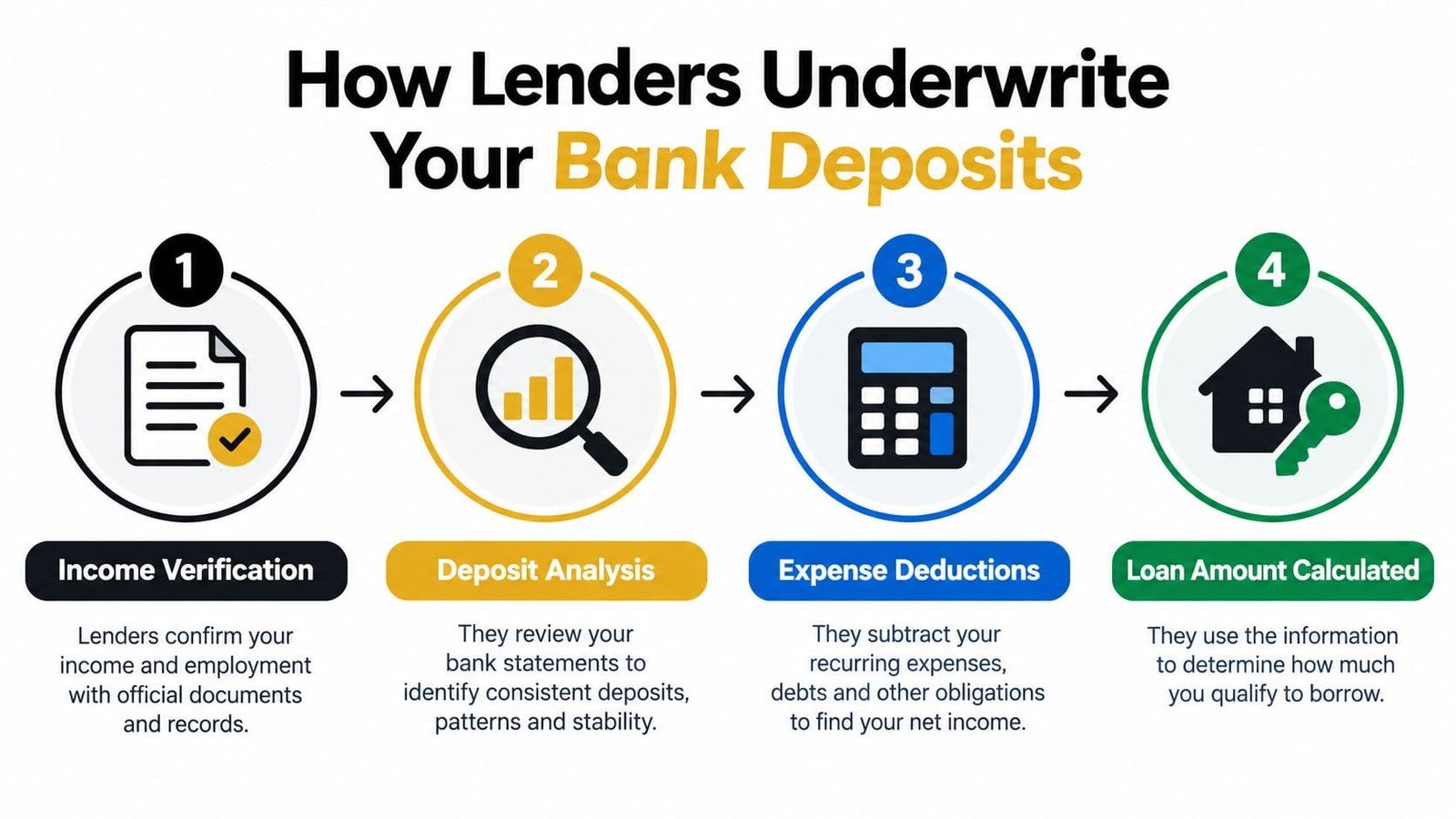
The underwriter doesn't stop at the ending balance printed on the final page of a statement. A modern review reconstructs the operating account over time, identifies the source and rhythm of deposits, subtracts recurring obligations, and tests whether the remaining cash can support the proposed payment.
Specialized workflows can parse statement PDFs or transaction feeds into structured ledgers. They classify inflows and outflows, reconcile balances, and run fraud or abnormality checks before a human underwriter reviews the file. That process is why bank-statement lending can use fewer documents while still examining more transaction detail.
The metrics that shape the offer
Underwriters typically focus on several connected signals:
- Gross deposits: Total money entering the account during each review period. The lender then removes transfers, financing proceeds, and other non-operating items where they can be identified.
- Deposit frequency: Regular receipts can indicate recurring sales activity. A few isolated deposits may require more explanation than a steady pattern from customers or payment processors.
- Average daily balance: This shows whether the business keeps a cash cushion or routinely operates near zero.
- Recurring expenses: Payroll, rent, supplier payments, taxes, existing debt, and other obligations reduce the cash available for a new payment.
- Overdrafts and NSF activity: Frequent negative days or failed payments signal that the business may already be stretched.
- Debt service coverage ratio: DSCR compares cash available for debt service with required debt payments. A commonly used comfortable benchmark is above about 1.25, meaning cash flow exceeds total debt payments by roughly 25%, as described in the cash-flow underwriting explanation.
Consider a hypothetical retailer whose account receives customer payments throughout the review period. The raw deposit total looks impressive, but the underwriter flags several entries that are transfers from another company account. A separate deposit is a prior financing advance, not sales. Once those items are excluded, the lender calculates operating receipts, subtracts recurring expenses and existing debt, and examines what remains during slower periods.
The lender then tests a proposed payment against that remaining cash. If the payment leaves little room for payroll, inventory, rent, or a weak sales week, the offer may be reduced, priced higher, or declined. The decision isn't based on revenue alone. It reflects the relationship between usable cash flow, existing obligations, balance stability, and the new installment.
For a deeper explanation of the broader underwriting process for business loans, focus on the sequence rather than a single approval number. Different lenders apply different policies, so there is no universal formula that converts deposits into a guaranteed loan amount.
Why strong revenue can still produce a weak file
A business can show high deposits and still fail the cash-flow test. If the owner moves money between several accounts, pays personal bills from the operating account, or draws down the balance immediately after each deposit, the statements become difficult to interpret. The lender may apply conservative adjustments because it can't verify the actual available cash.
Automation makes this review faster, but it doesn't make the underlying evidence less important. A machine can identify patterns, and an underwriter can ask questions, but neither can turn fragmented or unexplained activity into dependable repayment capacity.
Eligibility Criteria and Required Documentation
Bank-statement financing usually reduces the paperwork burden, but it raises the importance of the paperwork you do submit. A clean, complete statement set gives the underwriter a coherent view of your business. Missing pages, mismatched account names, and unexplained transfers create friction immediately.
Lenders may review 3 to 24 months of statements, depending on the lender type, loan request, and seasonality. Online products commonly begin with 3 to 6 months, while banks and SBA lenders typically want 12 to 24 months or more, according to guidance on bank statement business loans. Do not select the shortest history just because it is easier. Choose the period that presents your business fairly.
Prepare the file before you apply
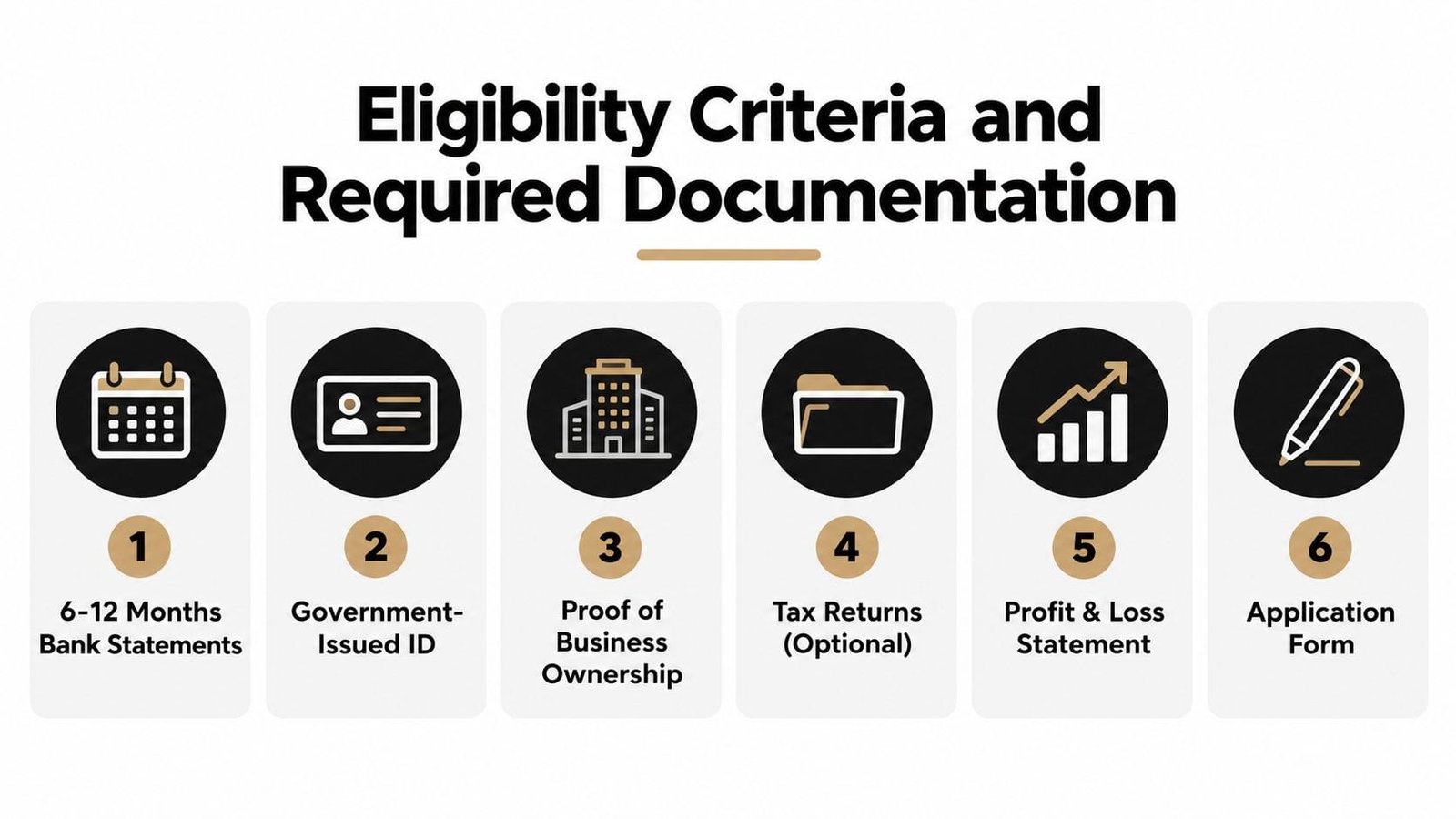
Use this checklist to assemble a lender-ready package:
- Recent business statements: Download complete PDFs directly from the bank portal. Include every page, even pages with no transactions.
- Ownership and identity records: Have government-issued identification and documents showing who owns and controls the business.
- Business formation records: Keep formation documents, tax identification details, and relevant licenses available.
- Profit and loss information: A current P&L can clarify margins and expenses even when the lender primarily uses statements.
- Existing debt details: Prepare payment amounts, balances, and lender names for current obligations.
- A short use-of-funds explanation: State whether the money will support inventory, equipment, payroll, expansion, or a specific working-capital need.
A lender may request personal statements from a majority owner, particularly when personal funds support the business or the owner has signed a guarantee. That request doesn't automatically indicate a problem. It means the lender wants to understand the full repayment picture.
Fix account structure before submission
Commingling is one of the quietest approval killers. If personal spending, business receipts, transfers from other entities, and payment processor settlements all run through several accounts, the underwriter may struggle to determine which deposits belong to the applicant.
Start by identifying every account that receives business revenue. Then create a simple account map:
- Primary operating account: Route ordinary customer receipts and core business expenses through one clearly identified account.
- Secondary operating accounts: List what each account is used for and provide statements when those accounts contain material business activity.
- Payment processors: Reconcile processor deposits to sales records so the lender can understand net settlements and timing.
- Owner transfers: Label transfers between business and personal accounts and explain their purpose.
- Personal spending: Stop using the business account for discretionary personal purchases before the review period you plan to submit.
Don't hide a relevant account. Omitting an account can make a file look cleaner initially, but the inconsistency may surface during verification and damage credibility. Your objective is not to make the statements look perfect. It's to make the cash-flow story verifiable.
For more detail on what lenders examine in business bank statements, review your documents as an underwriter would. Can someone unfamiliar with your business identify customer revenue, ordinary expenses, transfers, and existing debt without guessing?
Comparing Bank Statement Loans to Traditional Financing
The right financing method depends on the problem you're solving. A short-term working-capital gap doesn't require the same structure as an equipment purchase or a long expansion project. Choosing a bank-statement product solely because it is easier to qualify for can create an expensive mismatch.
Bank-statement loans make sense when current deposits tell a stronger story than tax-reported profit, when speed matters, or when the business lacks the documentation demanded by a conventional lender. SBA and traditional term loans may make more sense when you can document stable profitability, tolerate a longer review, and want a more conventional long-term structure.
| Feature | Bank Statement Loans | SBA Loans | Traditional Term Loans |
|---|---|---|---|
| Primary evidence | Business bank activity and cash-flow behavior | Broad financial documentation, repayment capacity, and program eligibility | Tax returns, financial statements, credit profile, and often collateral |
| Best fit | Strong deposits with limited or uneven tax income | Established businesses prepared for detailed qualification | Businesses with documented profitability and conventional financial records |
| Review speed | Designed for a streamlined review | More involved review through an SBA lender | Varies by lender and file complexity |
| Cost trade-off | Convenience and flexibility can mean a higher cost of capital | Often suited to borrowers seeking a conventional long-term structure | Often more economical for highly qualified applicants |
| Documentation burden | Concentrated around recent statements and verification documents | Broad and detailed | Broad, especially for larger requests |
| Cash-flow challenge | Volatile balances can reduce the offer | Inconsistent financial history can complicate approval | Low reported profit can weaken repayment analysis |
| Typical use | Working capital, inventory, equipment, or expansion needs | Longer-term growth and eligible business purposes | Planned investment with a predictable repayment schedule |
Match the product to the business decision
If you need to cover a brief timing gap between customer receipts and expenses, a line of credit may be more suitable than taking a full lump sum. If you need a specific piece of equipment, equipment financing may align the debt with the asset. If you are funding a location buildout or durable expansion, compare the total cost and repayment period rather than focusing only on approval speed.
Bank-statement financing can be useful for seasonal businesses because a lender can review a longer history and identify recurring peaks and troughs. But seasonality must be visible and explainable. A weak recent period may still limit an offer if the lender can't establish how the business will handle payments during the slow stretch.
Choose by repayment pattern: Borrow with a structure that matches how cash arrives, not merely the product that approves fastest.
Don't assume that a conventional lender is impossible just because one bank declined you. Different institutions interpret documentation differently, and a stronger file may produce a different result. Conversely, don't submit the same disorganized statements to several lenders and expect the market to overlook the problem.
If a lender asks for no bank statements, understand what replaces them. The business loan without bank statements may rely more heavily on tax returns, collateral, invoices, credit, or other verification. Less documentation doesn't mean less underwriting. It means the lender is measuring risk through a different set of evidence.
The Application Process and Fintech Automation
The application has moved from a stack of printed statements to a secure digital workflow. You may upload statement PDFs or connect an account through a read-only data connection. The platform then extracts transactions, classifies inflows and outflows, reconciles balances, and sends exceptions to an underwriter.
That automation improves consistency. It can identify recurring deposits, abnormal transfers, revenue concentration, balance volatility, and possible document irregularities before a manual review begins. Research on cash-flow underwriting describes engines that extract transaction data, calculate cash-flow indicators, and apply rule-based checks, while industry software claims to compress manual extraction from hours into minutes, as documented in research on automated cash-flow underwriting.
The secure connection doesn't eliminate your responsibility. Confirm that the account you connect is the correct business account, make sure the submitted period is complete, and keep explanations ready for unusual entries. A direct feed can expose more detail than a carefully selected PDF, so review your transaction history before granting access.
What happens after submission
The workflow generally follows this sequence:
- Initial application: You provide business details, ownership information, requested funding, and the intended use of proceeds.
- Data verification: The lender reviews uploaded statements or transaction data from a connected account.
- Automated classification: Software separates likely revenue, transfers, financing proceeds, expenses, and irregular activity.
- Human underwriting: An analyst evaluates account health, cash-flow trends, existing obligations, and the proposed payment.
- Offer review: You compare the amount, repayment schedule, total payback, fees, guarantees, and any lien provisions.
- Final verification: The lender confirms identity, account ownership, and outstanding conditions before funding.
Platforms that combine digital intake with human review can make it easier to compare several financing paths from one application. That convenience matters, but it isn't a reason to accept the first offer. Read the repayment frequency and total cost carefully, especially when payments occur daily or weekly.
The strongest application is still the one with the clearest financial story. Automation can shorten the path from submission to decision, but it can't compensate for unaffordable debt, unexplained transfers, or recurring negative balances.
Here is a practical visual explanation of the digital funding journey:
Use technology to reduce administrative delay, not to avoid financial preparation. Before you apply, reconcile deposits, list existing debt, and decide what payment the business can carry during an ordinary month and a difficult one.
Red Flags and Tips to Improve Approval Odds
High revenue doesn't rescue a poorly managed account. Underwriters care about whether cash remains available after the business meets its obligations. Frequent NSF events, overdrafts, negative days, and abrupt balance drops can outweigh an attractive deposit total.
A lender may also question irregular deposits that don't match the stated business model. Large unexplained cash deposits, repeated transfers from personal accounts, and payments from unrelated entities make revenue verification harder. If the underwriter can't tell where money came from, the lender may exclude it from usable revenue.
Clean the account before the application
Take these steps before submitting:
- Resolve negative balances: Bring overdue obligations current and stop relying on overdraft coverage to fund ordinary expenses.
- Consolidate visible revenue: Route customer receipts through a primary operating account where possible. Document the accounts that can't be consolidated.
- Explain unusual transactions: Keep a short reconciliation for transfers, refunds, owner contributions, loan proceeds, and large one-time receipts.
- Protect the average balance: Don't drain the operating account immediately after every deposit. Maintain a practical reserve for recurring expenses.
- Time the review intelligently: If the business is seasonal, provide enough history to show the pattern rather than submitting a short period that captures only the slow season.
Don't manufacture deposits or move money temporarily to create a stronger statement. That activity can trigger fraud checks, and it doesn't improve genuine repayment capacity. Underwriters are looking for repeatable operating cash, not a polished snapshot.
Read the statements like a lender
Review each account line by line and ask four questions:
- Which deposits are actual customer receipts?
- Which deposits are transfers or borrowed money?
- What expenses recur every month?
- What happens to the balance after those expenses clear?
Then compare the remaining cash with current debt payments and the proposed installment. If the account routinely approaches zero before the next group of receipts arrives, reduce the requested amount or consider a structure that better matches your collection cycle.
Practical rule: Never apply while your statements are telling a story you can't explain in one clear conversation.
A clean statement doesn't guarantee approval. It does remove avoidable uncertainty, which gives the lender a better basis for sizing and pricing the request. If the underlying cash flow is too thin, waiting and improving operations is better than layering expensive debt onto an already strained account.
Securing Your Business Growth with Confidence
Bank-statement financing isn't merely a fallback for owners with poor credit or missing tax returns. It is a cash-flow pricing model. The lender studies what your business collects, what it keeps, what it owes, and how consistently it handles ordinary operating pressure.
That distinction should change how you prepare. Don't ask only, “How much do I want?” Ask, “What payment survives a slow period after payroll, suppliers, taxes, rent, and existing debt?” The answer should come from your transaction history and a realistic cash-flow forecast, not from the maximum amount a form allows you to request.
Your next move should be analytical:
- Gather complete statements from every account carrying business activity.
- Separate operating revenue from transfers, owner contributions, and financing proceeds.
- Review average balances, recurring expenses, overdrafts, and existing debt payments.
- Decide whether the request supports a defined return, such as inventory that will convert into sales or equipment that increases capacity.
- Compare the total cost, payment frequency, guarantees, and repayment period across offers.
A lender may approve a larger amount than the business can comfortably carry. That isn't a victory. The useful offer is one that funds a specific objective without forcing you to borrow again to make the first payment.
If your statements show consistent deposits but your tax returns understate current operating strength, bank-statement underwriting deserves a serious look. If your statements show volatility, fragmented accounts, or persistent negative balances, address those issues before applying. Better documentation won't replace healthy cash flow, but it can prevent a lender from misreading the cash flow you already have.
Business Loan Warrior offers a single, no-fee application that lets business owners submit bank information, explore customized funding options, and track the approval process without an initial credit-score impact. Visit Business Loan Warrior to organize your recent statements and assess financing for working capital, equipment, expansion, or another defined business need.